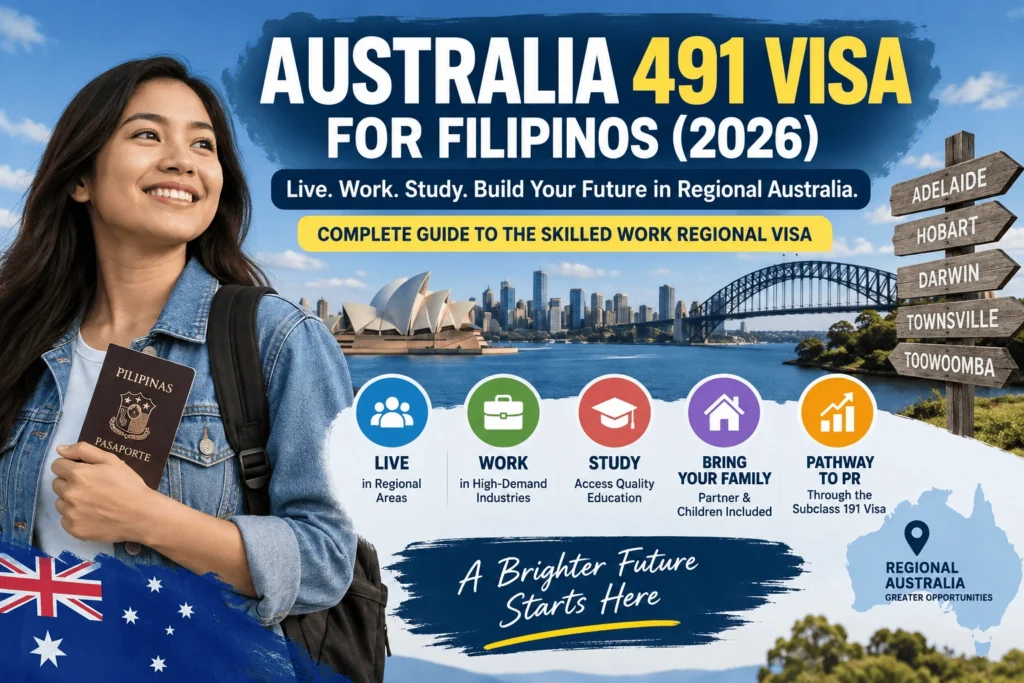
Quick Answer: The Australia 491 Visa — officially the Skilled Work Regional (Provisional) visa — is a five-year, points-tested visa that lets skilled Filipino workers live, work, and study in a designated regional area of Australia. To qualify, you need an occupation on an eligible skilled occupation list, a positive skills assessment, at least Competent English, and a minimum of 65 points on the points test. You must also be nominated by an Australian state or territory government, or sponsored by an eligible relative who already lives in a designated regional area — either pathway adds 15 bonus points. After three years of genuine regional residence and compliance with visa conditions, most holders become eligible to apply for the Subclass 191 Permanent Residence (Skilled Regional) visa.
What Is the Australia 491 Visa?
The Australia 491 Visa is a 5-year provisional visa that lets skilled workers live, work, and study in designated regional areas of Australia. It requires nomination from a state or territory government, or sponsorship from an eligible family member in a regional area, plus a minimum of 65 points on the skilled migration points test. It leads to permanent residency through the Subclass 191 visa.
How Many Points Are Needed for a 491 Visa?
You need a minimum of 65 points on the points test before nomination or sponsorship points are added. State or territory nomination, or eligible family sponsorship, adds 15 points on top of that. In practice, competitive 491 invitation rounds increasingly favour applicants with a combined score of 80 points or higher.
Is the 491 Visa Permanent Residency?
No, the 491 Visa is not permanent residency — it is a temporary, provisional visa valid for 5 years. However, it provides a direct pathway to permanent residency: after living and working in a designated regional area for at least 3 years and meeting tax reporting requirements, holders can apply for the Subclass 191 Permanent Residence (Skilled Regional) visa.
Key Takeaways
- The 491 visa is valid for 5 years from the date of grant.
- It is provisional, not permanent — it requires either state/territory nomination or eligible family sponsorship.
- Nomination or sponsorship adds 15 points, more than any other single points category except age.
- Holders must live, work, and study only in designated regional areas of Australia.
- After 3 years of compliant regional residence, holders can apply for the Subclass 191 permanent visa.
- Family members, including a partner and dependent children, can be included in the same application.
- Processing is points-competitive: the legal minimum is 65 points, but successful applicants in many occupations and states now score well above that.
What Is the Australia 491 Visa?
The Subclass 491 — Skilled Work Regional (Provisional) visa — is the centerpiece of Australia’s regional migration strategy. It was created to steer skilled migrants away from Sydney, Melbourne, and Brisbane and into regional economies that need workers: places like Adelaide, Hobart, Darwin, Toowoomba, Townsville, and dozens of smaller regional centers across every state and territory.
For Filipino applicants, the 491 is often more accessible than the flagship Subclass 189 (Skilled Independent) visa, because it rewards two things the 189 does not: state or territory nomination and family sponsorship, each worth 15 points. That single bonus can be the difference between an Expression of Interest (EOI) that never gets an invitation and one that does.
It is important to be precise about what the 491 is and isn’t:
- It is not a permanent residency visa at the point of grant.
- It is a legitimate, government-backed pathway to permanent residency through the Subclass 191 visa.
- It does not require an employer sponsor — unlike the Subclass 494 (Skilled Employer Sponsored Regional) visa.
- It does require you to actually live and work in a regional postcode, not just hold an address there on paper.
Atlas Regional Migration Framework™
Each stage below has its own requirements, timeline, and points implications, which we break down in detail throughout this guide:
- Skills Assessment — a recognised Australian authority confirms your occupation and qualifications are suitable.
- English Test — you sit IELTS, PTE Academic, or another accepted test and record your score.
- Expression of Interest (EOI) — you lodge your profile and claimed points through SkillSelect.
- State Nomination / Family Sponsorship — a state or territory government nominates you, or an eligible relative in a designated regional area sponsors you, adding 15 points.
- 491 Visa — you receive an Invitation to Apply, lodge your application, and are granted the 5-year provisional visa.
- 3 Years Regional Residence — you live, work, and study only in a designated regional area, complying with your visa conditions and lodging tax returns.
- 191 Visa — once eligible, you apply for the Subclass 191 Permanent Residence (Skilled Regional) visa.
- Permanent Residency — you and any included family members hold unconditional Australian PR.
This framework is the backbone of the entire regional migration strategy, and every section in this guide maps back to one of these eight stages.
Benefits of the Australia 491 Visa
Additional Points for Migration
State or territory nomination, or eligible family sponsorship, adds 15 points to your points test score — three times the 5 points a Subclass 190 nomination provides. For many Filipino applicants whose base score sits in the 60s, this bonus is what pushes an EOI into invitation range.
Access to More Occupations
Regional nomination programs often draw from a broader occupation list than the metro-focused Subclass 189, including the Regional Occupation List (ROL) in addition to the Medium and Long-Term Strategic Skills List (MLTSSL) and Short-Term Skilled Occupation List (STSOL). This means some occupations that cannot get an invitation for the 189 or 190 visa may still have a viable path through the 491.
Regional Employment Opportunities
Regional Australia faces persistent skill shortages in healthcare, education, engineering, trades, and agriculture-adjacent sectors. Employers in these areas are often more willing to hire overseas-trained professionals, and regional labor markets tend to be less saturated than capital-city job markets.
Family Inclusion
A partner and dependent children can be included on the same 491 application, meaning the whole family can migrate together rather than through separate sponsorship processes later.
Pathway to Permanent Residency
After three years of compliant regional residence, most 491 holders can transition to the Subclass 191 Permanent Residence (Skilled Regional) visa — a genuine, unconditional PR outcome with no further nomination or points test required.
Australia 491 Visa vs 189 Visa vs 190 Visa
| Feature | 189 (Skilled Independent) | 190 (Skilled Nominated) | 491 (Skilled Work Regional) |
|---|---|---|---|
| Permanent Residency at grant | Yes | Yes | No — provisional |
| State/Territory Nomination | Not required | Required | Required (or family sponsorship) |
| Nomination Points Bonus | 0 | 5 | 15 |
| Family Sponsorship Option | No | No | Yes |
| Regional Living Requirement | No | No (unless state-specific condition) | Yes, mandatory |
| Visa Validity | Permanent | Permanent | 5 years |
| Pathway to PR | Immediate | Immediate | Via Subclass 191 after 3 years |
| Occupation List | MLTSSL only | MLTSSL/STSOL | MLTSSL/STSOL/ROL |
The practical takeaway for most Filipino applicants: if your points score is below the competitive range for a 189 or 190 invitation, the 491’s 15-point bonus and broader occupation eligibility often make it the fastest realistic route into Australia — provided you’re genuinely willing to settle in a regional area for at least three years.
Who Can Apply for the Australia 491 Visa?
Skilled Filipino Professionals
Nurses, teachers, engineers, IT professionals, accountants, and tradespeople with an occupation on an eligible skilled list and a positive skills assessment are the visa’s core applicant base.
Overseas Applicants
Filipinos currently residing in the Philippines can lodge an EOI, secure nomination or sponsorship, and apply for the 491 entirely from abroad — there is no requirement to already be in Australia.
Applicants Already in Australia
Filipinos on a student visa, working holiday visa, or another substantive or bridging visa may transition to the 491 if they meet the occupation, skills assessment, and points requirements — a common pathway for former international students.
Applicants With Family in Regional Australia
If you have an eligible relative who is an Australian citizen, permanent resident, or eligible New Zealand citizen living in a designated regional area, you may qualify through family sponsorship instead of state nomination — a pathway many Filipino families use, given the size of the Filipino diaspora already settled across regional Australia.
Australia 491 Visa Requirements for Filipinos
Occupation on an Eligible Skilled Occupation List
Your nominated occupation must appear on the MLTSSL, STSOL, or ROL, and must match the specific occupation ceiling and criteria set by your nominating state or sponsoring pathway.
Positive Skills Assessment
A relevant Australian assessing authority (for example, ANMAC for nurses, VETASSESS for many other professions, or Engineers Australia for engineering occupations) must issue a positive skills assessment for your nominated occupation before you submit your EOI.
English Language Requirement
Competent English is the baseline requirement, but scoring Proficient or Superior English unlocks additional points (10 and 20 points respectively) and materially improves your competitiveness.
Age Requirement
You must generally be under 45 years old at the time you are invited to apply. Age itself is also a heavily weighted points category, with maximum points awarded to applicants aged 25–32.
Expression of Interest (EOI)
You lodge an EOI through SkillSelect, the Australian Government’s online skilled migration platform, declaring your occupation, skills assessment, English result, and claimed points.
State Nomination or Family Sponsorship
You need one of the two: nomination from a participating state or territory government, or sponsorship from an eligible relative living in a designated regional area.
Minimum Points Requirement
You need a minimum of 65 points on the points test before nomination or sponsorship points are added. Meeting the minimum only makes you eligible to submit an EOI — it does not guarantee an invitation, since invitation rounds are competitive and ranked by score.
Australia 491 Visa Requirements Checklist
| Requirement | Required |
|---|---|
| Occupation on an eligible skilled list | Yes |
| Positive skills assessment | Yes |
| English language test (IELTS/PTE, etc.) | Yes |
| EOI submitted via SkillSelect | Yes |
| State nomination or eligible family sponsorship | Yes |
| Invitation to Apply (ITA) received | Yes |
| Medical examination | Yes |
| Police clearance (including NBI clearance) | Yes |
| Valid passport | Yes |
| Minimum 65 points (before nomination bonus) | Yes |
State Nomination Pathway
What Is State Nomination?
State nomination means a state or territory government formally agrees to nominate you for the 491 visa because your occupation, skills, and experience align with that region’s labour market needs. Nomination adds 15 points and typically comes with a condition to live and work specifically within that state or territory’s designated regional areas.
Which States and Territories Offer 491 Nomination?
- New South Wales
- Victoria
- Queensland
- South Australia
- Western Australia
- Tasmania
- Australian Capital Territory
- Northern Territory
Each jurisdiction runs its own nomination program, with its own occupation priority lists, eligibility criteria, and opening/closing dates for applications. Streams open and close throughout the program year depending on occupation ceilings and demand, so checking the current status directly on each state’s migration website before you invest time in an application is essential.
How States Select Applicants
Most states use a combination of: occupation demand within their region, a genuine commitment to live in that state (sometimes evidenced through a state-specific questionnaire or letter of intent), points score, and in some cases prior study, work experience, or family ties to that state.
State Occupation Lists
Because each state manages its own list of priority occupations, an occupation that is closed in one jurisdiction may be open in another. Comparing multiple state lists — rather than assuming rejection from one state ends your options — is one of the most effective strategies available to Filipino applicants.
Family Sponsored 491 Visa Pathway
This is one of the most searched aspects of the 491 visa among Filipino families, largely because so many Filipinos already have relatives settled in regional Australia through earlier skilled or family migration.
Who Can Sponsor You?
Eligible relatives under the family sponsorship stream include:
- Parent
- Child
- Brother or sister
- Aunt or uncle
- Niece or nephew
- Grandparent
- First cousin
The sponsor must be an Australian citizen, Australian permanent resident, or eligible New Zealand citizen, and must be usually resident in a designated regional area at the time of sponsorship.
Sponsor Requirements
The sponsoring relative must meet character requirements, must genuinely reside (not just hold a mailing address) in a designated regional postcode, and must be willing to provide supporting evidence of the family relationship and their own residency status.
Family Sponsorship Documents
Typical evidence includes proof of the sponsor’s residence (utility bills, lease agreements, employment records in the region), proof of the family relationship (birth certificates, family records, or in some cases DNA evidence for disputed relationships), and the sponsor’s proof of citizenship or permanent residency.
Common Sponsorship Mistakes
The most frequent issues seen in family-sponsored 491 applications are: the sponsor does not actually reside in a designated regional postcode (some regional-sounding areas are excluded); insufficient documentary proof of the family relationship; and sponsors who hold a regional address but spend most of their time working or living elsewhere, which can undermine genuineness assessments.
Understanding the Australia 491 Visa Points Test
The 491 visa uses the same underlying General Skilled Migration (GSM) points test as the 189 and 190 visas, but with the added 15-point regional bonus available.
Age Points (maximum 30)
- 18–24 years: 25 points
- 25–32 years: 30 points
- 33–39 years: 25 points
- 40–44 years: 15 points
- 45 and above: 0 points (generally not eligible for invitation)
English Language Points
- Competent English: 0 points
- Proficient English: 10 points
- Superior English: 20 points
Skilled Employment Points (capped at 20 combined)
Overseas skilled employment:
- 3–4 years: 5 points
- 5–7 years: 10 points
- 8+ years: 15 points
Australian skilled employment:
- 1–2 years: 5 points
- 3–4 years: 10 points
- 5–7 years: 15 points
- 8+ years: 20 points
Education Points
- Doctorate from a recognised institution: 20 points
- Bachelor’s degree or above: 15 points
- Diploma, trade qualification, or occupation-recognised award: 10 points
Partner Skills Points
Up to 10 points if your partner also has a suitable skills assessment, is under 45, and meets the Competent English standard for an occupation on the same skilled list.
State Nomination or Family Sponsorship Points
15 points — the single largest bonus category available on the 491 points table, and higher than the 5 points offered for a 190 nomination.
Other Point Sources
- STEM specialist education (Master’s by research or Doctorate in a STEM/ICT field from an Australian institution): 10 points
- Professional Year completion in Australia (accounting, engineering, or ICT): 5 points
- Study in regional Australia: 5 points
- Accredited community language (interpreter-level): 5 points
Australia 491 Visa Points Calculator Example
| Factor | Points |
|---|---|
| Age (30 years old) | 30 |
| Superior English | 20 |
| Bachelor’s Degree | 15 |
| Overseas Work Experience (5–7 years) | 10 |
| Regional Nomination or Family Sponsorship | 15 |
| Total | 90 |
Disclaimer: This is a simplified illustrative example. Actual points depend on your exact age, English test score, verified work experience, and the specific claims accepted by the Department of Home Affairs. The legal minimum to lodge an EOI is 65 points, but competitive invitation rounds in many occupations and states now regularly favour scores in the 80–95+ range.
Latest Australia 491 Invitation Scores (2026)
One of the most practical questions for any applicant is not “what’s the minimum,” but “what score do people in my occupation actually need to get invited.” While the legal minimum to lodge an EOI remains 65 points, real-world 491 invitation rounds are ranked competitively, and the effective 491 minimum points needed varies by occupation and by which state or territory is nominating.
| Occupation | Competitive 491 Invitation Score Range |
|---|---|
| Registered Nurse | 80–95+ |
| Software Engineer | 85–95+ |
| Civil Engineer | 80–90+ |
| Teacher | 75–90+ |
| Accountant | 85–95+ |
| Mechanical Engineer | 80–90+ |
These ranges include the 15-point nomination or sponsorship bonus and reflect general trends across recent 491 invitation rounds rather than a fixed or guaranteed figure. Because invitation rounds respond to occupation ceilings, state demand, and the volume of EOIs in the pool at any given time, your effective 491 visa points required can shift from round to round. Always check the latest SkillSelect invitation round results and your target state’s current nomination criteria before finalising your points strategy.
Two practical implications follow from this table:
- A 65-point EOI is rarely enough on its own. Most successful applicants build their profile — English score, work experience, education, and partner skills — specifically to clear the effective competitive threshold for their occupation, not just the legislated minimum.
- State nomination criteria can move faster than SkillSelect invitation rounds. Some states nominate directly from their own pool of registered candidates who meet a state-specific minimum, which can sometimes be lower than the open competitive score in a general invitation round. This is why comparing multiple states’ criteria — rather than relying on one national number — is a core part of any realistic 491 points strategy.
Australia 491 Eligible Occupation Lists Explained
The 491 visa draws from three separate skilled occupation lists, and understanding the difference between them can materially change your strategy.
MLTSSL (Medium and Long-Term Strategic Skills List)
The MLTSSL is Australia’s core list of occupations facing sustained, long-term demand. Occupations on this list are eligible for the 189, 190, and 491 visas, and generally offer the widest range of pathway options. Most in-demand professions for Filipino applicants — including many nursing, engineering, and ICT occupations — sit on this list.
STSOL (Short-Term Skilled Occupation List)
The STSOL covers occupations with shorter-term or more localised demand. STSOL occupations are eligible for state/territory-nominated visas, including the 491, but are generally not eligible for the fully independent 189 visa. This makes the 491 an especially important pathway for applicants whose occupation sits only on the STSOL.
ROL (Regional Occupation List)
The Regional Occupation List was introduced specifically to widen the net for regional visas like the 491 and 494. It includes occupations that may not appear on the MLTSSL or STSOL at all, but that reflect genuine, documented shortages in regional labour markets. For some Filipino applicants — particularly in trades, allied health, and regional-specific roles — the ROL can open a pathway that simply doesn’t exist through the 189 or 190 visa.
Practical takeaway: before assuming you’re ineligible for regional migration, check your occupation against all three lists — MLTSSL, STSOL, and ROL — as well as your target state’s individual priority list, since eligibility can differ significantly between them.
Can 491 Visa Holders Buy Property in Australia?
Yes — 491 visa holders can generally buy residential property in Australia, but as a temporary visa holder you are classified as a “foreign person” under Australian law, which brings a few specific conditions into play.
FIRB Approval
Because 491 holders are treated as foreign persons for property purposes, you typically need approval from the Foreign Investment Review Board (FIRB) before signing a contract or settling on a property. FIRB applications are usually lodged online, and decisions are often issued within roughly 30 days, though timeframes can vary. There is also a government application fee, which scales with the value of the property.
Property Type Restrictions
FIRB approval for temporary visa holders is generally limited to:
- New dwellings or off-the-plan apartments
- Vacant land, provided you build on it within a required timeframe
Established (existing, previously lived-in) homes are typically not approved for temporary visa holders unless the purpose is redevelopment that adds to housing supply.
491 Visa Home Loans and Mortgages
Most Australian lenders will consider a home loan application from a 491 visa holder, but commonly expect:
- At least 12–24 months remaining on your visa at the time of application
- A minimum of around 6 months of stable local employment
- A larger deposit than citizens or permanent residents typically need — often in the 10–20% range, depending on the lender
Because temporary residents are assessed differently to citizens and permanent residents, it’s worth comparing lenders that specifically service visa holders, and factoring FIRB fees and any foreign buyer state surcharges into your total budget before making an offer.
Practical takeaway: many migration advisers suggest waiting until you hold your Subclass 191 permanent visa before making a significant property investment, since PR status removes the FIRB approval requirement, opens established homes as an option, and typically unlocks better financing terms.
What Is SkillSelect?
SkillSelect is the Australian Government’s online platform where skilled migrants lodge their Expression of Interest for the 189, 190, and 491 visas, and where states, territories, and employers search for and select candidates to nominate or sponsor.
Expression of Interest (EOI)
Your EOI records your occupation, skills assessment outcome, English test result, work history, and claimed points. It does not guarantee an invitation — it simply places you in the selection pool.
Invitation Rounds
The Department of Home Affairs runs regular invitation rounds, ranking EOIs by points score within each occupation ceiling. Higher-scoring EOIs are invited first.
Nomination Process
For the 491, most candidates first need nomination from a state/territory (applied for separately through that jurisdiction’s own portal) or family sponsorship, before SkillSelect can generate an invitation reflecting the 15-point bonus.
How Invitations Are Issued
Once nominated or sponsored, your EOI is updated with the bonus points, and — assuming your score is competitive for that round — you receive an Invitation to Apply (ITA), after which you have a limited window (commonly 60 days) to lodge your visa application.
Australia 491 Visa Documents Required
Identity Documents
- Valid passport
- Birth certificate (PSA-issued for Filipino applicants)
Skills Documents
- Positive skills assessment from the relevant assessing authority
English Documents
- IELTS, PTE Academic, or another accepted English test result
Employment Documents
- Certificates of employment
- Payslips
- Employment contracts and detailed duty statements
Character Documents
- NBI Clearance (and police clearances from any other country you’ve lived in for 12+ months)
Health Documents
- Medical examination results from a panel physician
Designated Regional Areas in Australia
What Is a Regional Area?
For 491 visa purposes, “regional Australia” is defined by postcode, not by general perception of what counts as a city or a rural town. Under current settings, this broadly covers all of South Australia, Tasmania, the Northern Territory, and the ACT, plus regional postcodes within New South Wales, Victoria, Queensland, and Western Australia — while excluding the major metropolitan centers of Sydney, Melbourne, Brisbane, and Perth, along with a small number of other high-growth metro-adjacent postcodes that are periodically reviewed. Because this list is updated from time to time, always confirm your intended address against the current official regional postcode list before committing to a nomination stream or property lease.
Regional Cities Popular With Skilled Migrants
- Adelaide
- Hobart
- Darwin
- Townsville
- Toowoomba
- Geelong
Regional Living Benefits
Many regional centers offer a substantially lower cost of living than Sydney or Melbourne, shorter commutes, tighter-knit communities (including established Filipino communities in cities like Adelaide, Darwin, and Toowoomba), and less competitive local job markets in shortage occupations.
Regional Work Opportunities
Regional employers in healthcare, aged care, education, engineering, and skilled trades frequently report ongoing shortages, which can translate into faster job placement for 491 visa holders compared with saturated capital-city markets.
Australia 491 Visa Cost
Total cost varies depending on family size, occupation, and how many pre-application steps you outsource to a migration agent, but the main cost components are:
- Visa application charge (VAC): This is indexed annually by the Department of Home Affairs and is charged per applicant, with additional charges for a partner and each dependent child included on the application. Because the government revises this fee every financial year, always confirm the exact current amount on the official Department of Home Affairs fee schedule before budgeting.
- Skills assessment fees: Vary by assessing authority and occupation (for example, ANMAC for nursing or VETASSESS for many other professions).
- English test fees: IELTS or PTE Academic registration costs.
- Medical examination fees: Paid to an approved panel physician in the Philippines.
- NBI clearance and other police clearance fees.
- Document translation and certification costs, where required.
- Optional migration agent or lawyer fees, if you choose professional assistance rather than a self-lodged application.
Because these fees change with each program year and vary by family composition, treat any specific peso or dollar figure you see online as indicative only, and verify current charges directly on immi.homeaffairs.gov.au before you lodge.
Australia 491 Visa Processing Time
Processing time for the 491 visa is one of the most variable aspects of the pathway, because it is made up of several separate stages, each with its own timeline:
| Application Stage | Typical Timeframe |
|---|---|
| Skills assessment | 4–12 weeks |
| EOI submission to invitation | 1–12 months (occupation and points-dependent) |
| State nomination or sponsorship decision | 2 weeks to 3 months, depending on the state |
| Visa processing after lodgement (50% of cases) | Roughly 6–20 months |
| Visa processing after lodgement (90% of cases) | Roughly 15–28 months |
Several factors affect where your individual application falls within these ranges:
- Completeness of your application at lodgement — an incomplete file that triggers a formal request for more documents can add several months to your timeline.
- Onshore vs. offshore lodgement — offshore applications sometimes take slightly longer due to additional verification steps.
- Occupation and state — some occupations and nominating states process faster than others depending on current demand and ceilings.
- Family composition — applications with a partner and children generally require more verification than single-applicant cases.
Because official processing statistics are updated regularly, check the Department of Home Affairs’ current published processing times for the Subclass 491 before finalizing your own planning timeline.
Australia 491 Visa to Permanent Residency (191 Visa)
This is, for most Filipino applicants, the entire point of choosing the regional pathway — and it’s worth understanding in detail.
What Is the 191 Visa?
The Subclass 191 Permanent Residence (Skilled Regional) visa is a genuine permanent visa available to eligible holders of the Subclass 491 or Subclass 494 visa who have completed the required period of regional residence and compliance.
Requirements for PR
To be eligible for the 191 visa, you generally need to have:
- Held the 491 (or 494) visa for at least 3 years.
- Lived, worked, and studied only in designated regional areas during that period, in compliance with your visa conditions.
- Met health and character requirements.
- Submitted Australian Taxation Office (ATO) Notices of Assessment for 3 of the 5 years you held the eligible provisional visa.
Income Requirements
This is an area where outdated information circulates widely, so it’s worth stating clearly: as of recent settings, there is no fixed minimum income threshold legislated for the Subclass 191 visa. Earlier guidance referenced a specific taxable income figure, but current requirements instead focus on demonstrating genuine economic participation — you need to provide three years of ATO Notices of Assessment showing that you lodged tax returns and earned taxable income while holding your 491 visa, rather than hitting a specific dollar figure. Because income-related settings can change, always check the current criteria on the official Department of Home Affairs page for the Subclass 191 before relying on any specific number you see elsewhere.
Timeline to Permanent Residency
Realistically, the total journey from EOI submission to holding a 191 permanent visa often spans 4 to 6 years or more: roughly 1–2 years from EOI to 491 visa grant, followed by a mandatory minimum of 3 years of regional residence, plus the processing time for the 191 application itself once you become eligible to apply.
Most Common 491 Visa Occupations for Filipinos
Healthcare
- Registered Nurses
- Physical Therapists
- Occupational Therapists
Education
- Teachers
- Early Childhood Teachers
Engineering
- Civil Engineers
- Mechanical Engineers
Information Technology
- Software Engineers
- ICT Business Analysts
These occupations consistently appear on state priority lists and the MLTSSL/STSOL/ROL, reflecting sustained shortages across regional Australia’s health, education, engineering, and technology sectors.
Common Reasons 491 Visa Applications Are Rejected
- Incorrect or unsupported points claims (for example, overstated work experience or English test results that don’t match official records)
- An invalid or expired skills assessment for the nominated occupation
- Failing to meet a specific state’s nomination requirements (such as genuine commitment to reside in that state)
- Incomplete documentation at lodgement, triggering delays or refusal
- Health concerns that don’t meet the Department’s medical criteria
- Character concerns, including undisclosed criminal history or previous visa refusals/cancellations
Step-by-Step Australia 491 Visa Application Process
- Check occupation eligibility against the MLTSSL, STSOL, and ROL, and against your target state’s priority list.
- Obtain a positive skills assessment from the relevant assessing authority for your occupation.
- Take an English test (IELTS, PTE Academic, or another accepted test) and aim for Proficient or Superior English if possible.
- Calculate your points honestly and conservatively, factoring in age, English, employment, education, and partner skills.
- Submit your Expression of Interest through SkillSelect.
- Obtain state/territory nomination or secure eligible family sponsorship in a designated regional area.
- Receive your Invitation to Apply (ITA) once your points-adjusted EOI is selected in an invitation round.
- Lodge your visa application within the required timeframe (commonly 60 days from invitation).
- Complete medical examinations and police/NBI clearances.
- Receive your visa decision and, if granted, plan your move to your designated regional area.
Frequently Asked Questions
1. What is the Australia 491 Visa? It is the Skilled Work Regional (Provisional) visa, a 5-year points-tested visa that requires state/territory nomination or eligible family sponsorship and requires holders to live and work in a designated regional area.
2. Is the 491 Visa permanent residency? No. It is a provisional visa. It leads to permanent residency through the Subclass 191 visa after at least 3 years of compliant regional residence.
3. Can Filipinos apply from the Philippines? Yes. You can lodge your EOI, secure nomination or sponsorship, and apply for the 491 visa entirely while living in the Philippines; there’s no requirement to be onshore in Australia first.
4. How many points do I need? The legal minimum is 65 points before nomination or sponsorship points are added, but competitive invitation rounds in many occupations now favour scores of 80 and above once the 15-point bonus is included.
5. Do I need state nomination? You need either state/territory nomination or eligible family sponsorship from a relative living in a designated regional area — one of the two is mandatory.
6. Can family members sponsor me? Yes. Eligible relatives — including a parent, child, sibling, aunt, uncle, niece, nephew, grandparent, or first cousin — who are Australian citizens, permanent residents, or eligible New Zealand citizens living in a designated regional area can sponsor you.
7. Who can sponsor a 491 visa applicant? Any of the eligible relative categories listed above, provided the sponsor genuinely resides in a designated regional postcode and meets character requirements.
8. Can I include my spouse in my application? Yes. A partner who meets health and character requirements can be included as a secondary applicant.
9. Can I include my children? Yes. Dependent children can generally be included as secondary applicants on the same visa application.
10. What occupations qualify? Occupations on the MLTSSL, STSOL, or ROL that also appear on your nominating state’s current priority list — commonly including nursing, teaching, engineering, and IT roles.
11. How much does the visa cost? The base visa application charge is indexed annually by the Department of Home Affairs and varies by number of applicants; always check the current official fee schedule, since the figure changes each program year.
12. How long does processing take? Processing varies widely — roughly half of applications are decided within 6 to 20 months of lodgement, with about 90% finalised within 15 to 28 months, though individual timelines depend heavily on completeness and occupation.
13. Can I move to Sydney or Melbourne after I get the visa? No. Your 491 visa carries a condition requiring you to live, work, and study only in designated regional areas, which excludes Australia’s largest metropolitan centers.
14. How do I get permanent residency after the 491? After holding the visa for at least 3 years while genuinely living and working in a designated regional area and meeting your tax reporting obligations, you can apply for the Subclass 191 permanent visa.
15. What is the difference between the 190 and 491 visas? The 190 is a permanent visa at grant with a 5-point nomination bonus and no regional living requirement, while the 491 is a provisional visa with a larger 15-point bonus, a mandatory regional residence condition, and a pathway to permanence via the 191 visa.
Related Guides
- How Filipinos Can Work in Australia (2026 Complete Guide)
- How Filipino Teachers Can Work in Australia (2026 Guide)
- How Filipino Nurses Can Work in Australia (2026): AHPRA, NCLEX & Visa Guide
- How Filipino Engineers Can Work in Australia (2026): Engineers Australia Skills Assessment & Visa Guide
- How Filipino Physical Therapists Can Work in Australia: APC Skills Assessment & Visa Guide
- Australia Migration Guide for Filipinos: Visa Pathways, Requirements & Skilled Occupations
- Australia Skilled Occupation List for Filipinos
- Australia Skills Assessment for Filipinos
- Australia Jobs with Visa Sponsorship for Filipinos: The Complete Guide
- Australia 482 Visa for Filipinos: Complete Guide
- Australia 186 Visa for Filipinos: Complete Employer Nomination Scheme Guide
- Australia 189 Visa for Filipinos: Complete Skilled Independent Visa Guide
This guide reflects publicly available migration settings as understood at the time of writing. Australian immigration rules, fees, occupation lists, and designated regional area boundaries are reviewed and updated regularly by the Department of Home Affairs and individual state and territory governments. Before making any migration decision, confirm current requirements on the official Department of Home Affairs website or consult a registered migration agent.