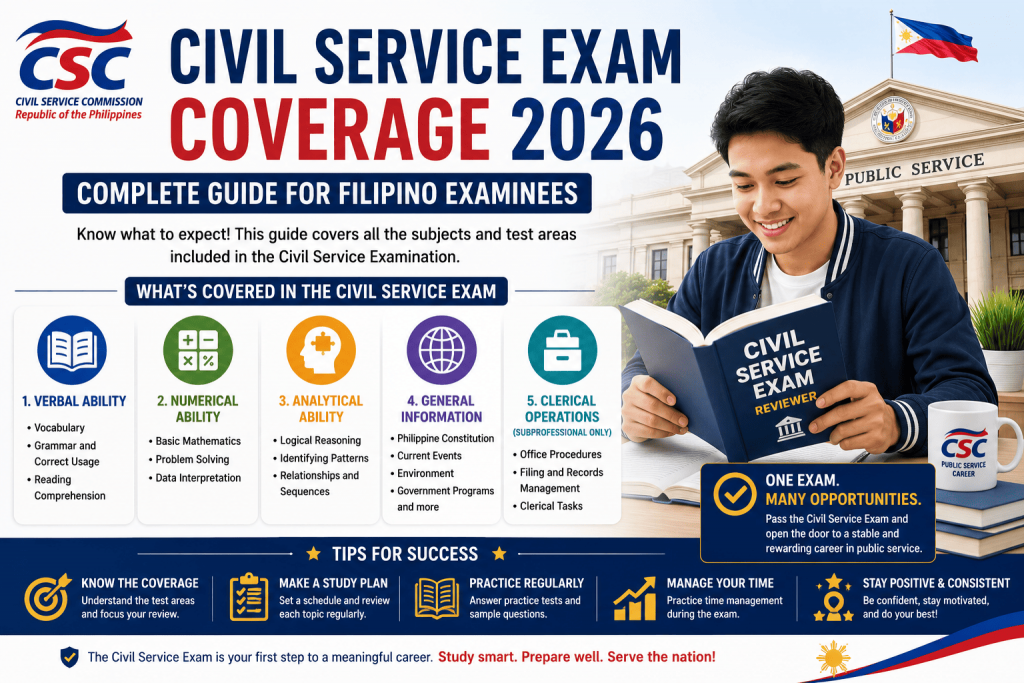
The Career Service Examination (CSE) is one of the most vital competitive exams in the Philippines. Passing the CSE grants official civil service eligibility, an absolute requirement for security of tenure and permanent placement across various government agencies.
Unfortunately, thousands of examinees fail every year—not because they lack intelligence, but because they study the wrong things. Understanding the exact Civil Service Exam coverage for 2026 allows you to streamline your review tracker, manage your study hours, and approach the test with absolute confidence.
The Two Levels of the Civil Service Exam
The Civil Service Commission (CSC) administers the CSE at two distinct tiers. Both require a general passing rating of at least 80%.
- Professional Level: Tailored for individuals targeting both first-level (clerical) and second-level (technical, administrative, and supervisory) positions in government.
- Subprofessional Level: Designed primarily for first-level positions focusing on clerical, mechanical, and administrative support tasks.
Not sure which exam level is right for you? Read our guide: [CSC Eligibility: Professional vs Subprofessional Exam – What’s the Difference?]
Detailed Civil Service Exam Coverage 2026
To maximize your score, you must align your review materials with the specific subjects designated for your chosen level.
Here is the exact breakdown of the topics featured in the 2026 CSE-PPT (Pen and Paper Test):
1. Verbal Ability (English and Filipino)
Both Professional and Subprofessional levels face this segment, testing core language proficiency.
- Vocabulary & Word Meaning: Context clues and identifying synonyms or antonyms.
- Grammar and Correct Usage: Sentence construction and subject-verb agreement.
- Error Recognition: Spotting structural and grammatical anomalies in a sentence.
- Paragraph Organization: Rearranging scrambled sentences into a logical sequence.
- Reading Comprehension: Drawing accurate conclusions and identifying main ideas from long passages.
2. Numerical Ability
This section gauges mathematical, data-driven, and numerical processing speeds.
- Basic Arithmetic Operations: Mastery of addition, subtraction, multiplication, and division.
- Fractions, Decimals, and Percentages: Core conversion concepts and equations.
- Ratio and Proportion: Identifying balanced mathematical relationships.
- Word Problems: Practical math applications including interest rates, age problems, work rates, and mixtures.
- Data Interpretation: Extracting information from charts, graphs, and tables.
3. Analytical Ability (Professional Level ONLY)
Exclusive to the Professional tier, this area tests non-verbal logic and critical reasoning.
- Logic and Abstract Reasoning: Syllogisms, assumptions, and identifying logical fallacies.
- Number Sequence and Letter Patterns: Recognizing progression matrices.
- Data Sufficiency: Determining if the provided information is enough to solve a problem.
4. Clerical Operations (Subprofessional Level ONLY)
Exclusive to the Subprofessional tier, focusing on foundational office workflows.
- Filing Systems & Alphabetizing: Organizing data using standardized indexing rules.
- Spelling & Error Checking: Precision checks on names, addresses, and lists.
- Office Procedures: Handling common corporate/government administrative tasks.
5. General Information (In English)
Both exam tiers include these critical public sector alignment items.
- Philippine Constitution: Emphasis on the Preamble, Bill of Rights (Article III), and Citizenship.
- Code of Conduct and Ethical Standards (R.A. 6713): The explicit rules governing accountability and ethics for public servants.
- Peace and Human Rights Issues: Contemporary local and global humanitarian guidelines.
- Environmental Management and Protection: Climate awareness, waste segregation, and conservation concepts.
Key Differences Summary
| Feature | Professional Exam | Subprofessional Exam |
| Unique Section | Analytical Ability (Logic) | Clerical Operations (Filing/Spelling) |
| Number of Items | 170 items | 165 items |
| Time Limit | 3 hours, 10 minutes | 2 hours, 40 minutes |
5 Practical Tips to Pass the 2026 Civil Service Exam
1. Build a Targeted Review Schedule
Do not cram. Give yourself at least 2 to 3 months of consistent daily review. Focus on one major domain (e.g., Numerical Ability) per week before jumping to the next.
2. Take Timed Mock Exams
The CSE is a race against the clock. On average, you have less than one minute per question. Practice tracking your speed using online sample tests or printed mock reviewers to avoid leaving questions blank.
Practice with our free Civil Service Exam Reviewer: https://cse.tinylaunch.site
3. Master the 80/20 Rule on Weak Areas
Identify the subjects where you struggle most—whether it is word problems or paragraph organization. Dedicate the first hour of your daily review to your weakest topics while your mind is still fresh.
4. Read Up on Current Events and R.A. 6713
Examinees often ignore the General Information section. Dedicate time to reading the 1987 Philippine Constitution and R.A. 6713. This is an easy section to score high on if you simply take the time to read the source documents.
5. Memorize Key Formulas Early
For the Numerical Ability section, build a dedicated cheat sheet for fractional values, percentage conversions, and algebraic formulas. Write them down repeatedly until they become muscle memory.
Final Thoughts
Securing a permanent role in the public sector starts with knowing exactly what you are up against. By matching your study materials directly to the Civil Service Exam coverage for 2026, you save time, reduce anxiety, and position yourself ahead of the competition.
For the official application deadlines, testing centers, and upcoming registration windows, visit the Civil Service Commission’s dedicated web portal at csc.gov.ph.
Related Resources
- Civil Service Exam Requirements 2026: Complete Application Guide and Checklist
- CSC Eligibility Requirements: Complete Guide for Government Job Applicants
- CSC Eligibility: Professional vs Subprofessional Exam – What’s the Difference?
- How to Apply for Government Jobs in the Philippines: Step-by-Step Guide
- Government Jobs in the Philippines 2026: Complete Job Search Guide
Free Civil Service Exam Reviewer
Practice online: