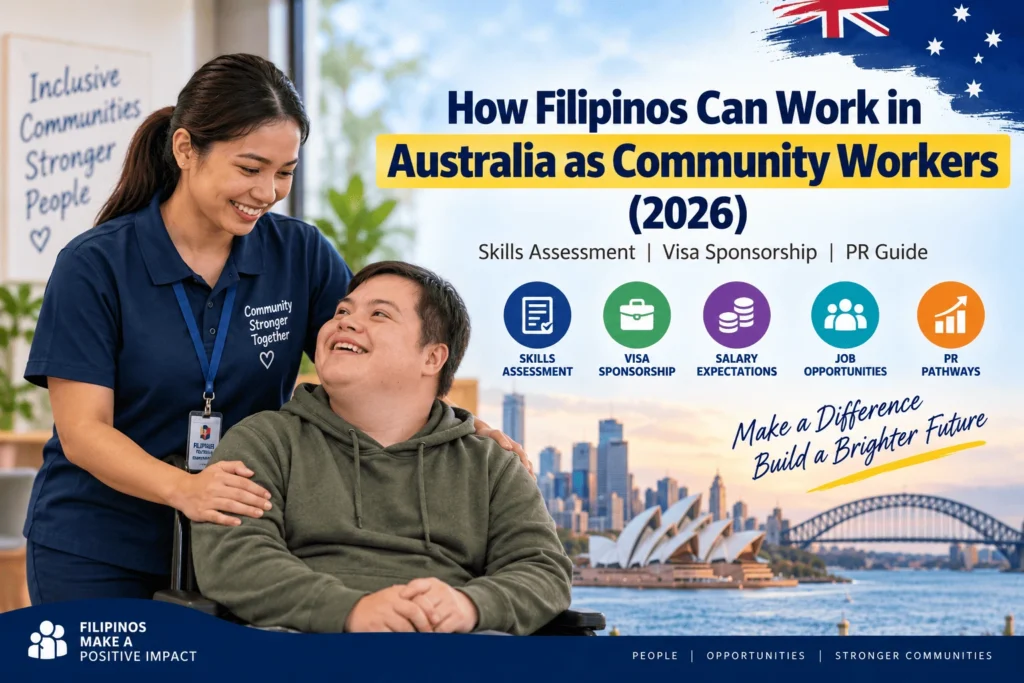
Quick Answer: Filipinos can work as Community Workers in Australia by meeting employer requirements, obtaining relevant qualifications, gaining community services experience, and applying through sponsorship or skilled migration pathways where eligible. Community Worker (ANZSCO 411711) is a recognized Skill Level 2 occupation that can be eligible for employer-sponsored and state-nominated migration pathways, making it one of the more accessible routes into Australia’s broader care and social services sector. For a full overview of how this fits into the wider Australia migration process for Filipinos, see our complete pillar guide.
Key Takeaways
- Community Worker is classified under ANZSCO 411711, Skill Level 2.
- Community Workers support individuals, families, and communities across health, housing, welfare, and employment-related needs.
- Community services remain a growing sector in Australia, driven by population growth and expanding social support programs.
- Sponsorship opportunities may be available through eligible employers, subject to current occupation list settings.
- Regional areas often have stronger demand and, in some cases, additional migration concessions.
- Community work experience can support long-term migration goals, including a genuine pathway to permanent residency.
What Is a Community Worker?
A Community Worker (ANZSCO 411711) facilitates community development initiatives and collective solutions within a community to address issues, needs, and problems associated with recreational, health, housing, employment, and other welfare matters. It’s classified as an ANZSCO Skill Level 2 occupation, comparable to an Associate Degree, Advanced Diploma, or Diploma level of skill.
Main Responsibilities
- Community outreach — engaging with community groups, welfare agencies, and government bodies to promote awareness of available resources and services
- Client support — interviewing and supporting clients to understand their needs and connect them with appropriate programs
- Welfare assistance — helping individuals and families navigate housing, employment, and welfare-related challenges
- Program coordination — assessing community needs and helping plan or coordinate relevant support programs
- Case support — monitoring client progress and making referrals to other agencies as needed
Can Filipinos Work as Community Workers in Australia?
Yes. Australia’s community services sector actively recruits from overseas, including from the Philippines, given the strong overlap between this occupation and skills many Filipinos already bring from social work, community development, healthcare support, or caregiving backgrounds.
International applicants are a meaningful and growing part of Australia’s community services workforce, particularly given ongoing domestic workforce shortages in the broader care and social support sector.
Community services sector growth in Australia has been sustained over recent years, driven by expanding government-funded programs and increasing recognition of the sector’s role in supporting vulnerable populations.
Employer demand for qualified, reliable community workers remains strong across non-profit organizations, local government, and disability and welfare service providers.
Career opportunities extend well beyond entry-level community outreach roles, with genuine progression into coordination, program management, and specialized case management roles available to workers who build experience and pursue further qualifications.
What makes Community Worker particularly worth understanding as a distinct pathway is how often it gets overlooked in favor of more commonly discussed care sector roles like nursing, aged care, or disability support. Yet because it sits at Skill Level 2 with an established skills assessment process, it frequently offers a more direct and predictable route to sponsorship and permanent residency than several of these better-known alternatives — making it a genuinely strategic option for Filipinos with a community services, social work-adjacent, or broader care background who are specifically prioritizing migration outcomes.
Why Australia Needs Community Workers
Population Growth
Australia’s continued population growth, driven substantially by immigration, increases demand for community services infrastructure and the workers who deliver it.
Disability Support Expansion
The continued growth of the National Disability Insurance Scheme (NDIS) has created substantial overlap and demand between disability support and broader community worker roles.
Mental Health Programs
Expanding government investment in mental health and psychosocial support programs has increased demand for community workers trained to support these specific client needs.
Regional Community Services
Regional and rural communities frequently face more pronounced service gaps than metropolitan areas, creating some of the strongest demand — and often the most accessible entry pathways — for community workers willing to relocate.
Indigenous Community Programs
Community worker roles supporting Aboriginal and Torres Strait Islander community programs represent a distinct and important area of ongoing workforce need across many parts of Australia.
ANZSCO 411711 Community Worker Explained
Occupation Description
Community Worker (ANZSCO 411711) sits within the broader “Welfare Support Workers” unit group, alongside closely related occupations such as Disabilities Services Officer and Residential Care Officer. The occupation description centers on facilitating community development and connecting individuals and groups with the services and resources they need.
Skill Level
Community Worker is classified as ANZSCO Skill Level 2, generally requiring an AQF Diploma, Advanced Diploma, or Associate Degree — a meaningfully higher formal qualification benchmark than Skill Level 4 occupations like the base Aged or Disabled Carer role, which is part of why Community Worker offers stronger, more consistent visa eligibility.
Typical Tasks
- Assessing community needs and available resources for health, welfare, housing, and employment services
- Liaising with community groups, welfare agencies, and government bodies
- Supporting families, including providing education and care-related coordination
- Preparing submissions for funding and reports to government bodies and other agencies
Employment Settings
- NGOs — non-government and non-profit organizations delivering community and welfare programs
- Local Government — council-run community service and outreach programs
- Welfare Organizations — dedicated welfare and social support agencies
- Community Centers — local, place-based community support and outreach hubs
- Disability Providers — NDIS and disability service organizations, given the substantial overlap between community work and disability support
Why the Skill Level 2 Classification Matters So Much
It’s worth pausing on this point specifically, since it’s the single biggest factor separating Community Worker from several superficially similar care sector occupations. Australia’s ANZSCO system assigns each occupation a skill level from 1 (highest, typically requiring a Bachelor’s degree or higher) to 5 (lowest, typically requiring limited formal training). Skill Level 1 and 2 occupations are generally the ones eligible for the widest range of skilled and employer-sponsored visa pathways, while Skill Level 4 and 5 occupations — including many frontline, hands-on care roles — are frequently excluded from these same pathways, regardless of how essential or in-demand the actual work is.
This is precisely why Community Worker deserves serious consideration as a migration strategy: it delivers meaningful, hands-on impact in people’s lives, similar in spirit to frontline care work, while sitting at a formal skill classification that keeps the door open to a genuinely broader set of visa options.
A Day in the Life of a Community Worker
Understanding the practical, day-to-day texture of this role can help you assess genuine fit before committing significant time and resources to this migration pathway.
A typical day might begin with reviewing case notes and scheduled client appointments, followed by a mix of direct client meetings — some in-office, others involving home visits or accompanying clients to appointments — and administrative work, including updating case records and liaising with other agencies on a client’s behalf. Community Workers often juggle a caseload of several clients simultaneously, each at different stages of their support journey, requiring strong organizational skills alongside genuine interpersonal warmth.
Much of the role also involves indirect work: attending team meetings, contributing to program planning, and staying current on available community resources and referral pathways. Unlike some care roles that are highly routine and task-based, Community Worker positions often require significant independent judgment — assessing a client’s specific situation and determining the most appropriate combination of supports, rather than following a fixed, standardized procedure.
For Filipino applicants coming from more clinically structured healthcare backgrounds, this shift toward a more autonomous, judgment-driven working style is worth understanding upfront — many find it a rewarding change, though it does require adjusting expectations about what “structured guidance” looks like day to day compared to a hospital or clinical setting.
Career Progression for Community Workers
Community Worker is rarely a career endpoint — most workers who stay in the field for several years progress into more senior or specialized roles.
Senior Community Worker or Team Leader — taking on a more experienced caseload alongside informal mentoring responsibilities for newer team members.
Program Coordinator — moving from direct client work into designing, managing, and evaluating entire community support programs.
Case Manager — specializing in more intensive, complex case management, often for clients with multiple, overlapping support needs.
Community Development Officer — shifting focus from individual client support toward broader, systemic community development initiatives, one of the specific specializations recognized under the ANZSCO 411711 classification itself.
Management and Leadership Roles — experienced community workers, particularly those who pursue further qualifications such as a Bachelor’s or Master’s degree, often progress into organizational leadership positions within community service organizations.
This progression matters for migration planning too — workers who reach more senior or specialized positions often find their profile increasingly competitive for state nomination programs and employer sponsorship, since organizations are frequently more willing to invest in sponsoring an experienced, proven staff member than an entirely new hire.
Community Worker vs. Disability Support Worker
| Category | Community Worker | Disability Support Worker |
|---|---|---|
| Focus | Community Services | Direct Personal Care |
| ANZSCO | 411711 | 423111 |
| Skill Level | 2 | 4 |
| Sponsorship Potential | Higher | More Limited |
| Career Growth | Strong | Moderate |
This distinction matters enormously for anyone weighing these two closely related pathways. As covered in our Disability Support Worker Australia guide, the frontline disability caregiving role itself sits at Skill Level 4 and generally doesn’t qualify for standard skilled visa sponsorship on its own. Community Worker, by contrast, sits at Skill Level 2 and carries a formal skills assessment pathway, making it a meaningfully stronger option for anyone specifically prioritizing visa sponsorship or a points-tested migration pathway, provided they hold or pursue the required Diploma-level qualification.
Community Worker vs. Social Worker
| Category | Community Worker | Social Worker |
|---|---|---|
| Degree Required | Often No (Diploma sufficient) | Usually Yes (Bachelor’s minimum) |
| Assessment Authority | Community Work Australia (CWA) | AASW |
| Client Support | Yes | Yes |
| Case Management | Some | Extensive |
Community Worker offers a meaningfully lower formal education barrier to entry than Social Worker, which generally requires a Bachelor’s degree in Social Work assessed by the Australian Association of Social Workers (AASW). For Filipinos with a Diploma-level community services background rather than a full social work degree, Community Worker represents a genuinely more accessible entry point into Australia’s broader social services sector, while still offering a credible long-term migration pathway.
Qualifications Needed
Certificate IV in Community Services
A foundational qualification, though generally below the AQF Diploma threshold that Community Work Australia requires for a positive skills assessment — useful as a stepping stone rather than a final qualification for migration purposes.
Diploma of Community Services
The standard, most directly relevant qualification for a positive CWA skills assessment, and the qualification level most Filipino applicants should specifically target if community worker migration is the goal. This qualification is available both in Australia (through registered training organizations) and, increasingly, through equivalent programs in the Philippines that some applicants pursue before beginning the CWA assessment process — though when studying outside Australia, it’s worth confirming in advance that the specific program and institution will be recognized as sufficiently comparable during assessment.
Bachelor-Level Qualifications
A Bachelor’s degree in a relevant field (such as social work, community development, or psychology) generally exceeds the minimum requirement and can strengthen an application, though it isn’t strictly necessary if you hold an appropriate Diploma-level qualification.
Relevant Healthcare Background
Applicants transitioning from an existing healthcare or care-related background often find this pathway a natural fit, including:
- Nurses, whose clinical training and client care experience translate well into community support contexts
- Caregivers, who bring direct, hands-on support experience
- Disability Workers, whose experience overlaps substantially with community worker responsibilities
- Aged Care Workers, who bring transferable client support and welfare assistance skills
Skills Assessment for Community Workers
Is Skills Assessment Required?
Yes. A positive skills assessment is generally required to apply for most points-tested and employer-sponsored visa pathways relevant to this occupation, including the 190, 491, and the Direct Entry stream of the 186 visa.
Assessment Pathways
Skills assessments for Community Worker are conducted by Community Work Australia (CWA), formerly known as the Australian Community Workers Association (ACWA). CWA assesses whether your qualification and, where relevant, your work experience meet the required AQF Diploma-equivalent standard for the occupation.
Documents Required
- Certified copies of academic transcripts and qualification certificates
- Detailed employment references documenting relevant community services experience
- Identity documents (passport and other required identification)
- Evidence of English language proficiency where required
Qualification Recognition
Applicants with a CWA-accredited or recognized qualification are generally considered to have met the core qualification requirement. Applicants with a relevant Diploma or higher qualification typically also need to demonstrate a minimum period of relevant industry experience within the past several years, and evidence that their skills and knowledge remain current — either through a qualification completed within the last four years, or a minimum period of recent relevant employment.
CWA Skills Assessment Fees and Timeline
Budgeting accurately for the skills assessment process helps avoid unwelcome surprises partway through your application. CWA skills assessment fees vary depending on the specific assessment type (standard assessment versus assessment for a specific occupation specialization like Community Development Officer), and processing timelines have historically run in the range of 10 to 12 weeks for a standard application, though this can vary based on application volume and completeness of submitted documentation.
Fast-tracking options, when available, typically involve an additional fee for expedited processing, though availability of fast-tracking can be suspended or limited at CWA’s discretion during high-volume periods. Given these variables, always confirm current fees and processing timelines directly through CWA’s official website before finalizing your application budget and timeline, since both can change from year to year.
What If Your Philippine Qualification Isn’t a Perfect Match?
Many Filipino applicants hold qualifications in related but not identically-named fields — social work, psychology, community development, or even nursing — rather than a qualification specifically titled “Community Services.” This is common, and CWA’s assessment process is built to evaluate relevance rather than requiring an exact title match.
In practice, this means your qualification will be assessed against the specific competencies and content it covered, compared to what an AQF Diploma of Community Services would typically include, rather than being rejected outright simply because the title differs. Applicants in this situation often benefit from working with a registered migration agent or directly consulting CWA’s published guidance to understand whether their specific qualification is likely to be assessed as sufficiently relevant, or whether a bridging course or additional Australian qualification may strengthen their application.
Community Worker Visa Sponsorship Australia
How Sponsorship Works
An Australian employer with a genuine vacancy can sponsor an eligible Community Worker under an appropriate visa subclass, provided the applicant holds a positive CWA skills assessment and meets the specific visa’s other eligibility requirements.
Employer Requirements
Sponsoring employers must meet standard sponsorship obligations, including demonstrating a genuine need for the position and meeting relevant labor market and training requirements associated with their chosen visa program.
Regional Opportunities
Regional community service organizations, particularly those operating under a Designated Area Migration Agreement (DAMA), sometimes offer additional flexibility or concessions for community worker sponsorship, reflecting more acute regional workforce shortages.
Typical Hiring Process
Most community worker hiring follows a standard process: application and resume screening, an interview (often including scenario-based questions about client support situations), reference checks, and, for sponsorship-track roles, a formal offer contingent on a positive skills assessment outcome and visa approval.
Visa Options for Filipinos
482 Visa
The employer-sponsored Skills in Demand visa, directly accessible for Community Worker given its Skill Level 2 classification and established skills assessment pathway. See our Australia 482 Visa Guide for full eligibility and cost details.
186 Visa
The Employer Nomination Scheme, offering permanent residency, generally requiring a positive skills assessment under the Direct Entry stream or a qualifying period of sponsored employment under the Temporary Residence Transition stream. See our Australia 186 Visa Guide for the complete pathway breakdown.
190 Visa
The State Nominated visa, a points-tested pathway to permanent residency, contingent on Community Worker being included in your target state’s current nomination priorities. See our Australia 190 Visa Guide for state-by-state details.
491 Visa
The Skilled Work Regional visa, a points-tested pathway to a provisional visa (leading to eventual permanent residency) for applicants willing to live and work in a designated regional area. See our Australia 491 Visa Guide for full requirements.
Other Skilled Migration Pathways
Community Worker may also feature on region-specific Designated Area Migration Agreements, offering additional visa concessions in participating regions beyond the standard national settings.
Community Worker Requirements
| Requirement | Usually Required |
|---|---|
| Passport | Yes |
| Resume | Yes |
| Experience | Preferred |
| Qualification | Usually Required |
| English Test | Often Required |
| Police Clearance | Often Required |
| Medical Examination | Required |
Step-by-Step Pathway
- Gain community service experience — build or document relevant welfare, community development, or care-related work experience
- Obtain qualifications — pursue a Diploma of Community Services or equivalent CWA-recognized qualification
- Prepare migration documents — transcripts, employment references, identity documents, and English test results
- Apply for jobs — target employers and roles aligned with community worker responsibilities
- Secure sponsorship — formalize an offer with an employer willing to sponsor your visa, where applicable
- Apply for visa — lodge your application under the appropriate subclass, supported by your CWA skills assessment
- Relocate to Australia — complete relocation logistics once your visa is granted
Community Worker Salary in Australia
| Position | Estimated Annual Salary (AUD) |
|---|---|
| Entry Level | $65,000–$80,000 |
| Experienced | $80,000–$100,000 |
| Senior Community Worker | $100,000+ |
Regional incentives — community worker positions in regional and remote areas frequently offer additional incentives, including relocation support, given more pronounced local workforce shortages.
Government-funded programs — salaries for roles within government-funded community programs are often benchmarked against structured, award-based pay scales, providing more predictable long-term salary progression than some non-profit sector roles.
Career progression — experienced community workers who move into coordination or program management roles can see meaningful salary growth beyond the base ranges above, particularly within larger, well-resourced organizations.
Best States for Community Workers
Queensland — strong demand tied to population growth and expanding regional community service infrastructure.
Western Australia — significant regional shortages, particularly in remote communities, often correlating with stronger relocation incentives.
South Australia — a consistently supportive state nomination environment for community and welfare services occupations.
Tasmania — smaller population but persistent regional community service workforce gaps.
Victoria — a large, diverse community services job market spanning both metropolitan Melbourne and substantial regional Victoria demand.
New South Wales — the largest overall community services job market by volume, with strong demand across both Sydney and regional NSW.
When comparing states, it’s worth remembering that state nomination priorities for occupations like Community Worker can shift from year to year based on each state’s evolving workforce needs. Rather than fixating on a single “best” state based on general reputation, it’s more effective to check the current nomination program details for your top two or three preferred states directly, since a state that wasn’t prioritizing community services occupations last year might actively be doing so this year, or vice versa.
Top Employers Hiring Community Workers
- Community Service Organizations — non-profits delivering a broad range of welfare and community development programs
- Welfare Agencies — dedicated welfare and social support organizations
- Disability Service Providers — NDIS providers whose services overlap substantially with community worker roles
- Local Councils — local government-run community outreach and support programs
- Government-Funded Programs — state and federally funded community services initiatives
Can Community Workers Get Permanent Residency?
Yes, and Community Worker offers a genuinely stronger, more direct pathway to permanent residency than many adjacent care sector roles, given its Skill Level 2 classification and established CWA skills assessment process.
Skilled pathways — the points-tested 190 and 491 visas offer direct routes to (or toward) permanent residency, provided Community Worker features on the relevant occupation list for your target state or region.
Employer sponsorship — the 482-to-186 pathway offers a direct, employer-driven route to permanent residency for workers who secure sponsored employment.
State nomination — several states have periodically prioritized community and welfare services occupations within their nomination programs, making the 190 visa a realistic option depending on current settings.
Regional pathways — the 491 visa, combined with regional community worker demand, offers a particularly accessible combination for applicants open to relocating outside major metropolitan areas.
Taken together, these multiple overlapping pathways are part of what makes Community Worker a genuinely strong migration occupation rather than a niche curiosity. Unlike occupations where only a single, narrow visa route is realistically available, Community Worker applicants often have the flexibility to pursue whichever combination of state nomination, regional relocation, or employer sponsorship best fits their personal circumstances and risk tolerance.
Common Mistakes Applicants Make
Wrong occupation selection — nominating a closely related but distinct occupation (such as the base Aged or Disabled Carer classification) instead of Community Worker, resulting in a mismatched or ineligible visa application.
Weak resume — failing to clearly translate Philippine community development, social work, or caregiving experience into terms that map directly onto the Community Worker occupation description.
No community experience — applying without any demonstrated welfare, outreach, or community support experience, which weakens both job applications and skills assessment outcomes.
Ignoring state requirements — assuming Community Worker is uniformly available across all state nomination programs, without checking current state-specific occupation lists and priorities.
Applying without qualification recognition — proceeding with a job or visa application before confirming your qualification meets CWA’s specific AQF Diploma-equivalent requirement.
Why Filipino Applicants Often Do Well in Community Worker Roles
Australian community services employers frequently cite specific strengths that make Filipino applicants particularly strong candidates for this kind of client-facing, relationship-driven work.
Strong interpersonal and caregiving orientation. The Philippines’ cultural emphasis on family care and community support (bayanihan) translates naturally into the empathetic, relationship-centered approach that effective community work requires.
English proficiency. As a country with widespread English fluency and English-medium education, Filipino applicants often navigate both the client-facing communication demands of the role and the visa English requirements more smoothly than applicants from many other source countries.
Multicultural adaptability. Filipinos with experience working or living abroad — whether in caregiving roles in the Middle East, healthcare roles elsewhere, or simply navigating the Philippines’ own diverse regional cultures — often demonstrate strong cultural adaptability, a genuinely valuable trait when supporting Australia’s own culturally and linguistically diverse client populations.
Existing care sector experience. Many Filipino applicants pursuing this pathway already have direct caregiving, healthcare support, or social work-adjacent experience, whether from domestic employment or from working overseas as a caregiver, nurse, or healthcare assistant — experience that maps naturally onto Community Worker’s core responsibilities.
None of this means the transition is automatic or effortless — succeeding in this role still requires deliberately building Australia-specific knowledge, including familiarity with the local welfare system, relevant legislation, and cultural expectations around client autonomy and confidentiality that may differ from practices in the Philippines. But the underlying interpersonal foundation many Filipino applicants bring is a genuine, recognized advantage in this specific occupation.
How to Strengthen Your Community Worker Application
Beyond simply avoiding the common mistakes above, a few proactive strategies can meaningfully improve your competitiveness for both employment and skills assessment purposes.
Document your experience specifically, not generically. Rather than describing your background in vague terms like “worked in community outreach,” detail the specific types of clients you supported, the programs you contributed to, and any measurable outcomes you can point to. This level of specificity helps both prospective employers and CWA assessors clearly map your experience onto the occupation’s official duties.
Pursue Australian qualification recognition early. If there’s any ambiguity about whether your Philippine qualification meets the AQF Diploma-equivalent standard, resolving this early — well before you’re actively job hunting or preparing a visa application — prevents a last-minute scramble that could delay your entire timeline.
Build English proficiency well ahead of when you need it. Since client-facing communication is central to this role, and since English test results carry an expiry window for visa purposes, timing your English test strategically (not too early, not too late relative to your application timeline) is worth planning deliberately.
Network within Filipino community services and healthcare migration circles. Many successful Filipino Community Worker migrants report that connections with others who’ve already completed this specific pathway were invaluable for practical, up-to-date guidance — since occupation list settings and specific employer practices can shift in ways that generic online guides don’t always capture in real time.
Consider a registered migration agent for complex cases. If your qualification background is unusual, if you’re combining this pathway with a family visa strategy, or if you’re simply unsure which of the several available visa routes best fits your situation, the cost of a registered migration agent consultation is often well justified by the time and risk it saves, particularly given how much can be at stake in getting your initial occupation and visa subclass selection right the first time.
Atlas Community Worker Migration Framework™
The full pathway from Philippine community services background to Australian permanent residency follows a clear, sequential structure.
Community Experience ↓ Qualifications ↓ Skills Assessment ↓ Job Search ↓ Employer Sponsorship ↓ Visa Approval ↓ Australian Employment ↓ Permanent Residency
Unlike some adjacent care sector pathways, this framework doesn’t require navigating a confusing distinction between eligible and ineligible occupation classifications — Community Worker’s Skill Level 2 status and dedicated CWA assessment pathway make each stage of this framework comparatively direct, provided you hold or pursue the required Diploma-level qualification early in the process.
Frequently Asked Questions
Can Filipinos become Community Workers in Australia?
Yes. Filipinos can work as Community Workers in Australia by meeting employer requirements, obtaining a relevant Diploma-level qualification, gaining community services experience, and applying through sponsorship or skilled migration pathways where Community Worker is currently listed as an eligible occupation.
What is ANZSCO 411711?
ANZSCO 411711 is the official occupation code for Community Worker, classified as a Skill Level 2 occupation within Australia’s official occupational classification system, generally requiring an AQF Diploma-equivalent qualification.
Is sponsorship available?
Yes, sponsorship is available through the 482 visa for eligible Community Worker applicants who hold a positive skills assessment from Community Work Australia (CWA) and secure a genuine employer sponsor.
What qualifications are needed?
A Diploma of Community Services or an equivalent CWA-recognized qualification is generally the minimum standard required for a positive skills assessment, though relevant work experience can also factor into the overall assessment.
Is skills assessment required?
Yes, a positive skills assessment from Community Work Australia is generally required for most points-tested and employer-sponsored visa pathways relevant to this occupation.
How much do Community Workers earn?
Base salaries typically range from AUD 65,000 for entry-level positions to AUD 100,000 or more for senior community workers, with regional roles often including additional incentives.
Can I get PR?
Yes, permanent residency is achievable through several pathways, including the 190 and 491 points-tested visas, or through employer sponsorship via the 482-to-186 pathway.
Is IELTS required?
English proficiency testing is generally required for visa purposes, with specific score requirements varying by visa subclass and, in some cases, by state nomination program.
Which visa is best?
The best option depends on your circumstances: applicants with a confirmed employer sponsor often find the 482-to-186 pathway most direct, while those without sponsorship but with strong points test scores may find the 190 or 491 more accessible, particularly if open to regional relocation.
Can family members come with me?
Generally yes, for most points-tested and employer-sponsored visa pathways, eligible partners and dependent children can be included in your application, subject to the specific visa subclass requirements.
Are Community Workers in demand?
Yes, demand remains strong, driven by population growth, NDIS expansion, mental health program growth, and persistent regional community services workforce gaps.
Which state has the most opportunities?
New South Wales and Victoria represent the largest overall community services job markets by volume, though Queensland and Western Australia also show strong, growing demand, particularly in regional areas.
Can Disability Support Workers transition into Community Work?
Yes, and this is a particularly common and valuable transition, since Disability Support Workers often already hold relevant experience and, in many cases, qualifications that align closely with Community Worker’s requirements — sometimes needing only to complete a Diploma of Community Services to formally qualify for a positive skills assessment.
How long does the migration process take?
Timelines vary, but applicants should generally plan for several months to complete qualification recognition and skills assessment, followed by additional time for job search, sponsorship arrangement (if applicable), and visa processing — often totaling one to two years from start to arrival in Australia. Applicants who already hold a qualifying Diploma-level credential and simply need to complete the CWA assessment process can move considerably faster than those who need to first complete additional study to meet the qualification threshold.
Can I apply directly from the Philippines?
Yes. The CWA skills assessment and much of the job search and sponsorship arrangement process can generally be completed while still based in the Philippines, before relocating to Australia once your visa is granted. Many successful applicants secure a job offer and complete their skills assessment entirely from the Philippines, only relocating once their visa has been finalized — meaning you don’t need to be physically present in Australia to begin this pathway.
Related Guides
- Australia Migration Guide for Filipinos
- Australia Skilled Occupation List for Filipinos
- Australia Skills Assessment for Filipinos
- Australia Jobs with Visa Sponsorship for Filipinos
- Australia 482 Visa for Filipinos
- Australia 186 Visa for Filipinos
- Australia 190 Visa for Filipinos
- Australia 491 Visa for Filipinos
- How Filipinos Can Become Disability Support Workers in Australia