Landing a stable, rewarding career in the Philippine government is a primary goal for many professionals seeking job security and competitive benefits. While passing the traditional Career Service Examination (CSE) is the most common route, many applicants are unaware that they might already hold equivalent status. Yes, meeting specific csc eligibility requirements exemptions allows you to skip the testing center entirely.
The Civil Service Commission (CSC) recognizes various special eligibilities granted under specific laws and presidential decrees. If you fall under any of these categories, you can obtain a legal gateway into public office without ever setting foot inside an exam hall.
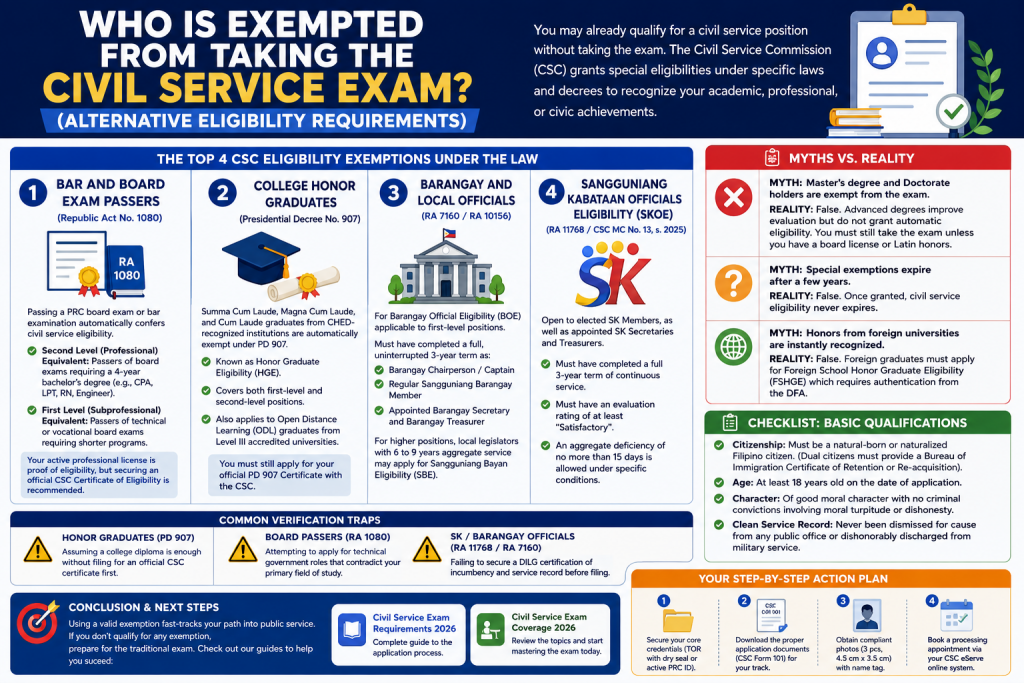
The Top 4 CSC Eligibility Requirements Exemptions Under the Law
The Philippine government provides structured alternative pathways for individuals who have already proven their academic, professional, or civic competence elsewhere.
1. Bar and Board Exam Passers (Republic Act No. 1080)
Under Republic Act No. 1080, passing a state regulatory board examination administered by the Professional Regulation Commission (PRC) or the bar examination managed by the Supreme Court automatically confers civil service eligibility.
- Second Level (Professional) Equivalent: Granted to passers of board examinations that strictly require a four-year bachelor’s degree (e.g., Certified Public Accountants, Licensed Professional Teachers, Registered Nurses, Engineers).
- First Level (Subprofessional) Equivalent: Granted to passers of technical or vocational board examinations requiring shorter program durations.
Your active professional license acts as your proof of eligibility. While you can apply for jobs directly using your PRC ID, securing an official Certificate of Eligibility from the CSC remains a highly recommended strategy for permanent government placement.
2. College Honor Graduates (Presidential Decree No. 907)
Summa Cum Laude, Magna Cum Laude, and Cum Laude graduates from CHED-recognized private higher education institutions, State Universities and Colleges (SUCs), or Local Universities and Colleges (LUCs) are automatically exempt under Presidential Decree No. 907.
Known as the Honor Graduate Eligibility (HGE), this pathway accommodates both first and second-level government career tracks. To reflect current educational pathways, csc eligibility requirements exemptions officially apply to individuals completing their degrees via Open Distance Learning (ODL), provided their respective universities hold valid Level III institutional accreditation.
3. Barangay and Local Officials (RA 7160 / RA 10156)
Local community leaders who invest their time in grassroots governance are eligible for the Barangay Official Eligibility (BOE). This applies strictly to first-level (clerical and administrative support) positions. To qualify, you must have completed a full, uninterrupted three-year term in one of the following positions:
- Barangay Chairpersons / Captains
- Regular Sangguniang Barangay Members
- Appointed Barangay Secretaries and Barangay Treasurers
For higher positions, local legislators (such as municipal councilors and provincial board members) who complete an aggregate service of six to nine years can apply for the Sangguniang Bayan Eligibility (SBE).
4. Sangguniang Kabataan Officials Eligibility (SKOE)
Following recent updates under CSC Memorandum Circular No. 13, Series of 2025, youth leaders are now entitled to specific csc eligibility requirements exemptions via the Sangguniang Kabataan Officials Eligibility (SKOE) under Republic Act No. 11768.
This exemption is open to elected SK Members, as well as appointed SK Secretaries and Treasurers. The primary requirement dictates a full three-year term of continuous service with an evaluation rating of at least “Satisfactory.” The CSC permits an aggregate service deficiency of no more than 15 days under specific structural conditions (such as when a term is shortened by law or due to automatic succession patterns).
💡 Human Experience: Real-World Scenarios & Common Mistakes
Navigating the recruitment space reveals that many qualified professionals lose out on government seats not due to a lack of skills, but because of common administrative oversight.
The “Double Practice” Confusion
A frequent point of confusion among applicants involves using an RA 1080 eligibility outside its intended environment. For instance, a Licensed Professional Teacher (LPT) holds an automatic professional-level eligibility. However, if that teacher applies for an internal auditing role within a local government unit, the Human Resource Merit Promotion and Selection Board (HRMPSB) will prioritize an applicant with an accounting background. Your exemption grants you entry into the system, but your academic background must still align with the specific position’s structural requirements.
Assuming Automatic Enrollment
A major mistake made by many college honor graduates is assuming their Latin honors automatically register within the CSC database upon graduation. University systems and the Civil Service Commission operate on separate networks. If you attach a plain university diploma to a government application without formally applying for your physical PD 907 certificate at a CSC regional field office first, your application faces automatic disqualification for lacking verified eligibility records.
| Exemption Type | Legal Basis | Common Verification Trap |
| Honor Graduates | PD 907 | Assuming a college diploma is enough without filing for an official CSC certificate first. |
| Board Passers | RA 1080 | Attempting to apply for technical government roles that contradict your primary field of study. |
| SK / Barangay Officials | RA 11768 / RA 7160 | Failing to secure a DILG certification of incumbency and service record before filing. |
🛑 Critical Warnings: Myths vs. Reality
Filing corridors and online forums are often filled with outdated information. Make sure you avoid these common traps:
- Myth 1: “Master’s degree and Doctorate holders are exempt from the exam.”
- Reality: This is false. Holding an MBA, a master’s degree, or a PhD enhances your evaluation score under education metrics, but it does not grant automatic civil service eligibility. Advanced degree holders must still sit for the exam unless they have an underlying board license or Latin honors.
- Myth 2: “Special exemptions lose their validity and expire after a few years.”
- Reality: Civil service eligibility—whether earned via a traditional pen-and-paper examination or awarded through a special exemption law—never expires. Once granted, it is permanent.
- Myth 3: “Honors received from foreign universities abroad are instantly recognized.”
- Reality: Graduates from international institutions cannot use a standard PD 907 exemption. They must apply for a specific Foreign School Honor Graduate Eligibility (FSHGE), which requires a strict authentication process through the Department of Foreign Affairs (DFA).
Checklist: Basic Qualification Standards to Apply for Special Eligibility
Being exempt from taking the physical test does not mean you are exempt from background and structural vetting. To successfully convert your exemption status into a certified CSC document, you must meet the universal baseline parameters:
- Citizenship: Must be a natural-born or naturalized Filipino citizen. (Dual citizens must provide a Bureau of Immigration Certificate of Retention or Re-acquisition).
- Age: At least 18 years old on the exact day of application filing.
- Character: Of good moral character with no criminal convictions involving moral turpitude or dishonesty.
- Clean Service Record: Never been dismissed for cause from any public office or dishonorably discharged from military service.
Conclusion & Actionable Next Steps
Utilizing a valid legal exemption is an excellent way to fast-track your career path into public service. It bypasses months of test preparation and allows you to transition directly into active job hunting.
However, if you review these categories and realize you do not qualify for an exemption, do not worry. Your next direct step is to prepare your documentation for the traditional examination window. You can read our definitive guide on [Civil Service Exam Requirements 2026] to ensure your forms are filled out correctly, or review the [Civil Service Exam Coverage 2026] to start mastering the test competencies today.
Your Step-by-Step Action Plan
- Secure Your Core Credentials: Request authenticated copies of your Transcript of Records (TOR) with dry seals from your university registrar, or ensure your PRC ID is active and valid.
- Download the Proper Application Documents: Secure CSC Form 101 (the specialized application form for special eligibilities) corresponding to your specific track (e.g., Form 101-HGE for honor graduates, or Form 101-SKOE for SK officials).
- Obtain Compliant Photographs: Secure 3 passport-sized photos ($4.5\text{ cm} \times 3.5\text{ cm}$) featuring a handwritten name tag and signature layout positioned exactly one inch below your chin.
- Book a Processing Appointment: Log on to your region’s official CSC booking platform or use the [CSC eServe Online Appointment] system to lock in a date for physical document submission at your nearest regional field office.
Related Topics
To learn more about navigating your career in the Philippine government, explore our deep-dive guides:
- Civil Service Exam Requirements 2026: Complete Application Guide and Checklist
- CSC Eligibility Requirements: Complete Guide for Government Job Applicants
- CSC Eligibility: Professional vs Subprofessional Exam – What’s the Difference?
- How to Apply for Government Jobs in the Philippines: Step-by-Step Guide
- Government Jobs in the Philippines 2026: Complete Job Search Guide