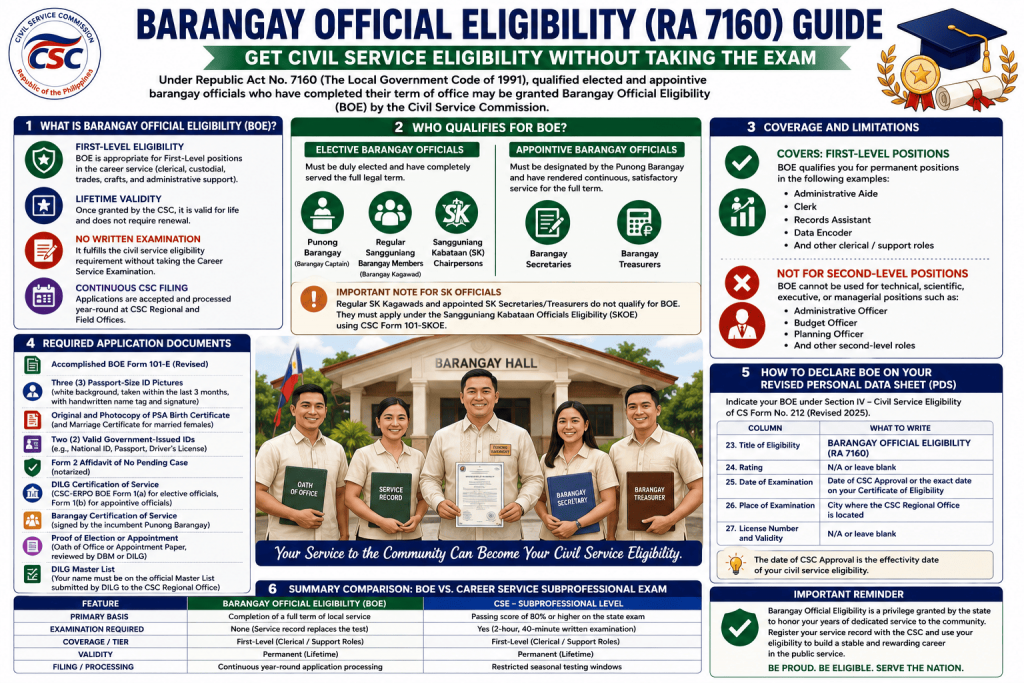
Local governance is the backbone of public service in the Philippines. Recognizing the dedication of grassroots leaders, the state provides a direct pathway into the permanent civil service. Under Republic Act No. 7160 (The Local Government Code of 1991), qualified elected and appointive community leaders can obtain Barangay Official Eligibility (BOE) without sitting for the traditional Career Service Examination.
This legal privilege honors community leaders by turning their years of local administrative service into an official civil service credential. This guide covers the qualifications, service terms, required documents, and steps to register your Barangay Official Eligibility and log it correctly on your state application forms.
What Is Barangay Official Eligibility (BOE)?
Barangay Official Eligibility is a special civil service grant awarded to specific community leaders who successfully complete their legally mandated terms of office.
Key Structural Strengths:
- Permanent Validity: Once the Civil Service Commission (CSC) grants your Barangay Official Eligibility, it is valid for life and does not require renewal fees or periodic maintenance.
- Testing Exemption: It fulfills the eligibility requirement under the CSC’s Qualification Standards (QS) for entry-level government careers without requiring you to take the written pen-and-paper test.
- Year-Round Processing: Unlike seasonal exam schedules, applications for special law grants like the BOE are processed continuously by CSC Regional and Field Offices.
Who Qualifies for BOE?
The CSC strictly limits the grant of Barangay Official Eligibility to specific elective and appointive positions.
1. Elective Barangay Officials
To qualify, you must have been duly elected to office and have completely served your full legal term as specified by prevailing local election laws.
- Punong Barangay (Barangay Captain)
- Regular Sangguniang Barangay Members (Barangay Kagawad)
- Sangguniang Kabataan (SK) Chairpersons
2. Appointive Barangay Officials
Appointive officials must be designated by the duly elected Punong Barangay and must have rendered continuous, satisfactory service. Their years of service must correspond directly to the full term of the appointing captain.
- Barangay Secretaries
- Barangay Treasurers
📢 Crucial 2026 Update for SK Officials:
While SK Chairpersons qualify for the Barangay Official Eligibility because they sit as ex-officio members of the Sangguniang Barangay, regular SK Kagawads and appointed SK Secretaries/Treasurers do not qualify for the BOE. Instead, they must apply under a separate civil service rule: the Sangguniang Kabataan Officials Eligibility (SKOE) using CSC Form 101-SKOE.
Determining Your Eligibility Tier: First Level Only
Before planning your government career path, note this structural limitation: Barangay Official Eligibility is strictly appropriate for First-Level positions in the career service.
- What it covers: It qualifies you for permanent appointments to clerical, custodial, trades, crafts, and administrative support functions (equivalent to Subprofessional Eligibility). Examples include Administrative Aide, Clerk, Records Assistant, and Data Encoder.
- What it restricts: It cannot be used to apply for Second-Level roles (technical, scientific, executive, or managerial positions like Administrative Officer or Budget Analyst). To see how these requirements diverge across career ranks, read our deep dive on CSC Eligibility: Professional vs Subprofessional Exam – What’s the Difference?. If you wish to climb into those upper ranks, you must eventually pass the Career Service Professional Exam.
Required Application Documents for BOE
Because this eligibility is based on physical community service rather than a written test, you must formally submit an application to the CSC Regional or Field Office that has jurisdiction over your barangay to claim your Barangay Official Eligibility.
General Requirements:
- Accomplished Application Form: BOE Form 101-E (Revised).
- Three (3) Passport-Size ID Pictures: Taken within the last 3 months with a white background. You must be shown holding a handwritten (not computerized) name tag that displays your signature over your printed full name.
- Original and Photocopy of PSA Birth Certificate (and Marriage Certificate for married female applicants) certified by the Philippine Statistics Authority (PSA).
- Two Valid Government-Issued IDs (e.g., National ID, Passport, Driver’s License).
- Form 2 Affidavit of No Pending Case: A notarized statement certifying that you have no active administrative or criminal records.
Specific Service Requirements:
- DILG Certification of Service: An official document issued by the authorized Department of the Interior and Local Government (DILG) officer at your municipal or city level using CSC-ERPO BOE Form 1(a) for elective officials, or Form 1(b) for appointive officials.
- Barangay Certification: A formal attestation of service signed by the incumbent Punong Barangay.
- Proof of Election or Appointment: Your original, duly signed Oath of Office, or your official Appointment Paper (for Secretaries and Treasurers) reviewed by the Department of Budget and Management (DBM) or DILG.
- DILG Master List: Your name must appear on the official Master List of Elected/Appointed Barangay Officials submitted directly from the DILG to the CSC Regional Office.
Declaring BOE on Your Revised Personal Data Sheet (PDS)
When applying for permanent municipal, provincial, or national roles, you must record your service credential under Section IV (Civil Service Eligibility) of the mandated CS Form No. 212 (Revised 2025) Personal Data Sheet.
Fill out your PDS entries using this precise structure to ensure your Barangay Official Eligibility is properly acknowledged:
- Column 23 (Title of Eligibility): Write
BARANGAY OFFICIAL ELIGIBILITY (RA 7160). - Column 24 (Rating): Write
N/Aor leave blank, as no numerical rating is given for service-based grants. - Column 25 (Date of Examination): Input the exact date your application was formally approved by the CSC Regional Office, or the date printed on your physical Certificate of Eligibility. This acts as the legal effectivity date of your civil service status.
- Column 26 (Place of Examination): Write the specific city where the approving CSC Regional Office is located.
- Column 27 (License Number and Validity): Write
N/Aor leave blank.
Summary Comparison: BOE vs. Career Service Subprofessional Exam
| Feature | Barangay Official Eligibility (BOE) | CSE – Subprofessional Level |
| Primary Route | Completion of a full term of local service | Passing score of 80% or higher on the state exam |
| Testing Requirement | None (Service record replaces the test) | 2-hour, 40-minute written examination |
| Operational Tier | First-Level (Clerical/Support Roles) | First-Level (Clerical/Support Roles) |
| Filing Window | Continuous year-round application processing | Restricted seasonal testing windows |
Your years of managing community welfare and local public administrative tasks are highly valuable. By registering your service record with the CSC, you can turn your local leadership experience into a lifelong asset for a permanent career in public service. If you want to check if you qualify for other test exemptions, read our list of Who Is Exempted from Taking the Civil Service Exam?.
Related Topics
To learn more about navigating your career in the Philippine government, explore our deep-dive guides: