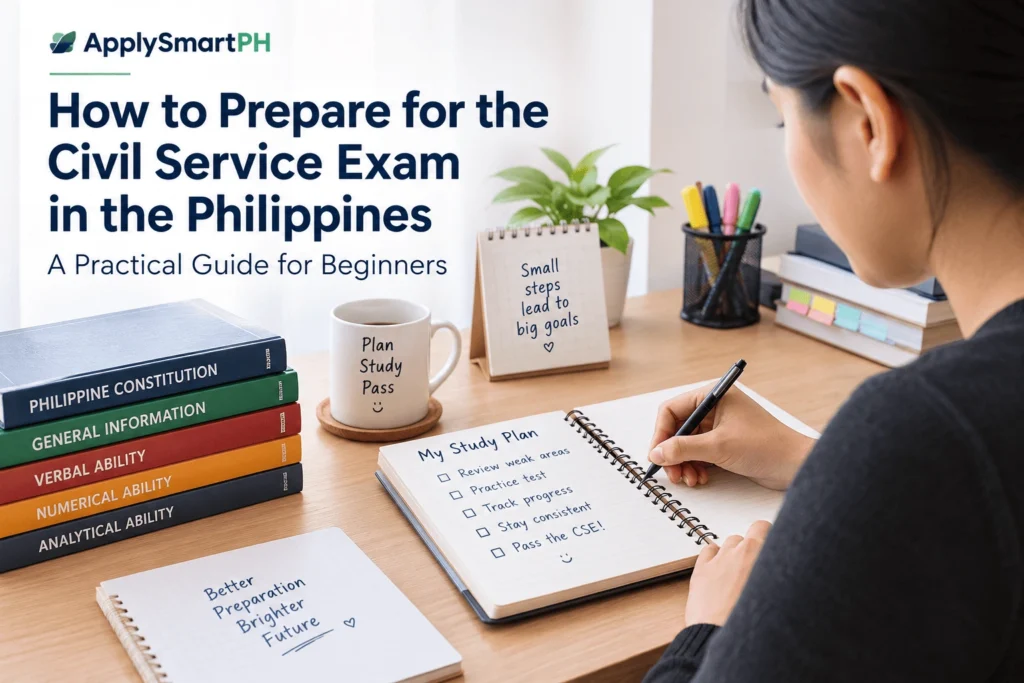
Quick answer: To prepare for the Civil Service Exam in the Philippines, confirm your exam level and coverage on the official CSC announcement, take a practice set to find your weak areas, then build a realistic weekly study plan around your actual schedule. Study consistently, track your mistakes, and prepare your documents and route before exam day.
By ApplySmartPH Editorial Team · Last updated: October 23, 2026
Starting Your Civil Service Exam Preparation
You have decided to take the Civil Service Exam. Maybe you want a stable government career, maybe a friend passed and encouraged you, or maybe you have been putting it off for years. Then you open a folder of reviewers, a dozen social media posts, and a few YouTube playlists, and a familiar feeling sets in: there is so much to cover, you barely have free time, and you are not sure what to do first.
That feeling is a common challenge for beginners, and it does not mean you are not cut out for the exam. It means you need a system. Knowing how to prepare for the Civil Service Exam in the Philippines is less about studying harder and more about studying in an organized way: knowing the exam, knowing your starting point, planning realistically, and showing up consistently.
Understand the Civil Service Exam First
Before you begin studying, find out exactly what you are preparing for. Many beginners skip this step and end up studying the wrong material or missing deadlines.
Know which level you are taking. The Career Service Examination, administered by the Civil Service Commission (CSC), has Professional and Subprofessional levels. Professional eligibility may qualify successful examinees for eligible first-level and second-level government positions, while Subprofessional eligibility generally applies to eligible first-level positions. However, civil service eligibility alone does not guarantee appointment. Applicants must also meet the education, training, experience, licensing, and other requirements of the specific position.
Read the official announcement. The CSC publishes an examination announcement for each cycle on its examination announcements and advisories page, covering the exam date, application period, eligibility, required documents, and testing centers. Treat it as your primary source of truth. Everything else, including this article, is a supplement.
Check the coverage. The exam is a general ability test, so it focuses on skills rather than a single subject. Recent announcements list general information (the Philippine Constitution, ethical standards for public officials, peace and human rights, and environment management), verbal ability, numerical ability, and analytical ability or clerical ability. Verbal ability covers both English and Filipino, while numerical ability is in English. Analytical ability is generally associated with the Professional level, and clerical ability (such as filing and spelling) with the Subprofessional level, so the two levels do not have exactly the same coverage. Coverage is subject to the current exam notice, so verify your own level’s coverage in the latest CSC examination announcement.
Keep your information current. Dates, application periods, and requirements can change between cycles, and the CSC publishes its exam calendar ahead of time (see the 2027 pen-and-paper test calendar). Do not rely on a year-old social media post or a friend’s memory. Confirm everything on the official CSC website before you plan around it.
Assess Your Starting Point
Two people can start preparing on the same day and need completely different plans. One may be strong in English but afraid of numbers. Another may breeze through math but struggle with long reading passages.
Look at your current study habits. When do you study best, in the morning or at night? Can you concentrate for an hour, or do you need shorter sessions? Do you study with a plan, or whenever you happen to have a free moment? You do not need to judge yourself, just notice. These answers will shape a schedule you can actually follow.
Sort topics into three groups. List the exam areas and mark each as comfortable, so-so, or confusing. Be honest, because this list is only for you.
Use a diagnostic activity. The best way to find out what you know is to try some questions. Take a practice set covering the main exam areas, ideally timed and without looking anything up. Use reputable materials that follow the official coverage. The score matters less than the pattern it reveals.
Write down your weak areas. List the topics where you made the most mistakes or ran out of time. This is the most valuable output of your assessment, because it tells you where your hours will do the most good. If numerical ability is your weakest area, it deserves more of your week than grammar rules you already handle well.
Create a Realistic Study Plan
A study plan is the bridge between wanting to pass and actually preparing well. The key word is realistic. A plan that looks impressive on paper but collapses after three days is worse than no plan, because it leaves you feeling like you failed.
Start with your real life. Look at your week as it actually is: work hours, commute, family responsibilities, errands, rest. Mark the pockets of time you truly have. A working parent may have two focused hours after the kids sleep. A student may have long weekend blocks. Build your plan around those windows instead of an imaginary schedule where you study six hours every day.
Work backward from the exam date. Once you have confirmed the date from the CSC announcement, count the weeks you have and divide them into phases:
- Foundation phase: Learn or refresh the basics of each exam area, starting with your weakest.
- Practice phase: Shift toward answering questions, timed sets, and reviewing mistakes.
- Final review phase: Take full-length practice tests, revisit weak spots, and focus on speed and accuracy.
With a long runway, spend more time on foundations. With only a few weeks, shorten that phase and start practicing sooner.
Break the work into small tasks. “Study English” is too vague to act on. “Complete 20 vocabulary items and review the answers” is a task you can finish and check off. Specific tasks reduce procrastination because you always know what to do when you sit down.
Set daily and weekly goals, and schedule review. A daily goal might be one topic or one practice set. A weekly goal might be a short timed quiz on Sunday. Keep goals modest enough that you can hit them on a busy day, and reserve time each week to revisit old material so you do not forget it.
Here is a simple sample weekly planner for someone who works full-time. Adjust it to your schedule and weak areas.
| Day | Time | Focus |
|---|---|---|
| Monday | 1 hour (evening) | Numerical ability: concepts and 15 practice items |
| Tuesday | 1 hour (evening) | Vocabulary and grammar: lesson and short drill |
| Wednesday | 45 minutes | Reading comprehension: two passages with review |
| Thursday | 1 hour (evening) | Analytical ability: logic and pattern practice |
| Friday | 30 minutes | Light review of the week’s mistakes |
| Saturday | 2–3 hours | General information topics plus a timed mixed quiz |
| Sunday | 1 hour | Weekly progress check and planning, then rest |
Notice the lighter day and the rest. Rest is not wasted time, and a plan with no breaks is a plan you will abandon.
If you would rather not build your planner from scratch, CSE Ready: Mindset & Mastery System can help you organize it.
Build a Consistent Study Routine
You can have the best study plan in the world and still fall short if you do not follow it. Consistency is where most beginners struggle.
Start with a routine you can keep. If you have never studied regularly before, do not begin with two hours a day. Begin with 30 to 45 minutes and increase gradually. A small routine you follow for eight weeks beats a heroic routine you follow for eight days.
Use a fixed study time when possible. When you study at the same time each day, it becomes part of your rhythm instead of a decision you have to make. If your schedule changes weekly, pick your study blocks every Sunday and treat them like appointments.
Reduce distractions. Put your phone on silent or in another room, close social media tabs, and tell the people at home you are studying. If home is noisy, try a library, a quiet cafe, or a corner of your workplace before or after your shift. A short, focused session beats a long, interrupted one.
Do not rely on motivation alone. Motivation comes and goes. On tired or stressful days, a routine does the work that motivation cannot. If you miss a day, do not abandon the plan. Resume the next day without guilt.
Track Your Progress and Learn From Mistakes
Preparation without tracking is like driving without looking at the dashboard. You may be moving, but you cannot tell whether you are on the right path or running out of fuel.
Record what you finish. Keep a simple log in a notebook, spreadsheet, or printed checklist: the date, what you studied, how long you spent, and how it went. A growing list of completed tasks is motivating, and it shows you how much work you are really doing, not how much you think you are doing.
Review your wrong answers. Mistakes are information. After each practice set, go back to every wrong item and ask:
- Did I not know the concept?
- Did I misread the question?
- Did I run out of time or rush?
Each cause calls for a different fix. A knowledge gap means restudying the topic. Misreading means slowing down. A time problem means more timed practice. A “mistake notebook,” where you write the question, the correct answer, and why you got it wrong, is a useful tool you can build.
Check in weekly. Once a week, look at your log and practice results. Did you hit your goals? Which topics are improving, and which are stuck? Are there patterns in your errors? This ten-minute review often separates organized learners from people who work hard without improving.
Change the plan when it is not working. If you consistently fail to finish your daily tasks, your plan is too heavy, not you too lazy. If a topic is still shaky after two weeks, give it more time or try a different resource. Adjusting is part of preparing well.
Prepare for Exam Day
Good preparation includes the logistics of the day itself. Many examinees lose focus, or even lose their chance to take the exam, because of avoidable problems.
Read the official instructions carefully. Weeks before the exam, re-read the CSC’s guidelines for examinees. They typically cover what to bring, what is prohibited, the dress code, and the process at the testing center. Do not assume the rules match last time or a friend’s experience.
Prepare your documents and materials early. Gather your exam permit, valid identification, and other required documents well ahead of time and check them against the official list. Prepare the allowed materials, such as pencils and a pen, exactly as specified. Put everything in one folder or bag the night before.
Plan your trip. Know where your testing center is, and look up the route in advance. Consider traffic and transport schedules, and plan to arrive early. Rushing in at the last minute raises anxiety and leaves you less ready to think clearly.
Take care of your sleep. In the last few days, shift from heavy studying to light review of your mistake notebook, formulas, and notes. Sleep a full night before the exam.
Avoid panic-driven cramming. Staying up all night trying to learn new topics rarely helps and often hurts. Trust the work you have already done, eat a proper meal, and stay hydrated.
Common Civil Service Exam Preparation Mistakes
Learning from other people’s mistakes is cheaper than making them yourself.
Having no study plan. Studying “whenever I have time” usually means studying rarely. Build a simple weekly schedule and stick to it.
Setting goals that are too big. “Study five hours every day” or “finish the whole reviewer in two weeks” feels exciting but is rarely sustainable, and missing those targets is discouraging. Start smaller and build up.
Studying only when motivated. If study time depends on your mood, it will vanish at the first stressful week. Create routines that run even when you do not feel like it.
Not tracking weak areas. If you keep reviewing topics you already enjoy, you will feel productive without improving where it counts. Keep a list of weak areas and give them a fair share of your time.
Skipping practice and only reading. Reading a reviewer feels productive, but the exam requires you to answer questions under time pressure. Mix reading with active practice from the start.
Relying on one resource only. One reviewer or video series will not show you everything. Study the official coverage first, then use several reputable sources, and be cautious with outdated materials that do not match the current exam.
How a Structured Study System Can Help
The people who prepare well are not necessarily the smartest or the ones with the most time. They are the ones with structure. They know what to study each day, they track what they have done, and they adjust when something is not working.
Building that structure from scratch is possible, but many beginners get stuck at the planning stage. CSE Ready: Mindset & Mastery System is an optional tool for examinees who want a more organized preparation routine. It supports four things this guide has emphasized:
- Study planning: turning your goals and available time into a clear, workable plan.
- Consistency: building habits you can repeat even on busy or low-energy days.
- Progress tracking: recording your effort and spotting what needs attention.
- Mindset: supporting the mental side of preparation, including staying steady when the process gets hard.
To be clear about what it is not: CSE Ready is not a substitute for the official information published by the Civil Service Commission, and it is not a comprehensive subject reviewer. You will still need to confirm exam details with the CSC and use quality practice materials for the content areas. No tool or plan can promise a passing result. What it can do is make your effort more focused.
Conclusion: Start With a Plan You Can Follow
Preparing for the Civil Service Exam does not have to feel overwhelming. Break it down:
- Understand the exam: your level, the official coverage, and current CSC announcements.
- Assess your starting point: find your strengths and weak areas.
- Create a realistic study plan: one that fits your actual life.
- Build a consistent routine: habits over motivation.
- Track your progress and learn from mistakes: adjust as you go.
- Prepare for exam day: documents, route, rest, and a calm mind.
- Avoid common mistakes: especially having no plan or an unrealistic one.
You do not need to do all of this today. Pick one small action and do it now: check the latest CSC announcement, take a short diagnostic set, or block out your study times for next week.
If you would like a structured way to organize your preparation, take a look at CSE Ready: Mindset & Mastery System. Whichever path you choose, start with a plan you can follow, and keep following it.
Frequently Asked Questions
How should a beginner start preparing for the Civil Service Exam?
Start by confirming your exam level and reading the latest official announcement from the Civil Service Commission, including the coverage, schedule, and requirements. Then take a short practice set to see which areas are strong and which need work, and build a simple weekly study schedule around those results. Begin with sessions short enough to maintain, and increase gradually.
How do I make a study schedule for the Civil Service Exam?
Count the weeks until your exam date, then mark the time you truly have available each week. Assign specific tasks to those blocks, such as “complete 20 numerical ability items” instead of “study math.” Give more time to weak areas, include weekly review, and leave at least one rest day. Check your progress every week and adjust if the plan is too heavy or too light.
Can I prepare for the Civil Service Exam while working full-time?
Yes, many examinees do. Work with the time you actually have rather than an idealized schedule. Short, consistent weekday sessions and a longer weekend block add up over several weeks. Starting early gives you more flexibility, so you do not need long sessions your job and family life may not allow.
What should I do if I don’t know which topics to study first?
Take a diagnostic practice set covering the main exam areas and note where you make the most mistakes. Start with the weakest topics while keeping short, regular practice on the stronger ones. If you still feel unsure, use the official coverage in the CSC announcement as your checklist.
Is a study plan enough to prepare for the Civil Service Exam?
A study plan is essential, but it is not enough on its own. You also need quality content to study from, plenty of timed practice, honest review of your mistakes, and accurate information from the CSC. A plan helps you use your time well, but no plan can guarantee a passing score or a specific result.
Always verify exam dates, requirements, and procedures through the official Civil Service Commission website before making plans.