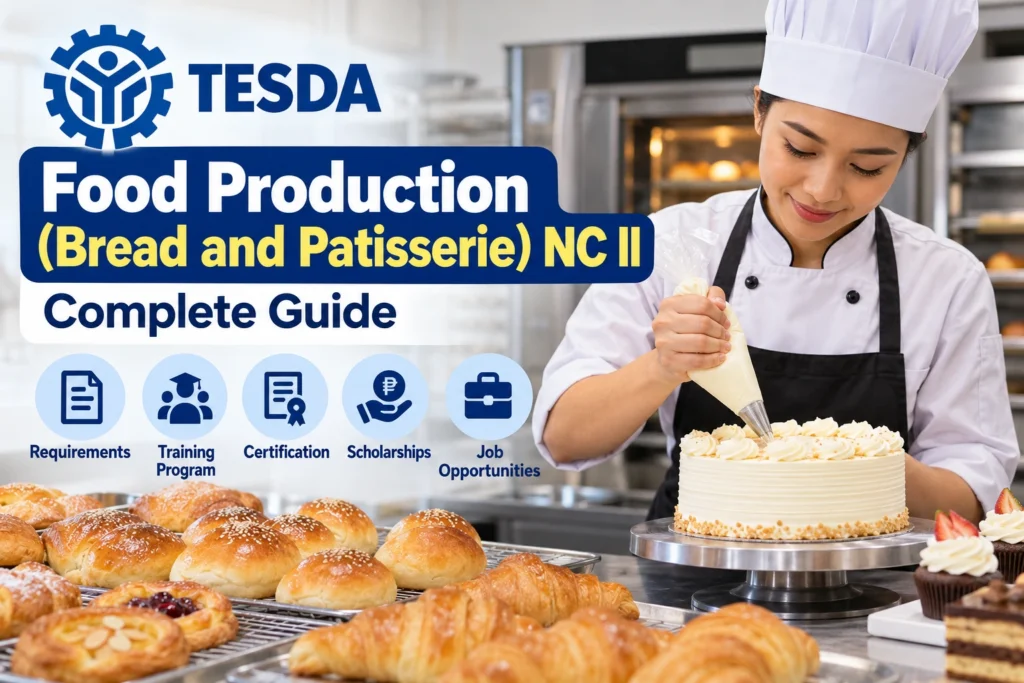
Quick Answer: TESDA Food Production (Bread and Patisserie) NC II is the current qualification for people who want to develop professional skills in bread, pastry, and dessert production. It replaced the older Bread and Pastry Production NC II qualification, which TESDA now lists as superseded. To earn the National Certificate (NC II), a candidate must demonstrate the required competencies through an assessment under TESDA’s certification system. Training hours, entry requirements, fees, and scholarship availability should be confirmed with the current Training Regulations and the registered training provider.
If you searched for “Bread and Pastry Production NC II,” this guide is for you. Many learners, training centers, and job advertisements still use the old qualification name. However, it is important to check the current qualification title before enrolling or applying for assessment.
This guide explains the qualification, expected skills, enrollment process, possible scholarship options, assessment, career opportunities, and steps to take before choosing a TESDA training center.
What Is TESDA Food Production (Bread and Patisserie) NC II?
Food Production (Bread and Patisserie) NC II is a TESDA qualification under the Tourism sector, specifically Hotel and Restaurant-related training. Its scope includes preparing, portioning, and presenting bread, pastry, and dessert products in food production operations.
TESDA identifies Kitchen Hand, Commis – Pastry, and Baker among the occupational roles associated with this qualification.
In everyday terms, it is a professional baking and pastry qualification intended to help learners develop practical skills for work in bakeries, hotels, restaurants, cafés, and other food-production settings.
You can check the current qualification through the official TESDA Training Regulations directory.
Is Bread and Pastry Production NC II Still the Current Name?
No. TESDA’s official Training Regulations directory lists Bread and Pastry Production NC II as superseded and identifies Food Production (Bread and Patisserie) NC II as the current qualification.
The change was approved through TESDA Board Resolution No. 2023-02, which amended the qualification from Bread and Pastry Production NC II to Food Production (Bread and Patisserie) NC II.
Here is the distinction:
- Former qualification: Bread and Pastry Production NC II
- Current qualification: Food Production (Bread and Patisserie) NC II
The old name remains useful when searching online because older articles, training materials, and advertisements may still use it. However, do not assume that an older course outline reflects the current requirements.
If you already hold a certificate under the former qualification, contact TESDA to confirm how your existing certificate is recognized. Do not assume that you must automatically retake the course or replace your certificate.
What Does NC II Mean?
NC stands for National Certificate. TESDA issues a National Certificate to a candidate who meets the required competency standards through the appropriate assessment and certification process.
NC II indicates a particular qualification level. It is not simply proof that someone attended a class. The candidate must demonstrate the competencies required for the qualification.
For related information, read What Is a TESDA National Certificate (NC)?
What Skills Can You Develop in a TESDA Baking Course?
The current Training Regulations establish the competency standards for Food Production (Bread and Patisserie) NC II. Your provider’s registered curriculum should follow the applicable standards.
Depending on the program outline and training activities, learners may develop skills in areas such as:
1. Bread and Bakery Production
Baking work commonly involves measuring ingredients, preparing dough, following mixing procedures, handling fermentation and proofing, shaping products, baking, finishing, and storing finished goods.
Accuracy matters because ingredient measurements, temperature, timing, and handling can affect the quality of the final product.
2. Pastry Preparation
Pastry production may involve preparing doughs, fillings, and other components, following recipes, handling ingredients correctly, and presenting finished products.
3. Cakes and Desserts
Learners may practise preparing cake components, fillings, icings, and desserts, along with finishing, decorating, portioning, and presentation techniques.
The exact products and activities covered depend on the current registered curriculum and training setup.
4. Food Hygiene and Workplace Safety
Safe food handling, personal hygiene, cleaning, sanitation, and proper use of equipment are important in professional kitchens. Learners should understand how to maintain clean work areas and follow workplace safety procedures.
5. Equipment and Workstation Management
Baking work may involve mixers, ovens, weighing scales, utensils, and other kitchen equipment. Correct handling and cleaning help maintain product quality and reduce workplace risks.
Before enrolling: Request the provider’s current course outline. Ask which products you will prepare, how much time is devoted to hands-on practice, and what equipment is available to trainees.
TESDA Food Production (Bread and Patisserie) NC II Requirements
The word “requirements” can refer to entry requirements, enrollment documents, or assessment requirements. These are not necessarily the same.
1. Official Trainee Entry Requirements
The applicable entry requirements should be taken from the current Training Regulations for Food Production (Bread and Patisserie) NC II, not copied from an older Bread and Pastry Production NC II module.
Before applying, ask the training provider for the current official entry requirements and confirm them against TESDA’s published regulations.
Do not rely on an old online checklist as the final authority. A provider may also have an enrollment process or scholarship screening requirements in addition to the qualification’s entry requirements.
2. Common Enrollment Documents
Training centers may request documents such as:
- Completed application or enrollment form
- Valid identification
- Recent ID photographs
- PSA birth certificate
- School records, when applicable
- Additional documents required by a particular scholarship program
This is a general preparation checklist, not a universal TESDA-mandated document list. The exact documents depend on the provider and the program.
For more information, read TESDA Requirements: Documents Needed for Enrollment.
3. Assessment Requirements
Assessment is a separate step from enrolling in or completing training. Candidates should ask a TESDA-accredited assessment center about the application form, supporting documents, schedule, assessment fee, and other applicable requirements.
If you have relevant work experience, ask TESDA or an accredited assessment center whether you may apply for assessment directly or whether additional preparation is recommended.
How Long Is the TESDA Baking Course?
There is no single training schedule that applies to every provider. The applicable nominal duration should be checked against the current Training Regulations and the registered curriculum being delivered.
Ask the provider for the total training hours, the number of practical hours, and the expected start and completion dates. Do not rely on duration figures copied from old Bread and Pastry Production NC II materials without checking whether they apply to the current qualification.
Your actual calendar time may depend on:
- Whether classes are full-time, part-time, or scheduled on weekends
- The training provider’s timetable
- Availability of equipment and practical training sessions
- The start date of the next batch
- The schedule of the competency assessment
Training hours and assessment scheduling are separate matters, so ask whether assessment is included in the advertised program or arranged afterward.
How to Enroll in TESDA Food Production (Bread and Patisserie) NC II
Follow these steps before committing to a training program.
Step 1: Find a Training Provider
Search for TESDA technology institutions and private training centers offering the current qualification.
You can search using both the current and former names, but do not rely on the course title in an advertisement alone.
Use the official TESDA directory and contact your TESDA provincial or regional office when you need clarification.
You can also read TESDA Accredited Training Centers: How to Find Approved Training Providers.
Step 2: Verify the Specific Program
A training institution may offer several registered programs. Confirm that the specific course you want is registered under the current qualification.
Ask the provider:
- Is this program registered as Food Production (Bread and Patisserie) NC II?
- Can you provide the current program outline?
- Does the program follow the current Training Regulations?
- Where can I confirm the program’s registration with TESDA?
If a provider advertises only the former qualification, ask whether it is authorized to offer the current one.
Step 3: Ask About Requirements and Schedule
Before submitting an application, confirm the official entry requirements, required documents, enrollment deadline, class schedule, and estimated completion date.
Ask for the complete fee breakdown. Find out whether tuition, ingredients, tools, uniform, and assessment are included or charged separately.
Step 4: Check for Scholarship Slots
Ask whether the provider currently has a funded slot for this exact qualification. Confirm the eligibility rules, application period, and documents required.
Scholarship availability can change, so an old announcement does not guarantee that funding is still available.
Step 5: Complete Enrollment
Submit the required documents, attend any orientation or screening, and follow the provider’s instructions.
Keep copies of your application, receipts, and enrollment confirmation. For a general walkthrough, see How to Enroll in TESDA Programs.
Is the TESDA Baking Course Free?
It may be free for eligible trainees when an applicable scholarship or funded training slot is available. However, not every provider or training batch offers free training.
TESDA-linked training support has included programs such as the Training for Work Scholarship Program (TWSP), the Special Training for Employment Program (STEP), and programs under the Tulong-Trabaho Act. The qualifications covered, eligibility conditions, and funding availability depend on the applicable program and current announcements.
Do not assume that Food Production (Bread and Patisserie) NC II is automatically free in every location.
How to Check for Free Training
Contact the training provider and your TESDA provincial or regional office. Ask:
- Is there an active scholarship slot for Food Production (Bread and Patisserie) NC II?
- Who is eligible to apply?
- What documents must I submit?
- Does the funding cover training, materials, and assessment?
- Are there other expenses I must pay?
Get clear answers before enrolling.
Be Careful With Scholarship Scams
Be cautious of people who promise guaranteed scholarship slots in exchange for an unofficial payment. Verify scholarship announcements directly with TESDA or the listed training provider before sending money.
Read the TESDA Scholarships Guide for more information about finding and applying for training support.
Online courses can help you learn related concepts, but they do not automatically replace the hands-on training or assessment required for this qualification. You can explore Free TESDA Online Courses with Certificates for other learning options.
How to Get the Food Production (Bread and Patisserie) NC II Certificate
Completing a training program does not automatically mean you have earned the National Certificate. Training and assessment are different steps.
The general process is:
Training and preparation → Competency assessment → Assessment result → Certification if found competent
Step 1: Prepare for Assessment
Ask your trainer or assessment center about the current assessment requirements. Practise the tasks and work processes covered by the qualification, and review the relevant Self-Assessment Guide when available.
TESDA’s Self-Assessment Guide directory can help you locate the applicable guide.
Step 2: Apply Through an Accredited Assessment Center
Contact a TESDA-accredited assessment center to confirm the application procedure, schedule, supporting documents, and fees.
Some providers may assist their graduates with assessment arrangements. Confirm this before assuming the service is included in the course.
Step 3: Demonstrate Your Competencies
An accredited assessor evaluates whether you meet the required standards. Follow the assessment instructions and demonstrate the required skills safely and consistently.
The exact assessment methods and tools should be confirmed using the current Training Regulations and the assessment center’s instructions.
Step 4: Receive the Assessment Result
If you are found competent and meet the applicable certification requirements, you can receive the relevant National Certificate. Assessment of only specified units may lead to a Certificate of Competency (COC), rather than the full NC II.
If you are assessed as not yet competent, ask the assessor which areas need improvement and confirm the applicable reassessment procedure and fees.
Training Certificate vs. National Certificate
<table> <thead> <tr><th>Type of document</th><th>What it generally shows</th></tr> </thead> <tbody> <tr><td>Certificate of Training or Completion</td><td>The trainee completed the provider’s training program</td></tr> <tr><td>Certificate of Competency (COC)</td><td>The candidate was assessed as competent in the specified units</td></tr> <tr><td>National Certificate (NC II)</td><td>The candidate met the requirements for the full qualification through the applicable assessment and certification process</td></tr> </tbody> </table>
Before paying for a course, ask what document you will receive after training and whether assessment is included.
After certification, you can use the TESDA Certificate Verification Guide to learn how to check certificate records. The applicable validity and renewal rules should be confirmed with TESDA and the details on your certificate.
Career Opportunities After the Qualification
TESDA identifies Kitchen Hand, Commis – Pastry, and Baker among the occupational roles associated with Food Production (Bread and Patisserie) NC II.
Related job titles may include:
| Job title | Possible workplace |
|---|---|
| Kitchen Hand | Hotel, restaurant, or catering kitchen |
| Commis – Pastry | Hotel or restaurant pastry section |
| Baker | Bakery, hotel, or commercial food-production facility |
| Bakery Production Worker | Commercial bakery or supermarket bakery department |
| Baking or Pastry Assistant | Bakeshop, café, or catering business |
Actual job duties and qualifications depend on the employer. Some positions may require additional experience, food safety training, or other credentials.
Does NC II Guarantee Employment?
No. The certificate can help demonstrate competency, but it does not guarantee a job or a particular salary.
Employers may consider practical experience, product quality, speed, reliability, teamwork, and compliance with food safety procedures. Applicants should read each job advertisement carefully and confirm its requirements.
Can the Qualification Help You Work Abroad?
It may support your skills profile, but overseas employers can require additional work experience, language ability, medical clearance, or other qualifications. Requirements differ by country and employer.
Verify overseas job offers and recruitment arrangements through the appropriate Philippine government agencies. Do not pay someone who guarantees an overseas job solely because you hold an NC II certificate.
For broader career comparisons, read Best TESDA Courses for High-Paying Jobs in the Philippines.
Can You Start a Baking Business After the Course?
Yes. The skills developed through baking and pastry training may help you prepare products for a home-based business, online orders, a café, or a small bakeshop.
However, completing the qualification does not automatically provide every business permit or replace the knowledge needed to operate a food business.
Skills to Develop Before Selling
Costing and pricing: Calculate the cost of ingredients, packaging, electricity or fuel, labor, and other overhead expenses. Price products with a sustainable margin instead of counting ingredients alone.
Recipe consistency: Standardize ingredient measurements, baking temperatures, portion sizes, and preparation methods so that customers receive consistent products.
Food safety and storage: Learn the appropriate storage, handling, and delivery practices for the products you sell.
Equipment planning: Choose equipment according to your products and expected order volume. A home-based cake business may need a different setup from a bread-production operation.
Order and financial management: Track orders, inventory, expenses, sales, customer feedback, and delivery schedules.
What About Business Permits?
Requirements vary according to the location, scale, and type of food business. Depending on the operation, you may need to check requirements with:
- The Department of Trade and Industry (DTI) for business name registration, where applicable
- Your city or municipal government for business permits and local requirements
- Your local health office for applicable sanitary permits and health certificates
- The Bureau of Internal Revenue (BIR) for tax registration
- The Food and Drug Administration (FDA), where its rules apply to your products or activities
Do not assume every home-based seller has exactly the same requirements. Contact the relevant offices before operating or expanding your business.
How to Choose a TESDA Baking Training Center
Compare training providers based on registration, practical experience, equipment, schedule, and total cost, not just the advertised course fee.
Checklist Before You Enroll
- ☐ Confirm that the institution and specific qualification are registered with TESDA.
- ☐ Ask for the current Food Production (Bread and Patisserie) NC II program outline.
- ☐ Confirm the official entry requirements and enrollment documents.
- ☐ Ask for the total training hours and practical training schedule.
- ☐ Check the availability and condition of ovens, mixers, tools, and workstations.
- ☐ Ask how many trainees share each workstation.
- ☐ Request a complete breakdown of tuition and other costs.
- ☐ Confirm whether assessment is included or arranged separately.
- ☐ Ask whether scholarship slots are available and verify the conditions.
- ☐ Keep copies of payment receipts and enrollment records.
Red Flags to Watch For
Be careful if a provider:
- Promises an NC II without the required assessment
- Cannot explain the registration status of the specific program
- Guarantees a job or guaranteed passing
- Refuses to provide a clear fee breakdown
- Pressures you to pay without issuing a receipt
- Advertises the superseded qualification without explaining its status
Verify unclear claims directly with TESDA before paying.
Frequently Asked Questions
What is the current TESDA baking course called?
The current qualification is Food Production (Bread and Patisserie) NC II. TESDA lists Bread and Pastry Production NC II as superseded.
Is Food Production (Bread and Patisserie) NC II the same as Bread and Pastry Production NC II?
It is the current qualification that replaced the former qualification. Check the current Training Regulations rather than assuming that older course materials still apply.
What are the requirements for TESDA baking NC II?
The official entry requirements should be checked in the current Training Regulations. Training providers may also request enrollment documents, while scholarship applicants may need additional proof of eligibility.
How many months does the TESDA baking course take?
The duration depends on the current applicable training requirements and the provider’s registered curriculum and schedule. Ask for the total hours and calendar dates before enrolling.
Is the TESDA baking course free?
It may be free when a suitable funded training slot is available and you meet the eligibility requirements. Availability and coverage vary, so confirm directly with TESDA or the training provider.
Do I need to pass an assessment to get NC II?
Yes. Completing training alone does not automatically grant the full National Certificate. You must meet the applicable assessment and certification requirements.
What jobs can I apply for after the course?
Possible roles include baker, kitchen hand, and commis – pastry, as well as related baking or pastry support jobs. Actual hiring requirements vary by employer.
Can I use the qualification to start a bakery?
The skills may help you prepare products for a business. You will also need to manage costing, food safety, equipment, orders, and any permits or registrations applicable to your operation.
Where can I find an accredited training center?
Check TESDA’s official directory of registered institutions and programs, or contact your TESDA provincial or regional office. You can also use our guide to TESDA Accredited Training Centers.
Related TESDA Guides
Continue exploring these ApplySmart PH resources:
- TESDA Courses List 2026: Complete Guide to Training Programs and Certifications
- Best TESDA Courses for High-Paying Jobs in the Philippines
- How to Enroll in TESDA Programs
- TESDA Requirements: Documents Needed for Enrollment
- TESDA Accredited Training Centers
- TESDA Scholarships Guide
- Free TESDA Online Courses with Certificates
- TESDA Certificate Verification Guide
- What Is a TESDA National Certificate (NC)?
- TESDA Welding Course
- TESDA Bookkeeping Course
- TESDA Caregiving Course
Final Thoughts
Food Production (Bread and Patisserie) NC II is the current TESDA qualification for learners pursuing baking and pastry-related work. If you are searching for the older Bread and Pastry Production NC II, make sure the training provider is offering the current qualification and following the applicable Training Regulations.
Before enrolling, confirm the entry requirements, total training hours, fees, scholarship availability, and assessment arrangements. Remember that a certificate of training is different from a National Certificate earned through the appropriate assessment process.
If your goal is to start a baking business, combine your production skills with food safety, proper costing, consistent product quality, and compliance with the requirements that apply to your business.
Official reference: TESDA Training Regulations directory – Bread and Patisserie. TESDA’s official directory identifies the current qualification and marks the former Bread and Pastry Production NC II qualification as superseded.
Last updated: October 14, 2026.
Note: Qualification titles, training requirements, fees, scholarship availability, and local business requirements can change. Confirm the latest details with TESDA, your training provider, and the relevant government offices before enrolling or paying.