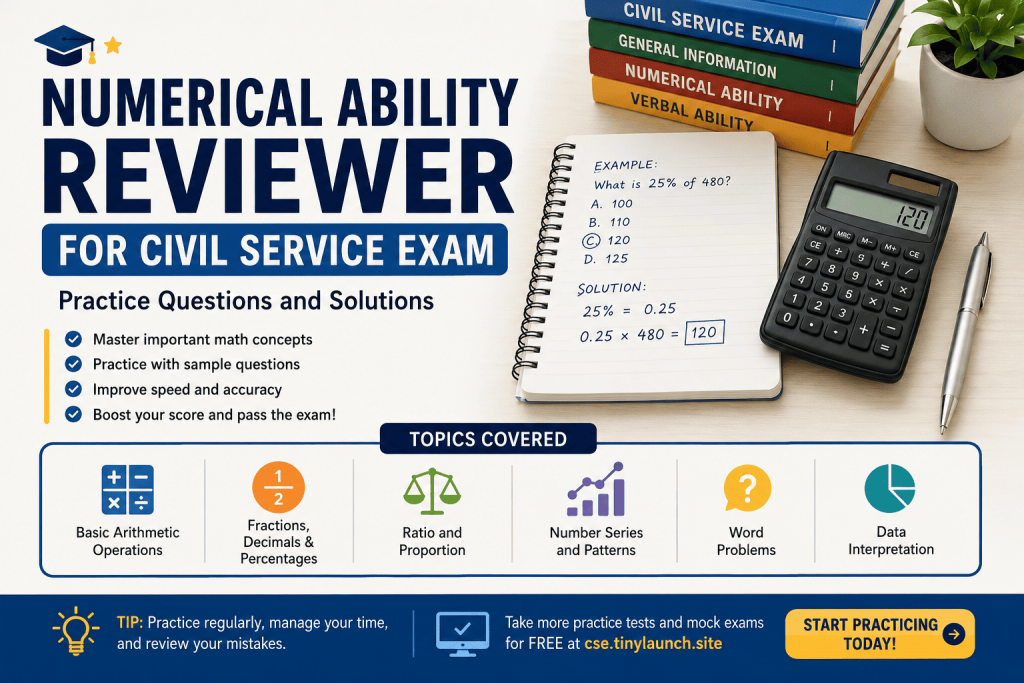
Numerical Ability is one of the most challenging sections of the Civil Service Examination (CSE). Many examinees struggle not because they lack mathematical ability, but because they become overwhelmed by time pressure, unfamiliar question formats, and simple calculation mistakes.
The good news is that you do not need to be a math genius to score well in this section. With consistent practice, familiarity with common problem types, and effective test-taking strategies, you can significantly improve your performance.
This Numerical Ability Reviewer for the Civil Service Exam provides sample questions, explanations, and practical tips to help both Professional and Subprofessional examinees strengthen their mathematical skills and increase their chances of passing the examination.
Related Guides:
- Civil Service Exam Reviewer
- Civil Service Exam Coverage
- CSC Eligibility: Professional vs Subprofessional Exam
Why Numerical Ability Matters
Many examinees lose valuable points in Numerical Ability because they spend too much time solving difficult questions or second-guessing simple computations. Since this section accounts for approximately 25 to 30 items in the Civil Service Examination, even a modest improvement in your score can significantly increase your chances of achieving the required passing mark of 80%.
The goal is not to solve every question perfectly. Instead, focus on answering as many questions correctly as possible within the allotted time. Developing speed, accuracy, and familiarity with common problem types can make Numerical Ability one of your strongest scoring areas.
How Many Numerical Ability Items Are in the CSE?
In the Paper-and-Pencil Test (PPT), Numerical Ability accounts for approximately 25 to 30 items out of the 170-item exam. In the Computer-Based Test (CBT), the proportion is similar.
This makes it one of the larger sections of the examination, and improving your score here can have a significant impact on whether you pass or fail.
Topics Covered in This Numerical Ability Reviewer
Both Professional and Subprofessional examinees may encounter questions involving:
- Basic Arithmetic Operations
- Fractions, Decimals, and Percentages
- Ratio and Proportion
- Number Series and Patterns
- Word Problems
- Data Interpretation
Mastering these topics will help you answer questions quickly and accurately during the actual examination.
1. Basic Arithmetic Operations
These questions assess your understanding of fundamental mathematical concepts, including the correct order of operations.
Sample Question 1
Difficulty: ⭐ Easy
What is the value of:
48 + 36 ÷ 6 × 2
A. 60
B. 72
C. 84
D. 96
Answer: A. 60
Solution
Follow the order of operations (PEMDAS/BODMAS). Division and multiplication come before addition.
36 ÷ 6 = 6
6 × 2 = 12
48 + 12 = 60
2. Fractions, Decimals, and Percentages
Examinees should know how to convert and manipulate these forms fluently.
Sample Question 2
Difficulty: ⭐ Easy
What is 25% of 480?
A. 100
B. 110
C. 120
D. 125
Answer: C. 120
Solution
25% = 0.25
0.25 × 480 = 120
3. Ratio and Proportion
Ratio questions test your ability to compare quantities and solve for unknown values.
Sample Question 3
Difficulty: ⭐⭐ Moderate
The ratio of boys to girls in a classroom is 3:5. If there are 15 girls, how many boys are there?
A. 6
B. 9
C. 12
D. 15
Answer: B. 9
Solution
Boys : Girls = 3 : 5
Girls = 15
Boys = (3 ÷ 5) × 15 = 9
4. Number Series and Patterns
Number series questions require you to identify the pattern governing a sequence and determine the missing or next number.
Sample Question 4
Difficulty: ⭐⭐ Moderate
What is the next number in the series?
2, 5, 10, 17, 26, ___
A. 35
B. 37
C. 39
D. 41
Answer: B. 37
Solution
Find the difference between consecutive terms:
5 − 2 = 3
10 − 5 = 5
17 − 10 = 7
26 − 17 = 9
The differences increase by 2 each time.
The next difference is 11.
26 + 11 = 37
Sample Question 5
Difficulty: ⭐ Easy
What is the missing number in the series?
3, 6, 12, ___, 48
A. 18
B. 20
C. 24
D. 30
Answer: C. 24
Solution
Each number is multiplied by 2.
3 × 2 = 6
6 × 2 = 12
12 × 2 = 24
24 × 2 = 48
5. Word Problems
Word problems require both reading comprehension and mathematical reasoning.
Sample Question 6
Difficulty: ⭐⭐⭐ Challenging
Ana is twice as old as Ben. Five years ago, Ana was three times as old as Ben. How old is Ana now?
A. 20
B. 24
C. 30
D. 36
Answer: A. 20
Solution
Let Ben’s current age = x.
Ana’s current age = 2x.
Five years ago:
Ana = 2x − 5
Ben = x − 5
Equation:
2x − 5 = 3(x − 5)
2x − 5 = 3x − 15
15 − 5 = x
x = 10
Ana = 2 × 10 = 20
6. Data Interpretation
Questions may involve tables, charts, or graphs.
Sample Question 7
Difficulty: ⭐ Easy
A company sold the following units:
| Month | Units Sold |
|---|---|
| January | 120 |
| February | 150 |
| March | 180 |
How many units were sold from January to March?
A. 420
B. 430
C. 440
D. 450
Answer: D. 450
Solution
120 + 150 + 180 = 450
Numerical Ability Reviewer
Civil Service Examination (CSE) — 100 Items
Numerical Ability — 100 Items
Tips to Improve Your Numerical Ability Reviewer Score
1. Master the Order of Operations
Always follow PEMDAS: Parentheses, Exponents, Multiplication/Division, and Addition/Subtraction.
2. Memorize Percentage Conversions
Useful shortcuts include:
- 50% = 1/2
- 25% = 1/4
- 75% = 3/4
- 20% = 1/5
- 10% = 1/10
- 33.3% ≈ 1/3
3. Know Common Number Series Patterns
Watch out for:
- Arithmetic sequences
- Geometric sequences
- Alternating patterns
- Increasing differences
- Perfect squares and cubes
4. Practice Word Problems Daily
Identify what is being asked and convert the problem into an equation before solving.
5. Use Elimination Techniques
If unsure, eliminate obviously incorrect answers. Since there is no penalty for wrong answers, never leave items blank.
6. Time Yourself
Practice solving questions within 60 to 90 seconds to simulate actual exam conditions.
Practice with Our FREE Interactive Reviewer
Reading explanations is a good start, but active practice is what builds real exam readiness.
Take full-length mock exams, subject-specific quizzes, and timed practice tests designed for both Professional and Subprofessional examinees.
👉 Start your free practice test today:
Frequently Asked Questions
Is Numerical Ability harder in the Professional Examination?
Generally, yes. The Professional Examination may include more complex numerical and analytical questions than the Subprofessional Examination.
Can I use a calculator during the Civil Service Examination?
No. Calculators, mobile phones, smartwatches, and other electronic devices are prohibited during the examination.
How many Numerical Ability questions appear in the exam?
Numerical Ability typically accounts for approximately 25 to 30 items, making it one of the largest sections of the CSE.
What is the best way to improve in Numerical Ability?
Consistent practice using a Numerical Ability reviewer, mock exams, and reviewing explanations is the most effective strategy. You can also continue practicing through our Civil Service Exam Reviewer: Complete Guide for additional subject-based quizzes and study strategies.
Is it okay to guess if I don’t know the answer?
Yes. The Civil Service Examination does not deduct points for incorrect answers. If you are unsure, make your best educated guess rather than leaving the item blank.
Final Thoughts
A good Numerical Ability reviewer for the Civil Service Exam does more than give you practice questions — it helps you understand the reasoning behind each solution so you can handle any question type on exam day.
Passing the Civil Service Examination is not about perfection — it is about preparation.
Continue your review with our Civil Service Exam Reviewer, learn what topics are covered in the Civil Service Exam Coverage guide, and find out which level is right for you in our Professional vs Subprofessional Exam comparison.
This guide is maintained by the Apply Smart editorial team. For official examination schedules and registration requirements, refer to the Civil Service Commission website at csc.gov.ph.