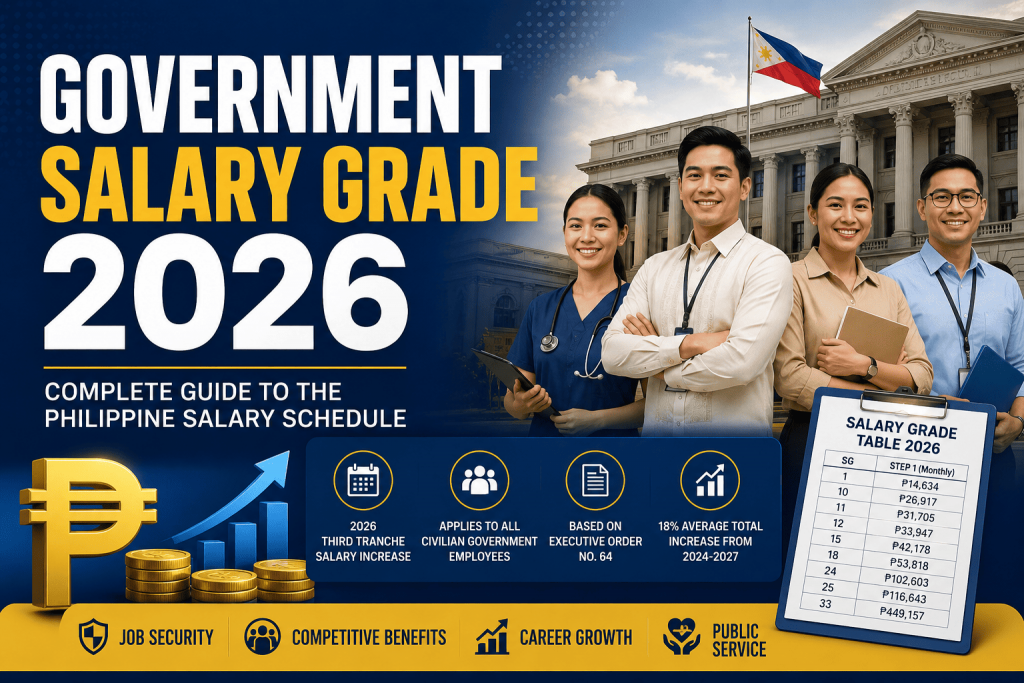
The most common question among government job applicants every year is simple: how much does a government employee earn in the Philippines?
Whether you are preparing for the Civil Service Examination (CSE), applying for a plantilla position, or already working in the public sector, understanding the Government Salary Grade 2026 system is essential. It helps you estimate your monthly pay, identify promotion opportunities, and plan a long-term career in public service.
What Is a Government Salary Grade?
A Salary Grade (SG) is a numerical classification assigned to government positions under the Compensation and Position Classification System (CPCS). It determines the monthly basic salary of a position based on the following factors:
- Level of responsibility
- Complexity of duties
- Required education and experience
- Required civil service eligibility
The salary grade structure ranges from SG 1 (entry-level support) to SG 33 (the highest government position). The higher the salary grade, the higher the compensation and level of responsibility.
2026 Government Salary Increase: What You Need to Know
Government employees received a salary increase effective January 1, 2026, as part of the Third Tranche of Executive Order No. 64. This is part of a four-tranche salary adjustment schedule covering 2024 to 2027.
The objectives of the program are to:
- Improve government compensation across all levels
- Attract qualified professionals to public service
- Retain skilled government employees
- Make public sector salaries more competitive with the private sector
A final tranche is scheduled for implementation in 2027.
Who Is Covered?
The 2026 salary adjustment covers civilian government personnel in the following categories:
- Regular, permanent, casual, and contractual employees
- Elective and appointive officials
- Full-time and part-time personnel
Coverage extends to the Executive, Legislative, and Judicial Branches, Constitutional Commissions, State Universities and Colleges (SUCs), and Government-Owned and Controlled Corporations (GOCCs) not covered by separate compensation laws.
Complete Government Salary Grade 2026 Table — Third Tranche
Below is the complete Government Salary Grade 2026 salary table showing monthly basic salary for all steps (Step 1 to Step 8) under the Third Tranche of Executive Order No. 64.
| Salary Grade | Step 1 | Step 2 | Step 3 | Step 4 | Step 5 | Step 6 | Step 7 | Step 8 |
|---|---|---|---|---|---|---|---|---|
| 1 | ₱14,634 | ₱14,730 | ₱14,849 | ₱14,968 | ₱15,089 | ₱15,211 | ₱15,333 | ₱15,456 |
| 2 | ₱15,522 | ₱15,636 | ₱15,752 | ₱15,869 | ₱15,986 | ₱16,103 | ₱16,233 | ₱16,342 |
| 3 | ₱16,486 | ₱16,610 | ₱16,732 | ₱16,856 | ₱16,982 | ₱17,106 | ₱17,234 | ₱17,360 |
| 4 | ₱17,506 | ₱17,636 | ₱17,767 | ₱17,898 | ₱18,031 | ₱18,163 | ₱18,298 | ₱18,433 |
| 5 | ₱18,581 | ₱18,720 | ₱18,858 | ₱18,998 | ₱19,137 | ₱19,280 | ₱19,423 | ₱19,565 |
| 6 | ₱19,716 | ₱19,862 | ₱20,009 | ₱20,158 | ₱20,307 | ₱20,456 | ₱20,609 | ₱20,761 |
| 7 | ₱20,914 | ₱21,069 | ₱21,224 | ₱21,382 | ₱21,539 | ₱21,699 | ₱21,859 | ₱22,022 |
| 8 | ₱22,423 | ₱22,627 | ₱22,832 | ₱23,038 | ₱23,246 | ₱23,456 | ₱23,668 | ₱23,883 |
| 9 | ₱24,329 | ₱24,523 | ₱24,720 | ₱24,917 | ₱25,117 | ₱25,318 | ₱25,521 | ₱25,725 |
| 10 | ₱26,917 | ₱27,131 | ₱27,347 | ₱27,565 | ₱27,786 | ₱28,007 | ₱28,230 | ₱28,456 |
| 11 | ₱31,705 | ₱31,820 | ₱32,109 | ₱32,401 | ₱32,697 | ₱32,998 | ₱33,302 | ₱33,611 |
| 12 | ₱33,947 | ₱34,069 | ₱34,357 | ₱34,648 | ₱34,943 | ₱35,242 | ₱35,544 | ₱35,850 |
| 13 | ₱36,125 | ₱36,263 | ₱36,569 | ₱36,919 | ₱37,244 | ₱37,572 | ₱37,904 | ₱38,241 |
| 14 | ₱38,784 | ₱39,141 | ₱39,523 | ₱39,910 | ₱40,300 | ₱40,698 | ₱41,097 | ₱41,503 |
| 15 | ₱42,178 | ₱42,594 | ₱43,015 | ₱43,442 | ₱43,874 | ₱44,310 | ₱44,753 | ₱45,202 |
| 16 | ₱45,694 | ₱46,152 | ₱46,615 | ₱47,084 | ₱47,559 | ₱48,040 | ₱48,528 | ₱49,022 |
| 17 | ₱49,562 | ₱50,066 | ₱50,576 | ₱51,092 | ₱51,614 | ₱52,144 | ₱52,678 | ₱53,221 |
| 18 | ₱53,818 | ₱54,371 | ₱54,933 | ₱55,499 | ₱56,075 | ₱56,657 | ₱57,248 | ₱57,842 |
| 19 | ₱59,153 | ₱59,988 | ₱60,793 | ₱61,632 | ₱62,488 | ₱63,353 | ₱64,236 | ₱65,132 |
| 20 | ₱66,052 | ₱66,970 | ₱67,904 | ₱68,853 | ₱69,818 | ₱70,772 | ₱71,727 | ₱72,671 |
| 21 | ₱73,303 | ₱74,337 | ₱75,388 | ₱76,456 | ₱77,542 | ₱78,645 | ₱79,692 | ₱80,831 |
| 22 | ₱81,796 | ₱82,963 | ₱84,151 | ₱85,356 | ₱86,582 | ₱87,746 | ₱89,011 | ₱90,295 |
| 23 | ₱91,306 | ₱92,622 | ₱93,962 | ₱95,330 | ₱96,823 | ₱98,341 | ₱99,883 | ₱101,318 |
| 24 | ₱102,603 | ₱104,209 | ₱105,841 | ₱107,500 | ₱109,185 | ₱110,898 | ₱112,533 | ₱114,301 |
| 25 | ₱116,643 | ₱118,469 | ₱120,326 | ₱122,212 | ₱124,131 | ₱126,079 | ₱128,061 | ₱130,073 |
| 26 | ₱131,807 | ₱133,870 | ₱135,968 | ₱138,100 | ₱140,268 | ₱142,469 | ₱144,707 | ₱146,983 |
| 27 | ₱148,940 | ₱151,273 | ₱153,644 | ₱155,906 | ₱158,353 | ₱160,235 | ₱162,752 | ₱165,310 |
| 28 | ₱167,129 | ₱169,752 | ₱172,418 | ₱174,797 | ₱177,545 | ₱180,339 | ₱182,660 | ₱185,537 |
| 29 | ₱187,531 | ₱190,482 | ₱193,480 | ₱196,528 | ₱199,624 | ₱202,005 | ₱205,191 | ₱208,430 |
| 30 | ₱210,718 | ₱214,038 | ₱217,207 | ₱220,425 | ₱223,691 | ₱227,224 | ₱230,595 | ₱234,240 |
| 31 | ₱300,961 | ₱306,691 | ₱312,532 | ₱318,182 | ₱323,938 | ₱329,989 | ₱336,092 | ₱342,310 |
| 32 | ₱356,237 | ₱363,257 | ₱370,418 | ₱377,359 | ₱384,805 | ₱392,400 | ₱400,150 | ₱408,055 |
| 33 | ₱449,157 | ₱462,329 | — | — | — | — | — | — |
Source: Executive Order No. 64, Third Tranche — effective January 1, 2026. Each salary grade has up to eight steps. Employees advance to higher steps through length of service and satisfactory performance ratings.
Atlas Salary Grade Career Ladder™
| Career Stage | Salary Grades | Typical Roles |
|---|---|---|
| Entry-Level | SG 1–10 | Administrative Aide |
| Professional | SG 11–15 | Teacher, Nurse |
| Senior Professional | SG 16–20 | Engineer, Supervisor |
| Management | SG 21–25 | Division Chief |
| Executive | SG 26–33 | Director |
SG 12 Salary 2026
Salary Grade 12 is one of the most searched classifications among professional government employees.
Under the 2026 salary schedule, SG 12 starts at ₱33,947 per month at Step 1, going up to ₱35,850 at Step 8.
Common positions under SG 12 include:
- Teacher II
- Accountant I
- Administrative Officer I
- Various technical and professional positions
Employees at this level receive benefits including GSIS, PhilHealth, Pag-IBIG, leave credits, and other authorized allowances.
SG 15 Salary 2026
Salary Grade 15 represents a key milestone for professional government positions and is frequently searched by nursing and technical applicants.
Under the 2026 salary schedule, SG 15 starts at ₱42,178 per month at Step 1, going up to ₱45,202 at Step 8.
Common SG 15 positions include:
- Nurse I
- Professional technical positions
- Entry-level supervisory roles in select agencies
SG 18 Salary 2026
Salary Grade 18 is commonly assigned to experienced professionals and supervisory personnel with specialized technical functions.
Under the 2026 salary schedule, SG 18 starts at ₱53,818 per month at Step 1, going up to ₱57,842 at Step 8.
Examples of SG 18 positions include:
- Engineer II
- Nurse III
- Senior Agrarian Reform Program Officer
- Other specialized professional roles
Salary Grade vs. Step Increment: What Is the Difference?
Many government applicants confuse Salary Grade and Step Increment. They are two different things.
Salary Grade refers to the classification level assigned to a specific government position.
Examples:
- Administrative Assistant I → SG 7
- Accountant I → SG 12
- Attorney III → SG 21
Step Increment is an increase in salary within the same salary grade. Each salary grade has eight steps. Employees move to higher steps through:
- Years of service
- Satisfactory performance ratings
- Merit-based advancement
This means two employees in the same position may earn different amounts depending on their current step.
Atlas Salary Grade Decision Matrix™
| Goal | Recommended SG |
|---|---|
| First Government Job | SG 1–10 |
| Professional Career | SG 11–18 |
| Supervisory Position | SG 19–24 |
| Executive Career | SG 25+ |
Government Positions by Salary Grade
SG 1–5: Entry-Level Support Positions
These positions handle basic operational and support functions.
Examples: Utility Worker, Laborer, Administrative Aide I through Administrative Aide IV.
SG 6–10: Clerical and Administrative Support
Employees in this range perform routine clerical and administrative duties.
Examples: Administrative Assistant I and II, Revenue Collection Clerk, Clerk I through Clerk III.
SG 11–15: Professional Entry to Mid-Level Positions
This range covers many professional career tracks in government.
Examples: Teacher I and II, Accountant I, Budget Officer I, Human Resource Management Officer I, Administrative Officer II, Nurse I.
Civil Service Professional Eligibility holders commonly qualify for positions in this range.
SG 16–20: Experienced Professionals and Supervisors
These positions require higher technical expertise and supervisory responsibilities.
Examples: Engineer II, Nurse III, Social Welfare Officer III, Senior Administrative Officer.
SG 21–25: Middle Management
These positions involve policy implementation, team supervision, and agency management.
Examples: Attorney III (SG 21), Chief Administrative Officer, Division Chief, Attorney V (SG 25).
SG 26–33: Executive and Leadership Positions
The highest-ranking positions in government service.
Examples: Director IV, Assistant Secretary, Undersecretary, Cabinet Secretary, Vice President, President of the Philippines.
Salary Grade 33 is the highest classification in the government compensation system, with a monthly basic salary of ₱449,157 at Step 1.
Common Positions and Their Salary Grades in 2026
Administrative Assistant I — Salary Grade 7
Administrative Assistant I is classified under Salary Grade 7 (SG 7). It is one of the most accessible plantilla positions in government.
Typical duties: records management and filing, data encoding, office correspondence, and administrative support.
Administrative Assistant II — Salary Grade 8
Administrative Assistant II is classified under Salary Grade 8 (SG 8).
Typical duties: office coordination, report preparation, records maintenance, and customer assistance.
Administrative Aide III — Salary Grade 3
Administrative Aide III positions are available across national government agencies, local government units, hospitals, and state universities.
Typical duties: clerical support, filing, messenger services, and records handling.
Accountant I — Salary Grade 12
Accountant I is classified under Salary Grade 12 (SG 12) and is one of the most searched professional government positions.
Typical duties: financial reporting, budget monitoring, preparation of accounting records, and government accounting compliance.
Certified Public Accountants (CPAs) may have additional opportunities for advancement under RA 1080 Eligibility.
Attorney III — Salary Grade 21
Attorney III is a professional legal position assigned to Salary Grade 21 (SG 21).
Typical duties: legal research, drafting legal opinions, court representation, and policy review.
Applicants must be members of the Philippine Bar. Bar passers automatically qualify under RA 1080 Eligibility.
Attorney V — Salary Grade 25
Attorney V is assigned to Salary Grade 25 (SG 25) and is among the highest legal positions in government agencies.
Typical duties: supervising legal teams, representing agencies in major litigation, and managing legal compliance and contract review.
Why the Salary Grade System Matters for CSE Passers
Understanding salary grades provides several practical advantages for Civil Service Exam passers.
Career Planning — Know the salary grade of a target position before applying so you can set realistic expectations.
Promotion Pathways — Promotions in government typically follow salary grade progression:
- Administrative Assistant I → Administrative Assistant II
- Accountant I → Accountant II
- Attorney III → Attorney IV → Attorney V
Long-Term Benefits — In addition to monthly salaries, government employees receive GSIS retirement and insurance benefits, PhilHealth coverage, Pag-IBIG Fund membership, leave credits, step increments, and other authorized allowances.
Atlas Government Career Planning Framework™
Step 1
Identify your target position
Step 2
Check eligibility
Step 3
Review qualification standards
Step 4
Understand salary grade
Step 5
Build promotion roadmap
Reason:
Natural transition from theory → action.
🎯 Planning a Government Career?
Knowing the salary grade is only the first step. Many permanent government positions also require Civil Service Eligibility.
Prepare with our free Civil Service Reviewer.
✅ 170-Item Mock Exam
✅ Professional & Sub-Professional Reviewers
✅ Practice Questions with Explanations
✅ Instant Results
Frequently Asked Questions About Government Salary Grade 2026
What is the salary of SG 15 in 2026?
Salary Grade 15 starts at ₱42,178 per month at Step 1 and goes up to ₱45,202 at Step 8 under the 2026 salary schedule.
What is the salary of SG 18 in 2026?
Salary Grade 18 starts at ₱53,818 per month at Step 1 and reaches ₱57,842 at Step 8.
What is the salary grade of Administrative Assistant I?
Administrative Assistant I is classified under Salary Grade 7 (SG 7).
What is the salary grade of Administrative Assistant II?
Administrative Assistant II is classified under Salary Grade 8 (SG 8).
Does passing the Civil Service Exam increase my salary?
No. Passing the CSE does not automatically change your salary. However, it qualifies you for permanent government positions that carry specific salary grades, step increments, and full government benefits.
Will there be another salary increase in 2027?
Yes. The four-tranche salary adjustment program under Executive Order No. 64 includes a final tranche scheduled for 2027.
What is the highest salary grade in the Philippine government?
The highest salary grade is SG 33, assigned to the President of the Philippines, with a monthly basic salary of ₱449,157.
Are GOCCs covered by the 2026 salary increase?
GOCCs not covered by separate compensation laws are generally included in the salary adjustment. GOCCs with their own compensation frameworks may follow different salary schedules.
Final Thoughts
The Government Salary Grade 2026 system is the foundation of public sector compensation in the Philippines. Through the Third Tranche of Executive Order No. 64, government employees across all levels receive higher salaries and improved compensation packages.
Whether you are applying for your first plantilla position, preparing for the Civil Service Examination, or planning your next promotion, understanding salary grades helps you make informed career decisions.
🚀 Ready for Government Service?
If you’re aiming for a permanent government position, passing the Civil Service Exam can open more career opportunities.
Practice anytime with our free Civil Service Reviewer.
✔ 170-Item Mock Exam
✔ Subject-Based Reviewers
✔ Mobile-Friendly Practice
Related Topics
To learn more about navigating your career in the Philippine government, explore our deep-dive guides:
- Salary Grade 1 in the Philippines (2026): Complete Guide to Pay, Steps, and Eligibility
- Salary Grade 2 in the Philippines (2026): Complete Guide to Pay
- Salary Grade 3 in the Philippines (2026): Complete Guide to Pay, Steps, and Eligibility
- Salary Grade 4 (SG 4): Salary, Positions, and Qualifications
- Salary Grade 5 Philippines (2026): Salary, Positions, Qualifications, and Benefits Guide
- Salary Grade 6 Philippines: Salary, Steps, Positions, and Career Guide
- Salary Grade 7 Philippines: Salary, Benefits & Positions
- Salary Grade 8 Philippines: Salary, Steps, Positions, Benefits, and Career Guide
- Salary Grade 9 Philippines (2026): Salary, Positions, Qualifications & Benefits Guide
- Salary Grade 10 Philippines: Salary, Positions, Benefits, and Career Guide
- Salary Grade 11 Philippines 2026: Complete Guide
- Salary Grade 12 Philippines 2026: Salary, Positions & Benefits
- Salary Grade 13 Philippines 2026: Complete Salary & Positions Guide
- Salary Grade 14 Philippines 2026: Complete Salary & Positions Guide
- Salary Grade 15 Philippines: Salary, Positions, Qualifications, and Career Guide
- Salary Grade 16 in the Philippines: Salary, Steps, Positions, Benefits, and Career Guide
- Salary Grade 17 in the Philippines: Salary, Positions, Benefits, and Career Guide
- Salary Grade 18 in the Philippines: Complete Guide to Salary, Steps
- Salary Grade 19 Philippines 2026: How Much Do SG 19 Employees Earn?
- Salary Grade 20 Philippines: Salary, Steps, Positions, Benefits, and Career Guide
- Salary Grade 21 in the Philippines (2026): Complete Guide to Pay, Steps, and Eligibility
- Salary Grade 22 in the Philippines: Official Salary, Positions, Benefits, and Career Guide
- Salary Grade 23 in the Philippines: Official Salary, Positions, Benefits, and Career Guide
- Salary Grade 24 Philippines 2026: Salary & Benefits
- Salary Grade 25 Philippines: Salary, Positions, Benefits, and Career Guide
- Salary Grade 27 in the Philippines: Salary, Positions, Benefits, and Career Guide
- Government Jobs in the Philippines 2026: Complete Job Search Guide
- How to Apply for Government Jobs in the Philippines: Step-by-Step Guide
- Salary Standardization Law (SSL) Guide 2026 — Complete Explainer
References
- Department of Budget and Management (DBM). National Budget Circular No. 601 – Implementation of the Third Tranche Compensation Adjustment for Civilian Government Personnel pursuant to Executive Order No. 64, s. 2024.
- Executive Order No. 64, s. 2024. Modifying the Salary Schedule for Civilian Government Personnel and Authorizing the Grant of Additional Benefits.
- Civil Service Commission (CSC). Position Qualification Standards and Civil Service eligibility policies.
- Official Gazette of the Republic of the Philippines. Executive Orders, laws, and official government issuances relating to the Salary Standardization Law.