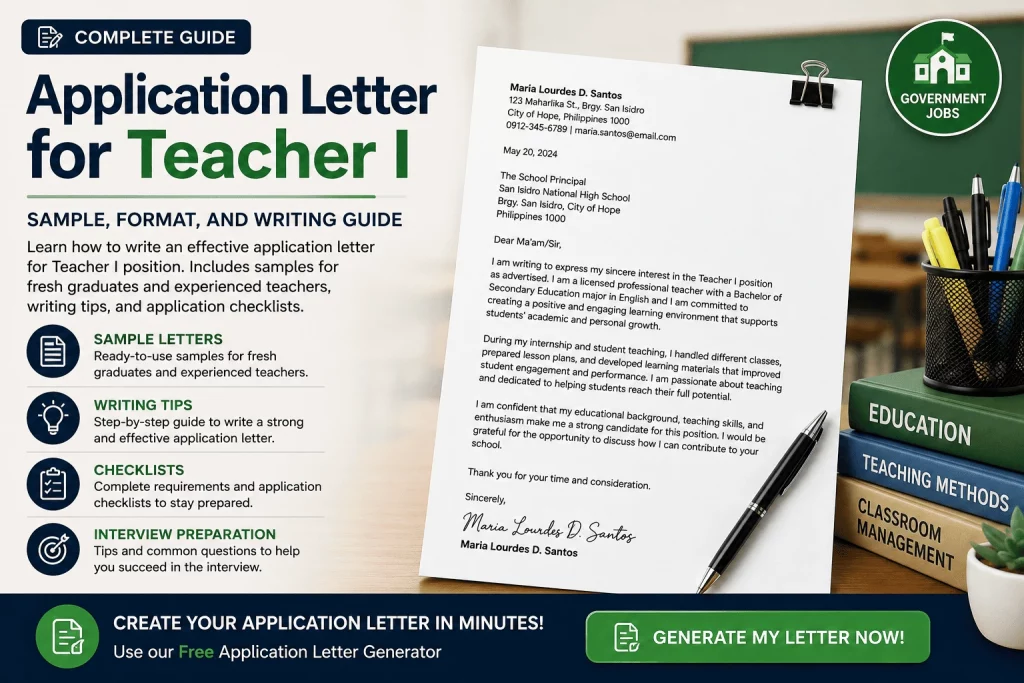
Teacher I is often the entry-level teaching position in public schools and educational institutions, making it one of the most competitive and frequently applied-for roles in the education sector. Whether you’re a newly licensed teacher or someone transitioning into public school teaching, the position typically serves as the starting point of a long-term teaching career.
Because so many qualified applicants compete for a limited number of Teacher I plantilla items each hiring period, the application letter plays a critical role in how you’re perceived even before you reach the interview stage. A strong application letter helps demonstrate professionalism, communication skills, educational background, and readiness for classroom responsibilities — all qualities that hiring committees are specifically screening for when reviewing hundreds of applications for a handful of open positions.
Teacher I positions are commonly hired by:
- Public elementary and secondary schools under the Department of Education (DepEd)
- Schools Division Offices (SDOs) during regular and special hiring periods
- State universities and colleges with laboratory or affiliated schools
- Private schools that follow similar entry-level teaching classifications
- Local government-run learning institutions and special education programs
This guide covers everything you need to write a strong Teacher I application letter — from understanding the role and its qualification requirements, to the proper letter format, full sample letters for different applicant profiles, common mistakes to avoid, what to expect in the hiring process, and how to prepare for the interview that typically follows a successful application.
Ready to apply now? Skip the blank page and use our Free Application Letter Generator to create a polished, ready-to-send Teacher I application letter in minutes.
How Do You Write an Application Letter for Teacher I?
A strong Teacher I application letter should:
- State the position clearly. Name the exact position — Teacher I — along with the school or division and any vacancy reference number.
- Mention teaching qualifications. Reference your education degree, license, and any relevant certifications.
- Highlight classroom experience. Include student teaching, practicum, or actual teaching experience where applicable.
- Discuss teaching philosophy. A brief, genuine statement of how you approach instruction and student development strengthens the letter.
- Showcase communication skills. Teaching is fundamentally a communication-heavy profession, and your letter itself is a demonstration of that skill.
- Demonstrate commitment to student learning. Hiring committees look for candidates who are motivated by student outcomes, not just employment.
- End with a professional closing. Restate your interest, thank the reader, and note your availability for an interview.
The sections below expand on each of these points in detail, with full sample letters you can adapt to your own background.
What Is a Teacher I?
Teacher I is typically the first-level teaching position within the public school system, held by newly hired or newly licensed teachers who are beginning their formal teaching career. While specific assignments vary by school and grade level, most Teacher I roles share a common core of responsibilities.
Typical Responsibilities
- Classroom instruction — delivering lessons in accordance with the approved curriculum for the assigned grade level and subject
- Lesson planning — preparing daily or weekly lesson plans aligned with curriculum standards and learning objectives
- Student assessment — creating and administering quizzes, tests, and other assessment tools, then recording and interpreting results
- Classroom management — maintaining an orderly, engaged, and safe learning environment
- Parent communication — coordinating with parents or guardians regarding student progress, behavior, and concerns
- Learning material preparation — developing visual aids, worksheets, and other instructional materials
- Student development activities — participating in co-curricular activities, remedial sessions, and other student support initiatives
Because Teacher I is an entry-level classification, schools generally expect new hires to be capable of independently managing a classroom while also being open to mentorship, professional development, and continued growth under the guidance of more senior faculty and school administrators.
Teacher I Qualification Requirements
Before writing your letter, it helps to understand what hiring committees typically expect from a Teacher I applicant. Requirements can vary slightly depending on the specific school, division, or subject area, but the table below reflects the most commonly expected qualifications.
Typical Requirements Checklist™
| Requirement | Commonly Expected |
|---|---|
| Education | Education Degree |
| Teaching Training | Preferred |
| Teaching Experience | Helpful |
| Communication Skills | Required |
| Classroom Management | Important |
| Lesson Planning Skills | Important |
| Professional Conduct | Required |
Note that specific licensure requirements, such as passing the Licensure Examination for Teachers (LET), and other qualification standards vary by hiring institution and by the exact plantilla item being filled. Always verify the official qualification standards listed in the specific vacancy announcement rather than assuming requirements are identical across schools or divisions.
Skills Employers Look For
In addition to formal qualifications, hiring committees evaluate a broader set of skills that predict success in the classroom. Use the checklist below to assess your own readiness and decide which strengths to emphasize in your letter.
Teacher Skills Checklist™
| Skill | Importance |
|---|---|
| Communication | High |
| Classroom Management | High |
| Lesson Planning | High |
| Student Engagement | High |
| Critical Thinking | High |
| Time Management | High |
| Creativity | High |
| Collaboration | High |
Nearly all of these skills are rated “High” importance, which reflects how holistic teaching evaluation tends to be — unlike more narrowly technical roles, teaching effectiveness depends on a wide combination of instructional, interpersonal, and organizational abilities working together.
Before You Write Your Application Letter
Gathering the right information before you start drafting will save you time and result in a more targeted, convincing letter.
Gather These Details
- Position Title — confirm the exact title as stated in the vacancy announcement (Teacher I, and the specific learning area or grade level if specified)
- School Name — the full and correct name of the school you’re applying to
- Hiring Office — whether the application goes directly to the school, the Schools Division Office, or another designated office
- Vacancy Details — item number, subject specialization, and grade level, if specified
- Educational Background — your degree, major, and school of graduation
- Teaching Experience — any prior teaching, student teaching, tutoring, or related instructional experience
- Certifications — your LET rating or professional teaching license, if applicable
- Relevant Training — seminars, workshops, or continuing education related to teaching methodology or classroom management
Skipping this preparation step often results in a vague, generic letter that fails to connect your specific qualifications to the specific position — one of the most common reasons strong candidates get overlooked at the initial screening stage.
Teacher I Application Letter Format
A well-structured application letter follows a predictable format that makes it easy for hiring committees to quickly locate the information they need.
Applicant Information
Place the following at the top of your letter:
- Name
- Address
- Contact Number
- Email Address
- Date
Recipient Information
Address your letter to the appropriate recipient, typically including:
- School Name
- Hiring Office (e.g., Schools Division Office, if applicable)
- Principal or Hiring Committee
Opening Paragraph
Your opening paragraph should clearly state:
- The position you’re applying for
- The source of the vacancy announcement (e.g., DepEd website, division memo, school posting)
Body Paragraph
The body of your letter should highlight:
- Education
- Teaching Experience
- Skills
- Certifications
- Training
Closing Paragraph
Your closing paragraph should express your interest in an interview opportunity, thank the reader for their time, and reaffirm your enthusiasm for the position.
Following this structure consistently across every application you send makes your letter easier to read and signals that you understand professional written communication — itself a quality directly relevant to the teaching profession.
Teacher I Application Letter Sample
The sample below is written for a newly qualified teacher applying for Teacher I, with a strong academic background and student teaching experience.
[Your Complete Address] [City, Province, Zip Code] [Your Email Address] [Your Contact Number] [Date]
[Name of Principal / Hiring Committee] [School Name] [School Address]
Dear [Principal’s Name / Sir or Madam],
I am writing to apply for the position of Teacher I at [School Name], as advertised [state where you saw the posting, e.g., “on the Schools Division Office website” or “through your school’s official announcement”], with reference to Vacancy Item No. [if applicable].
I am a graduate of [Bachelor of Secondary/Elementary Education, Major] from [School Name], and I am a licensed professional teacher having passed the Licensure Examination for Teachers. During my academic training, I completed my student teaching internship at [Cooperating School Name], where I independently handled lesson planning, delivered instruction across [subject/grade level], and managed a classroom of [number] students under the supervision of my cooperating teacher.
This experience allowed me to develop practical skills in lesson planning, formative assessment, and classroom management, while also reinforcing my belief that every student learns differently and deserves instruction tailored to their needs. My teaching philosophy centers on creating a supportive, engaging classroom environment where students feel confident participating and asking questions, while maintaining clear expectations and consistent routines.
I am comfortable using educational technology tools and basic productivity software to prepare instructional materials and communicate with parents and colleagues. I am also committed to continuous professional growth and welcome opportunities for mentorship as I begin my teaching career.
I have attached my resume, transcript of records, professional license, and other supporting documents for your review. I would welcome the opportunity to discuss my qualifications further and am available for an interview and demonstration teaching at your convenience.
Thank you for considering my application. I look forward to the possibility of contributing to the students and community of [School Name].
Respectfully yours,
[Your Full Name] [Signature, if submitting a printed copy]
This sample runs close to 350 words in the body, which reflects the slightly longer, more detailed format appropriate for a teaching application, where demonstrating both academic credentials and classroom readiness matters more than brevity alone.
Want this letter tailored to your own background? Try our Free Application Letter Generator — just fill in your details and get a ready-to-use Teacher I application letter instantly.
Teacher I Application Letter for Fresh Graduates
Fresh graduates entering the teaching profession often worry about competing against more experienced applicants. In practice, since Teacher I is designed as an entry-level position, schools generally expect a significant portion of applicants to be newly licensed teachers, and hiring committees place substantial weight on academic performance, student teaching quality, and demonstrated potential.
Focus On
- Student teaching — the specific grade levels, subjects, and responsibilities you handled during your practicum
- Internship experience — any additional teaching-related internships, tutoring programs, or volunteer teaching work
- Academic achievements — honors, relevant coursework, or recognitions from your education program
- Classroom exposure — even limited exposure, such as classroom observation hours, is worth mentioning if it shaped your teaching approach
- Willingness to learn — a genuine statement that you are eager to grow under mentorship and continue developing your craft
Sample Letter
[Your Complete Address] [City, Province, Zip Code] [Your Email Address] [Your Contact Number] [Date]
[Name of Principal / Hiring Committee] [School Name] [School Address]
Dear [Principal’s Name / Sir or Madam],
I am writing to express my interest in the Teacher I position at [School Name]. I recently graduated with a degree in [Bachelor of Elementary/Secondary Education, Major] from [School Name] and successfully passed the Licensure Examination for Teachers, and I am eager to begin my professional teaching career at your institution.
During my student teaching internship at [Cooperating School Name], I handled full classroom responsibilities for [subject/grade level] over a period of [duration], including lesson planning, instructional delivery, and student assessment. This experience taught me the importance of flexibility in the classroom — adjusting my teaching strategies in real time based on how students were responding — as well as the value of building genuine rapport with students to encourage active participation.
Throughout my academic program, I consistently received strong evaluations for my lesson delivery and classroom presence from both my cooperating teacher and my university supervisor. I am confident in my foundational teaching skills, and I am equally committed to continuing to learn from experienced colleagues as I transition from training into full-time classroom teaching.
I am proficient in preparing instructional materials using standard productivity software and am comfortable incorporating basic educational technology into my lessons. While I recognize that I am early in my teaching career, I bring genuine enthusiasm, strong preparation, and a sincere commitment to student learning.
I have enclosed my resume, transcript of records, professional license, and other requirements for your consideration. I would be grateful for the opportunity to discuss my qualifications and am available for an interview or demonstration teaching at your convenience.
Thank you very much for your time and consideration.
Respectfully yours,
[Your Full Name]
Teacher I Application Letter for Experienced Teachers
Applicants who already have teaching experience — whether in public school, private school, or another educational setting — should structure their letter to lead with concrete teaching accomplishments rather than academic background alone.
Highlight
- Teaching achievements — recognitions, positive evaluation results, or notable outcomes from your time in the classroom
- Student outcomes — improvements in student performance, engagement, or specific measurable results you contributed to
- Curriculum development — any involvement in developing, adapting, or improving instructional materials or curriculum guides
- Leadership activities — roles such as grade-level coordinator, subject group leader, or adviser for student organizations
- Professional development — relevant seminars, training programs, or continuing education completed since you began teaching
Sample Letter
[Your Complete Address] [City, Province, Zip Code] [Your Email Address] [Your Contact Number] [Date]
[Name of Principal / Hiring Committee] [School Name] [School Address]
Dear [Principal’s Name / Sir or Madam],
I am writing to apply for the position of Teacher I at [School Name], as advertised [state source of posting], with reference to Vacancy Item No. [if applicable].
I bring [number] years of teaching experience, most recently as a [Subject] teacher at [Previous School Name], where I taught [grade level/subject] and consistently received positive performance evaluations from school administrators. During my time there, I [describe a specific accomplishment — e.g., “developed supplementary reading materials that contributed to a measurable improvement in class reading comprehension scores” or “served as grade-level coordinator, overseeing curriculum alignment across three sections”].
In addition to classroom instruction, I have actively pursued professional development, completing training in [specific training, e.g., “differentiated instruction” or “classroom assessment techniques”] to continually strengthen my teaching practice. I have also served as [adviser/coordinator role], which further developed my organizational and leadership skills within a school setting.
I am comfortable integrating educational technology into my lessons and using learning management systems to track student progress and communicate with parents. Throughout my teaching career, I have remained committed to student-centered instruction, high academic standards, and building a positive, inclusive classroom culture.
I have attached my resume, transcript of records, professional license, certificates of employment, and other supporting documents for your review. I would welcome the opportunity to further discuss my qualifications and am available for an interview at your convenience.
Thank you for your time and consideration.
Respectfully yours,
[Your Full Name]
Best Skills to Mention in a Teacher I Application Letter
Whichever version of the letter you adapt, make sure it references a well-rounded mix of teaching, technology, and soft skills relevant to the role.
Teaching Skills
- Lesson planning
- Classroom management
- Assessment design
- Student engagement
- Curriculum implementation
Technology Skills
- Microsoft Office
- Google Workspace
- Learning Management Systems
- Educational technology tools
Soft Skills
- Communication
- Patience
- Adaptability
- Teamwork
- Leadership
When deciding which of these to emphasize, prioritize whichever skills are directly referenced in the vacancy announcement or align most closely with the grade level and subject you’re applying to teach. A Teacher I applicant for a science-related subject, for example, might emphasize hands-on assessment design and lab safety awareness, while an applicant for a lower elementary grade might emphasize patience, classroom routines, and foundational literacy support.
Common Mistakes to Avoid
Even highly qualified teaching candidates sometimes get passed over because of avoidable issues in their application letter.
Generic Application Letters
A letter that could apply to any school, sent without customization, rarely leaves a strong impression. Personalize the school name, position details, and at least one specific detail relevant to that institution for every application.
Focusing Only on Academic Credentials
While your degree and licensure are important, a letter that lists only academic credentials without connecting them to actual teaching skills or classroom experience misses the opportunity to demonstrate readiness for the role. Always include teaching skills and, where possible, actual classroom experience — even if it’s limited to student teaching.
Long Paragraphs
Hiring committees review large volumes of applications, especially during peak hiring periods. Keep your paragraphs concise and easy to scan.
Grammar and Formatting Errors
Since communication skills are directly relevant to teaching effectiveness, grammar and formatting errors in your application letter can undermine your candidacy more than in other professions. Proofread carefully, and ideally have someone else review your letter before submission.
Missing Teaching Achievements
If you have any measurable accomplishments — improved student outcomes, positive evaluation results, successful projects or initiatives — include them. Concrete achievements are far more persuasive than general statements about your teaching ability.
Teacher I Hiring Process Overview
Understanding the typical hiring process can help you prepare more effectively and set realistic expectations for timelines.
Step 1: Prepare Requirements
Gather all necessary documents, including your application letter, resume, transcript of records, professional license, and any relevant certifications or training records.
Step 2: Submit Application
Submit your complete application package through the channel specified in the vacancy announcement, whether directly to the school, the Schools Division Office, or an online portal.
Step 3: Document Screening
Your application is reviewed against the minimum qualification standards for the position, and your letter is assessed for clarity, professionalism, and relevance.
Step 4: Interview
Shortlisted applicants are typically invited for a panel interview, which may include a demonstration teaching component.
Step 5: Evaluation and Ranking
Applicants who pass the interview stage are evaluated and ranked based on a combination of qualifications, interview performance, and, where applicable, demonstration teaching results.
Step 6: Appointment and Onboarding
Selected applicants receive a formal appointment and undergo onboarding, which may include orientation on school policies, curriculum guides, and administrative procedures.
Timelines vary significantly by school, division, and hiring period — particularly during DepEd’s regular teacher hiring cycles, when large volumes of applications are processed simultaneously. Applying early and ensuring your documents are complete can help avoid unnecessary delays.
Interview Preparation Tips for Teacher I Applicants
Getting your application letter right is only the first step. If you’re shortlisted, preparing thoroughly for the interview — and, in many cases, a demonstration teaching segment — is essential.
Common Questions
- Why do you want to become a teacher?
- How do you handle classroom discipline?
- What is your teaching philosophy?
- How do you support struggling learners?
- How do you integrate technology into teaching?
Preparation Tips
- Review teaching methods. Be ready to discuss specific instructional strategies you use or plan to use, and why.
- Practice communication skills. Since much of the interview evaluates how clearly and confidently you communicate, rehearsing your answers out loud can help.
- Prepare classroom examples. Concrete examples from your student teaching or prior classroom experience make your answers more credible than general statements.
- Research the institution. Understanding the school’s mission, student population, and any special programs shows genuine interest and helps you tailor your answers.
Reviewing your own application letter before the interview is also worthwhile, since panels frequently ask applicants to elaborate on specific claims made in their letter — such as a particular teaching strategy, achievement, or philosophy statement.
Teacher I Application Checklist™
Before submitting your application, confirm that your package is complete. Missing documents are a common reason for disqualification at the screening stage, regardless of how strong the letter itself is.
| Item | Ready? |
|---|---|
| Application Letter | ✓ |
| Resume/CV | ✓ |
| Transcript of Records | ✓ |
| Certifications | ✓ |
| Training Certificates | ✓ |
| Teaching Portfolio | ✓ |
| Reference Documents | ✓ |
A teaching portfolio — a compiled collection of lesson plans, instructional materials, and evidence of student work or outcomes — is increasingly expected even for entry-level applicants, and can meaningfully strengthen your candidacy during the interview stage.
Teacher I Readiness Score™
Use the checklist above to tally how many of the seven listed items you have fully prepared, then match your count to the readiness levels below.
Beginning Applicant
0–3 items completed. Focus on completing your basic documentary requirements before applying, and consider building a simple teaching portfolio even with limited classroom experience.
Developing Applicant
4–5 items completed. You have a solid foundation. Prioritize completing any remaining certifications or training records before your next application.
Competitive Applicant
6–7 items completed. You meet most of what schools typically expect from a Teacher I applicant. Make sure your application letter clearly connects your documents to specific teaching strengths.
Highly Competitive Applicant
All documents complete, plus relevant teaching experience. You are well-positioned for this role. Focus your letter and interview preparation on quantifiable student outcomes and specific teaching accomplishments.
Teacher Career Progression Guide™
Teacher I is generally the starting point of a structured career path within the public school system. A typical progression looks like this:
Teacher I → Teacher II → Teacher III → Master Teacher I → Master Teacher II → School Head
Understanding this progression can help you frame your Teacher I application not just as a single job, but as the first step in a long-term teaching career — a framing that hiring committees often respond well to, since it signals genuine long-term commitment to the profession rather than viewing the position as temporary.
For more on related topics, see our upcoming guides on Teacher Salary Grades, Teaching Career Paths, and other Government Careers content.
Use Our Free Application Letter Generator
Need a customized Teacher I application letter without starting from a blank page? Use our Free Application Letter Generator to create a professional application letter in minutes — just enter your qualifications and experience, and get a ready-to-send letter tailored to the position.
Frequently Asked Questions
What should I include in a Teacher I application letter?
Your letter should include the exact position title and school name, a brief summary of your education and teaching credentials, relevant classroom or student teaching experience, a short statement of your teaching philosophy, and a professional closing indicating your availability for an interview. Supporting documents such as your resume, transcript of records, and professional license should accompany the letter rather than be summarized within it.
Can fresh graduates apply for Teacher I positions?
Yes. Teacher I is generally considered an entry-level teaching position, and schools regularly hire newly licensed graduates. What matters most is demonstrating readiness through student teaching experience, academic performance, and a genuine, well-articulated commitment to teaching.
How long should the application letter be?
A Teacher I application letter typically runs around 350 to 450 words, slightly longer than application letters for purely clerical or administrative roles, since it needs to convey both academic credentials and classroom readiness. It should remain concise enough to be read quickly while still covering your key qualifications.
Should I include teaching philosophy?
Yes. A brief, genuine statement of your teaching philosophy — how you approach instruction, classroom culture, and student development — helps hiring committees understand not just what you can do, but how you think about teaching, which is often just as important as your technical qualifications.
Can I use the same letter for multiple schools?
It’s not recommended. While the overall structure can be reused, each letter should be personalized with the correct school name, position details, vacancy reference (if applicable), and ideally a detail specific to that institution, such as a program or student population you’re particularly drawn to. Hiring committees can often tell when a letter has been mass-produced.
What teaching skills should I highlight?
Focus on a combination of instructional skills (lesson planning, classroom management, assessment design), relevant technology skills (learning management systems, educational technology tools), and soft skills (communication, patience, adaptability). Prioritize whichever skills are most directly relevant to the grade level, subject, or specific vacancy announcement you’re responding to.
Related Guides
- Free Application Letter Generator for Government Jobs and Private Companies
- Application Letter for Administrative Assistant I: Complete Sample and Writing Guide
- Civil Service Exam Requirements 2026: Complete Application Guide and Checklist
- CSC Eligibility: Professional vs Subprofessional Exam – What’s the Difference?
- Government Jobs in the Philippines 2026: Complete Job Search Guide
- CSC Eligibility Requirements: Complete Guide for Government Job Applicants
- Civil Service Exam Coverage 2026: Complete Guide for Filipino Examinees
- RA 1080 Eligibility Guide: Automatic Civil Service Eligibility for Board and Bar Passers
- Civil Service Exam Results: How to Check Your Rating, List of Passers & Release Date