Every Civil Service examinee reaches the same moment eventually — the exam is over, and now the waiting begins. For many, that wait is the hardest part of the entire process. You’ve studied, you’ve sat through the exam, and now all that’s left is checking whether it paid off.
The problem is that most examinees don’t actually know where to check their results, how the process works, or what the different terms even mean. Is your “result” the same as your “rating”? Is being on the “list of passers” the same as being “eligible”? These distinctions matter, and confusing them leads to unnecessary stress, wasted trips to CSC offices, and in some cases, examinees falling for unofficial websites that promise faster or easier access to results.
This guide brings everything into one place: where and how to check your Civil Service Exam results, what your rating actually means, how the list of passers works, what to do if you pass, and — just as important — what to do if you don’t. Whether this is your first time taking the exam or your third, understanding this process clearly will save you time, stress, and the risk of relying on the wrong sources.
Why This Guide Exists
Search “civil service exam results” on any given day, and you’ll find a scattered mix of outdated blog posts, unofficial Facebook groups reposting screenshots, and forum threads full of examinees asking each other questions no one can definitively answer. None of that is a substitute for understanding the actual official process — and relying on it can genuinely work against you, whether that means missing an actual official announcement buried under noise, or trusting a rumored release date that turns out to be wrong by weeks.
This guide is built to be the single resource you need: accurate on the process itself, honest about what can and can’t be predicted (like exact release timing), and practical about what to actually do next — whether you’re anxiously refreshing a results page for the first time or you’re a repeat examinee who already knows the drill but wants a faster reference.
How Can I Check My Civil Service Exam Results?
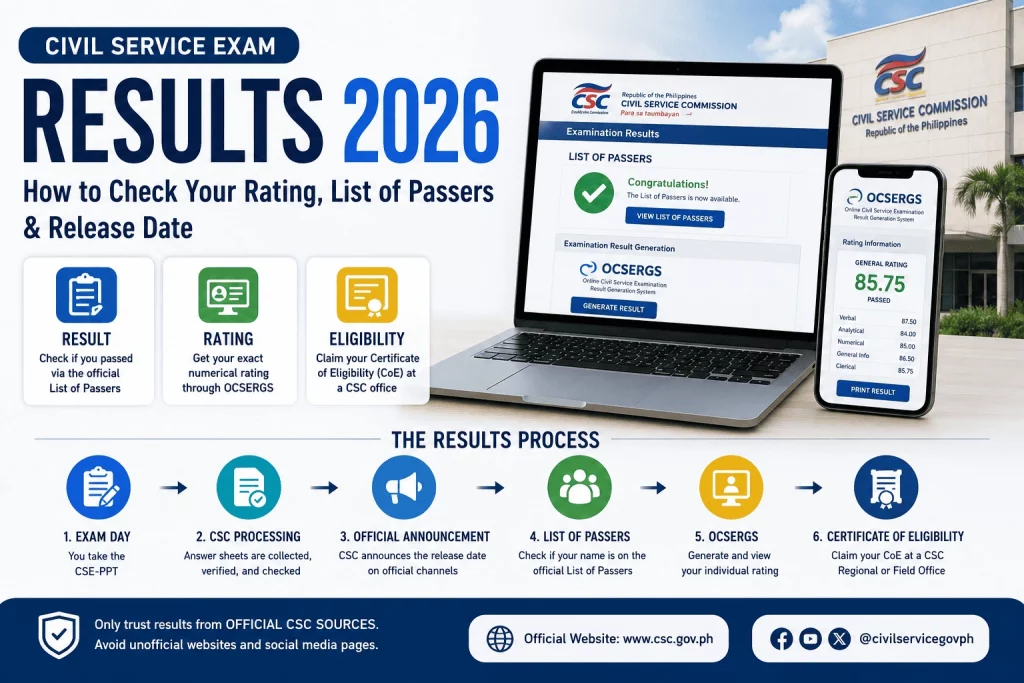
To check your Civil Service Exam results, visit the official Civil Service Commission (CSC) website or the CSC Examination Portal, locate the official list of passers for your exam date and level, and use the Online Civil Service Examination Result Generation System (OCSERGS) to generate and verify your individual rating once it becomes available. Only results published through official CSC channels should be considered valid — unofficial websites and social media pages are not authorized sources, even if they appear to have accurate information.
At a Glance: What to Check and Where
| Check | Where to Find It |
|---|---|
| Result (pass/fail status) | List of Passers (official CSC website) |
| Rating (your exact numerical score) | OCSERGS |
| Eligibility (your official credential) | Certificate of Eligibility (CoE), claimed at a CSC Regional/Field Office |
When Are Civil Service Exam Results Released?
This is the question every examinee wants answered with a specific number of days, and it’s also the one question no honest guide can answer with certainty. Civil Service Exam results are not released on a fixed, predictable schedule. The exact timeline depends on the examination cycle, the volume of examinees, and internal CSC processing — and it can vary meaningfully between one exam administration and the next.
What is consistent is the process: the CSC formally announces the official release date through its website and official communication channels once results are ready. This announcement typically includes when the list of passers becomes available, and when OCSERGS opens for both passers and non-passers to generate their individual rating reports.
Because of this variability, the most reliable approach is to bookmark the official CSC website and check it periodically, rather than relying on rumored release dates circulating on social media or unofficial forums. Those unofficial sources are often wrong, sometimes by weeks — and worse, some are not actually connected to the CSC at all, despite appearing to be.
Why Results Take Time
It helps to understand why results aren’t instant, since that context makes the wait easier to sit through. The Career Service Examination – Pen and Paper Test (CSE-PPT) is administered nationwide, across dozens of testing centers and regions, to a large volume of examinees simultaneously. After the exam, every answer sheet has to be collected, verified, and processed — and this happens at a national scale, not a single-office scale. Add in quality-control checks to ensure accuracy before any results are made public, and it becomes clear why the process takes weeks rather than days.
The CSC typically administers the CSE-PPT twice a year, generally in the first half and second half of the year. Results for each administration follow their own independent timeline — so if you’re comparing your wait time to what a friend experienced during a different exam cycle, keep in mind that timelines aren’t necessarily consistent from one cycle to the next.
What “Officially Announced” Actually Means
When this guide says results are released once “officially announced,” it specifically means the CSC has published the information through its own recognized channels — its official website, its official social media accounts, or direct communication through CSC Regional and Field Offices. It does not mean a reputable-looking blog, a large Facebook group, or a well-meaning acquaintance who “heard from someone.” Even accurate-seeming information from unofficial sources should be treated as unconfirmed until you see it reflected on the official CSC website yourself.
How to Check Your Civil Service Exam Results Online
Once the CSC has officially announced that results are available, here’s the step-by-step process to check them:
Step 1 — Visit the CSC website. Go to the official Civil Service Commission website. This is the only source you should treat as authoritative for results information.
Step 2 — Open the Examination Results section. Look for the section of the website dedicated to examination results — this is usually clearly labeled and features the current announcement about the most recent exam cycle.
Step 3 — Find your region. Results are typically organized by region and examination center. Locate the listing that corresponds to where you took your exam.
Step 4 — Check the PDF or list of passers. Open the official list of passers document for your region and exam level (Professional or Subprofessional). These are usually published as downloadable PDF files.
Step 5 — Verify your name. Search the document carefully for your full name as it appears on your exam application. If you don’t find it immediately, don’t panic — double-check spelling variations, and confirm you’re looking at the correct region and exam date before assuming anything about your outcome.
This process gives you your pass/fail status through the list of passers. To get your actual numerical rating, you’ll need a separate step through OCSERGS, explained next.
The Full Results Timeline, Visualized
Here’s the complete journey from exam day to holding your official eligibility, in order:
Exam Day (CSE-PPT)
      ↓
CSC Processing & Verification
      ↓
Official CSC Announcement
      ↓
List of Passers Released
      ↓
OCSERGS Opens (Individual Rating)
      ↓
Certificate of Eligibility (CoE) Claiming
Each stage depends on the one before it — OCSERGS won’t open before the official announcement, and CoE claiming isn’t available until after results (and often a follow-up announcement) confirm it’s ready. Skipping ahead to check a later stage before an earlier one is complete simply won’t return any information yet.
Checking Results on Mobile
Most examinees today check their results from a phone rather than a computer, and the process works essentially the same way — visit the official CSC website through your mobile browser, navigate to the Examination Results section, and open the relevant PDF. A few practical tips make this smoother: PDF list-of-passers documents can be large and image-heavy, so a stable internet connection helps avoid partial loading. If your mobile browser struggles to render a long PDF, using your phone’s built-in “search in page” or “find” function (rather than manually scrolling) is the fastest way to locate your name once the document has fully loaded.
If the Website Is Slow or Unresponsive
It’s common for the official CSC website to experience heavy traffic immediately after a results announcement, since large numbers of examinees attempt to check at the same time. If pages load slowly or time out, avoid repeatedly refreshing aggressively, which can add to server load. Instead, try again after a short interval, or attempt access during off-peak hours (very early morning or late evening) when traffic tends to be lighter.
How to Check Your Civil Service Rating
A lot of confusion among examinees comes from treating “result,” “rating,” and “eligibility” as if they’re the same thing. They’re related, but distinct — and understanding the difference will save you a lot of frustration.
Result refers to your basic outcome status — essentially, whether you passed or did not pass, as reflected in the official list of passers.
Rating is your actual numerical score on the examination, expressed as a general rating. This is a more detailed figure than simple pass/fail status, and it’s what determines whether you cleared the minimum threshold required for eligibility.
Eligibility is the legal status you gain once your rating meets or exceeds the required passing threshold. Eligibility is what actually qualifies you for certain government positions — it’s the practical outcome that matters most for your career, and it’s documented through a Certificate of Eligibility (CoE).
What Is OCSERGS?
OCSERGS stands for the Online Civil Service Examination Result(s) Generation System. It’s the official CSC platform where both passers and non-passers can generate and download their individual, detailed test result report — including their specific rating, not just their pass/fail status.
To use OCSERGS, you’ll typically need to provide accurate personal information along with details about your specific examination — including the date, type, and location of the exam you took. Because the system relies on exact data matching, small errors in how you enter your name, examinee number, or exam details can cause the system to fail to locate your record, even if your results genuinely exist.
OCSERGS becomes available once the CSC formally opens it following a results release — it isn’t accessible before that announcement, so checking early won’t yield anything beyond frustration.
Tips for Using OCSERGS Successfully
Because OCSERGS matches your results based on the exact information you provide, small input errors are the single biggest reason examinees fail to retrieve their report even when their results genuinely exist in the system. Keep these points in mind:
- Enter your name exactly as it appeared on your official exam application, including middle initials or suffixes, since minor mismatches can prevent the system from locating your record.
- Double-check your examinee number if the system requests it — a single transposed digit is a common and easily overlooked mistake.
- Select the correct examination date and type. If you’ve taken the exam more than once, make sure you’re selecting the specific administration you’re trying to check, not a previous attempt.
- Confirm the correct exam location/region, since results are organized around where you actually sat for the exam.
- Be patient with system load. Immediately after a results announcement, OCSERGS can experience heavy traffic, occasionally causing slow load times or temporary errors — this is usually resolved by trying again later rather than repeatedly resubmitting the form.
What Is the List of Passers?
The list of passers is the official document — usually released as a downloadable PDF, organized by region and exam level — that names every examinee who met the passing threshold for a specific examination cycle. It’s typically the first piece of information released, often ahead of full individual rating reports through OCSERGS.
Being on the list of passers confirms that you passed. It does not, by itself, give you your exact numerical rating — for that, you still need to check OCSERGS. And critically, appearing on the list of passers is not the same as holding formal eligibility documentation; that comes afterward, through the Certificate of Eligibility process.
List of Passers vs. Rating vs. Eligibility — Side by Side
Think of these three terms as three separate stages of the same journey:
- List of Passers tells you that you passed.
- Rating tells you exactly how well you scored, as a specific number.
- Eligibility is the official status and documentation you receive as a result of passing, which is what employers and HR offices actually check when considering you for a government position.
Examinees who only check the list of passers and stop there often don’t realize they still need to complete the eligibility documentation process before they can formally use their new status in a job application.
How Many Filipinos Actually Take the Civil Service Exam?
To put your own results in context, it helps to know the scale of this examination. Every cycle, the Career Service Examination – Pen and Paper Test draws hundreds of thousands of examinees nationwide. For example, the August 2025 CSE-PPT had 331,675 total examinees across both levels — 302,028 at the Professional level and 29,647 at the Subprofessional level — with 50,096 passing overall. The March 2025 administration saw 318,973 total examinees, with 46,470 passing, a rate of roughly 14.6 percent.
Passing rates have consistently landed in the low-to-mid teens in recent exam cycles — typically somewhere between 10 and 20 percent of all examinees, depending on the specific administration and level. That means, on average, only about one in every six to ten examinees passes on a given attempt. This isn’t meant to discourage you — if anything, it reframes what “not passing” actually represents. You’re not failing a test most people pass; you’re attempting a genuinely competitive, standards-based exam where the majority of every batch, including many capable and hardworking examinees, doesn’t clear the threshold on a single try. That context matters both for managing expectations and for understanding why consistent, sustained preparation — not last-minute cramming — is what actually separates passers from the rest.
Why the CSC Separates These Three Stages
It might seem simpler if the CSC just told you “pass” or “fail” and left it there — so why the extra layers of rating and eligibility documentation? The answer comes down to accountability and verification. Your rating provides an auditable, specific number tied to your exact performance, which matters if any question about your status ever arises later in your career. Your Certificate of Eligibility, in turn, gives employers and HR offices a physical, verifiable document they can check — rather than asking every applicant to somehow prove their status through a results webpage. Understanding this structure helps explain why simply seeing your name on a passers list, while a great sign, isn’t the end of the process.
Understanding Your Civil Service Rating
Your Civil Service Exam rating is a general average score calculated from your performance across the exam’s sections. To achieve a passing rating and gain eligibility, examinees generally need to meet a specific minimum threshold set by the CSC — historically, a general rating in the neighborhood of 80.00, though examinees should always confirm the exact current requirement through official CSC materials, since standards and exam formats can be updated over time.
Passing Rating
A passing rating means your general average met or exceeded the required threshold. This automatically qualifies you for the corresponding civil service eligibility — Professional or Subprofessional, depending on which level of exam you took.
Failing Rating
A failing rating means your general average fell short of the required threshold. Importantly, this does not necessarily mean you performed poorly across the board — it’s an aggregate figure, and it’s entirely possible to have performed well in some sections while falling short overall.
No Penalty for Guessing
One detail that surprises a lot of examinees: there is generally no separate penalty deducted specifically for guessing on the Civil Service Exam beyond simply not earning credit for an incorrect answer. This means leaving an item blank offers no advantage over making an educated guess — when in doubt, answering is almost always the better strategy compared to leaving a question unanswered.
What Your Rating Actually Means
Your rating is more than a pass/fail line — it’s a record of your performance that stays associated with your eligibility. While a bare pass and a high pass both result in the same eligibility status, a stronger rating can matter in contexts like ranking for competitive government positions where multiple eligible candidates are being compared. It’s worth aiming not just to pass, but to score as high as you reasonably can.
How Your Rating Is Calculated
Without getting into exact proprietary weighting formulas the CSC uses internally, it’s useful to understand the general principle: your general rating is derived from your performance across the different sections of the exam — typically covering areas like Verbal Ability, Numerical Ability, Analytical Ability, General Information, and, for Subprofessional examinees, Clerical Ability. These aren’t necessarily weighted identically, and different sections may contribute differently to your overall average. This is precisely why a well-rounded review — rather than over-focusing on just one or two sections — tends to produce more reliable, higher overall ratings than a lopsided study approach.
Regional and Batch Variation
One nuance worth knowing: because the exam is administered simultaneously across many regions and testing centers, results are processed and released region by region, and sometimes region-level timing can differ slightly even within the same overall exam cycle. If you notice examinees from a different region posting about their results before yours appear, that’s not necessarily a sign of an error on your end — it may simply reflect normal processing variation across regions.
What Happens If You Pass?
Passing the Civil Service Exam is a genuine milestone — but it’s the start of a short administrative process, not the finish line. Here’s what typically follows.
You Gain Eligibility
Once your rating clears the passing threshold, you’re granted the corresponding civil service eligibility — Career Service Professional Eligibility for the Professional-level exam, or the corresponding Subprofessional eligibility for that level. This eligibility becomes a formal credential attached to your name in CSC records.
You Become Qualified for Government Jobs
Civil service eligibility is a baseline requirement for many government positions. It doesn’t guarantee you a job by itself — you’ll still need to meet the specific qualification standards for education, experience, training, and other competencies required for the particular position you’re applying for — but without eligibility, many government roles simply aren’t accessible to you regardless of your other qualifications.
You Open the Door to Permanent Positions
For many entry-level government roles, appointees without civil service eligibility can sometimes be hired on a temporary or provisional basis. Eligibility is generally what allows an appointment to become permanent, giving you the job security and benefits that come with regular government employment.
You Need to Claim Your Certificate of Eligibility
Passing the exam and holding eligibility isn’t automatically documented in a form you can hand to an employer — you need to formally claim your Certificate of Eligibility (CoE). There are generally two paths:
- Letterhead CoE — issued free of charge, printed on official CSC letterhead, available for personal claiming at the CSC Regional or Field Office associated with where you took your exam. If you’ve since moved elsewhere, you can generally claim it at whichever CSC office is nearest your current residence or workplace, but it’s wise to confirm availability with that office before making the trip.
- Security paper CoE — a version printed on special security paper, available for a fee, and obtainable from any CSC Regional Office nationwide regardless of where you originally took the exam. This version is sometimes preferred for certain formal applications.
In both cases, you’ll typically need to claim your CoE in person, presenting valid identification — representatives generally aren’t permitted to claim it on your behalf. It’s always worth checking directly with your CSC Regional or Field Office to confirm current requirements and availability before visiting.
After You Have Your Certificate of Eligibility
Once your CoE is in hand, it becomes one of the core documents in your government job application toolkit going forward. A few practical notes for this stage:
- Keep both a physical and a scanned digital copy. Many government hiring processes now accept digital submissions during initial stages, even if a physical copy is required later.
- Your eligibility applies broadly, not to a single office. Once eligible, you’re not limited to applying only where you took the exam — your CoE is valid nationwide for the corresponding eligibility level.
- Eligibility alone doesn’t guarantee a position. You’re still competing against other eligible, qualified applicants for any specific opening, and hiring decisions also weigh relevant experience, education, and how well you match the specific role’s requirements.
- Start monitoring actual job openings. With eligibility secured, the practical next step is watching for plantilla or contractual openings that match your eligibility level, rather than waiting passively.
Related reading:
- How to Claim Your CSC Certificate of Eligibility
- Government Jobs Guide: Where and How to Apply
- Understanding Plantilla Positions in Government
What Happens If You Don’t Pass?
Not passing on your first attempt is common — statistically, it’s the outcome for the majority of examinees in any given exam cycle. That’s not said to minimize the disappointment, but to correct a misconception: not passing doesn’t mean you’re not capable, and it doesn’t mean the exam isn’t learnable with the right preparation.
One exam result doesn’t define your future in public service. Plenty of people currently working in stable, respected government positions didn’t pass on their first try — some didn’t pass on their second. What separated them from examinees who gave up wasn’t natural talent; it was that they kept their study habits alive instead of stopping completely after a disappointing result.
Here’s the mistake to avoid: many examinees, after not passing, put their books away entirely and only pick them back up a month or two before the next scheduled exam. That approach throws away months of potential retention and practice. A far more effective strategy is to keep a light, consistent study routine going in the meantime — even just 20 minutes a day is enough to keep the material fresh in your memory, so that when the next exam cycle approaches, you’re building on a foundation instead of starting over from zero.
Use the time between exam cycles productively:
- Identify honestly which sections felt weakest during your last attempt.
- Keep reviewing consistently, even in small daily doses, rather than in occasional long sessions.
- Take full-length, timed practice exams periodically to track whether your readiness is actually improving.
- Study the current exam coverage closely, since content emphasis can shift slightly between cycles.
Reframing the Wait Between Exams
The gap between exam cycles is often treated as dead time — something to simply get through until the next registration period opens. That mindset works against you. Instead, treat this window as the single biggest advantage you have over examinees who only start reviewing a few weeks before the next exam. Spaced-out study, even in short daily sessions, is consistently more effective for long-term retention than compressed cramming — which means the examinees who keep a light, steady routine going between cycles are often better prepared, not just equally prepared, compared to their first attempt.
If you’re unsure how to structure that ongoing review without burning out, a simple rotation works well: dedicate short blocks of time to a different section each day, mix in a handful of practice questions to keep recall active, and reserve a longer session every few weeks for a full timed mock exam to track whether your readiness is genuinely improving over time — not just whether you feel more familiar with the material.
Continue your preparation with:
- Verbal Reviewer
- Numerical Reviewer
- Analytical Reviewer
- General Information Reviewer
- Clerical Reviewer
- 170-Item Mock Exam
Common Reasons Why Examinees Can’t Find Their Results
If you’ve searched for your name and come up empty, don’t assume the worst right away. These are the most common, correctable reasons examinees fail to locate their results:
- Wrong spelling. If your name was entered with a slight variation during registration (a missing middle initial, a different suffix format, a misspelled surname), a straightforward name search may not match. Try variations before concluding anything.
- Wrong region. Results are typically organized by the region where you actually took the exam — not necessarily where you currently live. Double-check you’re viewing the correct region’s list.
- Checking too early. If OCSERGS or the list of passers hasn’t been officially released yet for your exam cycle, no amount of searching will produce results — the data simply isn’t published yet.
- Using unofficial websites. Some third-party sites republish or summarize CSC results, sometimes inaccurately or with delays. Relying on these instead of official CSC sources is a frequent source of confusion and misinformation.
- Confusing rating with result. As covered earlier, the list of passers and your OCSERGS rating report are two different documents. Checking only one and assuming it tells you everything can lead to incomplete or mistaken conclusions about your status.
A Note on Unofficial “Results Checker” Sites and Pages
It’s worth addressing this directly: during every results cycle, a wave of unofficial websites, Facebook pages, and even paid “checking services” appear, claiming to offer faster or easier access to your Civil Service Exam results. Some are simply outdated blogs republishing old information. Others are more concerning — pages designed to look official, sometimes requesting personal information or payment in exchange for “verifying” your results.
The CSC has repeatedly cautioned examinees against relying on postings from sources not affiliated with the official Commission. The safest practice is simple: treat the official CSC website and OCSERGS as your only two legitimate sources, and be skeptical of anything else, no matter how convincing it looks or how quickly it claims to deliver an answer you’re anxiously waiting for.
Common Questions About Civil Service Results
Can I check online? Yes. Both the list of passers and your individual rating (through OCSERGS) are accessible online via official CSC channels once results have been released.
When is the rating available? Individual ratings through OCSERGS typically become available shortly after — or sometimes alongside — the release of the official list of passers, though the exact timing is announced by the CSC for each exam cycle rather than following a fixed universal schedule.
How long is eligibility valid? Civil service eligibility obtained through passing the exam is generally treated as valid indefinitely once granted, though examinees should confirm current CSC policy, since specific rules can be updated and may vary depending on your particular situation.
What if my name isn’t listed? First, rule out the common causes above — wrong spelling, wrong region, or checking before official release. If you’ve confirmed none of those apply and you still can’t locate your name, the most reliable next step is to contact your CSC Regional or Field Office directly rather than relying on guesswork.
Can I retake the exam? Yes. There is generally no limit on how many times you can retake the Civil Service Exam, provided you have not already obtained eligibility at that specific level. Each attempt is a legitimate opportunity to try again — many successful government employees passed on a later attempt, not their first.
Are civil service exam results different from board exam results? Yes. The Civil Service Exam, administered by the CSC, follows its own separate process, systems, and channels (like OCSERGS) distinct from professional licensure board exams administered by the Professional Regulation Commission (PRC). If you’re also tracking a separate board exam, make sure you’re checking the correct official body’s website for each — they are not interchangeable.
Is there a fee to check my results? Checking your results and rating through official CSC channels, including OCSERGS and the list of passers, is free. Be cautious of any unofficial third-party service that asks for payment to “reveal” or “verify” your results — legitimate CSC results checking never requires a fee.
What should I do if I suspect an error in my listed information? If you notice a discrepancy in how your name or details appear in official results, the correct step is to contact your CSC Regional or Field Office directly for clarification and correction guidance, rather than assuming the result itself is inaccurate.
Civil Service Results Action Plan™
Once your exam is finished, here’s the clear path forward, regardless of outcome:
Exam Finished → Wait for Official Results → Check List of Passers → Check Rating
From there, the path splits into two outcomes:
If you PASS: Claim Eligibility → Apply for Government Jobs
If you did NOT PASS: Continue Reviewing → Take Practice Tests → Prepare for the Next Examination
Both paths are legitimate, forward-moving next steps. The only version of this process that leads nowhere is stopping entirely after a disappointing result instead of moving into the “not pass” track.
Results Readiness Checklist™
Before, during, and after your results are released, use this checklist to make sure you’re handling the process correctly:
- ✔ Know where to check results (official CSC website and OCSERGS only)
- ✔ Understand your rating (and how it differs from simple pass/fail status)
- ✔ Know how eligibility works (and that it requires claiming a CoE, not just passing)
- ✔ Prepare required documents (valid ID and any other requirements for claiming your CoE)
- ✔ Continue reviewing regardless of the outcome (so you’re never starting from zero if a retake is needed)
Frequently Asked Questions
When are Civil Service Exam results released? There is no fixed universal release date — timing varies by examination cycle. The CSC announces the official release date through its website once results for a specific exam administration are ready.
Where can I check my rating? Your individual rating is available through OCSERGS (Online Civil Service Examination Result Generation System), accessible via the official CSC website or the CSC Examination Portal.
What is OCSERGS? OCSERGS is the CSC’s online system that allows both passing and non-passing examinees to generate and download their individual, detailed test result report, including their specific numerical rating.
What is the passing score? Examinees generally need a general rating that meets or exceeds the CSC’s required threshold — historically around 80.00 — to be considered a passer and qualify for eligibility. Always confirm the current exact requirement through official CSC materials, since this can be subject to updates.
Can I appeal my rating? Civil Service Exam results are generally treated by the CSC as final and not subject to re-checking or rounding once released. Examinees with specific concerns about their results should direct inquiries to their CSC Regional or Field Office for official guidance.
How do I verify my eligibility? Eligibility is confirmed through your official CSC rating report (via OCSERGS) and formalized through your Certificate of Eligibility (CoE), which you claim in person at a CSC Regional or Field Office.
Can I take the exam again? Yes, provided you haven’t already obtained eligibility at that specific exam level. There’s no cap on the number of attempts, and CSC administers the Career Service Examination on a regular cycle throughout the year, giving you future opportunities to retake it.
How long is Civil Service eligibility valid? Civil service eligibility is generally understood to remain valid on an ongoing basis once granted, though examinees should verify current CSC policy directly, as rules can be clarified or updated over time.
Whatever Your Result, Keep Moving Forward
Checking your Civil Service Exam results is a single moment in a much longer process — one that includes understanding your rating, claiming the right documentation if you pass, and building a smarter, more consistent study habit if you don’t. Whichever outcome you’re facing, the right next step is always the same: know exactly where you stand, and act on it deliberately instead of waiting around unprepared for whatever comes next.
Official References
For the most accurate, up-to-date information on results, ratings, and eligibility, always refer directly to these official sources:
- Civil Service Commission (CSC) — www.csc.gov.ph
- CSC Examination Portal — exam.csc.gov.ph
- OCSERGS (Online Civil Service Examination Result Generation System) — accessible via the CSC website or erpo.csc.gov.ph/ocsergs
[Continue Reviewing with Our Free Practice Tools →]
Related Guides
- Civil Service Exam Requirements 2026: Complete Application Guide and Checklist
- CSC Eligibility: Professional vs Subprofessional Exam – What’s the Difference?
- Government Jobs in the Philippines 2026: Complete Job Search Guide
- CSC Eligibility Requirements: Complete Guide for Government Job Applicants
- Civil Service Exam Coverage 2026: Complete Guide for Filipino Examinees
- RA 1080 Eligibility Guide: Automatic Civil Service Eligibility for Board and Bar Passers