Verbal Ability is one of the highest-weighted subjects on the Career Service Examination – Pen and Paper Test (CSE-PPT), and it’s also one of the sections examinees most often underestimate. It feels familiar — everyone reads and speaks a language every day — which is exactly why so many examinees skip structured review for it and lose points they didn’t expect to lose.
This civil service verbal ability reviewer is built to close that gap. Verbal Ability measures grammar and correct usage, vocabulary, sentence construction, and reading comprehension, in both English and Filipino, and it typically makes up a substantial share of the total items on both the Professional and Subprofessional levels. That share alone makes it one of the most important subjects to master, regardless of which level you’re taking.
A large part of why examinees struggle here isn’t lack of intelligence — it’s lack of structured practice. Many candidates read casually but have never practiced spotting a subject-verb agreement error under time pressure, or distinguishing a near-synonym from the actual correct answer in a vocabulary item. Verbal Ability rewards pattern recognition built through repetition, not general reading habits alone, which is exactly what a proper reviewer is meant to build.
By the end of this guide, you’ll understand exactly what the Verbal Ability test measures, the specific question types you’ll face, common mistakes that quietly cost examinees points, practical tips to raise your score, and a full study plan you can follow week by week. You’ll also get 50 free practice questions across five major topic areas to start building your skills right now.
Start the Free Verbal Ability Reviewer
Practice Verbal Ability the Right Way
✔ Interactive Reviewer ✔ Easy to Advanced Questions ✔ Instant Feedback ✔ Mobile Friendly
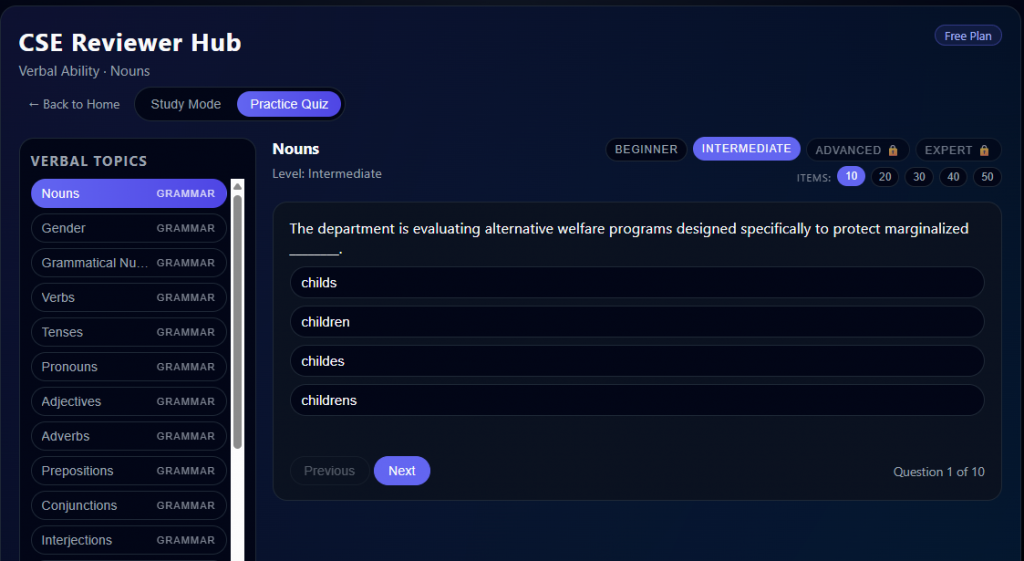
Start the Free Verbal Ability Reviewer
What Is the Verbal Ability Test in the Civil Service Exam?
Purpose
Verbal Ability exists to measure whether an examinee can communicate clearly and understand written information accurately — two skills that matter in nearly every government role, from front-line clerical work to policy-level writing. Government employees regularly draft memos, interpret regulations, and communicate with the public, so the exam treats language competency as a core, non-negotiable skill rather than a soft add-on.
Skills Measured
The section evaluates several distinct competencies at once: vocabulary depth, grammatical accuracy, the ability to follow and organize logical structure in writing, and reading comprehension under time pressure. It isn’t testing whether you can recognize a rule when it’s explained to you — it’s testing whether you can apply that rule instantly, while reading unfamiliar sentences and passages you’ve never seen before.
English and Filipino Coverage
Verbal Ability isn’t limited to English. The Filipino portion covers talasalitaan (vocabulary), wastong gamit ng wika (correct language usage), and pagbasa at pag-unawa (reading comprehension), testing the same underlying skills in the national language. Examinees who prepare only in English often leave points on the table in the Filipino portion simply because they never reviewed grammar and vocabulary rules formally in Filipino, even though they speak it fluently day to day.
Professional vs. Subprofessional
Verbal Ability appears on both the Professional and Subprofessional levels of the CSE-PPT, and the core skills tested are largely the same across both. What differs between the two levels is the surrounding exam structure — the Professional level pairs Verbal Ability with Analytical Ability, while the Subprofessional level pairs it with Clerical Ability instead. Regardless of which level you’re taking, a strong Verbal Ability score contributes meaningfully to your overall passing rating, since it’s one of the largest single subject blocks on the exam.
Topics Covered in the Verbal Ability Reviewer
Vocabulary
This covers word meanings, usage in context, and the ability to distinguish between words that seem similar but carry different shades of meaning. Strong vocabulary isn’t built by memorizing word lists in isolation — it comes from repeated exposure to words used correctly in real sentences, which is why context-based practice works better than flashcards alone.
Grammar
Grammar items test subject-verb agreement, correct tense usage, article and preposition placement, and common usage errors that even fluent speakers make out of habit. This is often the most “trainable” part of Verbal Ability, since grammar rules are fixed and finite — unlike vocabulary, which requires broader exposure, grammar rewards focused, repeatable drilling.
Reading Comprehension
Reading Comprehension presents a short passage followed by questions about its main idea, supporting details, tone, or implied meaning. The core challenge here isn’t understanding the passage in a relaxed setting — it’s extracting the correct answer quickly, under time pressure, without re-reading the entire passage multiple times.
Sentence Completion
These items present a sentence with one or more blanks and ask you to choose the word or phrase that completes it correctly, both grammatically and in meaning. Sentence completion tests vocabulary and grammar simultaneously, which makes it one of the more efficient question types for gauging overall language competency.
Paragraph Organization
Paragraph organization items scramble a set of sentences and ask you to arrange them into a logically coherent paragraph. This tests your sense of narrative and logical flow — recognizing transition words, cause-and-effect relationships, and topic sentences that signal where a paragraph should begin.
Synonyms and Antonyms
Synonym items ask for a word with the same or nearly the same meaning as an underlined word; antonym items ask for the opposite. These questions are deceptively simple-looking but frequently include distractor options that are related in meaning but not actually correct, which is why reading each option carefully matters more than answering on instinct.
Word Analogy
Analogy items present a pair of words with a specific relationship (such as cause-and-effect, part-to-whole, or synonym pairs) and ask you to identify a second pair with the same relationship. The key skill here is naming the relationship explicitly in your head before scanning the answer choices, rather than guessing based on surface similarity.
Free Verbal Ability Practice Questions
Below are 50 sample questions across the five most heavily tested Verbal Ability formats. Try to answer each one before checking the answer key, and time yourself if you can — aim for under a minute per item, which mirrors real exam pacing.
Vocabulary (10 Questions)
- The manager’s decision was arbitrary, made without any clear standard. A. Consistent B. Random C. Deliberate D. Fair
- The witness gave a candid account of the events. A. Vague B. Honest C. Biased D. Reluctant
- The new policy was met with widespread approval. A. Limited B. Extensive C. Mild D. Formal
- Her meticulous attention to detail impressed the auditors. A. Careless B. Careful C. Quick D. Casual
- The negotiations reached an impasse. A. Agreement B. Deadlock C. Compromise D. Delay
- The employee’s integrity was never in question. A. Honesty B. Ambition C. Skill D. Patience
- The report was criticized for being superficial. A. Detailed B. Shallow C. Accurate D. Lengthy
- The director’s approach was pragmatic rather than idealistic. A. Impractical B. Practical C. Emotional D. Theoretical
- The community showed resilience after the disaster. A. Weakness B. Recovery strength C. Anger D. Confusion
- The findings were inconclusive. A. Certain B. Undetermined C. Final D. Clear
Answer Key: 1-B, 2-B, 3-B, 4-B, 5-B, 6-A, 7-B, 8-B, 9-B, 10-B
Worked Example (Q1): “Arbitrary” describes a decision made on personal whim rather than a fixed rule or standard. “Random” is the closest match, since both words point to a lack of consistent, principled reasoning behind the decision. “Deliberate” is a common trap here — it suggests intentional action, which is the opposite of what “arbitrary” implies.
Grammar (10 Questions)
- Each of the applicants _____ required to submit a valid ID. A. are B. is C. were D. have been
- Neither the supervisor nor the staff members _____ aware of the change. A. was B. were C. is D. has been
- The committee _____ its report yesterday. A. submit B. submits C. submitted D. submitting
- By the time the exam starts, most examinees _____ their materials. A. organize B. will organize C. will have organized D. organized
- She is one of the employees who _____ always on time. A. is B. are C. was D. be
- The data _____ still being reviewed by the panel. A. is B. are C. was D. be
- If the applicant _____ the requirements, she would have qualified. A. meets B. met C. had met D. will meet
- The number of applicants _____ increased this year. A. have B. has C. were D. are
- Everyone _____ asked to bring two valid IDs. A. are B. is C. were D. have
- The reports, along with the summary, _____ due tomorrow. A. is B. are C. were D. have been
Answer Key: 1-B, 2-B, 3-C, 4-C, 5-B, 6-B, 7-C, 8-B, 9-B, 10-A
Worked Example (Q8): “The number of applicants” takes a singular verb because “the number” is the subject, not “applicants.” This is a classic trap — many examinees instinctively match the verb to the nearest noun (“applicants”) instead of the true subject of the sentence, which is exactly the kind of error civil service Grammar items are designed to catch.
Reading Comprehension (10 Questions)
Passage 1: Government agencies increasingly rely on digital platforms to process applications and disseminate public information. While this shift has improved efficiency and reduced processing time for many transactions, it has also raised concerns about accessibility for citizens in remote areas with limited internet connectivity. Agencies have responded by maintaining hybrid systems that combine online services with traditional walk-in options, ensuring that digital transformation does not leave any segment of the population behind.
- What is the main idea of the passage? A. Digital platforms have replaced all government services. B. Government agencies balance digital efficiency with accessibility concerns. C. Remote areas have no access to government services. D. Hybrid systems are being phased out.
- Why did agencies maintain hybrid systems? A. To reduce costs B. To ensure accessibility for all citizens C. To slow down digitalization D. To satisfy legal requirements only
- According to the passage, what is one benefit of digital platforms? A. Reduced processing time B. Elimination of paperwork entirely C. Lower application fees D. Increased staffing
- What concern does the passage raise about digitalization? A. Security risks B. Accessibility for remote areas C. Job losses D. Higher costs
- What can be inferred about the agencies’ approach? A. They prioritize efficiency over citizens’ needs. B. They aim to balance innovation with inclusivity. C. They plan to eliminate walk-in services soon. D. They are indifferent to connectivity issues.
Answer Key: 1-B, 2-B, 3-A, 4-B, 5-B
Passage 2: Effective public communication requires clarity, accuracy, and timeliness. When government offices delay releasing information or use overly technical language, public trust erodes, even if the underlying policy is sound. Plain language guidelines have therefore become a growing priority in public administration, encouraging agencies to write for the general public rather than for fellow specialists.
- What does the passage suggest damages public trust? A. Accurate information B. Delayed or overly technical communication C. Frequent updates D. Public consultations
- What is the purpose of plain language guidelines? A. To make writing more technical B. To help the public understand information easily C. To reduce the number of publications D. To standardize government logos
- Who are plain language guidelines meant to serve? A. Fellow specialists only B. The general public C. Legal experts only D. International agencies
- According to the passage, what three qualities does effective communication require? A. Speed, humor, brevity B. Clarity, accuracy, timeliness C. Formality, length, detail D. Confidentiality, precision, tone
- What is the tone of the passage? A. Sarcastic B. Informative C. Dismissive D. Apologetic
Answer Key: 6-B, 7-B, 8-B, 9-B, 10-B
Sentence Completion (10 Questions)
- The applicant was asked to _____ additional documents before the deadline. A. submit B. submits C. submitting D. submission
- Despite the heavy rain, the examinees _____ arrived on time. A. still B. never C. hardly D. rarely
- The office implemented new procedures to _____ efficiency. A. reduce B. improve C. delay D. ignore
- The manager was _____ pleased with the team’s performance. A. extreme B. extremely C. extremity D. extremist
- _____ the applicant lacked experience, she was still hired for her potential. A. Because B. Although C. Since D. So
- The report must be submitted _____ Friday. A. until B. by C. since D. from
- The new employee adapted _____ to the workplace culture. A. quick B. quickly C. quickness D. quicker
- The office was closed due to _____ maintenance work. A. schedule B. scheduled C. scheduling D. schedules
- The applicants were informed _____ the results would be released next week. A. that B. what C. which D. who
- The committee will convene _____ the final decision is made. A. until B. unless C. so that D. because
Answer Key: 1-A, 2-A, 3-B, 4-B, 5-B, 6-B, 7-B, 8-B, 9-A, 10-C
Word Analogy (10 Questions)
- DOCTOR : HOSPITAL :: TEACHER : ? A. Classroom B. School C. Book D. Student
- PEN : WRITE :: KNIFE : ? A. Sharp B. Cut C. Kitchen D. Metal
- AUTHOR : BOOK :: ARCHITECT : ? A. Building B. Design C. City D. Tools
- FISH : SCHOOL :: WOLF : ? A. Pack B. Herd C. Flock D. Group
- THIRST : DRINK :: HUNGER : ? A. Cook B. Eat C. Kitchen D. Food
- LAW : LEGISLATURE :: VERDICT : ? A. Judge B. Court C. Jury D. Trial
- SEED : TREE :: EGG : ? A. Nest B. Bird C. Feather D. Chick
- THERMOMETER : TEMPERATURE :: SCALE : ? A. Balance B. Weight C. Numbers D. Measurement
- IGNORANCE : KNOWLEDGE :: DARKNESS : ? A. Night B. Light C. Shadow D. Moon
- PILOT : AIRPLANE :: CAPTAIN : ? A. Ocean B. Ship C. Crew D. Navy
Answer Key: 1-B, 2-B, 3-A, 4-A, 5-B, 6-C, 7-D, 8-D, 9-B, 10-B
Worked Example (Q4): The relationship in “FISH : SCHOOL” is animal-to-group-name. A group of fish is called a “school,” so the correct match must name the specific term for a group of wolves, which is a “pack.” “Herd,” “flock,” and “group” are all group-related words, but only “pack” is the specific term that matches a wolf group, which is what analogy questions are really testing — precision, not just general association.
Start the Free Verbal Ability Reviewer
Bonus: Paragraph Organization Example
Paragraph organization doesn’t lend itself to a simple multiple-choice format the way vocabulary or grammar does, but here’s how a typical item works. You’re given four scrambled sentences and asked to arrange them into the most logical order:
(1) As a result, the office extended its filing deadline by two weeks. (2) The agency initially set a strict deadline for document submission. (3) However, many applicants reported technical issues with the online portal. (4) This adjustment allowed more applicants to complete their submissions without penalty.
Correct order: 2, 3, 1, 4
Explanation: Sentence 2 introduces the original situation (a strict deadline). Sentence 3 introduces a complication using the transition word “however.” Sentence 1 shows the resulting action, signaled by “as a result.” Sentence 4 closes the paragraph with the outcome of that action. Spotting transition words like “however,” “as a result,” and “this adjustment” is the fastest way to reconstruct the intended logical sequence without having to guess.
Common Mistakes Examinees Make
Reading too fast. In an effort to save time, many examinees skim passages and questions so quickly that they miss key qualifying words like “except,” “not,” or “mainly,” which completely change what the question is actually asking. A single skipped qualifier can flip the correct answer entirely, which is why re-reading the question stem itself — not just the passage — is worth the extra few seconds.
Ignoring context clues. Vocabulary and sentence completion items are almost always solvable using context, even when the target word is unfamiliar. Examinees who try to answer from memorized definitions alone, instead of reading the surrounding sentence carefully, miss clues that would have led them to the right answer. A sentence often “explains” a difficult word through the rest of its own structure — the tone, the contrast words like “but” or “however,” or the example that follows it.
Memorizing without understanding. Cramming vocabulary lists the night before rarely works, because the exam tests words in context, not in isolation. A word you’ve memorized as a flashcard definition can still trip you up if you don’t recognize how it functions inside an actual sentence. Understanding a word through several different example sentences builds more durable recall than repeating a single dictionary definition.
Poor vocabulary range. Verbal Ability draws from everyday, formal, and semi-technical vocabulary. Examinees who only read casual, conversational material — texts, social media captions, casual chat — tend to have narrower vocabulary exposure than examinees who regularly read newspapers, formal reports, or well-edited books. Widening your reading diet, even by just a few articles a week, compounds noticeably over a full review period.
Running out of time. Because Verbal Ability shares a single overall time allotment with the rest of the exam, spending too long agonizing over one difficult vocabulary word can cost you several easier points later in the section. Learning to make a confident guess and move on is itself a skill worth practicing, and it’s exactly what timed mock exams are designed to train.
Overthinking simple items. Some examinees second-guess an answer that was correct on their first instinct, talking themselves out of it after too much deliberation. When you’ve genuinely reviewed the material, your first read of a question is often more reliable than you think — reserve deep reconsideration for questions you were actually unsure about, not ones you already answered confidently.
Tips to Improve Your Verbal Ability Score
Read newspapers. Reading English and Filipino news articles regularly exposes you to formal sentence structures, current vocabulary, and well-organized paragraphs — almost exactly the register the exam tests.
Learn root words. Many English words share Latin or Greek roots. Learning common roots, prefixes, and suffixes (like “bene-” meaning good, or “-vert” meaning turn) lets you make educated guesses on unfamiliar words instead of guessing blindly.
Practice every day. Short, consistent daily practice — even just fifteen to twenty minutes — builds pattern recognition far more effectively than occasional long cram sessions. Verbal skills are built through repetition over time, not a single intense study session.
Use the elimination technique. When unsure of the correct answer, eliminate the options you’re confident are wrong first. Removing even one or two clearly incorrect choices significantly improves your odds on an educated guess.
Time yourself. Practicing without a timer builds knowledge but not exam-day pacing. Time your practice sets from the start, so you develop an instinct for how long a minute actually feels while reading and answering.
How Our Verbal Ability Reviewer Works
The reviewer is structured as a clear progression, so you build skills in the right order instead of jumping randomly between difficulty levels.
Easy → Medium → Advanced → Performance → Progress
You start with foundational, easy-level items to build confidence and confirm the basics, move into medium-difficulty questions that mirror typical exam items, and finish with advanced questions designed to stretch your skills past what the actual exam usually demands. Along the way, a performance summary shows your accuracy by topic, and a progress view tracks your improvement across sessions over time.
[ Screenshot: Easy → Medium → Advanced progression ] [ Screenshot: Performance and Progress dashboard ]
Free Reviewer vs Practice Mode
| Feature | Free Reviewer | PRO Practice Mode |
|---|---|---|
| Topic-by-topic lessons | ✅ | ✅ |
| Easy → Advanced questions | ✅ | ✅ |
| Timed practice sessions | ❌ | ✅ |
| Unlimited attempts | ✅ | ✅ |
| Performance analytics | ❌ | ✅ |
| Progress tracking | ❌ | ✅ |
| Detailed explanations | ✅ | ✅ |
The Free Reviewer is a genuinely useful starting point — full topic lessons and a real spread of easy-to-advanced questions, at no cost. PRO Practice Mode adds the layer that turns casual practice into structured exam preparation: timed sessions that mirror real pacing, unlimited attempts so you can drill a weak topic as many times as needed, and full performance analytics that show exactly which sub-topics — grammar tenses, specific vocabulary categories, analogy types — are actually holding your score back.
Start the Free Verbal Ability Reviewer
Study Plan for Verbal Ability
A five-week plan works well for most examinees, though you can compress it if your exam date is closer.
Week 1 — Vocabulary. Focus on synonyms, antonyms, and context-based vocabulary. Read at least one newspaper article daily and note unfamiliar words.
Week 2 — Grammar. Drill subject-verb agreement, tenses, and common usage errors. Grammar has fixed rules, so repetition here produces fast, measurable improvement.
Week 3 — Reading. Practice full passages under time pressure, focusing on main idea, supporting details, and inference questions specifically.
Week 4 — Mixed Practice. Combine all topics — vocabulary, grammar, reading, sentence completion, and analogy — in randomized sets, the way they’ll actually appear on the real exam.
Week 5 — Mock Exam. Take a full, timed simulation to test your pacing and stamina across the entire Verbal Ability section, then review every mistake before your actual exam date.
Verbal Ability Readiness Checklist™
Use this checklist to confirm you’re genuinely ready, not just familiar with the material.
☐ Understand grammar rules ☐ Know common vocabulary ☐ Score 80% in practice ☐ Finish within time ☐ Ready for mock exam
Verbal Ability Mastery Roadmap™
This is the structured sequence we recommend for building Verbal Ability skills from the ground up, and it’s the same order this reviewer follows internally.
Vocabulary ↓ Grammar ↓ Sentence Completion ↓ Reading Comprehension ↓ Analogy ↓ Mixed Practice ↓ 170-Item Mock Exam
Each stage builds on the one before it. Vocabulary and grammar form the raw materials; sentence completion applies both together; reading comprehension tests sustained application across longer text; analogy sharpens precise reasoning about word relationships; mixed practice forces you to switch between all of them under exam-like variety; and the full 170-item mock exam, a PRO-exclusive feature, is the final test of whether everything holds up under real timed conditions.
Frequently Asked Questions
What is Verbal Ability? Verbal Ability is a major subject on the CSE-PPT that tests grammar, vocabulary, sentence construction, and reading comprehension in both English and Filipino.
How many Verbal Ability questions are in the Civil Service Exam? Verbal Ability makes up a significant portion of the total items on both the Professional and Subprofessional levels, spanning multiple question types including vocabulary, grammar, sentence completion, reading comprehension, and analogy.
Is Verbal Ability difficult? It isn’t conceptually difficult for most examinees, since it draws on everyday language skills, but it’s easy to underestimate. Many examinees lose points not because the material is hard, but because they didn’t practice applying grammar and vocabulary rules quickly under time pressure.
How can I improve my Verbal Ability score? Consistent daily practice, wide reading exposure (newspapers, formal texts), learning root words for vocabulary, and timed practice sessions are the most effective ways to build measurable improvement over a few weeks.
Is this reviewer free? Yes. The topic-by-topic lessons and a full spread of easy-to-advanced practice questions are free to use. Timed sessions, unlimited attempts, performance analytics, and the full 170-item mock exam are part of PRO Practice Mode.
Can I practice on mobile? Yes. The entire reviewer, including Practice Mode, is built to work smoothly on mobile browsers, so you can study from your phone anytime.
Is Practice Mode included in the free plan? No. Practice Mode — with timed sessions, unlimited attempts, and analytics — is a PRO-exclusive upgrade. The free plan includes topic lessons and standard practice questions.
How often should I review Verbal Ability? Short, daily sessions of fifteen to twenty minutes tend to produce better long-term retention than infrequent, longer sessions. Consistency matters more than session length for language-based subjects like this one.
Ready to Improve Your Verbal Ability?
Practice by topic. Build confidence. Track your progress.
You don’t need to memorize a dictionary or relearn grammar from scratch to do well on this section — you need structured, repeated exposure to the exact question types the exam actually uses, and an honest sense of where your specific weak spots are. That’s what this reviewer is built to give you, starting today at no cost.
Upgrade to Practice Mode when you’re ready for timed exercises and detailed performance analytics that show exactly which sub-skills still need work before your exam date.
Start the Free Verbal Ability Reviewer
Related Guides
- Numerical Ability Reviewer for Civil Service Exam: Practice Questions and Solutions
- Civil Service Exam Analytical Ability Reviewer: 100-Question Interactive Mock Exam
- Analogy Reviewer: 100 Civil Service Questions and Answers
- Civil Service Exam Reviewer: Complete Guide
- Civil Service Exam Requirements 2026: Complete Application Guide and Checklist
- CSC Eligibility: Professional vs Subprofessional Exam – What’s the Difference?
- Civil Service Exam Coverage 2026: Complete Guide for Filipino Examinees
- Free Civil Service Exam Reviewer: Practice Questions & Mock Exam Online
- 170-Item Civil Service Mock Exam: Timed Practice Test