Quick Answer
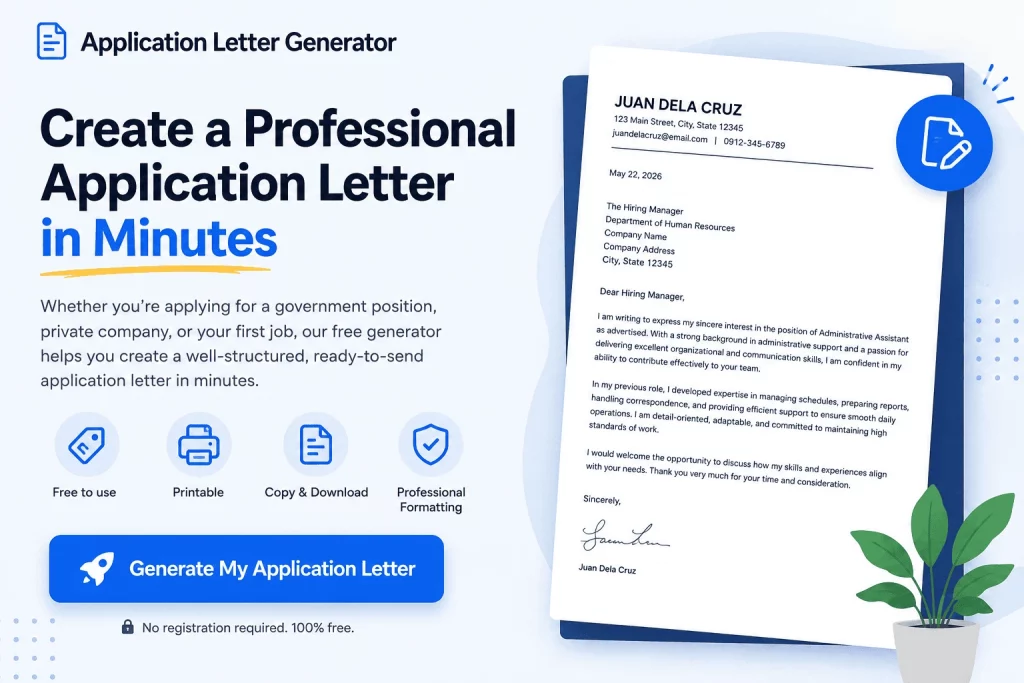
An application letter is a one-page formal letter that introduces a job applicant to an employer, states the position being applied for, and highlights relevant skills, experience, and qualifications. In the Philippines, it is typically submitted alongside a resume and, for government positions, a Personal Data Sheet (PDS). This free Application Letter Generator helps job seekers — including fresh graduates, experienced professionals, and government applicants — produce a properly formatted, ready-to-send letter in minutes, without starting from a blank page.
Create Your Application Letter in Minutes
Job hunting in the Philippines almost always starts with the same blank-page problem: you know you need an application letter, but you’re not sure how to open it, what to include in the body, or how formal it should sound. This tool removes that friction. Whether you’re applying to a government office, a local government unit (LGU), a private company, or submitting your very first job application as a fresh graduate, the generator builds a structured, professional draft based on the details you provide.
You can generate an application letter for:
- Government Jobs — national agencies, GOCCs, and Civil Service–covered positions
- DepEd Applications — teaching and non-teaching positions in public schools
- LGU Positions — city hall, municipal, provincial, and barangay-level roles
- Private Companies — corporate, retail, BPO, and service-industry employers
- Fresh Graduates — first-time applicants with little or no work experience
- Experienced Professionals — career changers and applicants with a solid work history
Key features:
- ✅ Free to use
- ✅ Printable
- ✅ Copy and Download
- ✅ Government-friendly format
Generate My Application Letter
What Is an Application Letter?
An application letter — sometimes called a cover letter or letter of intent, though the three terms are technically distinct — is a formal, single-page letter that introduces you to a potential employer and explains why you are applying for a specific position. It is almost always submitted together with a resume, and for Philippine government positions, it typically accompanies a Personal Data Sheet (PDS), transcript of records, and other supporting documents required by the hiring agency.
Unlike a resume, which lists your qualifications in outline form, an application letter tells a short, focused story: who you are, what position you’re applying for, why you’re qualified, and why the employer should grant you an interview. Hiring officers — whether in a government Human Resource Merit Promotion and Selection Board (HRMPSB), a private company’s HR department, or a school division office — use it as a first impression of your written communication skills, attention to detail, and genuine interest in the role.
In the Philippine setting, the application letter carries slightly more formal weight than in many Western hiring cultures. Government hiring processes, in particular, often treat the application letter as a required document with its own checklist item, separate from the resume and PDS. This makes getting the format and tone right especially important for public-sector applicants.
Why It Still Matters in 2026
Even as online job portals, LinkedIn profiles, and one-click “Easy Apply” buttons become more common, the formal application letter has not disappeared from Philippine hiring — particularly in government, education, and traditional corporate sectors. Civil Service Commission (CSC) guidelines and most Department of Education (DepEd) division offices still list an application letter as a standard requirement for vacancy postings. Many private companies, especially those with formal HR departments, also expect a letter that accompanies the resume, even if it’s submitted as the body of an email.
Why Use an Application Letter Generator?
Writing a strong application letter from scratch takes more time than most applicants expect — you need to get the salutation right, structure the paragraphs logically, choose a tone appropriate to the employer, and avoid sounding generic. A generator solves each of these problems at once.
Saves Time
Instead of staring at a blank document trying to figure out how to start, you answer a short series of prompts — your name, the position, the employer — and receive a structured draft in seconds. You can then adjust the wording to match your voice before sending it out.
Government-Friendly Format
Government hiring in the Philippines follows conventions that differ slightly from private-sector norms: more formal salutations, references to Civil Service eligibility, and a tone that leans traditional rather than casual. This generator is designed with those conventions in mind, so applicants targeting DepEd, LGUs, or national government agencies don’t have to guess at the expected format.
Suitable for Fresh Graduates
New graduates often struggle most with application letters, simply because they don’t yet have a long work history to describe. The generator adjusts its guidance for this situation, prompting fresh graduates to highlight academic achievements, internships, on-the-job training (OJT), relevant coursework, and transferable skills instead of forcing them to pad the letter with irrelevant experience.
Professional Structure
A formal business letter has a specific structure — sender’s information, date, recipient’s information, salutation, body paragraphs, closing, and signature block. Skipping or misordering any of these elements can make an otherwise strong applicant look careless. The generator enforces this structure automatically.
How to Use the Application Letter Generator
Using the tool takes about five simple steps, most of which involve information you already have on hand.
Step 1: Choose a Writing Style
Select the tone that best matches the position and employer:
- Formal / Traditional — best for government offices, banks, and conservative industries
- Modern — a slightly more contemporary tone for private companies and startups
- Concise — a shorter version for employers who prefer brevity
- Government / CSC — follows Civil Service–aligned conventions and language
- Fresh Graduate — emphasizes academic background and potential over work history
- Experienced Professional — leads with career achievements and measurable results
Step 2: Enter Your Details
Provide your basic applicant information:
- Full Name
- Complete Address
- Contact Number
- Email Address
Step 3: Provide Employer Details
Enter the information of the office or company you’re applying to:
- Agency or Company Name
- Hiring Manager or HR Officer’s Name (if known)
- Office Address
Step 4: Enter the Position You’re Applying For
Be specific. Use the exact position title as it appears on the vacancy announcement — for example, “Administrative Assistant I” rather than just “admin position.” Precision here matters more than most applicants realize, especially in government hiring, where position titles correspond to specific salary grades and qualification standards.
Step 5: Generate Your Application Letter Instantly
Click generate, and the tool will produce a complete, properly formatted draft. Review it, personalize a sentence or two so it doesn’t read as generic, and download or copy the final version.
The ApplySmartPH Application Letter Checklist™
Before you finalize any application letter — government or private sector — run it against this quick-reference checklist. It’s the same baseline standard used across every template and sample on ApplySmartPH.
| Item | Required |
|---|---|
| Application Letter | ✓ |
| Resume | ✓ |
| Personal Data Sheet (PDS) | ✓ (government only) |
| Eligibility Documents | ✓ (government / licensed roles) |
| Transcript of Records (TOR) | ✓ |
| Certificate of Employment | Situational |
| Training Certificates | Situational |
| Performance Ratings | Situational (government only) |
If every “Required” row is checked off before you hit send, your application packet meets the baseline standard expected by most Philippine government agencies and private-sector HR departments.
Application Letter Format
A standard Philippine application letter follows the structure of a formal business letter. Below is a breakdown of each section and what belongs in it.
1. Applicant Information (Letterhead Block)
Place this at the top-left of the page:
- Full Name
- Complete Address
- Contact Number
- Email Address
- Date (the current date the letter is being sent)
2. Recipient Information
Directly below your own details, include:
- Agency or Company Name
- Hiring Manager’s Name and Title (if available; use “The Human Resource Manager” or the equivalent office head if the specific name is unknown)
- Office Address
3. Salutation
Use a formal greeting. “Dear Sir/Madam,” “Dear Hiring Manager,” or, for government positions, “Dear Chairperson, HRMPSB” are all acceptable depending on the addressee. If you know the recipient’s name, use it: “Dear Ms. Santos.”
4. Opening Paragraph
State clearly and immediately the position you are applying for, and where you learned about the opening (job portal, agency website, referral, newspaper posting, etc.). This paragraph should be brief — two to three sentences is enough.
5. Body Paragraph(s)
This is the core of the letter. Highlight:
- Skills relevant to the position
- Experience — prior roles, responsibilities, and accomplishments
- Eligibility — Civil Service Eligibility, board licenses, or other required certifications, especially for government roles
- Achievements — measurable results, awards, or recognitions that support your candidacy
Keep this section to one or two paragraphs. Avoid restating your entire resume; instead, choose two or three points that best match the position’s requirements.
6. Closing Paragraph
Politely request consideration for the position and express interest in attending an interview. Thank the reader for their time, and mention that supporting documents are attached.
7. Signature Block
End with a formal closing (“Respectfully yours,” or “Sincerely,”) followed by your printed name. Leave space above your printed name for a physical signature if the letter will be printed and submitted in hard copy.
Sample Application Letter for Government Jobs
Target Position: Administrative Assistant I
[Your Complete Address] [Contact Number] | [Email Address] [Date]
The Chairperson HRMPSB, [Agency Name] [Office Address]
Dear Sir/Madam:
I am writing to apply for the position of Administrative Assistant I as posted on [source of vacancy announcement, e.g., the agency’s official website or CSC job portal]. I believe my educational background, Civil Service Eligibility, and administrative experience make me a strong candidate for this role.
I am a Career Service Professional eligible, having passed the Civil Service Examination in [year]. I hold a Bachelor’s degree in [course], and I have [number] years of experience performing administrative and clerical functions, including records management, correspondence handling, and scheduling support. In my previous role at [previous employer or office], I was responsible for maintaining accurate filing systems, preparing reports, and assisting walk-in clients and stakeholders — tasks that closely align with the responsibilities of this position.
I am particularly drawn to this opportunity because of my strong interest in public service. I take pride in delivering accurate, timely, and courteous support to the offices and communities I serve, and I am confident that this commitment would carry over into the Administrative Assistant I role at your agency.
Attached to this letter are my resume, Personal Data Sheet (PDS), Civil Service Eligibility certificate, transcript of records, and other supporting documents. I would welcome the opportunity to discuss my qualifications further in an interview at your convenience.
Thank you for considering my application. I look forward to your favorable response.
Respectfully yours, [Your Full Name]
This sample runs approximately 260 words — within the ideal one-page length for government applications — and follows the tone typically expected in Civil Service–aligned hiring: formal, direct, and grounded in eligibility and public-service motivation.
Government Job Application Checklist
Before submitting, make sure your application packet includes all of the following:
- ✓ Application Letter
- ✓ Personal Data Sheet (PDS) — CSC Form No. 212, latest revision
- ✓ Transcript of Records
- ✓ Eligibility Documents (Civil Service Eligibility certificate, board license, or equivalent)
- ✓ Certificate of Employment (for applicants with prior work experience)
- ✓ Training Certificates (relevant seminars, workshops, or certifications)
- ✓ Performance Ratings (if applicable, from your current or most recent employer)
Missing even one item on this checklist is one of the most common reasons applications get set aside during initial screening, especially in government hiring, where HRMPSBs typically follow a strict document-completeness review before evaluating qualifications.
Sample Application Letter for Fresh Graduates
Target Position: Administrative Aide
[Your Complete Address] [Contact Number] | [Email Address] [Date]
[Hiring Manager’s Name or “The Human Resource Officer”] [Company/Office Name] [Office Address]
Dear Sir/Madam:
I am writing to express my interest in the Administrative Aide position recently posted by your office. As a fresh graduate of [Course Name] from [School Name], I am eager to begin my professional career and believe this role is an excellent opportunity to apply the skills I developed throughout my studies and internship.
During my academic training, I completed [number] hours of on-the-job training at [company/agency], where I assisted with basic clerical work, data encoding, and document processing. This experience gave me a solid foundation in office procedures, as well as an appreciation for accuracy and confidentiality when handling records. I am also proficient in Microsoft Office applications, and I have strong organizational and communication skills that I developed through group projects and student leadership activities in school.
While I recognize that I am still early in my career, I am a fast learner, highly trainable, and genuinely enthusiastic about contributing to your office. I am confident that my academic background, combined with my willingness to learn and grow, would make me a valuable addition to your team.
I have attached my resume, transcript of records, diploma or certificate of graduation, and other relevant documents for your review. I would greatly appreciate the opportunity to discuss my application further at your convenience.
Thank you very much for your time and consideration.
Sincerely, [Your Full Name]
Fresh graduates often worry that a lack of work experience will weaken their application. In practice, hiring officers expect entry-level candidates to lean on academic achievements, internships, and demonstrated willingness to learn — which is exactly what this sample does.
Sample Application Letter for Private Companies
Target Position: Customer Service Representative
[Your Complete Address] [Contact Number] | [Email Address] [Date]
[Hiring Manager’s Name] [Company Name] [Company Address]
Dear [Hiring Manager’s Name / Hiring Manager]:
I am excited to apply for the Customer Service Representative position at [Company Name], as advertised on [job portal or company website]. With [number] years of experience in customer-facing roles and a strong track record of resolving concerns efficiently, I am confident I can contribute positively to your team.
In my previous role at [Previous Company], I handled an average of [number] customer interactions daily across phone, email, and chat support, consistently meeting or exceeding customer satisfaction targets. I have experience de-escalating difficult situations, troubleshooting account or product issues, and collaborating with other departments to resolve concerns quickly. My strong communication skills, patience, and ability to stay calm under pressure have consistently earned positive feedback from both customers and supervisors.
I am particularly interested in joining [Company Name] because of [specific reason related to the company — its reputation, growth, values, or industry]. I am confident that my background in customer service, combined with my adaptability and results-driven mindset, would allow me to make a meaningful contribution to your team from day one.
I have attached my resume and other relevant documents for your review. I would welcome the opportunity to discuss how my experience aligns with your team’s needs in an interview.
Thank you for your time and consideration.
Sincerely, [Your Full Name]
Notice that this version is slightly less formal in tone than the government sample, and it makes room for a specific, personalized reason for applying to that particular company — something private-sector hiring managers often look for as a sign of genuine interest rather than a mass-sent application.
Sample Application Letter for Experienced Professionals
Target Position: Finance Officer
[Your Complete Address] [Contact Number] | [Email Address] [Date]
[Hiring Manager’s Name] [Company/Agency Name] [Office Address]
Dear [Hiring Manager’s Name / Sir/Madam]:
I am writing to apply for the position of Finance Officer at [Company/Agency Name], as advertised on [source of vacancy]. With over [number] years of progressive experience in financial management, budgeting, and reporting, I am confident that my background aligns well with the requirements of this role.
Over the course of my career, I have managed annual budgets of up to [amount], led month-end and year-end closing processes, and implemented internal control improvements that reduced processing errors by [percentage or measurable result]. Most recently, as [Previous Job Title] at [Previous Company], I supervised a team of [number] finance staff, coordinated external audits, and ensured full compliance with regulatory and reporting requirements. I hold a [relevant certification, e.g., CPA license or equivalent], and I am comfortable working with financial systems such as [relevant software, e.g., SAP, QuickBooks, or government financial systems].
Beyond technical competence, I bring strong analytical judgment and a track record of identifying cost-saving opportunities without compromising accuracy or compliance. I am confident that my depth of experience would allow me to contribute immediately and meaningfully to your finance team.
Enclosed are my resume, professional certifications, and other supporting documents for your review. I would welcome the opportunity to discuss how my experience can support your organization’s financial operations in an interview at your convenience.
Thank you for your time and consideration.
Sincerely, [Your Full Name]
This version leads with quantifiable results rather than eligibility or academic background — a shift in emphasis that experienced applicants should make once they have a track record to point to. Hiring managers reviewing applications for mid- to senior-level roles typically look for specific numbers, outcomes, and evidence of leadership, rather than a general description of duties.
Writing Tips by Applicant Type
Different applicants benefit from different emphasis in their letters. Use the guidance below alongside the generator to fine-tune your draft.
For Government Applicants
- Lead with your Civil Service Eligibility or relevant board license early in the letter — hiring committees often screen for this first.
- Reference the specific vacancy announcement number or posting source if one was provided; this helps HR staff match your application to the correct opening.
- Keep the tone formal throughout. Avoid casual phrasing, even in the closing paragraph.
- If applying through a Provincial, City, or Municipal HRMPSB, address the letter to “The Chairperson, HRMPSB” unless a specific name is given.
For Fresh Graduates
- Don’t apologize for lacking experience. Frame your OJT, academic projects, and extracurricular involvement as genuine, relevant preparation for the role.
- Mention specific software, tools, or skills gained during training that directly relate to the position.
- Keep the letter shorter than a mid-career applicant’s — one to two solid paragraphs of substance is enough.
For Experienced Professionals
- Prioritize measurable achievements (percentages, amounts, team sizes, project outcomes) over a list of duties.
- Mention only the most recent and most relevant roles; a full career history belongs in the resume, not the letter.
- If changing industries, briefly acknowledge the shift and connect your transferable skills directly to the needs of the new role.
For Private Sector Applicants
- Research the company briefly and mention one specific, genuine reason you’re interested in working there — this single detail often differentiates a real applicant from a mass-sent one.
- Match your tone to the company culture; a startup or creative agency may welcome a slightly less formal voice than a bank or multinational corporation.
- Keep contact details (phone, email, and if relevant, LinkedIn profile) clearly visible near the top of the letter.
Where to Submit Your Application Letter
How you submit your application letter can matter as much as how you write it.
For government positions, application letters are typically submitted as physical or scanned documents attached to a complete application packet, which may include the PDS (CSC Form No. 212), resume, eligibility certificates, and transcript of records. Some agencies now accept submissions through online portals or email, but the letter itself should still follow the same formal, printable format described above.
For private companies, application letters are frequently submitted in one of two ways: as a separate attached file (PDF or Word document) alongside the resume, or pasted directly into the body of an email, with the resume attached separately. When submitting by email, keep the subject line clear and specific — for example, “Application for Customer Service Representative – [Your Name]” — so the letter is easy for HR staff to locate and route correctly.
Regardless of the submission method, always save or export your final letter as a PDF before sending, unless the employer specifically requests another format. A PDF preserves your formatting exactly as intended, regardless of the device or software used to open it.
The ApplySmartPH Application Letter Readiness Score™
Not sure if your letter is actually ready to submit? Use this self-assessment framework — developed specifically for Philippine job applicants — to score your draft before sending it out. Rate your letter honestly against each criterion, then check your total against the readiness bands below.
| Criterion | Points |
|---|---|
| Correct format (sender info, date, recipient block, salutation) | 20 |
| Position clearly stated in the opening sentence | 15 |
| Relevant skills and experience highlighted in the body | 20 |
| Eligibility or certifications mentioned, if applicable | 15 |
| Letter fits on one page | 10 |
| Free of grammar, spelling, and punctuation errors | 10 |
| Personalized to the specific employer or agency | 10 |
| Total | 100 |
Readiness Bands
- 90–100 — Submission Ready: Your letter meets professional and government-hiring standards. Do a final proofread and send it.
- 70–89 — Needs Minor Polish: Solid foundation, but revisit one or two weak areas — usually personalization or the opening sentence — before submitting.
- 50–69 — Needs Revision: Several core elements are missing or underdeveloped. Rebuild the body paragraph around your strongest, most relevant qualifications.
- Below 50 — Start Over: The letter is missing key structural elements. Restart using the format guide above, or regenerate using the tool with more complete details.
Readiness Score by Applicant Type
Different applicant types tend to lose points in different places. Use this quick guide to know where to focus:
Beginner Applicant — Most commonly loses points on “relevant skills and experience,” simply from unfamiliarity with how to frame limited experience. Focus on transferable skills and willingness to learn.
Fresh Graduate — Most commonly loses points on “eligibility or certifications” and “personalization.” Compensate with strong academic and OJT details, and always name the specific company or agency.
Government Applicant — Most commonly loses points on “correct format,” since government letters follow stricter formal conventions (correct salutation, HRMPSB addressing, item number references). Double-check the format section above before submitting.
Experienced Professional — Most commonly loses points on “letter fits on one page,” since longer work histories tempt applicants to over-explain. Keep only the two or three most relevant achievements.
Common Mistakes to Avoid
Even a well-structured application letter can fail to make an impression if it contains common, avoidable errors. Here are the mistakes hiring officers see most often — and how to avoid each one.
Generic Letters
Sending the same letter to every employer, with only the company name changed, is one of the fastest ways to get overlooked. Customize the letter for every position by referencing the specific role, the employer’s name, and at least one detail that shows you researched the position or organization.
Long Paragraphs
Dense, unbroken paragraphs are harder to read and signal poor communication skills. Keep each paragraph short — three to five sentences at most — and make sure the letter as a whole fits on a single page.
Grammar Errors
Spelling mistakes, inconsistent tenses, and awkward phrasing suggest carelessness, even if unintentional. Proofread the letter carefully before sending it — ideally by reading it aloud or asking someone else to review it — since errors are easy to miss in your own writing.
Missing Position Title
Always specify the exact position you’re applying for, ideally in the very first sentence. Vague openings like “I am writing to inquire about job opportunities” make it harder for HR staff to route your application correctly, especially in organizations hiring for multiple roles at once.
Forgetting Attachments
An application letter rarely stands alone. Applicants commonly attach the following supporting requirements along with the letter itself:
- Resume
- Personal Data Sheet or PDS (for government jobs)
- Eligibility Documents (Civil Service Eligibility, board license, etc.)
- Transcript of Records or Diploma (if required)
Before submitting, double-check the vacancy announcement for the complete list of required attachments — missing even one document can disqualify an otherwise strong application in government hiring processes.
Application Letter vs. Cover Letter vs. Letter of Intent
These three terms are frequently used interchangeably in the Philippines, but they serve slightly different purposes.
| Type | Purpose |
|---|---|
| Application Letter | Written specifically to apply for a particular, currently open position |
| Cover Letter | Accompanies a resume and briefly introduces the applicant; often shorter and more summary-focused |
| Letter of Intent | Expresses interest in working for an organization even when no specific vacancy currently exists |
In practice, most Philippine government and private-sector job postings use “application letter” as the standard term, and it typically functions as a combination of the first two — introducing the applicant, stating the position, and briefly summarizing qualifications, all in one document.
Frequently Asked Questions
Is an application letter required for government jobs in the Philippines?
Yes. Many government agencies, including national agencies, LGUs, and DepEd offices, require an application letter as part of the standard application package, typically alongside a resume, Personal Data Sheet (PDS), and eligibility documents. Requirements can vary slightly by agency, so applicants should always check the specific vacancy announcement.
How long should an application letter be?
An application letter should ideally fit on a single page — roughly 250 to 400 words. Hiring officers generally prefer letters that are concise and focused rather than long and repetitive of the resume.
Can fresh graduates use this generator?
Yes. The generator includes a “Fresh Graduate” style option specifically designed for applicants with little or no formal work experience, focusing instead on academic background, internships or OJT, and transferable skills.
Can I use this for DepEd applications?
Yes. The tool includes a government-friendly and CSC-aligned format suitable for DepEd teaching and non-teaching position applications, following the formal conventions typically expected by school division offices.
Is this tool free?
Yes. The Application Letter Generator is completely free to use, with no signup or payment required to generate, copy, or download your letter.
What is the difference between an application letter and a resume?
A resume is a structured, outline-style summary of your education, work experience, and skills. An application letter, by contrast, is a narrative document — it introduces you personally, states the specific position you’re applying for, and explains in a few sentences why you’re a strong fit. The two documents work together: the letter creates the first impression, and the resume provides the supporting detail.
Do I need a different application letter for every job I apply to?
Yes, ideally. While the overall structure of your letter can stay largely the same, you should always update the position title, the employer’s name, and at least one or two sentences that reference something specific about that particular job or organization. Hiring officers can easily spot a letter that was copy-pasted without any customization.
Should I address my application letter to a specific person?
Whenever possible, yes. If the vacancy announcement or job posting includes the name of the hiring manager, HR officer, or HRMPSB chairperson, use it. If no name is available, a general salutation such as “Dear Hiring Manager” or “Dear Sir/Madam” is an acceptable and widely used alternative in Philippine hiring practice.
Final Thoughts
A well-written application letter remains one of the simplest ways to stand out early in the hiring process — whether you’re applying to a government agency, a DepEd division office, an LGU, or a private company. It doesn’t need to be long or elaborate; it needs to be clear, specific to the position, and free of avoidable errors. Using a structured generator like this one takes care of the formatting and organization, so you can focus your energy on personalizing the details that will make your application memorable to the person reading it.
Ready to get started? Generate My Application Letter
Related Guides
- Civil Service Exam Requirements 2026: Complete Application Guide and Checklist
- CSC Eligibility: Professional vs Subprofessional Exam – What’s the Difference?
- Government Jobs in the Philippines 2026: Complete Job Search Guide
- CSC Eligibility Requirements: Complete Guide for Government Job Applicants
- Civil Service Exam Coverage 2026: Complete Guide for Filipino Examinees
- RA 1080 Eligibility Guide: Automatic Civil Service Eligibility for Board and Bar Passers
- Civil Service Exam Results: How to Check Your Rating, List of Passers & Release Date