Last updated: August 2026 | Applicable schedule: Third Tranche, Executive Order No. 64, s. 2024, effective January 1, 2026
Quick Answer
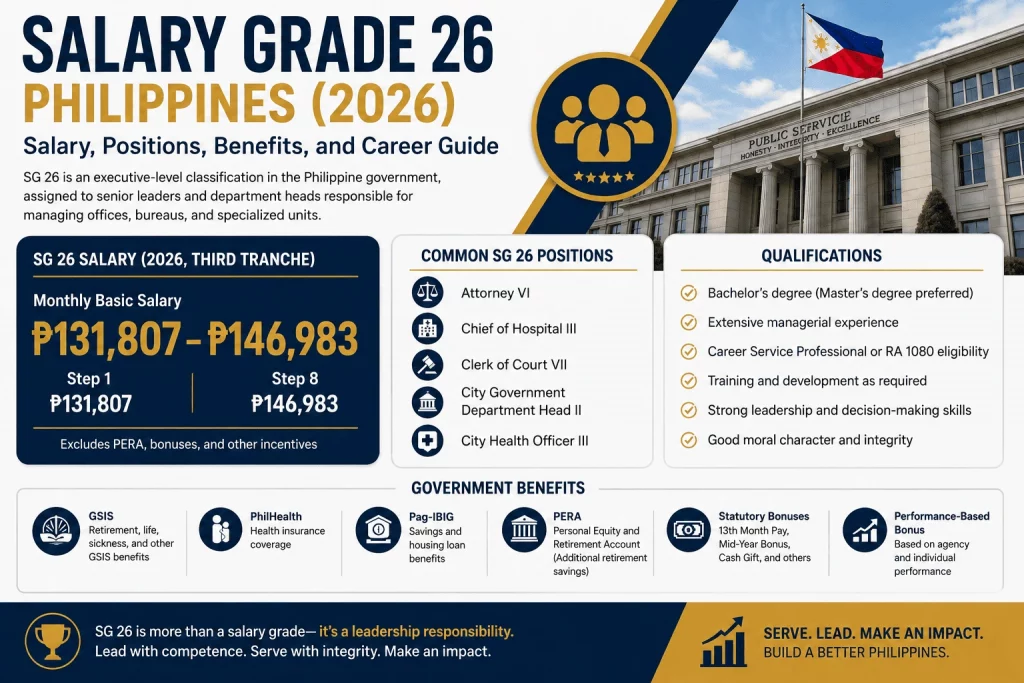
Salary Grade 26 (SG 26) is an executive-level classification in the Philippine government’s 33-grade Compensation and Position Classification System. Under the 2026 third-tranche salary schedule, SG 26 employees earn a monthly basic salary of approximately ₱131,807 at Step 1 up to ₱146,983 at Step 8, before PERA, bonuses, and performance-based incentives. Common SG 26 positions include Attorney VI, Chief of Hospital III, Clerk of Court VII, City Government Department Head II, and City Health Officer III. These roles typically require a bachelor’s degree (often with a master’s degree preferred), extensive managerial experience, and Career Service Professional or RA 1080 eligibility.
💡 Aiming for an executive-level government position? Most SG 26 roles still require Career Service Professional or RA 1080 eligibility as a baseline. Practice for free with our CSE Reviewer — mock exams and drills for all subjects. Start practicing free →
Salary Grade 26 is one of the more searched executive-level grades in the Philippine government pay structure, and for good reason. It’s the level where department heads, senior attorneys, hospital chiefs, and bureau-level officials tend to sit — professionals who have already spent years building technical expertise and are now responsible for running entire departments, offices, or specialized units.
Unlike the entry- and mid-level professional grades, SG 26 isn’t something most people apply for straight out of a licensure exam. It typically caps off fifteen, twenty, or more years of a government career, and it comes with a six-figure monthly salary, genuine organizational authority, and a level of prestige that few civil service positions carry. That combination — senior compensation plus real decision-making power — is exactly why so many long-tenured professionals research this grade specifically, whether they’re evaluating their own career trajectory or benchmarking a job offer.
This guide covers the 2026 salary table for SG 26, the job titles typically classified under it, what it takes to qualify, the full benefits package, and how SG 26 compares with the grades immediately above and below it. Because government compensation is governed by legislation that changes periodically, treat the figures here as a planning reference and confirm exact amounts against the Department of Budget and Management’s (DBM) official issuances before making decisions that depend on them.
SG 26 Quick Snapshot
| Item | Details |
|---|---|
| Salary Grade | SG 26 |
| Monthly Salary (2026, Third Tranche) | ₱131,807 (Step 1) – ₱146,983 (Step 8) |
| Position Level | Executive / Senior Leadership |
| Common Positions | Department Heads, Attorney VI, Chief of Hospital III |
| Typical Eligibility | Career Service Professional, RA 1080, position-specific eligibility |
| Promotion Path | SG 27 through SG 30 |
| Core Benefits | GSIS, PhilHealth, Pag-IBIG, PERA, statutory bonuses, Performance-Based Bonus |
What Is Salary Grade 26?
Salary Grade 26 sits well into the executive band of the Salary Standardization Law (SSL) framework — the legal system assigning every civilian government position a Salary Grade (1 to 33) and a Salary Step (1 to 8). Where a position lands on that scale depends on the complexity of its functions, the breadth of its authority, and the qualifications it demands, not the job title by itself.
Within the government’s 33-grade structure, SG 26 falls firmly in the senior leadership tier:
| Salary Grade Range | General Level |
|---|---|
| SG 1–10 | Entry-level and support positions |
| SG 11–17 | Professional, technical, and first-line supervisory positions |
| SG 18–24 | Managers, division chiefs, senior specialists |
| SG 26 | Executive / senior leadership, bureau and department-head level |
| SG 27–30 | Senior executive, bureau director, regional director level |
| SG 31–33 | Cabinet secretaries, agency heads, the Vice President, and the President |
At this level, a position holder is generally no longer executing a technical function directly but overseeing an entire department, office, hospital, or court branch — setting direction, managing budgets, supervising multiple units, and answering for organizational outcomes rather than individual tasks.
Role in National Agencies and LGUs
SG 26 positions appear across several types of government institutions:
- National government agencies, where they typically correspond to senior legal, medical, or administrative leadership roles.
- Local government units (LGUs), particularly larger cities, where department head positions (health, engineering, planning, legal) frequently reach this grade.
- The judiciary, where senior Clerk of Court positions at higher-level courts can be classified at SG 26.
- Specialized agencies, such as hospitals and airports, where chief-level or director-level operational roles are common.
Leadership Responsibilities and Policy Functions
What distinguishes SG 26 from the management grades just below it (SG 18–24) is the scope of authority. SG 26 officials typically:
- Lead an entire department, office, or specialized institution rather than a single unit or program
- Set strategic direction and policy within their area of responsibility
- Manage substantial budgets and multiple direct reports, often including other supervisors
- Represent their office or department in inter-agency and public-facing matters
- Exercise significant independent judgment, with accountability to the agency head or governing body
Salary Grade 26 Salary Table (2026)
The figures below reflect the third tranche of the modified salary schedule under Executive Order No. 64, s. 2024, implemented through DBM National Budget Circular No. 601, effective January 1, 2026.
| Step | Monthly Basic Salary |
|---|---|
| Step 1 | ₱131,807 |
| Step 2 | ₱133,807 |
| Step 3 | ₱135,968 |
| Step 4 | ₱138,100 |
| Step 5 | ₱140,268 |
| Step 6 | ₱142,469 |
| Step 7 | ₱144,707 |
| Step 8 | ₱146,983 |
These are basic monthly salary figures only — they exclude PERA, statutory bonuses, and performance-based incentives covered later in this guide. Figures are drawn from the official Third Tranche Salary Schedule (SG 1–33, Steps 1–8) under DBM National Budget Circular No. 601, effective January 1, 2026. Always cross-check against the latest published circular before relying on a specific figure.
How Salary Step Progression Works at This Level
As with every other salary grade, SG 26 employees typically start at Step 1 upon appointment, unless a higher step is specifically authorized. Movement to a higher step depends on:
- Length of service. Government-wide rules generally allow one step increase for every three years of continuous, satisfactory service (or faster with a consistently high performance rating).
- Performance ratings. At the executive level, performance evaluations often carry added weight, since SG 26 officials are directly accountable for department- or office-wide results.
- Merit considerations. Some step movements at senior levels also factor in demonstrated leadership outcomes, not just tenure.
- Budget availability. Where step increments require specific appropriation, funding availability can affect timing.
The gap between Step 1 and Step 8 at SG 26 is over ₱15,000 per month — a meaningfully larger spread than at lower grades, reflecting how much basic pay can shift purely through tenure and performance within the same executive position.
Common Salary Grade 26 Positions
Based on DBM position classifications, SG 26 positions tend to be senior, single-point-of-accountability roles rather than team-based technical positions. Representative examples include:
- Attorney VI
- Chief of Hospital III
- Clerk of Court VII
- City Government Department Head II
- City Government Office Head
- City Health Officer III
- Airport Manager IV
- Chief Political Affairs Officer
Important note: Actual salary grade assignments vary by agency, approved plantilla structure, and DBM-approved position classification. A department head title in one city government may sit at a different grade than the same title in another, depending on that LGU’s income classification and approved organizational structure. Always confirm the specific grade through the official plantilla or vacancy announcement rather than assuming based on job title alone.
The Nature of SG 26 Work
Across the range of SG 26 titles, a few common threads run through the work itself:
- Full accountability for a department, office, hospital, or specialized institution’s performance
- Strategic planning and policy-setting within the official’s area of authority
- Managing sizable budgets and overseeing multiple subordinate supervisors or units
- High-stakes decision-making, often with legal, medical, financial, or public-safety implications
- Representing the office in dealings with other agencies, the public, and oversight bodies
- Direct reporting relationships to an agency head, local chief executive, or governing board
Qualifications for Salary Grade 26 Positions
Qualification Standards (QS) for SG 26 positions are set by the Civil Service Commission (CSC) in coordination with the hiring agency, and they are considerably more demanding than at the professional or mid-management grades, reflecting the scope of executive responsibility involved.
Education
Most SG 26 positions require, at minimum, a bachelor’s degree directly relevant to the role, and a master’s degree is frequently preferred or required — particularly for department head and specialized director-level positions. Certain roles also call for specialized professional credentials:
| Position Type | Typical Credential |
|---|---|
| Attorney VI | Bachelor of Laws or Juris Doctor, Bar membership |
| Chief of Hospital III | Doctor of Medicine, relevant medical specialization |
| Clerk of Court VII | Law degree, relevant judiciary experience |
| City Government Department Head II | Bachelor’s degree in relevant field; master’s often preferred |
| City Health Officer III | Doctor of Medicine, public health background |
Experience
SG 26 positions are not entry points into government leadership — they generally require extensive managerial experience, often a decade or more of progressively responsible work, including a documented track record of supervising departments, programs, or large teams. Agencies typically look for candidates who have already succeeded at the SG 18–24 management band before being considered for SG 26.
Training
Executive development programs are a common — and sometimes mandatory — requirement, including leadership and management training accredited by the Civil Service Commission, specialized executive courses relevant to the field (legal, medical, administrative), and, in many agencies, completion of a formal Executive Development Program or equivalent.
Eligibility
Eligibility requirements at this level typically include one or more of the following:
- Career Service Professional Eligibility, for general executive and administrative roles.
- RA 1080 Eligibility (board/bar license), required for regulated professions such as law and medicine.
- Position-specific eligibility, which some specialized executive roles require on top of the general Civil Service eligibility — for example, specific judiciary eligibility for Clerk of Court positions.
✅ Don’t have Career Service Professional Eligibility yet? Prepare for the CSE now →
SG 26 Readiness Self-Assessment
Use this quick checklist to gauge how close you are to being competitive for an SG 26 opening:
| Question | Yes | No |
|---|---|---|
| Do you hold a professional degree relevant to the position? | ☐ | ☐ |
| Do you have substantial leadership experience? | ☐ | ☐ |
| Have you supervised teams or entire departments? | ☐ | ☐ |
| Do you meet the agency-specific eligibility requirements? | ☐ | ☐ |
How to read your results:
- 4 Yes answers: You’re executive-ready — start monitoring specific SG 26 vacancy announcements in your field.
- 3 Yes answers: You’re nearly ready — identify the single remaining gap and target it directly over the next year.
- 0–2 Yes answers: Treat SG 26 as a longer-term goal. Focus on building supervisory experience through the SG 18–24 management band first.
SG 26 Executive Readiness Score™
| Yes Answers | Rating | Status |
|---|---|---|
| 4 Yes Answers | ★★★★★ | Executive Ready |
| 3 Yes Answers | ★★★★☆ | Nearly Ready |
| 2 Yes Answers | ★★★☆☆ | Development Needed |
| 0–1 Yes Answers | ★★☆☆☆ | Build Leadership Experience First |
Government Benefits for SG 26 Employees
SG 26 employees are entitled to the standard package of statutory benefits available to civil servants, plus performance-related incentives that become more relevant at the executive level.
- GSIS (Government Service Insurance System): Retirement benefits, life insurance, disability and survivorship coverage, and access to policy and emergency loans — all scaled to a significantly higher salary base at this grade.
- PhilHealth: National health insurance coverage for hospitalization and selected outpatient and specialized services.
- Pag-IBIG Fund: Access to housing loans, multi-purpose loans, calamity loans, and a dividend-earning savings program.
- PERA (Personnel Economic Relief Allowance): The standard monthly allowance paid on top of basic salary.
- Mid-Year Bonus and Year-End Bonus: Statutory bonuses, each typically equivalent to one month’s basic salary.
- Cash Gift: An annual cash benefit usually released alongside the Year-End Bonus.
- Leave Credits: Vacation and sick leave accrual, plus other statutory leave types, with unused credits convertible to terminal leave pay upon separation or retirement.
- Performance-Based Bonus (PBB): A results-linked bonus tied to individual and organizational performance ratings — often more significant in both size and visibility at the executive level, since department-wide performance outcomes are directly attributable to SG 26 leadership.
Government employees at this level frequently receive compensation packages that extend well beyond base salary, but the exact mix of allowances and incentives still depends on appointment status, agency policy, and available appropriations.
Estimated Total Annual Compensation (Illustrative)
The table below illustrates roughly how the components stack up over a year for an SG 26 employee at a mid-range step. Treat these as planning estimates, since bonus amounts, performance-based incentives, and agency-specific allowances vary.
| Component | Estimated Annual Amount |
|---|---|
| Basic Salary (12 months, mid-step) | ~₱1,683,000 |
| PERA (₱2,000/month) | ~₱24,000 |
| Mid-Year Bonus (1 month basic) | ~₱140,000 |
| Year-End Bonus (1 month basic) | ~₱140,000 |
| Cash Gift | ~₱5,000 |
| Performance-Based Bonus (illustrative, varies widely) | ~₱70,000 – ₱140,000 |
| Estimated Total | ~₱2,062,000 – ₱2,132,000 |
This estimate excludes GSIS, PhilHealth, and Pag-IBIG contributions/benefits, and any agency-specific allowances (e.g., representation and transportation allowances often authorized for department-head-level positions), all of which can meaningfully change the total depending on your specific position and agency.
Salary Grade 26 vs. Salary Grade 25
| Factor | SG 25 | SG 26 |
|---|---|---|
| Monthly Salary (2026, Step 1–8) | ~₱116,643 – ₱130,073 | ~₱131,807 – ₱146,983 |
| Position Level | Senior specialist / upper management | Executive / department-head leadership |
| Leadership Scope | Oversees a division or specialized unit | Oversees an entire department, office, or institution |
Salary Grade 26 vs. Salary Grade 27
| Factor | SG 26 | SG 27 |
|---|---|---|
| Monthly Salary (2026, Step 1–8) | ~₱131,807 – ₱146,983 | ~₱148,940 – ₱165,310 |
| Authority | Department or office head level | Bureau or regional director level |
| Promotion Opportunities | Path toward SG 27–30 | Gateway toward senior bureau and agency leadership |
The step from SG 26 to SG 27 typically represents a jump from leading a single department or office to overseeing a bureau, regional structure, or an entire specialized agency function — a meaningfully broader scope of authority and accountability.
Career Progression: The Executive Leadership Framework
Reaching SG 26 tends to follow a recognizable arc across agencies and professions, even though the specific titles and timelines vary.
Stage 1 — Professional Expertise
- Build deep technical expertise in your field (legal, medical, administrative, financial).
- Earn professional credibility through consistent, high-quality work and, where applicable, licensure.
Stage 2 — Supervisory Leadership
- Take on responsibility for managing teams and leading projects.
- Develop the fundamentals of people management, budgeting, and reporting.
Stage 3 — Department Leadership
- Handle department-level budgets and operations.
- Supervise multiple units or programs simultaneously.
Stage 4 — Executive Management
- Lead an entire department, office, or institution.
- Influence organizational strategy and represent the office at a senior level.
Stage 5 — Senior Executive Track
- Pursue SG 27–30 opportunities.
- Compete for bureau-level or regional leadership roles.
A Simple Year-by-Year Planner
| Timeframe | Focus |
|---|---|
| Years 1–5 | Build technical expertise; gain initial supervisory experience |
| Years 5–10 | Move into middle-management roles; lead programs and projects |
| Years 10–15 | Manage departments or divisions |
| Years 15+ | Pursue executive and bureau-level positions such as SG 26 and above |
SG 26 Opportunity Snapshot
| Factor | Rating |
|---|---|
| Accessibility | Low — requires extensive tenure and demonstrated leadership |
| Competition | Very high — a highly sought executive-level grade |
| Salary Growth Potential | Very strong |
| Promotion Potential | Strong, for those who continue building executive credentials |
| Benefits Package | Comprehensive, including performance-based incentives |
Best suited for: senior government professionals, lawyers, doctors, department heads, and other executive-level employees who have already built a substantial leadership track record.
Why Professionals Target Salary Grade 26
Several factors make SG 26 a career milestone worth planning toward:
- A genuine six-figure monthly salary range — a significant jump from the management grades below it.
- Real executive leadership responsibility, including strategic direction-setting rather than purely operational oversight.
- A strong, comprehensive benefits package, including a more substantial Performance-Based Bonus at this level.
- Significant career prestige, particularly for department head, hospital chief, and senior legal or judicial roles.
- A gateway to SG 27–30 leadership positions, including bureau and regional director-level roles further into a career.
Who Should Apply for SG 26 Positions?
SG 26 tends to be a good fit for:
- Experienced government professionals with a decade or more of relevant tenure
- Department managers ready to move into full department-head accountability
- Lawyers and senior legal officers, particularly those eligible for Attorney VI or senior judiciary roles
- Medical administrators, including physicians ready to lead a hospital or health office
- Senior executives seeking the next step toward bureau or agency-level leadership
Preparing for Executive Government Careers
Advancing toward SG 26 requires more than technical competence in your original field — it demands demonstrated strategic planning ability, leadership across diverse teams, sound policy analysis, strong communication skills, and broad management expertise. For professionals pursuing a long-term government career, continuous learning through accredited executive development programs, graduate studies, and specialized leadership training is often essential for making a credible case for promotion into this grade.
It’s also worth building a track record that’s easy for a selection committee to evaluate: documented department or program outcomes, consistent high performance ratings, and visible leadership in cross-agency or public-facing initiatives all carry real weight when competing for executive-level appointments.
Common Mistakes to Avoid
1. Assuming tenure alone leads to SG 26. Reaching this grade requires a vacant, higher-graded position, meeting its specific Qualification Standards, and a merit-based selection process — years of service alone do not create an automatic promotion into executive ranks.
2. Overlooking position-specific eligibility. Some SG 26 roles, particularly in the judiciary and specialized medical or legal positions, require eligibility beyond the general Career Service Professional or RA 1080 license. Confirm the exact requirement in the vacancy announcement rather than assuming standard eligibility is sufficient.
3. Comparing only basic salary figures. The published ₱131,807–₱146,983 range is basic pay only. At the executive level, Performance-Based Bonus amounts, representation allowances, and other agency-specific incentives can meaningfully change total compensation — don’t evaluate an SG 26 opportunity on basic salary alone.
4. Assuming every SG 26 title carries identical duties. An Attorney VI’s day-to-day responsibilities look very different from a Chief of Hospital III’s, even though both sit at the same grade. The grade reflects a level of authority and accountability, not a specific function.
5. Relying on outdated salary tables. Government salary schedules are revised periodically through new executive orders and DBM circulars, with a fourth tranche already scheduled for 2027. Always cross-check figures against the latest DBM National Budget Circular before using them for financial or career planning.
How to Position Yourself for an SG 26 Appointment
Because SG 26 positions are rarely open to external applicants without a strong internal or comparable track record, the path here looks different from applying for an entry- or mid-level government job. It’s less about a single application and more about a multi-year positioning strategy.
- Establish deep credibility in your professional field first. Whether law, medicine, public administration, or a technical specialty, SG 26 selection committees are evaluating whether you can be trusted to run an entire department — that trust is built through years of visible, well-documented performance, not a single strong interview.
- Accumulate documented supervisory and management experience. Time spent successfully leading teams, programs, or divisions at the SG 18–24 level is typically a prerequisite. Keep clear records of budgets managed, teams supervised, and measurable outcomes achieved.
- Complete relevant executive development programs. Many agencies either require or strongly favor candidates who have completed a CSC-accredited leadership or executive development program, in addition to any position-specific training (judicial, medical administration, public financial management, and so on).
- Secure the applicable eligibility well in advance. For regulated professions, this means maintaining an active professional license. For general executive roles, it means holding Career Service Professional eligibility, and for select judiciary or specialized roles, meeting any position-specific eligibility requirement.
- Build a visible record of leadership beyond your immediate role. Participation in inter-agency committees, policy working groups, or professional associations often gives selection committees evidence of leadership capacity that a resume alone cannot.
- Monitor official vacancy channels directly. SG 26 openings are typically announced through the Civil Service Commission’s job portal, the specific agency’s official channels, or, for LGU department head roles, the local government’s own HR office — rather than general job boards.
Executive Application Checklist
- Relevant professional degree, with a master’s degree where preferred or required
- Active Career Service Professional eligibility, RA 1080 license, or position-specific eligibility
- Documented supervisory or department-level management experience
- Completed executive development or leadership training
- Updated Personal Data Sheet (PDS), transcript of records, and diploma
- Certificates of employment reflecting scope of managerial responsibility
- Recent performance ratings and any relevant awards or recognitions
- Evidence of leadership beyond the immediate role (committees, working groups, publications)
📋 Checking off “Civil Service eligibility” on your list? Take our free practice exam →
Expert Tips for Advancing Beyond SG 26
Reaching SG 26 is itself a significant achievement, but for officials aiming at SG 27 and above — bureau director, regional director, or senior agency leadership — a further set of competencies tends to matter most:
- Strategic and organizational leadership — the ability to set direction not just for a department, but across multiple departments or an entire bureau.
- Policy formulation experience — a track record of shaping, not just implementing, agency policy.
- Stakeholder and inter-agency management — demonstrated success coordinating across multiple government bodies, not just within a single office.
- Financial and resource stewardship at scale — managing significantly larger budgets and resource allocations than at the department-head level.
- A strong ethical and governance track record — since senior executive appointments face heightened scrutiny of past performance and conduct.
| Career Goal | Recommended Focus |
|---|---|
| SG 27 | Deepen bureau-level or regional operational experience |
| SG 28–29 | Build cross-departmental policy and coordination expertise |
| SG 30 | Develop agency-wide strategic leadership and governance credentials |
| SG 31 and above | Executive and cabinet-level public administration expertise |
SG 26 Career Path Visualization™
SG 18–20  (Managers, Division-Level Supervisors)
   ↓
SG 21–24  (Senior Managers, Specialists)
   ↓
SG 25     (Senior Specialist / Upper Management)
   ↓
SG 26     (Department Head / Executive Leadership) ← You are here
   ↓
SG 27–30  (Bureau / Regional Director, Senior Agency Leadership)
This progression isn’t automatic — each step up requires a vacant, higher-graded position, compliance with that position’s Qualification Standards, and a merit-based selection process. But it illustrates the typical route most SG 26 officials took to get here, and the range most look toward next.
Frequently Asked Questions
How much is Salary Grade 26 in 2026? Under the third-tranche salary schedule effective January 1, 2026, SG 26 ranges from ₱131,807 (Step 1) to ₱146,983 (Step 8) in monthly basic salary, excluding PERA, bonuses, and performance-based incentives.
What positions belong to SG 26? Common examples include Attorney VI, Chief of Hospital III, Clerk of Court VII, City Government Department Head II, City Government Office Head, City Health Officer III, Airport Manager IV, and Chief Political Affairs Officer. Actual classifications vary by agency and approved plantilla.
Is SG 26 considered executive level? Yes. SG 26 sits within the government’s executive and senior leadership band, typically covering department heads, bureau-level officials, and senior specialists with organization-wide accountability.
What benefits do SG 26 employees receive? Standard government benefits, including GSIS, PhilHealth, Pag-IBIG, PERA, Mid-Year and Year-End Bonuses, Cash Gift, leave credits, and a Performance-Based Bonus — subject to appointment status and agency policy.
What is the next promotion after SG 26? The typical next step is SG 27, followed by SG 28–30 as an official moves further into bureau, regional, or senior agency leadership. Promotion requires a vacant, higher-graded position and a merit-based selection process.
Can SG 26 employees become bureau or regional directors? Yes. SG 26 is often a direct stepping stone to bureau director or regional director roles at SG 27 and above, particularly for officials who continue to build executive leadership credentials and demonstrate strong organizational results.
🎯 Ready to move toward the senior leadership track? Start the right way — try our free 170-item full mock exam and subject-by-subject drills. Start your free CSE Reviewer →
Key Takeaways
- SG 26 is an executive-level grade paying ₱131,807–₱146,983 per month under the 2026 third-tranche schedule, before allowances and bonuses.
- It sits above SG 25 and below SG 27, generally requiring a bachelor’s degree (often with a master’s preferred), extensive managerial experience, and Career Service Professional, RA 1080, or position-specific eligibility.
- Typical positions include Attorney VI, Chief of Hospital III, Clerk of Court VII, and City Government Department Head II — roles defined by department- or office-wide accountability rather than a single technical function.
- Full government benefits apply, plus a Performance-Based Bonus that carries added weight at the executive level.
- Advancing beyond SG 26 depends on a vacant position, demonstrated leadership, and merit-based selection — not tenure alone.
Related Topics
To learn more about navigating your career in the Philippine government, explore our deep-dive guides:
- Salary Grade 1 in the Philippines (2026): Complete Guide to Pay, Steps, and Eligibility
- Salary Grade 2 in the Philippines (2026): Complete Guide to Pay, Steps, and Eligibility
- Salary Grade 3 in the Philippines (2026): Complete Guide to Pay, Steps, and Eligibility
- Salary Grade 4 (SG 4): Salary, Positions, and Qualifications
- Salary Grade 5 Philippines (2026): Salary, Positions, Qualifications, and Benefits Guide
- Salary Grade 6 Philippines: Salary, Steps, Positions, and Career Guide
- Salary Grade 7 Philippines: Salary, Benefits & Positions
- Salary Grade 8 Philippines: Salary, Steps, Positions, Benefits, and Career Guide
- Salary Grade 10 Philippines: Salary, Positions, Benefits, and Career Guide
- Salary Grade 11 Philippines 2026: Complete Guide
- Salary Grade 12 Philippines 2026: Salary, Positions & Benefits
- Salary Grade 13 Philippines 2026: Complete Salary & Positions Guide
- Salary Grade 14 Philippines 2026: Complete Salary & Positions Guide
- Salary Grade 15 Philippines: Salary, Positions, Qualifications, and Career Guide
- Salary Grade 19 Philippines 2026: How Much Do SG 19 Employees Earn?
- Salary Grade 24 Philippines 2026: Salary & Benefits
- Salary Grade 25 Philippines: Salary, Positions, Benefits, and Career Guide
- Government Jobs in the Philippines 2026: Complete Job Search Guide
- How to Apply for Government Jobs in the Philippines: Step-by-Step Guide
References
- Department of Budget and Management (DBM). National Budget Circular No. 601 – Implementation of the Third Tranche Compensation Adjustment for Civilian Government Personnel pursuant to Executive Order No. 64, s. 2024.
- Civil Service Commission (CSC). Position Qualification Standards and Civil Service eligibility policies.
- Official Gazette of the Republic of the Philippines. Executive Orders, laws, and official government issuances relating to the Salary Standardization Law
Disclaimer
This guide is intended for informational purposes only and is based on official government issuances available at the time of writing. While every effort has been made to ensure accuracy, salary schedules, qualification standards, benefits, and implementing rules may change through subsequent laws, executive orders, DBM circulars, CSC issuances, or other government regulations.
Readers should always consult the latest official publications of the Department of Budget and Management (DBM), Civil Service Commission (CSC), and the Official Gazette for the most current and authoritative information.