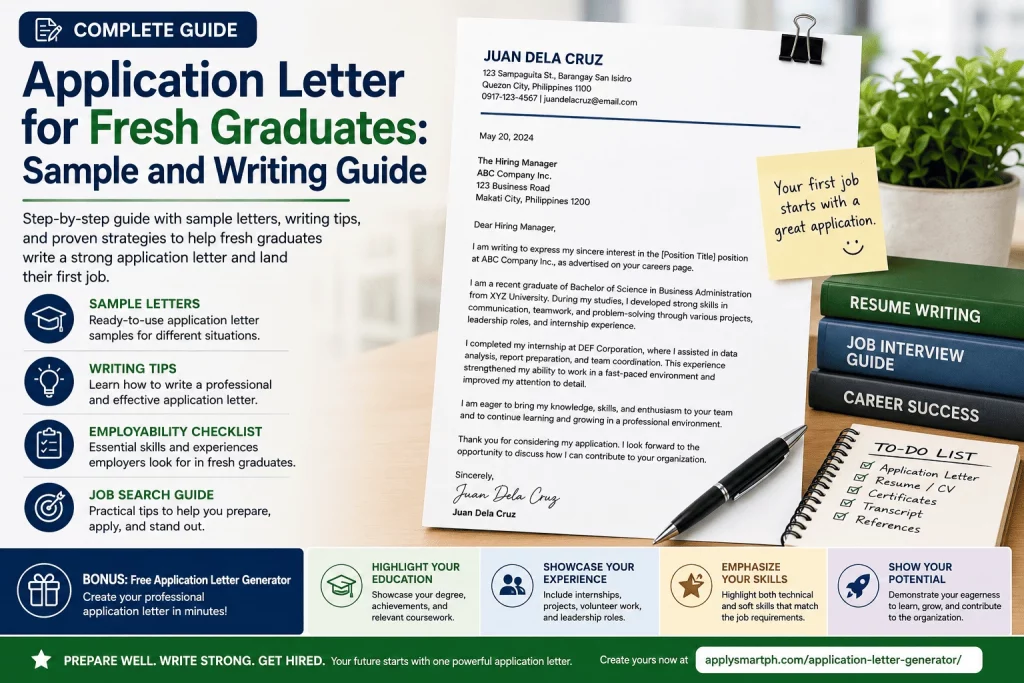
Landing your first job after graduation is one of the most exciting — and often most intimidating — milestones in a young professional’s career. Without years of work experience to point to, fresh graduates frequently worry that their application letters won’t stand out against candidates who already have a track record of employment.
The good news is that fresh graduates may not have extensive work experience, but a strong application letter can highlight education, internships, projects, leadership activities, volunteer work, and transferable skills that are just as compelling to employers as years on the job. Hiring managers understand that entry-level roles are meant for candidates who are early in their careers — what they’re really evaluating is potential, preparation, and professionalism.
Employers evaluate entry-level candidates differently from experienced hires. Rather than focusing heavily on job history, they look for signals that a candidate can learn quickly, communicate clearly, work well with others, and bring genuine enthusiasm to the role. A well-written application letter is often the clearest, most direct way to demonstrate all of these qualities in a single document.
This guide covers everything a fresh graduate needs to write a strong, professional application letter — from understanding how employers actually evaluate entry-level applicants, to the proper letter format, full sample letters for different experience levels, common mistakes to avoid, and practical strategies for standing out in a competitive entry-level job market.
Ready to apply now? Skip the blank page and use our Free Application Letter Generator to create a polished, ready-to-send application letter in minutes.
How Do You Write an Application Letter as a Fresh Graduate?
A strong application letter should:
- Introduce yourself professionally. State who you are and your academic background in a clear, confident opening.
- Mention the position you are applying for. Name the exact role and, where possible, how you learned about the opening.
- Highlight education and academic achievements. Your degree, relevant coursework, and any honors or recognitions.
- Discuss internships or projects. Practical experience, even if unpaid or school-based, demonstrates readiness for real work.
- Showcase relevant skills. Both technical and soft skills that align with the position’s requirements.
- Demonstrate willingness to learn. A sincere statement of your eagerness to grow and contribute.
- End with a professional closing. Thank the reader, restate your interest, and note your availability for an interview.
The sections below expand on each of these points, with full sample letters you can adapt to your own background and target role.
Can Fresh Graduates Get Hired Without Experience?
Yes.
Many fresh graduates assume that a lack of full-time work experience automatically puts them at a disadvantage. In reality, entry-level positions are specifically designed with this reality in mind, and employers hiring for these roles typically evaluate candidates based on a broader set of indicators.
Many employers hire fresh graduates based on:
- Academic performance — grades, honors, and relevant coursework that demonstrate subject-matter readiness
- Internship experience — even short-term or unpaid internships provide meaningful, employer-relevant exposure
- Communication skills — how clearly and professionally a candidate expresses themselves, both in writing and in person
- Technical skills — software proficiency, industry-specific tools, or other job-relevant technical competencies
- Leadership experience — roles in student organizations, class projects, or volunteer work that demonstrate initiative
- Learning potential — an employer’s assessment of how quickly and effectively a candidate is likely to pick up new skills on the job
Understanding that these are the actual evaluation criteria — rather than years of prior employment — should shape how you write your application letter. Your goal isn’t to apologize for a thin resume; it’s to clearly connect what you do have to what the employer needs.
It’s also worth remembering that entry-level hiring is, by design, a different process from hiring for mid-career or senior roles. Recruiters filling entry-level positions typically expect to invest in onboarding and training, which is precisely why they weigh trainability and attitude so heavily. A candidate who demonstrates strong fundamentals — clear communication, a solid academic record, and a genuine willingness to learn — is often seen as just as valuable, if not more so, than one who arrives with narrow technical experience but limited adaptability.
Most Valuable Experiences for Fresh Graduates
Not all experiences carry the same weight in an employer’s eyes. Some forms of experience consistently signal readiness more strongly than others, and knowing which ones to prioritize — both in how you spend your remaining time as a student and in what you choose to highlight in your letter — can meaningfully improve your competitiveness.
| Experience | Employer Value |
|---|---|
| Internship | High |
| OJT | High |
| Student Leadership | High |
| Volunteer Work | Medium |
| Academic Projects | High |
| Freelance Work | Medium |
| Certifications | High |
If you have any combination of the “High” value experiences above, make sure they’re featured prominently in your application letter rather than buried in a single sentence. If your background leans more toward “Medium” value experiences like volunteer work or freelance projects, you can still strengthen their impact by describing specific outcomes or responsibilities rather than simply listing them.
What Employers Look for in Fresh Graduates
Beyond academic and technical qualifications, employers consistently look for a specific set of soft skills and workplace behaviors when evaluating entry-level candidates. Use the checklist below to identify which of these you can genuinely claim, then make sure your letter reflects them.
Fresh Graduate Employability Checklist™
| Skill | Importance |
|---|---|
| Communication | High |
| Professionalism | High |
| Teamwork | High |
| Time Management | High |
| Adaptability | High |
| Problem Solving | High |
| Computer Skills | High |
| Willingness to Learn | High |
Notice that every item on this list is rated “High” importance. This reflects an important truth about entry-level hiring: employers are less focused on a narrow technical skill set and more focused on whether a candidate has the foundational workplace habits and attitude needed to succeed and grow within the organization.
Before Writing Your Application Letter
Taking a few minutes to gather the right information before you start drafting will make your letter far more specific and persuasive than starting to write cold.
Gather These Details
- Position Title — the exact title as listed in the job posting
- Company or Agency Name — the full, correct name of the organization
- Contact Information — the hiring manager’s name and title, if available, or the appropriate department
- Educational Background — your degree, major, school, and graduation details
- Internship Experience — organizations, duration, and key responsibilities or projects
- Certifications — any relevant certifications completed during or after your studies
- Volunteer Experience — organizations and roles, especially any involving leadership or coordination
- School Projects — major academic projects, particularly group projects or capstone work relevant to the position
- Achievements — honors, awards, publications, or recognitions from your academic career
Applicants who skip this preparation step often end up writing letters that are technically correct but generic — competent on the surface, yet forgettable to a hiring manager reviewing dozens of similar applications.
Application Letter Format for Fresh Graduates
A clear, consistent format makes your letter easy to read and signals professionalism from the very first line.
Header
Include the following at the top of your letter:
- Name
- Address
- Contact Number
- Email Address
- Date
Recipient Information
Address your letter to the appropriate person or department at the company or agency, using the correct name and title where available.
Opening Paragraph
Your opening paragraph should clearly state:
- The position you are applying for
- How you found the vacancy (company website, job board, referral, campus recruitment, etc.)
Body Paragraph
The body of your letter should highlight:
- Education
- Internship experience
- School projects
- Skills
- Certifications
Closing Paragraph
Your closing paragraph should express genuine interest in an interview opportunity, thank the reader for their time, and reaffirm your enthusiasm for the role.
Following this structure consistently across every application makes it easier for hiring managers to quickly find the information they’re looking for, and demonstrates the kind of clear, organized communication that employers value in entry-level hires.
Application Letter Sample for Fresh Graduates
The sample below is written for a bachelor’s degree graduate with no full-time work experience but with a completed internship, applying for an entry-level position.
[Your Complete Address] [City, Province, Zip Code] [Your Email Address] [Your Contact Number] [Date]
[Name of Hiring Manager, if known] [Title/Position] [Company/Agency Name] [Company Address]
Dear [Hiring Manager’s Name / Sir or Madam],
I am writing to apply for the position of [Position Title] at [Company/Agency Name], as advertised [state where you saw the posting, e.g., “on your company website” or “through our university’s career placement office”].
I recently graduated with a degree in [Degree Program] from [School Name], where I built a strong foundation in [relevant field/skills]. During my studies, I completed a [duration] internship at [Company/Organization Name], where I [describe one or two specific responsibilities or accomplishments, e.g., “assisted in preparing reports and coordinating team schedules” or “supported the marketing team in developing social media content that increased engagement by a measurable margin”]. This experience gave me practical exposure to real workplace expectations and reinforced my ability to work effectively within a team under real deadlines.
In addition to my internship, I completed a capstone project on [brief topic], which required strong research, collaboration, and problem-solving skills — qualities I understand are essential for this role. I am proficient in Microsoft Office and Google Workspace, and I adapt quickly to new tools and systems as needed.
I bring strong communication skills, a collaborative mindset, and genuine enthusiasm for beginning my professional career with an organization like [Company/Agency Name]. While I am early in my career, I am highly motivated, detail-oriented, and eager to contribute meaningfully from day one.
I have attached my resume, transcript of records, and other relevant documents for your review. I would welcome the opportunity to discuss my qualifications further and am available for an interview at your convenience.
Thank you for considering my application. I look forward to the possibility of contributing to [Company/Agency Name].
Respectfully yours,
[Your Full Name] [Signature, if submitting a printed copy]
This sample runs close to 350 words in the body — long enough to properly introduce your background and internship experience, while remaining concise enough to be read quickly by a busy hiring manager.
Want this letter tailored to your own background? Try our Free Application Letter Generator — just fill in your details and get a ready-to-use letter instantly.
Application Letter for Fresh Graduates With No Experience
Not every fresh graduate has completed a formal internship before entering the job market, and that’s entirely normal. If you fall into this category, your letter should lean more heavily on academic achievements, volunteer work, student leadership, and extracurricular activities to demonstrate the same underlying qualities an internship would have shown.
Focus On
- Academic achievements — strong grades, honors, relevant coursework, or notable projects
- Volunteer work — any community service, church, or organizational volunteering, especially roles involving coordination or public interaction
- Student leadership — officer positions in school organizations, clubs, or student government
- Extracurricular activities — sports, performing arts, competitions, or other structured activities that demonstrate discipline and teamwork
- Personal strengths — qualities like reliability, adaptability, and strong work ethic, ideally supported by a brief specific example
If you genuinely have no internship, volunteer work, or extracurricular involvement to draw from, it’s still better to focus your letter on your academic strengths and personal qualities than to open with an apology for your lack of experience — a mistake covered in more detail later in this guide.
Sample Letter
[Your Complete Address] [City, Province, Zip Code] [Your Email Address] [Your Contact Number] [Date]
[Name of Hiring Manager, if known] [Title/Position] [Company/Agency Name] [Company Address]
Dear [Hiring Manager’s Name / Sir or Madam],
I am writing to express my interest in the [Position Title] role at [Company/Agency Name]. I graduated with a degree in [Degree Program] from [School Name], where I maintained a strong academic record and actively participated in extracurricular activities that helped shape my professional readiness.
During my time in school, I served as [officer position, e.g., “Secretary of the Student Council”], where I coordinated meetings, prepared official documentation, and communicated regularly with faculty advisers and fellow students. I also volunteered with [organization name], assisting with [brief description of volunteer role], which strengthened my ability to work collaboratively toward shared goals in a structured environment.
Although I have not yet held a formal internship, these experiences have given me practical exposure to teamwork, communication, time management, and problem-solving — skills I understand are essential for success in this role. I am proficient in Microsoft Office and comfortable learning new tools and systems quickly.
I am highly motivated to begin my professional career and am confident that my strong academic foundation, leadership experience, and genuine eagerness to learn make me a strong fit for this position. I am committed to contributing meaningfully to your team while continuing to grow professionally.
I have enclosed my resume, transcript of records, and other supporting documents for your consideration. I would be grateful for the opportunity to discuss my qualifications and am available for an interview at your convenience.
Thank you very much for your time and consideration.
Respectfully yours,
[Your Full Name]
Application Letter for Fresh Graduates With Internship Experience
If you’ve completed one or more internships, your letter should lean into those experiences as the centerpiece of your application, treating them much like a first job.
Highlight
- Internship accomplishments — specific tasks you completed and, where possible, measurable outcomes
- Projects completed — individual or team projects you contributed to during your internship
- Office experience — exposure to real workplace systems, tools, and procedures
- Team collaboration — how you worked with colleagues, supervisors, or cross-functional teams
- Professional growth — what you learned about workplace expectations and how it shaped your readiness for full-time employment
Sample Letter
[Your Complete Address] [City, Province, Zip Code] [Your Email Address] [Your Contact Number] [Date]
[Name of Hiring Manager, if known] [Title/Position] [Company/Agency Name] [Company Address]
Dear [Hiring Manager’s Name / Sir or Madam],
I am writing to apply for the position of [Position Title] at [Company/Agency Name], as advertised [state source of posting].
I graduated with a degree in [Degree Program] from [School Name], and I bring hands-on experience from a [duration] internship at [Company/Organization Name], where I [describe key responsibilities, e.g., “supported the operations team with data encoding, report preparation, and process documentation”]. During this internship, I contributed to [specific project or accomplishment], which required close collaboration with team members across departments and gave me practical exposure to how professional teams manage deadlines and deliverables.
This experience significantly strengthened my communication, organization, and problem-solving skills, and gave me a realistic understanding of workplace expectations beyond the classroom. I am comfortable working independently as well as collaboratively, and I adapt quickly to new systems, tools, and processes.
I am proficient in Microsoft Office and Google Workspace, and I bring a strong, detail-oriented work ethic along with genuine enthusiasm for building a long-term career with an organization like [Company/Agency Name].
I have attached my resume, transcript of records, internship certificate, and other relevant documents for your review. I would welcome the opportunity to further discuss my qualifications and am available for an interview at your convenience.
Thank you for your time and consideration.
Respectfully yours,
[Your Full Name]
Best Skills to Mention in an Application Letter
Whichever version of the letter you adapt, make sure it references a well-rounded mix of professional, technical, and personal skills relevant to the position.
Professional Skills
- Communication
- Teamwork
- Time management
- Problem solving
- Critical thinking
Technical Skills
- Microsoft Word
- Microsoft Excel
- PowerPoint
- Google Workspace
- Data entry
Personal Qualities
- Adaptability
- Reliability
- Initiative
- Professionalism
- Eagerness to learn
When choosing which skills to feature, prioritize whichever ones are most directly referenced in the job posting. Matching your letter’s language to the employer’s own stated requirements makes it easier for hiring managers — and any automated screening tools — to quickly recognize you as a strong fit for the role.
Adjusting Skills by Industry
The specific skills worth emphasizing can shift depending on the industry you’re entering. A fresh graduate applying for an office or administrative role might lean more heavily on organization, data entry, and Microsoft Office proficiency, while one applying for a marketing or communications role might emphasize creativity, content creation, and social media familiarity. Someone entering a technical or IT-adjacent field should highlight any relevant coursework, certifications, or personal projects that demonstrate hands-on technical ability. Reading the job posting closely and mirroring its language — without copying it word for word — remains the most reliable way to decide which skills deserve the most attention in your letter.
Common Mistakes Fresh Graduates Make
Even strong candidates can undermine their own application through a handful of common, avoidable mistakes.
Apologizing for Lack of Experience
Opening a letter with a statement like “I know I don’t have much experience, but…” immediately puts the focus on what you lack rather than what you bring. Avoid focusing on what you lack, and instead lead confidently with your education, skills, and any relevant experience you do have.
Writing Generic Letters
A letter that could be sent to any company for any position rarely leaves a strong impression. Customize every application with the correct company name, position title, and at least one detail specific to that organization or role.
Repeating the Resume
Your application letter shouldn’t simply restate your resume in paragraph form. Use the letter to expand your story — explain the “why” behind your experiences, or add context your resume’s bullet points can’t fully capture.
Focusing Only on Grades
While academic performance matters, a letter that discusses only your GPA or honors without connecting them to actual skills or experiences reads as one-dimensional. Include skills and experiences alongside your academic achievements.
Grammar and Formatting Errors
Since attention to detail and communication skills are exactly what many entry-level roles are evaluating, grammar and formatting errors can directly undermine your candidacy. Always proofread carefully, and ideally have someone else review your letter before submission.
How to Stand Out as a Fresh Graduate
Beyond avoiding common mistakes, there are proactive steps you can take to make your application genuinely more competitive.
Practical Tips
- Tailor every application. Adjust your letter for each specific role rather than sending an identical letter to every employer.
- Highlight achievements. Lead with accomplishments rather than general descriptions of your responsibilities.
- Mention measurable results. Even in an academic or internship context, quantifying your impact — participants coordinated, deadlines met, improvements achieved — makes your claims more credible.
- Include relevant certifications. Any certifications relevant to the role, even short online courses, can help differentiate you from other entry-level candidates.
- Demonstrate enthusiasm. Genuine, specific interest in the company or role — rather than generic enthusiasm — signals that you’ve done your research and are serious about the opportunity.
Fresh Graduate Success Formula™
A useful way to think about what makes a fresh graduate application genuinely competitive:
Education + Skills + Internship Experience + Professionalism + Strong Application Letter = Competitive Applicant
Notice that a strong application letter is treated as its own distinct ingredient in this formula — not just a formality, but an active multiplier on everything else you bring to the table. Even two candidates with identical academic backgrounds and internship experience can have very different outcomes based on how effectively their letters communicate that background.
Fresh Graduate Job Search Checklist™
Before submitting your application, confirm that your full job search package is complete. Missing documents can slow down or derail an otherwise strong application.
| Item | Ready? |
|---|---|
| Application Letter | ✓ |
| Resume/CV | ✓ |
| Transcript | ✓ |
| Certificates | ✓ |
| Portfolio (if applicable) | ✓ |
| References | ✓ |
| LinkedIn Profile | ✓ |
An updated, professional LinkedIn profile is increasingly treated as a standard part of a fresh graduate’s job search toolkit, since many hiring managers will look up candidates online before or after reviewing their application letter.
Fresh Graduate Readiness Score™
Use the checklist above to tally how many of the seven listed items you have fully prepared, then match your count to the readiness levels below.
Beginner Applicant
0–3 items completed. Focus on completing your core documents first — resume, transcript, and application letter — before actively applying.
Developing Applicant
4–5 items completed. You have a solid foundation. Prioritize building a simple portfolio or securing references to round out your application package.
Competitive Applicant
6–7 items completed. You meet most of what employers typically expect from a fresh graduate applicant. Make sure your application letter clearly ties your documents together into a coherent, specific story.
Highly Competitive Applicant
All requirements complete, plus internship or leadership experience. You are well-positioned to compete for strong entry-level roles. Focus your letter on quantifiable achievements and specific, memorable examples from your internship or leadership experience.
Fresh Graduate Career Launch Roadmap™
Landing your first job is just the beginning of a longer professional trajectory. A typical entry-level career path looks like this:
Graduate → Entry-Level Position → Junior Professional → Mid-Level Professional → Senior Professional → Leadership Role
| Stage | Typical Focus |
|---|---|
| Graduate | Building foundational skills and job search readiness |
| Entry-Level Position | Learning workplace systems and gaining practical experience |
| Junior Professional | Taking on greater responsibility and independent tasks |
| Mid-Level Professional | Leading projects and mentoring newer hires |
| Senior Professional | Driving strategy and specialized expertise |
| Leadership Role | Managing teams and shaping organizational direction |
Keeping this longer-term trajectory in mind can help you approach your first application letter with the right perspective — not as a one-time hurdle, but as the opening move in a much longer professional story.
Use Our Free Application Letter Generator
Need a customized application letter without starting from a blank page? Use our Free Application Letter Generator to create a professional application letter in minutes — just enter your education, skills, and experience, and get a ready-to-send letter tailored to the position you’re applying for.
Frequently Asked Questions
Can I get hired without work experience?
Yes. Entry-level positions are specifically designed for candidates without full-time work experience. Employers typically evaluate fresh graduates based on academic performance, internship or volunteer experience, communication skills, and overall learning potential rather than years of prior employment.
How long should a fresh graduate application letter be?
A fresh graduate application letter typically runs around 300 to 400 words, or roughly three to four concise paragraphs. It should be long enough to properly introduce your education and relevant experience, but short enough to be read quickly by a hiring manager reviewing many applications.
Should I include my GPA?
Including your GPA can be worthwhile if it’s strong and relevant to the role, particularly for highly academic or research-oriented positions. However, it shouldn’t be the centerpiece of your letter — pair it with specific skills, projects, or experiences that demonstrate practical readiness for the job.
Can I use the same application letter for every job?
It’s not recommended. While you can reuse the overall structure, each letter should be personalized with the correct company name, position title, and at least one detail specific to that role or organization. Hiring managers can often tell when a letter has been mass-produced, and a generic letter is less likely to stand out.
What skills should I emphasize?
Focus on a combination of professional skills (communication, teamwork, problem solving), technical skills relevant to the role (such as specific software), and personal qualities like adaptability and eagerness to learn. Prioritize whichever skills are most directly referenced in the job posting itself.
How important are internships?
Internships are highly valuable for fresh graduates, since they provide real workplace exposure that academic coursework alone cannot replicate. That said, they are not strictly required — volunteer work, student leadership, and strong academic performance can also effectively demonstrate the same underlying qualities employers are looking for. What matters most is being able to speak specifically and confidently about whatever experience you do have, rather than the particular label attached to it.
Related Guides
- Free Application Letter Generator for Government Jobs and Private Companies
- Application Letter for Administrative Assistant I: Complete Sample and Writing Guide
- Application Letter for Teacher I: Sample, Format, and Writing Guide
- Civil Service Exam Requirements 2026: Complete Application Guide and Checklist
- CSC Eligibility: Professional vs Subprofessional Exam – What’s the Difference?
- Government Jobs in the Philippines 2026: Complete Job Search Guide
- CSC Eligibility Requirements: Complete Guide for Government Job Applicants
- Civil Service Exam Coverage 2026: Complete Guide for Filipino Examinees
- RA 1080 Eligibility Guide: Automatic Civil Service Eligibility for Board and Bar Passers
- Civil Service Exam Results: How to Check Your Rating, List of Passers & Release Date