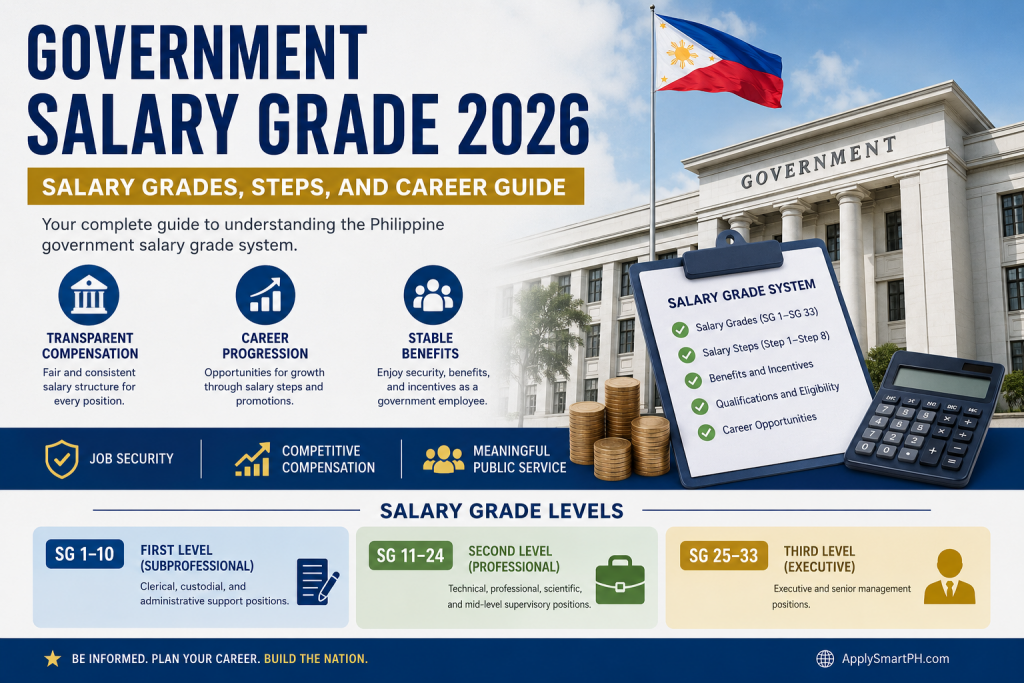
Many Filipinos know that government positions have corresponding salary grades, but few fully understand how salary steps affect compensation and career progression.
If you’re planning to work in the public sector, understanding how salary grades and step increments work can help you set realistic salary expectations, prepare for promotions, and maximize your long-term earning potential.
In this guide, you’ll learn how the Philippine government’s salary grade system works, how employees move through salary steps, and what these mean for career growth in government service.
What Is a Salary Grade?
A Salary Grade (SG) is a numerical classification assigned to every civilian government position in the Philippines. It determines the compensation range attached to a specific job based on factors established under the government’s compensation and position classification system.
These factors include:
- Duties and responsibilities;
- Educational requirements;
- Relevant work experience;
- Training requirements;
- Level of supervision; and
- Complexity of work.
The salary grade system promotes fairness and consistency by ensuring that employees performing work of comparable value receive similar compensation across government agencies.
For example, entry-level support positions generally receive lower salary grades, while technical, professional, and managerial positions receive higher salary grades due to greater responsibilities and qualification requirements.
How Salary Grades Are Structured in the Philippines
The Philippine government uses a standardized compensation structure covering Salary Grade 1 (SG 1) to Salary Grade 33 (SG 33).
These salary grades are commonly grouped into three levels.
First-Level Positions (SG 1–10)
These positions usually involve clerical, custodial, trade-related, and administrative support functions.
Examples include:
- Administrative Aide;
- Clerk;
- Data Encoder;
- Utility Worker; and
- Administrative Assistant.
Second-Level Positions (SG 11–24)
These positions involve professional, technical, scientific, and supervisory responsibilities.
Examples include:
- Teacher;
- Accountant;
- Engineer;
- Human Resource Management Officer;
- Planning Officer; and
- Nurse.
Many second-level positions require Civil Service eligibility or equivalent qualifications.
Third-Level Positions (SG 25–33)
These positions generally involve executive and senior management functions.
Examples include:
- Directors;
- Assistant Secretaries;
- Undersecretaries;
- Agency Heads; and
- Cabinet Officials.
What Are Salary Steps?
Every salary grade contains multiple salary steps that allow employees to receive compensation increases while remaining in the same position.
Newly hired employees usually enter government service at Step 1 of their assigned salary grade.
As employees gain experience and demonstrate satisfactory performance, they may progress through higher salary steps in accordance with existing government policies.
Factors influencing step progression may include:
- Length of service;
- Performance evaluations;
- Merit-based advancement; and
- Applicable Civil Service and DBM guidelines.
This means government employees can receive salary increases even without receiving promotions.
How Do Step Increments Work?
A common misconception is that government employees only receive salary increases when promoted.
In reality, compensation can increase in two ways:
Step Increment
Employees may advance to higher steps within the same salary grade after meeting the requirements prescribed by applicable policies.
This rewards satisfactory service and recognizes employee experience.
Promotion
Employees may also receive salary increases through promotion to higher positions carrying higher salary grades.
Promotions typically involve:
- Additional responsibilities;
- Higher qualification standards;
- Supervisory functions; and
- Increased accountability.
Understanding the difference between step increments and promotions can help employees plan their careers more effectively.
Common Government Positions by Salary Grade
The following examples illustrate how government positions are commonly classified.
| Position | Typical Salary Grade |
|---|---|
| Administrative Aide | SG 1–6 |
| Administrative Assistant | SG 7–10 |
| Teacher I | SG 11 |
| Human Resource Officer I | SG 11 |
| Engineer I | SG 12 |
| Accountant I | SG 12 |
| Nurse I | SG 15 |
| Attorney III | SG 21 |
Actual salary grades may vary depending on agency structure, qualification standards, and position classification.
Government Benefits Beyond Salary
One of the biggest advantages of permanent government employment is the benefits package available to qualified personnel.
Common benefits include:
GSIS Benefits
Government employees contribute to the Government Service Insurance System (GSIS), which provides:
- Retirement benefits;
- Life insurance;
- Disability benefits; and
- Separation benefits.
PhilHealth Coverage
Government employees receive healthcare coverage through PhilHealth.
Pag-IBIG Membership
Employees may access:
- Housing loans;
- Savings programs; and
- Other Pag-IBIG benefits.
Bonuses and Incentives
Qualified employees may receive:
- Mid-Year Bonus;
- Year-End Bonus;
- Cash Gift;
- Productivity Enhancement Incentive (PEI); and
- Clothing Allowance.
The availability and amount of these benefits depend on applicable government policies and appropriations.
Common Misconceptions About Government Salaries
Myth #1: All Government Employees Follow the Same Salary Table
Not necessarily.
Military and Uniformed Personnel (MUP), including members of the AFP, PNP, BFP, and BJMP, generally follow separate compensation systems.
This guide primarily applies to civilian government employees.
Myth #2: Job Order and COS Workers Receive the Same Benefits
Job Order (JO) and Contract of Service (COS) workers generally do not enjoy the same benefits and security of tenure available to permanent employees.
This is one reason why many applicants pursue permanent plantilla positions.
Myth #3: Salary Grade Alone Determines Take-Home Pay
Not entirely.
Actual compensation may also be affected by:
- Salary step level;
- Mandatory deductions;
- Allowances;
- Incentives; and
- Agency-specific benefits.
Practical Tips for Government Job Seekers
1. Identify Your Target Salary Grade
Review available government vacancies and determine which salary grades align with your qualifications and career goals.
2. Understand Qualification Standards
Every government position has specific requirements. Review these standards carefully before applying.
3. Secure the Appropriate Eligibility
Many permanent positions require Civil Service eligibility or equivalent qualifications.
4. Build Relevant Experience
Training, experience, and professional development significantly improve your competitiveness for higher salary grade positions.
Frequently Asked Questions
Do all government employees start at Step 1?
Most newly appointed employees begin at Step 1 of the applicable salary grade unless otherwise authorized by law or policy.
Can employees receive salary increases without promotion?
Yes. Employees may receive step increments within the same salary grade based on applicable policies.
Is promotion the only way to increase earnings?
No. Employees can increase their compensation through both step increments and promotions.
Are Job Order employees covered by the salary grade system?
JO workers generally do not receive the same compensation and benefits package as permanent employees.
Related Guide
Want to know the actual monthly salary rates for each salary grade?
Read our Government Salary Grade 2026: Complete Guide to the Philippine Salary Schedule for the latest salary table, third tranche updates, and examples of government positions.
Final Thoughts
Understanding how salary grades and steps work can help you make better career decisions in government service.
Beyond monthly pay, the government compensation system provides structured career progression, transparent qualification standards, and opportunities for long-term professional growth.
Whether you’re a fresh graduate preparing for your first application or an experienced employee planning your next promotion, knowing how salary grades and step increments work can help you navigate your public service career with confidence.
Related Topics
To learn more about navigating your career in the Philippine government, explore our deep-dive guides:
- Government Jobs in the Philippines 2026: Complete Job Search Guide
- How to Apply for Government Jobs in the Philippines: Step-by-Step Guide
- CSC Eligibility Requirements: Complete Guide for Government Job Applicants
- CSC Eligibility: Professional vs Subprofessional Exam – What’s the Difference?
- Civil Service Exam Requirements 2026: Complete Application Guide and Checklist