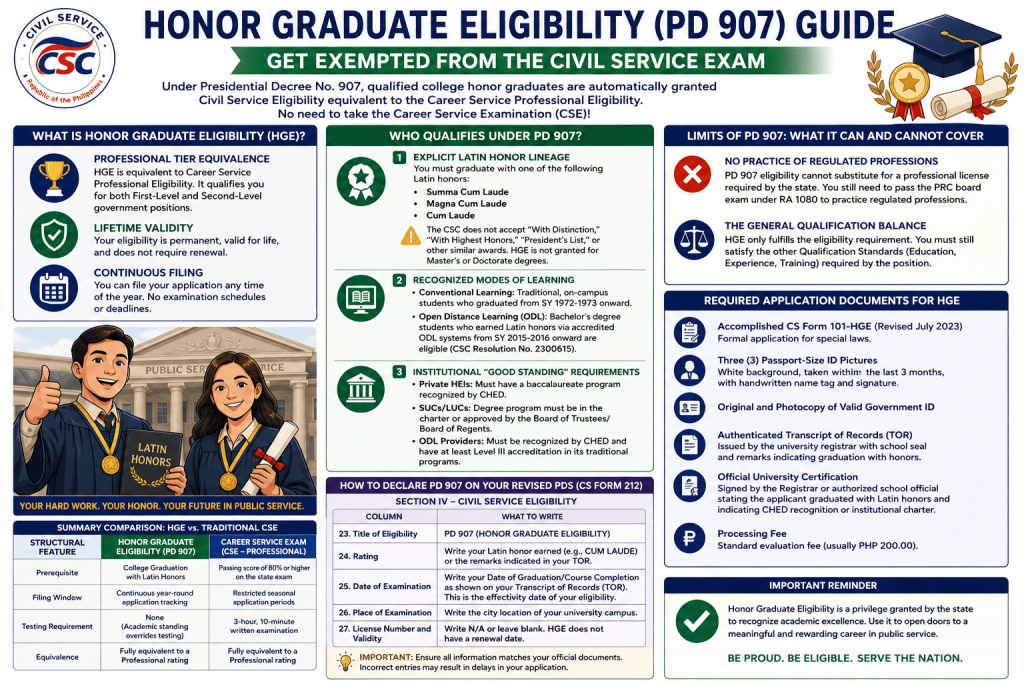
For top-performing college students in the Philippines, structural academic excellence yields exceptional professional rewards. Under Presidential Decree No. 907 (PD 907), individuals who graduate with Latin honors do not need to take the competitive Career Service Examination (CSE).
The state legally recognizes that completing a degree with distinction under the competitive atmosphere of the academic community serves as a sufficient indicator of merit, competence, and public sector fitness. This legal privilege automatically confers the Honor Graduate Eligibility (HGE), paving a seamless path toward permanent government employment.
This guide provides a comprehensive breakdown of PD 907 eligibility, the specific institutions recognized by the Civil Service Commission (CSC), filing requirements for 2026, and how to properly declare this honor on your application.
Legal Basis
Honor Graduate Eligibility is granted under Presidential Decree No. 907, issued on March 11, 1976, and implemented by the Civil Service Commission through applicable rules and resolutions.
What Is Honor Graduate Eligibility (HGE)?
Signed into law to immediately absorb high-quality talents into public affairs, Presidential Decree No. 907 grants automatic civil service eligibility to qualified college honor graduates.
Key Structural Strengths
Appropriate for First and Second Level Positions: Per official CSC policy, the HGE is considered appropriate for first-level and second-level government positions that do not involve the practice of a regulated profession and are not covered by bar, board, or other special laws.
Lifetime Validity: Unlike professional student scholarships or entry grants, your PD 907 civil service status is permanent, valid for life, and does not require periodic maintenance or renewal fees.
Continuous Filing: There are no testing windows or restrictive seasonal deadlines. Eligible individuals can file their applications at any time of the year.
Who Qualifies Under PD 907 in 2026?
To successfully qualify for the grant of Honor Graduate Eligibility, an applicant must strictly satisfy the following criteria.
1. The Explicit Latin Honor Lineage
The law strictly honors only three explicit designations earned during a baccalaureate/bachelor’s degree:
- Summa Cum Laude
- Magna Cum Laude
- Cum Laude
⚠️ Important CSC Policy Clarification: The CSC does not accept alternative titles, certifications, or institutional accolades such as “With Distinction,” “With Highest Honors,” “President’s List,” or “Academic Excellence Award.” The Commission has also specifically clarified that distinctions such as Excellentisimus, Benemeritus, Meritisimus, and Beneprobatus — which typically refer to thesis or dissertation grades rather than overall scholastic performance — do not fall within the coverage of PD 907. Furthermore, the HGE applies specifically to honors earned during a baccalaureate/bachelor’s degree, not to honors or distinctions earned during Master’s or Doctorate programs.
2. Recognized Modes of Learning (Conventional vs. Open Distance Learning)
Conventional Learning: Traditional, on-campus students who graduated from school year 1972–1973 onwards.
Open Distance Learning (ODL): Pursuant to CSC Resolution No. 2300615, bachelor’s degree students who earned Latin honors through CHED-accredited Open Distance Learning programs from school year 2015–2016 onwards are eligible to apply for HGE.
3. Institutional Recognition Requirements
Your alma mater must meet specific recognition criteria set by the Commission and the Commission on Higher Education (CHED):
- Private Higher Education Institutions (HEIs): The applicant must have graduated from a baccalaureate/bachelor’s degree program recognized by CHED.
- State Universities and Colleges (SUCs) / Local Universities and Colleges (LUCs): The degree program must be included in the institution’s charter, or duly approved by its Board of Trustees or Board of Regents.
- For ODL Providers: The open university, college, or institution must be recognized by CHED as a degree-granting HEI, and must hold at least Level III accreditation (or its CHED equivalent) in the programs it offers through the conventional classroom or traditional mode of learning.
Limits of PD 907: What It Can and Cannot Cover
While the Honor Graduate Eligibility serves as a useful gateway into public service, it carries explicit boundaries that applicants should understand clearly before relying on it.
Not a Substitute for Professional Licensure: HGE cannot be used for positions requiring professional licenses under special laws, such as physicians, engineers, nurses, architects, and other regulated professions. A Cum Laude graduate of Nursing or Civil Engineering, for example, still cannot practice their specific technical discipline in a public hospital or engineering department without passing the corresponding board examination administered by the Professional Regulation Commission (PRC).
Not Automatically Sufficient for Every Position: The eligibility fulfills the general civil service eligibility requirement for first- and second-level positions that don’t involve a regulated profession or fall under bar, board, or other special laws. If a specific government position additionally lists corporate experience, technical training, or other qualification standards, the applicant must still satisfy those components during evaluation by the agency’s human resource office.
Complete Documentary Requirements
Unlike board exam passers who can simply present their PRC license card, honor graduates must formally apply at the CSC Regional Office (or an appropriate Field Office) to have their eligibility evaluated and granted. Based on official CSC requirements, prepare the following:
- Properly Accomplished Application Form — CS Form 101 (Revised 28 July 2023), the official application form specifically for the grant of HGE.
- Three (3) Identical ID Pictures — Philippine passport size, colored with white background, printed on quality photo paper, taken within 3 months prior to filing, in full-face view with both ears showing, neutral expression, bare face (no eyeglasses or accessories covering facial features), and a handwritten (not computer-generated) name tag showing your signature over your printed full name.
- Original and Photocopy of a Valid Government ID — from the CSC’s specific accepted list (examples include Driver’s License, Passport, PRC License, UMID/SSS/GSIS ID, PhilID, Voter’s ID, and several others). IDs not on the CSC’s accepted list are not honored.
- Original and Photocopy of PSA Birth Certificate — issued or authenticated by the Philippine Statistics Authority (PSA). If the PSA copy is not legible or PSA has issued a negative certification, an additional Local Civil Registrar–issued birth certificate is required.
- Marriage Certificate (for married female applicants) — original and photocopy, authenticated or issued by the PSA, with the same fallback requirement for a Local Civil Registrar copy if needed.
- Certification of No Pending Case / Non-Conviction of Any Offense — using CSC SPEL Form 1 (April 2012), available for download on the official CSC website.
- Original and Photocopy of Transcript of Records (TOR) issued by the university registrar.
- Official University Certification — a separate document (distinct from the TOR) signed by the current university/college registrar or authorized official, bearing the institution’s official seal and printed on official letterhead, certifying that the applicant graduated Summa, Magna, or Cum Laude.
- List of Honor Graduates — this is typically an agency-to-agency requirement submitted directly by the school registrar to the CSC, rather than something the individual applicant personally submits.
- For ODL Honor Graduates Only: A CHED certification confirming that the institution holds at least Level III accreditation (or CHED equivalent) in its conventional classroom programs, signed by an authorized CHED official, bearing the CHED dry-seal, and printed on official CHED letterhead.
Because documentary requirements can be updated by the CSC from time to time, always confirm the current checklist directly with your CSC Regional Office or the official CSC website before filing.
Schedule of Fees
The grant of HGE covers two separate stages, each with its own fee, based on the CSC’s official schedule.
| Stage | Title of Fee | Amount | When Paid |
|---|---|---|---|
| Stage 1: Evaluation of Application | Evaluation Fee | ₱200.00 | Upon filing of application |
| Stage 2: Processing of Certificate of Eligibility | Processing Fee | ₱300.00 | Only upon approval of application |
Total possible cost: ₱500.00, assuming your application is approved and reaches the Certificate of Eligibility processing stage. Note that if you file your application at a CSC Field Office rather than directly at the Regional Office, you will typically only be charged the Evaluation Fee at that point, since your application is then forwarded to the Regional Office for final evaluation and processing.
Declaring PD 907 on Your Personal Data Sheet (PDS)
When applying for permanent government positions (plantilla) or other competitive assignments, you will need to document your honor graduate status on the CSC’s Personal Data Sheet.
For applicants using the Personal Data Sheet (CS Form No. 212), indicate “PD 907 (Honor Graduate Eligibility)” under the Civil Service Eligibility section, and follow the specific column instructions prescribed by the current version of the form or by the hiring agency’s HR office at the time of filing.
Because the PDS form is periodically revised by the CSC, the exact column layout and specific entry conventions can change between versions. Rather than following a fixed set of instructions that may become outdated, it’s best practice to:
- Refer to the instructions printed directly on the current version of the PDS form itself
- Consult the CSC Regional or Field Office nearest you for the most current guidance
- Ask the specific hiring agency’s HR office how they prefer the eligibility to be indicated, since some agencies provide their own supplementary guidance
This approach ensures your application stays accurate even if the PDS format changes after this guide was published.
Summary Comparison: HGE vs. Traditional Career Service Exam
| Structural Feature | Honor Graduate Eligibility (PD 907) | Career Service Exam (CSE-Professional) |
|---|---|---|
| Prerequisite | College graduation with Latin honors | Passing score on the state exam |
| Filing Window | Continuous, year-round application | Restricted seasonal application periods |
| Testing Requirement | None (academic standing substitutes for testing) | Formal written examination |
| Position Coverage | Appropriate for first- and second-level positions not involving a regulated profession or covered by bar/board/special laws | Appropriate for first- and second-level positions, subject to the same general limitations |
Quick HGE Eligibility Checklist
✔ Graduated from a bachelor’s degree program ✔ Earned Summa Cum Laude, Magna Cum Laude, or Cum Laude ✔ School or degree program recognized under CSC and CHED requirements ✔ Possess required supporting documents ✔ Not relying on HGE for positions requiring PRC licensure
Frequently Asked Questions
Do Cum Laude graduates automatically receive Honor Graduate Eligibility?
No. While qualifying graduates are entitled to apply under PD 907, they must still submit the required documents to the Civil Service Commission (CSC) for evaluation and processing before the eligibility is officially granted.
Do I still need to take the Civil Service Exam if I graduated with Latin honors?
No. Qualified Summa Cum Laude, Magna Cum Laude, and Cum Laude graduates covered by PD 907 are exempt from taking the Career Service Examination and may apply directly for Honor Graduate Eligibility.
Is Honor Graduate Eligibility valid for life?
Yes. Once granted by the CSC, Honor Graduate Eligibility has no expiration date and does not require renewal.
Can Honor Graduate Eligibility be used for government positions requiring a PRC license?
No. PD 907 cannot replace professional licenses required under special laws. Professions such as nursing, engineering, architecture, medicine, and accountancy still require the appropriate PRC license.
Can graduates from Open Distance Learning (ODL) programs apply for HGE?
Yes. Under CSC Resolution No. 2300615, qualified graduates who earned Latin honors through recognized Open Distance Learning programs may apply, subject to CSC and CHED requirements.
How much does it cost to apply for Honor Graduate Eligibility?
Applicants generally pay an Evaluation Fee of ₱200 and a Certificate Processing Fee of ₱300 upon approval, for a total possible cost of ₱500.
Can Master’s or Doctorate honors qualify for PD 907?
No. PD 907 applies only to Latin honors earned in a bachelor’s degree program.
How long does HGE processing take?
Processing times may vary by CSC Regional Office. Applicants should coordinate directly with the CSC office where they filed their application for updates on evaluation and approval timelines.
Final Note
If you graduated with Latin honors, PD 907 offers a genuinely efficient path into public service — one that skips the seasonal testing calendar and lets you file for your eligibility year-round. That said, treat this guide as a starting point rather than a final authority: CSC requirements, forms, and fees can be updated over time, so always verify current details directly with your CSC Regional or Field Office before filing your application.
Related Topics
To learn more about navigating your career in the Philippine government, explore our deep-dive guides: