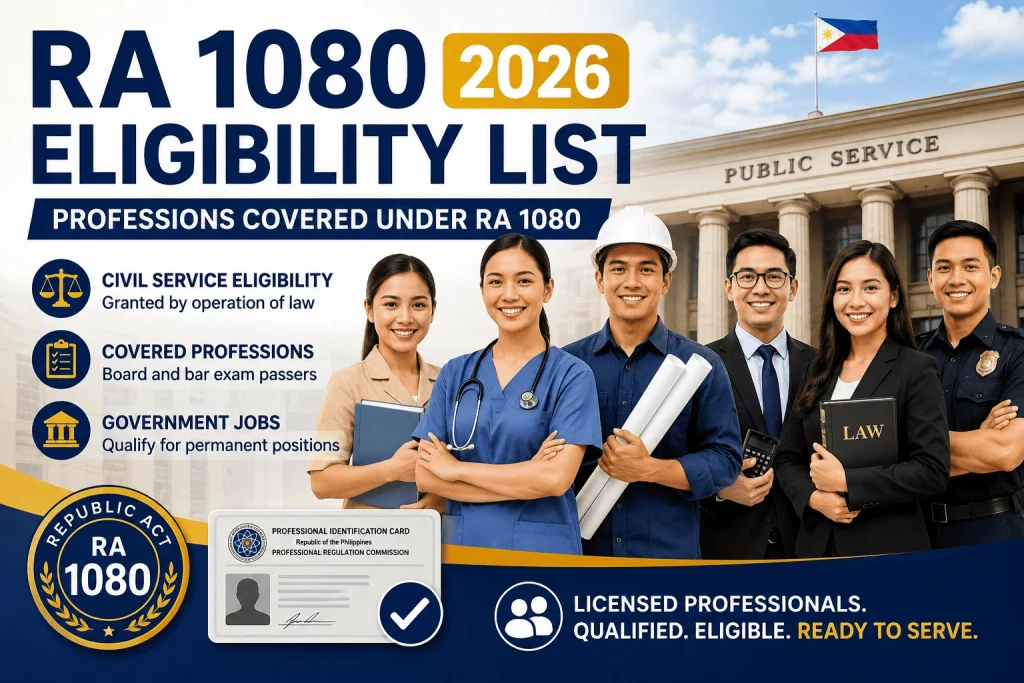
If you are a licensed professional in the Philippines, you may already possess civil service eligibility — and you might not even know it.
Under Republic Act No. 1080, passing a government-administered board or bar examination is officially recognized as equivalent to passing the Civil Service Examination. This means that individuals covered by RA 1080 automatically qualify for permanent government positions without having to take the Career Service Professional Examination (CSPE).
This complete guide covers the legal basis of RA 1080, every profession it applies to, how the eligibility works in practice, and the exact steps board passers need to take to convert their license into a recognized government credential.
📌(TL;DR)
- What is RA 1080? A law that automatically grants Civil Service Eligibility to board and bar exam passers.
- Who qualifies? Anyone who has passed a licensure exam administered by the PRC, the Supreme Court, or MARINA.
- Main benefit: You can skip the Civil Service Exam (Professional Level) when applying for permanent government jobs.
- Does it expire? No. The civil service eligibility itself is lifelong, though your PRC license must be renewed every three years for positions requiring active professional practice.
- Do I need to apply for it? No — it is granted automatically the moment your board results are released. A physical Certificate of Eligibility (COE) is optional, not required.
What Is Republic Act No. 1080 (RA 1080)?
Republic Act No. 1080, officially titled “An Act Declaring the Bar and Board Examinations as Civil Service Examinations,” was enacted to formally recognize the competence and qualifications of licensed professionals for purposes of government employment.
The principle behind the law is straightforward: because government-administered licensure examinations already rigorously test the competencies required for public service, requiring these same professionals to take a separate civil service exam would be redundant and unnecessarily burdensome. A registered nurse who has already passed a national licensure exam covering clinical competence, for instance, does not need to prove general clerical or administrative aptitude through a separate exam to qualify for a government hospital post.
The Civil Service Commission (CSC) consistently upholds RA 1080 across all branches, agencies, and levels of the Philippine government — national, regional, and local — and classifies it as a Second Level (Professional) Eligibility, the same tier as the Career Service Professional Examination.
Why This Law Exists
Before RA 1080, licensed professionals who wanted to enter government service still had to sit for the standard civil service exam, regardless of how technical or specialized their existing license already was. This created an unnecessary bottleneck: a licensed engineer or a bar-passing lawyer, already vetted through a rigorous national examination, would still need to queue for a generalist clerical-style exam just to be eligible for permanent appointment. RA 1080 closed that gap by legally equating board and bar exams with the CS Professional exam, streamlining the pipeline of qualified professionals into public service.
Who Is Covered by RA 1080 Eligibility?
This law automatically covers any individual who has passed the following government-administered examinations:
- Bar Examinations administered by the Supreme Court of the Philippines.
- PRC Licensure Examinations for regulated professions in the country.
- Marine Deck and Marine Engine Officer Examinations administered by MARINA.
- Shari’a Bar Examinations recognized by the CSC.
Complete RA 1080 Eligibility List: Professions Covered
Below is a quick-reference overview of the most common fields, followed by a detailed breakdown by category.
| Profession | Covered by RA 1080 |
|---|---|
| Teacher | Yes |
| Nurse | Yes |
| Engineer | Yes |
| Criminologist | Yes |
| Accountant | Yes |
| Lawyer | Yes |
Education
- Licensed Professional Teachers (LPT) — Passers of the Licensure Examination for Teachers (LET), both Elementary and Secondary levels, administered by the PRC.
Engineering
- Civil Engineers
- Mechanical Engineers
- Electrical Engineers
- Electronics Engineers
- Chemical Engineers
- Geodetic Engineers
- Agricultural and Biosystems Engineers
- Mining Engineers
- Sanitary Engineers
- Metallurgical Engineers
Engineering remains one of the largest professional clusters under RA 1080, and each discipline typically maps to a distinct set of government agencies where the eligibility becomes directly relevant — civil engineers to DPWH, sanitary engineers to DOH-affiliated units, mining engineers to the MGB, and so on.
Health and Medical Professions
- Registered Nurses
- Physicians (Medical Doctors)
- Dentists
- Pharmacists
- Medical Technologists
- Physical Therapists
- Occupational Therapists
- Nutritionist-Dietitians
- Midwives
- Psychologists
- Radiologic Technologists
- Respiratory Therapists
- Optometrists
Health professionals form the second-largest cluster, and this is also where RA 1080 has the most direct day-to-day impact: government hospitals, rural health units, and DOH regional offices routinely hire under permanent items that require Second Level eligibility, which board passers in these fields already satisfy on day one.
Business and Finance
- Certified Public Accountants (CPA)
- Real Estate Brokers
- Real Estate Appraisers
- Customs Brokers
Science and Technology
- Chemists
- Foresters
- Geologists
- Environmental Planners
- Agricultural Scientists
Legal Profession
- Lawyers (Bar Examination passers)
- Shari’a Lawyers
Maritime Profession
- Marine Deck Officers
- Marine Engine Officers
Architecture and Design
- Architects
- Interior Designers
- Landscape Architects
Social Sciences and Community Services
- Social Workers
- Guidance Counselors
- Librarians
- Psychometricians
Security and Public Safety
- Criminologists
Agriculture and Veterinary Sciences
- Veterinarians
- Fisheries Professionals
- Agriculturists
⚠️ Note: This list is not exhaustive. Any profession that requires a PRC licensure examination or a similar government-administered board exam is covered under RA 1080.
Is RA 1080 Eligibility Automatically Granted?
Yes. It is conferred “by operation of law” the exact moment your passing board exam results are officially released. You do not need to file any application with the CSC just to activate your eligibility — it exists the moment you pass.
When applying for government employment, any of the following documents serve as valid proof of your eligibility:
- PRC Certificate of Registration
- PRC Professional Identification Card (ID)
- PRC Report of Rating (Official Board Rating)
- Supreme Court Certificate of Passing (for lawyers)
Most hiring agencies will accept any one of these documents at the application stage. Some agencies, particularly national government agencies with stricter HR compliance requirements, may additionally request the CSC-issued Certificate of Eligibility discussed below — so it’s worth checking the specific requirements of the agency you’re applying to before assuming your PRC ID alone will suffice.
RA 1080 vs. Civil Service Exam (CS Professional)
To easily understand how they differ, here is a quick comparison:
| Factor | RA 1080 Eligibility | Civil Service Exam (CS Prof) |
|---|---|---|
| How Acquired | Automatically upon passing a board/bar exam | By passing the CSC-administered exam |
| Target Audience | Licensed professionals | General applicants without board exams |
| Eligibility Level | Professional (Second Level) | Professional (Second Level) |
| Application Needed | None — it is automatic | Must apply, pay a fee, and take the exam |
| Primary Use Cases | Tailored for specific professional roles (e.g., Nurse in a public hospital) | General administrative or technical office roles |
The key distinction worth remembering: both eligibilities sit at the same Second Level tier, so neither one is functionally “higher” than the other for most position classifications. The difference is in scope — RA 1080 eligibility is tied to your specific licensed profession, while a CS Professional eligibility is more general-purpose and can support a wider range of administrative roles that don’t require a specific license.
How to Get a Physical Certificate of Eligibility (COE) from the CSC
While your PRC ID is generally sufficient for government job applications, many professionals prefer to secure an official Certificate of Eligibility (COE) from the CSC for their personal portfolios or to satisfy specific human resource requests. Here are the steps to obtain it:
1. Prepare the Requirements
Gather the following before booking an appointment:
- A valid PRC ID (or any valid government-issued ID)
- Original and a photocopy of your Report of Rating or Certificate of Registration
- Two (2) pieces of 2×2 ID photos with a passport-style name tag (white background, name printed at the bottom)
- A fully accomplished Eligibility Recording Form (ERF), downloadable from the official CSC website
2. Book an Online Appointment
Visit the official online appointment system of the CSC Regional Office that has jurisdiction over your address or place of work. Book a slot under the schedule designated for Grant of Eligibility Under Special Laws (RA 1080). Appointment slots can fill up quickly in high-volume regional offices, so it’s worth booking a few weeks ahead if you’re working toward a specific application deadline.
3. Submit and Pay at the CSC Office
Go to your chosen CSC office on your appointment date. Submit your documents to the receiving officer for verification, pay the applicable processing fee, and claim your certificate as instructed by the office. Processing fees and turnaround times vary by region and are periodically updated by the CSC, so confirm the current schedule directly with your regional office rather than relying on a fixed figure.
4. Common Reasons for Delay or Rejection
A few recurring issues can slow down or derail a COE application:
- Mismatched name spelling between the PRC ID and the ERF
- Blurry or non-compliant photocopies of the Report of Rating
- Incomplete Eligibility Recording Forms
- Booking under the wrong appointment category
Double-checking these details before your appointment date can save a repeat trip to the CSC office.
Practical Scenarios: When RA 1080 Eligibility Actually Matters
Understanding the law is one thing — knowing when it actually comes into play during your job search is another. A few common scenarios:
Applying to a national government agency. Most Plantilla (permanent) positions in agencies like DOH, DepEd, DPWH, and DENR require Second Level eligibility as a baseline qualification. If you hold a relevant PRC license, RA 1080 satisfies this requirement outright.
Applying to a local government unit (LGU). City and municipal governments hiring for technical or professional plantilla items — municipal engineer, city nutritionist, provincial veterinarian — will typically list “RA 1080” explicitly as an acceptable eligibility in their job postings.
Transferring from private practice to public service mid-career. Professionals who spent years in private practice and later decide to move into government work often assume they need to start the eligibility process from scratch. In most cases, they don’t — their original board passing already carries RA 1080 eligibility, regardless of how long ago they passed.
Applying for a promotion within government. Some promotional plantilla items still require proof of Second Level eligibility even for employees already inside the system. RA 1080 documentation can satisfy this without requiring the employee to sit for a separate CSC exam.
Common Misconceptions About RA 1080
Even among licensed professionals, a few misunderstandings about this law persist. Clearing these up can save applicants unnecessary confusion during the hiring process.
“I need to renew my RA 1080 eligibility like a license.” This is incorrect. Unlike your PRC license, which requires renewal every three years, RA 1080 eligibility itself does not expire and does not need to be renewed. The two are separate: your license governs your right to practice your profession, while your RA 1080 eligibility governs your qualification for government employment. A lapsed license can still leave your RA 1080 eligibility intact, though it may affect whether you can be appointed to a role requiring active practice.
“RA 1080 is the same as a CSC exam certificate.” Not quite. A Certificate of Eligibility issued under RA 1080 acknowledges that your board or bar exam is being treated as equivalent to the CS Professional exam — it is not the same physical document, and it’s issued through a different process (Grant of Eligibility Under Special Laws, not the standard CSC exam application).
“Only doctors, nurses, and engineers qualify.” As the eligibility list above shows, RA 1080 spans a much broader range of professions — from librarians and guidance counselors to customs brokers and real estate appraisers. Any profession gated behind a government-administered licensure exam is a strong candidate for coverage.
“I have to secure my COE before I can apply for a government job.” Also incorrect. Since the eligibility is automatic, your PRC ID or Report of Rating is enough to apply. The COE is a convenience document, not a prerequisite.
“RA 1080 only applies to exams taken recently.” The eligibility is not time-bound. Whether you passed your board exam last year or twenty years ago, the eligibility remains equally valid today, since it was conferred the moment your results were released and does not carry an expiration clause.
Legal and Historical Context
RA 1080 has been in place for decades and has been amended over time to expand its coverage as new licensure examinations were established by the PRC and other regulatory bodies. Its underlying legal logic — that a rigorous, government-administered professional examination is functionally equivalent to the CS Professional exam — has been consistently upheld by the Civil Service Commission in its implementing rules and subsequent memorandum circulars.
This is also why the law’s practical scope has grown over the years without requiring a new piece of legislation each time: as the PRC creates or formalizes licensure exams for new professions (environmental planners and psychometricians are more recent additions to the regulated professions landscape, for example), those professions generally fall under RA 1080’s coverage as a matter of course, since the statute’s language covers any government-administered board or bar examination rather than naming professions individually.
For applicants, the practical implication is that this list will likely continue to grow as new professions become PRC-regulated — so if your profession isn’t explicitly named in this guide but is gated behind a government licensure exam, it’s worth checking directly with the CSC rather than assuming it falls outside RA 1080’s scope.
Frequently Asked Questions About RA 1080 Eligibility
Is the LET covered by RA 1080?
Yes. Passers of the Licensure Examination for Teachers (LET) — both Elementary and Secondary levels — automatically acquire RA 1080 civil service eligibility. This is a primary requirement for securing a permanent teaching position under the Department of Education (DepEd).
Are Criminologists covered under RA 1080?
Yes. Licensed Criminologists who pass the PRC licensure examination for Criminology are fully covered. They can use this eligibility when applying for qualified government roles in law enforcement, corrections, and public safety.
Can I use my RA 1080 eligibility if my PRC license has expired?
For the sole purpose of validating civil service eligibility, your RA 1080 status remains valid even if your PRC license has lapsed. However, if the government position you are applying for requires the active practice of your profession, the hiring agency will require you to renew your PRC ID before you can be formally appointed.
Do I need to register my RA 1080 eligibility with the CSC?
No separate registration is required. Your eligibility is active by law. You only need to present your proof of passing (PRC card, board rating, or passing certificate) directly to the government agency you are applying to.
Can RA 1080 holders apply for permanent government positions?
es. RA 1080 is recognized as a Second Level Eligibility and may qualify licensed professionals for permanent government appointments, provided they also meet the education, experience, training, and competency requirements of the position.
Is RA 1080 eligibility valid nationwide, or only in the region where I passed the exam?
It is valid nationwide. Since PRC licensure exams and bar exams are administered at the national level, the resulting RA 1080 eligibility applies uniformly across every region, agency, and branch of government in the Philippines.
What happens if my profession isn’t on the list above?
If your profession requires a PRC licensure examination or a similar government-administered board exam that isn’t explicitly listed here, it is very likely still covered — the list in this guide highlights the most common professions, but RA 1080’s coverage is defined by the nature of the exam (government-administered, licensure-based), not by an exhaustive enumeration. Confirm directly with the CSC if you’re uncertain about a specific profession.
Does having RA 1080 eligibility guarantee I’ll get hired?
No. RA 1080 satisfies the eligibility requirement of a government position, which is one qualification among several. Agencies still evaluate applicants based on education, relevant experience, training, and the specific competencies required for the post.
Key Takeaways
- RA 1080 eliminates the need for most licensed professionals to take the Career Service Professional Examination.
- Eligibility is automatic and lifelong — it activates the moment your board exam results are released, and it does not expire.
- Your PRC ID, Certificate of Registration, or Report of Rating is generally sufficient proof; a physical CSC-issued COE is optional but useful for portfolios or specific HR requests.
- The eligibility is nationwide and applies across every branch and level of Philippine government.
- RA 1080 confirms eligibility — it does not replace the education, experience, and competency requirements of the specific position you’re applying for.
This guide is intended for general informational purposes. For case-specific concerns or the latest processing fees and requirements, verify directly with your CSC Regional Office or refer to the official text of Republic Act No. 1080.
Related Topics
- Civil Service Exam Coverage 2026
- Civil Service Exam Requirements 2026
- How to Verify Civil Service Eligibility Online
- RA 1080 Eligibility Guide
- Plantilla Position Guide
- How to Claim CSC Certificate of Eligibility
References
- Republic Act No. 1080 — “An Act Declaring the Bar and Board Examinations as Civil Service Examinations.” Official copy hosted by the Civil Service Commission (CSC). Read the official text →
- Civil Service Commission (CSC) — Official government body that implements and interprets RA 1080 eligibility rules. csc.gov.ph
- Professional Regulation Commission (PRC) — Issuing body for board exam results, PRC IDs, and Certificates of Registration referenced throughout this guide. prc.gov.ph