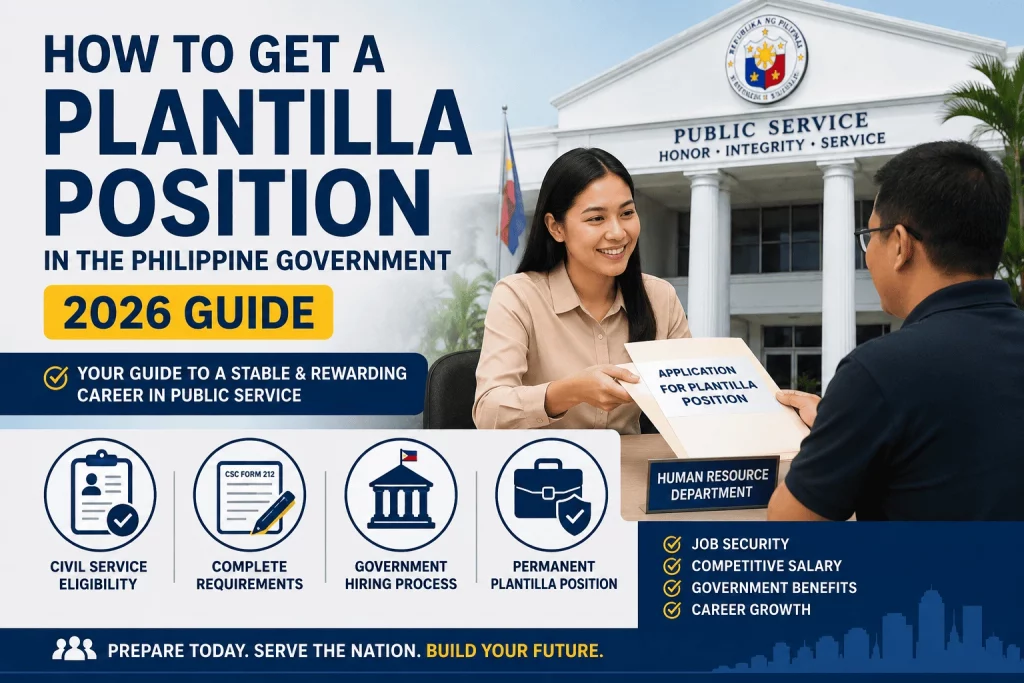
Many Filipinos dream of securing a plantilla position in the Philippine government because it offers job security, competitive salaries, government benefits, and long-term career growth. However, getting a plantilla position is often more competitive than applying for private-sector jobs because applicants must meet specific qualification standards and comply with Civil Service Commission (CSC) requirements.
If you’re planning to build a career in public service, learning how to get a plantilla position can significantly improve your chances of securing long-term government employment. This guide explains how to get a plantilla position, the qualifications you need, documentary requirements, salary grades, and practical strategies to improve your chances of being hired.
What Is a Plantilla Position?
A plantilla position is a permanent and funded government position officially included in an agency’s staffing pattern and budget. Employees holding plantilla positions receive regular salaries, government benefits, security of tenure, leave credits, and promotion opportunities.
In the Philippine government, a plantilla item refers to an authorized position approved by the Civil Service Commission (CSC) and assigned a specific salary grade under the Compensation and Position Classification System (CPCS).
The Apply Smart PH Plantilla Success Framework™
Landing a plantilla position isn’t just about meeting one requirement — it’s about stacking the right priorities in the right order. Here’s the framework we use to help applicants assess their readiness:
| Step | Priority |
|---|---|
| Eligibility | Critical |
| Qualification Standards | Critical |
| Complete Documents | High |
| Interview Preparation | Medium |
| Follow-up Applications | Medium |
The Success Formula:
Eligibility + Qualification Standards + Complete Documents + Interview Readiness = Higher Chance of Plantilla Appointment
Applicants who treat all four pillars as non-negotiable — rather than focusing only on eligibility — consistently outperform those who assume a single requirement is enough to secure an appointment.
How Do You Get a Plantilla Position?
To get a plantilla position in the Philippine government: (1) secure the required civil service eligibility, (2) meet the position’s education, experience, and training requirements, (3) prepare complete documents including your Personal Data Sheet (CS Form 212), (4) monitor vacancies through the CSC Job Portal and agency websites, (5) submit a complete application before the deadline, and (6) pass the agency’s screening, examination, and interview process.
Plantilla Position Meaning
The term plantilla refers to the official list of authorized positions within a government agency. It includes position titles, salary grades, qualification standards, and funding allocations.
A plantilla position is therefore a government position that has been formally created, approved, and funded. Unlike Job Order (JO) or Contract of Service (COS) arrangements, plantilla positions generally provide security of tenure and full government benefits.
What Is a Plantilla Position in Government?
A plantilla position in government is an officially authorized position that forms part of an agency’s approved organizational structure. Each plantilla item corresponds to a specific job title, salary grade, and qualification standard prescribed by the Civil Service Commission.
Examples of common plantilla positions include:
- Administrative Assistant I
- Administrative Officer II
- Accountant I
- Teacher I
- Nurse I
- Project Development Officer I
- Human Resource Management Officer I
Because plantilla positions are funded by government appropriations, employees receive regular salaries and are entitled to government-mandated benefits.
Why Do Many Filipinos Want a Plantilla Position?
Plantilla positions remain among the most sought-after employment opportunities in the Philippines because they offer long-term career stability and a comprehensive compensation package.
Security of Tenure Permanent plantilla employees enjoy protection under civil service laws and cannot be removed from their positions without due process.
Competitive Monthly Salary Government salaries have become increasingly competitive under the Salary Standardization Law and the government’s updated salary schedules.
Government Benefits Plantilla employees typically receive GSIS membership, PhilHealth coverage, Pag-IBIG Fund membership, vacation and sick leave credits, mid-year and year-end bonuses, cash gifts, and other incentives.
Promotion Opportunities Government agencies provide structured career paths that allow employees to move to higher positions and salary grades over time.
Plantilla Position vs Job Order vs Contract of Service
Many applicants confuse plantilla positions with Job Order (JO) and Contract of Service (COS) arrangements.
| Plantilla Position | Job Order (JO) | Contract of Service (COS) | |
|---|---|---|---|
| Appointment type | Permanent/regular | No employer-employee relationship | Contractual |
| Security of tenure | Yes | No | No |
| GSIS coverage | Yes | No | No |
| Leave credits | Yes | No | Limited/none |
| Promotion opportunities | Yes | No | No |
| Salary Grade classification | Yes | No | No |
For individuals seeking long-term careers in government service, plantilla positions remain the preferred employment status.
How to Get a Plantilla Position in the Philippine Government
Securing a plantilla position requires more than simply submitting an application. Applicants must meet qualification standards, possess the required eligibility, submit complete documents, and successfully pass the agency’s recruitment process.
Step 1: Identify a Position That Matches Your Qualifications
Before applying, determine which government position aligns with your education, work experience, training, and eligibility.
Common entry-level plantilla positions include Administrative Assistant, Administrative Officer, Human Resource Management Assistant, Budget Officer, Accountant, Planning Officer, Project Development Officer, Revenue Collection Clerk, Teacher I, and Nurse I. Each position has specific qualification standards prescribed by the Civil Service Commission.
Step 2: Obtain the Required Civil Service Eligibility
Civil service eligibility is one of the most important requirements for permanent plantilla appointments. Without the required eligibility, applicants may only qualify for temporary appointments or non-career positions.
Career Service Professional Eligibility — the most common eligibility used for second-level government positions, qualifying applicants for professional, technical, supervisory, and administrative positions.
Career Service Subprofessional Eligibility — generally used for first-level positions involving clerical, trades, crafts, and custodial work.
RA 1080 Eligibility — licensed professionals who pass government board examinations (teachers, nurses, engineers, architects, pharmacists, accountants, physical therapists, and others) automatically acquire civil service eligibility under Republic Act No. 1080, often considered equivalent to Career Service Professional Eligibility.
PD 907 Eligibility — honor graduates from recognized educational institutions may qualify for civil service eligibility under Presidential Decree No. 907 without taking the Civil Service Examination.
Special Eligibilities — some positions may require special eligibilities such as Barangay Official Eligibility, Electronic Data Processing Specialist Eligibility, or Sanggunian Member Eligibility. Always check the qualification standards indicated in the vacancy announcement.
Step 3: Meet the Qualification Standards
Government agencies strictly follow qualification standards established by the Civil Service Commission. These standards generally cover:
- Education — e.g., Administrative Officer II requires a Bachelor’s Degree; Teacher I requires a Bachelor’s Degree in Education; Nurse I requires a BS in Nursing; Accountant I requires a Bachelor’s Degree in Accountancy.
- Experience — some positions require previous work experience while others are open to fresh graduates.
- Training — many positions require training in leadership, HR management, accounting, planning, project management, or IT.
- Eligibility — applicants must possess the exact eligibility prescribed for the position.
Failure to meet any qualification standard may result in disqualification.
Step 4: Prepare Your Documentary Requirements
Incomplete applications are among the most common reasons applicants fail during screening. Most agencies require:
- Application Letter
- Personal Data Sheet (CSC Form 212)
- Work Experience Sheet (WES)
- Updated Resume or Curriculum Vitae
- Transcript of Records (TOR)
- Diploma
- Certificate of Eligibility
- Certificates of Training
- Certificates of Employment
- Performance Ratings (for current government employees)
Always review the vacancy announcement carefully, since some agencies require additional supporting documents.
Step 5: Monitor Government Job Vacancies
Finding the right vacancy is a critical step. Check the CSC Job Portal (the primary source of government vacancy announcements), individual agency websites, LGU websites and social media pages, verified government Facebook pages, and State Universities and Colleges (SUC) HR offices for teaching and administrative openings. Monitoring these sources regularly increases your chances of finding opportunities before application deadlines.
Step 6: Submit a Complete Application
Once you identify a suitable vacancy, submit a complete application package before the deadline — via email, an online application system, courier, or personal submission. Before submitting, verify document completeness, ensure all forms are signed, check file formats if submitting electronically, and review qualification requirements. Many applicants are automatically disqualified because of incomplete submissions.
Step 7: Pass the Screening and Selection Process
Initial Screening — The Human Resource Management Office (HRMO) reviews all submitted applications and verifies whether applicants meet the minimum qualification standards (education, experience, training, eligibility, and completeness of documents).
Examination — Some agencies conduct written examinations, technical assessments, or competency tests covering analytical skills, technical knowledge, communication skills, and position-specific competencies.
Interview — Qualified applicants are invited for an interview evaluating communication skills, professional experience, behavioral competencies, problem-solving abilities, and suitability for the position.
Background Verification — Agencies may verify employment records, educational credentials, eligibility documents, and character references. Providing accurate information in your Personal Data Sheet is essential.
Step 8: Receive and Accept Your Appointment
Successful applicants receive an official appointment approved by the appointing authority, containing the position title, salary grade, appointment status, office assignment, and effective date. Upon assumption of duty, you officially become a government employee. If appointed to a permanent plantilla position, you gain access to government benefits, career advancement opportunities, and security of tenure.
What Salary Grade Does a Plantilla Position Have?
Every plantilla position is assigned a corresponding Salary Grade (SG) under the Compensation and Position Classification System (CPCS). The assigned grade depends on the complexity of duties, level of responsibility, and required education, experience, and eligibility.
| Position | Salary Grade |
|---|---|
| Administrative Assistant I | SG 7 |
| Administrative Assistant II | SG 8 |
| Teacher I | SG 11 |
| Administrative Officer II | SG 11 |
| Accountant I | SG 12 |
| Nurse I | SG 15 |
| Attorney III | SG 21 |
Plantilla employees receive compensation according to the Government Salary Grade Schedule and may earn step increments through years of satisfactory service. (Verify current salary figures against the latest official Salary Schedule before publishing — do not rely on prior figures without confirming they’re current.)
Plantilla Readiness Scorecard™
Before you apply, use this scorecard to gauge how ready you actually are. Give yourself the listed points for each item that applies to you, then check your total against the readiness bands below.
| Readiness Factor | Points if Met |
|---|---|
| You hold the required civil service eligibility (CSE, RA 1080, or equivalent) | 30 |
| You meet the position’s education requirement | 20 |
| You meet the position’s experience requirement | 15 |
| You have relevant training certificates | 15 |
| Your documents (PDS, TOR, diploma, etc.) are complete and updated | 10 |
| You’ve prepared for a government hiring interview | 10 |
Score interpretation:
- 80–100 points — Ready to Apply. You meet the core requirements; focus on finding the right vacancy and submitting a polished application.
- 50–79 points — Almost Ready. You likely qualify for entry-level or lower-competition plantilla items, but should close gaps in training or documentation before applying to competitive posts.
- Below 50 points — Build Your Foundation First. Prioritize securing eligibility and meeting the education/experience requirements before actively applying — this is usually where most rejections happen.
This scorecard isn’t an official CSC tool — it’s a practical self-check based on the qualification standards every plantilla position shares.
Practical Tips to Improve Your Chances
- Obtain eligibility early — applicants with civil service eligibility often have a significant advantage.
- Build relevant experience — from private companies, internships, Job Order, or Contract of Service positions.
- Complete relevant training — leadership, HR management, project management, financial management, or government procurement training can strengthen your application.
- Submit complete requirements — many qualified applicants fail simply because of missing documents.
- Apply to multiple agencies — recruitment timelines vary, so applying broadly increases your chances of securing a position more quickly.
Common Mistakes Applicants Should Avoid
- Submitting incomplete documents
- Applying without the required eligibility
- Ignoring published qualification standards
- Missing application deadlines
- Providing inaccurate information on the Personal Data Sheet
- Failing to prepare for interviews
Can You Get a Plantilla Position Without Eligibility?
Generally, no — not for a permanent plantilla appointment. Civil service eligibility is one of the four Qualification Standards (education, experience, training, and eligibility) that the Civil Service Commission requires for permanent government positions, and it cannot be waived.
That said, there are a few important nuances:
- Temporary appointments are sometimes available for applicants who meet the education, experience, and training requirements but lack eligibility — though these carry no security of tenure and are subject to replacement once an eligible candidate is available.
- Casual, Job Order (JO), and Contract of Service (COS) arrangements don’t require civil service eligibility at all, since they fall outside the plantilla system entirely — but they also don’t carry plantilla benefits like GSIS coverage or security of tenure.
- Eligibility can often be earned quickly depending on your background — through the Civil Service Professional/Subprofessional Exam, or automatically through RA 1080 if you’re a licensed professional. Many applicants who assume they lack eligibility already qualify under RA 1080 without realizing it.
If you’re unsure whether you already hold a usable eligibility, start by checking whether your profession falls under RA 1080 before assuming you need to take the Civil Service Exam from scratch.
Frequently Asked Questions
What is a plantilla position?
A plantilla position is a permanent and funded government position officially included in an agency’s staffing pattern and budget, entitling the holder to regular salary, government benefits, and security of tenure.
What does plantilla mean in government?
It refers to the official list of authorized positions within an agency, including position titles, salary grades, qualification standards, and funding allocations.
Is a plantilla position permanent? Yes. Most p
Is a plantilla position permanent?
Yes. Most plantilla positions are filled through permanent appointments when applicants meet all qualification standards and eligibility requirements.
Do I need civil service eligibility to get a plantilla position?
In most cases, yes. Permanent plantilla positions generally require the appropriate civil service eligibility, professional license, or eligibility prescribed by law.
Can fresh graduates get a plantilla position?
Yes, provided they meet the educational requirements and possess the necessary eligibility or qualifications for the entry-level position.
Can Job Order (JO) and Contract of Service (COS) workers apply for plantilla positions?
Yes, provided they meet the qualification standards and eligibility requirements of the position.
How long does the government hiring process take?
It varies by agency, typically ranging from several weeks to several months depending on the number of applicants and approval procedures.
What are the benefits of a plantilla position?
GSIS benefits, PhilHealth coverage, Pag-IBIG membership, leave credits, mid-year and year-end bonuses, step increments, promotion opportunities, and security of tenure.
Can RA 1080 holders apply for plantilla positions?
Yes. Professionals covered by Republic Act No. 1080 may use their eligibility when applying for government positions that accept RA 1080 eligibility.
Final Thoughts
Understanding how to get a plantilla position is one of the most important steps toward building a successful career in public service. While the process can be competitive, applicants who possess the required eligibility, qualifications, training, and complete documentation significantly improve their chances of success.
A plantilla position offers more than just a regular salary — it provides long-term career growth, security of tenure, government benefits, retirement protection, and opportunities for advancement within the Philippine civil service system.
Whether you are a fresh graduate, a Civil Service Exam passer, an RA 1080 eligibility holder, or a Job Order employee seeking permanent government employment, preparing early and understanding the recruitment process can greatly increase your chances of securing a plantilla appointment.
Related Topics
- Job Order vs. COS vs. Permanent: What Is a Plantilla Position?
- CSC Eligibility Requirements: Complete Guide for Government Job Applicants
- How to Apply for Government Jobs in the Philippines: Step-by-Step Guide
- CSC Form 212 Guide: How to Fill Out the Personal Data Sheet (PDS) Correctly
- Government Salary Grade 2026: Complete Guide to the Philippine Salary Schedule
- RA 1080 Eligibility Guide: Automatic Civil Service Eligibility for Board and Bar Passers
References
- Civil Service Commission (CSC) — Official government body responsible for setting qualification standards, eligibility rules, and appointment policies for Philippine government positions. csc.gov.ph
- Republic Act No. 1080 — “An Act Declaring the Bar and Board Examinations as Civil Service Examinations.” Official copy hosted by the CSC. Read the official text →
- Department of Budget and Management (DBM) — Administers the Compensation and Position Classification System (CPCS) and the Government Salary Grade Schedule referenced in this guide. dbm.gov.ph
This guide is intended for general informational purposes. Qualification standards, salary schedules, and documentary requirements may vary by agency and are subject to change — always verify current details with the hiring agency’s HRMO or the CSC directly.