General Information is the subject most examinees assume they already know. It covers the Philippine Constitution, government structure, ethics standards, and civic knowledge — topics that feel like common sense after years of schooling and daily life as a Filipino citizen. That familiarity is exactly why so many examinees underestimate this section and lose points they were confident they’d get right.
The truth is that General Information tests specific, exact knowledge, not general awareness. Knowing that the Philippines has three branches of government isn’t the same as knowing which specific powers the Constitution assigns to each one. Knowing that government employees have ethical obligations isn’t the same as knowing the exact prohibited acts listed under Republic Act 6713. This civil service general information reviewer is built to close that exact gap between “I’ve heard of this” and “I can answer a specific question about this correctly.”
Memorization alone isn’t enough either. The exam frequently rephrases familiar concepts in unfamiliar ways, testing whether you actually understand a provision well enough to recognize it in a new sentence, not just whether you can recite it word for word. That’s a different skill, and it’s one that structured, question-based practice builds far better than passive reading.
General Information carries real weight on both the Professional and Subprofessional levels of the CSE-PPT, making it too significant a subject to leave to chance. In this guide, you’ll learn exactly what the section covers, the specific topics it draws from, common mistakes that quietly cost examinees points, practical study tips, a full weekly study plan, and 50 free practice questions with answers and explanations to start building real exam-ready knowledge today.
Start the Free General Information Reviewer
Practice General Information the Right Way
✔ Interactive Reviewer ✔ Easy → Advanced Questions ✔ Instant Feedback ✔ Mobile Friendly
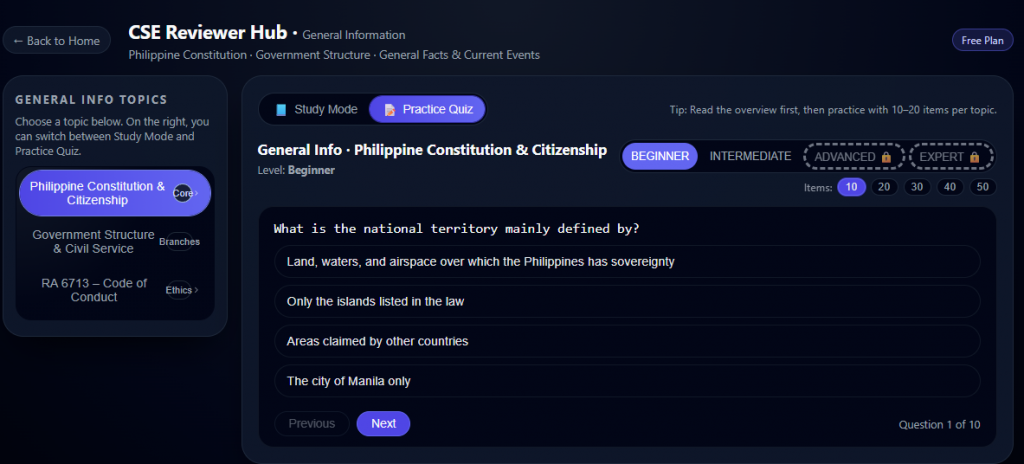
Start the Free General Information Reviewer
What Is the General Information Test in the Civil Service Exam?
Purpose
General Information exists to confirm that future government employees understand the legal, ethical, and civic foundations of public service before they’re granted eligibility. It isn’t trivia for its own sake — every topic in this section connects directly to the responsibilities of working in government, from following ethical standards to understanding the structure you’ll be working within.
Government Awareness
This includes understanding how the Philippine government is organized, how laws are made and enforced, and how different branches and agencies interact. A civil service employee is expected to understand this structure well enough to know where their own role fits within it.
Citizenship
Questions in this category test knowledge of constitutional rights and duties, the qualifications and process of citizenship, and the civic responsibilities that come with it — concepts every Filipino is expected to know, but that the exam tests with more precision than casual familiarity provides.
Ethics
Ethics questions draw heavily from RA 6713, the Code of Conduct and Ethical Standards for Public Officials and Employees. This is one of the most consistently tested areas in General Information, since ethical conduct is treated as a baseline requirement for anyone entering government service.
Public Service
This covers the values, standards, and expectations attached to working in a public office — accountability, transparency, and service to the public interest — often tested through scenario-based questions that ask you to identify the correct or expected course of action.
National Issues
This includes environmental management, peace and human rights, and broader civic and national concerns that a well-informed public servant is expected to understand, even outside their specific job function.
Topics Covered in the General Information Reviewer
Philippine Constitution
The Constitution is the foundational law of the Philippines, and Constitution-based questions typically test specific articles — the Bill of Rights, the structure and powers of government branches, and fundamental principles like the separation of powers and checks and balances. Expect questions that test not just what a provision says, but what it means in a practical scenario.
RA 6713: Code of Conduct and Ethical Standards
RA 6713 sets out the ethical obligations of public officials and employees, including norms of conduct, prohibited acts and transactions, and requirements like the Statement of Assets, Liabilities, and Net Worth (SALN). Because this law directly governs how government employees are expected to behave, it’s tested with a level of specificity that rewards examinees who’ve actually read the provisions rather than relying on general impressions of “government ethics.”
Environmental Management
This covers laws and principles related to environmental protection, sustainable development, and natural resource management. Questions often test awareness of the government’s role in environmental governance and the responsibilities of public agencies in protecting natural resources.
Peace and Human Rights
This category covers fundamental human rights principles, peace-building concepts, and the government’s role in protecting citizens’ rights. Expect conceptual questions about the meaning and scope of human rights, rather than case-specific legal detail.
Science and Technology
Science and Technology questions test general scientific literacy and awareness of how technology intersects with public administration and national development, rather than specialized technical knowledge in any single scientific field.
Philippine History
History questions cover major events, figures, and periods in Philippine history, particularly those tied to nation-building, governance, and the development of Philippine institutions. A working knowledge of key historical milestones tends to be more useful here than memorizing exact dates in isolation.
Current Events
This category tests general awareness of ongoing national and civic issues relevant to public service and governance. Because current events by definition change over time, the most reliable way to prepare is to build a habit of following credible news sources regularly, rather than memorizing any fixed list of facts — what matters on exam day is whatever is actually current at that time.
Government Structure
Executive. Covers the powers, functions, and composition of the executive branch, headed by the President, and its role in implementing laws and administering government agencies.
Legislative. Covers the structure and functions of Congress, including how laws are proposed, deliberated, and passed, and the respective roles of the Senate and House of Representatives.
Judicial. Covers the court system, judicial powers, and the judiciary’s role in interpreting laws and resolving disputes, including the structure from the Supreme Court down to lower courts.
Free General Information Practice Questions
Below are 50 sample questions across five major topic areas, each with an answer and a short explanation. Try answering before checking the explanation, and treat any topic where you get several wrong as a signal to review that section more closely.
Philippine Constitution (10 Questions)
- What is the supreme law of the Philippines? A. The Civil Code B. The Constitution C. The Revised Penal Code D. Executive Orders Answer: B. Explanation: The Constitution is the fundamental law from which all other laws derive their validity.
- Which part of the Constitution enumerates the fundamental rights of citizens? A. Bill of Rights B. Preamble C. Article on Suffrage D. Local Government Code Answer: A. Explanation: The Bill of Rights specifically lists the fundamental civil and political rights guaranteed to every citizen.
- How many branches of government does the Constitution establish? A. Two B. Three C. Four D. Five Answer: B. Explanation: The Constitution establishes three branches — Executive, Legislative, and Judicial — under the principle of separation of powers.
- What principle prevents any one branch of government from becoming too powerful? A. Federalism B. Checks and balances C. Due process D. Judicial review Answer: B. Explanation: Checks and balances allow each branch to limit the powers of the others, preventing the concentration of authority.
- Who has the power to declare war under the Constitution? A. The President alone B. Congress C. The Supreme Court D. The Vice President Answer: B. Explanation: The Constitution vests the power to declare war in Congress, not the President alone.
- What is the term of office of the President of the Philippines? A. Four years, one term only B. Six years, one term only C. Six years, renewable D. Four years, renewable Answer: B. Explanation: The Constitution sets a single six-year term for the President, with no re-election allowed.
- What does “due process of law” primarily guarantee? A. Free legal representation B. Fair legal procedures before deprivation of life, liberty, or property C. Automatic bail D. Speedy trials only Answer: B. Explanation: Due process guarantees fair procedures before the government can deprive a person of life, liberty, or property.
- Which body has the power to interpret the Constitution? A. Congress B. The President C. The Judiciary D. The Ombudsman Answer: C. Explanation: The judiciary, particularly the Supreme Court, holds the power of judicial review to interpret the Constitution.
- What is the principle of separation of church and state primarily meant to protect? A. Government funding of religion B. Religious freedom and neutrality of the state C. Church taxation D. Religious education in schools Answer: B. Explanation: This principle protects religious freedom by preventing the state from favoring or interfering with any religion.
- Under the Constitution, sovereignty resides in whom? A. The President B. Congress C. The people D. The Supreme Court Answer: C. Explanation: The Constitution declares that sovereignty resides in the people, and all government authority emanates from them.
RA 6713: Code of Conduct (10 Questions)
- What does RA 6713 primarily govern? A. Criminal penalties for corruption B. Ethical standards for public officials and employees C. Tax collection procedures D. Civil service examinations Answer: B. Explanation: RA 6713 sets the norms of conduct and ethical standards expected of everyone in public service.
- What document must public officials file to disclose their assets and liabilities? A. Personal Data Sheet B. Statement of Assets, Liabilities, and Net Worth (SALN) C. Certificate of Employment D. Oath of Office Answer: B. Explanation: The SALN is the specific annual disclosure document required under RA 6713.
- Which of the following is a norm of conduct under RA 6713? A. Political neutrality B. Personal enrichment C. Selective transparency D. Favoritism Answer: A. Explanation: Political neutrality is one of the explicit norms of conduct expected of public officials and employees.
- What is one purpose of requiring public officials to disclose their SALN? A. To calculate their taxes B. To promote transparency and prevent unexplained wealth C. To determine eligibility for promotion D. To assess retirement benefits Answer: B. Explanation: SALN disclosure promotes transparency and helps prevent and detect unexplained accumulation of wealth.
- Under RA 6713, accepting gifts in the course of official duties is generally what? A. Encouraged B. Prohibited C. Required D. Optional Answer: B. Explanation: RA 6713 generally prohibits public officials from soliciting or accepting gifts in connection with their official duties.
- What does the norm of “commitment to public interest” require of public servants? A. Prioritizing personal gain B. Prioritizing the public welfare over personal interest C. Avoiding public engagement D. Delegating all decisions Answer: B. Explanation: This norm requires public officials to place public welfare above their personal interests at all times.
- What is one prohibited act under RA 6713 related to private practice? A. Volunteering in community programs B. Engaging in private business that conflicts with official duties C. Attending seminars D. Teaching part-time with proper authorization Answer: B. Explanation: RA 6713 prohibits engaging in private business or practice that conflicts with one’s official government functions.
- Who is generally covered by RA 6713? A. Only elected officials B. Only appointed officials C. All public officials and employees in government service D. Only military personnel Answer: C. Explanation: RA 6713 applies broadly to all officials and employees in the government service, whether elected or appointed.
- What value does RA 6713 promote through the principle of “simple living”? A. Avoiding public visibility B. Living modestly and avoiding extravagance disproportionate to lawful income C. Refusing government benefits D. Minimizing work output Answer: B. Explanation: Simple living discourages public officials from living in a manner disproportionate to their legitimate income.
- What government body primarily enforces the standards under RA 6713? A. Department of Justice only B. Civil Service Commission and Ombudsman, among others C. Department of Finance D. Commission on Elections Answer: B. Explanation: Enforcement of RA 6713 involves several bodies, most notably the Civil Service Commission and the Office of the Ombudsman.
Government Structure (10 Questions)
- Which branch of government is primarily responsible for implementing laws? A. Legislative B. Executive C. Judicial D. Local government Answer: B. Explanation: The executive branch, headed by the President, is primarily responsible for implementing and enforcing laws.
- What is the primary function of Congress? A. Interpreting laws B. Enacting laws C. Enforcing laws D. Reviewing court decisions Answer: B. Explanation: Congress, composed of the Senate and House of Representatives, holds the primary law-making power.
- Which court has the highest judicial authority in the Philippines? A. Court of Appeals B. Regional Trial Court C. Supreme Court D. Sandiganbayan Answer: C. Explanation: The Supreme Court is the highest court and the final arbiter of legal and constitutional questions.
- How many houses make up the Philippine Congress? A. One B. Two C. Three D. Four Answer: B. Explanation: Congress is bicameral, composed of the Senate and the House of Representatives.
- What is the role of local government units within the government structure? A. National defense B. Delivering basic services and governance at the local level C. Foreign policy D. Monetary policy Answer: B. Explanation: Local government units are responsible for delivering public services and governance closer to citizens at the community level.
- Who serves as the head of the executive branch? A. Senate President B. Chief Justice C. President D. Speaker of the House Answer: C. Explanation: The President is the head of state and head of the executive branch of government.
- What is the main function of the Sandiganbayan? A. Handling family law cases B. Trying graft and corruption cases involving public officials C. Reviewing tax disputes D. Handling labor disputes Answer: B. Explanation: The Sandiganbayan is a special court that handles graft and corruption cases involving government officials.
- What body is primarily responsible for civil service examinations and personnel policies? A. Department of Budget and Management B. Civil Service Commission C. Commission on Audit D. Department of Labor and Employment Answer: B. Explanation: The Civil Service Commission is the central personnel agency responsible for civil service examinations and government workforce policy.
- Which body is tasked with auditing government funds and accounts? A. Commission on Audit B. Bureau of Internal Revenue C. Department of Finance D. Bangko Sentral ng Pilipinas Answer: A. Explanation: The Commission on Audit is the constitutional body responsible for auditing government revenues and expenditures.
- What is the general term limit for members of the House of Representatives per term? A. Two years B. Three years C. Four years D. Six years Answer: B. Explanation: Members of the House of Representatives serve a term of three years, subject to a limit on consecutive terms.
Environmental Management (10 Questions)
- What is the primary goal of environmental management laws in the Philippines? A. Restricting all resource use B. Balancing development with the protection of natural resources C. Promoting unrestricted industrialization D. Eliminating agriculture Answer: B. Explanation: Environmental management laws aim to balance economic development with sustainable protection of natural resources.
- What does “sustainable development” primarily mean? A. Rapid resource extraction B. Meeting present needs without compromising future generations’ ability to meet theirs C. Halting all development D. Focusing solely on urban growth Answer: B. Explanation: Sustainable development balances current development needs against the long-term availability of resources for future generations.
- Which government agency primarily oversees environmental protection in the Philippines? A. Department of Agriculture B. Department of Environment and Natural Resources (DENR) C. Department of Tourism D. Department of Trade and Industry Answer: B. Explanation: The DENR is the primary agency responsible for the conservation and management of the country’s environment and natural resources.
- What is one common cause of environmental degradation addressed by government policy? A. Reforestation B. Illegal logging and deforestation C. Wildlife protection programs D. Marine sanctuaries Answer: B. Explanation: Illegal logging and deforestation are commonly cited as major causes of environmental degradation that policy seeks to address.
- What is the purpose of an Environmental Compliance Certificate? A. To certify tax compliance B. To confirm a project meets environmental requirements before implementation C. To register a business name D. To grant land titles Answer: B. Explanation: An Environmental Compliance Certificate confirms that a proposed project has met environmental standards before it proceeds.
- What does “biodiversity” refer to? A. Variety of currencies B. Variety of life forms within a given ecosystem C. Variety of government agencies D. Variety of laws Answer: B. Explanation: Biodiversity refers to the variety of living organisms within a particular habitat or ecosystem.
- What is a primary concern addressed by climate change policy? A. Currency exchange rates B. Rising global temperatures and their environmental impact C. Trade tariffs D. Population census methods Answer: B. Explanation: Climate change policy primarily addresses the causes and impacts of rising global temperatures on the environment and society.
- What role do local government units play in environmental management? A. None; it is purely national B. Implementing and enforcing environmental regulations locally C. Setting international treaties D. Managing foreign relations Answer: B. Explanation: Local government units play a direct role in implementing and enforcing environmental regulations within their jurisdictions.
- What is the purpose of solid waste management programs? A. Increasing landfill use indefinitely B. Reducing, reusing, and properly disposing of waste C. Banning all packaging D. Eliminating recycling Answer: B. Explanation: Solid waste management programs promote reducing, reusing, and properly disposing of waste to minimize environmental harm.
- Why is watershed protection important? A. It has no significant impact B. It safeguards water sources for communities and ecosystems C. It only affects tourism D. It is unrelated to agriculture Answer: B. Explanation: Watershed protection safeguards the sources of water that communities, agriculture, and ecosystems depend on.
History & Current Events (10 Questions)
- What event is commonly recognized as marking the start of the Philippine Revolution against Spain? A. The Cry of Pugad Lawin B. The EDSA Revolution C. The Battle of Manila Bay D. The signing of the Treaty of Paris Answer: A. Explanation: The Cry of Pugad Lawin (or Balintawak) is commonly recognized as the event that sparked the Philippine Revolution.
- Which event led to the establishment of the Philippine Commonwealth? A. The Philippine Revolution B. The passage of the Tydings-McDuffie Act C. The EDSA Revolution D. World War II Answer: B. Explanation: The Tydings-McDuffie Act of 1934 paved the way for the establishment of the Philippine Commonwealth as a step toward independence.
- In what year did the Philippines gain formal independence from the United States? A. 1898 B. 1935 C. 1946 D. 1972 Answer: C. Explanation: The Philippines formally gained independence from the United States on July 4, 1946.
- What historical event is associated with the peaceful restoration of democracy in 1986? A. Martial Law declaration B. EDSA People Power Revolution C. Battle of Manila D. Commonwealth establishment Answer: B. Explanation: The EDSA People Power Revolution of 1986 peacefully restored democratic government after years of martial law.
- Why is it important for civil servants to stay updated on current events? A. It has no relevance to government work B. It helps them understand the context behind current policies and public concerns C. It is only relevant to journalists D. It is not tested on the exam Answer: B. Explanation: Staying informed helps civil servants understand the context behind current policies, programs, and the concerns of the public they serve.
- What is the most reliable way to prepare for current events questions on the exam? A. Memorizing a fixed list of past headlines B. Regularly following credible news sources leading up to the exam C. Ignoring the news entirely D. Relying only on social media trends Answer: B. Explanation: Since current events change constantly, regularly following credible news sources is more reliable than memorizing any fixed list of facts.
- What kind of national issues typically fall under this category? A. Only entertainment news B. Governance, policy, economic, and civic developments C. Only sports results D. Only celebrity news Answer: B. Explanation: Current events questions typically focus on governance, policy, economic, and civic developments relevant to public service.
- Why do civil service exams include History alongside Current Events? A. To confuse examinees B. To assess understanding of how past events shape present governance C. It is unrelated filler content D. It replaces Verbal Ability Answer: B. Explanation: History questions help assess whether examinees understand how past events have shaped current governance and institutions.
- What is a practical habit for staying updated on current events? A. Reading news only once a year B. Following a credible news source on a regular, ongoing basis C. Reading only entertainment blogs D. Avoiding news until exam week Answer: B. Explanation: A consistent, ongoing habit of following credible news sources builds better and more current awareness than last-minute cramming.
- Why does understanding Philippine history matter for a future public servant? A. It has no practical relevance B. It provides context for the values and institutions the public service is built on C. It is only relevant to teachers D. It replaces the need for legal knowledge Answer: B. Explanation: Understanding Philippine history gives public servants context for the institutions, values, and struggles that shaped the government they’ll serve in.
Start the Free General Information Reviewer
Most Common Mistakes in General Information
Studying only one subject. Some examinees focus heavily on the Constitution or RA 6713 because those feel more “exam-like,” while neglecting Environmental Management or Government Structure. General Information spreads its items across all these topics fairly evenly, so uneven review directly translates to uneven scores.
Ignoring the Constitution. Because it feels abstract or legalistic, many examinees skim the Constitution instead of studying it properly. This is a mistake, since Constitution-based items are consistently among the most frequently tested in this section.
Skipping RA 6713. Some examinees assume they already understand government ethics intuitively and skip formal review of RA 6713 altogether. The exam tests specific provisions and prohibited acts under this law, which intuition alone won’t reliably cover.
Depending on memorization. Memorizing isolated facts without understanding their context leads to shaky recall under pressure. The exam often rephrases familiar concepts, so understanding the reasoning behind a provision matters more than reciting it word for word.
Ignoring current affairs. Treating Current Events as unimportant, or assuming it can be skipped entirely, leaves a real gap, since staying broadly informed about ongoing national issues is part of what this section tests.
Not practicing enough. Reading reviewer material passively, without answering practice questions regularly, doesn’t reveal which specific facts you’ve actually retained versus which ones you only recognize when you see them. Active recall through practice questions is what actually builds exam-day readiness.
Tips to Improve Your General Information Score
Read official government sources. Official publications from agencies like the Civil Service Commission, DENR, and other government bodies provide accurate, exam-relevant information more reliably than secondhand summaries.
Review one topic daily. Rotating through Constitution, RA 6713, Government Structure, History, and Environment on a set daily schedule prevents any single topic from being neglected, and builds steady, cumulative retention.
Use flashcards. Flashcards work particularly well for General Information because much of it involves discrete facts, provisions, and definitions that benefit from spaced repetition.
Answer practice questions. Actively answering questions, rather than just reading notes, reveals exactly which facts you’ve truly retained and which ones need more review.
Take mock exams. Full timed mock exams reveal how your General Information knowledge holds up when mixed with other subjects under real exam pressure, not just in isolated topic review.
How Our General Information Reviewer Works
Easy → Medium → Advanced → Performance → Progress
You begin with foundational, easy-level items covering core facts and provisions, move into medium-difficulty questions that mirror typical exam phrasing, and finish with advanced items designed to test deeper understanding and application. A performance summary then shows your accuracy by topic, while a progress view tracks your improvement across sessions over time.
[ Screenshot: Easy → Medium → Advanced progression ] [ Screenshot: Performance and Progress dashboard ]
Free Reviewer vs Practice Mode
| Feature | Free Reviewer | PRO Practice Mode |
|---|---|---|
| Topic lessons | ✅ | ✅ |
| Easy → Advanced | ✅ | ✅ |
| Timed practice | ❌ | ✅ |
| Unlimited attempts | ✅ | ✅ |
| Analytics | ❌ | ✅ |
| Progress tracking | ❌ | ✅ |
| Detailed explanations | ✅ | ✅ |
The Free Reviewer already gives you full topic lessons and a genuine spread of easy-to-advanced questions across all seven General Information topics. PRO Practice Mode adds timed sessions that mirror real exam pacing, unlimited attempts to keep drilling a weak topic like RA 6713 or Environmental Management, and detailed analytics that show exactly which specific topics — not just subjects — are pulling your score down.
Start the Free General Information Reviewer
Weekly General Information Study Plan
Monday — Constitution. Focus on the Bill of Rights, the three branches, and core constitutional principles.
Tuesday — RA 6713. Review norms of conduct, prohibited acts, and SALN requirements in detail.
Wednesday — Government. Study the structure and functions of the Executive, Legislative, and Judicial branches.
Thursday — History. Review major events and periods that shaped Philippine governance and institutions.
Friday — Environment. Cover environmental management principles, key agencies, and sustainable development concepts.
Saturday — Mixed Questions. Answer randomized questions across all topics to simulate real exam variety.
Sunday — Mock Exam. Take a full, timed simulation and review every mistake before the following week begins.
General Information Readiness Checklist™
☐ Constitution reviewed ☐ RA 6713 mastered ☐ Government structure understood ☐ Environment reviewed ☐ Score at least 80% ☐ Ready for Mock Exam
General Information Mastery Roadmap™
Constitution ↓ RA 6713 ↓ Government ↓ Environment ↓ History ↓ Current Events ↓ Mixed Practice ↓ 170-Item Mock Exam
Each stage builds on the last. The Constitution and RA 6713 form the legal foundation; Government Structure shows how that foundation is organized in practice; Environment and History round out your civic knowledge; Current Events keeps that knowledge grounded in the present; Mixed Practice forces recall across all topics at once, the way the real exam will; and the full 170-item mock exam, a PRO-exclusive feature, is the final test of whether it all holds up under real timed conditions.
Frequently Asked Questions
What topics are included in General Information? The Philippine Constitution, RA 6713 (Code of Conduct and Ethical Standards), Environmental Management, Peace and Human Rights, Science and Technology, Philippine History, Current Events, and Government Structure.
How many General Information questions appear on the exam? General Information makes up a meaningful share of the total items on both the Professional and Subprofessional levels, drawn across all of the topics covered in this reviewer.
Is Current Events included? Yes. Current Events is part of General Information, testing general awareness of ongoing national and civic issues. Since it changes over time, the best preparation is following credible news sources regularly rather than memorizing a fixed list of facts.
Is RA 6713 important? Very. It’s one of the most consistently tested laws in this section, since it governs the ethical standards every public official and employee is expected to follow.
Do I need to memorize the entire Constitution? No. Focus on the provisions most relevant to civil service exam topics — the Bill of Rights, the structure and powers of the three branches, and core constitutional principles — rather than trying to memorize the document in full.
Is this reviewer free? Yes. Topic lessons and a full spread of easy-to-advanced practice questions across all seven topics are free. Timed sessions, unlimited attempts, and detailed analytics are part of PRO Practice Mode.
Can I practice on mobile? Yes. The entire reviewer, including Practice Mode, works smoothly on mobile browsers, so you can review from your phone anytime.
Does Practice Mode include analytics? Yes. PRO Practice Mode includes performance analytics and progress tracking, showing exactly which specific topics need more review.
How often should I review General Information? Following the weekly study plan — rotating through one topic per weekday, with mixed practice and a mock exam on weekends — builds steady, well-rounded retention across all seven topics.
How many mock exams should I take before the actual test? Most examinees benefit from at least two to three full, timed mock exams in the weeks before their actual exam date, spaced out with focused review of weak topics in between.
Ready to Improve Your General Information Score?
Practice by topic. Track your progress. Strengthen weak areas.
General Information rewards examinees who treat it with the same discipline as any other subject, rather than assuming it’s already covered by general knowledge. The topics are specific, the questions are precise, and the only reliable way to close the gap is structured, repeated practice — which is exactly what this reviewer is built to give you, starting today at no cost.
Upgrade to Practice Mode when you’re ready for timed exercises and detailed analytics that show exactly which topics still need work before your exam date.
Start the Free General Information Reviewer
Related Guides
- Numerical Ability Reviewer for Civil Service Exam: Practice Questions and Solutions
- Civil Service Exam Analytical Ability Reviewer: 100-Question Interactive Mock Exam
- Analogy Reviewer: 100 Civil Service Questions and Answers
- Civil Service Exam Reviewer: Complete Guide
- Civil Service Exam Requirements 2026: Complete Application Guide and Checklist
- CSC Eligibility: Professional vs Subprofessional Exam – What’s the Difference?
- Civil Service Exam Coverage 2026: Complete Guide for Filipino Examinees
- Free Civil Service Exam Reviewer: Practice Questions & Mock Exam Online
- 170-Item Civil Service Mock Exam: Timed Practice Test