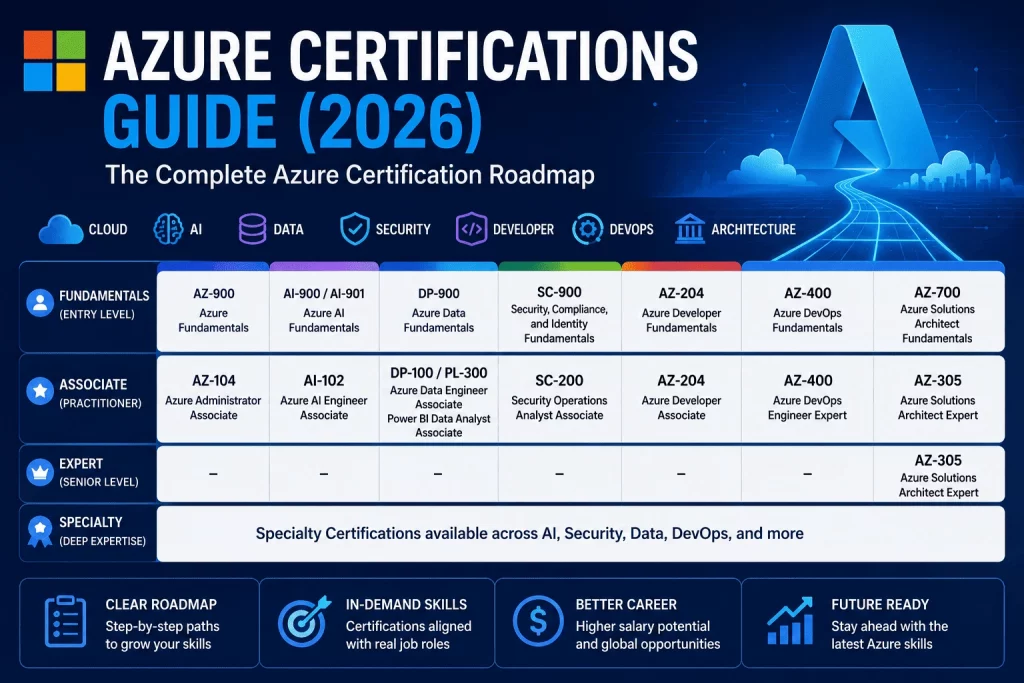
Microsoft’s Azure certification ecosystem has grown into one of the largest, most structured credentialing systems in tech — and also one of the most confusing to navigate from the outside. Unlike a single “Azure certification” you either have or don’t, Microsoft actually runs a tiered, role-based system spanning cloud infrastructure, AI, data, security, developer tools, DevOps, and solutions architecture, with each track climbing from beginner-friendly Fundamentals exams up through Associate, Expert, and narrow Specialty credentials.
That structure exists for a good reason: a cloud administrator, an AI engineer, and a security architect need genuinely different skills, even though all three might work inside the same Azure subscription. Microsoft’s certification system reflects that reality instead of flattening everyone into one generic “cloud certified” badge. This guide maps the entire Azure certification ecosystem in one place — every level, every track, every cost, and every decision point — so you can figure out exactly where you fit before committing study time to a specific exam.
Azure’s continued growth is what makes this ecosystem worth investing in seriously. Synergy Research data has repeatedly placed Azure as the fastest-growing of the three major hyperscale cloud providers, and Microsoft has spent the last several years deliberately expanding what “Azure skills” even means — folding AI engineering, generative AI application development, and Copilot proficiency into the same broad ecosystem that used to be almost entirely about infrastructure. That expansion is exactly why a single flat list of exam codes stopped being useful as a study resource; you need a map of tracks and levels, not just a list of names, to make a good decision about where to spend the next few months of study time.
Quick Verdict™
| If you are… | Start here | Why |
|---|---|---|
| Completely new to Azure | AZ-900 (Azure Fundamentals) | No prerequisites, cheapest entry point, broadest foundation |
| An IT admin moving to cloud infrastructure | AZ-104 (Azure Administrator Associate) | The most requested Azure credential in job postings |
| Targeting AI/ML work on Azure | AI-900/AI-901 → AI-102 | Fastest-growing certification category on Azure |
| Focused on cybersecurity | SC-900 → SC-200/SC-300 | Entry point into Microsoft’s full security stack |
| A data analyst or engineer | DP-900 → PL-300 or DP-100 | Covers both BI and data engineering paths |
| A software developer | AZ-204 (Azure Developer Associate) | Validates hands-on application development on Azure |
| Aiming for a senior architecture role | AZ-104 → AZ-305 (Solutions Architect Expert) | Requires AZ-104 as a hard prerequisite |
Azure Certification Levels
Every Azure credential sits in one of four tiers, and understanding the tier system is the single fastest way to avoid over- or under-investing in an exam relative to your actual experience.
| Level | Who it’s for | Prerequisites | Typical cost | Typical study time |
|---|---|---|---|---|
| Fundamentals | Beginners, non-technical roles | None | $99 | 15–30 hours |
| Associate | 6 months to 2+ years hands-on experience | None required, but strongly recommended | $165 | 60–120 hours |
| Expert | Senior professionals, architects | Often requires a specific Associate certification | $165 | 100–150+ hours |
| Specialty | Deep, narrow technical expertise | Varies by exam | $165 | 60–100 hours |
Fundamentals certifications don’t require renewal. Associate, Expert, and Specialty certifications are valid for one year and renew for free through a short Microsoft Learn assessment before they lapse — no need to retake the full paid exam.
Azure Certification Paths
Microsoft’s Azure track flows through seven functional areas, each with its own beginner-to-expert progression:
Cloud → AI → Data → Security → Developer → DevOps → Architecture
In practice, almost nobody climbs every single path to the top. Most professionals go deep in one or two functional areas that match their actual job, then add a Fundamentals-level credential in one or two adjacent areas for breadth. A cloud administrator, for example, typically goes deep in the Cloud path (AZ-900 → AZ-104 → AZ-305) while picking up SC-900 for basic security literacy, rather than trying to also become AI- or developer-certified.
Cloud
The infrastructure backbone of the entire ecosystem, and still the largest single path by candidate volume. AZ-900 (Azure Fundamentals) is the universal starting point, branching into AZ-104 (Azure Administrator Associate) for hands-on infrastructure management and climbing to AZ-305 (Azure Solutions Architect Expert) for senior design roles. Because this path underpins almost every other track — AI, security, and DevOps professionals all eventually touch core compute, storage, and networking concepts — it’s the single most defensible first Associate certification for anyone unsure exactly which specialty they want to pursue long-term.
AI
Anchored by AI-900, being refreshed as AI-901 (Azure AI Fundamentals), this path moves into AI-102 (Azure AI Engineer Associate) for technical AI solution building, with newer business-facing AI and Copilot-focused credentials expanding rapidly through 2026 as enterprise AI adoption accelerates. This is currently the fastest-changing path in the entire ecosystem — exam content, service names, and even entire credentials are being added or refreshed on a near-quarterly basis, so double-check exam currency before committing to a specific study guide.
Data
Starts with DP-900 (Azure Data Fundamentals), then splits based on specialization: PL-300 (Power BI Data Analyst Associate) for business intelligence work, DP-100 (Azure Data Scientist Associate) for machine learning-focused data science, and Microsoft Fabric-aligned engineering credentials for large-scale data platform work. Microsoft Fabric in particular has become the unifying platform tying together data engineering, warehousing, and analytics inside the broader Azure Data path, and its certifications are worth watching closely as the platform matures.
Security
Begins with SC-900 (Security, Compliance, and Identity Fundamentals), branching into SC-200 (Security Operations Analyst Associate) and SC-300 (Identity and Access Administrator Associate), and capping at SC-100 (Cybersecurity Architect Expert) for professionals designing organization-wide security strategy. This path consistently shows the strongest salary premiums of any Azure track, a reflection of persistent, global demand for qualified security professionals that hasn’t slowed even as the broader tech hiring market has fluctuated.
Developer
Centered on AZ-204 (Azure Developer Associate), which validates the ability to build and deploy cloud-native applications on Azure. GitHub-related credentials and Microsoft’s emerging Pro Badges program — verifying real, practical GitHub Copilot proficiency — sit alongside this path as it modernizes.
DevOps
Built around AZ-400 (DevOps Engineer Expert), which requires either AZ-104 or AZ-204 as a prerequisite and validates skill in CI/CD pipelines, release management, and infrastructure-as-code practices across development and operations teams. This path attracts a distinct hybrid candidate profile — professionals who don’t fit neatly into either pure infrastructure or pure development roles, but who own the process connecting the two.
Architecture
The convergence point for the Cloud and Developer paths. AZ-305 (Azure Solutions Architect Expert) requires AZ-104 as a hard prerequisite and validates the ability to design — not just operate — complete Azure solutions across identity, data, business continuity, and infrastructure. Unlike every other Expert-level exam in the ecosystem, AZ-305’s design-heavy case studies mean success depends as much on architectural judgment built through real project experience as it does on studying the official syllabus.
Best Azure Certifications for Beginners
If you’re new to Azure entirely, start with a Fundamentals certification matched to your intended direction rather than jumping into an Associate-level exam:
- Best overall starting point: AZ-900 (Azure Fundamentals) — the broadest, most universally useful entry point.
- Best if you’re AI-curious: AI-900/AI-901 (Azure AI Fundamentals).
- Best if you’re security-minded: SC-900 (Security, Compliance, and Identity Fundamentals).
- Best if you’re data-focused: DP-900 (Azure Data Fundamentals).
Most beginners can prepare for a single Fundamentals exam in 15–30 hours using free Microsoft Learn content, with no prior cloud experience required.
Best for Cloud Engineers
AZ-900 → AZ-104 is the standard infrastructure path, with AZ-305 as the natural senior-level extension. AZ-104 remains the single most requested Azure credential across cloud infrastructure job postings, making it the highest-priority Associate certification for anyone in or entering this role.
Best for AI
AI-900/AI-901 → AI-102 is the core technical AI path. Business professionals who use Copilot and AI tools without coding should look at Microsoft’s newer business-facing AI certifications rather than the more technical AI-102, which assumes hands-on development skill.
Best for Cybersecurity
SC-900 → SC-200 or SC-300, capping at SC-100 for senior architecture roles. Security certifications currently carry some of the strongest salary premiums across the entire Azure ecosystem, driven by a persistent global shortage of qualified security talent.
Best for Data
DP-900 → PL-300 for analytics-focused roles, or DP-900 → DP-100 for machine learning-focused data science roles. Professionals working with Microsoft Fabric should follow up with Fabric-specific associate credentials as that platform continues to unify Azure’s data engineering and analytics tooling.
Best for Developers
AZ-204 (Azure Developer Associate) is the core credential, with AZ-400 (DevOps Engineer Expert) as the natural next step for developers moving into release engineering and CI/CD ownership. Keep an eye on Microsoft’s Pro Badges program, which is expanding GitHub Copilot proficiency verification for developers throughout the second half of 2026.
Best for Architects
AZ-104 → AZ-305 is the only path here — AZ-104 is a hard, non-negotiable prerequisite for the Azure Solutions Architect Expert designation, and losing an active AZ-104 certification (through non-renewal) will cause your AZ-305-based Expert designation to lapse as well, even if AZ-305 itself is still technically valid.
Azure Certification Costs
Azure certification pricing follows Microsoft’s standardized global structure, meaning cost is determined by certification level, not by which specific exam you choose:
| Level | Typical U.S. price | Example exams |
|---|---|---|
| Fundamentals | $99 | AZ-900, AI-900/901, DP-900, SC-900 |
| Associate | $165 | AZ-104, AZ-204, AI-102, PL-300, SC-200 |
| Expert | $165 per exam | AZ-305, AZ-400, SC-100 |
| Specialty | $165 | Networking, IoT, and other narrow specialty exams |
Because AZ-305 requires AZ-104 as a prerequisite, and AZ-104 itself is often preceded by AZ-900, a genuinely senior architecture credential can represent $429 in direct exam fees alone once every step is paid for ($99 + $165 + $165) — before factoring in any paid training, practice tests, or retakes. Retakes cost the full exam fee again; Microsoft does not offer a standard discounted retake rate, though promotional “exam replay” bundles including one free retake sometimes appear for select Associate-level exams.
It’s worth separating direct exam cost from total cost of certification, since the two are frequently confused. Direct exam cost is just the Pearson VUE fee paid to Microsoft. Total cost also includes any paid training courses (ranging from free to well over $1,000 for instructor-led bootcamps), third-party practice test subscriptions ($15–$100), and — often overlooked — the value of your own study time. For most candidates working through free Microsoft Learn content and official practice assessments, total cost stays close to the direct exam fee alone; the ecosystem is genuinely designed so that paying for training is optional, not a hidden requirement to pass.
Azure Certification Renewal
- Fundamentals certifications never require renewal once earned.
- Associate, Expert, and Specialty certifications expire one year after being earned, with renewal reminders sent roughly six months in advance.
- Renewal is free, completed through a short online assessment on Microsoft Learn — not a full retake of the paid exam.
- The renewal assessment can be taken up to six months before expiration, and passing it extends validity another year from the original expiration date.
- Expert-level designations built on an Associate prerequisite are conditional. If your AZ-104 lapses without renewal, your AZ-305-based Solutions Architect Expert designation lapses too, even if AZ-305 itself remains within its own validity window. Renewal discipline on prerequisite certifications matters just as much as renewing the top-level credential.
This dependency structure surprises a lot of professionals who assume their hardest-earned, most senior credential is the one they need to watch most closely. In practice, it’s the opposite — the Associate-level prerequisite underneath an Expert designation is the quieter risk, precisely because it’s easy to forget about once you’ve moved on to studying for something harder. Setting a calendar reminder six months after earning any Associate certification you’re relying on as a prerequisite is a small habit that prevents a genuinely frustrating situation: discovering your Expert title has lapsed not because you failed anything, but because a renewal reminder got buried in an inbox.
Azure Certification Roadmap
The default Microsoft-designed progression for most Azure career paths looks like this:
- Beginner stage — no certification yet; focus on free Microsoft Learn content in your target functional area.
- Fundamentals stage — pass one Fundamentals exam (AZ-900, AI-900/901, DP-900, or SC-900) to build vocabulary and low-cost exam-day confidence.
- Associate stage — pass a role-based Associate exam (AZ-104, AZ-204, AI-102, PL-300, or SC-200/SC-300) tied to your actual job function.
- Expert stage — after 1–2+ years of applied experience, pursue an Expert-level credential (AZ-305, AZ-400, or SC-100), most of which require a specific Associate certification as a hard prerequisite.
- Specialty stage (optional) — add a narrow Specialty certification only if your role genuinely requires deep expertise in networking, IoT, or another specific domain.
Depth in one functional path consistently outperforms breadth across many for both hiring outcomes and salary growth — resist the temptation to collect Fundamentals badges across every track instead of pushing one path to Associate or Expert level.
A practical way to apply this roadmap: pick your Fundamentals exam based on your current job title, not your dream job title. If you’re doing IT support today but want to become a cloud architect eventually, AZ-900 still makes more sense as your starting point than jumping straight into AI or security material — the Cloud path is the foundation the Architecture path is ultimately built on, so time spent there is never wasted, even if your specific interests shift over the following year or two.
Atlas Azure Learning Path™
Cloud → Administration → Architecture → Expert
This is the condensed version of the Cloud path specifically, and it reflects how most working Azure professionals actually progress: general cloud literacy first, then hands-on administrative competence, then architectural design judgment, and finally expert-level, cross-domain mastery. Each stage builds directly on the one before it — skipping Administration and jumping straight to Architecture-level study is one of the most common reasons candidates struggle with AZ-305’s design-heavy case studies.
Atlas Certification Matrix™
| Certification | Level | Track | Prerequisite |
|---|---|---|---|
| AZ-900 | Fundamentals | Cloud | None |
| AI-900/901 | Fundamentals | AI | None |
| DP-900 | Fundamentals | Data | None |
| SC-900 | Fundamentals | Security | None |
| AZ-104 | Associate | Cloud | None (AZ-900 recommended) |
| AZ-204 | Associate | Developer | None |
| AI-102 | Associate | AI | None (AI-900 recommended) |
| PL-300 | Associate | Data | None (DP-900 recommended) |
| SC-200 | Associate | Security | None (SC-900 recommended) |
| SC-300 | Associate | Security | None (SC-900 recommended) |
| AZ-305 | Expert | Architecture | AZ-104 (hard requirement) |
| AZ-400 | Expert | DevOps | AZ-104 or AZ-204 |
| SC-100 | Expert | Security | SC-200 or SC-300 recommended |
Use this matrix as a quick sanity check before registering for any exam — several Associate and Expert certifications carry prerequisites that aren’t always obvious from the exam name alone, and skipping a prerequisite step doesn’t just make the exam harder, it can prevent you from earning the full Expert-level designation even after passing.
Two prerequisite patterns are worth memorizing because they catch candidates off guard most often. First, AZ-305’s prerequisite is a hard requirement enforced by Microsoft’s certification system itself — you cannot earn the Solutions Architect Expert title without an active AZ-104, no matter how well you score on AZ-305. Second, AZ-400’s prerequisite is flexible (either AZ-104 or AZ-204 qualifies), which makes it one of the few Expert-level credentials genuinely accessible from either the infrastructure or the development side of the ecosystem — a useful bridge certification if you’re not yet sure which side of DevOps you want to specialize in long-term.
Atlas Difficulty Meter™
On a 1 (easiest) to 5 (hardest) scale, based on typical study hours, hands-on requirements, and reported pass difficulty:
| Certification | Difficulty |
|---|---|
| AZ-900 | 1–2 |
| AI-900/901 | 2 |
| DP-900 | 2 |
| SC-900 | 2 |
| AZ-104 | 4 |
| AZ-204 | 3–4 |
| AI-102 | 3–4 |
| PL-300 | 3 |
| SC-200 | 3 |
| SC-300 | 3 |
| AZ-305 | 4–5 |
| AZ-400 | 4–5 |
| SC-100 | 4–5 |
Notice the consistent pattern: every Fundamentals exam sits at 1–2, every Associate exam sits at 3–4, and every Expert exam sits at 4–5. This isn’t a coincidence — Microsoft designs the tier system specifically so that difficulty scales predictably with the level, which is exactly why skipping levels (going straight from Fundamentals to Expert-level material, for example) so reliably backfires for candidates who try it.
Within a given tier, difficulty still varies meaningfully based on how hands-on and scenario-heavy an exam’s format is. AZ-104 and AI-102 both sit at the harder end of the Associate range because they combine broad conceptual coverage with genuine execution skill — you can’t pass either purely by memorizing definitions. PL-300 and the security Associate exams sit slightly lower not because the underlying material is easier, but because their scope is somewhat narrower and more directly tied to a single tool or workflow, which makes focused study more efficient relative to the breadth AZ-104 or AI-102 demand.
Atlas Career Map™
| Career | Certification |
|---|---|
| Cloud Engineer | AZ-104 |
| Solutions Architect | AZ-305 |
| AI Engineer | AI-102 (AI-900 as foundation) |
| Security Analyst | SC-200 |
| Security Architect | SC-100 |
| Data Analyst | PL-300 |
| Data Scientist | DP-100 |
| DevOps Engineer | AZ-400 |
| Application Developer | AZ-204 |
| Identity Administrator | SC-300 |
This map is deliberately simplified to one certification per career target — in reality, most job postings for these roles list a certification as “preferred” alongside real hands-on experience, not as a strict requirement. Treat this table as your primary study target for a given career, not the only credential worth having; pairing your primary certification with a relevant Fundamentals credential from an adjacent track (like a Cloud Engineer also holding SC-900) consistently strengthens a resume further.
Several of these careers also have a natural “next” certification once you’ve spent real time in the role. A Data Analyst holding PL-300 who moves into more engineering-heavy work often adds Fabric-aligned data engineering credentials. A Security Analyst holding SC-200 who takes on more strategic responsibility often progresses toward SC-100. Treat this table as a starting point for each career, not necessarily its ceiling — most senior roles in this ecosystem are held by professionals with two or more certifications earned across several years, not one credential earned all at once.
Azure Certification Salary Guide
Salary impact varies by certification level, track, and region, but a few consistent patterns hold across recent industry compensation data:
- AZ-104 (Azure Administrator Associate) is consistently associated with strong, six-figure average salaries in the U.S. market and remains the single most requested Azure credential in job postings.
- AZ-305 (Azure Solutions Architect Expert) typically shows a meaningful salary step-up over AZ-104 alone, reflecting its senior, cross-domain design responsibilities — it’s considered one of the highest-paying certifications in the entire Microsoft portfolio.
- Security certifications (SC-200, SC-300, SC-100) tend to command some of the strongest salary premiums of any Azure track, driven by the ongoing global shortage of qualified cybersecurity professionals.
- AI certifications (AI-900/901, AI-102) represent the fastest-growing category by both new job postings and reported salary growth, fueled by enterprise Copilot and generative AI adoption.
- Stacking certifications within a single path — AZ-900 → AZ-104 → AZ-305, for example — produces a stronger salary trajectory than collecting unrelated Fundamentals badges across multiple tracks without going deeper in any one of them.
Because compensation data shifts with market conditions and geography, treat these as directional patterns rather than fixed numbers, and check current regional salary data before making a career decision based on certification alone.
Geography and employer type both meaningfully change how far a certification’s salary impact travels. In major tech hubs and among large enterprises with heavy Microsoft investment — banks, government agencies, healthcare systems — the absolute dollar premium for an Azure Expert-level certification tends to be largest, since these organizations both pay well and explicitly filter for verified skills during hiring. In earlier-stage cloud markets, the relative premium (the percentage jump over an uncertified baseline) can actually be larger, because certification does more work to differentiate a candidate where fewer competitors hold one.
It’s also worth being honest about sequencing: certification rarely creates a salary jump by itself. What it reliably does is get a resume past automated filters and into a real interview. The professionals who see the largest financial return are the ones who pair a freshly earned certification with an active job search or an internal promotion conversation within a few months — while the credential is recent enough to be a natural talking point, not a line item from three years ago that nobody asks about.
Azure Certification Comparison: AI-900 vs AZ-104 vs AZ-305
This three-way comparison covers the most common decision point Azure learners face: which certification actually matches their goals right now.
| AI-900/901 | AZ-104 | AZ-305 | |
|---|---|---|---|
| Level | Fundamentals | Associate | Expert |
| Cost | $99 | $165 | $165 |
| Duration | 45 min | 100 min | 100–120 min |
| Prerequisite | None | None (AZ-900 recommended) | AZ-104 (hard requirement) |
| Coding/hands-on required | No | Yes | Yes (design-level, not implementation) |
| Study time | 15–30 hours | 60–120 hours | 100–150+ hours |
| Tests | AI/ML concepts | Azure administration execution | Azure solution design and architecture |
| Best for | AI beginners, business roles | IT admins, cloud engineers | Senior architects, principal engineers |
The key distinction between AZ-104 and AZ-305 that trips up many candidates: AZ-104 tests whether you can operate Azure correctly, while AZ-305 tests whether you can design Azure solutions correctly — the exam questions on AZ-305 ask “what’s the best way to architect this,” not “which command configures this.” AI-900 sits in a different category entirely, testing conceptual AI knowledge rather than infrastructure skill, which is why it pairs naturally alongside either AZ-104 or AZ-305 rather than competing with them for the same career track.
In practice, most candidates aren’t actually choosing between these three at the same moment — they’re deciding on a sequence. A common, well-supported pattern looks like this: complete AI-900 early as a low-cost way to build broad AI literacy regardless of your primary track, complete AZ-104 as your core infrastructure credential if you’re on the Cloud path, and treat AZ-305 as a longer-term goal to revisit once you have real, hands-on production experience beyond just passing AZ-104. Trying to compress all three into a single study season, rather than letting AZ-305 follow real work experience, is one of the most common reasons candidates struggle with its case-study-heavy format even after passing AZ-104 comfortably.
Frequently Asked Questions
1. What is the best Azure certification to start with? AZ-900 (Azure Fundamentals) is the most broadly useful starting point for nearly everyone, regardless of which functional track you eventually pursue.
2. How much do Azure certifications cost? Fundamentals exams cost $99 USD, while Associate, Expert, and Specialty exams cost $165 USD each.
3. Do Azure certifications expire? Fundamentals certifications don’t expire. Associate, Expert, and Specialty certifications expire one year after being earned and require free renewal.
4. How do I renew an Azure certification? Through a free, short online renewal assessment on Microsoft Learn, available starting about six months before expiration.
5. What’s the difference between AZ-900 and AZ-104? AZ-900 tests general cloud concepts with no hands-on requirement; AZ-104 tests real, hands-on Azure administration skill and is significantly harder.
6. Is AZ-104 or AZ-204 better for beginners? Neither is ideal for complete beginners — both are Associate-level. Start with AZ-900 first regardless of which direction you’re headed.
7. What certification do I need to become a Solutions Architect? AZ-305 (Azure Solutions Architect Expert), which has AZ-104 as a hard prerequisite.
8. Can I skip AZ-104 and go straight to AZ-305? No — AZ-104 is a required prerequisite for earning the full Solutions Architect Expert designation, even if you technically pass the AZ-305 exam itself.
9. What happens if my AZ-104 expires after I’ve earned AZ-305? Your Solutions Architect Expert designation lapses along with it, even if your AZ-305 exam pass itself remains within its own validity window — both certifications must stay active.
10. Which Azure certification pays the most? AZ-305 and SC-100 are generally associated with the highest salaries in the Azure portfolio, reflecting their senior, design-level responsibilities.
11. How long does it take to prepare for an Azure Associate certification? Typically 60–120 hours, depending on prior hands-on Azure experience.
12. Is AI-900 part of the Azure certification track? Yes — AI-900/AI-901 is the Fundamentals entry point for Microsoft’s AI track, which runs alongside the Cloud, Data, Security, Developer, DevOps, and Architecture tracks under the broader Azure ecosystem.
13. What’s the fastest way to get Azure certified? Pass a single Fundamentals exam (AZ-900, AI-900/901, DP-900, or SC-900), typically achievable in 15–30 hours for a motivated beginner.
14. Do I need a coding background for Azure certifications? Only for developer- and architecture-focused paths (AZ-204, AZ-305, AZ-400); Fundamentals and infrastructure-focused Associate exams like AZ-104 don’t require traditional coding skill.
15. What’s the difference between AZ-104 and SC-200? AZ-104 focuses on general Azure infrastructure administration; SC-200 focuses specifically on security operations, threat detection, and incident response.
16. Is Microsoft Learn enough to pass Azure certifications? Yes, for most candidates — Microsoft Learn’s free official learning paths and hands-on labs are aligned directly to every exam’s objectives.
17. How many Azure certifications should I get? Most professionals see the strongest career impact from going deep in one or two related tracks (like Cloud plus Security) rather than collecting many Fundamentals badges across unrelated tracks.
18. What certification is best for a career changer with no IT background? AZ-900, followed by a role-specific Associate certification once you’ve identified which functional track (cloud, data, security, AI) fits your target role.
19. Is the Azure certification exam hard? It depends heavily on the level — Fundamentals exams are easy to moderate, while Associate and especially Expert exams are considerably harder and require real hands-on experience.
20. What’s the difference between Azure Specialty and Expert certifications? Expert certifications validate broad, senior-level, cross-domain mastery (like solutions architecture); Specialty certifications validate deep expertise in one narrow area, such as networking or IoT.
21. Can I take Azure certification exams online? Yes — Microsoft certification exams can be taken online with a proctor or in-person at a testing center, depending on candidate preference and availability.
22. How current does my Azure knowledge need to be for renewal? The renewal assessment reflects current exam content, so staying reasonably current with Azure’s evolving services is necessary, even though the assessment itself is shorter and lower-stakes than the original exam.
23. What is the AZ-305 pass rate? Microsoft doesn’t publish official pass rates, but industry estimates commonly cite figures around 60%, reflecting the exam’s difficulty and heavy case-study format.
24. Should I get AZ-104 if I already have AWS certifications? Yes, if your target employer or projects run on Azure — cloud certifications generally don’t transfer between platforms, even though the underlying skills often do.
25. What’s the best Azure certification for a DevOps career? AZ-400 (DevOps Engineer Expert), which requires either AZ-104 or AZ-204 as a prerequisite.
26. Do Azure certifications guarantee a job? No — they significantly improve interview odds and often clear ATS filters, but real hiring decisions still weigh hands-on experience and interview performance heavily.
27. What’s the newest addition to Microsoft’s Azure certification ecosystem? Business-facing AI certifications and Applied Skills credentials tied to Copilot and AI agents are the fastest-growing recent additions across the Azure ecosystem.
28. Is DP-900 part of the Azure track or a separate track? DP-900 is part of the broader Azure certification ecosystem’s Data path, distinct from but related to the Cloud (AZ-series) path.
29. What’s the best certification combination for a well-rounded cloud resume? AZ-900 plus a role-specific Associate certification (AZ-104, AZ-204, or similar), paired with one adjacent Fundamentals credential like SC-900 for basic security literacy.
30. How often does Microsoft update Azure certification exams? Fairly frequently — Microsoft regularly refreshes exam content and domain weightings to reflect new Azure services and retires older exams, as seen with the 2026 AI-900-to-AI-901 transition.
31. What’s the difference between AZ-104 and AZ-400? AZ-104 focuses on core infrastructure administration; AZ-400 (DevOps Engineer Expert) focuses on CI/CD pipelines and release engineering practices layered on top of that infrastructure knowledge.
32. Can business analysts benefit from Azure certifications? Yes — AZ-900 and DP-900 in particular give business analysts enough technical literacy to work effectively alongside cloud and data teams without requiring hands-on engineering skill.
33. What’s the best free way to prepare for any Azure certification? Microsoft Learn’s official, exam-aligned learning paths, combined with hands-on practice using a free Azure account and Microsoft’s official practice assessments.
34. Is it worth getting both AI-900 and DP-900? Yes, if your role touches both AI and data work — they’re complementary Fundamentals credentials that take relatively little combined time and reinforce overlapping concepts like data quality and model training.
35. What should I do after finishing this guide? Identify your target functional track (Cloud, AI, Data, Security, Developer, DevOps, or Architecture), start with the relevant Fundamentals exam if you’re new to it, and follow the Atlas Azure Learning Path™ toward the Associate and Expert-level credential that matches your career goal.
Roadmap
Microsoft Certifications Guide ✅ ↓ Azure Certifications Guide ⭐ (you are here) ↓ AI-900 ↓ AZ-900 ↓ AZ-104 ↓ AZ-305 ↓ SC-900 ↓ DP-900 ↓ PL-300
This guide reflects Microsoft’s Azure certification ecosystem as of mid-2026, including current exam pricing, prerequisites, and the AI-900-to-AI-901 transition. Exam names, prices, and prerequisites can change — always confirm current details on Microsoft’s official Learn and Credentials pages before scheduling an exam.