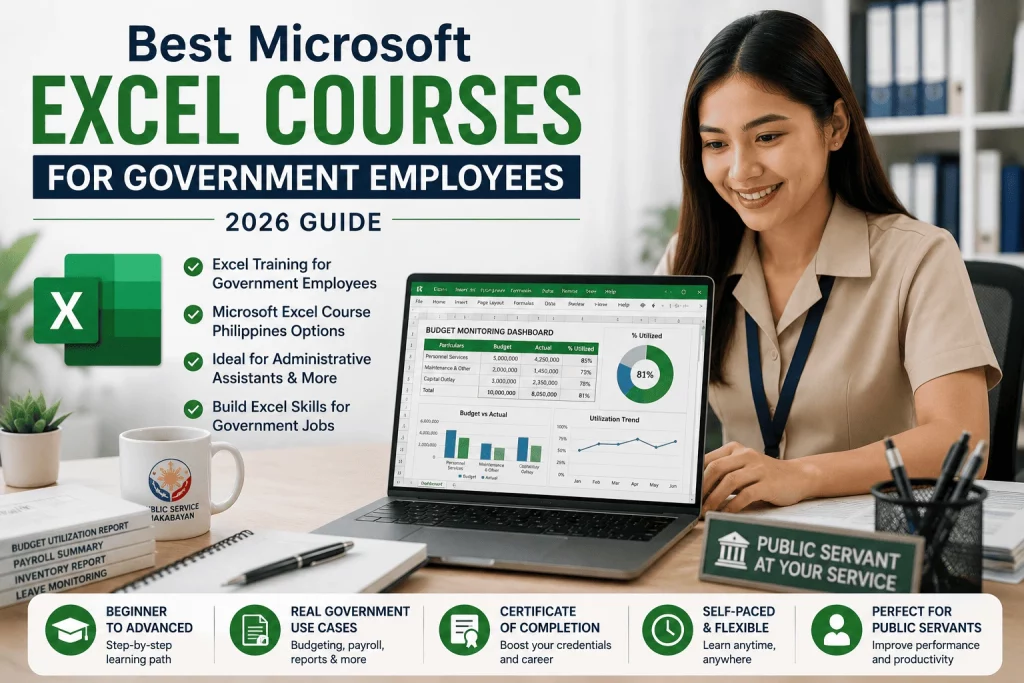
Quick Answer
If you’re a government employee who wants to master Excel quickly, the best Excel courses for government employees combine structured video lessons, hands-on practice files, and real-world government use cases like budget tracking, payroll reports, and data reconciliation. Whether you’re looking for excel training for government employees, a Microsoft Excel course in the Philippines, or excel skills for government jobs in general, Udemy’s beginner-to-advanced Excel courses are consistently ranked among the top choices because they’re affordable, self-paced, and include lifetime access — ideal for public sector workers with unpredictable schedules.
👉 Check the current best-selling Excel course on Udemy here
Compare the Top Excel Courses at a Glance
| Course | Best For | Price | Certificate |
|---|---|---|---|
| Udemy — Excel Beginner to Advanced | Government employees, administrative assistants, self-paced learners | Affordable (often $10–$20 on sale) | Yes |
| Coursera — Excel Skills for Business | Learners who want structured, university-style learning | Higher (subscription-based) | Yes |
| Microsoft Learn | Free, casual learners wanting official documentation | Free | Limited |
| LinkedIn Learning — Excel Essential Training | Professionals with an existing LinkedIn Learning subscription | Subscription | Yes |
This kind of side-by-side comparison is exactly what most readers are looking for before committing to a course — and it’s why the Udemy option remains the most frequently recommended pick for excel training for government employees on a budget.
Our Recommendation Matrix
Different government roles need different depths of Excel training. Use this quick matrix to match your goal to the right learning path:
| Goal | Recommended Course |
|---|---|
| Complete beginner | Udemy — Excel Beginner to Advanced |
| Administrative Assistant | Udemy — Excel Beginner to Advanced |
| HR Staff / HR Assistant | Udemy — Excel Beginner to Advanced |
| Budget Officer | Udemy — Excel Beginner to Advanced + Power Query modules |
| Planning / M&E Officer | Udemy — Excel Beginner to Advanced + PivotTable/Dashboard focus |
| Heavy data analysis roles | Excel foundation first, then Power BI |
The pattern here is intentional: almost every government role benefits from the same solid Excel foundation first. What changes is which advanced modules you prioritize once you’ve mastered the basics — Power Query for budget consolidation, PivotTables and dashboards for planning and M&E work, or a transition into Power BI for roles that are moving toward heavier data analytics.
Why Excel Skills Matter So Much in Government Work
Government employees — whether working in local government units (LGUs), national agencies, public schools, or state offices — deal with an enormous volume of spreadsheet-based tasks every single day. From payroll processing and budget allocation to procurement tracking, inventory management, and compliance reporting, Excel remains the single most-used software tool across public sector offices worldwide.
Unlike private companies that sometimes shift to specialized software, most government offices still rely heavily on Excel because:
- It’s already bundled with Microsoft Office, which most government units already have licenses for
- It doesn’t require additional procurement or IT approval to use
- It’s flexible enough to handle everything from simple attendance sheets to complex financial models
- Auditors (like COA in the Philippines, or equivalent bodies elsewhere) often expect data in Excel-compatible formats
Despite this, a large percentage of government employees only know the basics — typing data, simple formulas like SUM, and manual formatting. This skills gap is exactly why searching for the best Excel course for beginners has become so common among public servants who want to work faster, avoid errors, and stand out during performance evaluations or promotions.
A government employee who knows how to build a PivotTable, use VLOOKUP or XLOOKUP, and automate reports with basic formulas can often finish in 30 minutes what takes a co-worker half a day. That time savings compounds across weeks, months, and years — and it’s noticed by supervisors.
The Hidden Cost of Not Knowing Excel
Many government offices don’t formally require Excel training, which means employees are often expected to “figure it out” on their own — usually by watching a co-worker, copying old templates, or relying on trial and error. This creates several hidden costs:
- Wasted hours: Employees who don’t know keyboard shortcuts, formulas, or formatting tricks spend far more time on repetitive tasks than necessary.
- Formula errors that go unnoticed: A single wrong cell reference in a budget formula can cascade into inaccurate totals across an entire report, sometimes discovered only during an audit.
- Overreliance on one “Excel person”: In many offices, one employee becomes the unofficial spreadsheet expert, creating a bottleneck and single point of failure whenever that person is on leave or reassigned.
- Missed opportunities for automation: Tasks that could be automated with a simple formula or macro are instead done manually every single reporting period, month after month, year after year.
Investing a few hours into a structured course pays for itself almost immediately once you start applying what you learn to actual office tasks. This is precisely why so many public sector workers begin their search with a simple query like “best Excel course for beginners” — they’re looking for a shortcut past years of trial-and-error learning.
Excel and Digital Transformation in Government
Many government agencies are actively pushing toward digital transformation, e-governance, and data-driven decision-making. Even in offices transitioning to specialized software like enterprise resource planning (ERP) systems or government financial management systems, Excel often remains the tool used to prepare, clean, and validate data before it enters those systems. Employees who understand Excel well are better equipped to catch data entry errors, reconcile mismatched records, and prepare clean datasets for upload — skills that are increasingly valuable as agencies modernize their systems.
What Makes an Excel Course “Best” for Government Employees
Not all Excel courses are created equal, and government employees have specific needs that differ from, say, a private sector data analyst. Here’s what to look for:
A. Practical, Office-Relevant Examples
The best courses use real-world scenarios like budget templates, leave monitoring sheets, payroll computations, and procurement trackers — not generic “sales data” examples that don’t translate to public sector work.
B. Self-Paced, Flexible Access
Government employees often have irregular schedules, especially those in frontline services, field offices, or shifting departments. A good course should be available on-demand, with lifetime access, so you can learn during lunch breaks or after office hours.
C. Beginner-Friendly Structure
If you’re searching for the best Excel course for beginners, the course should start from zero — assuming no prior spreadsheet experience — and build up gradually to intermediate and advanced skills.
D. Certificate of Completion
Many government HR departments recognize training certificates for professional development points or CSC (Civil Service Commission) related credits, depending on the country and agency. A course that issues a certificate adds tangible value to your personnel file.
E. Affordability
Government salaries, especially at entry to mid-level, are modest compared to private sector equivalents. The best courses offer excellent value — often under $20 during sales — rather than expensive subscription-based platforms.
F. Regular Updates
Excel itself evolves — Microsoft 365’s newer functions like XLOOKUP, dynamic arrays, and Power Query weren’t available in older Excel versions. A great course keeps its content updated to reflect the current interface and functions.
G. Compatibility With Older Excel Versions
Not every government office has upgraded to the latest Microsoft 365 subscription. Some agencies still run Excel 2016, 2019, or standalone perpetual-license versions due to procurement cycles and IT budget constraints. A good course should acknowledge these differences and, ideally, show alternative approaches (e.g., VLOOKUP as a fallback when XLOOKUP isn’t available) so the lessons remain useful regardless of which version is installed on your office computer.
H. Depth Without Overwhelm
Some courses try to cram every possible Excel feature into a single package, which can overwhelm true beginners. The best courses for beginners strike a balance — thorough enough to be genuinely useful, but paced in a way that doesn’t scare off someone who has never opened a spreadsheet before.
I. Community or Q&A Support
Learning alone can be discouraging when you hit a confusing formula error or an unexpected result. Courses with active Q&A sections or discussion boards allow you to ask questions and see how the instructor (or other learners) resolved similar issues — a feature that free YouTube tutorials rarely offer.
Top Microsoft Excel Courses for Government Employees
Based on curriculum depth, beginner-friendliness, practical relevance, and value for money, here are the top-recommended courses:
1. Microsoft Excel — From Beginner to Advanced (Udemy)
This is consistently one of the highest-rated, best-selling Excel courses online, and it’s frequently recommended as the best Excel course for beginners because it starts with the absolute basics — opening Excel, understanding cells, and basic navigation — before progressing into formulas, functions, PivotTables, dashboards, and even automation with macros.
What makes it especially useful for government employees is the practical approach: you learn by building actual spreadsheets similar to budget trackers, attendance logs, and reporting templates, rather than abstract exercises.
👉 View the full course details and current pricing on Udemy
2. Excel Skills for Business Specialization (Coursera)
Offered through a university partnership, this specialization is more academic in tone and includes graded assignments. It’s a solid option for employees who want a structured, semester-like pace, though it typically requires a subscription fee for full access and certificates.
3. Microsoft Excel Official Training (Microsoft Learn)
Microsoft’s own free learning modules are a good supplementary resource, especially for understanding official terminology and Microsoft 365-specific features. However, they tend to be less hands-on and more documentation-style compared to video-based courses.
4. LinkedIn Learning — Excel Essential Training
This is a solid choice for employees who already have a LinkedIn Learning subscription through their agency (some government HR departments provide this as a benefit). The instructor-led video format is clear, though the pacing can feel slower for absolute beginners.
5. Excel Exercises for Beginners (Free YouTube Playlists)
While not a formal “course,” curated YouTube playlists can supplement paid courses, especially for reviewing specific functions. The downside is the lack of structure, practice files, and certification — which is why most learners eventually upgrade to a paid, structured course.
Bottom line: For most government employees who want one comprehensive, affordable, and practical course — especially those searching specifically for the best Excel course for beginners — the Udemy Excel course remains the most recommended starting point because of its depth, low cost, lifetime access, and beginner-first structure.
👉 Get started with the top-rated Excel course here
Free vs. Paid Excel Courses — Which Should You Choose?
| Factor | Free Courses | Paid Courses (e.g., Udemy) |
|---|---|---|
| Structure | Often scattered, no clear path | Organized curriculum from basics to advanced |
| Practice Files | Rarely included | Usually included with downloadable exercises |
| Certificate | Rarely provided | Certificate of completion included |
| Updates | Inconsistent | Frequently updated for new Excel versions |
| Support | No instructor access | Q&A sections, instructor responses |
| Cost | $0 | Often $10–$20 during sales |
For a government employee on a budget, free resources are a reasonable starting point, but most eventually find that a paid, structured course saves far more time than it costs — especially when factoring in fewer errors, faster report turnaround, and skills that support promotion applications.
Excel Skills Every Government Employee Should Master
Whether you’re in finance, HR, records management, or administrative support, these are the core Excel skills worth prioritizing:
Beginner Level
- Navigating the Excel interface (ribbon, cells, sheets, workbooks)
- Basic formulas: SUM, AVERAGE, COUNT, MIN, MAX
- Formatting cells, rows, and columns for readability
- Creating simple tables and sorting/filtering data
- Freezing panes for large datasets (common in payroll and attendance sheets)
Intermediate Level
- IF, IFS, and nested logical functions for eligibility checks or classifications
- VLOOKUP and XLOOKUP for cross-referencing employee records or budget codes
- Conditional formatting for flagging overdue reports or budget overruns
- Data validation for standardized entry (useful in procurement and inventory forms)
- Basic charts and graphs for presentations and reports
Advanced Level
- PivotTables and PivotCharts for summarizing large datasets (e.g., annual budget reports)
- Power Query for cleaning and merging data from multiple government offices or branches
- Macros and basic VBA for automating repetitive tasks like monthly report generation
- Dashboard creation for real-time monitoring (common in project management offices)
- Advanced formulas like INDEX-MATCH, SUMIFS, and array formulas
A structured course — again, this is why the best Excel course for beginners search leads so many people to comprehensive, all-in-one programs — typically walks through all three levels progressively, rather than leaving you to piece together scattered tutorials.
Excel Skills That Help in Government Offices
For government employees in the Philippines specifically, certain Excel use cases come up so often that they’re worth calling out on their own. If you’re searching for a microsoft excel course philippines-based readers actually need, look for one that touches on these real, everyday scenarios:
- Budget Utilization Reports (BUR): Tracking allocated vs. utilized funds per program, project, or activity — often required monthly or quarterly and cross-checked against COA guidelines.
- Payroll: Computing salaries, deductions (GSIS, PhilHealth, Pag-IBIG, withholding tax), overtime, and net pay for rank-and-file and job order personnel alike.
- Leave Monitoring: Maintaining leave credit balances, tracking vacation and sick leave usage, and flagging employees nearing zero balance — a task made significantly easier with conditional formatting and simple formulas.
- Inventory Reports: Managing supplies, equipment, and fixed asset registries, often required for annual Report on the Physical Count of Inventories (RPCI) or Property, Plant, and Equipment (RPCPPE) submissions.
- PDS (Personal Data Sheet) Data Management: HR and admin personnel frequently consolidate PDS information from multiple employees into master spreadsheets for reporting, plantilla monitoring, or CSC compliance purposes.
These are the exact kinds of tasks that separate a generic “learn Excel” course from one that’s genuinely useful for excel skills for government jobs — and it’s why practical, scenario-based lessons matter more than abstract, sales-data-driven tutorials.
How Long Does It Take to Learn Excel as a Beginner?
This depends on your starting point and consistency, but here’s a realistic timeline for a government employee learning part-time:
- Week 1–2: Basic navigation, formulas, and formatting (2–3 hours per week)
- Week 3–5: Intermediate functions like VLOOKUP, IF statements, and conditional formatting
- Week 6–8: PivotTables, charts, and dashboard basics
- Month 3 onward: Advanced automation, Power Query, and macros (optional, based on job requirements)
Most learners who dedicate even 3–4 hours per week to a structured course can go from “I only know how to type numbers” to “I can build a functional budget dashboard” within 2 to 3 months. This is significantly faster than trying to learn through trial and error on the job, which can take years to reach the same competency level.
Excel Certifications That Actually Help Government Careers
While a Udemy certificate of completion is useful for showing initiative and self-directed learning, some government employees also pursue more formal certifications:
- Microsoft Office Specialist (MOS) — Excel Associate/Expert: A globally recognized, exam-based certification that validates specific Excel competencies.
- Microsoft Certified: Data Analyst Associate: More advanced, useful for employees moving into data-heavy roles like budget analysis or planning offices.
- Agency-specific training certificates: Some government training institutes (like a Civil Service Academy or equivalent) offer their own Excel modules that count toward professional development hours.
For most beginners, though, the priority isn’t chasing a formal certification first — it’s building actual competency. A solid beginner-to-advanced course lays the foundation that makes exam-based certifications much easier to pass later, if you choose to pursue them.
Common Excel Tasks in Government Offices (With Examples)
To make this practical, here are real examples of how Excel skills translate directly into daily government work:
Budget Monitoring: Using SUMIFS to calculate total expenditures per department, per quarter, automatically updating as new entries are added.
Payroll Processing: Using IF and VLOOKUP formulas to calculate salary deductions, overtime pay, and tax withholdings based on employee classification tables.
Attendance and Leave Tracking: Using conditional formatting to flag employees who’ve exceeded their leave credits, and COUNTIFS to summarize attendance patterns.
Procurement and Inventory: Using data validation dropdowns to standardize item categories, and PivotTables to summarize purchase orders by supplier or department.
Report Generation: Using macros to automatically format and generate monthly or quarterly reports that used to take hours to compile manually.
Data Reconciliation: Using XLOOKUP and INDEX-MATCH to cross-check records between different offices or systems, catching discrepancies before audits.
These aren’t hypothetical — they’re the exact type of exercises covered in well-structured beginner-to-advanced Excel courses, which is why hands-on practice matters more than passively watching tutorials.
Can Excel Skills Help You Get Promoted in Government?
This is one of the most practical questions government employees ask — and the honest answer is yes, in more ways than most people realize. Excel proficiency isn’t just a “nice to have” line on a resume; it’s a competency that shows up directly in plantilla position qualifications, CSC (Civil Service Commission) competency frameworks, and day-to-day performance ratings across a wide range of government roles.
Here’s how Excel skills map to specific positions commonly found in government plantilla structures:
Administrative Assistant. Excel is used almost daily for correspondence tracking, inventory of office supplies, simple reporting templates, and data consolidation from multiple offices. Basic-to-intermediate Excel skills are often listed as a required or preferred competency for this position.
Administrative Officer. This role typically involves more responsibility — budget monitoring, procurement documentation, and personnel record-keeping — all of which benefit from intermediate skills like IF statements, VLOOKUP, and PivotTables.
Human Resource Assistant. HR-related positions frequently require consolidating PDS data, tracking plantilla items, monitoring leave credits, and preparing personnel summary reports — tasks that become dramatically faster with VLOOKUP/XLOOKUP and data validation skills.
Budget Officer. Budget-related plantilla positions almost always list spreadsheet proficiency as a core competency, since the role revolves around preparing Budget Utilization Reports, tracking obligations and disbursements, and reconciling figures against COA requirements.
Planning Officer. Planning and monitoring roles benefit heavily from PivotTables, dashboards, and data consolidation skills — especially when compiling reports from multiple field offices, departments, or local government units into a single annual or quarterly report.
In many government job postings — whether for a plantilla position or a job order/contract of service role — “proficient in Microsoft Excel” or “computer literate with spreadsheet skills” appears as a standard qualification requirement. Demonstrating this proficiency, whether through actual work output, a training certificate, or strong performance during a practical exam, can meaningfully strengthen an application for promotion, reclassification, or lateral transfer.
Beyond formal qualifications, Excel skills also influence how supervisors perceive performance during IPCR (Individual Performance Commitment and Review) evaluations. Employees who can independently produce accurate, well-organized reports — without needing constant help from a colleague — are consistently rated higher on efficiency and initiative, both of which factor into promotion readiness.
Choosing the Right Course Based on Your Government Role
Not every government employee needs the exact same Excel skill set. Here’s a breakdown of what to prioritize depending on your role:
Administrative and Clerical Staff
This is often where the search for an excel course for administrative assistant roles begins. Focus on formatting, basic formulas, sorting/filtering, mail merge integration, and creating simple templates for memos, forms, and tracking sheets. A beginner-focused course covering the first 40–50% of a comprehensive curriculum is usually sufficient.
Finance, Budget, and Accounting Personnel
Prioritize SUMIFS, COUNTIFS, IF-based conditional logic, PivotTables, and financial formatting (currency, accounting styles, percentage calculations). These roles benefit most from intermediate-to-advanced modules, especially anything covering budget variance analysis or multi-sheet consolidation.
Human Resources and Payroll Officers
Focus on VLOOKUP/XLOOKUP for cross-referencing employee data, IF statements for eligibility and classification, data validation for standardized entry forms, and conditional formatting for flagging issues like overdue documents or leave violations.
Planning, Monitoring, and Evaluation Officers
These roles benefit heavily from PivotTables, PivotCharts, dashboard creation, and even Power Query for merging data from multiple field offices or reporting periods. Advanced modules on data visualization are especially valuable here.
IT and Systems Support Staff
While not always Excel-focused, IT staff who support other departments benefit from understanding macros and basic VBA, since they’re often asked to help automate repetitive tasks for colleagues who lack technical skills.
Frontline and Field-Based Employees
Given limited desk time, these employees benefit most from mobile-friendly or short-format lessons they can complete in small chunks — making self-paced, on-demand video courses far more practical than scheduled webinars or in-person seminars.
Regardless of role, starting with a solid beginner-to-advanced foundation course ensures you’re not missing basic concepts before jumping into specialized formulas — which is why generalist courses remain the most recommended starting point even for employees in specialized roles.
Mistakes to Avoid When Learning Excel
Even with a good course, learners often slow their own progress with a few common mistakes:
Watching without practicing. Passively watching video lessons without opening Excel and following along significantly reduces retention. Always pause the video and try the exercise yourself before moving to the next lesson.
Skipping the “boring” basics. Some learners rush past fundamentals like cell referencing (absolute vs. relative) to get to “exciting” features like PivotTables, only to get confused later because they never understood the foundation.
Not using real work data. Once you’ve learned a concept in the course, immediately try applying it to an actual spreadsheet from your office (with sensitive data removed or anonymized, if needed). This cements the skill far faster than generic practice files alone.
Trying to memorize every formula. Excel has hundreds of functions. Rather than memorizing syntax, focus on understanding the logic of when to use SUM vs. SUMIF vs. SUMIFS, or VLOOKUP vs. INDEX-MATCH — the specific syntax can always be looked up.
Giving up after one confusing lesson. Some topics, like nested IF statements or array formulas, take longer to click. It’s normal to rewatch a lesson two or three times before it makes sense — this doesn’t mean you’re bad at Excel.
Frequently Asked Questions
Can I learn Excel for free as a government employee?
Yes, free resources like Microsoft Learn modules and YouTube tutorials exist, but they often lack structure, practice files, and certificates. Many government employees start free and eventually invest in an affordable paid course for a more complete, organized learning path.
How much does a good Excel course cost?
Q: How much does a good Excel course cost? A: Paid courses on platforms like Udemy are often available for $10–$20 during frequent sales, making them one of the most affordable professional development investments available, especially compared to in-person training seminars.
Will learning Excel help with government promotions?
Yes. Excel proficiency is frequently listed as a desired or required competency in government job postings, especially for administrative, finance, budget, HR, and planning roles. Demonstrated skills — and completion certificates — can strengthen promotion or transfer applications.
Do I need to know Excel formulas by heart?
No. Most professionals rely on reference sheets or Excel’s built-in formula suggestions. What matters more is understanding when to use which formula and how to structure your data correctly.
What’s the difference between VLOOKUP and XLOOKUP?
XLOOKUP is a newer, more flexible function available in Microsoft 365 that can search in any direction and handle errors more gracefully than VLOOKUP. Government offices still using older Excel versions may only have access to VLOOKUP, so it’s worth learning both.
Is a PivotTable hard to learn?
Not at all. PivotTables look intimidating at first, but with guided practice — typically a 20–30 minute lesson in most beginner courses — most learners can build their first functional PivotTable summarizing real data.
How is Excel different from Google Sheets, and does it matter which one I learn?
Excel and Google Sheets share similar core concepts — formulas, cell referencing, and basic functions work almost identically. However, most government offices still standardize on Microsoft Excel because of existing Office licenses, offline access requirements, and compatibility with legacy financial systems. Learning Excel first gives you a stronger foundation, since most of those skills transfer easily to Google Sheets later if needed.
Can older employees or non-tech-savvy staff still learn Excel effectively?
Absolutely. Age or general comfort with technology isn’t a reliable predictor of success in learning Excel. What matters more is consistent, hands-on practice. Beginner-focused courses are specifically designed to explain concepts in plain language, without assuming prior technical background, making them accessible to learners of any age or experience level.
Should I learn Excel or move straight to Power BI or other data tools?
Excel should almost always come first. Power BI and similar data visualization tools build on the same core logic as Excel — formulas, data structuring, and relationships between datasets. Skipping Excel to jump straight into more advanced tools often leads to confusion, since foundational concepts like structuring clean data are assumed knowledge in those platforms.
Final Recommendation
If you’re a government employee searching for the best Excel courses for government employees, the ideal choice is a structured, affordable, self-paced course that takes you from zero experience to confidently handling budgets, reports, and dashboards — the exact tasks you’ll face in your day-to-day role.
Among the available options, a comprehensive beginner-to-advanced Excel course on Udemy remains one of the most recommended paths due to its low cost, practical examples, lifetime access, and beginner-friendly pacing — all of which matter for busy public servants balancing work, family, and limited training budgets.
👉 Start learning Excel today — check the current course price and details here
Investing a few hours a week now can save you dozens of hours later — and position you as the go-to person in your office for anything spreadsheet-related.
Skills like these rarely go unnoticed in a government workplace. Supervisors and department heads consistently rely on employees who can turn messy, scattered data into clear, accurate reports without hand-holding. Over time, that reputation opens doors — whether it’s being tapped for a special project, recommended for a training assignment abroad, or considered first when a higher position opens up. Excel proficiency, in other words, isn’t just a technical skill; in many public offices, it quietly functions as a career accelerant.
If you’ve been putting off learning Excel because it seems technical or time-consuming, remember that most beginner courses are designed precisely for people starting from zero. You don’t need a background in IT, statistics, or accounting to become proficient — you just need a clear, structured course and a bit of consistent practice.
Ready to Improve Your Excel Skills?
Whether you’re preparing for an Administrative Assistant position, applying for a government job, or simply looking to improve your office productivity, Excel remains one of the most valuable skills you can learn.
👉 Start with the top-rated Excel course on Udemy today
Related Topics
Leadership rarely develops in isolation — it usually pairs with a handful of other practical workplace skills. If you’re building out a broader professional development plan, these guides cover the skills that most often complement leadership training: