Quick Answer
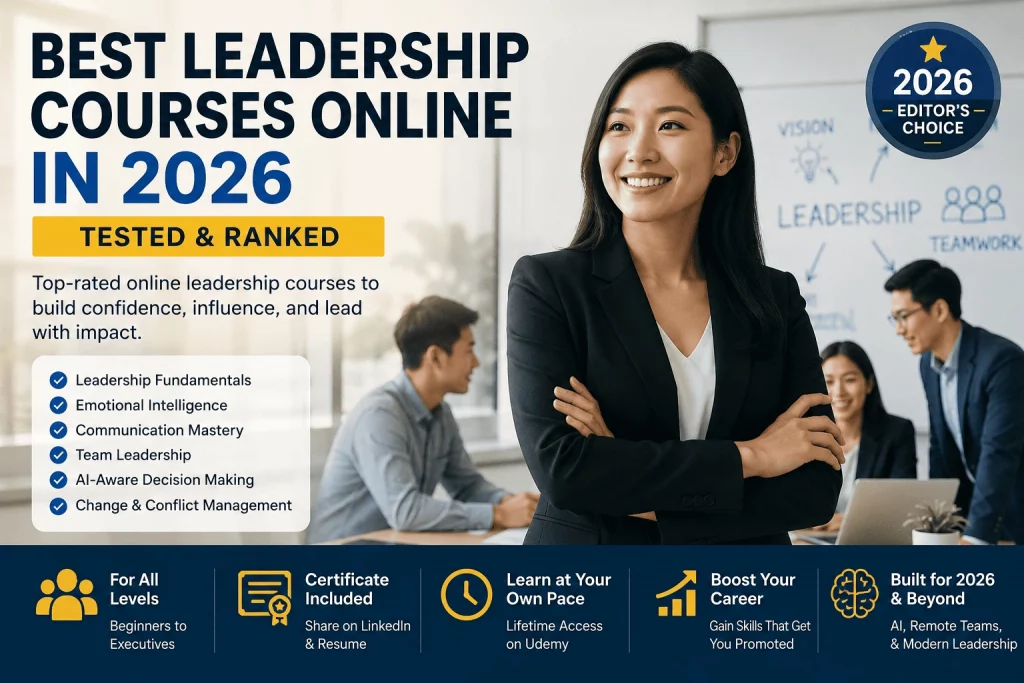
The best leadership course online in 2026 is Leadership Masterclass: Build Confidence, Influence & Lead, because it combines leadership fundamentals, emotional intelligence, communication, decision-making, team leadership, conflict resolution, and AI-era leadership skills in one modern, recently updated program. According to the course listing at the time this guide was published, it carries a 4.9/5 rating, has drawn well over 2,500 students, and was last updated in January 2026 — making it one of the most current leadership programs on Udemy.
If you only have two minutes, that’s the answer. If you want to know why, and which course fits your specific stage — new manager, government supervisor, introvert professional, or someone chasing deeper leadership theory — keep reading. We break down five of the top-rated leadership courses on Udemy, compare them side by side, and answer the questions people most often ask before enrolling.
Quick Comparison: Which Course Fits You?
| Best For | Recommended Course |
|---|---|
| Overall Best | Leadership Masterclass: Build Confidence, Influence & Lead |
| New Managers | Management Skills Masterclass: Lead Teams with Confidence |
| Leadership Theory & Deep Study | The Leadership Masterclass – Leadership Skill Development |
| Influence & Motivation | Leadership: How to Influence, Inspire and Impact as a Leader |
| Introverted Professionals | Introvert Leadership: Confidence, Trust & Quiet Strength |
📌 Apply Smart PH Recommendation
Our Editor’s Choice for 2026 is Leadership Masterclass: Build Confidence, Influence & Lead. A few reasons it stands apart from older, more generic leadership courses:
- Updated for 2026 — not a five-year-old course coasting on old reviews
- Emotional intelligence taught as its own dedicated section, not a passing mention
- Communication mastery, including storytelling, feedback, and active listening
- AI-aware decision making — a genuinely modern addition most competing courses don’t cover
- Remote and hybrid team leadership, built for how teams actually work in 2026
- Change management for leading people through uncertainty, not just steady-state teams
- Crisis leadership, for the moments when a team needs direction the most
All of these are explicitly part of the curriculum, not implied or assumed — which is why it’s our top pick over older, more narrowly scoped leadership courses.
Why Leadership Skills Matter More Than Ever in 2026
AI Is Replacing Tasks, Not Leadership
AI can generate a status report, summarize a meeting, or draft a project plan in seconds. What it cannot do is inspire a discouraged team, build trust after a difficult quarter, or lead people through a change they didn’t ask for. As routine tasks get automated, the leadership work that remains — the human work — becomes disproportionately more visible and more valuable. Organizations aren’t looking for fewer leaders because of AI; they’re looking for leaders who can do the parts of the job AI genuinely can’t touch.
Leadership Drives Promotions
Technical competence gets someone hired and, often, gets them their first few raises. But past a certain point, promotion boards start asking a different question: can this person communicate a vision, influence people who don’t report to them, and make sound decisions under pressure? Those are leadership skills, not technical ones, and they’re frequently the actual deciding factor between two similarly qualified candidates for a promotion.
Modern Organizations Need Leaders at Every Level
Leadership training used to be reserved for people with “Manager” in their title. That’s changed. Organizations now expect leadership behavior from team leads, supervisors, project coordinators, and government officers who may not have direct reports at all but are still expected to influence outcomes, coordinate across departments, and represent their team’s interests upward. If your job involves coordinating other people’s work, you’re already doing leadership — the only question is whether you’ve been trained for it.
Leadership Trends in 2026
Emotional Intelligence Is Becoming Essential
Leadership Masterclass dedicates an entire section specifically to emotional intelligence, empathy, and relationship building — reflecting a broader shift in how leadership is taught. Where older leadership training focused almost entirely on strategy and authority, 2026’s leading programs treat self-awareness and empathy as core leadership competencies, not soft add-ons.
Leading Remote and Hybrid Teams
With more teams distributed across locations and time zones, leadership increasingly happens without the benefit of daily in-person contact. That changes what “checking in,” “building trust,” and “reading the room” actually require, and modern courses are adapting their curriculum accordingly.
AI-Aware Decision Making
Leadership Masterclass specifically teaches data-driven and AI-aware decision-making — helping leaders use AI tools to inform decisions faster without outsourcing the judgment calls that still require human accountability. This is a genuinely new leadership competency that didn’t exist in most courses even a couple of years ago.
Psychological Safety
Teams that feel safe admitting mistakes, raising concerns, and disagreeing with a leader consistently outperform teams that don’t — and building that safety has become a named, teachable leadership skill rather than an abstract cultural ideal.
Inclusive Leadership
Leading a team well increasingly means leading a genuinely diverse one — different backgrounds, working styles, and communication preferences — which is why more 2026 leadership programs build inclusive practices directly into their core curriculum rather than treating it as a separate module.
Benefits of Taking an Online Leadership Course
Better Communication
Leadership and communication are inseparable. A course that trains both together — rather than treating communication as an afterthought — produces leaders who can actually translate their vision into something a team understands and acts on.
Greater Confidence
A lot of reluctant leaders aren’t short on competence; they’re short on confidence. Structured training replaces “hoping it goes well” with a repeatable process for handling meetings, feedback conversations, and high-stakes decisions, which builds confidence the same way practice builds confidence in any other skill.
Stronger Team Performance
Teams led by people who’ve been trained in delegation, coaching, and feedback consistently perform better than teams led by well-meaning but untrained managers, simply because clearer direction and better feedback loops remove a lot of friction from day-to-day work.
Better Decision Making
Good leadership courses don’t just tell you to “make good decisions” — they teach specific frameworks for weighing trade-offs, involving the right people, and making calls under incomplete information, which is what most real workplace decisions actually look like.
Conflict Resolution Skills
Nearly every leadership role eventually requires navigating conflict — between team members, across departments, or with a difficult stakeholder. Courses that teach this directly save leaders from having to learn it the hard way, through trial and error at their team’s expense.
Career Advancement
Leadership training shows up in performance reviews as more than a line item — it shows up as visibly better meetings, smoother team dynamics, and a track record of handling difficult situations well. Over time, that’s exactly the pattern that gets someone considered for the next level up.
Signs You Need Leadership Training
Not sure if this applies to you? These are the most common signals:
- You were recently promoted into a leadership role
- You struggle with delegation and end up doing too much yourself
- You avoid difficult conversations with your team
- You lack confidence leading meetings or presenting to leadership
- You have trouble motivating people who don’t seem engaged
- You frequently find yourself in the middle of workplace conflicts
If two or more of these sound familiar, structured leadership training is usually a faster path forward than continuing to learn purely through trial and error.
How We Evaluated These Courses
We didn’t just rank the first five leadership courses that showed up in a search. Every course on this list was evaluated against the same criteria:
- Curriculum depth — Does the course go beyond generic advice into specific, teachable frameworks?
- Instructor credibility — Does the instructor have real leadership or training experience behind the course?
- Student ratings — We prioritized courses with strong, consistent ratings from verified Udemy students.
- Career value — Does the course build skills that map to actual promotion and leadership criteria?
- Practical application — Are there exercises, or is it purely passive video content?
- Value for money — Does the depth of the course justify the price, especially at discounted rates?
- Certificate availability — Does completing the course generate a shareable certificate?
This article contains editorial opinions and independent recommendations based on our own evaluation criteria. Some links on this page are affiliate links, which means we may earn a commission if you enroll through them, at no additional cost to you. This does not affect which courses we choose to recommend.
Leadership Skills Employers Value Most in 2026
Leadership isn’t one skill — it’s a cluster of related competencies that work together. Here’s how the most commonly requested ones map to workplace and promotion impact:
| Skill | Workplace Impact | Promotion Impact |
|---|---|---|
| Communication | High | High |
| Emotional Intelligence | High | High |
| Decision Making | High | High |
| Conflict Resolution | Medium | High |
| Team Building | High | High |
| Coaching | Medium | High |
| Strategic Thinking | High | High |
Research on leadership effectiveness consistently points to confidence and demonstrated expertise as major drivers of how much influence a leader actually has over their team — which is exactly why courses that build both skill and confidence together tend to outperform theory-only training.
The 7 Core Leadership Competencies Framework
To make this easier to act on, we’ve distilled the research above into a simple importance ranking. If you’re prioritizing which skills to build first, start with the “Critical” tier before moving to “High”:
| Competency | Importance |
|---|---|
| Communication | Critical |
| Emotional Intelligence | Critical |
| Decision Making | Critical |
| Strategic Thinking | High |
| Delegation | High |
| Coaching | High |
| Change Leadership | High |
Every course on this list touches at least four of these seven competencies; the Leadership Masterclass is the only one that covers all seven directly.
Leadership Course Comparison at a Glance
Figures below reflect course listing data at the time of writing and may change as enrollment and reviews continue to grow — always check the current listing before enrolling.
| Course | Rating | Students | Best For |
|---|---|---|---|
| Leadership Masterclass: Build Confidence, Influence & Lead | 4.9/5 | 2,600+ | Overall Best |
| Management Skills Masterclass: Lead Teams with Confidence | 4.9/5 | 3,200+ | New Managers |
| The Leadership Masterclass – Leadership Skill Development | 4.6/5 | 4,000+ | Theory & Depth |
| Leadership: How to Influence, Inspire and Impact as a Leader | 4.7/5 | Tens of thousands | Influence & Motivation |
| Introvert Leadership: Confidence, Trust & Quiet Strength | Updated June 2026 | N/A | Introverts |
Best Leadership Courses Online in 2026
1. Leadership Masterclass: Build Confidence, Influence & Lead ⭐ Editor’s Choice
Best For: Professionals, managers, supervisors, team leaders, government employees
Course Snapshot (at the time of writing):
- Rating: 4.9/5
- Students: 2,600+
- Instructor: Mind Stack
- Last updated: January 2026
What You’ll Learn:
- Leadership mindset and identity
- Emotional intelligence and self-awareness
- Communication mastery, storytelling, and feedback
- Delegation and coaching
- Team building and psychological safety
- Conflict and crisis management
- AI-aware, data-driven decision making
- Digital transformation and change leadership
- Strategic thinking
Pros:
- Genuinely updated for 2026, including AI-aware decision-making content most competing courses don’t have
- Dedicated emotional intelligence curriculum, not just a passing mention
- Covers remote/hybrid team leadership directly
- Certificate of completion included
- No leadership experience required to start
Cons:
- Fewer total reviews than some older, longer-running courses simply because it’s newer
- The breadth of topics means less depth on any single one compared to a narrowly focused course
Why We Recommend This Course:
- ✅ Most current curriculum on this list — built around 2026 workplace realities, not 2019 management theory
- ✅ Covers both the “hard” skills (decision-making, strategy) and “soft” skills (emotional intelligence, empathy) in one program
- ✅ Certificate of completion for your resume or LinkedIn profile
- ✅ No prior leadership experience required
Verdict: If you can only take one leadership course this year, this is the strongest all-around option. It’s the only course on this list built specifically around 2026 workplace conditions — hybrid teams, AI-assisted decision-making, and the emotional intelligence demands of leading people through ongoing change — rather than repackaging leadership theory that predates all three of those realities.
Source: Mind Stack course on Udemy, 4.9/5 rating from verified student reviews, last updated January 2026.
2. Management Skills Masterclass: Lead Teams with Confidence
Best For: New managers and first-time supervisors
Course Snapshot (at the time of writing):
- Rating: 4.9/5
- Students: 3,200+
- Last updated: December 2025
What You’ll Learn:
- Delegation and prioritization
- Team leadership fundamentals
- Giving and receiving feedback
- Manager-specific communication
- Decision making for new leaders
Pros:
- Built specifically for the transition into a first management role, rather than for experienced leaders
- Strong, consistent student ratings
- Practical focus on the exact situations new managers hit in their first year
Cons:
- Narrower scope than the Master Class — less coverage of strategic or executive-level leadership
- Less relevant for experienced leaders who’ve already mastered the basics of managing a team
Why We Recommend This Course:
- ✅ Addresses the specific anxiety of being newly promoted and unsure how to lead former peers
- ✅ Practical delegation and feedback frameworks you can use in your first week
- ✅ Certificate of completion included
Verdict: The single biggest gap most new managers report is delegation — either they hold onto too much themselves, or they delegate without giving their team enough context to succeed. This course is built directly around that transition, making it the strongest pick specifically for someone in their first management role rather than an experienced leader looking to go deeper.
Source: Udemy course with a 4.9/5 rating from verified student reviews.
3. The Leadership Masterclass – Leadership Skill Development
Best For: Learners who want deep, comprehensive leadership theory
Course Snapshot (at the time of writing):
- Rating: 4.6/5
- Students: 4,000+
- Length: Extensive — one of the longest courses on this list
What You’ll Learn:
- Leadership styles and models
- Strategic leadership
- Team leadership frameworks
- Emotional intelligence fundamentals
Verdict: This is the course to choose if breadth and theoretical depth matter more to you than a fast, practical on-ramp. With significantly more runtime than the other options on this list, it’s built for learners who want to study leadership thoroughly — comparing models, styles, and frameworks — rather than get a quick, applied crash course. It pairs well as a second course for someone who’s already taken a shorter, practical program and wants to go deeper into the theory behind it.
Source: Udemy course with a 4.6/5 rating from verified student reviews.
4. Leadership: How to Influence, Inspire and Impact as a Leader
Best For: Professionals focused specifically on influence and motivation
Course Snapshot (at the time of writing):
- Rating: 4.7/5
- Students: Tens of thousands enrolled, one of the most widely taken courses on this list
- Instructors: Life Progression Project, with Dr. Lorraine Wiseman
What You’ll Learn:
- The mindset shift from manager to leader
- Leadership styles and which one fits you
- Motivating a team toward shared goals
- Authentic, influence-based leadership
Verdict: This course’s core strength is scale and consistency — it’s been taken by a very large number of students and holds a strong long-term rating, which suggests reliable, tested content rather than a newer, unproven program. If your specific gap is influence rather than day-to-day management mechanics — motivating a team that isn’t required to listen to you, building genuine buy-in rather than relying on authority — this is the most focused option on the list for that particular skill.
Source: Life Progression Project course on Udemy, 4.7/5 rating from thousands of verified student reviews.
5. Introvert Leadership: Confidence, Trust & Quiet Strength
Best For: Introverted and quieter professionals stepping into leadership
Course Snapshot:
- Last updated: June 2026 — one of the most recently updated courses on this list
What You’ll Learn:
- Building executive presence without changing your personality
- Communication strategies suited to quieter leadership styles
- Workplace influence that doesn’t rely on being the loudest voice in the room
- Navigating difficult conversations as an introvert
- Confidence building specifically for introverted professionals
Verdict: Most leadership courses are implicitly written for extroverted communication styles — lots of energy, lots of talking, commanding a room. This course takes the opposite approach, building leadership skills around the strengths introverts already have (careful listening, thoughtful decision-making, one-on-one relationship building) rather than asking introverts to imitate an extroverted leadership style that doesn’t fit them. If you’ve ever felt like leadership training assumes you’re someone you’re not, this is the course built specifically to close that gap.
Source: Recently updated Udemy course, June 2026.
Who Should Take Which Course?
If you want a fast, role-based answer without reading each review:
| If You Are | Best Course |
|---|---|
| Government Employee / Supervisor | Leadership Masterclass: Build Confidence, Influence & Lead |
| First-Time Manager | Management Skills Masterclass: Lead Teams with Confidence |
| Deep Leadership Theory Learner | The Leadership Masterclass – Leadership Skill Development |
| Team Lead Needing Buy-In / Influence | Leadership: How to Influence, Inspire and Impact as a Leader |
| Introverted Professional | Introvert Leadership: Confidence, Trust & Quiet Strength |
| Department Head / LGU Leader | Leadership Masterclass: Build Confidence, Influence & Lead |
🏆 Apply Smart PH Proprietary Ratings
We scored each course ourselves, out of 10, on how easy it is to actually get through and how much it moves the needle on your career. This reflects our own editorial judgment based on course structure, instructor credibility, and student feedback — not a repost of the course descriptions.
| Course | Ease of Learning | Career Value | Overall |
|---|---|---|---|
| Leadership Masterclass: Build Confidence, Influence & Lead | 9/10 | 10/10 | 9.5/10 |
| Management Skills Masterclass: Lead Teams with Confidence | 9/10 | 9/10 | 9/10 |
| The Leadership Masterclass – Leadership Skill Development | 8/10 | 9/10 | 8.5/10 |
| Leadership: How to Influence, Inspire and Impact as a Leader | 8/10 | 9/10 | 8.5/10 |
| Introvert Leadership: Confidence, Trust & Quiet Strength | 9/10 | 8/10 | 8.5/10 |
How to read this: Ease of Learning reflects how approachable the course is for someone without formal leadership training. Career Value reflects how directly the skills taught map to promotion and leadership advancement. The Master Class scores highest overall because it’s the only course that lands near the top on both dimensions simultaneously, rather than trading depth for accessibility or vice versa.
📊 Leadership Readiness Matrix
Course quality is only half the picture — the other half is matching a course to where you actually are in your leadership journey. Our editorial team mapped each seniority level to the course that best fits its specific demands:
| Leadership Level | Recommended Course |
|---|---|
| Aspiring Leader | Leadership Masterclass: Build Confidence, Influence & Lead |
| Team Lead | Management Skills Masterclass: Lead Teams with Confidence |
| Supervisor | Leadership Masterclass: Build Confidence, Influence & Lead |
| Manager | Leadership Masterclass: Build Confidence, Influence & Lead |
| Department Head | The Leadership Masterclass – Leadership Skill Development |
| Executive | The Leadership Masterclass – Leadership Skill Development |
Why this pattern holds: Early-career and mid-level leaders generally benefit most from the Leadership Masterclass’s breadth — it covers the full range of skills someone needs on the way up. Team Leads specifically benefit from the more mechanics-focused Management Skills Masterclass, since their day-to-day challenge is usually team execution rather than organizational strategy. Once you reach Department Head or Executive level, the priority shifts toward deeper theory, strategic frameworks, and comparative leadership models — which is exactly where the Leadership Skill Development course’s greater depth and length pay off.
Comparison Table
| Course | Best For | Certificate | Level |
|---|---|---|---|
| Leadership Masterclass: Build Confidence, Influence & Lead | Overall Best / Government & Professionals | Yes | All Levels |
| Management Skills Masterclass: Lead Teams with Confidence | New Managers | Yes | Beginner |
| The Leadership Masterclass – Leadership Skill Development | Deep Theory & Study | Yes | Intermediate–Advanced |
| Leadership: How to Influence, Inspire and Impact as a Leader | Influence & Motivation | Yes | All Levels |
| Introvert Leadership: Confidence, Trust & Quiet Strength | Introverted Professionals | Yes | All Levels |
Best Leadership Course for Government Employees
Government leaders carry a specific version of the leadership challenge: they manage people, but they’re also managing public accountability, formal processes, and stakeholder relationships that private-sector leaders often don’t deal with in the same way. This applies whether you’re:
- An Administrative Officer stepping into a supervisory role for the first time
- A Supervisor managing frontline staff and public-facing operations
- A Department Head balancing team leadership with upward reporting and budget accountability
- An LGU Leader coordinating across departments and directly with constituents
- A Public Service Manager responsible for both team performance and public trust
Government leaders must manage people, organizational change, communication, conflict, and stakeholder relationships — often all in the same week, and often under more public scrutiny than an equivalent private-sector role. That’s exactly why our recommendation for government leaders is the same as our overall top pick:
Leadership Masterclass: Build Confidence, Influence & Lead
The course directly addresses all five of those demands — people leadership, change management, communication mastery, conflict resolution, and stakeholder relationship-building — in a single program, rather than requiring a government professional to piece together separate training for each one.
Best Leadership Course for New Managers
Recommendation: Management Skills Masterclass: Lead Teams with Confidence
New managers face a specific, well-documented set of challenges: delegating without micromanaging, giving feedback without damaging the relationship, and shifting from “doing the work” to “leading the people who do the work.” This course’s strong focus on delegation, communication, and first-time management responsibilities makes it the most targeted option for someone in their first one to two years of managing a team.
Leadership vs. Management
These terms get used interchangeably, but they describe genuinely different — and complementary — skill sets.
| Leadership | Management |
|---|---|
| Inspires people | Manages processes |
| Creates vision | Executes plans |
| Builds influence | Controls resources |
| Focuses on change | Focuses on stability |
Most roles require both, in different proportions depending on seniority. A first-time supervisor typically needs more management skill (structure, process, delegation) to stay afloat, while a senior leader typically needs more leadership skill (vision, influence, change navigation) to be effective. This is part of why we recommend different courses for new managers versus more senior leaders — the two roles genuinely call for different skill emphasis, even though both fall under the umbrella of “leadership training.”
Leadership Learning Roadmap
If you want to build these skills in order rather than all at once, here’s a sensible progression:
Beginner
- → Self-Awareness
- → Communication
- → Emotional Intelligence
Intermediate
- → Team Leadership
- → Coaching
- → Delegation
Advanced
- → Strategic Thinking
- → Change Leadership
- → Organizational Leadership
This roadmap roughly mirrors how the courses on this list line up: the Management Skills Masterclass and the core modules of the Leadership Masterclass cover the beginner-to-intermediate stages, while the Leadership Skill Development course and the more advanced sections of the Masterclass carry learners into strategic and organizational leadership.
Free vs. Paid Leadership Courses
It’s worth addressing directly: can you learn leadership for free from YouTube, books, or a mentor? Partially — but with real trade-offs.
Free Resources
- Advantages: No cost, easy to access, huge volume of content and perspectives
- Disadvantages: No structured curriculum, no certificate, inconsistent quality, and no built-in accountability to actually finish anything
Paid Courses
- Advantages: Organized, sequential curriculum; practical exercises; a certificate you can add to your resume or HR file; lifetime access to revisit material
- Disadvantages: Requires an upfront (usually modest) payment and a real time commitment
For most professionals, structured learning produces better, faster results than scattered free content, mainly because leadership — like communication — is a skill built through repetition and feedback, not just information absorption. A course with built-in exercises pushes you to actually practice the skill, not just read or watch content about it.
How Leadership Skills Affect Career Growth
Leadership skills influence nearly every stage of a professional career, not just the transition into management. Employees and professionals with stronger leadership skills often experience:
- Better performance reviews
- Faster promotions
- Greater visibility within their organization
- Stronger relationships across departments
- Improved interview performance for senior roles
- More influence over decisions, even without a formal title
Technical skills may get someone hired. Leadership skills are what most often determine who gets promoted past a certain level — because leadership is the skill set that scales; technical output eventually plateaus at what one person can personally do, while leadership multiplies what a whole team can do.
Frequently Asked Questions
What is the best leadership course online?
Leadership Masterclass: Build Confidence, Influence & Lead is our top recommendation for 2026 because it combines emotional intelligence, communication, decision-making, and modern topics like AI-aware leadership and remote team management in a single, recently updated program.
Are leadership courses worth it?
Yes, for most working professionals. Given how directly leadership skills tie to promotions and career trajectory, a one-time course fee is a relatively low-cost investment compared to the career impact of leading a team well over years.
Which course is best for managers?
For new managers specifically, Management Skills Masterclass: Lead Teams with Confidence is the most targeted option. For managers at any stage who want a more comprehensive program, the Leadership Masterclass is the stronger all-around choice.
Which leadership skills are most important?
Based on workplace and promotion impact, communication, emotional intelligence, decision-making, team building, and strategic thinking consistently rank highest — see the Leadership Skills Employers Value Most table above for the full breakdown.
Can leadership be learned online?
Yes. Leadership is a learnable, practiceable skill set, not a fixed trait some people are simply born with. Structured online courses that combine instruction with practical exercises are an effective way to build it, particularly courses that ask you to apply concepts rather than just watch videos passively.
Are Udemy leadership certificates recognized?
Udemy certificates are widely accepted as evidence of self-directed professional development. They’re not accredited academic credentials, but they’re commonly used on resumes, LinkedIn profiles, and internal HR training records — and many organizations, including government agencies, accept them toward continuing education requirements.
Which leadership course is best for government employees?
Leadership Masterclass: Build Confidence, Influence & Lead, because it covers the specific mix of people leadership, change management, communication, and stakeholder relationship-building that government roles consistently require — see the Government Employees section above for more detail.
What leadership style is most effective?
There isn’t one universally “best” leadership style — effective leaders typically adapt their approach based on the team, the situation, and the stakes involved. This is exactly why the strongest leadership courses teach multiple styles and frameworks rather than promoting a single one-size-fits-all approach.
Is emotional intelligence really a leadership skill, or just a personality trait?
It’s a skill, and a trainable one. While some people start with a natural head start, self-awareness, empathy, and relationship management can all be deliberately developed through practice and feedback — which is why leading 2026 leadership programs treat emotional intelligence as a core curriculum item rather than an innate trait you either have or don’t.
Do I need to already be a manager to take a leadership course?
No. Several courses on this list, including the Leadership Masterclass, are explicitly designed for people preparing for leadership roles, not just people already in them. Building these skills before a promotion tends to make the transition considerably smoother than trying to learn on the job under pressure.
Can introverts be effective leaders?
Yes — and increasingly, organizations recognize that introverted leadership styles (careful listening, thoughtful decision-making, deep one-on-one relationships) bring real strengths that purely extroverted styles don’t. The Introvert Leadership course on this list is built specifically around leveraging those strengths rather than asking introverts to imitate a louder leadership style.
How is leadership training different from management training?
Management training tends to focus on process, structure, and resource control — the mechanics of running a team. Leadership training focuses more on vision, influence, and navigating change — the human side of getting a team to actually want to follow you. Most professionals eventually need both, which is part of why the Leadership vs. Management comparison above is worth reviewing before choosing a course.
Key Takeaways
- Leadership skills are becoming more valuable, not less, as AI automates routine tasks and leaves the distinctly human parts of leading a team — trust, motivation, change navigation — as the differentiator.
- Leadership Masterclass: Build Confidence, Influence & Lead is the best overall pick because it combines emotional intelligence, communication, decision-making, and modern AI-aware leadership content in one program.
- Government leaders benefit most from broad, all-in-one courses, since their roles combine people leadership, change management, and stakeholder relationships in ways narrower courses don’t fully address.
- New managers are better served by a course built specifically around their transition — delegation, feedback, first-time management — rather than a broader leadership program meant for experienced leaders.
- Leadership and management are related but distinct skill sets, and most professionals eventually need training in both.
- Free content can supplement learning, but structured paid courses with practical exercises and feedback loops drive real, lasting leadership growth.
- Employers consistently value communication, emotional intelligence, decision-making, and strategic thinking — skills that structured leadership courses are specifically designed to build.
Final Recommendation
If you only take one leadership course this year, choose Leadership Masterclass: Build Confidence, Influence & Lead. It wins on the combination of a modern curriculum, dedicated emotional intelligence training, leadership communication, AI-aware decision-making, remote team leadership, conflict management, and strategic thinking — and it’s been updated for 2026, not repackaged from years-old management theory.
For professionals who can only take one leadership course this year, this is the strongest all-around option currently available on Udemy.
Related Professional Development Guides
Leadership rarely develops in isolation — it usually pairs with a handful of other practical workplace skills. If you’re building out a broader professional development plan, these guides cover the skills that most often complement leadership training:
- Free Online Courses for Skill Upgrade in 2026: The Complete Global Guide
- Best Excel Courses Online
- Best Microsoft Word Courses Online
- Best PowerPoint Courses Online
- Best Project Management Courses Online in 2026
- Best Excel Courses for Government Employees (2026)
- Best Microsoft Word Courses for Government Employees (2026 Guide)
- Best Microsoft PowerPoint Courses for Government Employees in 2026
- Microsoft Certifications Guide (2026): The Complete Certification Roadmap
- AI-900 Review (2026): Is Azure AI Fundamentals Worth It?
- AZ-104 Microsoft Azure Administrator Review (2026): Is It Worth It?
- Azure Certifications Guide (2026): The Complete Azure Certification Roadmap
- Google Project Management Professional Certificate Review (2026): Is It Worth It?
- Google Career Certificates (2026): The Complete Career Certificate Guide
- Google AI Professional Certificate vs Google Data Analytics Professional Certificate
- Google AI Professional Certificate vs Google Data Analytics Professional Certificate