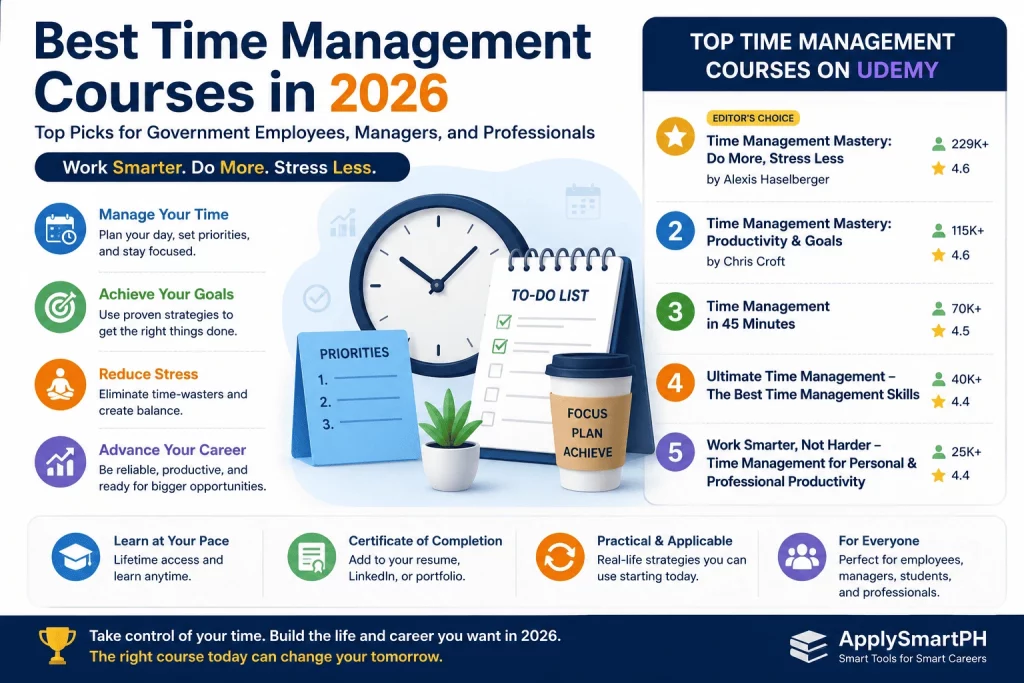
Time is the one resource nobody can generate more of — yet in 2026, with AI tools automating half the workday and still leaving people scrambling to keep up, the ability to manage time well has become the single most underrated career skill. Whether you’re an Administrative Officer juggling memos and deadlines, a Supervisor managing a team’s output, or a Virtual Assistant balancing five clients at once, the right time management course can be the difference between a stressful, reactive workday and one where you’re consistently in control.
This guide breaks down the best time management and productivity courses on Udemy in 2026, ranked by real outcomes — student numbers, ratings, practical applicability, and career value — with special attention to what actually matters for government employees, office-based professionals, and students.
Quick Answer
👉 Time Management Mastery: Do More, Stress Less by Alexis Haselberger
This is the best overall pick for 2026 because it combines scale, credibility, and practicality:
- 229,000+ students enrolled
- 98,000+ ratings, reflecting consistent learner satisfaction
- Updated February 2026, so the content reflects current tools and work realities, including AI-assisted workflows
- A practical, repeatable productivity system rather than abstract theory
- Strong fit for professionals, supervisors, and managers who need results they can apply the same week they take the course
If you only have time to take one course this year, this is it. But if your role, budget, or learning style calls for something different, the recommendations below cover every major use case — from absolute beginners to government office veterans.
Why Time Management Matters in 2026
A few years ago, time management advice mostly revolved around to-do lists and calendar blocking. That’s no longer the whole story. The workplace in 2026 looks different, and so does the skill set needed to thrive in it.
AI and Productivity: A Double-Edged Sword
AI saves time. Tools that draft emails, summarize documents, generate reports, and schedule meetings have quietly removed hours of manual work from the average week. Tasks that used to take an afternoon — compiling a report, transcribing a meeting, drafting a memo — can now take minutes.
But people still waste time. Here’s the paradox: giving people more free time doesn’t automatically make them more productive. Without a system for prioritization, the hours saved by AI get absorbed by distraction, unclear priorities, context-switching, and low-value busywork. Many employees report feeling just as overwhelmed as before, despite doing less manual labor — because the bottleneck was never really about typing speed. It was about decision-making, focus, and structure.
Productivity becomes a competitive advantage. In this environment, the people who pull ahead aren’t necessarily the ones using the most AI tools — they’re the ones who know how to plan, prioritize, and execute deliberately, with or without automation. Time management has shifted from a “nice to have” soft skill to a core competency that determines who gets promoted, who gets trusted with bigger projects, and who burns out.
The Real Benefits of Strong Time Management
Investing in a structured time management course pays off in ways that go well beyond “getting more done”:
- Better work-life balance — a clear system means work stops bleeding into evenings and weekends because tasks are planned, not chased.
- Less stress — uncertainty about what to do next is one of the biggest drivers of daily stress; a framework removes that uncertainty.
- Better performance reviews — consistent, visible output and met deadlines are exactly what supervisors evaluate.
- Faster promotions — employees who reliably deliver and manage their workload are the ones trusted with more responsibility.
- Better decision-making — when your calendar isn’t chaotic, you have the mental bandwidth to think clearly instead of just reacting.
How Time Management Connects to Other Career Skills
Time management rarely works in isolation. It’s the foundation that other professional skills build on top of. If you’re mapping out a broader skill-development plan, these related guides pair naturally with this one:
- Best Leadership Courses Online — because leading others starts with managing yourself
- Best Project Management Courses Online — time management at the individual level, project management at the team and timeline level
- Best Communication Skills Courses — poor communication is one of the biggest hidden time-wasters in any office
- Best Excel Courses — many time-tracking and prioritization systems are built and maintained in spreadsheets
Why Government Employees Need Time Management Training
Government offices operate under a unique combination of pressures: strict deadlines tied to public accountability, layered approval processes, high volumes of paperwork, and — often — leaner staffing than the workload requires. That combination makes time management less of a personal productivity hack and more of an operational necessity.
Here’s how the need shows up across different government roles:
Administrative Officer. Coordinates schedules, correspondence, procurement requests, and inter-office communication simultaneously. Without prioritization skills, urgent-but-unimportant requests (a printer issue, a last-minute meeting) constantly crowd out important strategic work like planning and reporting.
Administrative Assistant. Handles a high volume of small, varied tasks — filing, correspondence, scheduling — where the real skill isn’t speed but sequencing: knowing what to do first so nothing falls through the cracks.
HR Officer. Manages recruitment timelines, employee records, compliance deadlines, and grievance handling — often all in the same week. A missed HR deadline can have legal or policy consequences, making structured scheduling essential.
Planning Officer. Works against fixed government planning cycles (budget cycles, program cycles, reporting periods) where late submissions cascade into delays for entire departments. Time management here is about backward-planning from hard deadlines.
Budget Officer. Deals with cyclical, deadline-heavy work (budget preparation, utilization reports, liquidation) where errors from rushing are costly. Good time management creates the buffer needed for accuracy, not just speed.
In every one of these roles, the common thread is the same: high task volume, hard external deadlines, and limited control over when new requests arrive. A structured time management framework gives government employees a way to stay in control of their day instead of being run by it.
The Smart PH Productivity Pyramid™
To make time management practical rather than theoretical, we’ve built a simple, repeatable framework specifically for professionals and government employees managing high task volumes: the Smart PH Productivity Pyramid™.
The idea is simple — productive days follow a sequence. Skipping a level (like jumping straight to execution without planning) is where most time management breaks down.
            REVIEW
              ↑
          EXECUTION
              ↑
         SCHEDULING
              ↑
        PRIORITIZATION
              ↑
           PLANNING
Level 1 — Planning. Start by listing everything on your plate — tasks, requests, deadlines — before deciding what to do. Skipping this step is why so many days start with reactive firefighting instead of intentional action.
Level 2 — Prioritization. Not everything on the list deserves equal attention. This is where a tool like the Time Management Matrix (below) becomes essential — sorting tasks by real importance and urgency rather than by who asked loudest.
Level 3 — Scheduling. Once priorities are clear, assign them actual time blocks. A prioritized list without a schedule is just a wish list; a scheduled task is a commitment.
Level 4 — Execution. This is where focus techniques matter — single-tasking, minimizing interruptions, and protecting the time blocks you set in the previous step.
Level 5 — Review. The most frequently skipped step. A short daily or weekly review — what got done, what didn’t, why — is what turns a static schedule into a system that improves over time.
Most time management struggles trace back to skipping one of these five levels — usually planning or review, since they don’t feel like “real work.” The best courses on this list (especially the Editor’s Choice pick) teach a version of this full-cycle approach rather than just one piece of it.
The Time Management Matrix: Deciding What Actually Matters
Once you’ve planned your tasks, the next challenge is deciding what to do first. The classic tool for this — refined here for office and government contexts — is the Time Management Matrix. It sorts every task along two dimensions: importance and urgency.
| Activity | Priority |
|---|---|
| Important + Urgent | Do First |
| Important + Not Urgent | Schedule |
| Not Important + Urgent | Delegate |
| Not Important + Not Urgent | Eliminate |
Here’s how this plays out in a typical office setting:
- Do First — A compliance report due today, an urgent directive from a supervisor, a system outage affecting daily operations.
- Schedule — Long-term planning documents, professional development, relationship-building with colleagues or stakeholders, process improvement work. This quadrant is where career growth actually happens, but it’s the easiest to keep postponing.
- Delegate — Routine requests that don’t require your specific expertise, meeting scheduling, basic data entry that a colleague or assistant can handle.
- Eliminate — Excessive email checking, meetings without clear agendas, low-value interruptions, and busywork that exists out of habit rather than necessity.
The uncomfortable truth most people discover when they apply this matrix honestly is that far too much of their day is spent in the “Urgent but Not Important” quadrant — reacting to other people’s priorities instead of advancing their own. Time management courses that teach delegation and boundary-setting (not just scheduling apps) tend to produce the biggest real-world improvements, which is a key reason it factors heavily into the ratings below.
Recommended Time Management Courses
⭐ Editor’s Choice: Time Management Mastery: Do More, Stress Less
Instructor: Alexis Haselberger
This is the most complete, well-rounded time management course currently available on Udemy, and it earns its top spot on scale alone: 229,000+ students and 98,000+ ratings, with content updated February 2026 to reflect current work patterns, including AI-assisted workflows.
What sets it apart isn’t just popularity — it’s structure. Haselberger, a workplace productivity coach, teaches a full system rather than isolated tips: goal-setting, prioritization, calendar management, focus techniques, and boundary-setting are all covered as parts of one connected approach. That mirrors the Smart PH Productivity Pyramid™ outlined above — planning through review, not just scheduling.
Best for: Professionals, supervisors, and managers who want one comprehensive system rather than scattered tactics. Also an excellent fit for government employees managing multiple concurrent responsibilities, since the framework is designed for people whose day gets constantly interrupted by other people’s priorities.
🏆 Best for Productivity: Time Management Mastery: Productivity & Goals
Instructor: Chris Croft
Chris Croft is one of the most established names in workplace training on Udemy, known for practical, no-nonsense delivery aimed at working professionals rather than students or hobbyists. This course leans heavily into goal-setting as the engine of productivity — the idea that time management without a clear destination is just busywork with better labels.
Best for: Managers and team leads who want productivity techniques tied directly to measurable goals and outcomes, rather than general habit-building. A strong complement to the Editor’s Choice course for anyone in a leadership or supervisory role.
🌱 Best Beginner Course: Time Management in 45 Minutes
For anyone who’s never taken a structured course on this topic before, this option removes the biggest barrier: time itself. At under an hour, it distills core time management principles — prioritization, planning, avoiding common time-wasters — into a format that can realistically be finished in one sitting.
Best for: Students, entry-level employees, or anyone who wants a fast, low-commitment introduction before deciding whether to invest in a deeper course. It won’t replace a full system like the Editor’s Choice pick, but it’s an efficient starting point.
🔧 Best Practical Course: Ultimate Time Management — The Best Time Management Skills
This course is built around applied skills over theory — practical tools and exercises learners can put into use immediately rather than abstract productivity philosophy. It’s designed for people who learn best by doing, with a focus on techniques that translate directly into daily task management.
Best for: Administrative staff, Virtual Assistants, and anyone whose role involves a high volume of varied day-to-day tasks and who wants hands-on tools rather than conceptual frameworks.
⚖️ Best for Personal Productivity: Work Smarter, Not Harder — Time Management for Personal & Professional Productivity
This course draws a deliberate line between personal and professional productivity, recognizing that the same person who struggles with a chaotic inbox at work often struggles with disorganization at home — and that the two reinforce each other. It’s built around the “work smarter” philosophy: reducing wasted effort rather than simply working longer hours.
Best for: Professionals looking for a course that addresses whole-life productivity, not just office task management — useful for anyone whose personal disorganization is spilling into their professional performance, or vice versa.
Smart PH Course Rating: Ease, Career Value, and Overall Score
To make comparison easier, here’s how the five recommended courses stack up across the three factors that matter most to working professionals: how easy the course is to complete alongside a full-time job, how much it moves the needle for career growth, and an overall rating combining both with content depth.
| Course | Ease | Career Value | Overall |
|---|---|---|---|
| Time Management Mastery: Do More, Stress Less (Haselberger) | High | Very High | ⭐⭐⭐⭐⭐ |
| Time Management Mastery: Productivity & Goals (Croft) | High | High | ⭐⭐⭐⭐⭐ |
| Time Management in 45 Minutes | Very High | Moderate | ⭐⭐⭐⭐ |
| Ultimate Time Management – The Best Time Management Skills | Moderate | High | ⭐⭐⭐⭐ |
| Work Smarter, Not Harder | High | Moderate–High | ⭐⭐⭐⭐ |
How to read this table: “Ease” reflects how manageable the course is to complete around a full workweek — shorter, well-structured courses score higher. “Career Value” reflects how directly the skills taught translate into workplace outcomes like performance reviews, promotions, and reduced overtime. The Editor’s Choice course leads because it scores strongly on both dimensions rather than trading one for the other.
Smart PH Career Readiness Score™: Editor’s Choice
For our top pick, we go one level deeper. The Smart PH Career Readiness Score™ breaks career impact into four specific dimensions instead of one general “value” rating — because a course can be strong in one area (say, certificate prestige) and weaker in another (government-specific relevance), and professionals deserve to know which is which before enrolling.
| Time Management Mastery: Do More, Stress Less | Rating |
|---|---|
| Career Readiness | ★★★★★ |
| Promotion Value | ★★★★★ |
| Government Relevance | ★★★★★ |
| Certificate Value | ★★★★☆ |
- Career Readiness (★★★★★) — Covers the full cycle from planning to execution, so learners leave able to apply the system immediately, not just recite concepts.
- Promotion Value (★★★★★) — Directly builds the reliability and visible output that performance reviews and promotion boards look for.
- Government Relevance (★★★★★) — The emphasis on boundary-setting and prioritization under constant interruption maps closely onto real government office conditions.
- Certificate Value (★★★★☆) — A strong, well-recognized Udemy certificate suitable for professional development logs, though it stops just short of five stars since it isn’t an accredited academic credential.
This is the kind of side-by-side breakdown most course comparison lists skip — and it’s exactly why the Editor’s Choice pick holds up under closer scrutiny, not just at a glance.
The Smart PH Decision Tree™: Which Course Is Right for You?
Rankings and tables are useful, but sometimes the fastest way to choose is a simple yes/no path. The Smart PH Decision Tree™ walks you straight to the right course in three questions.
                    New to Time Management?
                            │
                           YES
                            │
                            ▼
              Time Management in 45 Minutes
                    (start here, then advance)


                    Already Working Full-Time?
                            │
                           YES
                            │
                            ▼
        Time Management Mastery: Do More, Stress Less
                   (Alexis Haselberger)


                  Preparing for a Promotion
                     or Leading a Team?
                            │
                           YES
                            │
                            ▼
        Time Management Mastery: Productivity & Goals
                       (Chris Croft)
How to use it: Start at the top and answer honestly. A student or first-time learner should start with the 45-minute course. A working professional with no prior training should go straight to the Editor’s Choice pick. A supervisor or manager already comfortable with the basics — or actively being considered for promotion — gets the most career value from Chris Croft’s goal-driven course. If more than one answer applies to you (common for managers who are also new to formal time management training), take them in that order: fundamentals first, system second, goal-alignment third.
The Career Development Roadmap™: Where Time Management Fits in Your Bigger Career Plan
Time management is rarely the finish line — it’s the entry point to a longer skill-building sequence. The Career Development Roadmap™ maps out the order that gives professionals, and especially government employees, the strongest compounding return on their learning investment.
   Communication
        ↓
   Time Management
        ↓
     Leadership
        ↓
  Project Management
        ↓
       Excel
        ↓
  Public Administration
Why this order works:
- Communication first. Poor communication creates most of the “urgent interruptions” that time management has to manage around. Fixing it at the source reduces the noise before you even start optimizing your schedule.
- Time Management second. Once communication is cleaner, you need a personal system — this is where the courses on this page come in — to control your own workload before taking on anyone else’s.
- Leadership third. You can’t manage other people’s time until you’ve proven you can manage your own. Leadership training builds on the discipline established in step two. See Best Leadership Courses Online.
- Project Management fourth. Leadership gives you influence over people; project management gives you a formal system for influencing timelines, deliverables, and cross-team coordination. See Best Project Management Courses Online.
- Excel fifth. Reporting, budgeting, and tracking — the tools that make everything above measurable and visible to supervisors — are built in Excel more often than any other single tool in government and office settings. See Best Excel Courses.
- Public Administration last. For government employees specifically, formal public administration training consolidates everything above into policy-level and systems-level competence, positioning you for senior and leadership-track roles.
Following this roadmap in sequence — rather than jumping straight to leadership or project management courses — builds each skill on a foundation that’s actually ready to support it. Most professionals who stall out at mid-career skipped a step somewhere in this chain, usually time management itself.
Which Course Should You Choose? Recommendations by Role
Best Time Management Course for Government Employees
Time Management Mastery: Do More, Stress Less (Alexis Haselberger). Government roles involve constant interruptions, layered approvals, and competing deadlines from multiple stakeholders. This course’s emphasis on boundary-setting and prioritization — not just scheduling — directly addresses the “urgent but not important” trap that defines so much of government office work.
Best Course for Managers and Supervisors
Time Management Mastery: Productivity & Goals (Chris Croft). Managers need time management tied to team outcomes, not just personal task lists. Croft’s goal-driven approach helps supervisors translate personal productivity gains into team-level results — useful when performance reviews and reports depend on collective output, not just individual effort.
Best Course for Students
Time Management in 45 Minutes. Students juggling coursework, part-time jobs, and personal commitments benefit most from a course that respects their limited free time. It delivers the core fundamentals — prioritization and planning — without the time investment a full system-based course requires.
Best Course for Beginners
Time Management in 45 Minutes, followed by Ultimate Time Management – The Best Time Management Skills as a natural next step. This pairing lets a true beginner start with fundamentals in under an hour, then build toward more applied, hands-on skills once the basics are in place.
Free vs. Paid Time Management Courses: Which Is Worth It?
It’s tempting to start with free YouTube content or free introductory courses, and for basic exposure to concepts like the Eisenhower Matrix or the Pomodoro Technique, that’s a reasonable starting point. But there are real trade-offs worth knowing before deciding where to invest your time.
Free courses typically offer:
- Surface-level coverage of well-known frameworks
- No structured practice exercises or accountability
- No certificate of completion recognized for HR or performance-review purposes
- Content that isn’t updated regularly, meaning outdated advice (especially around digital tools and AI-assisted workflows)
Paid courses (like the ones recommended above) typically offer:
- A complete, sequenced system rather than isolated tips
- Practical exercises and downloadable templates
- A certificate of completion — often directly relevant for government employees who need to log professional development hours or include credentials in performance evaluations
- Regular content updates (note that the Editor’s Choice course was updated as recently as February 2026)
- Instructor credibility backed by real coaching or training experience, not just personal opinion
Our recommendation: If you’re testing whether structured time management training is worth your while at all, a free short course is a reasonable first step. But if you’re serious about career improvement — especially if you want a certificate to support a performance review, promotion application, or professional development requirement — a paid course from an established instructor is worth the investment. Udemy’s frequent discounting also means most of these courses can be accessed for a fraction of their list price, narrowing the practical gap between “free” and “paid” considerably.
Frequently Asked Questions
What is the best time management course on Udemy in 2026?
Time Management Mastery: Do More, Stress Less by Alexis Haselberger is the top-rated overall pick, based on its combination of scale (229,000+ students), consistent ratings (98,000+), recent updates, and practical applicability for professionals and managers.
Do Udemy time management courses give a certificate?
Yes. Paid Udemy courses include a certificate of completion once you finish all required lectures. This certificate can typically be added to a LinkedIn profile, resume, or submitted as evidence of professional development.
Are Udemy certificates recognized by government agencies?
Recognition varies by agency and country. Many government offices accept Udemy certificates as evidence of self-directed professional development, particularly for internal training logs or performance evaluation documentation, but they generally aren’t equivalent to accredited academic credentials. Check your agency’s specific professional development policy before assuming it counts toward formal requirements.
How long does it take to complete a time management course?
This varies widely by course. Short options like Time Management in 45 Minutes can be completed in under an hour, while comprehensive system-based courses like the Editor’s Choice pick may take several hours spread across multiple sessions, depending on how much time you spend on exercises and templates.
Which time management course is best for beginners?
Time Management in 45 Minutes is the most beginner-friendly option due to its short length and focus on foundational concepts. It’s a good entry point before moving to a more comprehensive course.
Is time management training worth it for government employees specifically?
Yes. Government roles typically involve high task volume, strict external deadlines, and frequent interruptions from multiple stakeholders — exactly the conditions structured time management training is designed to address. Employees who complete this kind of training often report better ability to meet deadlines and reduced last-minute scrambling.
What’s the difference between time management and productivity courses?
Time management focuses specifically on how you allocate and prioritize time — scheduling, prioritization frameworks, avoiding time-wasters. Productivity courses often cover a broader range of topics, including focus techniques, energy management, and tool usage (like automation or AI tools). Many of the top-rated courses, including our Editor’s Choice pick, blend both.
Can time management skills help with career advancement?
Yes. Employees who consistently meet deadlines, manage workload visibly, and demonstrate reliability are more likely to be trusted with additional responsibility, which is often a direct precursor to promotion. Several of the courses above specifically address this connection between personal systems and career outcomes.
What is the Smart PH Productivity Pyramid™?
It’s a five-level framework — Planning, Prioritization, Scheduling, Execution, and Review — designed to show how effective time management works as a full cycle rather than a single habit like calendar-blocking. Skipping any level, especially planning or review, is a common reason time management systems break down.
How does the Time Management Matrix help with prioritization?
It sorts tasks into four categories based on importance and urgency — Do First, Schedule, Delegate, and Eliminate — helping you quickly identify which tasks deserve immediate attention, which should be planned for later, which can be handed off, and which shouldn’t be done at all.
Should I take a free course or a paid course first?
If you’re unsure whether structured training will help, a short free course is a reasonable low-risk starting point. If you already know you need a complete system — especially for a professional development requirement or career goal — a paid course from an established instructor offers more depth, structure, and a recognized certificate.
How often are these course recommendations updated?
This list reflects course quality, enrollment, and ratings as of 2026, with particular attention to recency of content updates (the Editor’s Choice course, for example, was last updated in February 2026). Course rankings can shift as instructors update content or new courses launch, so it’s worth checking current ratings before enrolling.
Key Takeaways
- Time Management Mastery: Do More, Stress Less by Alexis Haselberger is the best overall course in 2026, combining scale, recent updates, and practical applicability.
- AI has reduced manual work but hasn’t eliminated the need for prioritization — if anything, it’s made deliberate time management more of a competitive advantage, not less.
- Government employees face a unique combination of high task volume and strict external deadlines that make structured time management especially valuable.
- The Smart PH Productivity Pyramid™ (Planning → Prioritization → Scheduling → Execution → Review) and the Time Management Matrix (Do First / Schedule / Delegate / Eliminate) are practical frameworks you can apply immediately, with or without a formal course.
- Course choice should match your role: managers benefit most from goal-driven courses, beginners and students from shorter courses, and administrative staff from hands-on, applied-skills courses.
- Paid courses offer certificates, deeper content, and regular updates — worth the investment for anyone pursuing career advancement or professional development credit.
Final Recommendation
If you want one course that covers the full system — planning, prioritization, scheduling, execution, and review — Time Management Mastery: Do More, Stress Less by Alexis Haselberger remains the strongest choice for 2026, particularly for professionals, supervisors, and government employees managing high, varied workloads. Pair it with the Smart PH Productivity Pyramid™ and Time Management Matrix outlined above, and you’ll have both a course-based system and daily practical tools to put it to work immediately.
For managers specifically looking to tie personal productivity to team and goal outcomes, Chris Croft’s course is an excellent complement. And if you’re just starting out or short on time, beginning with the 45-minute course before advancing to a more complete system is a smart, low-friction path in.
Whichever course you choose, the real gain doesn’t come from watching the videos — it comes from applying the framework consistently, starting with your very next workday.
Related Professional Development Guides
Leadership rarely develops in isolation — it usually pairs with a handful of other practical workplace skills. If you’re building out a broader professional development plan, these guides cover the skills that most often complement leadership training: