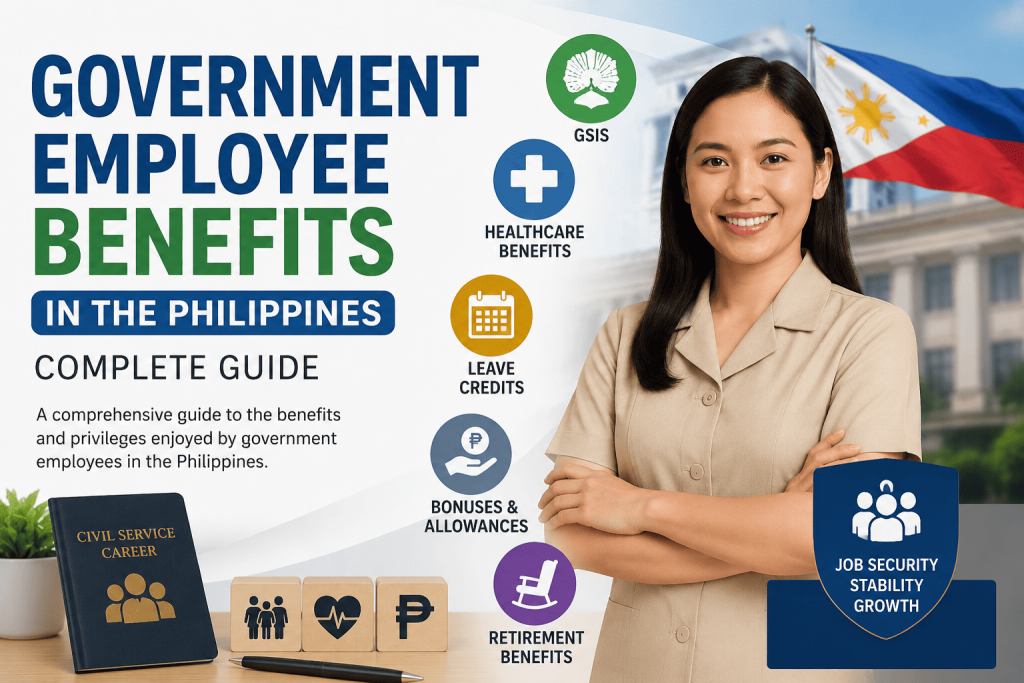
Understanding Government Employee Benefits in the Philippines helps aspiring and current public servants appreciate the full value of government employment beyond monthly salary. From GSIS protection and healthcare coverage to bonuses and leave privileges, these benefits provide long-term financial security and career stability.
Government Employee Benefits in the Philippines extend far beyond basic compensation. Permanent government employees enjoy retirement protection, healthcare coverage, housing assistance, paid leave privileges, bonuses, and security of tenure that collectively make public service an attractive long-term career option.
This guide covers the complete government employee benefits package for 2026, with actual figures and legal bases so you know exactly what you’re entitled to.
GSIS: A Key Part of Government Employee Benefits in the Philippines
Government employees are covered by GSIS instead of SSS. The employee share of the GSIS contribution is 9% of actual monthly basic salary, with the government agency covering the employer share. Pasei
Life Insurance
All eligible government employees are automatically enrolled in GSIS life insurance, which covers life insurance benefits, separation benefits, disability benefits, and survivorship benefits for qualified dependents.
Retirement Benefits
Employees who meet the required years of service may qualify for:
- A lump-sum retirement package
- A monthly pension
- A combination of both
The amount depends on years of service and the applicable retirement law (primarily RA 8291, the GSIS Act).
Loans
GSIS members may access emergency loans, salary loans, policy loans, and multi-purpose loans — providing a safety net for unexpected financial needs without resorting to informal lenders.
PhilHealth
The current PhilHealth premium rate is 4% of monthly basic salary, shared equally between the employee and employer. Monthly premiums range from ₱400 (for those earning ₱10,000 and below) to a cap of ₱3,200 (for those earning ₱80,000 and above). Pasei
Benefits include inpatient hospitalization, outpatient consultations, selected diagnostic procedures, maternity packages, and case rate packages for specific conditions — covering both the employee and qualified dependents.
Pag-IBIG Fund
Mandatory Pag-IBIG contributions in 2026 follow the existing structure: 1% employee plus 2% employer for monthly compensation up to ₱1,500, and 2% employee plus 2% employer above that threshold, computed off a ₱5,000 base. SweldoPH
Housing Loan
Members may apply for Pag-IBIG housing loans to purchase a house and lot, construct a home, renovate an existing property, or refinance a housing loan — one of the most tangible long-term benefits of government employment.
Multi-Purpose Loan (MPL)
Short-term loans are available for education, medical needs, home improvement, and other financial needs.
Provident Savings
Regular contributions earn annual dividends and may be withdrawn upon membership maturity or separation from service.
Bonuses and Cash Incentives Under Government Employee Benefits in the Philippines
Mid-Year Bonus
The mid-year bonus is equivalent to one month’s basic pay as of May 15 and is granted to employees who have rendered at least four months of service from July 1 of the preceding year through May 15 of the current year, remain in government service as of May 15, and have obtained at least a satisfactory performance rating in the immediately preceding rating period. GMA News Online
For FY 2026, the DBM allocated ₱73.456 billion for the mid-year bonus, benefiting over 1.9 million civilian, military, and uniformed personnel across national government agencies. Payout began May 15, 2026. INQUIRER.net
Year-End Bonus and Cash Gift
The year-end bonus is equivalent to one month’s basic pay as of October 31, plus a ₱5,000 cash gift, released no earlier than November 15 of the current year. Eligibility requires at least four months of aggregate service from January 1 to October 31 and active status as of October 31. Government Philippines
Performance-Based Bonus (PBB)
Government agencies that meet their performance targets may grant a PBB to qualified employees. The amount varies based on agency performance ratings, individual IPCR scores, and eligibility requirements set by the DBM.
Leave Benefits Available Under Government Employee Benefits in the Philippines
Government employees enjoy a comprehensive set of paid leave privileges:
| Leave Type | Details |
|---|---|
| Vacation Leave | For personal or family use; accumulates over tenure |
| Sick Leave | Paid leave during illness or medical treatment |
| Maternity Leave | 105 days for normal delivery; additional 30 days optional unpaid |
| Paternity Leave | 7 days for married male employees |
| Solo Parent Leave | Additional 7 working days for qualified solo parents (RA 8972) |
| Special Leave Privileges | 3 days per year for specific personal events |
Unused vacation and sick leave credits may be monetized upon retirement or resignation from permanent service.
Clothing and Uniform Allowance
Under BIR Revenue Regulations 29-2025, the uniform and clothing allowance de minimis ceiling was updated to ₱8,000 per year effective January 6, 2026 — the tax-exempt annual allowance for work-related clothing expenses. SweldoPH
Security of Tenure
Permanent government employees cannot be removed from service without due process under the Civil Service Law. This protection — absent in most private sector employment — means your position cannot be eliminated for arbitrary reasons, reorganization pressures, or employer preference.
For Civil Service Exam passers, qualifying for a permanent plantilla position is the gateway to this protection.
Career Development
Government service provides structured pathways for advancement through:
- Step increments — salary increases within your grade based on years of satisfactory service
- Promotions — movement to higher salary grade positions
- Scholarships and training programs — agency-funded and CSC-supported
- Leadership development initiatives under the CSC’s merit system
What Job Order and COS Workers Should Know
Job Order (JO) and Contract of Service (COS) workers are not entitled to the full benefits package described above. They are generally not covered by GSIS, do not earn leave credits, and are not entitled to the mid-year or year-end bonus under standard government rules.
This is one of the most important practical differences between JO/COS engagement and a permanent plantilla appointment — and a key reason why passing the Civil Service Exam and qualifying for permanent positions matters beyond salary.
Summary: Government Benefits at a Glance
| Benefit | Amount / Rate |
|---|---|
| GSIS Contribution | 9% of basic salary (employee share) |
| PhilHealth | 4% of basic salary (₱400–₱3,200/mo) |
| Pag-IBIG | 2% employee + 2% employer |
| Mid-Year Bonus | 1 month basic pay (released May 15) |
| Year-End Bonus | 1 month basic pay + ₱5,000 cash gift (Nov 15) |
| Clothing Allowance | ₱8,000/year (tax-exempt) |
| Maternity Leave | 105 days |
| Paternity Leave | 7 days |
Frequently Asked Questions
Do Job Order employees receive these benefits? Generally no. JO workers are not covered by GSIS, do not earn leave credits, and are not entitled to government bonuses. Benefits depend on their specific terms of engagement.
Are COS employees covered by GSIS? COS employees are typically not covered under GSIS in the same manner as permanent personnel, which means no retirement protection and no GSIS loan privileges.
Does passing the Civil Service Exam automatically increase my benefits? Passing the CSE doesn’t change your benefits immediately, but it qualifies you for permanent plantilla positions — which come with the full benefits package, security of tenure, and retirement coverage.
Do LGU employees receive the same bonuses? Local government employees are also entitled to the mid-year bonus, but its release is subject to approval by their respective sanggunian and the conditions under DBM Budget Circular No. 2017-2. GMA News Online
Final Thoughts
The government benefits package in 2026 — GSIS retirement and life insurance, PhilHealth, Pag-IBIG housing assistance, two months’ worth of bonuses annually, comprehensive leave privileges, and security of tenure — represents a compensation picture that goes well beyond the monthly basic pay figure.
For anyone preparing for the Civil Service Exam or considering a move into public service, understanding the full value of this package is essential to making an informed career decision.
Explore our related guides on Government Salary Grade 2026, plantilla positions, and Civil Service eligibility requirements to plan your public sector career.
Related Topics
To learn more about navigating your career in the Philippine government, explore our deep-dive guides:
- Government Salary Grade 2026: Complete Guide to the Philippine Salary Schedule
- Job Order vs. COS vs. Permanent: What Is a Plantilla Position?
- Government Jobs in the Philippines 2026: Complete Job Search Guide
- Civil Service Exam Requirements 2026: Complete Application Guide and Checklist
- Civil Service Exam Reviewer: Complete Guide