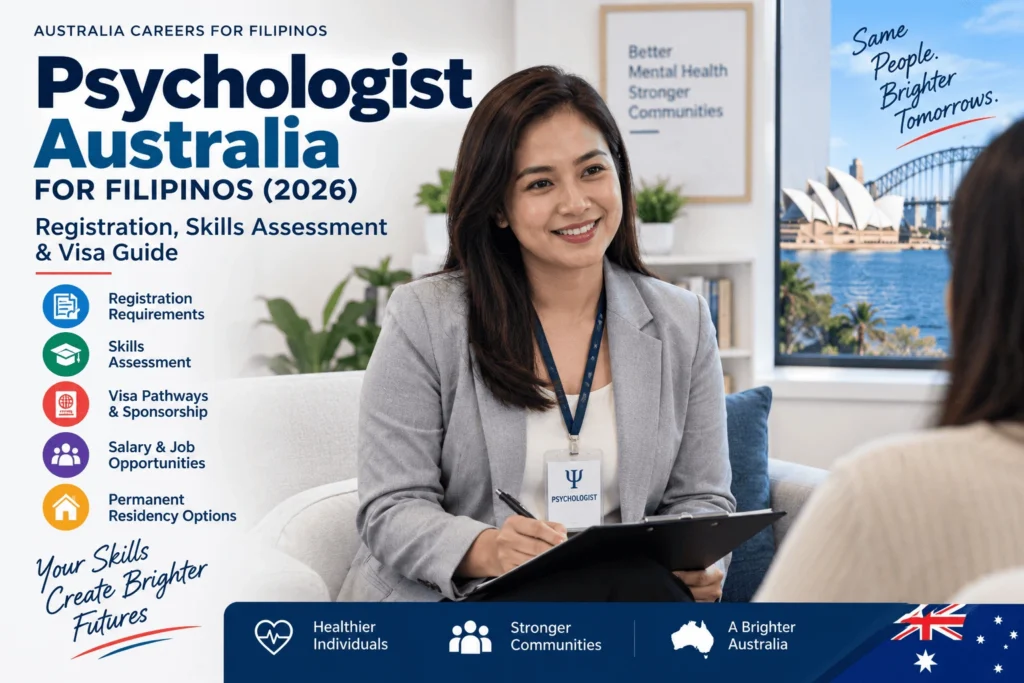
Quick Answer: Filipino Psychologists can work in Australia by having their qualifications assessed and registered through the Psychology Board of Australia (via Ahpra), meeting English requirements, securing employment, and applying through skilled migration or employer-sponsored visas. Unlike some allied health professions, psychology is a nationally regulated title — registration is mandatory before you can practice. See our complete guide on how Filipinos can work in Australia for the bigger picture.
This guide walks through everything a Filipino-trained Psychologist needs to know in 2026: how registration works, how your degree is assessed, which visas are realistic, what you can expect to earn, and how the whole journey fits together from application to permanent residency.
If you’re still deciding whether Australia is the right destination at all, our complete guide on how Filipinos can work in Australia is a good starting point before diving into the profession-specific details below.
Key Takeaways
- Psychology is a regulated profession in Australia — you cannot legally practice or use the title “Psychologist” without registration.
- Registration is granted through the Psychology Board of Australia, working under the Australian Health Practitioner Regulation Agency (Ahpra).
- Demand exists across healthcare, education, disability support (particularly NDIS), and community mental health services.
- Skilled migration and employer sponsorship pathways are both realistic options for qualified Filipino Psychologists.
- Several visa routes can lead to permanent residency, including state-nominated and regional pathways.
Can Filipino Psychologists Work in Australia?
Yes. Filipino Psychologists are welcome to pursue registration and employment in Australia, provided their qualifications meet the standards set by the Psychology Board of Australia. Because Psychology is a nationally regulated health profession, the pathway is more structured than many other careers — but it is also well-established, with clear steps that thousands of overseas-trained professionals have followed before you.
Demand for Psychologists in Australia
Australia has faced a well-documented shortage of registered Psychologists, particularly outside major metropolitan centers. Rising rates of anxiety, depression, and other mental health conditions — combined with expanded government-funded mental health programs — have pushed demand for psychological services well beyond what the local workforce can supply.
Opportunities for Overseas-Trained Professionals
Overseas-trained Psychologists, including those from the Philippines, can apply for registration through Ahpra’s overseas qualification assessment process. While the pathway involves more documentation than some other occupations, it is a recognized and frequently used route into the profession.
Career Prospects and Growth
Once registered, Psychologists in Australia can work across a wide range of settings — hospitals, private practice, schools, disability services, and government agencies — with clear opportunities to specialize (clinical, educational, organizational, forensic, and more) as their career progresses.
What Does a Psychologist Do?
Before diving into registration and visas, it helps to understand the day-to-day scope of the role in an Australian context.
Mental Health Assessment
Psychologists conduct structured assessments to understand a client’s mental health status, cognitive functioning, and emotional wellbeing, forming the basis for diagnosis and treatment planning.
Counseling and Therapy
Individual, group, and family therapy sessions using evidence-based approaches such as cognitive behavioral therapy (CBT) are a core part of clinical practice.
Behavioral Interventions
Psychologists design and implement behavior support plans, particularly in disability, education, and NDIS-funded settings.
Psychological Testing
Standardized testing — cognitive, personality, and diagnostic — is used to support formal assessments, particularly in clinical and educational psychology roles.
Crisis Intervention
Psychologists are often called on to support individuals during acute mental health crises, working alongside other health professionals in hospitals and community settings.
Community Mental Health Support
Many roles involve outreach and preventative mental health work within community health organizations, schools, and government programs.
Why Australia Needs Psychologists
Growing Mental Health Awareness
Public conversation and policy attention around mental health have grown significantly in Australia over the past decade, increasing both funding and demand for services.
Workforce Shortages
Psychology has repeatedly appeared on Australia’s shortage occupation lists, reflecting a persistent gap between demand for services and the number of registered practitioners.
NDIS and Disability Services
The National Disability Insurance Scheme (NDIS) has created substantial demand for Psychologists who can provide behavior support and therapeutic services to participants.
School and Youth Mental Health Programs
Government-funded programs placing Psychologists in schools have expanded significantly, creating steady demand for educational and child psychology roles.
Regional Healthcare Needs
Regional and rural areas face particularly acute shortages, which is one reason regional visa pathways (covered below) are especially relevant for this profession.
Psychologist Occupation Overview
Occupation Classification
Psychologist roles in Australia fall under recognized ANZSCO occupation codes for skilled migration purposes, covering general, clinical, educational, and organizational psychology streams.
Professional Scope
Scope of practice depends on your area of registration (general vs. endorsed areas of practice such as Clinical Psychology), which affects both the services you can provide and, often, your earning potential.
Typical Responsibilities
Responsibilities typically include assessment, diagnosis, treatment planning, therapy delivery, case documentation, and collaboration with other healthcare or education professionals.
Work Settings
- Hospitals
- Mental Health Clinics
- Schools
- Universities
- Community Services
- Government Agencies
- Private Practice
Psychology Specializations in Australia
Beyond general registration, many Psychologists pursue an area of practice endorsement — additional postgraduate training and supervised experience that allows them to work within a recognized specialty. Understanding these specializations early can help you plan your registration pathway and target the right employers.
Clinical Psychologist
Clinical Psychologists diagnose and treat more complex mental health conditions and are typically eligible for higher Medicare rebates, making this one of the most sought-after endorsements in both public and private practice.
Educational Psychologist
Educational (and Educational and Developmental) Psychologists work primarily in schools and early intervention settings, supporting learning difficulties, developmental assessments, and behavioral concerns in children and young people.
Counselling Psychologist
Counselling Psychologists focus on therapeutic support for everyday psychological and emotional difficulties, often working in private practice, community health, and employee assistance programs.
Health Psychologist
Health Psychologists work at the intersection of physical and mental health, supporting patients managing chronic illness, pain, or lifestyle-related health conditions, often within hospital or rehabilitation settings.
Forensic Psychologist
Forensic Psychologists apply psychological expertise within the legal and correctional systems, including risk assessments, court reports, and rehabilitation programs.
Organizational Psychologist
Organizational Psychologists work with businesses and government agencies on workplace wellbeing, leadership development, recruitment, and performance — a specialization increasingly in demand outside traditional clinical settings.
Psychology Registration in Australia
Registration is the single most important requirement for Filipino Psychologists — without it, you cannot practice or hold yourself out as a Psychologist anywhere in Australia.
Why Registration Is Required
Psychology is a nationally regulated profession under Australia’s National Registration and Accreditation Scheme, designed to protect the public by ensuring only qualified, competent practitioners provide psychological services.
Psychology Board of Australia
The Psychology Board of Australia sets registration standards, approves qualifications, and oversees the professional conduct of registered Psychologists nationwide.
Australian Health Practitioner Regulation Agency (Ahpra)
Ahpra administers registration on behalf of the Psychology Board, processing applications, managing the national register, and handling notifications or complaints against practitioners.
Registration Standards
Registration standards cover qualifications, criminal history checks, English language proficiency, recency of practice, and professional indemnity insurance arrangements.
English Language Requirements
Applicants generally need to demonstrate English proficiency through an approved test (such as IELTS Academic) unless they qualify for an exemption based on prior education or work history in an English-speaking country.
Psychology Registration Fees and Processing Times
Budgeting for registration is often overlooked by overseas applicants, but fees and waiting periods can add up. Ahpra reviews its fee schedule annually, so treat the figures below as a general planning guide and always confirm current amounts on the Ahpra and Psychology Board websites before applying.
Initial Registration Fees
First-time registration with the Psychology Board of Australia typically involves a standalone application fee, separate from any qualification assessment fee, payable when you first submit your registration application.
Application Fees
On top of the base registration fee, overseas-trained applicants generally pay an additional qualification assessment fee to have their Filipino psychology degree formally evaluated — this is billed separately from your eventual registration fee.
Typical Processing Periods
Qualification assessments for overseas applicants commonly take several months, and timelines can extend further if bridging requirements, supervised practice, or additional documentation are identified along the way. Applying early — ideally before you have a firm job offer — helps avoid delays later in the process.
Renewal Costs
Once registered, Psychologists must renew their registration annually with the Psychology Board, paying a recurring renewal fee and confirming ongoing compliance with continuing professional development (CPD) requirements.
How Filipino Psychology Degrees Are Assessed
Qualification Assessment
Filipino-trained Psychologists must have their qualifications assessed against the Psychology Board’s approved program standards to determine whether further study, supervised practice, or examinations are required.
Academic Comparability
Assessors compare the structure, content, and duration of Philippine psychology programs against Australian-accredited equivalents, looking closely at coursework in areas like assessment, ethics, and supervised practicum hours.
Overseas Qualifications Assessment
Depending on the outcome, applicants may be asked to complete bridging coursework, a period of supervised practice, or additional examinations before full registration is granted.
Common Assessment Outcomes
Outcomes generally fall into a few categories: full recognition, recognition with additional requirements (bridging study or supervised practice), or a recommendation to complete further formal study in Australia.
Psychology Internship and Supervised Practice Requirements
Many Filipino applicants are surprised to learn that formal registration is only part of the journey — a period of supervised practice is often required before full, independent registration is granted.
Supervised Practice Pathway
Applicants who don’t hold a qualification the Board considers directly equivalent may be placed on a supervised practice pathway, working under an approved supervisor for a defined period while building local competencies.
Internship Requirements
Where a formal internship is required, it typically combines structured supervision, case documentation, and periodic assessment against the Board’s competency standards, similar in spirit to the local pathways Australian-trained graduates complete themselves.
Competency Pathways
The Board assesses candidates against defined professional competencies — covering areas like ethical practice, assessment, and intervention — rather than simply counting hours, so the length and structure of your supervised practice period will depend on how closely your Filipino training already aligns with these standards.
Skills Assessment for Migration Purposes
Why Skills Assessment Matters
For skilled migration visas, a positive skills assessment from the relevant assessing authority is typically required before you can submit an Expression of Interest (EOI) — this is separate from, but related to, professional registration.
Assessing Authorities
Skills assessments for Psychologists are generally handled by the relevant assessing authority linked to the occupation on the skilled occupation list, working in coordination with registration requirements from the Psychology Board.
Required Documents
| Document | Purpose |
|---|---|
| Academic transcripts and diplomas | Verify qualification content and duration |
| Certified proof of identity | Confirm applicant identity |
| English test results | Meet language proficiency requirements |
| Employment references | Verify relevant work experience |
| Curriculum vitae/resume | Summarize qualifications and experience |
| Police clearance | Confirm good character |
| Registration/licensing evidence (Philippines) | Confirm standing as a practicing professional |
For a broader walkthrough of how skills assessments work across occupations, see our Australia Skills Assessment Guide for Filipinos.
Psychologist Visa Sponsorship Australia
Employer Sponsorship Opportunities
Some Australian employers — particularly larger healthcare networks and NDIS providers — are open to sponsoring qualified overseas Psychologists, especially in areas facing acute shortages.
Public Health Employers
State and territory health departments occasionally sponsor mental health professionals for hospital-based and community mental health roles, particularly in regional service areas.
Mental Health Providers
Private mental health clinics and telehealth providers are increasingly sponsoring registered Psychologists to meet growing client demand.
Regional Sponsorship Opportunities
Regional employers often face the steepest shortages and may offer sponsorship alongside additional visa or migration incentives tied to working outside major cities.
For an overview of how sponsorship works across industries, our guide to Australia jobs with visa sponsorship for Filipinos is a useful companion resource.
Visa Pathways for Filipino Psychologists
Once registration and/or a skills assessment is in place, several visa options become available:
189 Skilled Independent Visa
A points-tested permanent visa that does not require employer or state sponsorship, provided the occupation appears on the relevant skilled occupation list. Full details are in our Australia 189 Visa guide for Filipinos.
190 State Nominated Visa
A permanent visa requiring nomination from an Australian state or territory government, often prioritizing occupations — like Psychology — facing local shortages.
491 Regional Visa
A provisional visa for regional Australia that can lead to permanent residency, particularly attractive given the acute demand for Psychologists outside major cities. Learn more in our Australia 491 Visa guide.
482 Skills in Demand Visa
An employer-sponsored temporary visa that allows Psychologists to work in Australia while an employer supports their application, often serving as a stepping stone to permanent residency. See our Australia 482 Visa guide for eligibility details.
186 Employer Nomination Scheme
A permanent employer-sponsored visa suited to Psychologists who have already been working in Australia (often via a 482 visa) and whose employer is willing to nominate them permanently. Full breakdown here: Australia 186 Visa guide.
For the bigger picture on how all these pathways connect, our Australia Migration Guide for Filipinos maps out visa options, requirements, and skilled occupations in one place.
Requirements for Filipino Applicants
| Requirement | Usually Required |
|---|---|
| Passport | Yes |
| Psychology Degree | Yes |
| Registration Eligibility | Yes |
| English Test | Usually Required |
| Resume | Yes |
| Experience | Beneficial |
| Police Clearance | Often Required |
| Medical Examination | Required |
Step-by-Step Pathway
- Complete your Psychology qualification — a bachelor’s and, in most cases, postgraduate-level psychology training recognized in the Philippines.
- Prepare academic documents — certified transcripts, diplomas, and course descriptions for assessment.
- Meet English requirements — sit an approved English test such as IELTS Academic if required.
- Apply for qualification assessment — submit documents to the Psychology Board of Australia via Ahpra.
- Obtain registration eligibility — complete any bridging requirements identified in your assessment.
- Apply for jobs — target employers in healthcare, education, disability services, or community mental health.
- Apply for a visa pathway — whether skilled migration, state nomination, or employer sponsorship.
- Move to Australia — finalize registration, onboard with your employer, and begin practicing.
Psychologist Salary in Australia
| Position | Estimated Salary |
|---|---|
| Entry Level | AUD 80,000–100,000 |
| Experienced | AUD 100,000–130,000 |
| Senior Psychologist | AUD 130,000+ |
Public sector salaries tend to follow structured pay scales tied to state health department enterprise agreements, offering predictable progression and strong benefits.
Private practice opportunities can significantly increase earning potential, particularly for endorsed Clinical Psychologists billing through Medicare rebates or private health funds.
Regional incentives — including relocation allowances, housing support, and retention bonuses — are common for Psychologists willing to work outside major cities.
Specialist roles, such as Clinical, Forensic, or Organizational Psychology, generally command higher salaries than general registration roles, reflecting the additional training and endorsement required.
Best States for Psychologists
- Victoria
- Queensland
- New South Wales
- Western Australia
- South Australia
- Tasmania
Each state has its own nomination priorities and demand patterns, so it’s worth checking current state occupation lists alongside your Australia Skilled Occupation List for Filipinos research before committing to a location.
Top Employers Hiring Psychologists
- Public Hospitals
- Mental Health Services
- NDIS Providers
- Schools and Universities
- Community Health Organizations
- Government Agencies
Can Psychologists Get Permanent Residency?
Yes — Psychology is generally a strong occupation for permanent residency pathways in Australia, given its inclusion on skilled occupation lists and the ongoing shortage across states and territories.
Skilled migration through the points-tested 189 visa remains available to Psychologists who meet the threshold without needing sponsorship.
State nomination via the 190 visa is often a faster route, since states actively seek to fill mental health workforce gaps.
Regional migration through the 491 visa opens additional points and nomination opportunities for Psychologists willing to work outside metro areas, often converting to permanent residency after a qualifying period.
Employer sponsorship, starting with a 482 visa and potentially transitioning to a 186 visa, gives Psychologists a direct, employer-backed route to permanent residency.
Psychologist vs Social Worker
| Category | Psychologist | Social Worker |
|---|---|---|
| Mental Health Assessment | Extensive | Limited |
| Therapy Services | Yes | Some Roles |
| Community Support | Yes | Yes |
| Registration Requirements | Higher | Different Pathway |
Both professions serve overlapping populations but differ significantly in scope, training, and registration pathway. If you’re weighing which career fits your background, our Social Worker Australia guide for Filipinos breaks down that pathway in full.
Common Mistakes Applicants Make
- Assuming registration is automatic — even highly qualified Filipino Psychologists must go through the formal Ahpra assessment process.
- Incomplete documentation — missing transcripts, unclear course descriptions, or unverified references can delay assessments significantly.
- Weak English scores — falling short of the required band can stall an otherwise strong application.
- Ignoring state requirements — different states prioritize different occupations and nomination criteria, and overlooking this can waste time on the wrong pathway.
- Delaying registration planning — registration can take considerably longer than employment or visa processing, so it should start early.
Atlas Psychologist Migration Framework™
Psychology Degree
        ↓
Qualification Assessment
        ↓
Registration Eligibility
        ↓
English Requirements
        ↓
EOI Submission
        ↓
State Nomination / Sponsorship
        ↓
Visa Approval
        ↓
Australian Employment
        ↓
Permanent Residency
Frequently Asked Questions
Can Filipino Psychologists work in Australia? Yes. Filipino Psychologists can work in Australia after their qualifications are assessed and registration is granted by the Psychology Board of Australia, followed by employment and an appropriate visa.
Is Psychology a regulated profession in Australia? Yes. Psychology is a nationally regulated health profession under Ahpra, meaning only registered practitioners can legally use the title and provide psychological services.
Do I need registration before working? Yes. You must hold current registration with the Psychology Board of Australia before practicing as a Psychologist anywhere in the country.
Can I get visa sponsorship? Yes. Employer sponsorship is available for qualified Psychologists, particularly through the 482 and 186 visa pathways, though it depends on individual employers being willing to sponsor.
Which visa is best for Psychologists? It depends on your circumstances — the 189 suits those who qualify without sponsorship, the 190 and 491 suit those open to state or regional nomination, and the 482/186 suit those with an employer willing to sponsor.
Can Psychologists get PR? Yes. Multiple pathways — skilled independent, state-nominated, regional, and employer-sponsored — can lead to permanent residency for registered Psychologists.
Is IELTS required? In most cases, yes, unless you qualify for an exemption based on prior study or work experience in an English-speaking country. IELTS Academic is the most commonly accepted test.
How much do Psychologists earn? Salaries typically range from around AUD 80,000 for entry-level roles to AUD 130,000 or more for senior and specialist Psychologists, with private practice offering additional earning potential.
Are Psychologists in demand? Yes. Psychology has consistently appeared on Australia’s shortage occupation lists, driven by rising mental health needs and workforce gaps, especially in regional areas.
Which states have the most opportunities? Victoria, Queensland, New South Wales, Western Australia, South Australia, and Tasmania all report ongoing demand, though specific nomination priorities vary by year.
Can I apply from the Philippines? Yes. The qualification assessment and much of the registration process can begin while you’re still based in the Philippines, before you relocate.
Is work experience required? It’s not always mandatory for registration, but relevant supervised practice and clinical experience strengthen both your registration application and your competitiveness for jobs and sponsorship.
Can my family accompany me? Yes. Most skilled and employer-sponsored visa pathways allow eligible family members to be included as dependents on the application.
How long does registration take? Timelines vary depending on the completeness of your documentation and whether bridging requirements are identified, but applicants should plan for a multi-month process and start early.
Can Psychologists work in NDIS services? Yes. Registered Psychologists are in strong demand within NDIS-funded disability support services, particularly for behavior support and therapeutic interventions.
Related Guides
Psychology is one of several regulated professions Filipinos are pursuing in Australia’s healthcare and social services sectors. If you’re exploring your options more broadly, these guides may help:
- How Filipinos Can Work in Australia (2026 Complete Guide)
- How Filipino Nurses Can Work in Australia (2026): AHPRA, NCLEX & Visa Guide
- How Filipino Teachers Can Work in Australia (2026 Guide)
- How Filipino Engineers Can Work in Australia (2026): Engineers Australia Skills Assessment & Visa Guide
- How Filipino Physical Therapists Can Work in Australia: APC Skills Assessment & Visa Guide
- How Filipinos Can Become Disability Support Workers in Australia (2026)
- How Filipinos Can Work in Australia as Community Workers (2026)
- How Filipino Social Workers Can Work in Australia (2026)
- How Filipino Speech Pathologists Can Work in Australia (2026)
- How Filipino Pharmacists Can Work in Australia (2026)
- Australia Skilled Occupation List for Filipinos
- Australia Skills Assessment for Filipinos
- Australia Jobs with Visa Sponsorship for Filipinos: The Complete Guide