Quick Answer
Salary Grade 2027 in the Philippines is the fourth and final tranche of salary increases under Executive Order No. 64, s. 2024. Effective January 1, 2027, the monthly basic salary of civilian government personnel ranges from ₱15,208 (SG 1, Step 1) to ₱472,641 (SG 33, Step 2). For example, Teacher I (SG 11) starts at ₱33,387 per month.
The Salary Grade 2027 Philippines table reflects the fourth and final tranche of salary increases under Executive Order No. 64, s. 2024, commonly called Salary Standardization Law VI (SSL VI). Beginning January 1, 2027, the updated schedule sets new monthly basic salaries for civilian government personnel from Salary Grade 1 to Salary Grade 33.
This guide gives you the complete Salary Grade 2027 table with all eight steps, shows how much each grade goes up compared with 2026, and answers the most common questions about coverage, timing, and what happens after 2027.
Key Takeaways
- Salary Grade 2027 takes effect on January 1, 2027
- It is the fourth and final tranche under Executive Order No. 64, s. 2024 (SSL VI)
- SG 1 starts at ₱15,208 per month (Step 1)
- SG 33 starts at ₱459,469 per month (Step 1); its Step 2 is ₱472,641
- Applies to civilian government personnel; Job Order and Contract of Service workers are excluded
- Figures are monthly basic salary only, not allowances
What is the Salary Grade 2027 Philippines Table?
The Salary Grade 2027 Philippines table is the official compensation schedule for government employees under the fourth tranche of Salary Standardization Law VI. It sets the monthly basic salary of civilian government workers from Salary Grade 1 to Salary Grade 33, effective January 1, 2027. Each grade has up to eight salary steps, and your step depends on your length of service.
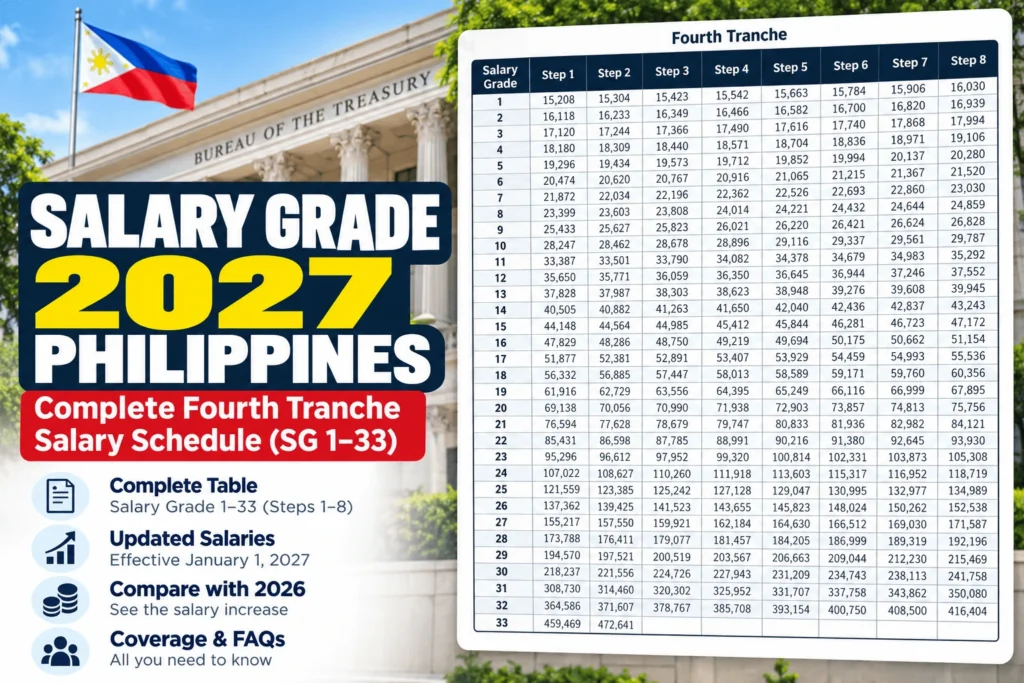
Complete Salary Grade 2027 Table (SG 1–33)
Quick reference: Monthly salary at Step 1 (2027)
Step 1 is the hiring rate, which is what a newly appointed employee starts at.
| Salary Grade | Monthly Salary 2027 (Step 1) |
|---|---|
| SG 1 | ₱15,208 |
| SG 2 | ₱16,118 |
| SG 3 | ₱17,120 |
| SG 4 | ₱18,180 |
| SG 5 | ₱19,296 |
| SG 6 | ₱20,474 |
| SG 7 | ₱21,872 |
| SG 8 | ₱23,399 |
| SG 9 | ₱25,433 |
| SG 10 | ₱28,247 |
| SG 11 | ₱33,387 |
| SG 12 | ₱35,650 |
| SG 13 | ₱37,828 |
| SG 14 | ₱40,505 |
| SG 15 | ₱44,148 |
| SG 16 | ₱47,829 |
| SG 17 | ₱51,877 |
| SG 18 | ₱56,332 |
| SG 19 | ₱61,916 |
| SG 20 | ₱69,138 |
| SG 21 | ₱76,594 |
| SG 22 | ₱85,431 |
| SG 23 | ₱95,296 |
| SG 24 | ₱107,022 |
| SG 25 | ₱121,559 |
| SG 26 | ₱137,362 |
| SG 27 | ₱155,217 |
| SG 28 | ₱173,788 |
| SG 29 | ₱194,570 |
| SG 30 | ₱218,237 |
| SG 31 | ₱308,730 |
| SG 32 | ₱364,586 |
| SG 33 | ₱459,469 |
Full Fourth Tranche table: Steps 1–8 (effective January 1, 2027)
| SG | Step 1 | Step 2 | Step 3 | Step 4 | Step 5 | Step 6 | Step 7 | Step 8 |
|---|---|---|---|---|---|---|---|---|
| 1 | ₱15,208 | ₱15,304 | ₱15,423 | ₱15,542 | ₱15,663 | ₱15,784 | ₱15,906 | ₱16,030 |
| 2 | ₱16,118 | ₱16,233 | ₱16,349 | ₱16,466 | ₱16,582 | ₱16,700 | ₱16,820 | ₱16,939 |
| 3 | ₱17,120 | ₱17,244 | ₱17,366 | ₱17,490 | ₱17,616 | ₱17,740 | ₱17,868 | ₱17,994 |
| 4 | ₱18,180 | ₱18,309 | ₱18,440 | ₱18,571 | ₱18,704 | ₱18,836 | ₱18,971 | ₱19,106 |
| 5 | ₱19,296 | ₱19,434 | ₱19,573 | ₱19,712 | ₱19,852 | ₱19,994 | ₱20,137 | ₱20,280 |
| 6 | ₱20,474 | ₱20,620 | ₱20,767 | ₱20,916 | ₱21,065 | ₱21,215 | ₱21,367 | ₱21,520 |
| 7 | ₱21,872 | ₱22,034 | ₱22,196 | ₱22,362 | ₱22,526 | ₱22,693 | ₱22,860 | ₱23,030 |
| 8 | ₱23,399 | ₱23,603 | ₱23,808 | ₱24,014 | ₱24,221 | ₱24,432 | ₱24,644 | ₱24,859 |
| 9 | ₱25,433 | ₱25,627 | ₱25,823 | ₱26,021 | ₱26,220 | ₱26,421 | ₱26,624 | ₱26,828 |
| 10 | ₱28,247 | ₱28,462 | ₱28,678 | ₱28,896 | ₱29,116 | ₱29,337 | ₱29,561 | ₱29,787 |
| 11 | ₱33,387 | ₱33,501 | ₱33,790 | ₱34,082 | ₱34,378 | ₱34,679 | ₱34,983 | ₱35,292 |
| 12 | ₱35,650 | ₱35,771 | ₱36,059 | ₱36,350 | ₱36,645 | ₱36,944 | ₱37,246 | ₱37,552 |
| 13 | ₱37,828 | ₱37,987 | ₱38,303 | ₱38,623 | ₱38,948 | ₱39,276 | ₱39,608 | ₱39,945 |
| 14 | ₱40,505 | ₱40,882 | ₱41,263 | ₱41,650 | ₱42,040 | ₱42,436 | ₱42,837 | ₱43,243 |
| 15 | ₱44,148 | ₱44,564 | ₱44,985 | ₱45,412 | ₱45,844 | ₱46,281 | ₱46,723 | ₱47,172 |
| 16 | ₱47,829 | ₱48,286 | ₱48,750 | ₱49,219 | ₱49,694 | ₱50,175 | ₱50,662 | ₱51,154 |
| 17 | ₱51,877 | ₱52,381 | ₱52,891 | ₱53,407 | ₱53,929 | ₱54,459 | ₱54,993 | ₱55,536 |
| 18 | ₱56,332 | ₱56,885 | ₱57,447 | ₱58,013 | ₱58,589 | ₱59,171 | ₱59,760 | ₱60,356 |
| 19 | ₱61,916 | ₱62,729 | ₱63,556 | ₱64,395 | ₱65,249 | ₱66,116 | ₱66,999 | ₱67,895 |
| 20 | ₱69,138 | ₱70,056 | ₱70,990 | ₱71,938 | ₱72,903 | ₱73,857 | ₱74,813 | ₱75,756 |
| 21 | ₱76,594 | ₱77,628 | ₱78,679 | ₱79,747 | ₱80,833 | ₱81,936 | ₱82,982 | ₱84,121 |
| 22 | ₱85,431 | ₱86,598 | ₱87,785 | ₱88,991 | ₱90,216 | ₱91,380 | ₱92,645 | ₱93,930 |
| 23 | ₱95,296 | ₱96,612 | ₱97,952 | ₱99,320 | ₱100,814 | ₱102,331 | ₱103,873 | ₱105,308 |
| 24 | ₱107,022 | ₱108,627 | ₱110,260 | ₱111,918 | ₱113,603 | ₱115,317 | ₱116,952 | ₱118,719 |
| 25 | ₱121,559 | ₱123,385 | ₱125,242 | ₱127,128 | ₱129,047 | ₱130,995 | ₱132,977 | ₱134,989 |
| 26 | ₱137,362 | ₱139,425 | ₱141,523 | ₱143,655 | ₱145,823 | ₱148,024 | ₱150,262 | ₱152,538 |
| 27 | ₱155,217 | ₱157,550 | ₱159,921 | ₱162,184 | ₱164,630 | ₱166,512 | ₱169,030 | ₱171,587 |
| 28 | ₱173,788 | ₱176,411 | ₱179,077 | ₱181,457 | ₱184,205 | ₱186,999 | ₱189,319 | ₱192,196 |
| 29 | ₱194,570 | ₱197,521 | ₱200,519 | ₱203,567 | ₱206,663 | ₱209,044 | ₱212,230 | ₱215,469 |
| 30 | ₱218,237 | ₱221,556 | ₱224,726 | ₱227,943 | ₱231,209 | ₱234,743 | ₱238,113 | ₱241,758 |
| 31 | ₱308,730 | ₱314,460 | ₱320,302 | ₱325,952 | ₱331,707 | ₱337,758 | ₱343,862 | ₱350,080 |
| 32 | ₱364,586 | ₱371,607 | ₱378,767 | ₱385,708 | ₱393,154 | ₱400,750 | ₱408,500 | ₱416,404 |
| 33 | ₱459,469 | ₱472,641 | — | — | — | — | — | — |
Source: Fourth Tranche Monthly Salary Schedule under Executive Order No. 64, s. 2024, effective January 1, 2027. Figures are monthly basic salary in Philippine pesos. Confirm your exact rate against the DBM implementing circular once it is released.
How to Read the Salary Grade 2027 Table
Every government position is assigned a Salary Grade, and every grade has up to eight steps. Your salary grade is set by the position, not by the person holding it. Your step reflects seniority within that grade. New appointees generally start at Step 1, and employees advance one step for every three years of continuous satisfactory service.
A few patterns in the 2027 table are worth knowing:
- Steps within a grade rise gradually. At SG 11, for example, the gap between Step 1 (₱33,387) and Step 8 (₱35,292) is ₱1,905 a month.
- The jump from SG 10 to SG 11 is large. Step 1 rises from ₱28,247 to ₱33,387, a difference of ₱5,140. This is where the table moves from clerical and support grades into professional grades.
- SG 30 to SG 31 is the biggest gap in the table. Step 1 goes from ₱218,237 to ₱308,730. The top three grades are reserved for a small number of senior positions, and SG 33 is a single position, the President of the Philippines.
- The figures are basic salary only. Allowances, benefits, and deductions such as GSIS, PhilHealth, Pag-IBIG, and withholding tax are separate. Your take-home pay will differ from the table.
How Steps Change Your Pay in 2027
Your salary grade decides which row of the table you read, but your step decides which column. Under the standard rule, a new appointee starts at Step 1 and moves up one step after every three years of continuous satisfactory service. Seven step increases separate Step 1 from Step 8, so reaching the top of a grade at the normal pace takes about 21 years.
How much you gain over that stretch depends on your grade:
| Salary Grade | Step 1 (2027) | Step 8 (2027) | Difference | Step 8 vs Step 1 |
|---|---|---|---|---|
| SG 1 | ₱15,208 | ₱16,030 | ₱822 | 5.4% higher |
| SG 11 | ₱33,387 | ₱35,292 | ₱1,905 | 5.7% higher |
| SG 15 | ₱44,148 | ₱47,172 | ₱3,024 | 6.8% higher |
| SG 24 | ₱107,022 | ₱118,719 | ₱11,697 | 10.9% higher |
| SG 28 | ₱173,788 | ₱192,196 | ₱18,408 | 10.6% higher |
Two lessons follow. First, step progression matters more in the higher grades: the gap between Step 1 and Step 8 is ₱822 at SG 1 but ₱11,697 at SG 24. Second, the percentage gap between Step 1 and Step 8 is generally larger in the upper grades, from about 5.4% at SG 1 to roughly 10–11% at SG 24 and SG 28. Employees in the middle and upper grades therefore see a bigger long-term payoff from step increments than employees in the lowest grades.
What is the Fourth Tranche Salary Increase?
The fourth tranche is the last scheduled installment of the salary increase authorized by Executive Order No. 64, s. 2024, signed by President Ferdinand R. Marcos Jr. Rather than raising salaries all at once, the order spreads the increase over four years. Each tranche takes effect on January 1 of its year: 2024 for the first, 2025 for the second, 2026 for the third, and 2027 for the fourth and last.
| Tranche | Effective date |
|---|---|
| First tranche | January 1, 2024 |
| Second tranche | January 1, 2025 |
| Third tranche | January 1, 2026 |
| Fourth (final) tranche | January 1, 2027 |
Two clarifications are useful for readers searching for “Salary Standardization Law 2027”:
- “SSL VI” is a label, not a new act of Congress. The salary schedule in question was set by an executive order. The previous round, the Salary Standardization Law of 2019 (RA 11466), covered the 2020–2023 tranches.
- Each tranche needs its own DBM circular. The Department of Budget and Management issues implementing guidelines for every tranche. For the third tranche, that was National Budget Circular No. 601. For 2027, the implementing circular is expected around January 2027, and pay is generally computed from the January 1 effectivity date.
Once the 2027 tranche takes effect, the EO 64 schedule is complete. Any pay movement after 2027 would need a new law or executive issuance.
How Much is the Salary Increase in 2027?
The increase differs by salary grade. Two patterns hold across the schedule:
- Higher grades receive larger peso increases. An SG 33 employee gains far more in pesos per month than an SG 1 employee.
- Percentage increases vary. Among the grades compared below, the percentage gain runs from about 2.3% at SG 33 to about 5.3% at SG 11.
The examples below compare Step 1 rates for 2026 and 2027. The 2026 rates come from the third-tranche schedule under NBC 601. Annual figures multiply the monthly difference by 12 and cover basic salary only.
Example 1: Administrative Aide I (SG 1)
- 2026: ₱14,634
- 2027: ₱15,208
- Increase: ₱574 per month (about 3.9%), or about ₱6,888 per year
- At Step 8, the monthly rate moves from ₱15,456 to ₱16,030.
Example 2: Teacher I (SG 11)
- 2026: ₱31,705
- 2027: ₱33,387
- Increase: ₱1,682 per month (about 5.3%), or about ₱20,184 per year
- At Step 8, the monthly rate moves from ₱33,611 to ₱35,292.
Example 3: Nurse I (SG 15)
- 2026: ₱42,178
- 2027: ₱44,148
- Increase: ₱1,970 per month (about 4.7%), or about ₱23,640 per year
- At Step 8, the monthly rate moves from ₱45,202 to ₱47,172.
Example 4: Director IV (SG 28)
- 2026: ₱167,129
- 2027: ₱173,788
- Increase: ₱6,659 per month (about 4.0%), or about ₱79,908 per year
- At Step 8, the monthly rate moves from ₱185,537 to ₱192,196.
These examples show why the raise feels different at different levels. An SG 1 employee gains a smaller peso amount than an SG 28 director, but the raise is a meaningful share of a much smaller salary, which is why entry-level and mid-level grades feel it more in day-to-day budgeting.
Is the 2027 Increase the Same at Every Step?
Almost. The fourth tranche adds nearly the same peso amount at every step within a grade. The table below compares the 2026 and 2027 schedules at Step 1, Step 2, and Step 8 for five grades:
| Salary Grade | Step 1 | Step 2 | Step 8 |
|---|---|---|---|
| SG 1 | +₱574 | +₱574 | +₱574 |
| SG 11 | +₱1,682 | +₱1,681 | +₱1,681 |
| SG 15 | +₱1,970 | +₱1,970 | +₱1,970 |
| SG 24 | +₱4,419 | +₱4,418 | +₱4,418 |
| SG 28 | +₱6,659 | +₱6,659 | +₱6,659 |
In practice, the answer to “how much will my salary go up?” depends mostly on your grade, not your step. Because the same peso amount is added to a larger base at higher steps, the percentage gain is slightly smaller at Step 8 than at Step 1. At SG 11, for example, the increase is about 5.3% at Step 1 and about 5.0% at Step 8.
To estimate your own raise, subtract your 2026 rate from the 2027 rate in the same row and column. The 2026 figures used here come from the third-tranche schedule published in our Salary Grade 2026 table, so verify them against NBC 601 if you need exact numbers for payroll purposes.
Salary Grade 2027 by Position
The ranges below show the 2027 monthly basic salary from Step 1 (hiring rate) to Step 8 (ceiling). Actual salary grades for a given position can vary by agency and the applicable classification, so always confirm against your appointment papers or plantilla.
Administrative Aide I — SG 1
₱15,208 to ₱16,030. Entry-level support positions handle basic operational and office support functions.
Administrative Assistant III — SG 9
₱25,433 to ₱26,828. Clerical and administrative positions at this level often perform coordination, records, and report-preparation work.
Teacher I — SG 11
₱33,387 to ₱35,292. Teacher I is the entry rung of the DepEd classroom teaching ladder.
Teacher III — SG 13
₱37,828 to ₱39,945. Teacher III sits two grades above Teacher I on the same ladder.
Master Teacher I — SG 18
₱56,332 to ₱60,356. Master Teacher I is the first rung of the master teacher track under the Expanded Career Progression (ECP) System, and it carries a much higher salary grade than the classroom teacher positions below it.
Nurse I — SG 15
₱44,148 to ₱47,172. Nurse I is a common entry-level professional position in public hospitals and health offices.
Nurse II — SG 16
₱47,829 to ₱51,154. Nurse II is one grade above Nurse I.
Engineer I — SG 12
₱35,650 to ₱37,552. Engineering positions in national agencies are among the most searched technical grades.
Accountant I — SG 12
₱35,650 to ₱37,552. Accountant I is one of the most popular professional entry positions among CPAs and accounting graduates.
Police Officer I and Fire Officer I
Police, fire, and other uniformed personnel are not paid according to this salary grade table. Police, military, and other uniformed personnel follow a separate base pay schedule. If you are looking for PNP or BFP pay, check the schedule issued for uniformed personnel rather than the civilian table above.
State University Instructor
Faculty positions in state universities and colleges are classified by academic rank, and each rank carries its own salary grade assignment. Check your institution’s plantilla or the approved faculty salary grade assignments to find the correct grade, then read the matching row in the table above.
Salary Grade 2027 by Career Stage: Atlas Salary Grade Career Ladder™
Grouping the 33 grades into career stages makes the schedule easier to plan around. The ranges below run from Step 1 of the lowest grade in each stage to Step 8 of the highest grade in that stage (SG 33 tops out at Step 2).
| Career Stage | Salary Grades | 2027 Monthly Range | Typical Roles |
|---|---|---|---|
| Entry-Level | SG 1–10 | ₱15,208 – ₱29,787 | Administrative Aide, clerical and support staff |
| Professional | SG 11–15 | ₱33,387 – ₱47,172 | Teacher, Nurse, Accountant |
| Senior Professional | SG 16–20 | ₱47,829 – ₱75,756 | Engineer II, supervisory roles |
| Management | SG 21–25 | ₱76,594 – ₱134,989 | Attorney III, Division Chief |
| Executive | SG 26–33 | ₱137,362 – ₱472,641 | Director and higher executive positions |
Two features of the ladder stand out. The professional stage starts at ₱33,387, which is higher than the ₱29,787 ceiling of the entry-level stage, which is why the move from SG 10 to SG 11 is one of the biggest jumps in the table. The executive stage is also by far the widest, running from ₱137,362 to ₱472,641, because it includes the top three grades, which are reserved for a small number of senior positions.
Use the ladder as a planning tool, not a promise. Your actual grade depends on the specific position, and agencies apply qualification standards before appointing anyone to a higher grade.
Who is Covered by the Salary Grade 2027 Increase?
The fourth tranche applies to civilian government personnel. The table’s own coverage note says the rates represent monthly remuneration for regular or contractual personnel, appointive or elective, working full time, with part-time pay proportionate to actual services rendered.
- National Government Agencies (NGAs): Executive departments, bureaus, and offices are covered. For national government employees the increase is automatic, with no application needed. Your agency’s HR and finance offices process it.
- State Universities and Colleges (SUCs): SUC personnel are covered under the same schedule.
- Local Government Units (LGUs): LGU employees are covered, but LGUs implement the increase on different timelines, under separate DBM issuances for local governments. Ask your LGU’s HR office when your local implementation starts.
- Constitutional Offices: The Executive, Legislative, and Judicial branches and the Constitutional Commissions are covered.
- Government-Owned and Controlled Corporations (GOCCs): GOCCs not covered by separate compensation laws are generally included, while GOCCs with their own compensation framework may follow different schedules.
Who is not covered: Job Order and Contract of Service workers are excluded, because they have no employer-employee relationship with the agency. Uniformed personnel follow a separate schedule, as noted above.
Salary Grade 2027 vs Salary Grade 2026
The table compares Step 1 rates for the most-searched grades.
| Salary Grade | 2026 (Step 1) | 2027 (Step 1) | Monthly Increase | % Increase |
|---|---|---|---|---|
| SG 1 | ₱14,634 | ₱15,208 | ₱574 | 3.92% |
| SG 11 | ₱31,705 | ₱33,387 | ₱1,682 | 5.31% |
| SG 15 | ₱42,178 | ₱44,148 | ₱1,970 | 4.67% |
| SG 18 | ₱53,818 | ₱56,332 | ₱2,514 | 4.67% |
| SG 24 | ₱102,603 | ₱107,022 | ₱4,419 | 4.31% |
| SG 28 | ₱167,129 | ₱173,788 | ₱6,659 | 3.98% |
| SG 33 | ₱449,157 | ₱459,469 | ₱10,312 | 2.30% |
The 2026 rates come from the third-tranche schedule under Executive Order No. 64, effective January 1, 2026. Three things stand out:
- SG 11 sees the largest percentage gain (5.31%) among the grades compared, which benefits entry-level teachers.
- SG 33 sees the smallest percentage gain (2.30%), even though its peso increase is the largest.
- Peso increases climb steadily with grade, from ₱574 at SG 1 to ₱10,312 at SG 33.
Monthly and Annual Basic Salary 2027
Job seekers often ask what a government salary looks like over a full year. The table below multiplies the Step 1 monthly rate by 12 for the most-searched grades:
| Salary Grade | Monthly Basic (Step 1) | Annual Basic (12 months) |
|---|---|---|
| SG 1 | ₱15,208 | ₱182,496 |
| SG 11 | ₱33,387 | ₱400,644 |
| SG 15 | ₱44,148 | ₱529,776 |
| SG 18 | ₱56,332 | ₱675,984 |
| SG 24 | ₱107,022 | ₱1,284,264 |
| SG 28 | ₱173,788 | ₱2,085,456 |
| SG 33 | ₱459,469 | ₱5,513,628 |
These are simple multiples of the monthly basic salary. They do not include allowances, bonuses, or other benefits, and they are not take-home pay, since GSIS, PhilHealth, Pag-IBIG, and withholding tax deductions apply. Treat the figures as a rough planning baseline, then check your agency’s payroll for the exact numbers.
Benefits of the Fourth Tranche Salary Increase
Improved compensation. Every grade from SG 1 to SG 33 gets a higher basic salary. Because basic salary is the base for many other computations, including GSIS contributions and certain benefits, a higher base can affect more than the monthly paycheck.
Employee retention. Government agencies compete with the private sector for skilled workers, especially in teaching, nursing, engineering, and accounting. A stronger salary schedule helps public service hold on to experienced staff.
Increased purchasing power. A higher nominal salary helps households keep up with the cost of living, although the real gain depends on how prices move over the year.
Public sector competitiveness. Completing the four-tranche schedule brings the salary structure to its intended level, which makes government positions easier to compare against private offers when graduates and job seekers weigh their options.
How to Find Your Salary Grade 2027 Rate
Follow these steps to find your exact monthly basic salary under the fourth tranche:
- Identify your salary grade. Check your appointment paper, your agency’s plantilla of positions, or your latest Notice of Salary Adjustment. Your salary grade is tied to the position, not to you personally.
- Identify your step. Your current step appears in the same documents or in a Notice of Step Increment from your HR office. New appointees generally start at Step 1.
- Read the row and column. Find your salary grade in the first column of the full table above, then read across to your step.
- Compare with 2026. Subtract your current rate from the 2027 figure to see your expected monthly increase.
- Confirm with your HR office. The DBM implementing circular and your agency’s payroll processing determine the exact figure and the release date.
If you are still applying for a position, find the salary grade in the job posting or the plantilla, then read the Step 1 column, since that is the usual starting rate for a new appointee.
Common Mistakes When Using the Salary Grade 2027 Table
Even a clear table can be misread. Watch out for these common errors:
- Treating Step 1 as everyone’s salary. Step 1 is the hiring rate. An employee with several years of service may already be at a higher step, so read the column that matches your current step.
- Mixing the 2026 and 2027 tables. The 2027 rates take effect on January 1, 2027. Until then, the third-tranche rates remain the ones in force, so do not use 2027 figures to compute your current pay.
- Assuming the table equals take-home pay. The table shows basic salary. Deductions reduce your net pay, and allowances or bonuses are separate.
- Confusing salary grade with job title. Two positions with similar names may sit in different grades depending on the agency and its classification. Always confirm the grade in your appointment papers.
- Assuming everyone is covered. Job Order and Contract of Service workers are excluded, and uniformed personnel follow a separate schedule.
- Expecting the same start date everywhere. National government agencies follow the January 1 effectivity, but LGUs implement on their own timelines under separate DBM issuances.
Avoiding these mistakes will save you from budgeting errors and unrealistic expectations, especially if you are comparing a government offer against a private-sector one.
Frequently Asked Questions
When will Salary Grade 2027 take effect?
The fourth tranche takes effect on January 1, 2027. Actual payment depends on your agency completing the salary adjustment, and the DBM implementing circular is expected around the start of the year. As with the third tranche, agencies that cannot process the change right away pay the unpaid portion later as a salary differential.
Is Salary Grade 2027 the final tranche?
Yes. The fourth tranche is the last scheduled installment under Executive Order No. 64, s. 2024. It completes the four-year schedule that began in 2024.
Who qualifies for the increase?
Civilian government personnel across the Executive, Legislative, and Judicial branches, Constitutional Commissions, SUCs, LGUs, and covered GOCCs qualify. Permanent, temporary, casual, and coterminous appointees are covered, and part-time personnel are paid in proportion to services rendered. Job Order and Contract of Service workers are excluded.
Do LGU employees receive the increase?
Yes, but LGUs follow their own implementation timelines under separate DBM issuances for local governments. Your LGU’s HR or budget office can tell you when your local schedule takes effect.
Will there be a Salary Grade 2028 increase?
Under the current schedule, no. Executive Order No. 64 ends with the 2027 tranche. Any further adjustment would need a new law or executive issuance, and none has been announced as of this update.
Is the increase automatic?
For national government employees, yes. You do not need to apply. Your agency’s HR and finance offices process the adjustment and typically issue a Notice of Salary Adjustment.
What law covers the Salary Grade 2027 increase?
Executive Order No. 64, s. 2024, commonly referred to as Salary Standardization Law VI. The DBM implements each tranche through its own budget circular.
How can I determine my salary grade?
Check your appointment paper, your agency’s plantilla of positions, or your latest Notice of Salary Adjustment. Your HR office can confirm the exact grade and step. Once you know your grade, find your row in the table above.
Final Thoughts
The Salary Grade 2027 Philippines schedule closes out the four-year salary increase under Executive Order No. 64. For most government employees, the practical takeaway is simple: find your salary grade and step, read across the 2027 row, and expect the new rate to apply from January 1, 2027.
Related Guides
- Salary Grade 2026 Table
- Salary Standardization Law (SSL) Guide
- RA 1080 Eligibility Guide
- Government Employee Benefits in the Philippines
- Government Jobs in the Philippines
References
- Executive Order No. 64, s. 2024 — Modifying the Salary Schedule for Civilian Government Personnel and Authorizing the Grant of Additional Benefits.
- Civil Service Commission (CSC) — Position classification and qualification standards.
Last updated: September 24, 2026.