Quick Answer
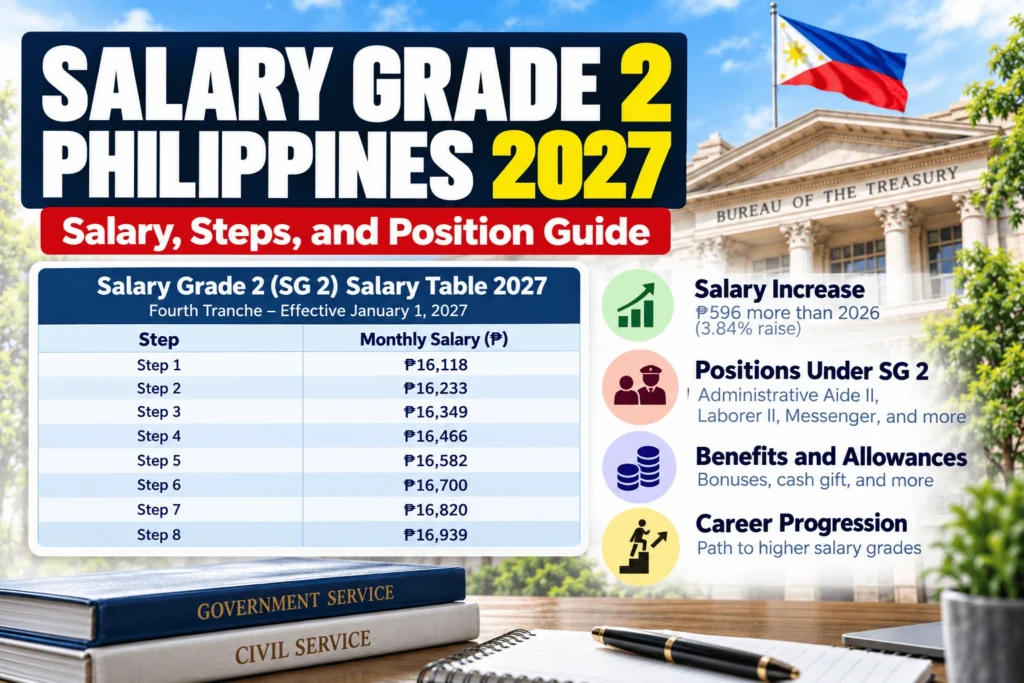
Salary Grade 2 (SG 2) pays ₱16,118 a month at Step 1 and ₱16,939 at Step 8 starting January 1, 2027, the fourth and last tranche under Executive Order No. 64, s. 2024. That is ₱596 more than the 2026 rate at Step 1. Job ads often call SG 2 positions Laborer II or Messenger, while the official DBM class is commonly Administrative Aide II.
Open a list of government vacancies and you may find a Laborer II opening at one agency and an Administrative Aide II opening at another. Both can sit at Salary Grade 2. That naming quirk is one reason SG 2 confuses applicants, so this guide clears it up alongside the money side: the 2027 pay table, the raise from 2026, and what each step and each promotion is really worth.
You will also find a side-by-side comparison of SG 1, SG 2, and SG 3, a promotion calculation, a yearly pay estimate that includes bonuses, and a checklist to run through before you accept an offer. For the complete schedule of grades 1 to 33, see the Salary Grade 2027 Philippines guide.
Key Takeaways
- Salary Grade 2 starts at ₱16,118 monthly in 2027 and tops out at ₱16,939 (Step 8).
- The fourth tranche adds about ₱596 per month at Step 1, a 3.84% raise.
- Laborer II, Messenger, and Administrative Aide II can all describe SG 2 work.
- One promotion to SG 3 adds more (₱1,002) than all seven SG 2 step increments combined (₱821).
- Basic salary plus bonuses and the cash gift comes to roughly ₱230,652 to ₱242,146 a year at SG 2.
What is Salary Grade 2?
Salary Grade 2 is the second-lowest rung on the 33-grade ladder that prices civilian government jobs. A grade reflects how demanding a position is, how much responsibility it carries, and what qualifications it needs. At SG 2, the work is basic and hands-on: semi-skilled manual tasks, maintenance support, and carrying documents and mail between offices. Compared with the most basic SG 1 work, these jobs usually come with a little more accountability for the materials or papers you handle.
Two agencies split the rulemaking. The Civil Service Commission (CSC) defines who qualifies for a position, and the Department of Budget and Management (DBM) defines what the position pays. The pay levels for 2027 come from Executive Order No. 64, s. 2024, commonly called Salary Standardization Law VI (SSL VI), which delivers one salary increase in four yearly tranches from 2024 to 2027. This guide covers the fourth.
Salary Grade 2 Salary Table 2027
Monthly basic salary for SG 2, effective January 1, 2027, in Philippine pesos. The figures exclude bonuses, allowances, and deductions.
| Step | Monthly Salary (2027) |
|---|---|
| Step 1 | ₱16,118 |
| Step 2 | ₱16,233 |
| Step 3 | ₱16,349 |
| Step 4 | ₱16,466 |
| Step 5 | ₱16,582 |
| Step 6 | ₱16,700 |
| Step 7 | ₱16,820 |
| Step 8 | ₱16,939 |
Step 8 is ₱821 above Step 1, so the entire pay range of the grade spans about 5%. Individual step-to-step moves are small, between ₱115 and ₱120.
Source: Fourth Tranche Monthly Salary Schedule under Executive Order No. 64, s. 2024, effective January 1, 2027. Confirm your exact rate against the DBM implementing circular once it is released.
How Much is the Salary Grade 2 Increase in 2027?
At Step 1, SG 2 rises from ₱15,522 in 2026 to ₱16,118 in 2027, a gain of ₱596 per month (3.84%). Over a year, that is ₱7,152 more in basic salary. The mid-year and year-end bonuses each equal one month of basic salary, so each grows by ₱596 too, which brings the total yearly gain at Step 1 to about ₱8,344 if the current bonus rules carry into 2027.
The raise is nearly flat across the grade. The table shows every step:
| Step | 2026 | 2027 | Monthly Increase | % Increase |
|---|---|---|---|---|
| Step 1 | ₱15,522 | ₱16,118 | ₱596 | 3.84% |
| Step 2 | ₱15,636 | ₱16,233 | ₱597 | 3.82% |
| Step 3 | ₱15,752 | ₱16,349 | ₱597 | 3.79% |
| Step 4 | ₱15,869 | ₱16,466 | ₱597 | 3.76% |
| Step 5 | ₱15,986 | ₱16,582 | ₱596 | 3.73% |
| Step 6 | ₱16,103 | ₱16,700 | ₱597 | 3.71% |
| Step 7 | ₱16,223 | ₱16,820 | ₱597 | 3.68% |
| Step 8 | ₱16,342 | ₱16,939 | ₱597 | 3.65% |
Because the same peso amount lands on a larger base at higher steps, the percentage slips from 3.84% to 3.65%. In practice, a ten-year veteran at Step 4 and a new hire at Step 1 both receive about ₱600 more each month.
When will you see it? The tranche takes effect on January 1, 2027, but the DBM issues a budget circular for each tranche, and the 2027 circular is expected around the start of the year. Agencies that cannot process the new rates in time typically release the missed amount later as a salary differential. The 2026 rates above come from the third-tranche schedule under National Budget Circular No. 601, so check them against the official tables before using them for payroll.
Laborer II, Messenger, or Administrative Aide II?
Vacancy ads use working titles. Official records use the DBM class title. In the DBM’s occupational index, many positions in the lowest grades fall into one umbrella called the Administrative Aide series, numbered with Roman numerals, and the SG 2 class is commonly Administrative Aide II. Agencies can attach a descriptive working title to that class, such as Laborer II or Messenger, as long as the grade and qualification standard stay the same.
Here is how the two best-known SG 2 working titles compare:
| Laborer II | Messenger | |
|---|---|---|
| Typical work | Semi-skilled manual tasks such as maintenance support and materials handling | Delivering documents, mail, and communications inside and between offices |
| Where you work | Usually within one facility | Often moves between offices or branches |
| Physical or travel demands | Physical tasks | Some travel; a few agencies prefer a driver’s license or motorcycle skills |
| Official class | Often Administrative Aide II | Often Administrative Aide II |
A few practical consequences follow from this naming system:
- Search under all three titles. If “Laborer II” finds nothing at your target agency, try “Messenger” and “Administrative Aide II.” The same opening can be listed under any of them.
- Expect the formal title on paper. Your Notice of Appointment and payroll records may say Administrative Aide II even when the ad said Laborer II. That is normal and does not mean a lower classification.
- Do not trust the Roman numeral in a working title. The number in a working title does not always match the grade number, so read the salary grade printed in the posting or the plantilla item.
- A driver’s license is a local preference, not a national rule. It is not a universal CSC requirement at this grade. Read each announcement.
Who Can Apply for an SG 2 Position?
The entry bar is low. The usual standards for SG 2 are:
- Education: elementary graduate, or the ability to read and write, depending on the plantilla item
- Training: none required
- Experience: none required
- Eligibility: First Level Eligibility (CSC) or as the position requires; some items are filled through exempt or casual appointments
Agencies describe positions slightly differently, so two SG 2 openings can carry slightly different requirements. Always follow the vacancy announcement, and prepare the standard application documents, including the Personal Data Sheet (CS Form No. 212). Our guide on how to apply for government jobs walks through the process.
How Step Increments Work at SG 2
Each grade has eight steps. Under the standard rule, you move up one step after three years of continuous satisfactory service. It is not a calendar-year raise: it depends on your service record and a satisfactory or better performance rating, and your agency’s HR office processes it.
If you start at Step 1 and advance at the standard pace, your pay ladder looks like this:
| Step | Years in Service (Standard Pace) | Monthly Salary | Extra vs. Step 1 |
|---|---|---|---|
| Step 1 | 0 | ₱16,118 | — |
| Step 2 | 3 | ₱16,233 | ₱115 |
| Step 3 | 6 | ₱16,349 | ₱231 |
| Step 4 | 9 | ₱16,466 | ₱348 |
| Step 5 | 12 | ₱16,582 | ₱464 |
| Step 6 | 15 | ₱16,700 | ₱582 |
| Step 7 | 18 | ₱16,820 | ₱702 |
| Step 8 | 21 | ₱16,939 | ₱821 |
Two lessons come out of the table. First, patience pays slowly: nine years of service adds only ₱348 a month. Second, the ceiling is real. After about 21 years, you reach Step 8, and within SG 2 the salary stops rising. A performance rating below satisfactory can postpone an increment until your rating recovers.
SG 1 vs SG 2 vs SG 3: A Three-Grade Comparison
Comparing neighboring grades step by step shows how much a grade change is worth at each point in a career. All figures are 2027 monthly basic salary.
| Step | SG 1 | SG 2 | SG 3 | SG 2 minus SG 1 | SG 3 minus SG 2 |
|---|---|---|---|---|---|
| Step 1 | ₱15,208 | ₱16,118 | ₱17,120 | ₱910 | ₱1,002 |
| Step 2 | ₱15,304 | ₱16,233 | ₱17,244 | ₱929 | ₱1,011 |
| Step 3 | ₱15,423 | ₱16,349 | ₱17,366 | ₱926 | ₱1,017 |
| Step 4 | ₱15,542 | ₱16,466 | ₱17,490 | ₱924 | ₱1,024 |
| Step 5 | ₱15,663 | ₱16,582 | ₱17,616 | ₱919 | ₱1,034 |
| Step 6 | ₱15,784 | ₱16,700 | ₱17,740 | ₱916 | ₱1,040 |
| Step 7 | ₱15,906 | ₱16,820 | ₱17,868 | ₱914 | ₱1,048 |
| Step 8 | ₱16,030 | ₱16,939 | ₱17,994 | ₱909 | ₱1,055 |
What the table shows:
- The pay ranges are stacked, not overlapping. The top of SG 1 (₱16,030) sits ₱88 below the bottom of SG 2 (₱16,118). The top of SG 2 (₱16,939) sits ₱181 below the bottom of SG 3 (₱17,120). Longer service inside a grade never lifts you past the next grade’s starting rate.
- The SG 1 to SG 2 gap is steady. It hovers between ₱909 and ₱929 at every step.
- The SG 2 to SG 3 gap widens. It grows from ₱1,002 at Step 1 to ₱1,055 at Step 8, so each grade step-up is worth slightly more than the last.
Promotion Math: Why a Higher Grade Beats Waiting for Step 8
Suppose you spend 21 years at SG 2 and collect every step increment. Your monthly pay rises by ₱821, from ₱16,118 to ₱16,939. A single promotion from SG 2 to SG 3, measured Step 1 to Step 1, adds ₱1,002 a month. That is more than the whole step ladder in one move, and it is worth roughly eight and a half increments, or about 25 years of waiting at the standard pace.
The gains keep stacking as you climb:
| Target Grade | Step 1 (2027) | Monthly Gain Over SG 2 Step 1 | % Above SG 2 |
|---|---|---|---|
| SG 3 | ₱17,120 | ₱1,002 | 6.2% |
| SG 4 | ₱18,180 | ₱2,062 | 12.8% |
| SG 5 | ₱19,296 | ₱3,178 | 19.7% |
| SG 9 | ₱25,433 | ₱9,315 | 57.8% |
Actual placement after a promotion follows CSC and DBM rules, so treat these as Step 1 to Step 1 comparisons. Salary grade belongs to the position, not to you, so there are only three ways to move up:
- Promotion to a higher-graded position in your own office, subject to a vacancy and the agency’s merit selection process. In the Administrative Aide series, this is the most common route, since many agencies like to promote from within.
- Lateral transfer to a higher-graded position in another office, if you qualify.
- Reclassification of your position. If duties have grown, an agency can justify an upgrade to the DBM, and the incumbent usually keeps the item without reapplying. It applies to the position, not to you personally.
A realistic ladder in the administrative support track runs from Administrative Aide II (SG 2) to Administrative Aide III (SG 3), then to higher aide levels and clerical positions such as Clerk I, commonly cited at SG 4, and eventually to Administrative Assistant roles, for example Administrative Assistant III at SG 9. Each level asks for more schooling, training, experience, or a higher level of civil service eligibility, so start preparing early.
What SG 2 Employees Take Home in a Year
Basic salary is only part of the annual picture. A regular plantilla employee also receives a mid-year bonus (one month of basic salary as of May 15), a year-end bonus (one month of basic salary as of October 31), and a ₱5,000 cash gift released with the first November payroll. Each bonus requires at least four months of service, and the mid-year bonus is all-or-nothing for full-time personnel. Assuming the current rules continue into 2027 and you stay at the same step all year:
| Step | Basic Salary (12 months) | Bonuses and Cash Gift | Yearly Total Before Deductions |
|---|---|---|---|
| Step 1 | ₱193,416 | ₱37,236 | ₱230,652 |
| Step 4 | ₱197,592 | ₱37,932 | ₱235,524 |
| Step 8 | ₱203,268 | ₱38,878 | ₱242,146 |
The bonus totals stay well below the ₱90,000 combined tax-exempt ceiling for bonuses and similar benefits, so they are generally not taxed. The yearly totals are before GSIS, PhilHealth, and Pag-IBIG contributions and any tax on other income, and allowances such as PERA and leave credits are extra where they apply. Casual and contractual personnel may not get the same package, because coverage depends on appointment status. For the full explanation, read our guides on government employee benefits and the mid-year bonus.
Where SG 2 Sits in the Bigger Picture
Zoom out and SG 2 looks even more clearly like a starting point. Grades 1 to 10 form the entry-level band of the schedule, running from ₱15,208 (SG 1, Step 1) to ₱29,787 (SG 10, Step 8) in 2027. SG 2 occupies the bottom slice of that band. The band’s upper end, SG 10 at Step 1 (₱28,247), pays ₱12,129 more than SG 2 at Step 1, a difference of about 75%.
The professional grades begin at SG 11, where Step 1 is ₱33,387, the starting rate for a Teacher I. An SG 2 employee at Step 1 earns about 48% of that figure. The lesson is not that SG 2 work is unimportant. It is that the schedule rewards additional qualifications heavily, and each degree, training, or eligibility that lets you qualify for a higher-graded position shows up directly in your monthly pay.
Where SG 2 Positions Are Found
The fourth tranche covers civilian government personnel in national agencies, state universities and colleges, local government units, constitutional offices, and government-owned and controlled corporations that follow the national schedule. National agencies process the raise automatically. LGUs implement it on their own timeline under separate DBM issuances and local budget capacity, so ask your local HR office when the 2027 rates begin. Some smaller LGUs with tight personnel budgets fill fewer SG 2 items, which can make openings less frequent there.
Job Order and Contract of Service workers are outside the plantilla and have no salary grade. Uniformed personnel follow a separate base pay schedule.
Common Misreadings of SG 2 Information
- Reading an SG 1 row for an SG 2 job. The two grades look alike, but SG 2 pays ₱909 to ₱929 more at every step.
- Using the 2026 table after January 1, 2027. The old rates stop applying on that date, and the ₱596 difference at Step 1 adds up over a year.
- Assuming a Laborer II ad always means SG 2. Working titles do not always match the grade number, so confirm the salary grade stated in the posting.
- Treating the yearly total as take-home pay. Contributions and taxes come out first, and casual or contractual appointments may not receive the full bonus package.
- Waiting on steps instead of planning a move. Seven increments add ₱821, while a single promotion to SG 3 adds ₱1,002.
Checklist: Before You Accept an SG 2 Offer
- Read the grade and step in your Notice of Appointment. It should state both, plus the effectivity date.
- Match the working title to the official class. Confirm whether the plantilla item is Administrative Aide II, even if the ad said Laborer II or Messenger.
- Ask about your appointment status. Permanent, casual, and contractual appointments come with different benefit coverage.
- For an LGU post, ask about the 2027 rates. Find out whether the national schedule is adopted and from what date.
- For a Messenger post, ask about travel. Confirm whether a driver’s license or motorcycle skills are expected.
- Ask how promotion works in the office. Find out how often SG 3 and higher aide items open and how the merit selection process runs.
- Confirm how delayed rates are handled. Ask whether any unpaid amount is released as a salary differential.
Frequently Asked Questions
How much is Salary Grade 2 in 2027?
Salary Grade 2 pays ₱16,118 at Step 1 and ₱16,939 at Step 8 per month, effective January 1, 2027, under the fourth tranche of Executive Order No. 64.
Is Laborer II the same as Administrative Aide II?
Often, yes. Many SG 2 items are formally classified as Administrative Aide II, and agencies use working titles like Laborer II or Messenger for the same class and grade. Check the salary grade in the posting, not the title.
Do Messenger positions require a driver’s license?
Not as a national CSC requirement. Some agencies list a license or motorcycle skills as preferred because Messengers may travel between offices, so read each vacancy announcement.
How much more does SG 2 pay than SG 1?
At Step 1 in 2027, SG 2 pays ₱910 more per month than SG 1 (₱16,118 versus ₱15,208). The gap stays between ₱909 and ₱929 at every step.
How much does SG 3 pay compared with SG 2?
SG 3 pays ₱1,002 more at Step 1 (₱17,120) and ₱1,055 more at Step 8 (₱17,994).
How long does it take to reach Step 8 at SG 2?
About 21 years at the standard pace of one step every three years of satisfactory service, since seven increments separate Step 8 from Step 1.
Is a promotion or a step increment worth more?
A promotion. Moving from SG 2 to SG 3 adds ₱1,002 a month at Step 1, more than the ₱821 gained by climbing all seven SG 2 steps.
Can an SG 2 position be upgraded without a new appointment?
Yes, through reclassification. If an agency can justify that the duties of an SG 2 item have grown, it can ask the DBM to reclassify it, and the current holder usually keeps the position.
Are SG 2 bonuses taxable?
The mid-year bonus, year-end bonus, and cash gift together come to about ₱37,236 to ₱38,878, which is below the ₱90,000 combined ceiling, so they are generally not taxable.
Will SG 2 pay rise again after 2027?
The 2027 tranche is the last one scheduled under Executive Order No. 64. Any further adjustment would need a new law or executive issuance, and none has been announced as of this update.
Final Thoughts
Salary Grade 2 pays ₱16,118 to ₱16,939 a month in 2027, and its story is less about the peso amount than about how the grade works. The title on the ad may not be the title on your papers, steps move slowly, and one promotion outweighs two decades of increments. If you are starting at SG 2, treat the first years as a launch pad: learn the plantilla, build qualifications, and watch for the next Administrative Aide vacancy.
Related Guides
- Salary Grade 2027 Philippines: Complete Fourth Tranche Salary Schedule (SG 1–33)
- Salary Grade 1 Philippines 2027: Salary, Steps, and Position Guide
- Government Employee Benefits in the Philippines
- Mid-Year Bonus for Government Employees
- Government Jobs in the Philippines
References
- Executive Order No. 64, s. 2024, Modifying the Salary Schedule for Civilian Government Personnel and Authorizing the Grant of Additional Benefits.
- Civil Service Commission (CSC), Position qualification standards and civil service eligibility policies.
Disclaimer
This guide is for informational purposes only and is based on official government issuances available at the time of writing. Salary schedules, qualification standards, benefits, and implementing rules may change through later laws, executive orders, or DBM and CSC circulars. Always consult the latest official publications of the DBM, the CSC, and the Official Gazette for authoritative information.
Last updated: September 24, 2026.