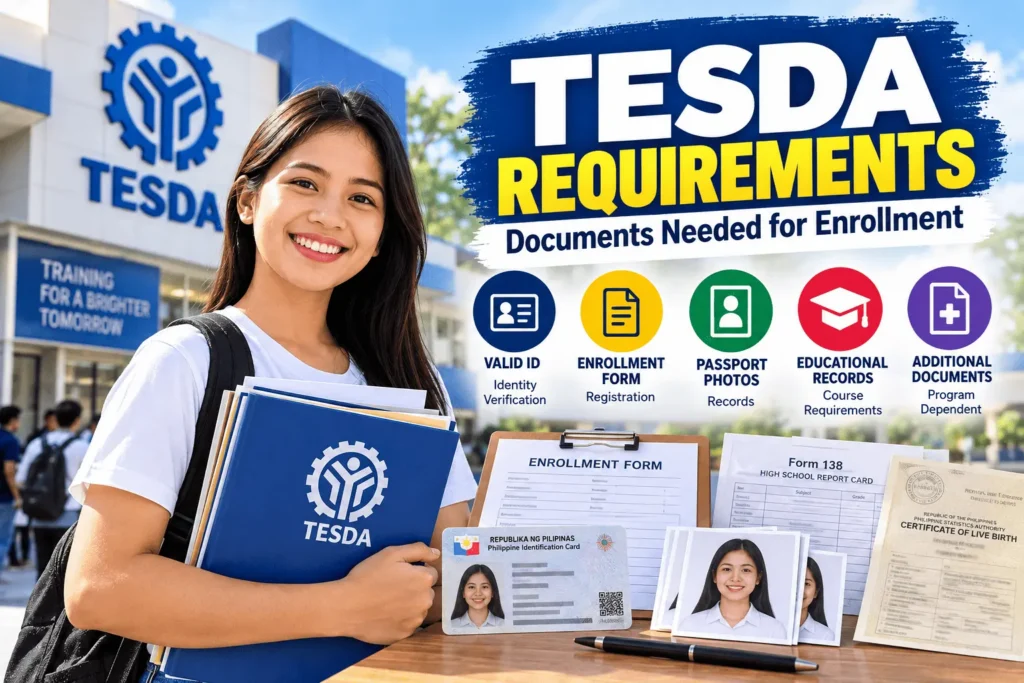
Quick answer: TESDA enrollment requirements vary depending on the training program and institution, but applicants are generally asked to submit a valid identification card, passport-sized photos, educational records when required, and completed enrollment forms. Some programs may require additional documents such as birth certificates, medical clearances, or proof of eligibility. Applicants should verify specific requirements with their chosen TESDA-accredited training provider.
Few things slow down a TESDA application more than showing up with the wrong papers. One center asks for a PSA birth certificate, another only wants a photocopy of your ID, and a scholarship office wants proof of income on top of everything else. If you are not sure what to bring, you can easily make two trips, or miss a slot altogether.
This guide explains what documents TESDA training providers commonly ask for, who can enroll, which IDs are usually accepted, how to prepare your photos, what educational records you may need, which courses have extra requirements, what changes for scholarships and online courses, and how to avoid the mistakes that delay applications. It also covers the separate requirements for the competency assessment and National Certificate, which many people mix up with enrollment.
Quick Answer Box
What is the most important TESDA requirement?
A valid ID and completed enrollment form are among the most commonly required documents, although specific requirements may vary by course and training institution.
Quick Facts About TESDA Enrollment Requirements
| Item | Details |
|---|---|
| Minimum Age | Depends on Program |
| Valid ID Required | Usually Yes |
| Photos Required | Commonly Required |
| Enrollment Form | Required |
| Additional Documents | Program Dependent |
Before you start: TESDA does not publish a single enrollment checklist that applies to every course and every training center. The requirements below reflect what is commonly asked for. Always confirm your exact list with your chosen training provider, and check the TESDA Training Regulations for your qualification’s entry requirements.
What Are the TESDA Requirements for Enrollment?
TESDA, the Technical Education and Skills Development Authority, oversees technical-vocational education and training in the Philippines. The actual enrollment is handled by training institutions: TESDA-operated technology institutes, public training centers, and private institutions with programs registered with TESDA. Each institution collects the documents it needs, guided by TESDA’s rules and the qualification’s Training Regulations.
General enrollment process
In most cases, enrolling follows the same basic path. You choose a qualification, find a training provider with a registered program, get their requirements checklist, submit your documents and enrollment form, and complete any screening or orientation they require. Some centers accept applications online, while others require you to submit in person.
Why documents are required
Training providers collect documents for several practical reasons:
- To confirm who you are and that the information on your application is accurate.
- To check that you meet the entry requirements of the qualification, such as age or education.
- To create your learner record, which is later used for assessment and certification.
- To determine whether you qualify for scholarships or other assistance.
Verification and qualification purposes
Documents also protect the system. Training regulations set minimum requirements for many qualifications, and providers need proof that you meet them. Later, when you apply for a National Certificate, your records and identity need to be consistent across your enrollment and assessment documents.
Quick answer box: Most TESDA programs require applicants to submit identification documents, enrollment forms, photographs, and other supporting documents depending on the training course and provider.
Who Can Enroll in TESDA Programs?
TESDA training is meant to be accessible. A wide range of people can enroll, as long as they meet the conditions of the specific course.
Eligible applicants include:
- Students: Senior high school students and college students who want practical skills alongside their studies. Some centers offer weekend or short-term batches.
- Graduates: High school and college graduates who want a skill they can use right away.
- Out-of-school youth: Young people who left school and want a path to work.
- Job seekers: Unemployed or underemployed adults looking to qualify for available jobs.
- Employed workers: People who want to upskill, get certified for the work they already do, or prepare for a promotion.
- Career shifters: Adults moving from one field to another.
- Returning OFWs: Workers who came home and want to retrain or start a livelihood.
Conditions that commonly apply:
- Age. The minimum age depends on the program. As an example, TESDA’s scholarship programs set different minimum ages: TWSP applicants must be at least 18 by the end of training, while PESFA and STEP applicants must be at least 15 at the start. Some technical courses have their own age rules for safety reasons.
- Education. Requirements depend on the qualification’s Training Regulations. Some accept applicants with limited schooling, while others need a high school or senior high school completion.
- Physical and health conditions. Certain courses, such as those with physical demands or direct patient contact, may require a medical certificate.
Important note: Eligibility requirements may vary depending on the specific TESDA course.
Common TESDA Requirements
The exact list differs by provider, but most applicants are asked for the following.
| Requirement | Purpose |
|---|---|
| Valid ID | Identity Verification |
| Enrollment Form | Registration |
| Passport Photos | Records |
| Educational Records | Qualification Verification |
| Birth Certificate | Personal Information Verification |
Valid ID
A government-issued or otherwise accepted ID confirms your identity. Bring the original and a clear photocopy. The next section explains the IDs that are usually accepted.
Enrollment form
This is the registration form provided by the training center or TESDA office. It collects your personal details, contact information, chosen qualification, and educational background. Fill it out completely and legibly, and make sure the information matches your other documents.
Passport photos
Providers use ID photos for your learner record, student ID, and later for assessment applications. Prepare several copies. The photo section below explains typical rules.
Educational records
If the qualification has an educational requirement, you may need to show a diploma, report card, Form 137, or another proof of schooling. Requirements vary, so ask whether a copy is enough or the original is needed for verification.
Birth certificate
Many providers ask for a PSA-issued birth certificate to verify your name, birthdate, and citizenship details. Others accept a photocopy or another proof of age. TESDA’s own assessment guidelines also allow a certified photocopy of a passport or birth certificate when correcting an erroneous entry on a certificate, which shows how important consistent civil records are.
Other documents you may be asked for
Depending on the provider and program, you may also need a barangay certificate or proof of residency, a medical certificate, proof of income for income-based programs, a certificate of employment if you are employed, or a recommendation or interview. Ask early so you can prepare in time.
Valid IDs Accepted for TESDA Enrollment
Training providers typically accept government-issued IDs, and some accept school IDs. Common examples include:
- National ID (Philippine Identification System)
- Driver’s License
- Passport
- UMID
- Voter’s ID (if accepted by the provider)
- School ID
Other government-issued IDs, such as a postal ID or a professional ID, may also be accepted depending on the provider.
Reminder: Training institutions may have different ID requirements. Ask which IDs the center accepts before you go, especially if you do not have a government-issued ID.
Tips for using IDs
- Check the expiration date. An expired ID is one of the most common reasons an application gets stopped.
- Use the same name across documents. If your ID shows a different spelling or a married name, bring a supporting document, such as a marriage certificate.
- Bring the original and a clear photocopy. Some offices keep the copy and only verify the original.
- Make sure the photo and details are readable. A blurry photocopy may be rejected.
- If you have no ID yet, ask the center what alternatives they accept, and start applying for a national ID or another valid ID early, since processing can take time.
Passport-Sized Photo Requirements
Photos are simple, but they cause many small delays because of wrong size, wrong background, or old images.
Typical photo requirements
Most training centers ask for a few colored, passport-sized photos. Some ask for additional sizes, such as a 1×1 photo for school records. The number of copies also varies, so ask the center how many they want.
Background recommendations
A plain white background is the safest choice. This is also the standard TESDA uses for its own assessment applications. TESDA’s official assessment application steps call for three colored, passport-size pictures with a white background, wearing a collared shirt, and with your name printed at the back. Even if your training center does not require the same format, following it means you can reuse the photos for assessment.
Recent photo requirements
Photos should be recent, so the person in the photo matches how you look today. Old photos or photos taken years ago can be rejected.
Photo checklist
- ✓ Recent photo: taken within the last few months
- ✓ Clear image: sharp, well lit, not blurry or pixelated
- ✓ Proper attire: a collared shirt or similar neat clothing, with no sunglasses or hats
- ✓ Correct size: passport size unless the provider asks otherwise
- ✓ Plain white background
- ✓ Name printed at the back in case the center or assessment office asks for it
Photo tips
- Get 6 to 10 copies in one printing session. You will use them for enrollment, your student ID, and later for assessment.
- Keep a digital copy in case the provider accepts online submissions.
- Avoid filters, heavy editing, or self-printed photos on plain paper.
Educational Requirements for TESDA Courses
Educational requirements depend on the qualification. The rules are set in each qualification’s Training Regulations, which describe the entry requirements, training hours, and competencies. Some courses accept applicants without a diploma, and others expect a certain level of schooling.
What some courses may require
- High school completion
- Junior high school completion
- Senior high school completion
- Course-specific educational qualifications, such as specific subjects or prior training
Table
| Course Type | Possible Requirement |
|---|---|
| Basic Courses | Minimal Educational Requirement |
| Technical Courses | Course-Specific Requirements |
| Advanced Programs | Additional Qualifications |
How to check the requirement for your course
- Look up your qualification in TESDA’s list of Training Regulations.
- Read the section on entry requirements.
- Ask your training provider whether they apply any additional conditions.
- If you do not meet the requirement, ask about alternative pathways, such as a lower NC level in the same field, or a different qualification.
If you do not have your diploma
If you cannot find your diploma or report card, ask the school for a certified true copy or a certification of completion. If you finished school long ago and cannot get records, ask the training center what they accept. Some centers may accept alternative documents or an assessment of your background.
Additional Requirements for Certain TESDA Courses
Some courses carry extra requirements, usually for safety, health, or regulatory reasons.
Healthcare programs
Programs such as Caregiving and Health Care Services may require:
- A medical certificate
- Health clearance showing you are fit to work with patients or vulnerable people
Some centers may also ask for vaccination records or other health documents, depending on where you will do your practical training.
Maritime programs
Maritime-related training may require:
- A medical examination
- Additional certifications, depending on the qualification and the regulations that apply to seafarers
Maritime training is governed by additional regulations beyond TESDA, so confirm the requirements with the training provider and the relevant maritime authorities.
Driving courses
Driving-related courses may require:
- Age requirements, since driving rules restrict who can drive
- Identification documents
- A valid or student driver’s permit, depending on the course and provider
Ask the training center whether you should bring a driver’s license or permit, or whether they process it for you.
Other courses
Courses that involve physical work or equipment, such as construction, electrical, welding, and automotive, may ask for a medical certificate or a signed agreement on safety rules. Food-related courses may ask for basic health documents. Requirements differ by center.
TESDA Scholarship Requirements
If you are applying for a scholarship, expect more than a regular enrollment.
Additional forms
Scholarship applications usually have their own forms, such as a scholarship application or profiling form. If you apply through TESDA’s online application, you first register to receive a Learner’s ID, then select your qualification, verify your profile, and wait for feedback from the TESDA office by email.
Income-related documents
Some programs consider household income. For example, PESFA applicants must come from households with an annual income that does not exceed a set limit, so proof of income or a certification may be requested. Other programs prioritize applicants based on prior training or the poverty level of their area.
Eligibility verification
TESDA also verifies eligibility conditions such as age, citizenship, and educational background. Some programs, such as those under the UAQTEA, have additional conditions, including profiling requirements and limits on prior scholarships or certificates.
Read next: For a full breakdown of programs, eligibility, and how to apply, see our TESDA Scholarships Guide.
Requirements for TESDA Online Programs
The TESDA Online Program (TOP) is different from center-based training because you do not need to submit paper documents.
What you typically need
- An email address you can access, since you must confirm your account through an activation email
- An online registration account on the TOP platform
- Internet access and a device, such as a computer, tablet, or smartphone
Things to keep in mind
- Use your real name and details, since they may appear on any certificate you receive.
- Check your spam folder if you do not see the activation email.
- Some courses may require an enrollment key or other conditions, so read the course page.
- A certificate of completion from an online course is not the same as a National Certificate, which requires competency assessment.
Read next: Learn how to register and choose a course in our guide to Free TESDA Online Courses with Certificates.
Comparison: Requirements by Program Type
| Program Type | Typical Requirements |
|---|---|
| Online Courses | Account Registration |
| Scholarship Programs | Additional Eligibility Documents |
| Technical Courses | Course-Specific Requirements |
What this means for you
- Online courses are the lightest. You mainly need an email address, an account, and internet access.
- Scholarship programs need the usual enrollment documents plus proof that you meet the program’s conditions, such as income, age, or educational background.
- Technical courses depend on the qualification. Check the Training Regulations and ask the provider about safety, medical, or age-related requirements.
Requirements for TESDA Assessment and National Certificates
Enrollment and assessment are two separate steps, and each has its own requirements. Many people finish training and then discover they need additional documents to take the assessment.
TESDA publishes the steps for applying for assessment and certification on its website. According to that official page, a new applicant should follow this process:
- Apply at an accredited assessment center or TESDA office. Go to any TESDA-accredited assessment center or your nearest TESDA district or provincial office.
- Submit the documentary requirements. These are a duly accomplished application form, a properly filled-out Self Assessment Guide for your chosen qualification, and three colored passport-size pictures with a white background, with collar, and with your name printed at the back.
- Pay the assessment fee at the assessment center cashier, then get an official receipt and admission slip.
- Attend your assessment on the scheduled date and place, and bring your admission slip.
- Get your Competency Assessment Result Summary (CARS) at the assessment center.
- Apply for certification at the TESDA district or provincial office if you passed.
- Claim your certificate. The official page states that passers can claim their National Certificate or Certificate of Competency seven working days after applying for certificate issuance.
Some important notes from TESDA’s official guidelines:
- Assessment covers only qualifications that already have promulgated Training Regulations.
- A National Certificate or COC is released directly to the applicant. A representative needs a Special Power of Attorney.
- When claiming a certificate, bring your assessment result, the official receipt from the assessment center, and a valid ID.
- Falsifying or fraudulently duplicating documents can lead to disqualification from TESDA assessment and certification programs.
Renewal, replacement, and corrections
The same official page also lists requirements for certificate services:
- Renewal or revalidation: an accomplished application form, your original NC or COC, three colored passport-size photos with a white background, and a certificate of work or teaching experience of at least 12 months during the certificate’s validity in the relevant qualification. Where new Training Regulations have been promulgated, holders may need to undergo assessment again based on the new regulations.
- Lost certificate: a letter of request, a notarized affidavit of loss, and one colored passport-size photo.
- Damaged certificate: a letter of request, the original certificate, and one colored passport-size photo.
- Correction of an erroneous entry: a letter of request, the original certificate, one colored passport-size photo, and a certified photocopy of your passport or birth certificate.
- Certificate of Authentication and Verification (CAV): two photocopies and the original of your certificate, plus payment of the authentication fee.
Fees and steps can change, so confirm on the official page or with your TESDA office.
How to Prepare Your TESDA Requirements
Preparation is the easiest way to avoid delays. Follow this process.
Step 1: Choose a TESDA course. Decide on the qualification you want and why. Browse our TESDA courses list if you need ideas, then check the entry requirements in the qualification’s Training Regulations so you know whether you qualify.
Step 2: Contact the training provider. Choose a TESDA-registered provider. You can check whether a program is registered using TESDA’s TVI with Registered Programs page, or ask your nearest TESDA office. Call or visit the center to ask about schedules, fees, and available slots.
Step 3: Request a requirements checklist. Ask for the complete list, including any program-specific documents. Ask whether they need originals, photocopies, or both, and how many copies of each.
Step 4: Prepare all documents. Gather your ID, photos, birth certificate, educational records, and any special documents. If you need to request records from a school or the PSA, start early because processing can take days or weeks.
Step 5: Submit requirements. Bring everything in an organized folder, with originals and photocopies separated. Submit them to the center or through the online process they specify, and get a receipt or acknowledgment if possible.
Step 6: Complete the enrollment process. Attend any interview, orientation, or screening, pay any required fees (if not on scholarship), and confirm your class schedule and start date.
Organizing tips
- Use a folder or envelope with dividers for originals and copies.
- Label each document.
- Take photos or scans of everything as a backup.
- Keep receipts and acknowledgment slips.
Common Reasons TESDA Applications Get Delayed
Most delays come from small mistakes that can be avoided.
Common issues
- Missing documents. Forgetting a birth certificate, photo, or educational record is the top reason applications are put on hold.
- Incorrect information. Different spellings, wrong birthdates, or mismatched names across documents raise questions and require corrections.
- Incomplete forms. Blank fields, missing signatures, or unchecked boxes can cause the application to be returned.
- Expired IDs. Providers will not accept an expired ID.
- Unclear photocopies. Blurry, cut-off, or faded copies may be rejected.
- Wrong photo format. Photos with the wrong background, size, or attire may need to be retaken.
- Missing scholarship documents. For scholarship applicants, missing proof of income or eligibility can delay a decision or cost you a slot.
Prevention tips
- Ask for the complete requirements checklist before gathering documents.
- Double-check names, birthdates, and spellings across every document.
- Read your forms line by line before submitting.
- Check ID expiration dates before you go.
- Make clear, complete photocopies, and bring extras.
- Apply early. Slots and schedules fill quickly, especially for scholarships.
- Keep your phone and email active so the center can reach you.
- If a document is missing, ask how to get a replacement and how long it takes, rather than waiting.
- Never submit altered or falsified documents. It can lead to disqualification.
Watch out for scams
TESDA training and scholarships do not require you to pay for “slot reservations” or “guaranteed approval.” Use only official channels, and confirm that a training institution has registered programs. TESDA also publishes a list of institutions issued with a cease and desist order, which is worth checking if a center looks suspicious.
TESDA Requirements Checklist
Use this checklist as a starting point. Adjust it based on your training provider’s actual list.
Basic enrollment
- □ Valid ID (original and photocopy)
- □ Passport Photos (colored, white background, name at the back)
- □ Enrollment Form (fully filled out)
- □ Educational Documents (diploma, report card, or Form 137, if required)
- □ Birth Certificate (if required, PSA copy is commonly requested)
Additional program requirements
- □ Medical certificate (health, maritime, and physically demanding courses)
- □ Barangay certificate or proof of residency (if requested)
- □ Additional Program Requirements (as listed by your provider)
Scholarship applicants
- □ Scholarship application form or online registration (Learner’s ID)
- □ Proof of income or eligibility (if required)
- □ Other documents requested by the scholarship program
For the assessment (after training)
- □ Assessment application form
- □ Self Assessment Guide for your qualification
- □ Three colored passport-size photos (white background, with collar, name at the back)
- □ Assessment fee (if not covered by your scholarship)
- □ Admission slip (bring it on the assessment date)
Before you go
- □ Photocopies of everything
- □ Folder or envelope to keep documents organized
- □ Pen and extra photos
- □ Checklist from your training provider
Frequently Asked Questions
What documents are required for TESDA enrollment?
The most common documents are a valid ID, passport-sized photos, an enrollment form, and educational records when required. Many providers also ask for a birth certificate. Some courses need extra documents, such as a medical certificate. Since requirements vary by course and training institution, ask your provider for their checklist.
Is a birth certificate required for TESDA?
Often, yes, but not always. Many training providers ask for a PSA-issued birth certificate to verify your name and birthdate, while others accept a photocopy or another proof of age. Requirements are set by the provider and can vary by program. Ask ahead so you can request a copy early if you need one.
Can students enroll in TESDA programs?
Yes. Senior high school and college students can enroll in TESDA courses, especially short-term or weekend programs. Some scholarship programs are also aimed at students of private training institutions. Check the entry requirements of your chosen course and ask about schedules that fit your classes.
Do TESDA online courses require documents?
Not in the same way as center-based training. To join the TESDA Online Program, you generally need an email address, an online account, and internet access. You do not typically submit paper documents. Some courses may have their own requirements, such as an enrollment key, so read the course page. See our guide to free TESDA online courses for the steps.
Are requirements the same for all TESDA courses?
No. Requirements depend on the qualification’s Training Regulations and on the training provider. Basic courses may have minimal requirements, technical courses may have specific ones, and courses in health, maritime, or driving may ask for medical documents, age proof, or additional certifications. Always confirm the list for your specific course.
Can I enroll without a high school diploma?
It depends on the course. Some TESDA qualifications accept applicants with lower educational attainment, while others require high school or senior high school completion. Check the entry requirements in the qualification’s Training Regulations and ask the training provider. If you do not meet the requirement, ask about alternative pathways or programs that fit your background. Some scholarship programs also list their own education requirements, such as completion of 10 years of basic education.
Do TESDA scholarship applicants need additional documents?
Usually, yes. Scholarship applicants generally submit the standard enrollment documents plus program-specific requirements, such as an application or profiling form, proof of income for income-based programs, and proof that they meet age and education conditions. You can also apply through TESDA’s online scholarship application. For details, see our TESDA Scholarships Guide.
Related Guides
- TESDA Courses List 2026: Complete Guide to Training Programs and Certifications
- Free TESDA Online Courses with Certificates
- TESDA Scholarships Guide: How to Apply for Free Training Programs
- What Is a TESDA National Certificate (NC)? NC I, NC II, NC III, and NC IV Explained
- How to Enroll in TESDA Programs: Step-by-Step Guide
- TESDA Accredited Training Centers: How to Find Approved Training Providers
Official TESDA Resources
For the latest and most reliable information, use official sources:
- TESDA Official Website
- TESDA Training Regulations
- TVI with Registered Programs (TESDA-accredited training institutions)
- TESDA Technology Institutes (Training Centers)
- TESDA Regional and Provincial Offices
- Steps in Applying for Assessment and Certification
- TESDA Accredited Assessment Centers
- TESDA Online Scholarship Application
- TESDA Online Program
You can also reach TESDA’s contact center at 8887-7777 or contactcenter@tesda.gov.ph.
Last Updated: September 2026
Sources:
- TESDA: Steps in Applying for Assessment and Certification, Regular Qualifications (tesda.gov.ph/About/TESDA/46)
- TESDA Online Application page (tesda.gov.ph/Barangay): scholarship eligibility and application steps
- TESDA website directories: assessment centers, registered programs, and regional offices
Official References:
- TESDA Official Website
- Republic Act No. 7796 (the law that created TESDA)
Final Thoughts
TESDA training is open to many kinds of learners, and the paperwork does not need to be stressful. With a little preparation, you can enroll smoothly and focus on the part that matters: learning a skill you can use.
A few points to remember:
- Requirements vary by course. A short online course, a scholarship-funded technical program, and a health or maritime qualification each ask for different documents.
- Preparing documents early can speed up enrollment. Getting your ID, photos, and records ready before you visit saves time and helps you secure a slot.
- Always verify requirements with the training provider. Ask for the checklist, confirm whether originals or copies are needed, and check that the program is TESDA-registered.
- TESDA programs remain accessible to many types of learners. Students, job seekers, workers, and returning OFWs can all find a course that fits.
Your next step is simple: pick a course, call your chosen training center, ask for the requirements checklist, and use the checklist in this guide to prepare. Once you are enrolled and trained, keep your documents organized, because you will need them again when you apply for assessment and your National Certificate.