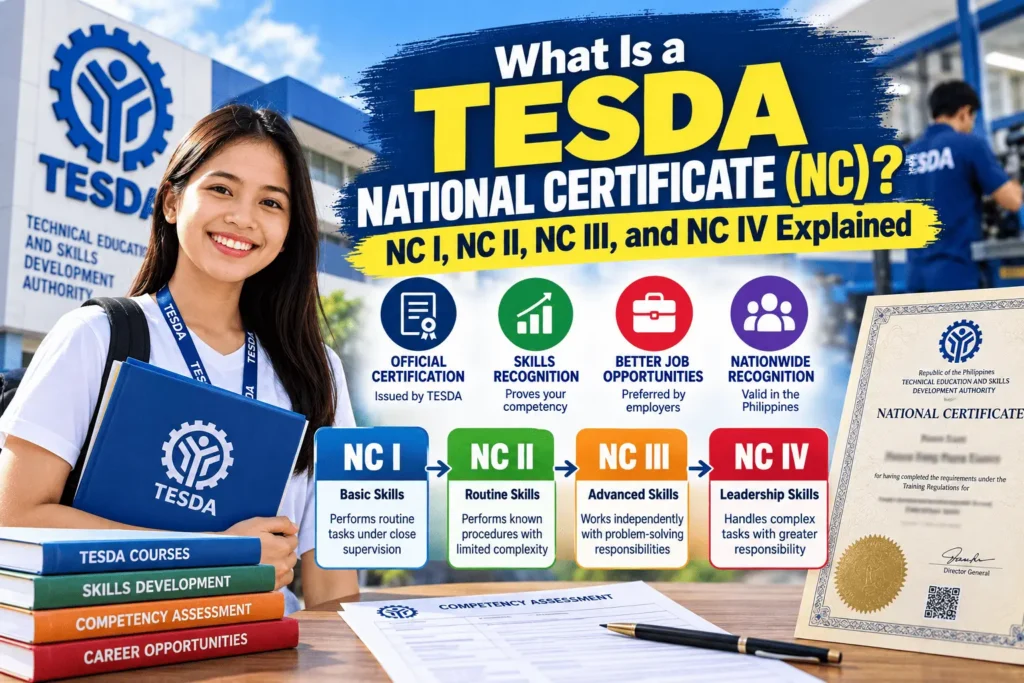
Quick answer: A TESDA National Certificate (NC) is an official certification issued to individuals who pass a competency assessment and demonstrate competence in all required units of a national qualification under TESDA Training Regulations. National Certificates are classified into NC I, NC II, NC III, and NC IV, with each level representing increasing knowledge, skills, responsibility, and workplace complexity.
If you have looked at TESDA courses for more than five minutes, you have seen the letters “NC” everywhere: Caregiving NC II, Bookkeeping NC III, Driving NC II. Job ads ask for them. Recruitment agencies ask for them. Training centers advertise them. But many people still are not sure what an NC actually is, how it differs from a certificate you get for finishing a course, what the levels mean, or how to get one.
This guide is the full explanation. It covers what a National Certificate is, why it matters, how NC I to NC IV differ, how to get certified, what a competency assessment involves, how an NC differs from a Certificate of Competency (COC), how long it stays valid and how to renew it, how employers verify it, and which NC qualifications people commonly pursue. Where TESDA publishes an official rule, this guide follows it.
Quick Facts About TESDA National Certificates
| Item | Details |
|---|---|
| Issuing Agency | TESDA (Technical Education and Skills Development Authority) |
| Purpose | Skills certification |
| Levels | NC I, NC II, NC III, NC IV |
| Assessment Required | Yes |
| Validity | 5 years |
| Recognition | Nationwide |
In TESDA’s words (paraphrased): A National Certificate is issued when a person has been assessed and found competent in all the units of competency that make up a qualification.
What Is a TESDA National Certificate (NC)?
Definition of a National Certificate
A National Certificate (NC) is the credential TESDA issues to a person who has shown that they can perform the tasks of a specific occupation to a national standard. It is not a certificate of attendance. You do not get an NC for sitting through classes. You get it by being assessed by a TESDA-accredited assessor and being found competent in every unit of competency required for the qualification.
Quick answer box: A TESDA National Certificate (NC) is proof that an individual has demonstrated competency in a specific occupation or qualification through TESDA’s competency assessment and certification system.
TESDA officially describes an NC as being awarded when a candidate has demonstrated competence in all the units of competency that make up a qualification. A “unit of competency” is a specific work function, such as preparing and cooking a dish, installing a wiring circuit, or recording financial transactions. A qualification is a bundle of these units that together describe a job.
Role in Technical Vocational Education and Training (TVET)
TESDA assesses and certifies the competencies of middle-level skilled workers through what it calls the Philippine TVET Competency Assessment and Certification System. The goal is to find out whether a graduate or worker can perform to the standards expected in the workplace, based on defined competency standards. Those standards are written in documents called Training Regulations, and TESDA conducts assessment and certification for qualifications that have promulgated Training Regulations.
In simple terms, the system works like this:
- Industry and TESDA define what a competent worker in an occupation should be able to do.
- Training programs teach those competencies.
- Assessors check whether a person can actually perform them.
- TESDA certifies those who meet the standard.
Why employers value NC holders
Employers cannot always tell from a resume whether an applicant can really do the job. A National Certificate gives them a standardized, government-backed signal that the person was tested on defined competencies rather than simply claiming a skill. For jobs where mistakes are costly or risky, such as electrical work, caregiving, or food handling, that signal matters even more.
An NC is also easy to check. TESDA maintains an online registry of certified workers, so an employer or recruiter can confirm that a certificate is real. That is covered in detail later in this guide.
Why Is a TESDA National Certificate Important?
| Benefit | Description |
|---|---|
| Skills Recognition | Validates competency |
| Better Employment Opportunities | Preferred by many employers |
| Industry Recognition | Aligned with standards |
| Career Advancement | Supports professional growth |
| Qualification Verification | Easy credential checking |
Here is what those benefits look like in practice.
It proves what you can do. Many Filipino workers learned their skills on the job, from family, or through informal training. Certification turns that experience into a document that others can recognize.
It can open doors. Some employers require an NC for specific positions, and many others prefer certified applicants. It can also be useful when applying through recruitment agencies, especially for overseas work, though destination countries and employers set their own requirements.
It aligns with standards. Because NCs are based on national competency standards, your certification means the same thing across employers and regions.
It supports advancement. Moving from NC II to NC III or NC IV can help you qualify for roles with more responsibility.
It is verifiable. Unlike a self-declared skill, an NC can be checked against TESDA’s records.
A note on expectations: An NC strengthens your application, but it does not guarantee a job or a specific salary. Hiring depends on the employer, the job market, your experience, and many other factors.
Understanding TESDA Certification Levels
How the levels fit into the national framework
TESDA’s National Certificate levels are part of the Philippine Qualifications Framework (PQF), a national system that classifies qualifications into eight levels from basic education to doctoral degrees. In the technical-vocational track, NC I to NC IV correspond to the first four levels of the framework. A diploma sits at level 5, where the technical-vocational and higher education systems meet, and the higher education levels follow.
| PQF Level | Qualification |
|---|---|
| Level 1 | National Certificate I (NC I) |
| Level 2 | National Certificate II (NC II) |
| Level 3 | National Certificate III (NC III) |
| Level 4 | National Certificate IV (NC IV) |
| Level 5 | Diploma |
The PQF describes each level in terms of knowledge and skills, how they are applied, and the degree of independence expected. As you go up the levels, work becomes less routine, the person makes more decisions, and responsibility for other people and outcomes increases.
Which levels exist for a given occupation depends on the qualification. Many qualifications have only an NC I or NC II, some go up to NC III, and fewer go up to NC IV. The Training Regulations for each qualification list what exists.
National Certificate I (NC I)
What it means: NC I is the entry level. It certifies that a person can perform routine, predictable tasks, usually under close supervision and with limited need for independent judgment.
Characteristics:
- Performs routine tasks
- Works on predictable, well-defined activities
- Works under close supervision
- Limited judgment required
Examples of qualifications at this level (check the current Training Regulations for the full list):
- Agricultural Crops Production NC I
- Automotive Servicing NC I
Who it suits: Beginners entering a field, or workers who want a basic credential in an entry-level role.
National Certificate II (NC II)
What it means: NC II is the level most Filipinos know best, because many popular TESDA courses are at this level. It certifies that a person can follow known procedures and handle routine workplace situations with some independence, though the complexity and accountability remain limited.
Characteristics:
- Performs known procedures
- Handles routine workplace situations
- Limited complexity
- Limited accountability
Popular NC II qualifications:
| Course | Typical Field |
|---|---|
| Driving NC II | Transportation |
| Cookery NC II | Hospitality |
| Bread and Pastry Production NC II | Hospitality |
| Housekeeping NC II | Hospitality |
| Electrical Installation and Maintenance NC II | Construction and electrical |
| Caregiving NC II | Healthcare |
Who it suits: People starting a skilled-trade or service career, and those who want a recognized credential for jobs that ask for one. For many learners, NC II is the first goal.
National Certificate III (NC III)
What it means: NC III certifies a wider range of skills and more responsibility. A person at this level handles more complex tasks, makes more decisions, solves problems, and works with greater autonomy.
Characteristics:
- Wider range of skills
- More decision-making responsibilities
- Problem-solving involvement
- Greater workplace autonomy
Examples of qualifications at this level:
- Bookkeeping NC III
- Commercial Cooking NC III
- Web Development NC III
Who it suits: Workers with experience who want to move into more skilled or senior roles, and learners entering fields where the entry qualification itself sits at NC III.
National Certificate IV (NC IV)
What it means: NC IV is the highest National Certificate level. It certifies complex responsibilities, technical decision-making, evaluation and analysis, and often leadership or supervisory duties.
Characteristics:
- Complex responsibilities
- Leadership responsibilities
- Evaluation and analysis
- Technical decision-making
Examples of qualifications at this level:
- Dental Technology NC IV
- Electrical Installation and Maintenance NC IV
Who it suits: Experienced practitioners moving into supervisory, technical lead, or management roles.
Note: The qualifications listed above are examples. Availability changes as TESDA promulgates, revises, and retires Training Regulations. Check TESDA’s official list of Training Regulations for the current qualifications and levels.
NC I vs NC II vs NC III vs NC IV
| Level | Skills Complexity | Responsibility | Supervision |
|---|---|---|---|
| NC I | Basic | Low | Close |
| NC II | Routine | Limited | Guided |
| NC III | Advanced | Moderate | More independent |
| NC IV | Complex | High | Leadership role |
This table is a simplified summary based on TESDA and PQF level descriptors.
Is a higher level always better?
Not necessarily. The right level is the one that matches the job. An NC II in Cookery is exactly what a restaurant kitchen might ask for, and an NC IV may not even exist in your field. What matters is whether the qualification matches the work you want and whether you can meet its requirements.
Which level should you aim for?
- New to the field: Start with NC I or NC II, depending on what exists for your qualification.
- Already working in the field: Consider going straight to the level that matches your experience. Assessment is based on demonstrated competence, so you do not necessarily have to start at the bottom.
- Aiming for supervision: Build experience, then aim for NC III or NC IV where those levels exist.
How to Get a TESDA National Certificate
The path to an NC is based on one thing: showing that you are competent. Here are the main steps.
Step 1: Choose a TESDA qualification. Pick the occupation you want to be certified in. Assessment is available for qualifications with promulgated Training Regulations, so check the list of Training Regulations to confirm that yours is covered. Our TESDA courses list can help you compare options.
Step 2: Complete training or gain relevant work experience. You can prepare through a TESDA-registered training program, a scholarship, self-study, or on-the-job experience. See the section below on whether training is required.
Step 3: Apply for competency assessment. Apply at a TESDA-accredited assessment center or a TESDA regional or provincial office. For a new applicant, TESDA’s official requirements are a duly accomplished application form, a properly filled-out Self Assessment Guide for your chosen qualification, and three colored passport-size pictures with a white background, with collar, and with your name printed at the back. You then pay the assessment fee at the center’s cashier and receive an official receipt and admission slip.
Step 4: Undergo assessment at a TESDA-accredited assessment center. Be present at the scheduled date and venue, and bring your admission slip. A TESDA-accredited competency assessor conducts the assessment.
Step 5: Receive certification if found competent. After assessment you get a Competency Assessment Result Summary (CARS). If you passed, you apply for certification at the TESDA district or provincial office with jurisdiction over the assessment venue. TESDA states that passers can claim their NC or COC seven working days after applying for issuance.
Remember: TESDA certification is based on demonstrated competency, not on training attendance alone.
For the full official steps, see TESDA’s page on applying for assessment and certification. For scholarship-funded training that includes assessment, see our TESDA Scholarships Guide, and for documents to prepare, see our guide to TESDA requirements.
What Is a Competency Assessment?
A competency assessment is the process TESDA uses to decide whether you meet the standard. According to TESDA, it is the process of collecting evidence and making judgments on whether competency has been achieved. It looks at your skills, knowledge, attitudes, and work values in relation to a unit or cluster of units of competency.
Practical skills evaluation
For most trades and technical work, the assessor watches you do the job. A cook prepares dishes. A caregiver demonstrates care procedures. An electrician installs and tests wiring. This is why hands-on practice before the assessment matters so much.
Knowledge verification
Assessors also check that you understand what you are doing. This can include oral questioning during a demonstration, a written test, or an interview. It confirms that your performance is based on real understanding, not just memorized steps.
Performance assessment
TESDA lists several ways assessors can gather evidence:
- Demonstration or observation with oral questioning
- Written test
- Interview
- Third-party report
- Portfolio
- Submission of work projects
The method depends on the qualification and the competencies being assessed. In some cases, evidence from your workplace or a portfolio of work can support the assessment.
Results
The assessment determines whether you meet the competency standards defined in the Training Regulations. The result is typically “Competent” or “Not Yet Competent.” If you are found not yet competent in some units, you can generally prepare further and retake the assessment for those units. Ask your assessment center about the process and any fees.
How much does assessment cost?
The assessment fee is based on a list of fees promulgated by the TESDA Board. TESDA publishes the fee list on its website: TESDA assessment fees. Private TESDA-accredited assessment centers may collect assessment fees based on that list. Many scholarship programs cover the assessment fee for scholars, as explained in our scholarships guide.
National Certificate (NC) vs Certificate of Competency (COC)
| Feature | NC | COC |
|---|---|---|
| Covers Entire Qualification | Yes | No |
| Covers Specific Competencies | No | Yes |
| Full Qualification Recognition | Yes | Partial |
| Can Lead to NC | N/A | Yes |
TESDA explains that a National Certificate is issued when a candidate has demonstrated competence in all units of competency that make up a qualification, while a Certificate of Competency (COC) is issued to individuals who have satisfactorily demonstrated competence in a particular unit or cluster of units of competency.
How to think about the difference
Imagine a qualification with several units, such as preparing food, serving food, and cleaning the work area. If you pass all of them, you can receive the NC for the full qualification. If you pass only some of them, you may receive a COC for those units. The COC is real recognition, but it is partial.
Why COCs are useful
A COC fits when you only need part of a qualification, when you want to build toward the full NC gradually, or when you were found competent in some units but not others and want that achievement documented.
Which should you aim for?
If your job or target employer asks for a full qualification, go for the NC. If you only need a specific skill set, a COC may do. When in doubt, ask the employer or recruiter what they require.
How Long Is a TESDA National Certificate Valid?
According to TESDA’s official FAQ on assessment and certification, an NC or COC is valid for five (5) years.
Expiration rules
The five-year validity means the certificate has an expiry date printed on it. After that date, it is no longer considered current until it is renewed. Check the dates on your certificate and keep track of them, especially if your job or a recruitment process depends on a valid certificate.
Updating competency standards
Competency standards are revised over time. TESDA’s rules for renewal depend on whether new Training Regulations have been promulgated for your qualification:
- If new Training Regulations exist, an NC or COC holder who has reached expiration must undergo competency assessment based on the new competency standards and assessment tools.
- If no new Training Regulations exist, the certificate holder may be renewed on request, after verification in TESDA’s Registry of Certified Workers.
This is why renewal is not always the same process for everyone. It depends on what has changed for your qualification.
How to Renew an Expired NC
Renewal is handled through TESDA’s district and provincial offices. Here is the general process.
Step 1: Verify certificate status. Check your certificate’s expiry date, and verify your record in TESDA’s Registry of Certified Workers (2017 issuances and later) or the earlier registry (2016 and earlier).
Step 2: Visit the TESDA office that issued the certificate. TESDA states that renewals and replacements are handled at the district or provincial office where the original certificate was issued. Find contact details in the regional and provincial directory.
Step 3: Submit renewal requirements. According to TESDA’s official steps for regular qualifications, renewal requires:
- A duly accomplished application form
- Your original NC or COC
- Three colored passport-size photos with a white background
- A certificate of work and/or teaching experience of at least 12 months during the validity period of your certificate in the relevant qualification, signed by your employer or school administrator (for self-employed applicants, signed by an official of an appropriate government agency)
You then pay the renewal fee at the assessment center cashier, get an official receipt, and claim your renewed certificate on the date given by the issuing office.
Step 4: Follow applicable assessment or renewal procedures. If new Training Regulations apply to your qualification, you may need to take competency assessment based on the new standards instead of a simple renewal.
Lost, damaged, or incorrect certificates
TESDA also provides procedures for:
- Lost certificates: a letter of request, a notarized affidavit of loss, and one colored passport-size photo.
- Damaged certificates: a letter of request, the original certificate, and one colored passport-size photo.
- Erroneous entries: a letter of request, the original certificate, one colored passport-size photo, and a certified photocopy of your passport or birth certificate.
Important: Certificates are released directly to the applicant. If a representative claims it, a Special Power of Attorney is required. Fees, requirements, and processing times can change, so confirm with the issuing TESDA office.
Can You Get a Job Without an NC?
Yes, you can get a job without an NC. Many jobs do not require one, and plenty of skilled workers are hired based on experience, references, or an employer’s own skills test. But in some situations, an NC makes a real difference.
Some employers require NCs
Certain employers, particularly in regulated or safety-sensitive fields, require or strongly prefer certified workers. Recruitment agencies and clients may also ask for NCs as proof of skills for specific roles.
Some positions prioritize certified workers
When two applicants have similar experience, the one with a verifiable certificate may have an advantage. Some company hiring policies, training programs, and government projects give priority to certified workers.
Certification can strengthen applications
Even if an NC is not required, it shows initiative and gives employers confidence. For people with limited formal work experience, such as fresh graduates and career shifters, it can help fill the gap.
Be realistic: An NC improves your chances, but it does not guarantee employment. Always check the actual requirements for the jobs you want, and keep building experience alongside your certification.
Industries That Commonly Require NC Certifications
Requirements differ by employer and by country, so there is no single official list. But NC qualifications are commonly sought in the following sectors.
- Hospitality: Cookery, housekeeping, food and beverage services, bread and pastry production, and related roles in hotels, restaurants, resorts, and food businesses.
- Construction: Carpentry, masonry, plumbing, welding, and other building trades.
- Automotive: Automotive servicing, driving, and related technical work.
- Healthcare: Caregiving and health care services, where trust and safe practice are central.
- Information Technology: Computer systems servicing, programming, web development, and related digital work.
- Electrical Services: Electrical installation and maintenance, where safe, standards-based work is critical.
- Tourism: Tour guiding, travel services, and other visitor-facing roles.
For overseas jobs, check the requirements of the destination country and the recruitment agency. Some employers accept TESDA certification, while others require additional exams, licenses, or language tests.
Best TESDA NC Certifications for Employment Opportunities
No single NC is “best” for everyone. The right choice depends on your goals, your local job market, and whether you plan to work locally, abroad, or for yourself. The qualifications below are commonly pursued because they connect to recurring job opportunities. This list is not a ranking and does not promise outcomes.
| Certification | Field | Commonly Associated Roles |
|---|---|---|
| Caregiving NC II | Healthcare | Caregiver, nanny, home health aide |
| Electrical Installation and Maintenance NC II | Construction and electrical | Electrician, maintenance technician |
| Bookkeeping NC III | Business and finance | Bookkeeper, accounting clerk |
| Driving NC II | Transportation | Company driver, delivery driver |
| Housekeeping NC II | Hospitality | Housekeeper, room attendant |
| Cookery NC II | Hospitality | Cook, kitchen staff |
Tips for choosing
Look at local demand by checking job postings and asking employers what they want. If you plan to work abroad, research the destination country’s requirements first. Choose a qualification that matches your strengths, compare training length and cost (our TESDA Scholarships Guide explains what funding exists), and plan the next level, since some NC II holders later pursue NC III or NC IV.
Pay varies widely by region, employer, and experience, so check current job postings rather than relying on general claims.
How Employers Verify TESDA Certificates
TESDA maintains an Online Registry of Certified Workers with information on certified workers nationwide. According to TESDA, the registry can be searched by name, certificate number, or qualification. TESDA provides separate registries for 2017 issuances onward and 2016 issuances and earlier.
Tips for holders and employers
Holders should keep their certificate number and a clear copy handy, and apply for correction at the issuing TESDA office if any entry is wrong. Employers and recruiters should check the registry before relying on a certificate, confirm it is still within its validity period, and contact the issuing TESDA office if they need more verification.
Beware of fake certificates
Fake or purchased certificates can cost you a job and cause legal trouble. TESDA states that falsification or fraudulent duplication of documents is grounds for disqualification and forfeiture of the right to participate in assessment and certification programs. Only pursue certification through TESDA-accredited assessment centers and TESDA offices.
Frequently Asked Questions
What is NC II in TESDA?
NC II stands for National Certificate II. It is the level at which a person can follow known procedures and handle routine workplace situations with some independence, though complexity and accountability remain limited. Many popular TESDA qualifications are at this level, including Cookery NC II, Driving NC II, Housekeeping NC II, and Caregiving NC II. You earn it by passing a competency assessment for the qualification.
Is NC II better than NC I?
NC II is a higher level than NC I, and it certifies a broader range of skills and more independence. But “better” depends on your goal. NC I may be the right starting point in some fields, and some qualifications do not have an NC I at all. Choose the level that matches the job you want and the qualification’s available levels.
What is the difference between NC and COC?
A National Certificate (NC) is issued when you demonstrate competence in all units of competency that make up a qualification. A Certificate of Competency (COC) is issued when you demonstrate competence in a particular unit or cluster of units. An NC recognizes the full qualification, while a COC recognizes part of it, and COCs can help you build toward an NC.
How long is a TESDA certificate valid?
TESDA states that an NC or COC is valid for five years. After that, it must be renewed or, where new Training Regulations apply, you may need to undergo assessment based on the new standards.
Can I renew an expired NC?
Yes. You apply for renewal at the TESDA district or provincial office where your certificate was issued. If new Training Regulations have been promulgated for your qualification, you will need to undergo assessment based on the new competency standards. Otherwise, renewal can be granted on your request after verification in the Registry of Certified Workers. Renewal requirements include an application form, your original certificate, photos, and proof of at least 12 months of work or teaching experience in the qualification during the certificate’s validity.
Is training required before assessment?
TESDA’s official FAQ says that students, workers, or any individual who wants to determine their qualification level may apply for assessment, and the listed requirements are an application form, passport-size photos, and a self-assessment guide. Training is not listed as a requirement for regular assessment. That said, you must be able to demonstrate the competencies, and assessment centers may advise training if you are not yet ready. Graduating students of registered programs may also be required to take assessment as part of their program. Confirm the rules for your qualification with the assessment center.
Can work experience qualify me for assessment?
Work experience can support your assessment. TESDA lists portfolios, third-party reports, and work projects among the ways assessors gather evidence, so workers with real experience in a field can apply for assessment even if they did not attend a formal training program. You still need to demonstrate competence in every unit of the qualification to receive an NC. Ask your assessment center how they evaluate experience-based applicants.
How do employers verify TESDA certificates?
Employers can check TESDA’s Online Registry of Certified Workers, which can be searched by name, certificate number, or qualification. They can also contact the TESDA office that issued the certificate. Keep your certificate number and a clear copy ready for any employer or recruiter who asks.
Related TESDA Guides
- TESDA Courses List 2026: compare qualifications by field
- TESDA Scholarships Guide: how to get free training and assessment support
- TESDA Requirements: Documents Needed for Enrollment: what to prepare before you enroll
- Free TESDA Online Courses with Certificates: study online before assessment
- How to Enroll in TESDA Programs: Step-by-Step Guide
- TESDA Accredited Training Centers: How to Find Approved Training Providers
Official TESDA Resources
For the latest and most reliable information, use official sources:
- TESDA Assessment and Certification
- Assessment and Certification FAQs
- Steps in Applying for Assessment and Certification
- TESDA Training Regulations
- TESDA Online Registry of Certified Workers: 2017 issuances onward and 2016 issuances and earlier
- TESDA Accredited Assessment Centers
- TESDA Assessment Fees
- TESDA Provincial and Regional Offices
You can also reach TESDA’s contact center at 8887-7777 or contactcenter@tesda.gov.ph.
Last Updated: October 2026
Sources:
- TESDA: Assessment and Certification (tesda.gov.ph/About/TESDA/25)
- TESDA: Frequently Asked Questions on Assessment and Certification (tesda.gov.ph/About/TESDA/127)
- TESDA: Steps in Applying for Assessment and Certification, Regular Qualifications (tesda.gov.ph/About/TESDA/46)
- Philippine Qualifications Framework level descriptors (DepEd and TESDA materials)
Official References:
- TESDA Official Website
- Republic Act No. 7796 (the law that created TESDA)
- Executive Order No. 83, s. 2012 (Institutionalization of the Philippine Qualifications Framework)
Final Thoughts
A TESDA National Certificate is one of the clearest ways for a skilled Filipino worker to prove what they can do. It is based on demonstrated competence, it follows national standards, and it can be verified. Whether you are just starting out, already working, or planning to work abroad, understanding how NCs work helps you choose the right qualification and the right level.
A few points to remember:
- NCs validate workplace competencies. They show that you were assessed against national standards and found competent in every unit of a qualification.
- NC I to NC IV represent increasing levels of skills and responsibility. Higher levels mean more complex work, more independence, and, at NC IV, leadership responsibilities.
- Certification is obtained through competency assessment. Training can prepare you, but the certificate comes from passing the assessment.
- NCs can support career development and qualification recognition. They strengthen your applications and help you move forward, but they do not guarantee a job or income.
Your next step is simple: pick a qualification, confirm that it has Training Regulations, find an accredited assessment center near you, and prepare for the practical assessment. Keep your certificate number and expiry date safe, and set a reminder before it expires so you can renew on time.