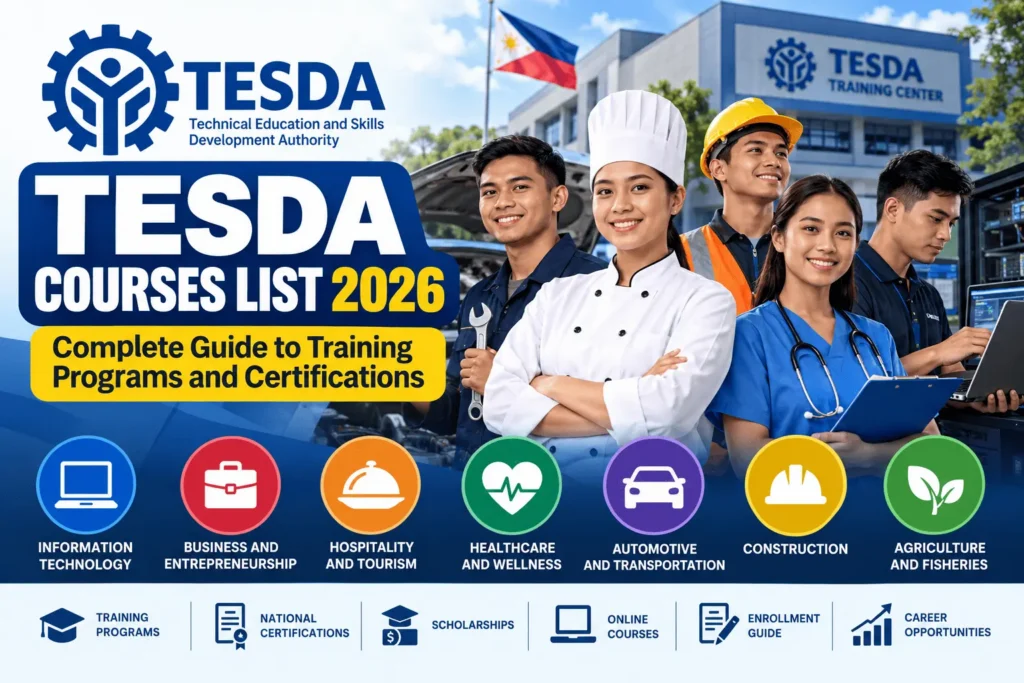
Quick answer: TESDA offers hundreds of technical-vocational courses in areas such as information technology, healthcare, construction, hospitality, agriculture, automotive, and business services. These programs help Filipinos gain practical skills, earn National Certificates (NC), and improve employment opportunities both locally and abroad. Many TESDA courses are available through training centers, scholarships, and the TESDA Online Program.
If you are a high school graduate deciding what to do next, or a worker who wants a better-paying job, or an OFW planning your next contract, TESDA is one of the most practical routes to a skill you can put to work. You do not need a four-year degree to get started, and many programs take only a few weeks or months.
This guide covers what TESDA is, the main course categories, the most in-demand programs, scholarships, the TESDA Online Program, enrollment steps and requirements, the National Certificate system, costs, and the careers your certification can open up.
Quick Facts About TESDA
| Fact | Details |
|---|---|
| Full name | Technical Education and Skills Development Authority |
| What it is | Philippine government agency for technical-vocational education and training (TVET) |
| Established | 1994, through Republic Act No. 7796 |
| Main credentials | National Certificate (NC) and Certificate of Competency (COC) |
| NC levels | NC I, NC II, NC III, NC IV |
| How certification works | Pass a competency assessment (results are “Competent” or “Not Yet Competent”) |
| Scholarship programs | TWSP, PESFA, STEP, and other regional or local programs |
| Free online learning | TESDA Online Program (TOP), self-paced |
| Course duration | Weeks to several months, depending on the qualification |
| Official website | tesda.gov.ph |
What Is TESDA?
TESDA stands for the Technical Education and Skills Development Authority. It is the Philippine government agency responsible for managing and supervising technical-vocational education and training (TVET) across the country. It was created in 1994 through Republic Act No. 7796, which merged several earlier agencies that handled vocational training, apprenticeship, and technical education into one body.
Mandate and purpose
TESDA’s core job is to make sure Filipinos have access to quality skills training that matches what employers actually need. In practice, that means the agency does several things:
- It sets national standards for technical-vocational programs through documents called Training Regulations.
- It registers and accredits training institutions so that the quality of training is consistent.
- It runs assessment and certification, which is how a trainee proves they can perform the skills of a job.
- It manages scholarship and financial assistance programs that make training free or low-cost for eligible Filipinos.
- It runs its own online learning platform for self-paced study.
Role in technical-vocational education
The Philippines has a long-standing gap between what schools teach and what industries need. TESDA fills part of that gap by focusing on competency-based training. Instead of grading you mainly on written exams, competency-based training asks a simple question: can you actually do the task? A trainee in Cookery is expected to demonstrate cooking techniques. A trainee in Electrical Installation is expected to wire and test installations correctly.
Training happens in several types of institutions: TESDA-operated technology institutions, public training centers run by local governments and state colleges, and private training institutions that have registered their programs with TESDA.
Benefits of TESDA training
Compared with a traditional degree, TESDA training generally offers:
- Shorter duration. Many courses can be completed in weeks or months rather than years.
- Lower cost. Scholarships can cover tuition and sometimes allowances, and even self-funded training is usually more affordable than college.
- Practical focus. Most of the time is spent on hands-on skills.
- A recognized credential. The National Certificate is a nationally recognized proof of competence.
Key points to remember
- TESDA is a government agency focused on skills development.
- Its programs are designed to prepare people for work quickly.
- Its National Certificates are the standard credentials for skilled workers in many industries.
Why Take a TESDA Course?
There are plenty of reasons Filipinos choose TESDA. Here are the ones that matter most.
Affordable training. Cost is the biggest barrier to education for many families. TESDA scholarships, free public training, and the free online platform lower that barrier considerably. Even where you pay, the total is usually a fraction of college tuition.
Industry-recognized certification. Employers in many fields look for National Certificates because they signal that a worker has passed a standardized assessment. In some trades, such as electrical work or caregiving, holding the relevant NC can be a hiring requirement or a significant advantage.
Employment opportunities. Skills-based jobs such as caregiving, bookkeeping, driving, electrical work, food service, and IT support are consistently in demand. A TESDA certificate can help you apply for entry-level work or move up to a better position.
Overseas job qualifications. Many Filipinos who work abroad start with a TESDA qualification. Some destination countries and recruitment agencies specifically look for TESDA certification or equivalent proof of skills, especially in caregiving, hospitality, construction, and technical trades. Requirements differ by country and employer, so always confirm with your recruitment agency or the receiving country’s rules.
Entrepreneurship opportunities. TESDA is not only for job seekers. Courses in Bread and Pastry Production, Cookery, Massage Therapy, Automotive Servicing, and Agricultural Crops Production give you the skills to start a small business, such as a bakery, food stall, home-service massage, repair shop, or farm.
Quick benefits table
| Benefit | Description |
|---|---|
| Skills Training | Learn practical skills you can use immediately on the job or in your own business |
| Certification | Earn National Certificates recognized by employers |
| Employment | Improve your job prospects, locally and abroad |
| Career Growth | Gain specialized expertise and move up through higher NC levels |
TESDA Course Categories
TESDA organizes its programs into sectors. The exact list of available courses changes over time and differs by region and training center, but the main categories below give you a solid overview of what is typically offered. Course names use the official qualification titles wherever possible.
Information and Communications Technology (ICT)
The ICT sector covers computer servicing, programming, digital design, and related fields. It is popular with young learners and career shifters because the skills transfer easily to freelancing and remote work.
Examples:
- Computer Systems Servicing NC II: assembling, installing, and repairing computers, setting up networks, and troubleshooting hardware and software.
- Programming courses: entry-level programming qualifications covering the fundamentals of writing and testing code.
- Web Development: building and maintaining websites, including front-end and basic back-end skills.
- Animation: 2D and 3D animation skills for media, games, and advertising.
Who it suits: People who enjoy problem-solving, working with computers, or building things digitally.
Business and Entrepreneurship
This sector covers office skills, finance-related work, customer service, and business operations.
Examples:
- Bookkeeping NC III: recording financial transactions, preparing financial reports, and supporting accounting work.
- Contact Center Services NC II: handling customer inquiries, communication skills, and support processes for call centers and BPO roles.
- Events Management: planning, coordinating, and running events such as weddings, conferences, and corporate gatherings.
Who it suits: People who are organized, communicate well, and like working with numbers, clients, or logistics.
Hospitality and Tourism
Hospitality is one of the largest and most popular TESDA sectors, and it connects directly to hotels, restaurants, cruise lines, resorts, and food businesses.
Examples:
- Cookery NC II: preparing and cooking a range of dishes, kitchen safety, and food handling.
- Bread and Pastry Production NC II: baking breads, cakes, and pastries, a strong option for starting a home bakery.
- Housekeeping NC II: cleaning and maintaining guest rooms and public areas in hotels and resorts.
- Food and Beverage Services NC II: serving food and drinks, dining service standards, and customer care.
Who it suits: People who enjoy service work, food, or the travel industry.
Healthcare and Wellness
Healthcare-related skills are in steady demand at home and overseas, thanks to aging populations and a growing wellness industry.
Examples:
- Caregiving NC II: assisting children, older adults, and people who need care, including basic health support and daily living assistance.
- Massage Therapy NC II: therapeutic and wellness massage techniques for spas, clinics, and private practice.
- Health Care Services NC II: foundational care skills for supporting patients in health facilities.
Who it suits: Patient, caring individuals who are comfortable working closely with people.
Automotive and Transportation
Vehicles need constant maintenance, and drivers are needed across many industries, so this sector offers steady work.
Examples:
- Automotive Servicing NC I and NC II: servicing, maintaining, and repairing vehicles, from basic engine care to systems diagnostics.
- Driving NC II: safe and professional driving skills, road rules, and vehicle handling.
Who it suits: People who like mechanical work or want a driving-based career.
Construction
The construction sector supports building, housing, and infrastructure projects, and skilled tradespeople are needed both locally and abroad.
Examples:
- Masonry NC II: laying blocks and bricks, plastering, and concrete work.
- Carpentry NC II: building and installing wooden structures, formworks, and fixtures.
- Electrical Installation and Maintenance NC II: installing, testing, and maintaining electrical wiring and equipment in homes and buildings.
Who it suits: People who enjoy hands-on, physical work and want to build a trade.
Agriculture and Fisheries
Agriculture remains a major part of the Philippine economy, and TESDA supports farmers, growers, and entrepreneurs with modern techniques.
Examples:
- Organic Agriculture Production NC II: producing crops and vegetables using organic methods.
- Agricultural Crops Production NC II: planting, growing, and harvesting a variety of crops.
Who it suits: People who live in farming communities or want to run an agri-business.
Note: TESDA has many more qualifications beyond this list, including shipbuilding, welding, tailoring, plumbing, beauty care, and more. The courses actually offered near you depend on your region and the accredited training centers in your area.
Most In-Demand TESDA Courses in 2026
Demand shifts with the economy, but the courses below tend to remain popular because they lead to clear, recurring job opportunities. This table gives an overview, and the sections after it explain the career paths for each.
| Course | Industry | Common Career Opportunities |
|---|---|---|
| Caregiving NC II | Healthcare | Caregiver, nanny, home health aide, elderly care assistant |
| Bookkeeping NC III | Finance | Bookkeeper, accounting clerk, payroll assistant, freelance bookkeeper |
| Computer Systems Servicing NC II | IT | Computer technician, IT support staff, network setup assistant |
| Bread and Pastry NC II | Hospitality | Baker, pastry assistant, home bakery owner |
| Driving NC II | Transportation | Company driver, delivery driver, private driver |
| Electrical Installation NC II | Construction | Electrician, maintenance technician, wiring installer |
Caregiving NC II
Caregiving is consistently among the most sought-after TESDA programs, largely because of overseas demand. Graduates can work in private homes, care facilities, and hospitals as support staff. Locally, opportunities include working as a family caregiver or nanny. Abroad, caregiver roles are common in countries with older populations, though visa and licensing rules vary and often require additional steps beyond a TESDA certificate.
Bookkeeping NC III
Bookkeeping equips you to maintain business financial records. Small businesses, accounting firms, and BPO companies all need reliable bookkeepers. Many bookkeepers also work as freelancers for multiple small clients, which suits people who want flexible or remote work. Combined with basic Excel and accounting software skills, this qualification can lead to accounting assistant roles.
Computer Systems Servicing NC II
This is a go-to course for anyone who wants to enter IT support. Graduates can work as computer technicians, help-desk support, or repair shop staff. Because the skills cover hardware, software, and basic networking, they also serve as a stepping stone to more advanced IT certifications and roles.
Bread and Pastry Production NC II
Baking is one of the most accessible ways to start a business. Graduates can work in bakeries, hotels, and restaurants, or start selling from home. Many trainees pair this course with basic business skills to grow a small food business.
Driving NC II
Professional drivers are needed by logistics companies, delivery services, private households, and transport operators. Driving NC II covers safe driving practices, vehicle handling, and basic maintenance awareness, which employers value.
Electrical Installation NC II
Electricians are needed in residential, commercial, and industrial settings. This qualification covers installing and maintaining electrical systems safely. Note that some electrical work in the Philippines is also regulated by separate licensing rules, so a TESDA certificate is a strong foundation but may not replace every professional requirement. Check the rules that apply to your intended work.
TESDA Salary Comparison Table: Courses and Typical Career Paths
Salary is one of the first things people want to know before they enroll. The figures below are rough, indicative monthly ranges for entry-level to early-career work in the Philippines. Actual pay depends on your region (Metro Manila usually pays more than provincial areas), employer, experience, shift, and whether you work locally, abroad, or for yourself. Overseas and self-employment income can be very different from local wages. Check current job postings and the latest regional minimum wage orders for your area.
| Course | Typical Career | Typical Salary Range (Monthly, PHP) |
|---|---|---|
| Caregiving NC II | Caregiver, nanny, home health aide | ₱10,000 – ₱18,000 locally; overseas pay varies widely by country |
| Bookkeeping NC III | Bookkeeper, accounting clerk | ₱15,000 – ₱25,000 (freelance rates vary per client) |
| Computer Systems Servicing NC II | Computer technician, IT support | ₱13,000 – ₱22,000 |
| Contact Center Services NC II | Call center / BPO agent | ₱18,000 – ₱28,000 (higher with night differentials and incentives) |
| Bread and Pastry Production NC II | Baker, pastry assistant | ₱11,000 – ₱18,000 as an employee; business income varies |
| Driving NC II | Company or delivery driver | ₱12,000 – ₱20,000 |
| Automotive Servicing NC II | Automotive technician | ₱13,000 – ₱24,000 |
| Electrical Installation and Maintenance NC II | Electrician, maintenance technician | ₱15,000 – ₱28,000 |
Note: These ranges are estimates for illustration, not official TESDA or DOLE figures. Verify against current job listings before making decisions or publishing exact numbers.
What increases your pay? Higher NC levels, added certifications, years of experience, licensing where required (for example, in electrical work), English and computer skills, and willingness to work in higher-paying regions or abroad.
Quick Comparison of Popular TESDA Courses
| Course | Approx. Duration | Industry | NC Level |
|---|---|---|---|
| Caregiving NC II | About 786 hours | Healthcare | NC II |
| Health Care Services NC II | About 996 hours | Healthcare | NC II |
| Bookkeeping NC III | About 292 hours | Business / Finance | NC III |
| Computer Systems Servicing NC II | About 280 hours | ICT | NC II |
| Cookery NC II | About 316 hours | Hospitality | NC II |
| Bread and Pastry Production NC II | About 141 hours | Hospitality | NC II |
| Housekeeping NC II | About 436 hours | Hospitality | NC II |
| Driving NC II | About 118 hours | Transportation | NC II |
| Electrical Installation and Maintenance NC II | Varies by center; check the current Training Regulations | Construction | NC II |
Note: Durations are approximate nominal training hours listed by TESDA-registered institutions and can differ by center, Training Regulations version, and whether supervised industry learning (SIL) is added. Ask your chosen center for the exact hours and schedule.
TESDA Online Program (TOP)
Not everyone can attend a physical training center. Work, distance, or family responsibilities can get in the way. The TESDA Online Program (TOP) was built for exactly those situations.
What is TOP?
TOP is TESDA’s e-learning platform, which lets Filipinos study technical-vocational topics through the internet. You register for an account on the platform, choose from the available courses, and study on your own schedule.
What makes it useful
- Free online learning. Courses on the platform are offered at no cost to learners.
- Self-paced training. You decide when and how quickly to study, which works well if you have a job or other commitments.
- Digital certificates. Completing a course typically earns a certificate of completion from the platform.
- Wide access. All you need is an internet connection and a device.
An important distinction: completing an online course and earning a National Certificate are two different things. The National Certificate requires passing a competency assessment, which generally involves demonstrating skills in person. Online courses are excellent for learning and building foundations, but check whether a particular course leads toward assessment for an NC.
Popular online courses
The platform’s catalog changes over time, but learners commonly look for courses in:
- Digital Literacy: basic computer use, internet safety, and productivity tools.
- Entrepreneurship: starting and managing a small business, including basic planning and marketing.
- English Language: communication and language skills useful for work and overseas jobs.
- ICT Fundamentals: core concepts in information and communications technology.
Tips for learning online
- Set a fixed weekly study schedule so you finish what you start.
- Take notes and practice the skills hands-on where possible.
- Combine online learning with a physical program if your goal is a National Certificate.
- Keep copies of your completion certificates for your résumé.
TESDA Scholarships in 2026
Scholarships are one of the biggest reasons TESDA is so accessible. Programs and slot availability vary by year and region, so treat the descriptions below as an overview and confirm the current details with your nearest TESDA office.
TWSP: Training for Work Scholarship Program
TWSP is designed to help Filipinos gain skills in priority sectors, the industries where the government and employers expect strong demand for workers. It generally covers training costs for qualified scholars and is one of the most commonly used TESDA scholarships. Slots are usually tied to specific courses that match labor market needs, so the list of covered qualifications can change from year to year.
PESFA: Private Education Student Financial Assistance
PESFA provides financial assistance to eligible students who enroll in TESDA-registered programs at private institutions. It exists so that learners who want to study at a private training institution, and who need financial support, have a way to do so. Eligibility and coverage depend on program rules for the current year.
STEP: Special Training for Employment Program
STEP is a community-based program that focuses on training for employment and livelihood, often delivered in partnership with local governments and community organizations. It tends to serve residents of specific localities, helping them acquire skills for wage employment or self-employment right where they live.
Other support programs
Beyond the three programs above, other government initiatives, such as those tied to the Tulong Trabaho fund or local government partnerships, may also support skills training. Ask your regional or provincial TESDA office what is available in your area.
Benefits of TESDA scholarships
- Free training. Tuition for the covered program is typically paid for by the scholarship.
- Assessment support. Many scholarships cover the assessment fee, so scholars can attempt certification at no additional cost.
- Skills certification opportunities. Scholars who complete training and pass assessment can earn the National Certificate.
- Additional support. Depending on the program, scholars may receive extra assistance such as training allowances or starter toolkits.
How to apply for a scholarship
- Visit your nearest TESDA provincial or district office, or an accredited training center.
- Ask which scholarship programs and courses are currently open.
- Prepare your documents (see the requirements section below).
- Fill out the application and complete any interview or screening.
- Wait for confirmation of your slot, then begin training.
Scholarship slots are limited, so apply early and stay in touch with your local office.
How to Choose the Right TESDA Course
“What TESDA course should I take?” is one of the most common questions, and there is no single best answer. The best TESDA course is the one that fits your goals, your budget, your location, and the jobs you can realistically get. Use the factors below to narrow it down.
1. Career goals
Start with the kind of work you want to do every day. If you like working with people, look at Caregiving, Food and Beverage Services, or Contact Center Services. If you prefer hands-on technical work, consider Electrical Installation, Automotive Servicing, or Carpentry. If you enjoy computers, look at Computer Systems Servicing or Web Development.
2. Salary potential
Pay differs by field, region, and experience. Skilled trades, technical roles, and qualifications with overseas demand often pay more over time, especially at higher NC levels. See the salary table above for rough ranges, and check current job postings in your area.
3. Local job demand
A course is only useful if employers nearby are hiring for it. Look at job boards, ask local employers, and talk to your TESDA provincial office about which qualifications are in demand in your region.
4. Overseas opportunities
If you plan to work abroad, research the destination country first. Caregiving, cookery, housekeeping, construction trades, and automotive skills are commonly sought, but each country has its own licensing, language, and visa rules. Confirm requirements with a licensed recruitment agency before you enroll.
5. Training duration
Short courses such as Driving NC II or Bread and Pastry Production NC II can be completed faster, so you can start earning sooner. Longer programs such as Caregiving NC II or Health Care Services NC II take more time but can open more doors. Compare hours in the table above.
6. Cost
Check whether a scholarship covers the course, whether a public center offers it for free or at low cost, and what a private center charges. Ask if assessment fees, uniforms, and toolkits are included.
Choose by goal
| If your goal is… | Consider courses like… |
|---|---|
| Start earning as fast as possible | Driving NC II, Bread and Pastry Production NC II, Food and Beverage Services NC II |
| Work abroad | Caregiving NC II, Cookery NC II, Housekeeping NC II, Electrical Installation and Maintenance NC II |
| Work from home or freelance | Bookkeeping NC III, Web Development, programming courses |
| Start a small business | Bread and Pastry Production NC II, Cookery NC II, Massage Therapy NC II, Agricultural Crops Production NC II |
| Build a long-term technical career | Electrical Installation and Maintenance NC II, Automotive Servicing NC I and II, Computer Systems Servicing NC II |
Quick answers to common searches
- Best TESDA course: There is no universal winner. The best choice matches your goal, budget, and local job market.
- Highest paying TESDA course: Pay depends on the field, experience, and location, but technical trades and internationally in-demand qualifications tend to offer stronger earning potential over time.
- TESDA course for beginners: Start with an NC I or NC II qualification in a field you are interested in, then move up to higher levels as you gain experience.
How to Enroll in TESDA Courses
Enrolling is more straightforward than many people expect. Here is the process from start to finish.
Step 1: Choose a course. Start with your goal. Do you want a job quickly, a specific overseas role, or your own business? Match the course to your goal, your interests, and local demand. If you are unsure, talk to a TESDA officer or a training center adviser.
Step 2: Find an accredited training center. Make sure the training institution and the specific program are registered with TESDA. Registered programs meet standards and can lead to assessment and certification. Unregistered programs may not. You can ask TESDA offices directly or check TESDA’s official channels for registered programs.
Step 3: Prepare requirements. Gather your documents early so there are no delays. The common requirements are listed in the next section.
Step 4: Submit your application. Apply at the training center, at a TESDA office, or through the process specified for the scholarship you are applying for. Some centers accept applications online, while others require you to submit in person.
Step 5: Attend training. Take part in classes and hands-on practice. Attendance matters because competency-based training expects you to demonstrate skills, not only learn theory. Take the practical sessions seriously.
Step 6: Complete assessment. After training, you can take the competency assessment for your qualification, conducted by a TESDA-accredited assessor at an accredited assessment center. You will demonstrate your skills through practical tasks and, in many cases, an oral or written component. Results are typically either “Competent” or “Not Yet Competent.” If you are not yet competent, you can usually retake the assessment for the units you did not pass after more practice.
Step 7: Receive certification. If you are found competent, you receive your National Certificate (or Certificate of Competency for individual units, where applicable). Keep both the original and copies safe, since employers and recruitment agencies will ask for them.
TESDA Enrollment Requirements
The exact documents depend on the course, the training institution, and the scholarship you are applying to, but most applicants are asked for the following.
Common requirements
- Valid ID. A government-issued ID or another accepted identification.
- Birth certificate. A copy issued by the Philippine Statistics Authority (PSA) is commonly requested.
- Educational records (if required). Some courses need proof of schooling, such as a diploma or Form 137 or report card. Others accept lower educational attainment.
- Passport-sized photos. Usually a few recent photos with a plain background.
Depending on the program, you may also be asked for:
- A barangay clearance or certificate of residency
- A medical certificate for physically demanding or health-related courses
- Proof of income or a certificate of indigency for certain scholarships
- An application form and a short interview
Note: Requirements may vary by training institution and program. Always confirm the exact list with the center before you start gathering documents.
Understanding TESDA National Certificates
What is a National Certificate?
A National Certificate (NC) is an official credential issued by TESDA to a person who has passed the competency assessment for a specific qualification. It confirms that you can perform the tasks required for a job to a national standard. Unlike a certificate of attendance, which only shows that you sat through a course, an NC shows that you were tested and found competent.
You may also see a Certificate of Competency (COC). This is given when you pass assessment for a smaller set of units within a qualification, rather than the full qualification. COCs are useful if you only need or have completed part of the skills package.
Many National Certificates carry a validity period, commonly around five years, after which you may need to renew or be reassessed depending on the qualification. Always check the validity stated on your certificate and TESDA’s current rules.
Difference between NC I, NC II, NC III, and NC IV
National Certificate levels reflect the complexity of the skills and the level of responsibility involved. They are part of the Philippine TVET Qualification Framework.
| Level | Description |
|---|---|
| NC I | Basic skills: performing simple, routine tasks under close supervision |
| NC II | Intermediate skills: performing a broader range of tasks with some independence |
| NC III | Advanced technical skills: handling complex tasks and working with greater autonomy |
| NC IV | Supervisory/management level: leading teams, planning work, and making decisions |
Not every qualification has all four levels. For example, some fields stop at NC II, while others go up to NC III or NC IV. Above NC IV, the framework also includes higher levels such as diploma qualifications for certain fields.
Which level should you take?
- If you are new to a field, start with NC I or NC II, depending on what is available for that qualification.
- If you already have work experience, you may go straight for the level that matches your existing skills.
- If you want to move into supervisory roles, aim for NC III or NC IV after building experience.
How Much Do TESDA Courses Cost?
The honest answer is that it depends. Cost varies by the course, the type of institution, the region, and whether you qualify for support. Here is how the different cost categories generally work.
Free courses
Some TESDA training is free. The TESDA Online Program is free for learners, and public institutions may offer certain programs at no cost, particularly when they are supported by government funding. If you are on a tight budget, start by asking what free options exist in your area.
Scholarship-funded courses
Scholarships such as TWSP, PESFA, and STEP can cover training costs for qualified applicants. When a program is scholarship-funded, you typically do not pay tuition, and the assessment fee is often covered too. Some scholarships also provide allowances or starter kits. Keep in mind that slots are limited and competitive in popular courses.
Private training costs
Private training institutions set their own fees. Prices depend on the course length, equipment needed, and the institution’s location and facilities. Technical courses that use expensive equipment, such as automotive or culinary programs, tend to cost more than classroom-based programs. Always ask for a written breakdown of fees so you know what is included, such as materials, uniforms, and toolkits.
Assessment fees
The competency assessment is a separate step from training and may have its own fee if it is not covered by a scholarship. The fee depends on the qualification and the assessment center. If you finished training under a scholarship, ask whether assessment is included. If you are self-funding, budget for it in advance so you do not stop just short of certification.
Money-saving tips
- Ask about scholarships before you pay for any private program.
- Compare fees across at least two or three accredited centers.
- Confirm exactly what the fee covers, including whether assessment is included.
- Be wary of any center that asks for large payments without giving official receipts or proof of TESDA registration.
TESDA Career Opportunities After Certification
A National Certificate is a stepping stone, not the finish line. Here is what the path can look like for popular qualifications.
Caregiver. After completing Caregiving NC II, you can work with families, care homes, and health facilities. Experience and additional training can lead to lead caregiver or supervisory roles.
Bookkeeper. Bookkeeping graduates can join small businesses, accounting firms, or BPOs. With time, some grow into accounting staff roles or run their own bookkeeping service for multiple clients.
Call center agent. Contact Center Services graduates are well-prepared for BPO work, where communication and customer handling skills are the core requirements. Strong performers often move into team lead or quality assurance roles.
Baker. Bread and Pastry graduates can work in bakeries, hotels, and restaurants, or start their own home-based business selling breads, cakes, or pastries.
Automotive technician. Automotive Servicing graduates can work in service centers, dealerships, or their own repair shops. As vehicles become more complex, technicians who keep updating their skills are especially valuable.
Electrician. Electrical Installation graduates find work in construction, building maintenance, and industrial facilities. With more experience and the right licensing, they can advance into supervisory roles.
Local opportunities
Within the Philippines, TESDA graduates work in hotels, restaurants, factories, construction companies, hospitals, BPO firms, schools, farms, and small enterprises. Many also take the self-employment route, which is often overlooked. A certificate combined with a small capital investment can become a real business.
Overseas opportunities
Many Filipino workers use TESDA qualifications as part of their overseas job applications. Caregiving, cookery, housekeeping, construction trades, and automotive skills all have international demand. A few important points to keep in mind:
- Requirements differ by country. Some destinations accept TESDA certification, while others require additional exams, licenses, language tests, or their own certifications.
- Use licensed channels. Apply through recruitment agencies and programs that are accredited by the appropriate Philippine government agencies to avoid illegal recruitment and scams.
- Verify before you invest. Confirm the requirements for your target country and job before spending money on extra training.
Growing your career
To keep advancing after you earn your first NC:
- Gain real work experience and document it.
- Move up to higher NC levels in your field.
- Add complementary skills, such as English communication, basic computer use, or entrepreneurship.
- Consider related qualifications that make you more versatile, such as adding Food and Beverage Services to a Cookery certificate.
Find TESDA Training Centers Near You
TESDA has offices and accredited training centers across the country, and the courses offered differ by region. Once you have chosen a course, look for centers in your area that have a registered program for it. Regional guides:
<!– TODO: These are placeholder internal links. Publish the regional articles and confirm the slugs. Add more regions later (Quezon City, Pampanga, Iloilo, Cagayan de Oro, Baguio). –>
When comparing centers, ask about registered programs, class schedules, total costs, scholarship slots, assessment center availability, and the center’s track record of graduates passing assessment.
Frequently Asked Questions
Is TESDA training free?
Some of it is. The TESDA Online Program is free, and scholarship programs like TWSP, PESFA, and STEP can cover training costs for qualified applicants. However, not every course at every center is free, and private institutions charge their own fees. Ask your local TESDA office which free or subsidized options are available for the course you want.
Can high school graduates enroll?
Yes. Many TESDA courses are open to high school graduates, and some accept applicants with lower educational attainment, depending on the qualification and its Training Regulations. Certain advanced courses may have additional prerequisites. Check the specific requirements of your chosen program.
Are TESDA certificates valid abroad?
TESDA certificates are recognized in the Philippines and are often used as proof of skills in overseas job applications. Whether a certificate is accepted abroad depends on the destination country, the employer, and the type of job. Some countries require their own licensing or assessment in addition to your TESDA certificate. Confirm requirements with your recruitment agency and the relevant government authorities before applying.
How long do TESDA courses take?
Duration varies by qualification. Some short programs take a few weeks, while more technical qualifications can take several months. The length depends on the number of training hours set in the qualification’s Training Regulations and on the schedule of the training center. Ask the center for the exact number of hours and the class schedule.
Can I take TESDA courses online?
Yes. The TESDA Online Program offers free, self-paced courses. Keep in mind that online completion certificates are different from National Certificates, which require competency assessment. If your goal is an NC, ask whether the online course you want prepares you for assessment and where you can take it.
How do I verify a TESDA certificate?
The most reliable method is to go through official TESDA channels. You can contact the TESDA office that issued the certificate, or use the verification options published on TESDA’s official website. Employers and recruitment agencies commonly ask for the certificate number and details so they can confirm authenticity. Be cautious with anyone offering “fast” or purchased certificates, as fake documents can cost you a job and cause legal trouble.
What is the easiest TESDA course?
There is no official ranking of easy or hard courses, and difficulty depends on your background and interests. Shorter, less equipment-heavy programs such as Bread and Pastry Production NC II, Driving NC II, and Food and Beverage Services NC II are often considered more approachable by beginners because of their shorter training hours. The best way to choose is to pick a field you enjoy and check the course duration and requirements first.
What TESDA course is best for OFWs?
Courses commonly linked to overseas work include Caregiving NC II, Cookery NC II, Housekeeping NC II, Food and Beverage Services NC II, Electrical Installation and Maintenance NC II, and various construction and automotive qualifications. Demand and requirements vary by country and employer, and some destinations require additional licenses, language tests, or their own certifications. Confirm with a licensed recruitment agency before you enroll.
Which TESDA course has the highest salary?
No single TESDA course guarantees the highest salary. Earnings depend on your field, region, experience, NC level, and whether you work locally or abroad. Technical trades, skilled roles with overseas demand, and higher-level qualifications tend to offer stronger long-term earning potential. See the salary table in this guide for rough ranges, and compare current job postings in your area.
Can senior citizens enroll in TESDA?
Many TESDA programs do not set a strict upper age limit, so older learners can often enroll in courses that suit their goals, such as livelihood, food, and small business programs. Some courses have physical demands, and certain scholarships have their own age or eligibility rules. Ask your nearest TESDA office or training center about the requirements for your chosen program.
Can college graduates take TESDA courses?
Yes. College graduates, undergraduates, and professionals enroll in TESDA courses to gain practical skills, earn a National Certificate, or change careers. Some scholarship programs prioritize specific groups, so check the eligibility rules for the program you want.
Related Guides
- Free TESDA Online Courses with Certificates
- TESDA Scholarships Guide: How to Apply for Free Training Programs
- TESDA Requirements: Documents Needed for Enrollment
- What Is a TESDA National Certificate (NC)? NC I, NC II, NC III, and NC IV Explained
- How to Enroll in TESDA Programs: Step-by-Step Guide
- TESDA Accredited Training Centers: How to Find Approved Training Providers
Official TESDA Resources
For the latest information on courses, requirements, schedules, and scholarships, always check official sources:
Fees, slots, and program lists change often, so confirm details with your nearest TESDA provincial or district office before you enroll or pay.
Final Thoughts
TESDA gives Filipinos a practical route to skills, certification, and better income without requiring years of college. Its programs cover everything from IT and healthcare to construction, agriculture, and hospitality, and its scholarships and online platform make training reachable for people who might otherwise be shut out.
A few things are worth remembering as you decide your next step:
- TESDA provides accessible skills training. With centers across the country and a free online platform, you have more options than ever to start learning.
- Certifications improve employability. A National Certificate proves that you passed a standardized assessment, which gives employers and recruiters more confidence in your skills.
- Scholarships and online learning make training more accessible. Before paying for any program, check whether you qualify for free or subsidized training.
- Choosing the right course depends on your goals and industry demand. Think about the kind of work you want, what is hiring near you, and whether you plan to work locally, abroad, or for yourself.
Your best next move is simple: pick two or three courses that interest you, visit your nearest TESDA office or accredited training center, and ask about schedules, costs, and available scholarships. Confirm that the program is registered with TESDA, prepare your documents, and take the first step. A skill you can prove is one of the most durable assets you can build, and TESDA is one of the most direct ways to build it.