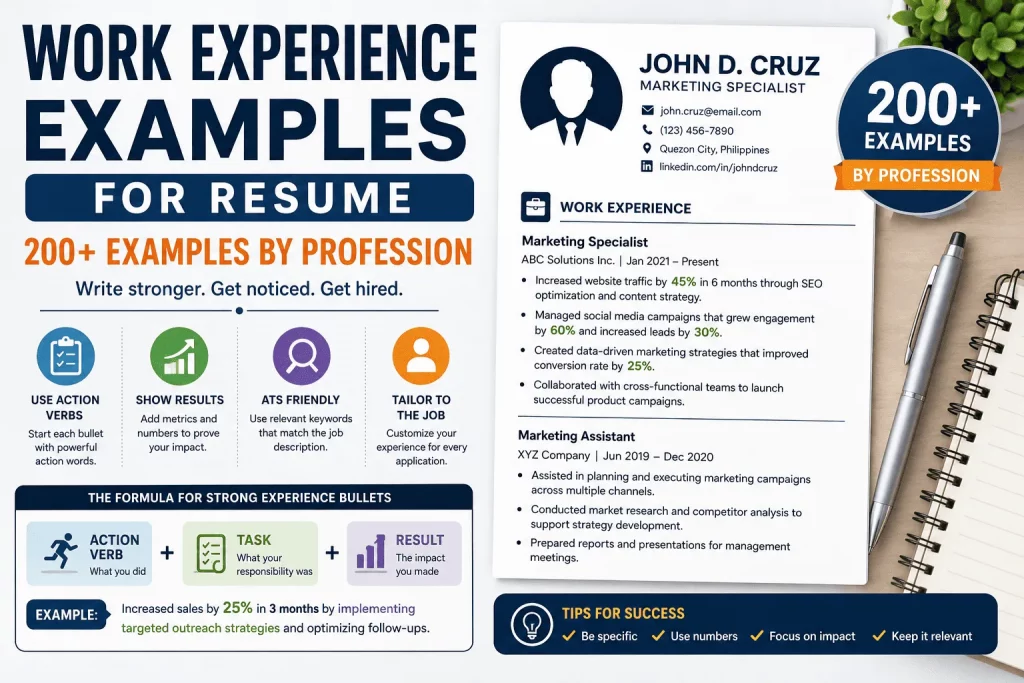
Recruiters spend more time reading the work experience section than any other part of a resume, because it’s where they look for proof — not claims. Your summary tells a recruiter who you say you are. Your skills section tells them what you say you can do. Your work experience section is where they check whether any of that holds up, bullet by bullet, against real jobs and real results.
Applicant tracking systems (ATS) scan this section just as closely, matching the language in your bullet points against the requirements in the job posting. This is also where the single biggest gap between weak and strong resumes shows up: the difference between listing duties and listing achievements. A duty describes what you were assigned to do. An achievement describes what happened because you did it well. Resumes that only list duties tend to blend into every other resume for the same job title — resumes that lead with measurable achievements stand out immediately, because most candidates never bother to write them that way.
This guide covers exactly how to write a strong work experience section, with more than 200 example bullet points organized by profession, career stage, and situation — so you can find one close to your own background and adapt it instead of starting from a blank page.
What should you write in the work experience section? Include your job title, employer, employment dates, key responsibilities, and — most importantly — measurable achievements. For example: “Increased customer satisfaction by 20% through improved complaint resolution procedures.”
Why Work Experience Matters
The work experience section carries more weight than any other part of the resume because it’s the closest thing to direct evidence a recruiter has before an interview. A confident summary and an impressive skills list only go so far if the work history underneath them doesn’t back up the claims — this is the section where a recruiter decides whether your resume matches reality.
It’s also the section most likely to determine salary conversations later in the hiring process. A candidate who documents measurable impact throughout their work history walks into negotiation with concrete leverage; a candidate whose bullets only describe duties has nothing specific to point to when asked to justify a higher offer.
How Recruiters Read Experience
Recruiters typically scan the most recent one or two roles closely, then skim the rest for relevant keywords and standout numbers. They’re looking for a pattern: does this person consistently produce measurable results, or do they mostly describe assigned tasks? A resume where every bullet reads like a job description, with no outcomes attached, gives a recruiter nothing to differentiate you from the next applicant with the same job title.
This scanning behavior also means position within the resume matters. A strong achievement buried as the fifth or sixth bullet under an older role is far less likely to be read than the same achievement placed as the first bullet under your current position — recruiters simply don’t have time to read every line of every job with equal attention.
How ATS Evaluates Experience
ATS platforms parse the work experience section for keyword matches against the job posting, much like they do with the skills section — but here, they also often weigh how recently and how frequently a skill or responsibility appears. A tool or responsibility mentioned in your most recent role typically carries more weight than the same one buried in a position from eight years ago, which is one more reason to keep your most relevant, most recent experience the sharpest and most detailed section of the resume.
Some systems also evaluate structural cues — consistent date formatting, clearly labeled job titles, and a logical reverse-chronological order — as part of determining whether a resume can be parsed reliably at all. A resume that confuses the ATS structurally can lose points before a single keyword is even compared.
Why Achievements Matter More Than Duties
A duty tells an employer what you were responsible for. An achievement tells them what you actually delivered. Employers aren’t hiring you to be responsible for tasks — they’re hiring you to produce outcomes, and a bullet point built around a measurable result answers the question every hiring manager is silently asking: “What will this person actually do for us?”
This distinction matters even more when two candidates share nearly identical job titles and responsibilities. If one resume says “managed a sales territory” and the other says “managed a sales territory, growing quarterly revenue by 22%,” the second candidate has answered a question the first one left open — and in a competitive applicant pool, that unanswered question is often enough to eliminate a resume from consideration.
Work Experience vs Job Duties
| Weak (Duty-Focused) | Strong (Achievement-Focused) |
|---|---|
| Answered customer inquiries | Resolved 50+ customer inquiries daily while maintaining 95% satisfaction |
| Managed social media | Increased social engagement by 40% through targeted campaigns |
| Responsible for filing reports | Reduced report turnaround time by 30% through a streamlined filing process |
| Handled customer complaints | Resolved customer complaints, improving satisfaction scores by 15% |
| Assisted with training | Trained 15 new employees, reducing onboarding time by one week |
Notice that the weak column describes an activity, while the strong column describes an activity plus its measurable outcome. That single addition — a number, a percentage, a named result — is almost always the difference between a forgettable bullet and a persuasive one.
This pattern holds regardless of industry or seniority level. An executive-level bullet and an entry-level bullet follow the exact same underlying logic — only the scale of the numbers changes. “Reduced onboarding paperwork errors by 20%” and “Reduced enterprise-wide compliance violations by 20% across 12 regional offices” are structurally identical achievements; one simply operates at a larger scope than the other.
Atlas Work Experience Formula™
Every strong bullet point in this guide follows the same underlying structure:
ACTION VERB + TASK + RESULT
Weak Example:
Handled customer complaints.
Strong Example:
Resolved customer complaints, resulting in a 15% increase in customer satisfaction scores.
The weak version is a duty with no outcome attached — a recruiter has no way to know whether “handling” complaints meant doing the job well or barely getting by. The strong version keeps the same underlying activity but closes the loop with a measurable result, which is what actually persuades a recruiter that the work mattered.
Need help building an ATS-friendly work experience section? Use our Free Resume Builder Online | Create & Download PDF Resume to organize your work experience automatically using this same formula.
Case Study: Turning a Weak Bullet Into a Strong One
Watching the formula applied step by step makes it easier to use on your own experience. Start with a plain duty statement:
“Responsible for managing inventory.”
Step 1 — add the action verb and scope: Replace the passive “responsible for” with an active verb and specify the actual scope of the work.
“Managed inventory for a 15,000-square-foot warehouse.”
Step 2 — add context: Clarify how the work was done or what made it notable.
“Managed inventory for a 15,000-square-foot warehouse using a barcode-based tracking system.”
Step 3 — add the result: Close with a measurable outcome that shows the impact of the work.
“Managed inventory for a 15,000-square-foot warehouse using a barcode-based tracking system, reducing stock discrepancies by 22% within six months.”
The final version is longer, but every added word is doing work — establishing scope, method, and measurable impact. Compare that to the original six-word duty statement, which told a recruiter almost nothing about how well the job was actually done. This same three-step expansion works on nearly any duty-only bullet: start with the verb and scope, layer in context, then close with whatever result you can reasonably attach.
Atlas Achievement Builder™
Once you’re comfortable with the basic formula, use the Achievement Builder to turn any duty into a quantified achievement:
ACTION + METRIC + RESULT
Examples:
- Increased sales by 25%
- Reduced processing time by 40%
- Managed 50+ client accounts
- Trained 15 new employees
- Cut operating costs by $12,000 annually
- Improved on-time delivery rate to 98%
- Grew email subscriber list by 3,000 in six months
If you’re struggling to find a number for a given achievement, start by estimating a reasonable range from memory (a volume of calls per day, an approximate percentage improvement, a rough dollar figure) rather than leaving the bullet unquantified. An estimated, defensible number is almost always stronger than no number at all — just make sure you can explain how you arrived at it if asked in an interview.
This builder works for almost any duty you’re currently describing without a number attached. Take a task you’ve written down as a plain responsibility, ask yourself what changed as a result of doing it, and attach whatever metric best captures that change — volume handled, time saved, cost reduced, or people impacted are usually the fastest places to look first.
Common Achievement Categories to Mine
If you’re stuck trying to find a metric for a given role, work through these categories one at a time — almost every job has at least one measurable outcome hiding in each:
- Revenue or sales: Did you contribute to growth, a new account, or a larger deal size?
- Cost or time savings: Did you streamline a process, cut waste, or reduce turnaround time?
- Volume handled: How many customers, transactions, cases, or units did you manage regularly?
- Quality or accuracy: Did you reduce errors, improve a satisfaction score, or pass an audit cleanly?
- People led or trained: How many direct reports, new hires, or trainees did you support?
- Scale of budget or resources: What size budget, account list, or inventory did you manage?
- Speed or efficiency: Did you reduce the time something took, from days to hours or hours to minutes?
Most candidates can find at least one usable number in each category for any role they’ve held — the exercise is less about remembering an exact figure and more about recognizing that the outcome existed at all.
Work Experience Impact Pyramid™
Not every line in your work experience section carries equal weight. The Work Experience Impact Pyramid™ helps you decide what to lead with and what to trim.
Tier 1: Measurable Achievements (Highest Priority)
The strongest, most persuasive bullets — outcomes with numbers attached.
Examples: Increased revenue, reduced costs, improved efficiency, grew a customer base, cut turnaround time.
Tier 2: Key Responsibilities
Meaningful scope-of-work statements that establish what you were trusted to handle, even without a specific metric attached.
Examples: Managed projects, coordinated teams, oversaw a budget, led a department initiative.
Tier 3: Basic Duties
Routine tasks that are worth including for completeness but shouldn’t dominate the section.
Examples: Answered calls, prepared documents, filed paperwork, attended meetings.
How to use the pyramid: Lead each role with one or two Tier 1 achievements, follow with a couple of Tier 2 responsibility statements that establish scope, and use Tier 3 duties sparingly — only when they’re relevant to the target role and there’s room left after the stronger bullets.
Atlas Insight: The most effective work experience sections read top-heavy on purpose — the strongest, most quantified achievement in each role should be the very first bullet a recruiter sees, not buried in the middle or saved for last. Recruiters scanning quickly often read the first bullet of each role closely and skim the rest, so that first line carries a disproportionate share of the section’s persuasive weight.
How to Write Work Experience
Step 1: Start With Action Verbs
Open every bullet with a strong, specific action verb rather than a passive phrase like “was responsible for.” Verbs like Managed, Developed, Implemented, Coordinated, Analyzed, Led, Streamlined, and Negotiated immediately signal ownership of the work.
Step 2: Add Context
After the action verb, answer the basic who/what/how questions: what exactly did you do, for whom or on what, and using what method or approach? This context is what separates a vague bullet (“Managed a team”) from a specific one (“Managed a five-person customer support team handling over 200 daily tickets”).
Step 3: Add Results
Close the bullet with a measurable result wherever possible — numbers, percentages, revenue figures, time saved, or customer satisfaction scores. This is the step most resumes skip, and it’s the single highest-leverage change you can make to an otherwise generic bullet point.
If you genuinely don’t have access to an exact figure — common for roles without direct visibility into company-wide metrics — describe the result in terms of scale or scope instead: “supported a team of 12,” “handled a caseload of 40+ clients,” “processed transactions for a $2M monthly budget.” Scale statements aren’t as strong as a direct percentage improvement, but they’re still far more informative than a bare duty statement with no numbers at all.
Step 4: Tailor to the Job Description
Review the job posting and adjust your bullet points to mirror its language and priorities. If the posting emphasizes “cross-functional collaboration,” and one of your bullets describes exactly that but in different words, rewrite it to match — this improves both ATS keyword matching and the human recruiter’s sense that you’re a direct fit.
Work Experience Examples by Profession
The examples below are grouped by profession. Adapt the specifics — numbers, tools, and scope — to reflect your own experience rather than copying them verbatim.
Administrative Assistant
- Managed executive calendars for five senior managers, reducing scheduling conflicts by 25%.
- Coordinated travel arrangements and expense reporting for a 12-person department.
- Organized company records and filing systems, cutting document retrieval time in half.
- Processed incoming correspondence and routed inquiries to the appropriate department within 24 hours.
- Maintained office supply inventory, reducing monthly procurement costs by 15%.
- Prepared meeting agendas and minutes for weekly leadership meetings.
- Onboarded new hires by coordinating orientation schedules and paperwork completion.
- Implemented a digital filing system that reduced document retrieval errors by 30%.
- Managed vendor invoicing and purchase orders for the department’s annual $80,000 budget.
- Coordinated logistics for quarterly all-staff meetings attended by over 150 employees.
- Digitized a decade of paper archives into a searchable electronic filing system.
- Coordinated catering and logistics for over 50 internal events annually.
- Reduced office supply waste by 18% through a revised inventory reorder process.
- Served as the primary point of contact for building maintenance and facilities requests.
- Drafted routine correspondence on behalf of two department directors.
Customer Service Representative
- Resolved 60+ customer inquiries daily while maintaining a 95% satisfaction rating.
- Processed customer orders accurately, reducing fulfillment errors by 20%.
- De-escalated high-priority complaints, retaining an average of 90% of at-risk accounts.
- Trained three new customer service hires on company systems and communication standards.
- Maintained a first-call resolution rate 15% above the team average.
- Documented recurring customer issues, contributing to a product FAQ that cut repeat inquiries by 30%.
- Achieved a customer retention rate 10% above the department average through proactive follow-up.
- Handled refund and exchange requests, maintaining compliance with company policy on 100% of cases.
- Cross-trained in three product lines to support seasonal call volume spikes.
- Processed warranty claims, maintaining a 48-hour average turnaround time.
- Collected and summarized customer feedback that informed two product improvements.
- Maintained detailed case notes that reduced repeat contacts for the same issue by 20%.
- Handled outbound retention calls for at-risk accounts, saving 65% of contacted customers.
- Supported a product recall communication effort, reaching 5,000+ affected customers within 72 hours.
Virtual Assistant
- Managed multiple client calendars across three time zones with zero scheduling conflicts.
- Scheduled appointments and handled email correspondence for two active clients simultaneously.
- Prepared weekly reports and presentations for client business reviews.
- Coordinated travel bookings and itinerary planning for executive clients.
- Managed a client’s social media posting schedule, maintaining consistent daily engagement.
- Streamlined a client’s inbox management process, reducing unread email backlog by 80%.
- Managed invoicing and basic bookkeeping for two small business clients using QuickBooks.
- Researched and compiled competitor pricing data to support a client’s quarterly strategy review.
- Coordinated podcast guest scheduling and pre-interview logistics for a growing media client.
- Managed a client’s Amazon seller account, maintaining a 4.8-star average rating.
- Coordinated freelance contractor onboarding for a growing digital agency client.
- Built and maintained a client resource wiki that reduced repeat training questions by 40%.
- Prepared monthly performance summaries for three concurrent client engagements.
- Transcribed and organized meeting notes for weekly leadership syncs.
Teacher
- Developed lesson plans aligned with curriculum standards for a class of 30 students.
- Improved average student assessment scores by 15% through targeted, differentiated instruction.
- Managed classroom activities and behavior for 40 students across two class sections.
- Implemented a reading intervention program that raised literacy scores by 20% within one semester.
- Coordinated with parents and guardians to support student progress, increasing parent engagement at conferences by 25%.
- Mentored two student teachers through their classroom practicum requirements.
- Integrated technology tools into daily lessons, increasing student engagement scores by 18%.
- Organized a school-wide reading event that increased library checkout rates by 25%.
- Collaborated with fellow teachers to redesign the grade-level curriculum pacing guide.
- Designed a project-based unit that increased student participation scores by 22%.
- Coordinated with special education staff to implement accommodations for 8 students.
- Led a parent-teacher conference cycle with a 95% attendance rate.
- Piloted a new classroom technology tool later adopted school-wide.
- Supervised extracurricular clubs, growing combined membership by 35% over one school year.
Accountant
- Prepared monthly financial statements for a company with $10M in annual revenue.
- Managed accounts payable and receivable, reducing outstanding invoices by 20%.
- Conducted financial reconciliations, identifying and correcting $50,000 in reporting discrepancies.
- Streamlined the month-end close process, cutting completion time from 10 days to 6.
- Prepared and filed quarterly tax documents in full compliance with regulatory deadlines.
- Supported the annual audit process, resulting in zero material findings.
- Implemented a new expense-tracking process that reduced reimbursement processing time by 25%.
- Managed vendor payment schedules for over 100 active accounts.
- Trained two junior accounting staff on reconciliation procedures and internal controls.
- Managed payroll processing for a workforce of 150 employees with zero errors over 12 cycles.
- Prepared cost-benefit analyses that supported two capital investment decisions.
- Reconciled multi-currency transactions for an international vendor portfolio.
- Automated a manual invoice-matching process, saving 8 hours of staff time weekly.
- Supported budget variance reporting for six department heads on a monthly basis.
Nurse
- Administered medications safely to a patient caseload of up to 8 patients per shift.
- Maintained accurate patient records in compliance with hospital documentation standards.
- Coordinated patient care plans with a multidisciplinary team, improving discharge readiness scores.
- Reduced average patient wait time by 20% through improved triage prioritization.
- Educated patients and families on post-discharge care, lowering 30-day readmission rates.
- Precepted two newly licensed nurses through unit orientation.
- Maintained a medication administration error rate of zero across a 12-month period.
- Participated in a unit quality improvement initiative that reduced fall incidents by 20%.
- Coordinated discharge planning with case managers, shortening average length of stay by half a day.
- Administered pre- and post-operative care for a surgical caseload of 6-8 patients per shift.
- Conducted patient education sessions that improved chronic disease self-management compliance.
- Led code-team response for cardiac and respiratory emergencies on a med-surg unit.
- Collaborated with physical therapy to accelerate post-surgical mobility milestones.
- Maintained charting accuracy that passed two consecutive Joint Commission reviews with no citations.
Software Developer
- Developed web applications using React and Node.js, serving over 100,000 monthly users.
- Improved system performance by 30% through backend query optimization.
- Implemented API integrations that reduced manual data entry across two internal tools.
- Led the migration of a legacy codebase, cutting page load times by 40%.
- Wrote automated test coverage that reduced production bugs by 25%.
- Mentored two junior developers on code review best practices.
- Built a CI/CD pipeline that reduced deployment time from two hours to fifteen minutes.
- Refactored a legacy authentication module, eliminating a recurring class of production bugs.
- Collaborated with product and design teams to ship three major features per quarter.
- Designed a microservices architecture that improved system scalability during a 3x traffic increase.
- Reduced API response times by 45% through targeted caching and query optimization.
- Collaborated with QA to implement a bug-triage process that cut resolution time by 30%.
- Built an internal admin dashboard that eliminated a previously manual weekly reporting task.
- Participated in an on-call rotation, maintaining a 99.9% uptime SLA across six months.
- Built a component library that reduced front-end development time on new features by 20%.
- Integrated a third-party payment gateway, processing over $1M in monthly transactions.
- Led a code refactor that reduced application bundle size by 35%.
- Documented internal engineering standards adopted across a 10-person development team.
- Contributed to an open-source internal tool used by three product teams company-wide.
IT Professional
- Troubleshot hardware and software issues for a 300-employee organization, maintaining a 98% resolution rate.
- Managed Active Directory accounts and permissions across multiple departments.
- Reduced average ticket resolution time from 48 hours to 12 hours.
- Implemented a new ticketing system that improved help desk response tracking.
- Maintained server uptime above 99.5% through proactive monitoring and maintenance.
- Led a cybersecurity awareness initiative that reduced phishing click-through rates by 35%.
- Migrated 200+ employee accounts to a new cloud email platform with zero data loss.
- Documented standard operating procedures that cut new IT hire ramp-up time by a week.
- Managed vendor relationships for hardware procurement, negotiating a 10% cost reduction.
- Migrated the organization’s file storage to a cloud-based system, improving accessibility for remote staff.
- Reduced average onboarding setup time for new hires from 2 days to 4 hours.
- Maintained compliance with data security policies across 250+ employee devices.
- Led the rollout of a new VoIP phone system across four office locations.
- Documented a disaster recovery plan that was successfully tested during a regional outage.
Marketing Specialist
- Increased website traffic by 50% through a targeted SEO and content strategy.
- Managed social media campaigns that grew follower count by 10,000 in six months.
- Conducted keyword research and SEO audits that informed a full content calendar overhaul.
- Launched an email nurture campaign that increased conversion rate by 18%.
- Coordinated a product launch campaign that exceeded lead generation targets by 30%.
- Managed a $50,000 quarterly paid advertising budget, achieving a 3.5x return on ad spend.
- Built and executed a content calendar that grew organic blog traffic by 75% year-over-year.
- Led rebranding efforts for a product line relaunch, contributing to a 20% sales lift.
- Analyzed campaign performance data to reallocate spend toward the highest-converting channels.
- Managed influencer partnerships that generated over 2 million impressions in a single campaign.
- Redesigned the company website landing page, improving conversion rate by 25%.
- Produced a monthly newsletter with an average open rate 10 points above industry benchmark.
- Led market research that identified a new customer segment, informing a successful product pivot.
- Coordinated a trade show presence that generated 300+ qualified leads over three days.
Human Resources
- Managed recruitment and onboarding processes for over 40 hires annually.
- Coordinated employee training programs that improved new-hire retention by 15%.
- Maintained HR compliance records across a workforce of 250 employees.
- Reduced average time-to-hire from 45 to 30 days through a streamlined interview process.
- Implemented an employee engagement survey that informed two new retention initiatives.
- Administered benefits enrollment for the full employee population with zero compliance errors.
- Redesigned the new-hire onboarding process, improving 90-day retention by 12%.
- Investigated and resolved employee relations cases in compliance with company policy.
- Led a compensation benchmarking project that informed a company-wide pay structure update.
- Designed a performance review process adopted company-wide, improving manager consistency scores.
- Managed layoffs and severance processes in full compliance with labor regulations.
- Facilitated conflict resolution between department heads, restoring a stalled cross-team project.
- Built an internal mentorship program that paired 30 employees across two departments.
- Reduced HR-related compliance complaints by 40% through improved policy communication.
Government Employee
- Processed permit applications for a municipal office, reducing average processing time by 20%.
- Managed public records requests in compliance with regulatory disclosure timelines.
- Coordinated interagency communications for a multi-department community initiative.
- Reduced backlog of pending case files by 35% through improved workflow prioritization.
- Prepared budget reports supporting a $5M departmental annual allocation.
- Facilitated public information sessions attended by over 200 community members.
- Streamlined the license renewal process, reducing average applicant wait time by 15%.
- Coordinated disaster response logistics for a regional emergency management office.
- Maintained regulatory compliance across 500+ active case files with zero audit findings.
- Drafted policy recommendations adopted into the agency’s updated procedures manual.
- Coordinated a multi-department response to a public records request involving 10,000+ documents.
- Managed a constituent services hotline, resolving 85% of inquiries on first contact.
- Prepared grant applications that secured $250,000 in additional program funding.
- Led community engagement outreach that increased public meeting attendance by 50%.
Data Analyst
- Built Power BI dashboards that reduced manual reporting time by 10 hours per week.
- Conducted SQL-based data analysis supporting quarterly business planning decisions.
- Improved reporting efficiency by automating a previously manual data pipeline.
- Identified a data trend that informed a pricing adjustment, increasing margin by 8%.
- Cleaned and standardized a dataset of over 100,000 records for enterprise-wide reporting.
- Presented data-driven insights to leadership that shaped a new customer segmentation strategy.
- Built a churn prediction model that improved retention campaign targeting accuracy by 20%.
- Automated a weekly executive reporting workflow, saving 6 hours of manual work per week.
- Partnered with product teams to define and track key performance metrics for a new feature launch.
- Designed A/B tests that informed a UI change resulting in a 12% increase in conversion.
- Migrated legacy reporting from Excel to a centralized BI platform, improving accuracy and speed.
- Conducted cohort analysis that identified the primary driver of a customer retention decline.
- Built a self-service reporting tool that reduced ad hoc data requests by 60%.
- Presented quarterly data findings to a cross-functional leadership team of 12 stakeholders.
Ready to see profession-specific work experience suggestions for your own resume? Create an ATS-friendly resume with our Free Resume Builder Online | Create & Download PDF Resume, which offers tailored suggestions by role.
Work Experience for Fresh Graduates
Fresh graduates without extensive paid work history can still build a strong experience section by drawing on internships, academic projects, volunteer work, and student organization involvement — framed with the same action-plus-result structure used throughout this guide. The mistake most fresh graduates make isn’t a lack of experience; it’s failing to recognize that unpaid or academic work still counts as legitimate experience when it’s described with the same specificity and outcome-focus as a paid role.
Internship Examples
- Assisted the marketing team in drafting social media content, contributing to a 10% increase in engagement.
- Supported the finance department with data entry and reconciliation for weekly expense reports.
- Shadowed senior consultants on client calls and helped prepare presentation materials.
- Conducted market research that informed a new product positioning recommendation.
- Compiled and formatted client-ready reports using Excel and PowerPoint under tight weekly deadlines.
- Coordinated logistics for a summer internship cohort of 20 interns across three departments.
Academic Project Examples
- Led a four-person capstone team to design and present a functional engineering prototype.
- Conducted statistical analysis on a research dataset of 500+ survey responses using SPSS.
- Developed a business plan for a class venture project that placed in the top 3 of 20 teams.
- Built a working web application as part of a semester-long software engineering course.
- Analyzed a local business’s sales data for a marketing capstone, recommending a pricing change that modeled a 12% margin improvement.
- Presented original research findings at a university-wide undergraduate research symposium.
Volunteer Experience Examples
- Coordinated a fundraising event that raised $5,000 for a local nonprofit.
- Organized weekly volunteer shifts for a team of 15 at a community food bank.
- Led campus outreach efforts that increased club membership by 40% in one semester.
- Tutored underserved high school students in mathematics, improving average test scores.
- Organized a clothing drive that collected over 800 items for a local shelter.
- Led a team of 10 volunteers coordinating logistics for a campus sustainability fair.
Student Organization Examples
- Served as treasurer for a 60-member student organization, managing an annual budget of $3,000.
- Planned and executed three campus events with attendance exceeding 200 students each.
- Managed the organization’s social media accounts, growing followers by 500 in one year.
- Recruited and onboarded 20 new members during the fall semester recruitment drive.
- Designed promotional graphics for club events, increasing average attendance by 30%.
- Represented the organization at two inter-university leadership conferences.
Work Experience for Career Changers
Career changers should frame prior experience around transferable responsibilities rather than industry-specific tasks, drawing a clear line between what you did before and what the new role requires.
Common transferable experience to highlight: leadership of teams or projects, budget oversight and resource management, client and stakeholder communication, process improvement initiatives, cross-functional collaboration, and any measurable outcome that translates across industries regardless of the specific field it happened in.
Example:
Former retail store manager transitioning into operations: “Managed a team of 20 employees and a $2M annual budget, reducing operating costs by 12% through improved scheduling and inventory processes.” — this bullet reads just as relevant to a logistics or operations hiring manager as it did in its original retail context, because the underlying skills (team leadership, budget management, process improvement) transfer directly.
Additional career-change bullet examples:
- Led a cross-functional team of 8 through a system migration, completing the project two weeks ahead of schedule.
- Managed vendor relationships and contract negotiations, reducing annual procurement costs by 10%.
- Trained and supervised a rotating staff of 15, maintaining service quality during a 40% year-over-year growth period.
- Oversaw daily operations for a multi-location business, standardizing procedures that improved consistency across all sites.
A brief summary line connecting your prior industry to the new one — placed just above your work history or within your resume summary — can also help a recruiter immediately understand the transition rather than having to piece it together from job titles alone.
It’s also worth being selective about which older, industry-specific bullets to keep versus cut. A career changer doesn’t need to preserve every bullet from their prior field — trim the ones that only make sense within the old industry’s specific jargon or context, and keep the ones where the underlying skill reads clearly to someone outside that field. If a bullet requires the reader to already understand your old industry to appreciate the achievement, it’s a candidate for rewriting or removal.
ATS-Friendly Work Experience
Why ATS Reads Experience
Most mid-size and large employers run resumes through an ATS before a human reviews them, and the work experience section is typically the largest source of keyword matches on the page. A resume that lists responsibilities and achievements without ever naming the specific tools, methods, or terminology from the job posting risks a lower match score, regardless of how strong the underlying experience actually is.
Keywords Matter
Identify the specific tools, certifications, and terminology repeated in the job posting, and make sure your work experience bullets use that same language wherever it’s accurate to do so — not just your skills section. Many candidates make the mistake of loading their skills section with the right keywords while leaving the work experience section in vague, generic language — but since the experience section is usually the largest block of text on the resume, it’s also where the ATS finds the bulk of its keyword matches.
Use Exact Job Posting Language
If a posting says “cross-functional collaboration” and your bullet describes the same thing as “worked with other departments,” rewrite it to match the posting’s phrasing. ATS platforms often match on exact or near-exact terms rather than loosely related synonyms.
Formatting Tips
Use a clean, reverse-chronological format with clear job titles, employer names, and dates. Avoid placing bullet content inside tables, text boxes, or graphics, since many ATS platforms fail to parse those elements correctly — plain bullet points in a standard font remain the safest, most reliably parsed format.
Choosing the Right Resume Format for Your Work Experience
Most candidates should default to a reverse-chronological format — listing roles from most recent to oldest — since it’s the format both recruiters and ATS platforms are most familiar with and best able to parse accurately. A functional or skills-based format, which groups experience by competency rather than by job and timeline, can help candidates with employment gaps or a heavily career-changed background, but it comes with a real trade-off: many ATS platforms and recruiters are less comfortable with it, and some read it as an attempt to obscure a spotty work history even when that isn’t the intent.
A hybrid format — a brief skills or qualifications summary at the top, followed by a standard reverse-chronological work history — often gives career changers and candidates with gaps the best of both approaches: it lets you lead with relevant qualifications while still presenting a work history in the format everyone expects to see.
Work Experience for Remote and Hybrid Roles
Remote and hybrid job postings often list additional expectations around self-management and asynchronous collaboration, and your work experience bullets can address these directly even if your prior roles weren’t formally “remote.” If you managed your own schedule, coordinated with colleagues across time zones, or delivered results with minimal day-to-day supervision, name that explicitly.
Examples:
- Managed a fully remote client portfolio across four time zones with no missed deadlines over 18 months.
- Independently prioritized and completed a weekly workload with minimal direct supervision.
- Facilitated asynchronous project updates for a distributed team of 8 using Slack and Notion.
- Delivered consistent results while transitioning a previously in-office role to a hybrid schedule.
Framing past experience this way is especially useful for candidates applying to their first fully remote role — it reassures a hiring manager that you already have the self-direction the role requires, even without formal remote-work history on paper.
How AI-Powered Screening and Generative Search Read Work Experience
Beyond traditional ATS platforms, a growing number of hiring workflows involve AI-assisted screening tools that summarize or rank candidates based on resume content, and increasingly, professional profiles surface in generative search results and AI-generated career advice. These systems tend to reward the same qualities that make a resume clear to a human reader: specific, quantified bullet points rather than vague task descriptions; consistent terminology that matches how a role is typically described in the industry; and a clean, parseable structure rather than dense, unstructured paragraphs.
Practically, this means the habits that make a resume ATS-friendly and human-readable also make it easier for AI-based systems to parse and summarize accurately. A bullet point built on the Action Verb + Task + Result formula used throughout this guide is inherently easier for any reader — human, ATS, or AI — to extract meaning from than a vague, duty-only sentence with no clear structure.
How Many Bullet Points Per Job?
There’s no universal rule, but most well-structured resumes follow a simple weighting pattern: your most recent and most relevant role gets the most detail — typically 4 to 6 bullet points — while older or less relevant roles taper down to 2 or 3. A role from more than 10 years ago that isn’t directly relevant to your target job might warrant a single summary line rather than a full bullet list.
This tapering serves two purposes. First, it keeps the resume focused on what matters most to the hiring decision at hand. Second, it implicitly signals seniority and career progression — a resume where detail decreases as roles get older reads as a natural career arc, rather than an undifferentiated list where a ten-year-old internship gets the same space as last year’s management role.
Work Experience Mistakes to Avoid
Listing duties only. A bullet point that describes an assigned task with no outcome attached reads as generic and forgettable, no matter how important the task actually was.
No metrics. Bullets without numbers force a recruiter to guess at scale and impact. Even an estimated range is stronger than leaving a bullet unquantified entirely.
Using passive language. Phrases like “was responsible for” or “duties included” put the emphasis on the job description rather than on you as the person who delivered results. Lead with an active verb instead.
Including irrelevant experience. Older or unrelated roles that don’t support your case for the target job take up space that could go toward more relevant, more recent achievements — trim or shorten these rather than giving them equal weight.
Using generic descriptions. Vague phrasing like “helped with various tasks” or “assisted the team” tells a recruiter almost nothing. Be specific about exactly what you did and what changed because of it.
Overloading a single bullet with too much information. A bullet trying to cram three separate accomplishments into one long, run-on sentence is harder to scan than three short, focused bullets. If a bullet needs more than one “and” to hold everything together, consider splitting it.
Repeating the same achievement across multiple roles. If you’ve held similar positions at different companies, resist the temptation to reuse the exact same bullet for both. Even when the underlying responsibility was similar, find a distinguishing detail — a different metric, a different scope, a different challenge solved — so each role reads as its own contribution rather than a copy-paste of the last one.
Good vs Bad Work Experience Example
Weak
Responsible for customer service.
Problem: This is a duty statement with no context, no scope, and no measurable outcome. It could describe almost any customer-facing role at any level of performance.
Strong
Resolved 50+ customer inquiries daily while maintaining a 95% customer satisfaction rating.
Why it works: It quantifies the volume of work handled, states a clear performance metric, and gives a recruiter an immediate, credible sense of both scale and quality.
A second comparison:
- Weak: “Assisted with project coordination.”
- Strong: “Coordinated a 6-month product launch across four departments, delivering on schedule and 8% under budget.”
The weak version could describe almost any level of involvement, from a minor supporting role to full ownership. The strong version removes that ambiguity entirely — it states the scope, the timeline, and the outcome, leaving no doubt about the level of responsibility involved.
Atlas Experience Strength Score™
Before finalizing your work experience section, score each bullet point against this scale.
| Score | Meaning |
|---|---|
| 90–100 | Outstanding |
| 70–89 | Strong |
| 50–69 | Average |
| Below 50 | Rewrite |
Evaluation questions:
- Does it use a strong action verb?
- Does it include a measurable result?
- Is it relevant to the target role?
- Does it include ATS-relevant keywords?
A bullet that answers yes to all four questions typically lands in the 90–100 range. A bullet missing a measurable result but otherwise solid usually falls to 70–89 — strong, but with room to improve. Any bullet that’s still describing a duty with no result, no relevance check, and no keyword alignment belongs below 50 and is a candidate for a full rewrite rather than a minor edit.
Work Experience Checklist™
Before submitting your resume, confirm each of the following:
- Action verbs used to open every bullet point
- ATS keywords from the job posting included throughout
- Metrics added wherever a result can be reasonably quantified
- Most relevant experience prioritized and placed first
- Achievements highlighted ahead of routine duties
Ready to turn your experience into a professional resume? Use our Free Resume Builder Online | Create & Download PDF Resume to build a polished, ATS-ready work experience section from scratch.
Key Takeaways
- Focus on achievements, not duties.
- Add numbers whenever possible.
- Use ATS-friendly keywords that mirror the job posting.
- Tailor your experience section to every application.
- Lead with the most relevant accomplishments.
Frequently Asked Questions
How far back should work experience go?
Most resumes should cover the past 10 to 15 years of relevant experience. Older roles can be summarized briefly or omitted entirely unless they’re directly relevant to the target position — for senior candidates with a long history, a brief “earlier career” line summarizing older roles in one sentence is often more effective than listing them individually.
Should I include internships?
Yes, especially for fresh graduates or early-career candidates with limited full-time work history. Frame internship experience with the same action-plus-result structure used for paid roles.
Can I include volunteer experience?
Yes, particularly when it demonstrates transferable skills relevant to the target role or when your paid work history is limited. Treat volunteer bullets with the same level of specificity and measurable detail as any other experience entry.
What if I have no work experience?
Lean on academic projects, internships, volunteer work, and student organization involvement, framed using the same formula: action verb, context, and measurable result wherever possible.
How many bullet points should each job have?
Most roles should have 3 to 6 bullet points, with more detail given to recent and highly relevant positions and fewer bullets for older or less relevant roles.
Should I include achievements?
Yes — achievements should make up the majority of your work experience section. They’re the single strongest signal of your actual impact in a role, far more persuasive than a list of assigned duties.
What if I changed careers?
Frame your experience around transferable skills and outcomes rather than industry-specific tasks, and consider a brief note or summary line connecting your prior background to the new direction so the transition reads as intentional rather than confusing.
Should I quantify every single bullet point?
Not necessarily — aim for as many quantified bullets as you can honestly support, but a role or task without a clean, defensible number is still worth including if it’s relevant, described specifically, and framed around what you actually did rather than a vague duty. The goal is a strong majority of quantified bullets, not a rigid requirement that every line include a number.
Do I need a different work experience section for every job I apply to?
You don’t need to rewrite it from scratch, but you should review and adjust it for every application. Reorder bullets to lead with the most relevant achievements for that specific posting, swap in language that mirrors the job description, and trim anything that doesn’t support your case for that particular role.
Final Thoughts
A resume doesn’t win an interview because it lists the most responsibilities — it wins because it proves, in specific and measurable terms, that the candidate gets results. Every bullet point in your work experience section is an opportunity to make that case. Lead with action verbs, back every claim with a number wherever you can, and tailor the section to each job posting rather than reusing one static version. Combined with a strong summary and a sharply targeted skills section, a results-driven work experience section is what turns a resume from a list of past jobs into a genuine case for why you should get the next one.
Related Guides
- Skills for Resume: 300+ Skills Examples for Every Profession
- Resume Summary Examples: 150 Professional Summary Examples for Every Job
- Resume Builder: Complete Guide to Creating a Professional Resume
- Resume Objective Examples: 150+ Examples for Every Job
- Application Letter for Fresh Graduates: Sample and Writing Guide
- Free Application Letter Generator for Government Jobs and Private Companies
- Application Letter for Administrative Assistant I: Complete Sample and Writing Guide
- Application Letter for Teacher I: Sample, Format, and Writing Guide
- Application Letter for Nurse I: Sample and Writing Guide