Quick Answer
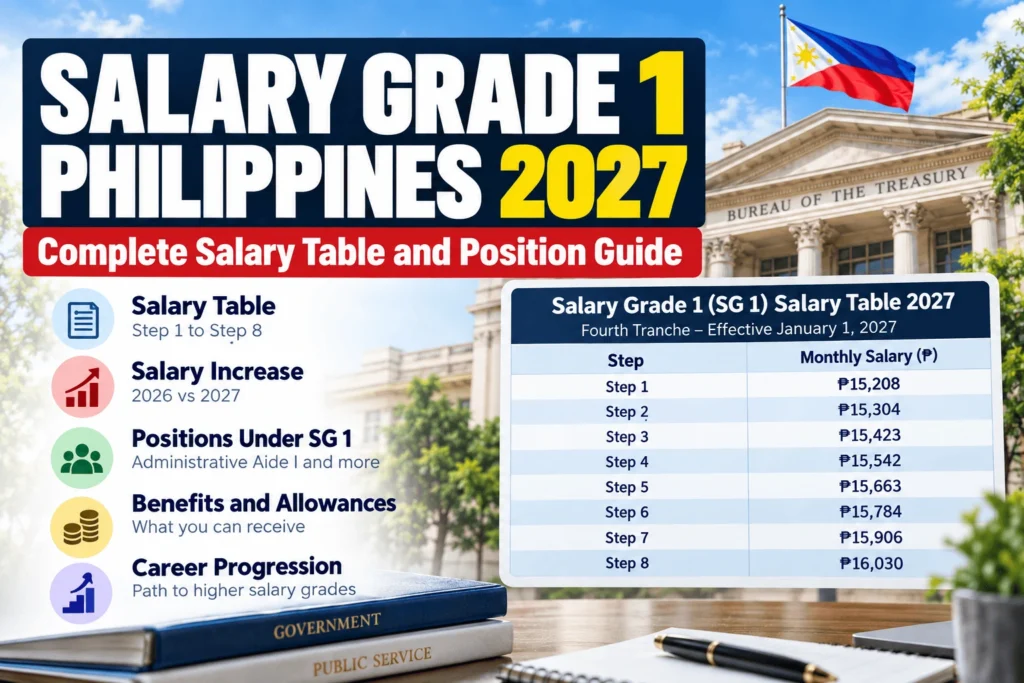
Salary Grade 1 (SG 1) is the entry-level salary grade in the Philippine government. Effective January 1, 2027, SG 1 pays a monthly basic salary of ₱15,208 at Step 1, rising to ₱16,030 at Step 8, under the fourth and final tranche of Executive Order No. 64, s. 2024. Administrative Aide I is a common SG 1 position.
Salary Grade 1 (SG 1) is the entry-level salary grade in the Philippine government compensation system. Effective January 1, 2027, employees under Salary Grade 1 receive a monthly basic salary ranging from ₱15,208 at Step 1 to ₱16,030 at Step 8 under the fourth tranche of Executive Order No. 64.
This guide gives you the complete SG 1 salary table for 2027, shows how much the pay rises from 2026, and explains how step increments work. It also covers the positions under SG 1, the path to higher grades, the benefits that come with the job, and who is covered. For the full schedule of all 33 grades, see our Salary Grade 2027 Philippines guide.
Key Takeaways
- Salary Grade 1 starts at ₱15,208 monthly in 2027.
- Step 8 reaches ₱16,030 monthly.
- Administrative Aide I is a common SG 1 position.
- SG 1 receives the fourth tranche increase under EO 64.
- Government employees may progress through Step 1 to Step 8 over time.
- The increase from 2026 is about ₱574 per month at Step 1 (3.92%).
What is Salary Grade 1?
Salary Grade 1 is the lowest of the 33 salary grades in the Philippine government pay scale. Every civilian government position is assigned a grade based on the difficulty of the work, the level of responsibility, and the qualifications the position requires. SG 1 sits at the very bottom of that structure and is reserved for basic support work that needs little formal schooling and no prior experience.
The grade belongs to the Compensation and Position Classification System (CPCS), the framework the government uses to organize and pay its workforce. Two bodies share responsibility for it. The Civil Service Commission (CSC) sets the qualification standards for each position, covering education, training, experience, and eligibility. The Department of Budget and Management (DBM) sets the peso amounts attached to each grade and step. Together, they decide who can hold an SG 1 position and how much it pays.
A few points define SG 1:
- Lowest salary grade in government. No civilian grade pays less at the same tranche.
- Entry-level classification. Positions here are the usual starting point for people with minimal formal qualifications.
- Common support roles. Typical SG 1 work includes basic office and utility support, such as running errands, keeping the workplace clean and orderly, and helping with the delivery of documents and supplies.
- Eight salary steps. Like most grades, SG 1 has eight steps, so pay can rise gradually without a change of position.
The current pay levels come from Executive Order No. 64, s. 2024, commonly called Salary Standardization Law VI (SSL VI). The order spreads a salary increase over four annual tranches, each taking effect on January 1 from 2024 to 2027. The 2027 figures in this guide belong to the fourth and final tranche.
Salary Grade 1 Salary Table 2027
The table below shows the monthly basic salary for every step of SG 1, effective January 1, 2027. Figures are in Philippine pesos and cover basic salary only, before deductions, allowances, or bonuses.
| Step | Monthly Salary (2027) |
|---|---|
| Step 1 | ₱15,208 |
| Step 2 | ₱15,304 |
| Step 3 | ₱15,423 |
| Step 4 | ₱15,542 |
| Step 5 | ₱15,663 |
| Step 6 | ₱15,784 |
| Step 7 | ₱15,906 |
| Step 8 | ₱16,030 |
The gap between Step 1 and Step 8 is ₱822 a month. Each move from one step to the next adds a small, fairly even amount:
| Step Change | Monthly Increase |
|---|---|
| Step 1 to Step 2 | ₱96 |
| Step 2 to Step 3 | ₱119 |
| Step 3 to Step 4 | ₱119 |
| Step 4 to Step 5 | ₱121 |
| Step 5 to Step 6 | ₱121 |
| Step 6 to Step 7 | ₱122 |
| Step 7 to Step 8 | ₱124 |
Source: Fourth Tranche Monthly Salary Schedule under Executive Order No. 64, s. 2024, effective January 1, 2027. Confirm your exact rate against the DBM implementing circular once it is released.
How Much is the Salary Grade 1 Increase in 2027?
The fourth tranche raises the SG 1 Step 1 salary from ₱14,634 in 2026 to ₱15,208 in 2027. That is an increase of ₱574 per month, or about 3.92%.
Comparison with the previous tranche. In 2025, the SG 1 Step 1 rate was ₱14,061. The third tranche added ₱573 to reach ₱14,634 in 2026 (about 4.08%). The fourth tranche adds ₱574 (about 3.92%). In peso terms, the last two tranches are almost identical. Compared with 2025, the 2027 Step 1 rate is ₱1,147 higher, a gain of about 8.2% over two years.
Annual impact. Multiplying the monthly increase by 12 gives about ₱6,888 more in basic salary per year at Step 1. Because the mid-year and year-end bonuses are each equal to one month of basic salary, they rise by ₱574 each as well. If the current bonus rules continue in 2027, the total yearly gain at Step 1, counting basic salary and both bonuses, comes to about ₱8,036.
The increase is nearly the same at every step. Employees at higher steps receive almost the same peso amount as employees at Step 1, which means the percentage gain is slightly smaller as you move up. Step 1 gains about 3.92%, while Step 8 gains about 3.71%.
Timing matters too. The fourth tranche takes effect on January 1, 2027, but the DBM issues implementing guidelines for each tranche through a budget circular. For 2027, the circular is expected around the start of the year. As with earlier tranches, agencies that cannot process the new rates immediately typically pay the difference later as a salary differential.
Salary Grade 1: 2026 vs 2027
The table compares the third-tranche (2026) and fourth-tranche (2027) rates at every step of SG 1.
| Step | 2026 | 2027 | Monthly Increase | % Increase |
|---|---|---|---|---|
| Step 1 | ₱14,634 | ₱15,208 | ₱574 | 3.92% |
| Step 2 | ₱14,730 | ₱15,304 | ₱574 | 3.90% |
| Step 3 | ₱14,849 | ₱15,423 | ₱574 | 3.87% |
| Step 4 | ₱14,968 | ₱15,542 | ₱574 | 3.83% |
| Step 5 | ₱15,089 | ₱15,663 | ₱574 | 3.80% |
| Step 6 | ₱15,211 | ₱15,784 | ₱573 | 3.77% |
| Step 7 | ₱15,333 | ₱15,906 | ₱573 | 3.74% |
| Step 8 | ₱15,456 | ₱16,030 | ₱574 | 3.71% |
Two things stand out. First, the peso increase is ₱573 or ₱574 at every step, so your raise depends on your grade far more than on your step. Second, the percentage gain shrinks steadily from 3.92% at Step 1 to 3.71% at Step 8, because the same peso amount is added to a larger base.
The 2026 rates come from the third-tranche schedule under National Budget Circular No. 601. If you need exact figures for payroll or legal purposes, verify them against the official DBM tables.
Positions Under Salary Grade 1
Administrative Aide I
Administrative Aide I is a common SG 1 position across national agencies and local government units. Some agencies and older references use the title Utility Worker I for positions at the same grade, so you may see both names in job postings and plantilla documents.
Typical duties. The work is basic support. Depending on the agency and office, an Administrative Aide I may keep offices and facilities clean and orderly, carry and deliver documents, run errands, assist with the movement of supplies, and help set up rooms for meetings and events. Exact duties depend on the position description attached to the plantilla item.
An entry-level government role. Administrative Aide I is one of the most accessible ways into government service. The usual qualification standards for SG 1 are modest:
- Education: ability to read and write
- Training: none required
- Experience: none required
- Eligibility: First Level Eligibility (CSC) or as required by the specific position; some SG 1 items may fall under exempt or casual appointment categories
These standards can vary slightly by agency and plantilla item, so always read the vacancy announcement for the exact requirements.
Career path. Administrative Aide I is the first rung of the administrative support series. From here, an employee can build experience, meet the qualification standards of higher positions, and apply for promotion. The next section on step increments and the career progression section below explain how pay and grade change along the way.
Other possible SG 1 positions
Other general laborer-type positions with similarly low complexity may also be classified at SG 1. Position titles differ from agency to agency, and the same title can carry different salary grades depending on the specific plantilla item and its classification. The reliable way to confirm a grade is to check the plantilla item description or the Notice of Appointment, not the job title alone.
How Step Increments Affect Your Salary
Every salary grade has eight steps, and your step decides where you land within the grade’s pay range. Under the standard rule, employees advance one step after every three years of continuous satisfactory service. Step increments are not simply automatic: they depend on your length of service and on a satisfactory or better performance rating, and your agency’s HR office processes the adjustment.
Step 1: Newly hired employee
Step 1 is the hiring rate. Most new appointees start here, and the figure is ₱15,208 in 2027. Your Notice of Appointment states your grade and step.
Step 4: Mid-level progression
Step 4 is reached after three step increments, which takes about nine years at the standard pace. The 2027 rate is ₱15,542, which is ₱334 above Step 1. An employee at Step 4 has a few years of service behind them but still has four more steps to go.
Step 8: Maximum step within SG 1
Step 8 is the top of the grade at ₱16,030. Reaching it takes about 21 years at the standard pace, since seven increments of three years each separate Step 8 from Step 1. Once you reach Step 8, further pay growth within SG 1 stops. Only a promotion to a higher-graded position raises your pay ceiling.
The catch at the top of SG 1
The pay ranges of neighboring grades overlap in a way that surprises many employees. An SG 1 employee at Step 8 earns ₱16,030, while a newly hired SG 2 employee at Step 1 earns ₱16,118. The difference is only ₱88 a month. After more than two decades at SG 1, an employee earns barely less than a brand-new hire one grade higher. That is why promotion matters more than step progression for long-term earnings.
Career Progression From Salary Grade 1
Salary grade is tied to the position, not to the person. An employee who stays in an SG 1 item stays at SG 1, no matter how long they serve. Moving up requires appointment to a position with a higher grade. A typical progression in the administrative support track looks like this:
- Administrative Aide I (SG 1), ₱15,208 to ₱16,030
- Administrative Aide II, a higher salary grade
- Administrative Assistant positions, higher grades still; for example, Administrative Assistant III sits at SG 9, with a 2027 Step 1 rate of ₱25,433
- Administrative Officer positions, in the professional-level grades
Each move up brings a higher qualification standard, which may mean more schooling, training, experience, or a higher level of civil service eligibility. An employee can move up in three ways:
- Promotion to a higher-graded position in the same office, subject to a vacancy and the agency’s merit selection process
- Lateral transfer to a higher-graded position in another office, if qualified
- Reclassification of the position itself, which the agency initiates and the DBM approves; it applies to the position, not to a specific person
The Step 1 rates for the grades just above SG 1 show how quickly pay grows with a promotion:
| Salary Grade | Step 1 (2027) | Increase Over the Previous Grade |
|---|---|---|
| SG 1 | ₱15,208 | — |
| SG 2 | ₱16,118 | ₱910 |
| SG 3 | ₱17,120 | ₱1,002 |
| SG 4 | ₱18,180 | ₱1,060 |
| SG 5 | ₱19,296 | ₱1,116 |
By SG 5, the Step 1 salary is ₱4,088 higher than at SG 1, a difference of about 27%. Climbing to SG 9 more than doubles the gap: ₱25,433 at Step 1 is about 67% higher than SG 1. Preparing early pays off, whether that means finishing a degree, taking short courses, or passing the civil service exam.
Benefits Received by SG 1 Employees
The monthly basic salary is only part of what an SG 1 employee receives. Employees under a regular plantilla item are generally entitled to the standard government benefits, subject to their appointment status.
Basic salary
The 2027 basic salary is ₱15,208 to ₱16,030 a month depending on step, which comes to about ₱182,496 to ₱192,360 a year over twelve months.
Mid-year bonus
The mid-year bonus is equal to one month of basic salary as of May 15. It requires at least four months of satisfactory service and active status on that date. There is no proration for full-time personnel: you either qualify for the full month or you do not.
Year-end bonus
The year-end bonus is equal to one month of basic salary as of October 31. It requires at least four months of aggregate service from January 1 to October 31 and active status on October 31. It is released together with the first agency payroll for November.
Cash gift
The cash gift is a fixed ₱5,000, released together with the year-end bonus. It does not depend on your salary grade.
If the current rules continue in 2027, the bonuses for SG 1 look like this:
| Step | Mid-Year Bonus | Year-End Bonus | Cash Gift | Total |
|---|---|---|---|---|
| Step 1 | ₱15,208 | ₱15,208 | ₱5,000 | ₱35,416 |
| Step 4 | ₱15,542 | ₱15,542 | ₱5,000 | ₱36,084 |
| Step 8 | ₱16,030 | ₱16,030 | ₱5,000 | ₱37,060 |
These amounts are far below the ₱90,000 combined ceiling that applies to bonuses and similar benefits under the tax rules, so an SG 1 employee’s bonuses are generally not taxable. Each bonus depends on the basic salary as of its reference date, so the final amount can differ if your step changes.
GSIS, PhilHealth, and Pag-IBIG
Regular government employees are covered by three mandatory programs:
- GSIS (Government Service Insurance System) provides life insurance and retirement benefits and gives members access to salary and policy loans. Government employees are covered by GSIS, not SSS.
- PhilHealth provides national health insurance coverage.
- Pag-IBIG Fund provides savings and access to housing-related loans.
Contributions are deducted from your salary, so your take-home pay is lower than the basic salary in the table. Other allowances, such as the Personal Economic Relief Allowance (PERA), and leave credits under CSC rules may also apply where applicable.
Casual, contractual, and job order personnel may not receive the same package. Coverage depends on appointment status, not on salary grade alone. For a fuller picture, read our guides on government employee benefits and the mid-year bonus.
SG 1 Compared to the Minimum Wage
Because SG 1 is the bottom of the government scale, applicants often compare it to private-sector minimum wage. The two are set separately. Regional wage boards adjust minimum wages on their own schedule, while the government salary schedule changes through the tranches of Executive Order No. 64. Depending on your region and the timing of the latest wage order, the monthly equivalent of the minimum wage can be close to, or in some periods higher than, SG 1 Step 1.
Do not decide on salary alone. A government position adds bonuses, a cash gift, GSIS coverage, and leave credits, and it offers a defined path to higher grades. Check the latest regional wage order from the Department of Labor and Employment (DOLE) if you want a direct comparison for your area.
Who Receives Salary Grade 1 Compensation?
The fourth tranche applies to civilian government personnel. The following groups are covered:
- National Government Agencies (NGAs): Departments, bureaus, and offices that follow the national salary schedule. The increase is processed by the agency’s HR and finance offices, and employees do not need to apply.
- Local Government Units (LGUs): LGU employees are covered, but LGUs implement the schedule on their own timelines under separate DBM issuances for local governments and depending on local budget capacity. Ask your local HR office when the 2027 rates start.
- State Universities and Colleges (SUCs): Non-teaching and support personnel in SUCs follow the same salary schedule.
- Constitutional Offices: Personnel in constitutional bodies and commissions are covered by the same schedule.
- Government-Owned and Controlled Corporations (GOCCs): GOCCs not covered by a separate compensation system generally follow the schedule as well.
Not covered: Job Order (JO) and Contract of Service (COS) workers do not have a salary grade because they are outside the regular plantilla. Uniformed personnel, such as the military and police, follow a separate base pay schedule.
Common Mistakes When Reading SG 1 Salary Information
- Using an outdated table. The schedule changes every January until 2027. Do not use 2026 figures to compute pay after January 1, 2027.
- Assuming Step 1 applies to everyone. Step 1 is the hiring rate. Long-serving employees may already be at a higher step.
- Expecting automatic step increases every year. Steps depend on years of satisfactory service and a documented performance rating, and they are processed by your HR office.
- Confusing salary grade with job title. The same title can carry different grades depending on the plantilla item.
- Treating the table as take-home pay. Deductions such as GSIS, PhilHealth, Pag-IBIG, and tax reduce the amount you actually receive.
- Expecting an SG for JO or COS work. These arrangements are not covered by the salary schedule.
Frequently Asked Questions
How much is Salary Grade 1 in 2027?
Salary Grade 1 pays a monthly basic salary of ₱15,208 at Step 1, rising to ₱16,030 at Step 8, effective January 1, 2027, under the fourth tranche of Executive Order No. 64.
What position is under Salary Grade 1?
Administrative Aide I is a common SG 1 position. Some agencies and older references use the title Utility Worker I for positions at the same grade. Other general laborer-type support positions may also fall under SG 1, depending on the agency’s plantilla.
Is Administrative Aide I SG 1?
Yes. Administrative Aide I is commonly classified at Salary Grade 1. To confirm the grade for a specific job, check the plantilla item or the Notice of Appointment.
How much is Step 8 salary?
The Step 8 salary for Salary Grade 1 in 2027 is ₱16,030 per month, which is ₱822 higher than Step 1.
How do step increments work?
Each salary grade has eight steps. Employees generally advance one step after three years of continuous satisfactory service. The advance is not simply automatic: it requires a satisfactory or better performance rating and is processed by the agency’s HR office.
Is Salary Grade 1 covered by EO 64?
Yes. Salary Grade 1 is part of the salary schedule authorized by Executive Order No. 64, s. 2024. The 2027 rates are the fourth and final tranche.
Can an SG 1 employee be promoted?
Yes. Salary grade is tied to the position, so an SG 1 employee moves up by being appointed to a higher-graded position, through promotion, lateral transfer, or reclassification of the position. The employee must meet the qualification standards of the new position.
What benefits do SG 1 employees receive?
Regular plantilla employees generally receive basic salary, a mid-year bonus, a year-end bonus, a ₱5,000 cash gift, GSIS, PhilHealth, and Pag-IBIG coverage, and leave credits. Coverage depends on appointment status.
Do I need a college degree for an SG 1 position?
No. The usual qualification for SG 1 is the ability to read and write, with no training or experience required, although an eligibility may still be required for a specific item.
Will SG 1 salaries increase after 2027?
The 2027 tranche is the last one scheduled under Executive Order No. 64. Any further adjustment would need a new law or executive issuance, and none has been announced as of this update.
Final Thoughts
Salary Grade 1 is the starting point of the government pay scale, and in 2027 it pays between ₱15,208 and ₱16,030 a month, plus bonuses, a cash gift, and standard government coverage. The pay is modest, but the job is easy to enter and offers a clear route upward. Steps raise your salary slowly, while a promotion to a higher grade can raise it much faster. If you are starting at SG 1, plan your next move early: build your qualifications, learn the eligibility requirements of the positions you want, and keep your performance record clean.
Related Guides
- Salary Grade 2027 Philippines: Complete Fourth Tranche Salary Schedule (SG 1–33)
- Government Employee Benefits in the Philippines
- Mid-Year Bonus for Government Employees
- Government Jobs in the Philippines
- How to Apply for Government Jobs in the Philippines
References
- Executive Order No. 64, s. 2024, Modifying the Salary Schedule for Civilian Government Personnel and Authorizing the Grant of Additional Benefits.
- Civil Service Commission (CSC), Position qualification standards and civil service eligibility policies.
Disclaimer
This guide is for informational purposes only and is based on official government issuances available at the time of writing. Salary schedules, qualification standards, benefits, and implementing rules may change through later laws, executive orders, or DBM and CSC circulars. Always consult the latest official publications of the DBM, the CSC, and the Official Gazette for authoritative information.
Last updated: September 24, 2026.