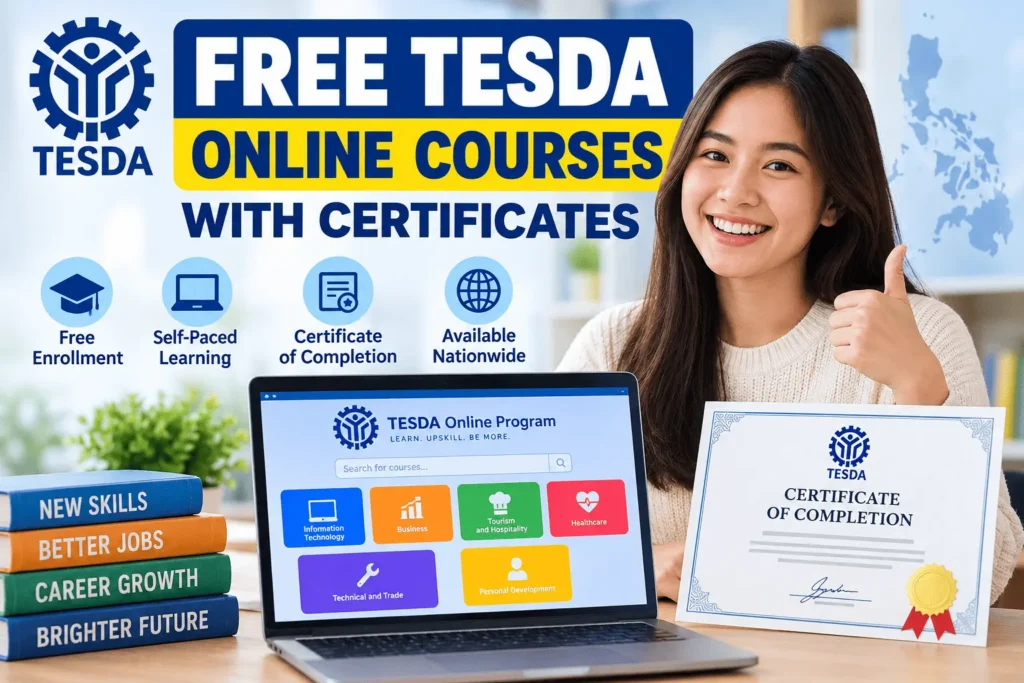
Quick answer: TESDA offers free online courses through the TESDA Online Program (TOP), allowing learners to develop practical skills in areas such as information technology, entrepreneurship, tourism, and personal development. Participants can study at their own pace and complete courses online. Depending on the program, learners may receive certificates of completion and may pursue further assessment for National Certification.
If you have ever wanted to learn a new skill but could not afford tuition, could not leave work, or lived too far from a training center, the TESDA Online Program was built for you. All you need is an internet connection, an email address, and the discipline to study on your own schedule.
This guide explains what the TESDA Online Program is, what kinds of free courses you can expect to find, how certificates work (and where people often get confused), how to register and enroll step by step, who can join, which courses suit beginners, how online study compares with classroom training, and how to turn what you learn into real career progress.
Quick Facts About TESDA Online Program
Quick Facts About TESDA Online Courses
- ✓ Free enrollment
- ✓ Self-paced learning
- ✓ Online access
- ✓ Certificate of completion (when course requirements are met)
- ✓ Available nationwide
- ✓ Accessible to OFWs
Before you start: Course lists, certificate policies, and platform features can change. Confirm the current details on the official TESDA Online Program website at e-tesda.gov.ph.
What Is the TESDA Online Program?
The TESDA Online Program (TOP) is the free e-learning platform of the Technical Education and Skills Development Authority (TESDA), the Philippine government agency that oversees technical-vocational education and training. Through TOP, Filipinos can take technical and vocational courses over the internet instead of attending a physical training center.
Definition of TOP
TOP is an open educational resource. In plain terms, that means it is a website where learning materials are made available to the public at no cost. After you register for an account, you can browse courses, enroll, and work through the learning content on your own time, using a computer, tablet, or smartphone with a stable internet connection.
Purpose of the platform
TESDA created TOP to widen access to skills training. Traditional training centers require you to be in a specific place at a specific time, and that is hard for many people. Working parents, students, out-of-town learners, and overseas workers often cannot commit to a fixed class schedule. TOP removes those barriers by letting learners study whenever and wherever they can.
Self-paced learning
Most TOP courses are designed to be self-paced. You decide when to log in, how long to study, and how fast to move through the modules. There is no classroom schedule to follow. The trade-off is that nobody is watching your attendance, so finishing a course depends entirely on your own motivation and habits.
Accessibility for Filipino learners
TOP is meant for a broad audience, including students, out-of-school youth, unemployed adults, local and overseas workers, and working professionals. Because it runs online, it reaches learners in remote provinces and in other countries who would otherwise have no easy access to TESDA training.
Key takeaway: The TESDA Online Program (TOP) is a free web-based platform that provides technical and vocational education courses accessible anytime and anywhere.
Benefits of Taking Free TESDA Online Courses
| Benefit | Description |
|---|---|
| Free Learning | No tuition fees for accessing the courses |
| Flexible Schedule | Learn anytime, day or night |
| Self-Paced | Study at your own speed |
| Skills Development | Build knowledge that improves employability |
| Career Growth | Gain job-relevant skills for promotions or career shifts |
Here is what those benefits mean in practice.
No tuition cost. The biggest advantage is obvious: you do not pay tuition to access TOP courses. That makes it a low-risk way to test a field before spending money on formal training. If you discover that a subject is not for you, you have lost time but not money.
Flexibility that fits real life. You can study after work, on weekends, or during breaks. Night-shift workers, BPO employees, and OFWs in different time zones can all fit lessons around their own routines.
A foundation for further training. Online courses are an excellent way to build background knowledge before attending in-person training. Someone who understands the theory of a subject beforehand often finds hands-on classes much easier to follow.
Better job readiness. Even foundational courses in computer use, customer service, or communication can make a resume stronger and help you feel more confident in interviews.
Lifelong learning habits. Finishing a self-paced course teaches you how to manage your own time and stay consistent. Those habits are useful in every job.
Popular Free TESDA Online Courses
TOP organizes its courses by sector, and the catalog grows and changes over time. The categories and examples below give you a realistic picture of what learners commonly look for. Because TESDA updates the list, always check the platform to see which courses are currently open for enrollment.
Information Technology Courses
ICT courses are among the most popular because they connect directly to jobs that can be done locally, remotely, or overseas.
Examples of topics you may find:
- Computer Systems Servicing: the basics of computer hardware, software installation, and troubleshooting.
- Web Development Fundamentals: introductory concepts for building websites.
- Digital Literacy: using computers, the internet, email, and common productivity tools safely and confidently.
- Basic Computer Operations: the essential skills for anyone starting from zero.
Digital literacy is a strong starting point if you are new to computers. It is also useful for people who already work but want to become more efficient with everyday digital tools.
Entrepreneurship Courses
Not everyone wants to be employed. Entrepreneurship courses help learners think like small business owners.
Examples of topics you may find:
- Starting a Small Business: identifying an idea, understanding your market, and planning your first steps.
- Entrepreneurial Skills: basics of pricing, customer handling, record keeping, and growing a small enterprise.
These courses suit sari-sari store owners, online sellers, home-based food entrepreneurs, and anyone who wants to turn a skill into income.
Tourism and Hospitality Courses
Tourism and hospitality are major industries in the Philippines and abroad.
Examples of topics you may find:
- Housekeeping: cleaning and room-preparation standards used in hotels and resorts.
- Food and Beverage Services: dining service basics and how to serve guests properly.
- Customer Service: communication, courtesy, and handling complaints.
These courses can help you prepare for hotel, restaurant, cruise, and resort work, or refresh your skills before an interview.
Personal Development Courses
Soft skills are often the difference between getting hired and getting passed over.
Examples of topics you may find:
- Workplace Communication: speaking, writing, and listening clearly at work.
- Financial Literacy: budgeting, saving, and managing money responsibly.
- Time Management: organizing tasks and meeting deadlines.
Employers consistently say they value these skills, and they apply to nearly every job.
Note: The exact course titles, availability, and content depend on what TESDA currently offers on the platform. Treat the examples above as typical categories rather than a guaranteed list, and browse the platform for the latest catalog.
Free TESDA Online Courses by Category
| Category | Example Courses |
|---|---|
| ICT | Digital Literacy, Computer Systems Servicing |
| Entrepreneurship | Business Skills, Starting a Small Business |
| Tourism | Housekeeping, Food and Beverage Services |
| Personal Development | Communication, Financial Literacy, Time Management |
| Language and Soft Skills | Workplace Skills, Customer Service |
TOP has also offered courses in other sectors, including agriculture, automotive, construction, and health-related fields. If you are interested in a hands-on trade, browse those categories too, keeping in mind that trades usually require practical training in addition to online study.
Most Popular TESDA Online Courses
Learners most often look for foundational courses that are quick to start and useful across many jobs. The table below lists course topics that are commonly searched for and taken by beginners. It is not an official ranking, and course availability changes, so confirm on the platform.
| Course | Category | Best For |
|---|---|---|
| Digital Literacy | ICT | Beginners who need basic computer and internet skills |
| Entrepreneurship | Entrepreneurship | Aspiring and current small business owners |
| Housekeeping | Tourism and Hospitality | Hotel, resort, and hospitality job seekers |
| Customer Service | Tourism and Hospitality / Soft Skills | Retail, BPO, and service industry workers |
| Financial Literacy | Personal Development | General learners, OFWs, and families managing money |
| Computer Systems Servicing | ICT | Aspiring computer technicians and IT support staff |
| Workplace Communication | Personal Development | Students, fresh graduates, and career shifters |
TOP has also offered courses in agriculture, automotive, construction, electrical and electronics, health care, maritime, and other sectors. Browse the course catalog to see what is currently open.
Do TESDA Online Courses Come with Certificates?
This is the most searched question about TOP, and it deserves a careful answer, because the information circulating online is not always consistent.
Certificate of completion
Depending on the program, learners who finish a course and meet its requirements may receive a certificate of completion. This certificate shows that you completed the online learning. It can be a useful addition to a resume, a portfolio, or a job application, especially for foundational and soft-skills courses.
Course completion requirements
Requirements differ by course. In general, expect to:
- Enroll in the course using your registered account.
- Go through the learning modules and materials.
- Complete the required activities or quizzes.
- Pass the final assessment or test, where the course has one. Some courses set a passing score.
Certificate policies can differ between courses and may change over time. TESDA has publicly described an electronic certificate of completion that learners receive when they finish a course, and learner guides describe a passing score of about 80% on the final assessment for many courses. Requirements can vary per course, so read the course page before you plan around a certificate.
Differences between online completion and National Certification
A certificate of completion and a National Certificate (NC) are not the same thing.
| Feature | Certificate of Completion | National Certificate (NC) |
|---|---|---|
| What it shows | You finished an online course | You passed a competency assessment |
| How you earn it | Complete the modules and requirements | Pass an assessment by a TESDA-accredited assessor |
| Where it happens | Online, on the platform | At a TESDA-accredited assessment center |
| Recognition | Useful for learning and resumes | Recognized standard credential for skilled workers |
Important note: Completing an online course may provide a certificate of completion, but some occupations require competency assessment and National Certification through TESDA-accredited assessment centers.
If your goal is to work in a trade or a regulated occupation, or to apply for jobs that specifically ask for an NC, treat online learning as preparation. Once you feel ready, you can look for an accredited assessment center and ask about taking the competency assessment for your qualification.
Can TESDA Online Courses Lead to National Certification?
Short answer: Online study can prepare you for National Certification, but it does not replace the assessment. A National Certificate (NC) or Certificate of Competency (COC) is earned by passing a competency assessment at a TESDA-accredited assessment center, not by finishing an online course.
How the pathway works
- Choose a course tied to a qualification. Some TOP courses cover the full set of competencies for a qualification, such as Computer Systems Servicing NC II. Others are general or short courses that are not linked to an NC.
- Complete the online course. Finish the modules and pass the required assessments to receive your certificate of completion.
- Find an accredited assessment center. Assessments are conducted by TESDA-accredited assessors at accredited centers. Use TESDA’s official list of accredited assessment centers, or ask your nearest TESDA regional or provincial office. You can read the general requirements for new applicants on TESDA’s assessment and certification page.
- Take the competency assessment. You will demonstrate your skills, often through practical tasks, and possibly an oral or written component. Results are typically “Competent” or “Not Yet Competent.” Assessment fees may apply unless you are covered by a scholarship.
- Receive your certificate. If you are found competent, you receive the NC (or a COC for individual units).
What to expect at the assessment center
TESDA has responded to a public inquiry about this. A learner who finished the Computer Systems Servicing NC II course online was told they may present the TOP certificate of completion to show they have covered the theory portion. The assessment center, however, has the discretion to assess your knowledge of the qualification, and it may require face-to-face training if needed. Bring your certificate, but be ready to demonstrate the practical skills.
Tips before you book an assessment
- Practice the hands-on skills, since the assessment tests what you can actually do.
- Ask the assessment center what tools, materials, and documents to bring.
- Confirm the fees and schedule in advance.
- Consider a short face-to-face training or review at a TESDA-registered center if the qualification is heavily practical.
How to Enroll in TESDA Online Courses
Signing up takes only a few minutes. Follow these steps.
Step 1: Create an account. Go to the official TESDA Online Program website at e-tesda.gov.ph. Look for the login or sign-up option and choose to create a new account. Fill in the required details, such as your name, a username, a password, your email address, and your location. Use your real name and information, since this may be used on any certificate you receive. Choose a strong password and save it somewhere safe.
Step 2: Verify your email. After you submit the form, TESDA sends a confirmation message to your email address. Open it and click the activation link to confirm your account. If you do not see the message within a few minutes, check your spam or junk folder. You cannot enroll until your account is activated.
Step 3: Log in to the platform. Return to the website and log in with your username and password. It is a good idea to complete or update your profile information right away, because some details may be required before you can enroll in courses.
Step 4: Browse available courses. Open the course list and look through the categories, such as ICT, tourism, entrepreneurship, agriculture, and others. Read the course description so you know what the course covers and how it is organized.
Step 5: Enroll in a course. Click the course you want, then use the enrollment option on the course page, typically labeled as enrolling yourself in the course, and confirm when prompted. Some courses may ask you to choose a specific module or lesson to start with, and some courses require an enrollment key from TESDA, so read the course page for instructions.
Step 6: Complete learning modules. Work through the lessons, readings, videos, and activities in order. Finish the quizzes or tests included in the course. Track your progress so you know what is left. Do not rush: retaking a module you did not understand is better than moving on with gaps.
Step 7: Receive your certificate. If the course issues a certificate, it becomes available after you meet the completion requirements. Look for it in your account or course page, and save a digital copy right away. If you finish everything and do not see a certificate, check the course instructions and contact TESDA through its official channels to ask about the policy for that course.
Who Can Take TESDA Online Courses?
TOP is open to a wide range of learners. If you are a Filipino learner with internet access, you can generally register. Typical users include:
- Students: Senior high school and college students can use TOP to pick up practical skills that complement their studies.
- Job seekers: Unemployed adults can build skills and strengthen their applications while searching for work.
- Employees: Workers can upskill for promotions, new responsibilities, or a career change without taking leave.
- OFWs: Overseas Filipino workers can study from abroad, which is a major advantage of an online platform.
- Career shifters: People moving into a new field can test their interest and learn the basics first.
- Entrepreneurs: Small business owners and aspiring business owners can learn how to plan, price, and manage.
Most free TOP courses do not require a formal diploma, but you should be comfortable using a computer or phone, reading course materials, and following instructions online. Individual courses may have their own recommended background, so read the description before enrolling.
Best TESDA Online Courses for Beginners
If you are not sure where to start, choose a course that builds general skills and matches your immediate goal.
| Course | Ideal For |
|---|---|
| Digital Literacy | Beginners who need basic computer and internet skills |
| Entrepreneurship | Aspiring business owners |
| Customer Service | Service industry workers and job seekers in retail, BPO, and hospitality |
| Housekeeping | Hospitality workers and those aiming for hotel or resort jobs |
| Financial Literacy | General learners who want better control of their money |
How to choose among them:
- If you have never used a computer much, start with Digital Literacy. Nearly every other online course becomes easier once you are comfortable with the basics.
- If you dream of running your own business, start with an Entrepreneurship course before spending money on capital.
- If you plan to apply for service work, Customer Service helps you speak and behave the way employers expect.
- If hotels and resorts are your target, Housekeeping gives you a look at industry standards.
- If you simply want to be better with money, Financial Literacy is useful for everyone.
Availability can change, so if a title above is not listed, look for a closely related course in the same category.
TESDA Online Courses vs Classroom Training
Online learning is not a full replacement for training centers, and it is not meant to be. Each format has strengths. Here is how they compare.
| Feature | Online Courses | Classroom Training |
|---|---|---|
| Cost | Free | May vary (free, scholarship-funded, or paid) |
| Schedule | Flexible | Fixed |
| Location | Anywhere with internet | Training center |
| Practical Activities | Limited | Hands-on |
| Certification Path | Course completion | Assessment ready |
When online learning is the better choice
- You have a job or family duties that make fixed schedules impossible.
- You live far from a training center or work overseas.
- You want to explore a subject before committing to a longer program.
- Your goal is knowledge, soft skills, or foundations rather than a hands-on trade.
When classroom training is the better choice
- Your target occupation depends heavily on physical skills, such as cooking, electrical work, automotive repair, or caregiving.
- You want supervised practice with tools and equipment.
- You are aiming for a National Certificate and want to be fully ready for the practical assessment.
The best approach: combine both
Many learners get the most value by using TOP for theory and foundations, then joining a TESDA-registered training center or scholarship program for the hands-on part. This can save time in class and lower your costs, since you arrive already familiar with the basics.
Tips for Successfully Completing TESDA Online Courses
Self-paced learning is flexible, but it is easy to start strong and then drift away. These habits help you finish.
- Set a study schedule. Decide on specific days and times, for example three evenings a week for one hour. Treat them like appointments.
- Complete modules consistently. Short, regular sessions beat occasional marathons. Finish one module before moving to the next.
- Take notes. Writing key points in your own words helps you remember them and gives you a quick review guide before quizzes.
- Practice what you learn. Apply lessons in real life. If you take a customer service course, practice in your work or business. If you study digital literacy, use the tools every day.
- Finish the assessments. Do not skip quizzes or final tests. They are often required for completion and are the best way to check your understanding.
- Use a stable connection and a proper device. A weak connection can interrupt videos and quizzes. If your internet is unreliable, download or note what you can and plan study sessions when your connection is best.
- Protect your account. Keep your username and password safe and use an email you will always have access to, because it is tied to your account.
- Track your progress. Keep a simple list of courses you have completed and the dates, along with copies of any certificates.
Career Benefits of TESDA Online Learning
A free course will not automatically land you a job, but it can move you in the right direction when you use it well.
Upskilling
Small, steady learning adds up. Someone who completes a digital literacy course, a customer service course, and a communication course has a broader skill set than someone who has not studied anything new in years.
Resume enhancement
Listing relevant online courses shows initiative. Employers often notice applicants who invest their own time in learning, particularly for entry-level roles where formal experience is limited. If you receive a certificate of completion, include the course title and completion date. If not, you can still list the course and describe what you learned.
Employment opportunities
Foundational skills in computers, customer handling, and communication are requirements in many jobs, from retail and BPO to hospitality and administration. Online courses can help you meet those baseline expectations.
Career advancement
If you already have a job, new skills can help you qualify for promotions or take on responsibilities. A supervisor is more likely to trust you with a bigger role if you have built the relevant knowledge.
Lifelong learning
Industries change. New tools appear, and old methods fade. Learners who keep building skills tend to adapt more easily. Free online platforms like TOP make it possible to keep learning throughout your career without heavy costs.
Pathway to National Certification
For occupations that require or prefer a National Certificate, online study can be the first step. After you build your knowledge, you can look for an accredited assessment center, prepare for the practical assessment, and pursue the NC for your qualification where applicable.
Frequently Asked Questions
Are TESDA online courses really free?
Yes. The TESDA Online Program is offered free of charge, and there is no tuition fee to access the courses. You only need an account, internet access, and a device. Be careful with websites or individuals who ask you to pay for “TESDA online enrollment.” Use only the official website and confirm any fee claims with TESDA directly.
How long does a TESDA online course take?
It depends on the course. Short courses on a single topic may take a few hours to several days, while longer courses made up of multiple modules can take weeks. Because most courses are self-paced, the total time depends on how many hours you can study each week. Check the course description for guidance on its content and structure.
Can I get a certificate after completion?
Depending on the program, you may receive a certificate of completion after you meet the course requirements. Certificate policies can differ between courses and may change over time, so check the course instructions on the platform. Keep in mind that a certificate of completion is different from a National Certificate, which requires a competency assessment at a TESDA-accredited assessment center.
Do employers recognize TESDA certificates?
Many employers recognize TESDA credentials, especially National Certificates, which show that a person passed a competency assessment. A certificate of completion from an online course is generally viewed as evidence of learning and initiative rather than proof of full occupational competence. It can still strengthen your resume, particularly for entry-level roles. For jobs that require an NC, plan to pursue assessment.
Can OFWs enroll in TESDA online courses?
Yes. TOP is designed to be accessible to local and overseas workers, so OFWs can study from anywhere with a stable internet connection. This is especially helpful for those who want to upgrade their skills during their contract or prepare for a career change when they return home. If you plan to take a National Certificate assessment, check where and when you can do so, since assessments are done at accredited assessment centers.
Can I take multiple TESDA online courses?
Yes. You can enroll in more than one course, and many learners take several over time. To avoid getting overwhelmed, consider finishing one course before starting another, or limit yourself to two at a time. Choosing related courses, such as digital literacy followed by web development fundamentals, helps you build skills in a logical order.
What is the easiest TESDA online course?
There is no official ranking of easy and hard courses, and difficulty depends on your background. Introductory courses such as digital literacy, basic computer operations, and general soft-skills topics like workplace communication or time management are usually the most approachable because they assume little prior knowledge. Technical courses that mirror trade qualifications tend to be more demanding.
Which TESDA online course is best for beginners?
Digital Literacy is a strong first choice for most beginners because it builds the computer and internet skills you will need for every other online course. If you already have basic computer skills, choose based on your goal: Entrepreneurship if you want to start a business, Customer Service if you want to work in service industries, or Financial Literacy if you want to manage your money better.
Can I study TESDA online using a mobile phone?
Yes. The TESDA Online Program has an official mobile app, available on Google Play and the App Store (search “TESDA Online Program”), and the website can also be opened in a mobile browser. TESDA has previously reported that the app lets enrollees keep learning offline and sync their progress once they reconnect to the internet. For longer sessions, a laptop or desktop can be easier on the eyes, since some videos and quizzes are simpler to use on a bigger screen. Feature availability can change, so check the app listing for the latest details.
How do I download my TESDA certificate?
If the course you completed issues a certificate, log in to the TESDA Online Program account you used to enroll. Once the course status shows as completed, learner guides describe a “Generate Certificate” or “Certificate of Completion” link on the course page, which lets you open and download your e-certificate. Save a copy right away and keep a backup. If you have finished everything and cannot find it, review the course requirements (such as the passing score) and email tesdaonlineprogram@tesda.gov.ph. Button names and steps can change, so follow what your account shows.
Related Guides
- TESDA Courses List 2026: Complete Guide to Training Programs and Certifications
- TESDA Scholarships Guide: How to Apply for Free Training Programs
- TESDA Requirements: Documents Needed for Enrollment
- What Is a TESDA National Certificate (NC)? NC I, NC II, NC III, and NC IV Explained
- How to Enroll in TESDA Programs: Step-by-Step Guide
- TESDA Accredited Training Centers: How to Find Approved Training Providers
Official TESDA Resources
For the latest and most reliable information, use official sources:
- TESDA Official Website
- TESDA Online Program (TOP)
- TOP Course Catalog
- TOP FAQs
- TOP How-To Guide
- TOP support: tesdaonlineprogram@tesda.gov.ph
- Mobile app: search “TESDA Online Program” on Google Play or the App Store
- TESDA Accredited Assessment Centers
- TESDA Competency Assessment and Certification
- Assessment and Certification FAQs
- Requirements for NC/COC Applicants
- TESDA Training Regulations
- Registry of Certified Workers (2017 onwards)
- Registry of Accredited Assessors
- TESDA Regional and Provincial Offices Last Updated: September 30, 2026
Sources:
- TESDA Online Program website (e-tesda.gov.ph): homepage, course sectors, mobile app listings, and support contact
- Philippine News Agency report on the TESDA Online Program mobile app and e-certificates of completion
- TESDA response to a Freedom of Information request (foi.gov.ph) on presenting the TOP certificate at an assessment center
Official References:
- TESDA Official Website
- TESDA Online Program
- TESDA Republic Act No. 7796 (the law that created TESDA)
Check these for current course lists, registration guidance, certificate policies, and announcements. Avoid paying anyone who claims they can enroll you, speed up a certificate, or sell you a “TESDA online certificate.”
Final Thoughts
The TESDA Online Program is one of the most accessible learning opportunities available to Filipinos. It costs nothing to join, fits around your schedule, and reaches learners in every province and in other countries.
A few points to remember:
- The TESDA Online Program offers accessible learning opportunities. With just an account, an internet connection, and a device, you can start learning today.
- Courses are free and flexible. You can study at your own pace, which makes it possible to learn while working, studying, or caring for family.
- Certificates can strengthen resumes and support career growth. Where a course provides a certificate of completion, it is a helpful proof of learning, though it is different from a National Certificate.
- Learners can continue toward National Certification where applicable. If your goal is a recognized credential for a trade or occupation, use online learning as preparation and then pursue assessment at a TESDA-accredited assessment center.
Your next step is simple: visit e-tesda.gov.ph, create your account, and choose one beginner-friendly course to start with. Set a weekly study schedule, finish what you begin, and build from there. Small, consistent effort is what turns free courses into real career progress.