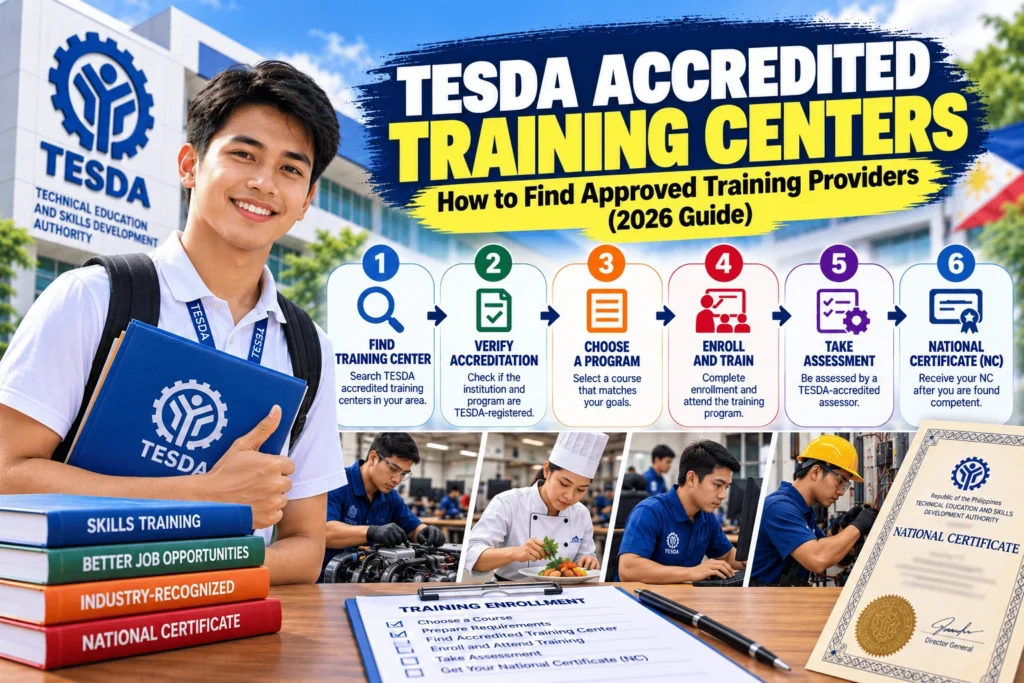
Quick answer: A TESDA Accredited Training Center is a school, institution, or training provider authorized to offer TESDA-registered technical-vocational programs that meet TESDA standards. Students should verify both the institution and the specific course to ensure the program is properly registered before enrolling.
Choosing where to train matters as much as choosing what to learn. A good TESDA accredited training center gives you structured, hands-on instruction that matches national standards and prepares you for assessment. A bad one can take your money, waste months of your time, and leave you with a certificate that is worth nothing. The problem is that from the outside, a legitimate center and a questionable one can look very similar. Both have a signboard, a Facebook page, and a promise of “TESDA training.”
This guide shows you how to tell the difference. It explains what a TESDA accredited training center is, why registration matters, the types of training providers, three ways to find approved providers, a five-step method to verify one, the difference between an accredited institution and a registered program, how to choose the right center, the warning signs of fake providers, and how accreditation connects to your National Certificate and your job prospects.
Quick Facts
| Item | Details |
|---|---|
| Regulating Agency | TESDA |
| Purpose | Skills training |
| Accreditation Required | Yes |
| Training Providers | Public and private |
| Program Registration | Required |
| Assessment Eligibility | Depends on qualification |
A note on terms: People use “accredited,” “registered,” and “approved” interchangeably, but TESDA’s official system works at the level of the program. Technical-vocational institutions must register each program with TESDA under its Unified TVET Program Registration and Accreditation System (UTPRAS). “Accreditation” in TESDA’s vocabulary also applies to assessment centers and assessors. This guide explains both so you know exactly what to check.
What Is a TESDA Accredited Training Center?
A TESDA accredited training center, in everyday language, is a training provider that TESDA recognizes as allowed to offer technical-vocational programs. In practice, what TESDA checks and records is whether the provider’s programs are registered. TESDA describes program registration as mandatory for technical-vocational education and training (TVET) programs, and TESDA has stated that all TVET programs open to the public must first be registered with the agency.
Quick answer box: A TESDA accredited training center is an institution authorized to offer TESDA-registered technical-vocational programs that comply with TESDA standards and regulations.
Why accreditation matters
Registration is not paperwork for its own sake. It is how TESDA makes sure a provider can actually deliver the training it advertises. If a program is registered, it means TESDA evaluated the provider against the minimum requirements of the qualification. If it is not registered, there is no assurance that the training is real, complete, or recognized.
TESDA officials have also stated that offering unregistered TVET programs is not allowed and that erring institutions can face penalties, suspension, or closure. They have further stated that only registered institutions can provide legitimate National Certificates and document authentication, and that graduates of registered institutions receive a special order that allows their credentials to be verified.
TESDA quality standards
Under UTPRAS, registration checks compliance with the minimum requirements set in the qualification’s Training Regulations. According to TESDA, these include:
- The curricular program
- Faculty and staff qualifications
- Physical sites and facilities
- Tools, equipment, supplies, and materials
- Similar requirements prescribed for the qualification
When an institution meets the requirements, TESDA issues a Certificate of TVET Program Registration, which some TESDA materials call the Certificate of Program Registration, and the program is listed in TESDA’s Compendium of Registered Programs. TESDA says registered programs are also subject to compliance audits.
Why Is TESDA Accreditation Important?
| Benefit | Why It Matters |
|---|---|
| Program Quality | Meets TESDA standards |
| Industry Recognition | Widely recognized |
| Assessment Readiness | Aligned with qualifications |
| Skills Development | Structured training |
| Learner Protection | Verified provider |
Program quality. A registered program has been checked against the minimum standards for its qualification, including trainers, facilities, and equipment.
Industry recognition. Employers and recruiters know that registered programs follow national standards, and your records can be verified.
Assessment readiness. Registered programs are built around the competencies in the Training Regulations, which are the same competencies assessed for the National Certificate. Our guide to the TESDA National Certificate explains how that works.
Skills development. Structured training means you learn the full set of competencies, not just a few popular skills.
Learner protection. If something goes wrong, a registered provider can be held accountable through TESDA. With an unregistered provider, you have much less recourse.
Types of TESDA Training Providers
TESDA training is delivered by three broad groups of providers. Each can be a good choice, as long as the program you want is registered.
TESDA training centers
These are TESDA-operated institutions. Examples include:
- Regional training centers: centers operated by TESDA at the regional level
- Provincial training centers: centers operated at the provincial level
- Specialized TESDA centers: institutions focused on particular sectors or groups, such as the TESDA Women’s Center
TESDA publishes a directory of its technology institutions in the TESDA Technology Institutes directory. TESDA-operated centers are often the main hosts of scholarship slots, though scholarship programs can also be run through other providers.
Public technical-vocational institutions
These are government-supported institutions outside of TESDA’s own network. Examples include:
- State colleges and universities: many offer TESDA-registered technical-vocational programs
- Government training institutions: training operated by other government agencies or local governments
- Public vocational schools: public schools that offer technical-vocational qualifications
Public providers often have lower fees or free programs, and many take part in scholarship programs.
Private technical vocational institutions (TVIs)
These are privately run providers. Examples include:
- Private vocational schools: schools focused on technical-vocational training
- Skills training academies: specialized academies in fields such as cooking, caregiving, or driving
- Industry training centers: centers run by companies or industry groups
Private TVIs set their own fees, schedules, and facilities, so quality varies widely. That is why verification matters most here. A private TVI can be excellent, but you should confirm that the exact program is registered before you pay.
TESDA centers vs private TVIs at a glance
| Feature | TESDA / Public Providers | Private TVIs |
|---|---|---|
| Fees | Often low or free, especially for scholars | Set by the provider |
| Scholarship slots | Commonly available | Available in some programs |
| Schedules | Fixed by program or batch | Often more flexible |
| Facilities | Vary by center | Vary widely by provider |
| Verification needed | Yes, check the program | Yes, check the program |
How to Find TESDA Accredited Training Centers
You do not need to guess. TESDA gives you several ways to find approved providers.
Method 1: TESDA official website
TESDA’s website is the best starting point. It offers:
- Regional directories: contact details for TESDA offices and technology institutions. See the TESDA regional and provincial directory and the TESDA Technology Institutes directory.
- Training provider listings: searchable lists of institutions with registered programs.
- Program information: details about the qualifications, including Training Regulations that explain entry requirements and what you will learn. See TESDA’s list of Training Regulations.
Method 2: TESDA registry of programs
TESDA maintains a searchable database called TVI with Registered Program. It is described on TESDA’s site as a place to search and verify institutions with registered programs and courses. You can search by course, school, or location, and the page also lists newly registered and closed programs. Access it here: TVI with Registered Programs.
When you search, verify three things:
- Institution name: Does it match the name of the provider you are dealing with?
- Program title: Is the exact qualification you want listed, such as Cookery NC II or Caregiving NC II?
- Registration status: Is the program currently registered, and has it not been closed?
TESDA has urged the public to confirm with this list before enrolling to avoid inconvenience.
Method 3: TESDA regional and provincial offices
The people at your local TESDA office know what is available near you. Contacting them has several benefits:
- Updated information: Offices know about newly registered programs, closed programs, and current batches.
- Local provider recommendations: They can point you to registered centers in your area.
- Program availability: They can tell you which scholarship slots and programs are open right now.
Find your office in the regional and provincial directory, or call TESDA’s contact center at 8887-7777.
Tips for finding providers
- Search by course and location to find centers near you.
- Compare at least two or three registered providers before choosing.
- Ask each provider for their batch schedule, total fees, and assessment arrangements.
- Check whether the provider’s trainers hold the qualifications TESDA expects. TESDA maintains a registry of trainers with a National TVET Trainer Certificate (NTTC) on its website.
How to Verify if a Training Center Is Accredited
Use this five-step method before you pay or submit documents.
Step 1: Identify the institution. Get the provider’s complete and exact name, address, and contact details. Be wary of providers that use only a nickname, a social media page, or a name that differs from what appears on their paperwork.
Step 2: Check TESDA registration. Search the provider in TESDA’s TVI with Registered Programs database by school name or location. If the provider does not appear at all, ask them to explain and show proof of registration.
Step 3: Verify the specific course. Search for the exact program. An institution can be registered for some programs but not others. Confirm that the qualification you want, at the level you want, is listed under that provider.
Step 4: Confirm registration validity. Check that the program is current and not listed as closed. Ask the provider to show their registration certificate for the program, and compare it with what you see on TESDA’s site. Registration details can change as programs are added, renewed, or closed, so use the current TESDA listing as your reference.
Step 5: Contact TESDA if necessary. If you cannot find the provider, if the details do not match, or if something feels wrong, call or visit your local TESDA office. You can also check TESDA’s list of institutions issued with a cease and desist order.
What to ask the provider for
- The program’s registration certificate or registration details
- The exact qualification title as listed by TESDA
- The names of trainers and their qualifications
- The fee breakdown in writing
- How and where assessment is done
A legitimate provider will not mind these questions. A provider that avoids them is giving you useful information.
Accredited Center vs Registered Program
Important clarification
Many students assume that if a school is accredited or registered, all of its courses are automatically recognized. That is not always the case. TESDA registers programs, so each program must be verified, not just the institution.
For example, a school might be registered for Cookery NC II and Housekeeping NC II, but not for Caregiving NC II. If you enroll in Caregiving NC II there, your training may not be recognized, even though the school appears in TESDA’s list for other courses.
Comparison table
| Item | Institution | Program |
|---|---|---|
| Registration Required | Yes | Yes |
| Verification Needed | Yes | Yes |
| Student Should Check | Yes | Yes |
What this means for you
- Check the school and the course. Both must be verified.
- Check the qualification level. For example, Housekeeping NC II and Housekeeping NC III are separate qualifications.
- Check that the program is currently registered, not closed or expired.
- Remember that accreditation in TESDA’s system also applies to assessment centers and assessors. A training provider is not automatically an assessment center. Check the list of accredited assessment centers separately if you need one.
Common TESDA Programs Offered
TESDA-registered providers across the country commonly offer the following qualifications, though the exact programs at any center depend on its registration.
| Program | Field |
|---|---|
| Caregiving NC II | Healthcare |
| Driving NC II | Transportation |
| Housekeeping NC II | Hospitality |
| Cookery NC II | Hospitality |
| Electrical Installation and Maintenance NC II | Construction and electrical |
| Bookkeeping NC III | Business and finance |
| Welding NC II | Metals and engineering |
| Computer Systems Servicing NC II | ICT |
This is a sample, not a full list. TESDA has registered programs in many other fields, including agriculture, automotive, tourism, beauty care, and more. For help comparing qualifications, see our TESDA courses list.
How to Choose the Right TESDA Training Center
After you verify registration, compare the providers that pass. Use this evaluation checklist.
Evaluation checklist
- □ Accredited provider (verified in TESDA’s database)
- □ Registered program (the exact course you want)
- □ Qualified trainers
- □ Accessible location
- □ Available schedule
- □ Good facilities
- □ Assessment support
What to look for in each item
Accredited provider and registered program. These are non-negotiable. Do not move on to the rest of the checklist until both are confirmed.
Qualified trainers. Ask who will teach you, what their experience is, and whether they hold the trainer qualifications TESDA expects. Experienced trainers who have worked in the industry often make the biggest difference.
Accessible location. A center you can reach consistently is more useful than a famous one that is hard to get to. Consider travel time, cost, and safety, especially for evening or weekend batches.
Available schedule. Check the start date, class hours, and total duration. Make sure the schedule fits your work or family commitments.
Good facilities. Visit if you can. Look for working tools and equipment, adequate space, safety practices, and enough stations for the number of trainees. Hands-on programs such as cookery, automotive, and electrical need proper equipment.
Assessment support. Ask whether assessment is included in the fee, whether the center is itself an assessment center or works with one, and how scheduling works. Training without a clear path to assessment can leave you short of a National Certificate.
Questions to ask when you visit
- Is this exact program registered with TESDA?
- How many hours does the program run, and what is the schedule?
- What is the total cost, and what does it include?
- Are scholarship slots available?
- Who are the trainers?
- How many trainees per class, and how much hands-on practice do I get?
- How and when is assessment done, and who pays for it?
For help with documents and the application itself, see our guides to TESDA requirements and how to enroll in TESDA programs. If you want free or subsidized training, read our TESDA Scholarships Guide.
Warning Signs of Unaccredited Training Providers
Most fake or unregistered providers give themselves away. Watch for these red flags.
Red flags
- Cannot provide TESDA registration details. A registered provider can tell you the status of its program and show proof. If they dodge the question, treat that as a serious warning.
- No program registration number or certificate. Ask for the registration details of the exact program. Vague answers such as “we are TESDA-approved” are not proof.
- Guarantees certification without assessment. A National Certificate is issued only after a competency assessment by a TESDA-accredited assessor. Anyone promising an NC for a fee without assessment is misleading you.
- Misleading advertising. Claims like “100% TESDA recognized,” “instant NC,” or “guaranteed overseas job” are common in scams. Be especially careful with posts that use TESDA logos without naming the registered program.
- Refuses to provide accreditation information. Legitimate providers expect this question and answer it.
Other warning signs
- Pressure to pay immediately or to “reserve a slot” with a non-refundable deposit
- Payment requests to a personal account instead of an official one
- No official receipts
- Vague or constantly changing schedules
- No physical training venue, or no tools and equipment for hands-on courses
- Scholarship “guarantees” in exchange for fees (TESDA scholarships are free for qualified applicants)
What to do if you suspect a fake provider
- Stop paying. Do not send more money or documents.
- Verify with TESDA. Check the TVI database, the cease and desist list, and call your local TESDA office or the contact center at 8887-7777.
- Keep records. Save receipts, chat messages, advertisements, and screenshots.
- Report it. Tell your TESDA regional or provincial office. Fake training can also be reported to other authorities if money was taken.
Why it matters: TESDA has stated that offering unregistered programs can lead to penalties and closure, and that only registered institutions can provide legitimate National Certificates and credential authentication. Training at an unregistered provider can leave you without a recognized certificate.
Can You Get a TESDA National Certificate Without Training?
Yes, in many cases. This surprises people, but it follows from how TESDA certification works: the National Certificate is based on demonstrated competence, not training attendance.
Assessment pathways
According to TESDA’s official FAQ on assessment and certification, students, workers, or any individual who wants to determine their qualification level may apply for assessment. The listed requirements are an application form, passport-size photos, and a Self Assessment Guide. Training is not listed as a requirement for regular assessment. However, assessment is available only for qualifications that already have promulgated Training Regulations, and TESDA also describes mandatory assessment for graduating students of certain registered programs.
Recognition of prior learning
In general terms, assessing skills gained through work experience is sometimes called recognition of prior learning. In TESDA’s system, assessors can gather evidence in several ways, including demonstrations with oral questioning, written tests, interviews, third-party reports, portfolios, and work projects. This means a worker with years of experience can apply for assessment even without having attended a formal program. Ask your assessment center how it evaluates experience-based applicants.
Competency-based assessment
Whatever path you take, you must demonstrate competence in all units of the qualification to receive a full NC. If you are found competent in only some units, you may receive a Certificate of Competency (COC) for those units.
Why training still helps
Even if training is not required, accredited training centers are useful when you need to learn skills you do not yet have, practice with proper tools, or prepare systematically for the practical assessment. Assessment centers may also advise training if they find you are not yet ready.
For a full explanation of levels, validity, and renewal, read our guide to the TESDA National Certificate (NC).
How Training Centers Prepare Students for Certification
A good registered training center does more than teach theory. It prepares you to prove your skills.
Skills training
Training follows the competencies in the qualification’s Training Regulations. You learn the tasks employers expect, in the sequence and depth described in the standards.
Practical exercises
Hands-on practice makes up much of the training. In a cookery program you cook. In an electrical program you install and test wiring. Practical exercises build both skill and confidence.
Mock assessments
Many centers run practice assessments, where trainers simulate the competency assessment, check your performance, and point out gaps. If a center does this, take full advantage of it. If it does not, ask whether you can get a practice run before the real assessment.
Competency development
Beyond the technical tasks, training should build the safety habits, workplace attitudes, and communication skills assessors look for. Competency covers skills, knowledge, attitudes, and work values.
The workflow
Training Center
      ↓
Skills Training
      ↓
Competency Assessment
      ↓
National Certificate (NC)
After training, you apply for assessment at a TESDA-accredited assessment center. TESDA’s official steps for applying for assessment and certification list the requirements: an application form, a Self Assessment Guide for your qualification, and three colored passport-size photos with a white background, with collar, and with your name printed at the back. If you are found competent, you receive your certificate.
TESDA Accredited Training Centers by Region
TESDA operates across the country through regional offices, provincial offices, and training institutions, and registered private and public providers operate alongside them. The exact list of centers and programs changes over time, so treat this section as a guide to what to expect and where to look, and use TESDA’s database for current information.
NCR
Overview. The National Capital Region has a dense concentration of training providers, including TESDA-operated centers, public institutions, and many private TVIs. That variety gives you plenty of choice, but also means you should be careful about verification, because the number of private providers is high. NCR is also where many assessment centers operate, which can make scheduling assessment easier.
How to find providers. Search the TVI with Registered Programs database by course and city or location, and check the regional directory for the NCR office.
Luzon
Overview. Luzon outside Metro Manila includes many provinces with TESDA provincial offices, state colleges, and private providers. Training opportunities are commonly available in hospitality, construction, automotive, electrical, ICT, agriculture, and healthcare programs, and many centers near industrial areas and tourism hubs offer qualifications tied to local jobs.
How to find providers. Contact your provincial TESDA office for the current list of registered providers and open scholarship slots, and verify each program in the TVI database.
Visayas
Overview. The Visayas has a mix of TESDA centers, state colleges, and private institutions in its major cities and provinces, with strong demand for hospitality, tourism, caregiving, construction, and ICT-related training.
Cebu example. Cebu is in Central Visayas (Region VII), one of the busiest training areas in the region. A TESDA regional official reported in a Philippine Information Agency interview in early 2025 that Central Visayas had about 300 TVET providers and about 1,195 registered programs, counting programs with training regulations, without training regulations, and mobile training programs. These figures change over time, so use them only as a sense of scale. If you are in Cebu, search the TVI database by course and location, and contact your TESDA provincial or regional office for current slots.
Mindanao
Overview. Mindanao has TESDA regional and provincial offices, state universities and colleges, and private providers across its regions. Opportunities are commonly available in agriculture and fisheries, construction, automotive, hospitality, caregiving, and ICT, and many scholarship and community-based programs are implemented through local offices.
How to find providers. Check the TVI database by location and ask your TESDA provincial office about scholarship batches and mobile training programs that reach remote communities.
Tips for any region
- Start with TESDA’s official directory, not social media ads.
- Verify the exact program, not just the school.
- Ask your local TESDA office what is open now, since schedules and slots change.
- Check that the provider is within reach for the full length of the training.
Frequently Asked Questions
How do I verify a TESDA accredited training center?
Search the provider and the exact program in TESDA’s TVI with Registered Program database, which lets you search by course, school, and location. Confirm that the program is currently registered, ask the provider to show its registration details, and contact your local TESDA office if anything does not match. You can also check TESDA’s list of institutions issued with a cease and desist order.
Are private schools TESDA accredited?
Many private schools and training institutions have TESDA-registered programs, but not all. Private technical-vocational institutions must register their programs with TESDA before offering them. Being a private school does not make a program recognized, and being registered for one program does not cover other programs. Verify the exact program before you enroll.
Can I enroll in a TESDA accredited center online?
Often yes, but it depends on the provider. Some centers accept online applications, and TESDA also offers online registration for learners and scholarship applicants through its systems. For the free TESDA Online Program, enrollment is entirely online. Verify the provider’s registration before you submit documents or pay. See our guide to how to enroll in TESDA programs for the steps.
What is a TESDA registered program?
A TESDA registered program is a technical-vocational program that a provider has registered with TESDA under UTPRAS, after TESDA checked that the provider meets the minimum requirements of the qualification’s Training Regulations, such as curriculum, trainers, facilities, tools, and equipment. Registered programs are listed in TESDA’s Compendium of Registered Programs and are subject to compliance audits.
Do all TESDA courses lead to certification?
Not automatically. A National Certificate is issued only after you pass a competency assessment, and assessment is available for qualifications that have promulgated Training Regulations. Some courses, such as short or non-qualification programs, may lead only to a certificate of completion from the provider. Ask the provider which certificate the course leads to and how assessment works. Our guide to the TESDA National Certificate explains the difference.
How do I avoid fake TESDA schools?
Verify the exact program in TESDA’s database, ask for registration details, and be cautious about guarantees of certification without assessment, requests to pay a deposit to “reserve a slot,” payments to personal accounts, and missing official receipts. Check the cease and desist list, and call TESDA if you are unsure. TESDA scholarships are free for qualified applicants, so never pay anyone for a scholarship slot.
Can I take assessment without training?
In many cases, yes. TESDA’s official FAQ says that students, workers, or any individual who wants to determine their qualification level may apply for assessment, and training is not listed among the requirements for regular assessment. You still need to demonstrate competence in the qualification, and assessment centers may advise training if you are not yet ready. Confirm with your assessment center.
How do I find TESDA centers near me?
Use TESDA’s TVI with Registered Program database and search by course and location. You can also use the Technology Institutes directory, the regional and provincial office directory, and TESDA’s contact center. Your local TESDA office can tell you which registered providers and scholarship slots are open near you right now.
Official TESDA Resources
For the latest and most reliable information, use official sources:
- TESDA Official Website
- TVI with Registered Programs (TESDA registry of programs)
- TESDA Program Registration and Accreditation (UTPRAS)
- Institutions Issued with Cease and Desist Order
- TESDA Accredited Assessment Centers
- Registry of Accredited Assessors
- TESDA Technology Institutes
- TESDA Regional and Provincial Offices
- TESDA Training Regulations
- TESDA Online Program
- TESDA Online Scholarship Application
You can also reach TESDA’s contact center at 8887-7777 or contactcenter@tesda.gov.ph.
Related guides
- How to Enroll in TESDA Programs
- TESDA Requirements: Documents Needed for Enrollment
- TESDA Courses List 2026
- TESDA Scholarships Guide
- What Is a TESDA National Certificate (NC)?
- Free TESDA Online Courses with Certificates
Last Updated: October 2026
Sources:
- TESDA: TVI with Registered Program database and Program Registration and Accreditation (UTPRAS) pages (tesda.gov.ph)
- TESDA news release encouraging the public to enroll in registered training programs (tesda.gov.ph)
- Philippine Information Agency: TESDA reminds academic institutions to register their tech-voc programs (pia.gov.ph)
- TESDA: Assessment and Certification FAQs and Steps in Applying for Assessment and Certification (tesda.gov.ph)
Official References:
- TESDA Official Website
- Republic Act No. 7796 (the law that created TESDA)
Final Thoughts
Choosing a training provider is one of the most important decisions in your TESDA journey, and it is one you can make with confidence if you know what to check. Registration is not a formality. It is the difference between training that leads to a recognized certificate and training that does not.
A few points to remember:
- Verify both the institution and the course. A school can be registered for some programs and not others, so check the exact qualification you want.
- Use official TESDA resources. The TVI with Registered Program database, the regional offices, and the contact center are more reliable than ads or word of mouth.
- Avoid unaccredited providers. Be wary of guarantees of certification without assessment, pressure to pay immediately, and refusal to show registration details.
- Choose programs aligned with career goals. Match the qualification and the provider to the job, business, or overseas plan you have in mind.
- Confirm certification pathways before enrolling. Ask how assessment works, who pays for it, and whether the course leads to a National Certificate or only a certificate of completion.
Your next step is simple: pick a course, search for registered providers in TESDA’s database, verify the exact program, and visit or call your top choices. A few hours of checking now can save you months of lost time and thousands of pesos.