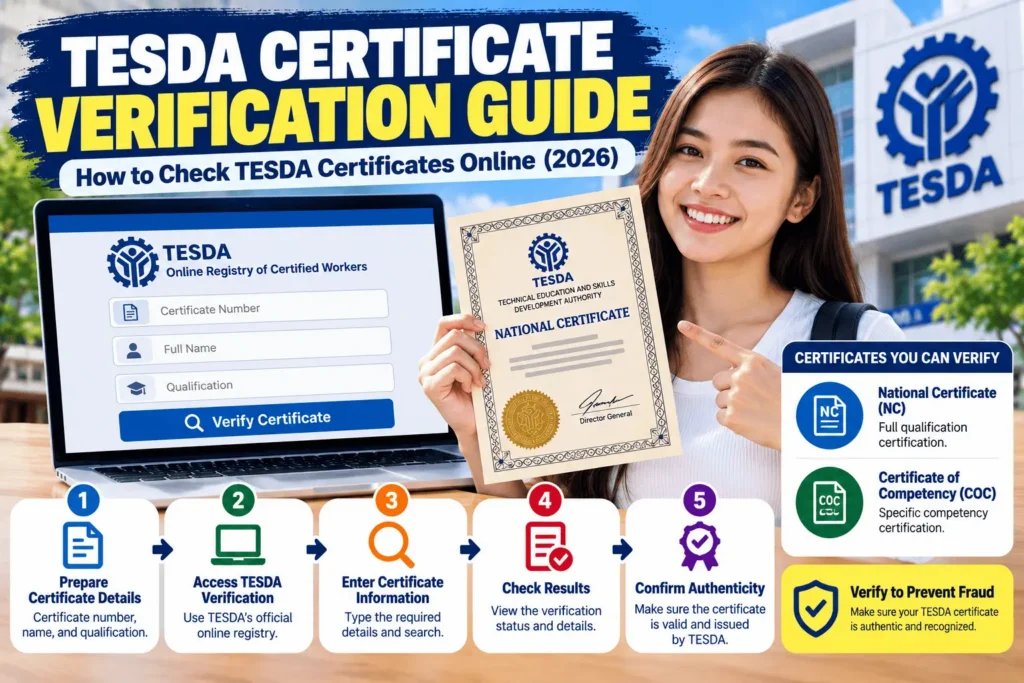
Quick Answer: TESDA certificate verification lets certificate holders, employers, and organizations confirm that a TESDA-issued National Certificate (NC) or Certificate of Competency (COC) is authentic. You check the holder’s name, certificate number, and qualification against TESDA’s official Registry of Certified Workers. Verifying protects employers from fraud and protects honest workers from having their credentials questioned.
You’ve passed your assessment and the certificate is finally in your hands. Or you’re an employer holding a stack of applications, each with a “NC II” line, and you need to know which are real. Either way, the same question comes up: how do you confirm a TESDA certificate is genuine?
This guide covers how to verify a TESDA certificate online, what to prepare, how to read the results, and what to do when a record can’t be found. It also covers how employers and overseas job applicants handle verification, and how to replace a lost or damaged certificate.
It’s the last step in the learner journey on ApplySmart PH. If you’re still earlier in that journey, start with the TESDA Courses List 2026, then check the TESDA Requirements and How to Enroll in TESDA Programs.
Quick Facts About TESDA Certificate Verification
| Item | Details |
|---|---|
| Issuing Agency | TESDA (Technical Education and Skills Development Authority) |
| Certificates Covered | National Certificate (NC) and Certificate of Competency (COC) |
| Verification Purpose | Authentication of the certificate and the holder’s record |
| Used By | Employers, recruitment agencies, OFWs, graduates, government offices |
| Online Verification | Available through TESDA’s Registry of Certified Workers |
| Certificate Validity | Typically 5 years |
What Is TESDA Certificate Verification?
TESDA certificate verification is the process of confirming that a National Certificate (NC) or Certificate of Competency (COC) was officially issued through TESDA’s assessment and certification system. In practice, someone takes the details printed on a certificate and compares them with TESDA’s official records.
Why verification exists
TESDA certifies workers who have passed a competency assessment against the standards for their qualification. TESDA maintains an Online Registry of Certified Workers with key information on certified workers nationwide, searchable by name, certificate number, or qualification. Verification is how the public uses that registry.
The system exists because paper certificates can be copied, altered, or sold by scammers. TESDA has publicly warned about fake National Certificates and electronic National Certificates, stating that NCs are issued solely by TESDA and that any certificate not released or verifiable through its official channels should be treated as fraudulent.
Why it matters for employment
For many skilled trades, such as welding, automotive servicing, electrical installation, caregiving, cookery, and food processing, an NC is the proof that you can do the work to a recognized standard. Employers use it to shortlist candidates, to meet workplace safety expectations, and sometimes to satisfy client or regulatory requirements. If the certificate is fake, the employer carries the risk, including the risk of putting an unqualified person in a safety-critical job.
Why it matters for overseas applications
Overseas employers and licensing bodies often ask for proof of skills. The TESDA-issued NC has been among the requirements for deploying OFWs abroad, including seafarers. That requirement was set by the agencies that used to be POEA and MARINA, so check the current rules of the Department of Migrant Workers (DMW) and your recruitment agency for your specific job and country. Overseas, an authenticated certificate can be the difference between a smooth application and a delayed one.
Why Is TESDA Certificate Verification Important?
| Benefit | Why It Matters |
|---|---|
| Prevent Fraud | Detects fake or altered certificates before they cause harm |
| Employment Screening | Gives employers a reliable way to check applicant credentials |
| Government Applications | Supports applications that require proof of qualification |
| Overseas Employment | Helps confirm skills certification for deployment |
| Skills Recognition | Confirms that a worker’s competency status is officially recorded |
Protecting the integrity of your own certificate
Verification isn’t only for employers. If you earned your NC honestly, checking that your record is correctly encoded protects you. A misspelled name or wrong certificate number can cause trouble months or years later, usually at the worst time, such as during a visa application or a job offer. Checking soon after your certificate is released lets you fix errors while the paperwork is fresh.
Protecting employers and the public
A fake certificate harms more than the employer who accepts it. Customers, co-workers, and the public can be put at risk when a person without proven competencies is hired for work that involves safety. That’s why TESDA has urged both individuals and institutions to check certificates against its official registry.
Types of TESDA Certificates That Can Be Verified
TESDA issues two main kinds of competency certificates. A National Certificate is issued when a candidate has shown competence in all the units of competency that make up a qualification. A Certificate of Competency is issued for a particular unit or cluster of units of competency. Both can be verified.
National Certificate (NC)
A National Certificate is issued after a person is assessed as competent in all the units of a qualification. Key points:
- Full qualification certification. The holder has been judged competent across the entire qualification, such as “Shielded Metal Arc Welding NC II” or “Bookkeeping NC III.”
- Issued after competency assessment. You don’t get an NC just for finishing a training program. You must pass an assessment conducted by a TESDA-accredited assessor, usually at an accredited assessment center. Training and assessment are separate steps, and a school diploma or training completion certificate is not an NC.
- Industry-recognized credential. Employers, agencies, and overseas partners recognize the NC level (I to IV) as a signal of skill depth.
For a full breakdown of levels, read What Is a TESDA National Certificate (NC)? NC I, NC II, NC III, and NC IV Explained.
Certificate of Competency (COC)
A Certificate of Competency recognizes a specific competency or cluster of competencies rather than a whole qualification.
- Specific competency certification. For example, a candidate may be certified in one or two units from a larger qualification.
- Partial qualification completion. A COC shows progress toward a full qualification without claiming the full NC.
- A pathway toward an NC. Many workers collect COCs first and later complete the remaining units to earn the NC.
COCs are also used in specialized fields. TESDA’s regional pages list separate verification registries for areas like maritime COCs, household service workers, and welders, alongside the main registry of certified workers.
Information Needed Before Verifying a TESDA Certificate
Gather these details first. Having them ready makes the search quicker and helps you spot discrepancies.
Verification Checklist
- ✔ Full Name
- ✔ Certificate Number
- ✔ Qualification Title
- ✔ Date of Issuance
- ✔ Assessment Center Information
Why each detail matters
Full name. The registry matches records to the holder’s name. Spelling, middle names, suffixes (Jr., III), and married versus maiden names are common causes of “not found” results. Use the name exactly as printed on the certificate.
Certificate number. This is the most precise identifier. A single wrong digit can return no results or a different person’s record.
Qualification title. Searching by qualification helps narrow results. It also confirms that the certificate really covers the qualification it claims.
Date of issuance. This matters more than people expect. TESDA’s online registries are split by issuance period: one for certificates issued in 2016 and earlier, and another for 2017 onward. Choosing the wrong one is a classic reason for a false “not found.”
Assessment center information. This isn’t always needed for the online search, but it’s essential if you have to follow up. The assessment center holds records of your assessment results and can help TESDA trace your certification.
How to Verify a TESDA Certificate Online
TESDA has updated its website over the years, so menu labels may change slightly. The process below follows TESDA’s official guidance.
Step 1: Gather Certificate Information
Have the certificate in front of you, or a clear scan or photo of it. Write down:
- The holder’s full name exactly as printed
- The certificate number
- The qualification title and NC level
- The date issued, including the year, which decides which registry you use
If you’re an employer, ask the applicant for a clear copy of the certificate. TESDA’s guidance on the main verification data points centers on the name, certificate number, and date issued.
Step 2: Access TESDA Verification Services
Use only official TESDA channels. TESDA directs the public to its Registry of Certified Workers at tesda.gov.ph/RWAC. You can also go to the TESDA website, open the verification or online services menu, and choose “Registry of Certified Workers.”
Safety tip: Type the web address yourself or navigate from the main TESDA site. Don’t use links from social media comments, chat messages, or “fixer” websites. Anyone offering to “verify” or “process” a certificate for a fee through an unofficial site is a red flag.
[Insert TESDA Certificate Verification Portal Screenshot]
Choose the correct registry by issuance year. If your certificate was issued in 2016 or earlier, use the “2016 Issuance and Earlier” registry. If it was issued in 2017 or later, use the “2017 Onwards Issuance” registry.
Step 3: Enter Certificate Details
On the search page, enter the information you collected.
- Name matching. Enter the name as printed. If you get no result, try variations: with and without a middle name, last name first, or a maiden name instead of a married name. Some entries are encoded slightly differently from how the certificate prints them.
- Certificate number. Enter it exactly, including any dashes or letters. Searching by certificate number is often the fastest way to a specific record.
- Qualification information. If a field for qualification is available, choose the one that matches your certificate.
You can search with one or more of these fields. Start narrow, such as by certificate number, and broaden only if needed.
Step 4: Review Verification Results
If a record is found, the result typically shows the holder’s name, qualification title, certificate number, date of issuance, and expiration date. Compare each field against the certificate in your hands.
Here’s how to interpret what you see:
| Status | Meaning |
|---|---|
| Verified | A record exists and the details match the certificate |
| Not Found | No record turned up under the details entered |
| Partial Match | A record exists but some information doesn’t match (name, number, qualification, or dates) |
| Pending Verification | The record can’t be confirmed online and needs additional review by TESDA |
A note on these labels: the registry usually returns either a matching record or no record. “Partial Match” and “Pending Verification” describe situations you may run into, such as a record that matches on number but not on name, or a recent certificate not yet in the database. They aren’t necessarily on-screen messages. Treat anything other than a clean, fully matching record as a reason to follow up.
Save the result. Take a screenshot or print the page, with the date. Employers should attach it to the applicant’s file. Certificate holders should keep it with their documents.
Verifying electronic certificates (e-certificates)
TESDA has been rolling out electronic certificates. One way to verify an e-certificate is by scanning the QR code, which leads to the worker’s information and certification details. The other is the Registry of Certified Workers. If an applicant gives you an e-certificate, scan the QR code and also run the registry search so you have two independent confirmations. Be careful with QR codes on printed copies. A fake can carry a QR code that points to a lookalike page, so confirm that the page you land on is on TESDA’s official domain.
How Employers Verify TESDA Certificates
Employers, HR teams, and recruitment agencies are among the main users of verification. Employers and recruitment agencies can use the Registry of Certified Workers on the TESDA website, or visit the nearest TESDA Regional office if a name can’t be found online.
What employers check
- Certification authenticity. Is there an official record under this name and number?
- Qualification level. Does the certificate cover the qualification and NC level the job requires? An NC II in one field doesn’t qualify someone for work requiring an NC III in another.
- Expiration date. Is the certificate still valid? Certificates are typically valid for five years.
- Competency assessment records. For higher-stakes roles, employers may ask the applicant for assessment documents such as the Competency Assessment Result Summary, or confirm the details with the assessment center.
Why employers verify
- Hiring decisions. A verified credential reduces the risk of a bad hire.
- Skills validation. An NC isn’t the whole picture, but it gives a baseline standard that has been independently assessed.
- Compliance requirements. Some industries, clients, and overseas deployment processes require proof of valid certification. Keeping a record of your verification helps if you’re ever audited.
A practical employer workflow
- Collect a clear copy of the certificate at application stage.
- Run the registry search yourself instead of relying on screenshots the applicant provides.
- Print or save the result and note the date and the staff member who verified.
- If the record isn’t found, don’t reject the applicant immediately. Ask them to check with TESDA, since encoding errors and delays do happen.
- If you strongly suspect a forged certificate, contact TESDA. TESDA’s hotline is 8887-7777 and its email is contactcenter@tesda.gov.ph.
TESDA National Certificate Verification
Verifying an NC is the most common kind of check. The process is the one described above, with a few points worth emphasizing.
The NC verification process
- Identify the NC’s issuance year to pick the right registry.
- Search by certificate number and/or name.
- Compare the qualification title and NC level with the job requirement.
- Check the date of issuance and expiration date.
Qualification validation
An NC is tied to a specific qualification, such as “Plumbing NC II” or “Housekeeping NC II.” When verifying, confirm that the qualification on the record is the one claimed. A common form of fraud is a real certificate for one qualification presented as something higher or different.
Employment use
For job seekers, a verified NC is a strong signal in resumes and applications. Keep a PDF of your verification result with your digital documents. Many employers will happily accept it as a supporting document, although they may still run their own check.
For more on how NCs fit into the training pathway, read the TESDA National Certificate (NC) Guide.
TESDA Certificate of Competency (COC) Verification
COCs can also be verified, using the same Registry of Certified Workers and following the same year-based approach. Some specialized COCs have their own registries or procedures. TESDA’s regional pages list separate verification pages for maritime COCs, household service workers, and welders. If your COC belongs to one of these categories, check the specialized registry as well.
NC vs. COC at a glance
| Feature | NC | COC |
|---|---|---|
| Full Qualification | Yes | No |
| Specific Competencies | No | Yes |
| Employment Use | Yes | Yes |
| Verification Available | Yes | Yes |
When verifying a COC, pay attention to which competencies are listed. An employer who needs a full qualification shouldn’t accept a COC as equivalent. A COC is valuable evidence of specific skills, but it isn’t the same as the full NC.
What to Do If Your TESDA Certificate Cannot Be Verified
A “not found” result is stressful, but it isn’t automatically proof that a certificate is fake. Records can fail to appear for ordinary reasons.
Possible causes
- Incorrect certificate number. A mistyped digit, or a letter confused with a number (O and 0, I and 1).
- Name spelling errors. Differences between the certificate and the encoded record, including middle names, suffixes, and married versus maiden names.
- Wrong registry. Searching the 2017-onward registry for a 2015 certificate, or the other way around.
- Delayed system updates. Recently issued certificates may take time to appear.
- Damaged or incomplete records. Older records can contain gaps or errors.
- Old certification records. Older certificates sometimes require a manual check at the issuing office.
Recommended actions
- Double-check the details. Re-enter the information carefully, try name variations, and try both registries if you’re unsure of the year.
- Contact TESDA. Verification can also be done in person at the nearest TESDA District or Provincial Office. Bring the original certificate and a valid ID. The hotline and email above are good starting points for general inquiries.
- Contact the assessment center. The center that conducted your assessment keeps assessment records and can help trace what was submitted to TESDA.
- Request record verification. If the certificate is genuine but missing from the registry, ask the issuing office to check and update the record. One guide suggests presenting a copy of a genuine physical certificate to the TESDA Regional or Provincial Office that handled your assessment so they can index your record. Procedures can vary by office, so ask what they require.
If, after all this, no record exists and nobody at TESDA can confirm the certificate, treat the document as unverified. Don’t use it for applications, and be cautious about how you obtained it. If you paid someone for a certificate without taking an assessment, you may have been a victim of a scam. Consider reporting it to TESDA.
Certification, Verification and Authentication (CAV)
The online registry search is the quickest check, but some situations call for more than that, especially overseas use. TESDA’s published pages don’t list a fee for searching the registry.
TESDA offers a Certification of Authentication and Verification (CAV) for TESDA-issued NCs and COCs. The process involves applying at the TESDA issuing office, submitting the original certificate, paying the authentication fee (listed at P50 in TESDA’s published steps), and then claiming the CAV document. Documentary requirements listed on TESDA’s regional pages include two photocopies of the certificate along with the original.
Fees and procedures can change, and local offices sometimes have their own schedules, so confirm with your TESDA issuing office before you go. Whether a foreign employer or agency also requires additional authentication (such as apostille through the DFA) depends on the destination country and employer. Ask your recruiter or the receiving organization.
How to Replace a Lost TESDA Certificate
Losing your certificate doesn’t mean losing your certification. Your record remains in TESDA’s system, and you can request a replacement. TESDA says an individual may apply for renewal or replacement of an NC or COC at the District or Provincial Office where the original was issued.
Step 1: Identify the issuing office
Look at your records or any copy of the certificate to see which TESDA District or Provincial Office issued it. If you can’t tell, the assessment center that handled your assessment can tell you which office has jurisdiction.
Step 2: Prepare valid identification
Bring at least one valid government-issued ID. Offices may ask for photocopies as well as the original ID.
Step 3: Submit the replacement request
For a lost certificate, TESDA’s published requirements are a letter of request, a duly notarized Affidavit of Loss, and one colored passport-size photo. If you’ve also lost your assessment results (CARS) or temporary certificate, one guide advises contacting your assessment center for a record of your results, so ask about that too.
For a damaged certificate, the requirements are a letter of request, the original damaged certificate, and a passport-size photo.
For erroneous entries (such as a misspelled name), the published requirements include a letter of request, the original certificate, a photo, and a certified photocopy of a passport or birth certificate.
Step 4: Pay applicable fees if required
Fee information isn’t consistent across sources. Some older guides mention a P50 fee for replacement, but one more recent guide said it could not confirm an official replacement fee. Ask the issuing office what applies and request an official receipt for any payment.
Step 5: Claim the replacement document
You’ll be given a schedule for claiming the replacement. TESDA’s instructions note that the NC/COC should be released directly to the applicant, so bring your ID. Before leaving the office, check that every detail on the new certificate is correct.
Replacement checklist
- ✔ Valid ID
- ✔ Affidavit of Loss (notarized, if the certificate is lost)
- ✔ Certificate details (number, qualification, issue date, assessment center)
- ✔ Letter of request / request form
- ✔ One colored passport-size photo
- ✔ Original certificate (if damaged or being corrected)
Tip: Get the Affidavit of Loss notarized as soon as you realize the certificate is missing. It’s usually the first thing that delays the process.
How Long Is a TESDA Certificate Valid?
NC validity period
TESDA states that both the National Certificate and the Certificate of Competency are valid for five years. The expiration date appears on the certificate and in the registry result.
Renewal requirements
Renewal depends on whether the qualification’s standards have changed. Where new Training Regulations have been issued, holders must undergo competency assessment against the new standards upon expiration. Where no new regulations exist, NC or COC holders can be renewed on request after verification in the registry. Renewal rules and requirements can be updated, so ask your local TESDA office for the current process.
Expired certifications
An expired NC isn’t worthless. It shows you were once certified. But many employers and agencies, especially for overseas work, will want a current one. If yours has expired, start the renewal process early. Don’t wait until a job offer depends on it.
For the bigger picture on NC levels and validity, see What Is a TESDA National Certificate (NC)?
Common TESDA Verification Problems and Solutions
| Problem | Solution |
|---|---|
| Certificate Not Found | Verify the certificate number and issuance year, then try the other registry |
| Name Mismatch | Check spelling, middle name, suffix, and maiden vs. married name |
| Missing Records | Contact the TESDA issuing office and the assessment center |
| Damaged Certificate | Request a replacement with the original damaged copy |
| Expired NC | Check the renewal process with your TESDA office |
| Wrong Details on Certificate | Apply for correction of entry with supporting ID documents |
| E-certificate QR Won’t Open | Confirm the registry record directly on TESDA’s website |
Tips for Protecting Your TESDA Certificate
Keep digital copies. Scan or photograph your certificate in good quality and store copies in cloud storage and on a separate device. Keep your verification result screenshot with them.
Store originals safely. Use a waterproof folder in a safe place. Avoid laminating the original unless an issuing office says it’s acceptable, since it can complicate later authentication.
Record certificate numbers. Keep your certificate number, qualification, and issuance date in a notes app or a document. If you lose the paper, these details speed up replacement.
Verify details immediately after issuance. Check the registry shortly after you receive your NC. If anything is wrong, you can correct it while the assessment center and TESDA staff still remember your case.
Maintain updated personal information. If you change your name through marriage or a legal process, ask your TESDA office how to align your certification records with your new documents.
Be careful with sharing. Only share clear copies with people who need them. Consider marking copies “For [purpose] only” if appropriate, which makes misuse harder.
Avoid “fixers.” Anyone who offers to get you an NC without assessment is likely selling a fake. Using a fake certificate can lead to disqualification, job loss, or legal trouble. TESDA’s published procedures state that falsification or fraudulent duplication of documents can be grounds for disqualification from its assessment and certification programs.
Frequently Asked Questions
How do I verify a TESDA certificate?
Go to TESDA’s official website and open the Registry of Certified Workers. Choose the registry that matches the year your certificate was issued (2016 and earlier, or 2017 onward), then search by name, certificate number, or qualification. Compare the result with your certificate. You can also verify in person at a TESDA District or Provincial Office.
Can employers verify TESDA certificates?
Yes. Employers and recruitment agencies can use the same public registry. If a name doesn’t appear online, they can check with the nearest TESDA office.
What information is needed for verification?
At minimum, the holder’s full name, certificate number, and date of issuance. The qualification title and assessment center details help when you have to follow up or resolve a mismatch.
Can I verify a National Certificate online?
Yes. National Certificates can be checked through the Registry of Certified Workers. Electronic certificates can also be checked by scanning the QR code, though you should confirm the result on TESDA’s official site.
How do I replace a lost TESDA certificate?
Apply at the TESDA office that issued it. For a lost certificate, the published requirements are a letter of request, a notarized Affidavit of Loss, and one colored passport-size photo. Claim the replacement on the scheduled date, with your ID.
What if my certificate is not found?
First, re-check your details and try both registries (by year). Then contact the TESDA issuing office and your assessment center. If the certificate is genuine, ask TESDA to verify and update the record. If no one can confirm it, treat it as unverified and don’t use it.
Is TESDA certificate verification free?
TESDA’s published pages don’t list a fee for searching the online registry. Services like a CAV or a replacement may involve fees, and published amounts have varied over time (a P50 fee appears in TESDA’s CAV instructions). Confirm current fees with your TESDA office.
How long does verification take?
An online registry search takes a few minutes. In-person verification or a CAV depends on your TESDA office’s schedule. Replacements are released on a date set by the issuing office, so ask for an estimate when you apply.
Official TESDA Resources
Use only official channels for verification and certificate services:
- TESDA Official Website (tesda.gov.ph) for the Registry of Certified Workers and program information
- TESDA Certification Offices at the District or Provincial Office that issued your certificate
- TESDA Assessment Centers for assessment records and result summaries
- TESDA Regional Offices for regional procedures and specialized registries
- TESDA Online Services, including the e-certificate system where available
- TESDA Contact Center: hotline 8887-7777 and contactcenter@tesda.gov.ph for inquiries and reporting suspected fake certificates
To find the right assessment center or training provider, see TESDA Accredited Training Centers: How to Find Approved Training Providers.
Related TESDA Guides
- TESDA Courses List 2026: Complete Guide to Training Programs and Certifications
- TESDA Requirements: Documents Needed for Enrollment
- How to Enroll in TESDA Programs: Step-by-Step Guide
- TESDA Scholarships Guide: How to Apply for Free Training Programs
- Free TESDA Online Courses with Certificates
- What Is a TESDA National Certificate (NC)? NC I, NC II, NC III, and NC IV Explained
- TESDA Accredited Training Centers: How to Find Approved Training Providers
Final Thoughts
TESDA certificate verification protects everyone involved. Employers avoid hiring on the strength of forged paper, and workers who earned their certification honestly can prove it quickly and confidently.
- Verification protects certificate holders and employers. A confirmed record is the strongest proof a credential is real.
- Keep your certification records accurate. Check your details right after issuance and correct errors early.
- Use official TESDA channels. The Registry of Certified Workers, TESDA offices, and the TESDA contact center are the only sources you should trust for confirmation.
- Ask for help if records can’t be located. A “not found” result is a prompt to follow up, not necessarily a dead end.
- Maintain copies of important documents. Digital backups, a recorded certificate number, and a saved verification result can save weeks of delay.
Whether you’re a graduate with a fresh NC, an OFW preparing a skills package, or an HR officer screening applicants, a few minutes on the official registry can prevent months of trouble. If you’re just starting your TESDA journey, begin with the TESDA Courses List and follow the path through enrollment, training, assessment, and certification. Then use this guide to verify the result.
Procedures, fees, and website layouts can change. Always confirm current requirements with TESDA before applying or paying for any service.