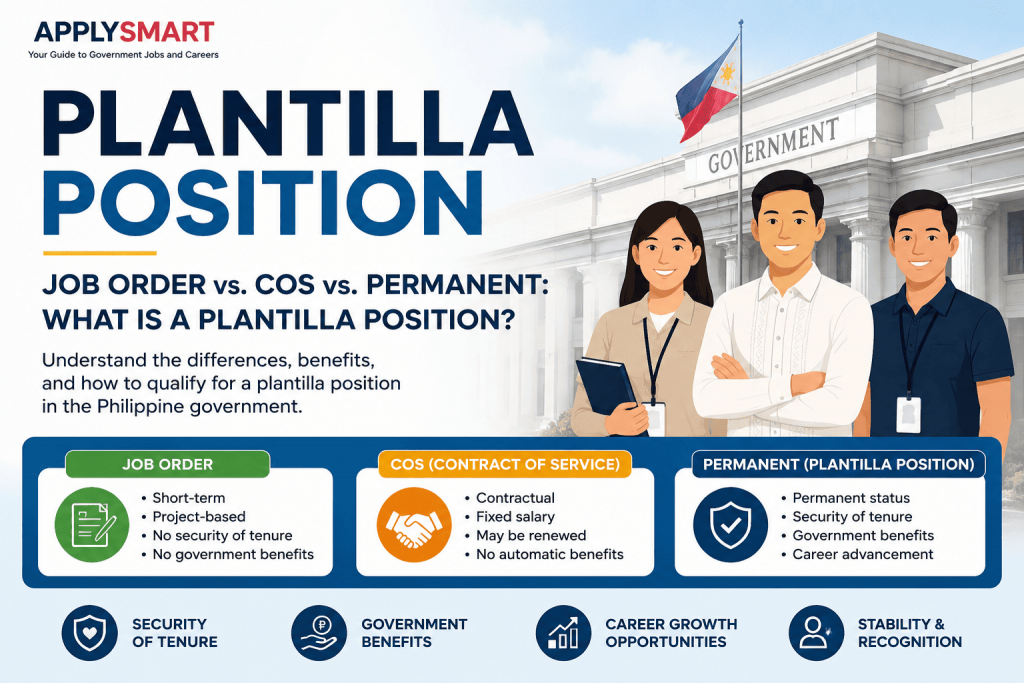
What Is a Plantilla Position?
A plantilla position is a regular, funded position listed in a government agency’s official staffing pattern. It has a fixed title, item number, and salary grade. A person appointed to a plantilla item is a government employee. That means a salary based on the Salary Grade system, leave credits, GSIS membership, government bonuses, and, for permanent appointments, security of tenure. It also means the years you serve count as government service, which matters for retirement. This sets plantilla apart from Job Order (JO) and Contract of Service (COS) arrangements, where the worker is not a government employee and gets no leave credits, GSIS coverage, or standard bonuses.
If you are planning a career in government, “plantilla” is the word you will see most. It appears in vacancy notices, on agency websites, and in every conversation about “regular” government jobs. Yet many applicants only have a vague idea of what it means. Some think it is the same as “permanent.” Others think a few years as a JO worker automatically turns into a plantilla item. Neither is true.
This guide explains what a plantilla position is, how one is created, what it pays, what benefits it carries, and what you need to qualify. It also covers the steps to apply and how a plantilla item compares with JO and COS work. If you are a fresh graduate, a JO or COS worker, or a private-sector professional thinking about a move to government, this is the place to start.
Quick Comparison: Plantilla vs JO vs COS
| Feature | Plantilla Position | Job Order (JO) | Contract of Service (COS) |
|---|---|---|---|
| Employer-employee relationship | Yes | No | No |
| Security of tenure | Yes (permanent appointments) | No | No |
| Leave credits | Yes | No | No |
| GSIS coverage | Yes | No | No |
| Mid-Year, Year-End Bonus, Cash Gift | Yes | No | No |
| Civil service eligibility | Usually required | Usually not required | Usually not required |
| Salary basis | Salary Grade and step | Agreed daily or contract rate | Agreed contract rate |
| Counts as government service | Yes | No | No |
Terms vary by agency and by the contract or appointment. Always read the vacancy notice or contract before accepting.
Plantilla Position Meaning
Official Definition
The word plantilla refers to the list of authorized positions in a government office, together with their salary grades and the pay attached to each. Every item in that list is a “plantilla position.” Each one exists because it has been approved by the proper authority and given a budget.
That is the key idea. A plantilla position is not simply a job someone posts. It is a position the government has formally created, classified, and funded. This is why it comes with more rights and protections than a contract-based engagement.
How Plantilla Positions Are Created
Creating a plantilla item is a process, not a single decision. Four things have to line up.
- Authorized by the DBM. For national government agencies, the Department of Budget and Management approves the organizational structure, the staffing pattern, and the creation and classification of positions, including their salary grades. Other bodies handle other sectors. For example, the Governance Commission for GOCCs covers government-owned or controlled corporations, and local government units have their own rules under the Local Government Code.
- Funded by the GAA. A position needs money. For national agencies, the General Appropriations Act provides the budget for the salaries of authorized positions.
- Included in the PSIPOP. The Personal Services Itemization and Plantilla of Personnel is the government-wide record of authorized and funded positions. A position has to be listed there to be filled.
- Governed by CSC rules. The Civil Service Commission sets the qualification standards, the merit selection rules, and the eligibility requirements. It also reviews appointments for compliance with civil service law.
Because of this chain of approvals, a plantilla item is a stable, legally recognized position. The agency cannot simply create one or remove one at will.
Common Examples of Plantilla Positions
Plantilla items exist in almost every agency. Common examples include:
- Administrative Aide, Administrative Assistant
- Administrative Officer (I to V)
- Accountant
- Engineer
- Teacher
- Nurse
- Attorney
- Planning Officer
- Information Technology Officer
Each is tied to a salary grade and a Qualification Standard (QS).
Plantilla Position vs “Permanent” Position
This is the most common confusion, so it deserves its own section.
A plantilla position is the item. The appointment is the status of the person filling it. The same plantilla item can be filled under different appointment statuses, depending on the person’s qualifications and the circumstances.
Under civil service rules, the main appointment statuses are:
- Permanent. Given to a person who meets all the qualification requirements for the position, including the required eligibility. It is the only status that carries full security of tenure.
- Temporary. Given to a person who meets the education, experience, and training requirements but lacks the required eligibility. It is limited in duration.
- Coterminous. Tied to the term of the appointing authority or to the life of a project or program. It ends when that term or project ends.
- Fixed term. Given for a specific period, such as for certain officials whose terms are set by law.
- Casual. Used for emergency, seasonal, or short-term needs, usually for positions that do not require an eligibility.
- Contractual. Used for specific work or projects of limited duration, under a contract that is subject to civil service rules.
One point trips up many applicants. A contractual appointment in government is not the same as a Contract of Service (COS) engagement. A contractual appointment is a form of government employment covered by civil service rules. A COS engagement is a non-employment arrangement. The two names sound similar, so always check what the vacancy or offer actually is.
Why this matters: if you get an appointment to a plantilla item but without the required eligibility, you may receive a temporary appointment rather than a permanent one. Getting your eligibility later may allow the agency to appoint you as permanent, depending on the rules and the agency’s decision.
Benefits of a Plantilla Position
Regular Salary and the Salary Grade System
Plantilla salaries are set through the Salary Grade (SG) system. Grades run from SG 1 at the lower end up to SG 33 for the highest officials. Each grade has eight steps. New appointees typically start at Step 1. Step increments follow length of service and satisfactory performance, and they come at regular intervals under civil service and DBM rules.
Salary schedules are set by law and executive issuance under the Salary Standardization Law and are adjusted in tranches. This makes plantilla pay transparent. Before you apply, you can look up the salary grade in the vacancy notice and check the current DBM salary schedule to see what it pays.
Some positions and agencies also carry additional allowances or benefits, such as PERA (Personnel Economic Relief Allowance), hazard pay, or others, depending on the position and applicable rules.
Government Bonuses and Incentives
Regular government employees are typically entitled to:
- Mid-Year Bonus. Equivalent to one month of basic salary, usually released around May.
- Year-End Bonus. Equivalent to one month of basic salary, usually released in November.
- Cash Gift. A fixed amount given together with the Year-End Bonus.
- Performance-Based Bonus (PBB). Given when the agency meets its performance targets. The amount depends on the agency’s rating and the guidelines for that year.
- Productivity Enhancement Incentive (PEI). A fixed amount typically released toward the end of the year, subject to annual rules.
Amounts and release dates depend on annual budget and DBM issuances, so verify current figures with the agency’s HR office.
Leave Credits
Plantilla employees earn:
- Vacation Leave: 1.25 days per month, or 15 days per year.
- Sick Leave: 1.25 days per month, or 15 days per year.
Leave credits accumulate. On retirement or separation, qualified employees may receive a cash equivalent of their accumulated leave credits, subject to the rules. Employees may also be entitled to Special Privilege Leave, Forced Leave, and other leave privileges under the law, such as maternity, paternity, and solo parent leave, when qualified.
GSIS Benefits
Regular government employees are compulsory members of the Government Service Insurance System (GSIS). Membership gives:
- Retirement benefits when you meet the age and service requirements.
- Life insurance coverage.
- Disability benefits.
- Survivorship benefits for qualified beneficiaries.
- Loan privileges, such as salary, emergency, and housing loans.
For many people, GSIS is the strongest reason to prefer plantilla work. A career of service builds toward a defined retirement benefit, and every year in a plantilla position counts.
Security of Tenure
Security of tenure means a permanent employee cannot be removed except for a cause provided by law, and only after due process. That includes written notice of the charges, a chance to answer them, and a fair hearing. It is rooted in the Constitution’s protection of the civil service.
This protection applies most fully to permanent appointments. Temporary, coterminous, casual, and contractual appointments are tied to their own terms. If your appointment is not permanent, ask exactly what your status is and what happens when the term ends.
Career Growth and Promotion
Plantilla positions sit inside a career ladder. Employees can be promoted to higher positions in the same agency through the merit selection process, based on qualifications, performance, and other criteria in the agency’s CSC-approved Merit Selection Plan. Employees also become eligible for training, scholarships, and awards that are not open to contract-based workers.
How Much Does a Plantilla Position Pay?
Pay depends on the salary grade and step of the position. Lower-level items, such as Administrative Aide, sit in the lower grades. Officer-level and professional items sit in the middle grades. Managerial and executive items sit higher.
Here is how to check pay for a specific vacancy:
- Find the position title and salary grade in the vacancy notice.
- Open the current DBM salary schedule for the year (national government employees).
- Read the amount at Step 1 of that salary grade for entry pay.
Agencies outside the standard schedule, such as some GOCCs and local government units, may follow different pay rules. LGU pay follows the salary schedule for local government units, which depends on the LGU’s income class. If you are applying to a GOCC or an LGU, ask about their compensation scheme.
Qualification Standards: How to Qualify for a Plantilla Position
Each plantilla position has a Qualification Standard (QS). It is the official set of minimum requirements for that position. You will find it in the vacancy notice or in the agency’s QS manual. It covers four areas.
Education
The QS states the minimum education, such as a high school diploma, a college degree, or a specific program. An Accountant item generally asks for a degree in Accountancy. A Nurse item asks for a Nursing degree. Many entry-level professional items ask for a bachelor’s degree in a relevant field.
Experience
Higher positions ask for years of relevant work experience. Entry-level ones may need none. Check how the QS words its experience requirement, because “relevant experience” means work that relates to the duties of the position. Keep your certificates of employment, service records, and work documents ready.
Training
Some positions require a minimum number of hours of relevant training. Keep your training certificates in an organized folder.
Eligibility
Eligibility is proof that you passed a recognized civil service exam or a professional licensure exam. It is often the requirement that decides whether you can be appointed as permanent. Common examples include:
- CSC Professional. For first-level and second-level professional positions.
- CSC Subprofessional. For clerical and other subprofessional positions.
- RA 1080. Covers Bar and Board exam passers, for positions that require a license.
- Board exam. A PRC license for a regulated profession, such as nurse, engineer, or accountant.
- Bar exam. For attorney and legal positions.
The CSC also recognizes other eligibilities granted under special laws or programs. If you are unsure whether yours applies, ask a CSC regional or field office.
If you have no eligibility yet, taking the Civil Service Exam is the most practical step. It opens many more plantilla vacancies to you.
How to Apply for a Plantilla Position
The exact steps vary by agency, but the general process looks like this.
Step 1: Find Vacancies
Agencies publish vacant positions so that qualified applicants can apply. Look at:
- The CSC Job Portal
- The agency’s own website and social media pages
- Bulletin boards at the agency and at CSC offices
The vacancy notice is usually based on the agency’s request for publication of vacant positions (CSC Form 9). It lists the position title, salary grade, QS, place of assignment, and the deadline and requirements for applying.
Step 2: Check the Qualification Standard
Compare your education, experience, training, and eligibility against the QS for that item. If you fall short in one area, decide if the gap can be fixed before the deadline.
Step 3: Prepare Your Requirements
Typical requirements include:
- A letter of intent addressed to the head of the agency
- A fully accomplished Personal Data Sheet (PDS) using the current CSC form
- A Work Experience Sheet
- Photocopies of your eligibility certificate or PRC license
- Transcript of records and diploma
- Certificates of training and seminars
- Certificates of employment or service records
- Performance ratings, if you are already in government
Requirements differ by agency, so follow the list in the specific vacancy notice.
Step 4: Submit on Time
Send your application by the deadline. Late or incomplete applications are usually not considered.
Step 5: Go Through Evaluation
The agency’s Human Resource Merit Promotion and Selection Board (HRMPSB) evaluates applicants under the agency’s CSC-approved Merit Selection Plan. Depending on the position, the process may include a review of documents, an interview, and other assessments, such as written tests, skills tests, or a psychological evaluation.
Step 6: Appointment
If you are selected, the appointing authority issues an appointment for the position. The appointment is then reviewed by the CSC for compliance with civil service rules. You report for duty and take an oath of office.
Tip: keep a ready folder of your documents, both scanned and printed. Agencies often ask for the same set, and vacancy deadlines can be short.
Plantilla vs Job Order vs Contract of Service
Because many applicants come in through JO or COS work, it helps to see how they differ from a plantilla item.
What Is a Job Order (JO)?
A Job Order is a contractual engagement for a specific task or short-term service, often paid at a daily or agreed rate. Under CSC-COA-DBM rules, JO work is not government service, and the JO worker is not a government employee. Typical JO roles include administrative and clerical support, utility work, data encoding, and driving.
What Is a Contract of Service (COS)?
A Contract of Service is another non-employment arrangement, usually for more specialized or technical services, such as IT support, research, consulting, and technical assistance. It is paid at an agreed contract rate. It is also not government service.
The Premium for JO and COS Workers
Because JO and COS workers do not receive employee benefits, the rules allow a premium of up to 20% of the salary or wage, subject to the availability of funds. Under CSC-COA-DBM Joint Circular No. 1, s. 2025, the premium is meant to cover the worker’s own contributions as a voluntary or self-employed member of SSS, PhilHealth, and Pag-IBIG. It does not replace leave credits, bonuses, or GSIS coverage.
Side-by-Side Comparison
| Category | Plantilla | Job Order | Contract of Service |
|---|---|---|---|
| Legal status | Government employee | Service provider under contract | Service provider under contract |
| Monthly pay | Set by Salary Grade and step | Set by contract | Set by contract |
| Premium | Not applicable | Up to 20%, subject to funds | Up to 20%, subject to funds |
| Leave credits | 15 VL and 15 SL per year | None | None |
| Bonuses | Mid-Year, Year-End, Cash Gift, PBB, PEI (when applicable) | None | None |
| Retirement | GSIS | None from GSIS | None from GSIS |
| Insurance | GSIS coverage | Worker arranges own coverage | Worker arranges own coverage |
| Promotion | Yes, through merit selection | No formal promotion | No formal promotion |
| Tenure | Security for permanent appointments | Contract term only | Contract term or project only |
| Counts as government service | Yes | No | No |
A COS worker with a high monthly rate may take home more each month than a low-grade plantilla employee. But over a full career, the plantilla employee has paid leave, a bonus stack, GSIS retirement and insurance, and job protection. Compare the entire package, not only the monthly figure.
Can a JO or COS Worker Become a Plantilla Employee?
Yes, but never automatically. The worker has to apply for a vacant, funded plantilla item, meet the QS, and go through the agency’s merit selection process. The latest joint circular encourages agencies to consider qualified existing COS and JO workers for vacant positions, subject to civil service rules. “Consider” is not “guarantee.” JO or COS time is not government service, though relevant work can still help your application as work experience if it is documented and fits the QS.
The CSC also offers a Career Service Eligibility-Preference Rating to specific workers in government agencies, which can help some COS and JO workers meet eligibility requirements.
Current Rules Job Seekers Should Know
The rules on JO and COS have been changing, and they affect how many entry routes exist.
- CSC-COA-DBM Joint Circular No. 1, s. 2025 was issued on December 15, 2025 and contains the revised rules on engaging COS and JO workers.
- According to the DBM’s FAQs, agencies may still hire new COS and JO workers and renew existing contracts in FY 2026, but they can no longer exceed their baseline number of COS and JO workers as of December 31, 2025.
- Under the Government Optimization Act (RA 12231), agencies whose optimization plans are approved cannot hire COS or JO workers for five years from the approval of the plan.
- The DBM said it is considering converting some COS and JO items into contractual or casual items in certain agencies, and creating regular positions for regular functions.
- Local government units are not covered by the joint circular, since they operate under the Local Government Code.
What this means for you: JO and COS slots are not a guaranteed doorway into government. Preparing to apply directly for plantilla vacancies, with your eligibility and documents ready, is a safer strategy.
Which Option Is Right for You?
Plantilla Position
Best for:
- Long-term career growth
- Retirement planning
- Stability and legal protection
If you want a full career in government, aim for a plantilla item.
Job Order
Best for:
- Beginners and fresh graduates
- Building work experience while preparing for the civil service exam
Treat JO as a stepping stone, and use the time to get your eligibility.
Contract of Service
Best for:
- Specialists and technical professionals
- Consultants and project-based workers
If you take COS work, arrange your own protection: keep your SSS, PhilHealth, and Pag-IBIG contributions active, and consider private insurance and savings.
Common Misconceptions About Plantilla Positions
Myth 1: All plantilla positions are permanent.
A plantilla item is a regular position in the staffing pattern, but the appointment status can be permanent, temporary, coterminous, casual, or another status. Only permanent appointments carry full security of tenure. Always check the status in the vacancy notice or appointment paper.
Myth 2: JO workers automatically become regular employees.
No. Years of JO service do not convert into a regular appointment. A regular appointment needs a vacant, funded item, meeting the QS, and going through merit selection.
Myth 3: COS personnel receive the same benefits as plantilla employees.
No. COS personnel are not government employees under the joint circular. They have no leave credits, no GSIS coverage, and no standard government bonuses. They may receive a premium of up to 20% and certain ancillary benefits if funds and the contract allow.
Myth 4: You cannot apply without government experience.
Many entry-level plantilla items require little or no experience. What most of them do require is the right education and eligibility. Fresh graduates can and do apply.
Myth 5: Once you are appointed to a plantilla item, it is permanent forever.
Even permanent appointees can be separated for causes provided by law, after due process. Positions can also be affected by reorganization or abolition, as provided by law and civil service rules. Security of tenure protects you from arbitrary removal, but it is not absolute.
Conclusion
A plantilla position is the core of a government career. It is a regular, funded position with a salary grade, leave credits, GSIS membership, government bonuses, promotion opportunities, and security of tenure for permanent appointments. Understanding what a plantilla position is, and the difference between an item and an appointment status, will save you from the most common mistakes applicants make.
To qualify, focus on the four parts of the Qualification Standard: education, experience, training, and eligibility. Of those, eligibility is often the deciding one. If you do not have it yet, the Civil Service Exam is your best next step. Keep your documents organized, watch the CSC Job Portal and agency pages, and apply on time.
JO and COS work can be useful stepping stones, but they are not the same as plantilla, and the move is never automatic. Read every vacancy notice and every contract carefully, and build the qualifications that let you apply directly.
Frequently Asked Questions
What is a plantilla position?
A plantilla position is a regular, funded position in a government agency’s official staffing pattern, with a fixed title, item number, and salary grade. A person appointed to it is a government employee with a salary, leave credits, GSIS coverage, and government bonuses.
Is a plantilla position permanent?
Not always. The position is regular, but the appointment can be permanent, temporary, coterminous, casual, or another status. Only permanent appointments carry full security of tenure.
Is civil service eligibility required for a plantilla position?
Usually, yes. Most plantilla positions require an eligibility that matches the level of the position, such as CSC Professional, CSC Subprofessional, or a professional license under RA 1080. Some positions and appointment categories have different rules, so check the QS in the vacancy notice.
Can a fresh graduate apply for a plantilla position?
Yes, if the graduate meets the QS, including any required eligibility. Many entry-level items ask for a degree and eligibility, and little or no experience. A graduate without eligibility can prepare for the Civil Service Exam or gain experience through a JO or COS role in the meantime.
How do I find out if there is a vacant plantilla item?
Check the CSC Job Portal, the agency’s website and social media pages, and bulletin boards at the agency and CSC offices. Vacancies are published with the position title, salary grade, qualification standards, requirements, and application deadline.
What government benefits do plantilla employees receive?
Plantilla employees typically receive a salary based on Salary Grade and step, Mid-Year and Year-End Bonuses, a Cash Gift, PBB and PEI when applicable, vacation and sick leave credits, GSIS membership (retirement, life insurance, disability and survivorship benefits, and loan privileges), and security of tenure for permanent appointments. Allowances such as PERA may also apply.
Can a JO or COS worker become a plantilla employee?
Yes, but not automatically. The worker must apply for a vacant, funded plantilla item, meet the QS, and go through the agency’s competitive selection process. The joint circular encourages agencies to consider qualified existing JO and COS workers.
Does a COS or JO worker receive GSIS benefits?
No. JO and COS workers are not government employees under the joint circular and are not covered by GSIS. They may receive a premium of up to 20% of their pay, subject to available funds, to help pay their own SSS, PhilHealth, and Pag-IBIG contributions.
What is the difference between a plantilla position and a contractual appointment?
A plantilla position is the regular item in the staffing pattern. A contractual appointment is one of the appointment statuses that can be used for specific work of limited duration, and it is a form of government employment under civil service rules. A Contract of Service (COS), by contrast, is a non-employment arrangement.
Which is better: plantilla, JO, or COS?
For stability, retirement, and career growth, plantilla is generally better. JO suits beginners who want experience, and COS suits specialists doing project-based work. The right choice depends on your goals, qualifications, and how much risk you can take on.
Related Topics
To learn more about navigating your career in the Philippine government, explore our deep-dive guides:
- Civil Service Exam Requirements 2026: Complete Application Guide and Checklist
- Government Salary Grade 2026: Salary Grades, Steps, and Career Guide
- CSC Form 212 Guide: How to Fill Out the Personal Data Sheet (PDS) Correctly
- Civil Service Exam Coverage 2026: Complete Guide for Filipino Examinees
Disclaimer: This article is for general information. Rules, rates, and benefit amounts change through CSC, DBM, and COA issuances. Confirm current terms with the agency’s HR office or the official CSC and DBM websites before making a decision.