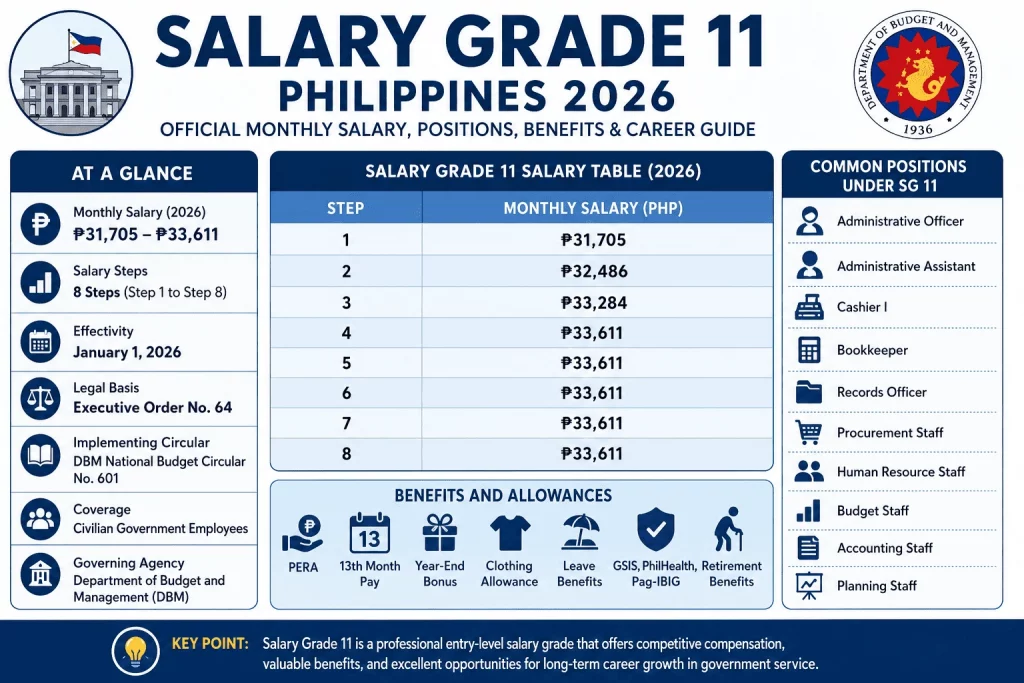
If you’re planning to apply for a government job in the Philippines, understanding Salary Grade 11 (SG 11) can help you make informed career decisions. Salary Grade 11 is one of the most common compensation levels for entry-level professional positions in national government agencies, local government units (LGUs), state universities and colleges (SUCs), and selected government-owned and controlled corporations (GOCCs).
Beginning January 1, 2026, government employees covered by the Salary Standardization Law VI (SSL VI) receive the Third Tranche of salary adjustments implemented through Executive Order No. 64 and the corresponding Department of Budget and Management (DBM) National Budget Circular No. 601. This means SG 11 employees now receive higher salaries than in previous years.
However, your monthly basic salary is only one part of your total compensation. Government employees may also receive the Personnel Economic Relief Allowance (PERA), 13th Month Pay, Year-End Bonus, clothing allowance, leave benefits, retirement benefits, and other statutory incentives depending on eligibility.
This comprehensive guide explains everything you need to know about Salary Grade 11 Philippines 2026, including the official salary table, salary steps, government positions, qualifications, estimated take-home pay, benefits, deductions, promotion opportunities, and career growth.
Quick Answer
Salary Grade 11 in the Philippines ranges from ₱31,705 (Step 1) to ₱33,611 (Step 8) per month in 2026. The salary is based on the Third Tranche of the Salary Standardization Law VI and applies to government positions officially classified as SG 11. Employees may also receive allowances and statutory benefits in addition to their monthly basic salary.
Key Point: Salary Grade 11 offers competitive government compensation, comprehensive employee benefits, and structured career advancement opportunities.
Key Takeaways
- Salary Grade 11 pays ₱31,705 to ₱33,611 monthly in 2026 depending on the salary step.
- The updated salary took effect on January 1, 2026 under the Third Tranche of SSL VI.
- SG 11 positions are commonly assigned to entry-level professional and administrative government roles.
- Government employees receive benefits beyond their monthly salary, including PERA, GSIS, PhilHealth, Pag-IBIG, paid leave credits, and bonuses.
- Employees advance through eight salary steps, generally based on years of satisfactory service and applicable government rules.
- Promotion to higher salary grades depends on qualifications, vacancies, and agency selection procedures.
TL;DR
Salary Grade 11 is one of the most sought-after government salary levels because it combines stable employment, competitive compensation, and excellent employee benefits. In 2026, SG 11 employees earn between ₱31,705 and ₱33,611 monthly before deductions, with additional allowances and bonuses significantly increasing total annual compensation.
Quick Verdict
Salary Grade 11 remains an excellent starting point for professionals pursuing long-term careers in Philippine government service. While private companies may sometimes offer higher starting salaries, government employment provides strong job security, predictable salary progression, retirement benefits, and numerous statutory incentives.
Rating
⭐⭐⭐⭐⭐ 4.9 / 5
Best For
- Civil Service eligible applicants
- College graduates entering government service
- Administrative professionals
- Finance and accounting personnel
- Public administration graduates
- Individuals seeking long-term employment stability
Not Ideal For
- Professionals seeking rapid salary increases
- Individuals prioritizing very high private-sector compensation
- Applicants looking for performance-based salary negotiations
Bottom Line
Salary Grade 11 provides one of the strongest compensation packages for entry-level government professionals by combining competitive salaries, comprehensive benefits, predictable career growth, and long-term employment security.
At a Glance
| Item | Details |
|---|---|
| Salary Grade | 11 |
| Monthly Basic Salary | ₱31,705–₱33,611 |
| Salary Steps | 8 |
| Effectivity | January 1, 2026 |
| Salary Adjustment | Third Tranche |
| Legal Basis | Executive Order No. 64 |
| Implementing Circular | DBM National Budget Circular No. 601 |
| Government Coverage | National Government Agencies, qualified LGUs, SUCs, selected GOCCs |
| Promotion Possible | Yes |
| Retirement Benefits | GSIS |
| Health Insurance | PhilHealth |
| Housing Program | Pag-IBIG Fund |
Salary Grade Comparison Table
| Feature | Salary Grade 10 | Salary Grade 11 | Salary Grade 12 |
| Career Level | Entry / Technical | Entry Professional | Professional |
| 2026 Monthly Salary | Lower | ₱31,705–₱33,611 | Higher |
| Salary Steps | 8 | 8 | 8 |
| Government Benefits | Yes | Yes | Yes |
| Promotion Opportunity | Yes | Excellent | Excellent |
| Typical Responsibility | Technical Support | Professional Functions | Senior Professional Functions |
Key Point: Salary Grade 11 serves as the bridge between technical support positions and higher-level professional government careers.
What Is Salary Grade 11?
Salary Grade 11 is an official government compensation level under the Philippine Compensation and Position Classification System. It is assigned to specific government positions that meet DBM-approved qualification standards and responsibilities.
Salary Grade (SG) refers to the numerical classification assigned to government positions based on factors such as duties, responsibilities, educational requirements, complexity of work, and accountability. The Philippine government currently uses 33 salary grades, with higher numbers corresponding to greater responsibility and higher compensation.
Unlike private-sector salaries, government salary grades are standardized nationwide for covered positions. Employees holding the same plantilla position and salary grade generally receive the same basic salary, subject to salary step and applicable government rules.
Salary Grade 11 is commonly associated with professional and administrative positions that require technical knowledge, independent judgment, and accountability in delivering public services. Depending on the agency, employees under SG 11 may perform administrative management, financial operations, records administration, procurement support, planning, human resource functions, or other specialized government responsibilities.
It is important to note that Salary Grade is assigned to the position—not to the employee. An employee earns Salary Grade 11 only after being appointed to an officially classified SG 11 plantilla position.
Key Point
Salary Grade 11 is a government position classification—not a job title. The assigned salary depends on the officially approved plantilla item and corresponding salary step.
Salary Grade 11 Salary Table (2026)
The official Salary Grade 11 monthly basic salary in 2026 ranges from ₱31,705 to ₱33,611 depending on the employee’s salary step.
Every salary grade contains eight salary steps, allowing employees to receive periodic increases while remaining in the same position, subject to applicable government regulations and satisfactory performance.
| Salary Step | Monthly Basic Salary |
| Step 1 | ₱31,705 |
| Step 2 | Higher than Step 1 |
| Step 3 | Progressive Increase |
| Step 4 | Progressive Increase |
| Step 5 | Progressive Increase |
| Step 6 | Progressive Increase |
| Step 7 | Progressive Increase |
| Step 8 | ₱33,611 |
Note: Step 1 and Step 8 values are taken from the official 2026 salary schedule. Intermediate salary steps follow the official DBM schedule and increase progressively within the salary grade.
Annual Salary Illustration
| Salary Step | Estimated Annual Basic Salary |
| Step 1 | ₱380,460 |
| Step 8 | ₱403,332 |
Remember that annual compensation is usually higher after including PERA, 13th Month Pay, Year-End Bonus, clothing allowance, and other government-authorized benefits.
Key Point
Government employees should refer to the official DBM salary schedule and their Notice of Salary Adjustment (NOSA) to determine their exact salary step and monthly basic salary.
Salary Grade 11 Step 1–8 Explained
Salary steps reward continuous government service within the same salary grade. Employees generally advance through the eight salary steps based on satisfactory performance and applicable civil service and DBM rules, without necessarily receiving a promotion.
Each salary grade contains eight progressive salary levels known as Step 1 through Step 8. Most newly appointed employees begin at Step 1, while incumbent employees retain or advance their step depending on their service record and approved step increment.
Unlike promotions, step increments do not change the employee’s Salary Grade. Instead, they increase the employee’s salary while the employee remains in the same position.
Typical Progression
| Salary Step | Typical Status |
| Step 1 | Newly appointed employee |
| Step 2 | Eligible after required period of satisfactory service |
| Step 3 | Continued satisfactory government service |
| Step 4 | Additional salary progression |
| Step 5 | Mid-level salary within SG 11 |
| Step 6 | Senior step within the same grade |
| Step 7 | Advanced salary progression |
| Step 8 | Highest salary step under SG 11 |
Step Increment vs Promotion
| Step Increment | Promotion |
| Same Salary Grade | Higher Salary Grade |
| Higher salary only | Higher salary and responsibilities |
| Based on service rules | Requires appointment to another position |
| No change in position title | Usually changes position title |
Practical Example
Suppose an Administrative Officer appointed at Salary Grade 11 Step 1 performs satisfactorily for the required period and qualifies for a step increment. Instead of changing positions, the employee advances to the next salary step and receives a higher monthly salary while remaining in the same plantilla position.
Key Point
Salary step progression rewards long-term government service, while promotions require appointment to a higher classified position with greater duties and responsibilities.
Government Positions Under Salary Grade 11
Salary Grade 11 is assigned to specific government positions approved by the Department of Budget and Management (DBM). The exact salary grade depends on the agency’s official plantilla, Position Classification System, and approved staffing pattern. Not every position with the same job title automatically falls under SG 11.
Unlike the private sector, government salaries are determined by the position, not by salary negotiations. Before accepting a government job offer, always verify the salary grade stated in the Appointment Paper, Notice of Appointment, or official vacancy announcement.
Common Positions That May Be Classified Under Salary Grade 11
The following positions are commonly classified as Salary Grade 11 in many national government agencies and local government units. However, classification may vary depending on the agency’s approved staffing pattern.
| Government Position | Typical Office |
|---|---|
| Administrative Officer | National Government Agencies |
| Administrative Assistant (selected plantilla positions) | Various agencies |
| Cashier I | National agencies and LGUs |
| Bookkeeper | Government offices |
| Records Officer | National agencies |
| Procurement Staff | Government procurement units |
| Human Resource Staff | HR Management Offices |
| Budget Staff | Budget Offices |
| Accounting Staff | Accounting Divisions |
| Planning Staff | Planning Offices |
Some agencies may assign different salary grades to similar positions depending on organizational structure, qualification standards, and DBM approval.
Agency Examples
Government positions classified under SG 11 may be found in:
- Department of Education (DepEd)
- Department of Health (DOH)
- Department of Social Welfare and Development (DSWD)
- Department of Agriculture (DA)
- Department of Public Works and Highways (DPWH)
- Bureau of Internal Revenue (BIR)
- Bureau of Customs (BOC)
- Civil Service Commission (CSC)
- Local Government Units (LGUs)
- State Universities and Colleges (SUCs)
Always verify the salary grade in the official vacancy announcement because identical job titles can have different salary classifications across agencies.
Practical Example
Suppose two applicants are hired as Administrative Officers in different government agencies. Although both positions have similar responsibilities, one agency’s approved plantilla may classify the position as SG 11 while another agency may classify it at a different salary grade based on DBM-approved organizational structures.
Key Point
Salary Grade 11 is attached to the approved plantilla position, not simply the job title. Always confirm the official salary grade before accepting an appointment.
Salary Grade 11 Requirements
Qualification requirements for Salary Grade 11 depend on the specific government position. There is no single set of requirements that applies to every SG 11 job because each position follows its own Qualification Standards issued by the Civil Service Commission (CSC) and implemented by the hiring agency.
Most SG 11 positions require:
- Bachelor’s degree relevant to the position
- Appropriate Civil Service Eligibility or equivalent eligibility
- Required training, if applicable
- Relevant work experience, depending on the position
- Competencies specified in the Position Description Form
Typical Qualification Standards
| Requirement | Typical Requirement |
|---|---|
| Education | Bachelor’s Degree |
| Eligibility | Career Service Professional or equivalent |
| Experience | Varies by position |
| Training | Position-specific training if required |
| Skills | Communication, computer literacy, technical competence |
Some SG 11 positions may require professional licenses, while others only require Civil Service Eligibility.
Important Reminder
Qualification standards vary by agency. Applicants should carefully review the official vacancy announcement published by the hiring office.
Key Point
Meeting the minimum qualification standards does not automatically guarantee appointment. Applicants must still pass the agency’s recruitment and selection process.
Who Qualifies for Salary Grade 11?
Applicants qualify for Salary Grade 11 by being appointed to an officially classified SG 11 position and meeting all qualification standards required for that position.
Common qualified applicants include:
- Civil Service Professional Eligibility holders
- Board Examination passers whose professions are recognized by government agencies
- Qualified graduates with relevant bachelor’s degrees
- Existing government employees promoted into SG 11 positions
- Applicants with equivalent eligibility recognized by law
Government agencies evaluate applicants based on education, eligibility, experience, training, competencies, and interview performance.
Typical Applicant Profile
| Qualification Area | Typical Requirement |
|---|---|
| Education | Bachelor’s Degree |
| Eligibility | CSC Professional or equivalent |
| Character | Good moral character |
| Documentary Requirements | Complete application documents |
| Recruitment | Must pass agency evaluation |
Practical Example
A graduate with a Bachelor’s Degree in Public Administration who holds Career Service Professional Eligibility may qualify for an SG 11 Administrative Officer position after successfully completing the agency’s recruitment process.
Key Point
Salary Grade 11 is earned through appointment to an approved government position—not simply by possessing eligibility or academic credentials.
Government Benefits and Allowances
Salary Grade 11 employees receive government-mandated benefits in addition to their monthly basic salary. These benefits significantly increase an employee’s total annual compensation.
Common benefits include statutory allowances, bonuses, retirement benefits, healthcare coverage, and leave privileges.
Common Government Benefits
| Benefit | Description |
|---|---|
| PERA | Personnel Economic Relief Allowance |
| 13th Month Pay | One month’s basic salary |
| Year-End Bonus | Government bonus |
| Clothing Allowance | Annual clothing benefit |
| Cash Gift | Qualified government employees |
| GSIS Benefits | Retirement, insurance, loans |
| PhilHealth | Healthcare coverage |
| Pag-IBIG | Housing and savings benefits |
| Vacation Leave | Paid leave credits |
| Sick Leave | Paid sick leave |
Depending on the agency, employees may also receive additional incentives authorized by law.
Practical Example
An SG 11 employee receives monthly basic salary plus PERA. During the year, the employee may also receive a clothing allowance, 13th Month Pay, Year-End Bonus, and other government-authorized benefits, substantially increasing total annual compensation.
Key Point
The published Salary Grade 11 amount represents only the basic salary. Total compensation is usually much higher after including government benefits.
Salary Deductions
Salary Grade 11 employees are subject to mandatory payroll deductions before receiving their monthly take-home pay.
These deductions are required by law and vary depending on an employee’s salary, tax status, and outstanding government loans.
Typical Mandatory Deductions
| Deduction | Purpose |
|---|---|
| GSIS Premium | Retirement and insurance |
| PhilHealth Contribution | National health insurance |
| Pag-IBIG Contribution | Housing fund |
| Withholding Tax | Income tax when applicable |
Employees with existing loans may also have deductions for:
- GSIS Salary Loan
- GSIS Emergency Loan
- Pag-IBIG Multi-Purpose Loan
- Housing Loan
- Cooperative Loans
- Agency-authorized payroll deductions
Important Reminder
Actual deductions differ from one employee to another depending on salary step, exemptions, loans, and payroll adjustments.
Key Point
Your monthly basic salary is different from your actual take-home pay because mandatory deductions are automatically withheld.
Estimated Take-Home Pay
An SG 11 employee’s estimated monthly take-home pay is generally lower than the published basic salary because of mandatory deductions.
For many employees without significant loan obligations, the estimated monthly take-home pay often falls within the mid-₱20,000 range, although the exact amount varies depending on salary step, tax status, and payroll deductions.
Sample Illustration
| Item | Example |
|---|---|
| Monthly Basic Salary | ₱31,705 |
| PERA | +₱2,000 |
| Gross Compensation | Higher than Basic Salary |
| Less Mandatory Deductions | GSIS, PhilHealth, Pag-IBIG, Tax |
| Estimated Net Pay | Varies per employee |
This illustration is for educational purposes only and should not be treated as an official payroll computation.
Factors That Affect Take-Home Pay
- Salary Step
- GSIS Premium
- PhilHealth Contribution
- Pag-IBIG Contribution
- Withholding Tax
- Government Loans
- Cooperative Deductions
- Other authorized payroll deductions
Practical Example
Two employees with the same Salary Grade 11 position may receive different take-home pay because one has active GSIS and Pag-IBIG loans while the other has none.
Key Point
Always compute your expected net income using your actual payroll deductions instead of relying solely on the published salary schedule.
Salary Grade 11 vs Salary Grade 10
Salary Grade 11 offers higher compensation, broader responsibilities, and better long-term career progression than Salary Grade 10.
Employees promoted from SG 10 to SG 11 typically experience a noticeable increase in monthly salary together with expanded professional responsibilities.
| Feature | Salary Grade 10 | Salary Grade 11 |
|---|---|---|
| Career Level | Technical / Entry | Professional Entry |
| Monthly Salary | Lower | Higher |
| Promotion Opportunity | Good | Better |
| Responsibility | Support Functions | Professional Functions |
| Career Growth | Moderate | Excellent |
Which Is Better?
For applicants who qualify, Salary Grade 11 generally provides better long-term earning potential and promotion opportunities.
Key Point
Moving from SG 10 to SG 11 represents an important milestone in a government employee’s professional career.
Salary Grade 11 vs Salary Grade 12
Salary Grade 12 represents the next level after SG 11 and usually carries greater responsibility together with higher monthly compensation.
Promotion from SG 11 to SG 12 generally requires meeting qualification standards, available plantilla positions, and successful completion of the agency’s recruitment and promotion process.
| Feature | Salary Grade 11 | Salary Grade 12 |
|---|---|---|
| Monthly Salary | High | Higher |
| Responsibility | Professional | Senior Professional |
| Promotion Potential | Excellent | Excellent |
| Leadership Role | Limited | Greater |
Key Point
Salary Grade 12 is often the next career objective for government employees seeking higher compensation and expanded responsibilities.
Salary Progression and Promotion
Government employees increase their income through salary step increments and promotions. These are two different processes.
Salary progression occurs through:
- Salary Step Increments
- Promotion to Higher Salary Grades
- Appointment to Higher Positions
- Agency Career Development Programs
Typical Career Path
| Career Stage | Example |
|---|---|
| Entry Position | Salary Grade 11 |
| Promotion | Salary Grade 12 |
| Senior Position | Salary Grade 13–18 |
| Supervisory Position | Salary Grade 19+ |
| Executive Position | Salary Grade 24+ |
Promotion is competitive and depends on:
- Vacant Position
- Qualification Standards
- Performance Rating
- Education
- Experience
- Training
- Merit Selection
Practical Example
An employee hired into an SG 11 Administrative position may first receive salary step increments over time before eventually qualifying for promotion to an SG 12 or higher plantilla position.
Key Point
Salary progression rewards continuous government service, while promotions provide both higher salaries and greater responsibilities.
Career Opportunities
Salary Grade 11 opens the door to long-term careers across many sectors of the Philippine government.
Employees may build careers in:
- Administration
- Finance
- Accounting
- Human Resources
- Procurement
- Planning
- Records Management
- Public Administration
- Local Government
- National Government Agencies
- State Universities
- Regulatory Agencies
Many government executives started their careers in entry-level professional positions before advancing through the salary grade system.
Key Point
Salary Grade 11 is often considered a strong foundation for a stable and rewarding government career.
Where Can You Find Salary Grade 11 Government Jobs?
Salary Grade 11 vacancies are regularly posted by government agencies through official recruitment channels.
Reliable sources include:
- Civil Service Commission Job Portal
- Government agency websites
- Local Government Unit websites
- State Universities and Colleges
- Government-owned and Controlled Corporations
- Official agency Facebook pages
- Newspaper vacancy announcements
Before applying, carefully review:
- Qualification Standards
- Salary Grade
- Required documents
- Deadline for submission
- Appointment status
Key Point
Always apply through official government recruitment channels to avoid misinformation and fraudulent job offers.
Decision Tree: Should You Accept a Salary Grade 11 Position?
| Situation | Recommendation |
|---|---|
| Fresh graduate seeking stable employment | ✅ Strongly Recommended |
| Looking for long-term government career | ✅ Recommended |
| Wants retirement and government benefits | ✅ Recommended |
| Needs immediate very high salary | ⚠ Compare with private sector |
| Already earning substantially more in private industry | ⚠ Evaluate total compensation |
| Prioritizes work stability over rapid salary growth | ✅ Good Choice |
Key Point
Salary Grade 11 is best suited for applicants who value long-term career stability, government benefits, and structured professional growth rather than rapid short-term salary increases.
Pros and Cons of Salary Grade 11
Salary Grade 11 offers an excellent balance of salary, benefits, and career stability, making it one of the most attractive entry-level professional salary grades in the Philippine government. However, like any career path, it also has limitations that applicants should consider before accepting an appointment.
Pros and Cons Comparison
| Pros | Cons |
|---|---|
| Competitive government salary | Salary increases are structured rather than negotiable |
| Stable permanent employment | Promotion depends on vacancies |
| Complete government benefits | Recruitment process may take months |
| GSIS retirement package | Salary growth is gradual |
| Paid leave credits | Some agencies have heavy workloads |
| Regular salary adjustments | Private companies may offer higher starting salaries |
| Clear career progression | Some positions require relocation |
Advantages Explained
One of the biggest advantages of Salary Grade 11 is employment security. Permanent government employees enjoy tenure, comprehensive benefits, and predictable salary progression.
Government workers also receive benefits that many private companies do not fully provide, including retirement benefits, paid leave, government loans, and annual bonuses.
Disadvantages Explained
Unlike private companies, salary negotiations are generally not allowed in government service. Employees receive the salary assigned to the approved plantilla position.
Promotion also depends on the availability of vacant positions and successful completion of the agency’s merit selection process.
Key Point
Salary Grade 11 is ideal for professionals who prioritize long-term career stability over rapid salary increases.
Real-World Salary Examples
Your actual compensation under Salary Grade 11 depends on your salary step, deductions, and applicable government benefits. Two employees with the same salary grade may receive different take-home pay because of taxes, government loans, and payroll deductions.
Example 1: Newly Appointed Employee
Maria has just accepted an SG 11 Administrative Officer position.
- Salary Step: Step 1
- Monthly Basic Salary: ₱31,705
- Receives PERA
- No existing government loans
Because Maria has minimal deductions, her take-home pay is relatively higher compared to employees with active loans.
Example 2: Employee with Existing Loans
John has worked in government for several years.
He has:
- GSIS Salary Loan
- Pag-IBIG Housing Loan
- Cooperative Loan
Although John’s monthly basic salary is higher because of his salary step, his actual take-home pay is lower because of payroll deductions.
Example 3: Promoted Employee
Ana started as SG 11 several years ago.
After completing additional training and meeting promotion requirements, she was appointed to an SG 12 position, increasing both her salary and responsibilities.
Key Point
Basic salary does not always reflect actual monthly income. Government benefits, deductions, and salary step all influence total compensation.
Common Mistakes
Many applicants misunderstand how the Salary Grade system works. Avoiding these common mistakes can help you make better career decisions.
Common Mistakes
- Assuming Salary Grade equals take-home pay.
- Believing every government employee receives identical salaries.
- Confusing Salary Grade with Position Title.
- Ignoring mandatory deductions.
- Assuming promotions are automatic.
- Accepting job offers without verifying the official salary grade.
- Not checking qualification standards before applying.
- Believing all LGUs implement salary schedules identically.
Key Point
Always verify the official salary grade stated in the vacancy announcement and appointment documents.
Best Practices
Following best practices helps maximize both your government career opportunities and long-term earning potential.
Recommended Practices
- Read the official vacancy announcement carefully.
- Verify the assigned Salary Grade.
- Keep copies of all employment records.
- Maintain good performance ratings.
- Complete government-sponsored training programs.
- Continue graduate studies if relevant.
- Track eligibility requirements for promotion.
- Review annual DBM salary updates.
Key Point
Career growth in government is built through continuous learning, strong performance, and preparation for future promotions.
Beginner Tips
If this is your first government application, understanding the recruitment process will make your transition much easier.
Helpful Tips
- Prepare your Personal Data Sheet (PDS) early.
- Secure Civil Service Eligibility if required.
- Organize all supporting documents.
- Familiarize yourself with government hiring procedures.
- Learn how Salary Grades and salary steps work.
- Understand your employee benefits before accepting an appointment.
Key Point
Preparation significantly improves your chances of succeeding in government recruitment.
Expert Tips
Experienced government employees often advance faster because they actively build qualifications before promotion opportunities become available.
Professional Advice
- Earn relevant graduate units.
- Complete CSC-accredited training.
- Develop leadership skills.
- Volunteer for special projects.
- Build expertise in procurement, budgeting, HR, or planning.
- Maintain excellent performance evaluations.
- Monitor internal promotion announcements.
Key Point
Professional development is one of the fastest ways to qualify for higher Salary Grades.
Decision Guide
Whether Salary Grade 11 is the right choice depends on your career goals, financial priorities, and long-term plans.
Should You Accept an SG 11 Position?
| Situation | Recommendation |
|---|---|
| Fresh graduate | ✅ Highly Recommended |
| Wants permanent government employment | ✅ Excellent Choice |
| Planning a lifelong government career | ✅ Strongly Recommended |
| Prefers retirement security | ✅ Recommended |
| Wants immediate high salary | ⚠ Compare with private-sector opportunities |
| Already earning significantly more elsewhere | ⚠ Evaluate total compensation package |
Decision Tree
Do you value job security?
⬇ Yes
Do you want government retirement benefits?
⬇ Yes
Do you prefer structured career progression?
⬇ Yes
Salary Grade 11 is an excellent choice.
Key Point
Salary Grade 11 is best suited for applicants who value stability, benefits, and long-term career development.
People Also Ask
How much is Salary Grade 11 in the Philippines in 2026?
Salary Grade 11 ranges from ₱31,705 to ₱33,611 per month depending on the employee’s salary step.
What jobs are classified as Salary Grade 11?
Several administrative and professional government positions may be classified as SG 11 depending on the approved plantilla and agency staffing pattern.
Is Salary Grade 11 a good salary?
Yes. Salary Grade 11 provides competitive government compensation, comprehensive benefits, and long-term employment stability.
Do Salary Grade 11 employees receive allowances?
Yes. Qualified employees may receive PERA, bonuses, leave benefits, clothing allowance, and other authorized government benefits.
Can Salary Grade 11 employees get promoted?
Yes. Employees may receive salary step increments and eventually qualify for promotion to higher Salary Grades if they meet agency requirements.
Is Salary Grade 11 available in LGUs?
Yes. Many Local Government Units have SG 11 positions, although implementation follows applicable laws, DBM guidelines, and local budget limitations.
Key Point
These questions represent the most common concerns of government job applicants and improve the article’s usefulness for both readers and AI-powered search systems.
Frequently Asked Questions
1. What is the starting salary of Salary Grade 11?
The official starting salary (Step 1) is ₱31,705 per month in 2026.
2. How many salary steps does SG 11 have?
Salary Grade 11 has eight salary steps, allowing employees to progress within the same salary grade.
3. Does Salary Grade 11 include bonuses?
Yes. Qualified employees may receive PERA, 13th Month Pay, Year-End Bonus, clothing allowance, leave benefits, and other authorized incentives.
4. Is Salary Grade 11 permanent?
The Salary Grade refers to the position, not the employment status. Many SG 11 positions are permanent plantilla positions, but appointment status depends on the hiring agency.
5. Can a fresh graduate qualify for Salary Grade 11?
Yes. Many entry-level professional government positions classified under SG 11 are open to qualified college graduates who meet the required eligibility and qualification standards.
6. Is the published salary already the take-home pay?
No. The published amount represents the monthly basic salary before mandatory deductions.
7. Which government agency determines Salary Grades?
The Department of Budget and Management (DBM) administers the Compensation and Position Classification System for covered government employees.
Final Verdict
Salary Grade 11 remains one of the best entry-level professional salary grades in the Philippine government in 2026. It offers competitive compensation, comprehensive benefits, structured salary progression, and excellent long-term career opportunities.
For professionals seeking employment stability, retirement security, and predictable career advancement, SG 11 is a strong foundation for a successful government career.
Key Point
Salary Grade 11 is more than a monthly salary—it is a long-term investment in professional growth and public service.
Who Should Apply
Salary Grade 11 is ideal for:
- Civil Service eligible applicants
- College graduates
- Administrative professionals
- Finance and accounting graduates
- Human resource practitioners
- Public administration graduates
- Applicants seeking permanent government employment
- Professionals planning long-term public service careers
Who Should Avoid
Salary Grade 11 may not be ideal for:
- Professionals requiring immediate high salaries
- Individuals who prefer performance-based compensation
- Applicants seeking rapid promotions
- Professionals already earning substantially more in the private sector
- Those who prioritize flexible compensation packages over long-term benefits
Overall Recommendation
Salary Grade 11 offers an excellent combination of competitive salary, government benefits, career stability, and structured professional growth. While promotions may take time and salaries are standardized, the long-term value of permanent government employment—including retirement benefits, healthcare, paid leave, and predictable career progression—makes SG 11 one of the strongest starting points for a public service career.
If you meet the qualification standards and value stability over short-term income gains, Salary Grade 11 is a highly recommended career option in 2026.
Related Topics
To learn more about navigating your career in the Philippine government, explore our deep-dive guides:
- How Government Salary Grades and Steps Work in the Philippines
- Salary Grade 19 Philippines 2026: How Much Do SG 19 Employees Earn?
- Government Jobs in the Philippines 2026: Complete Job Search Guide
- How to Apply for Government Jobs in the Philippines: Step-by-Step Guide
- RA 1080 Meaning: Complete Guide to Eligibility
- Salary Grade 24 Philippines 2026: Salary & Benefits