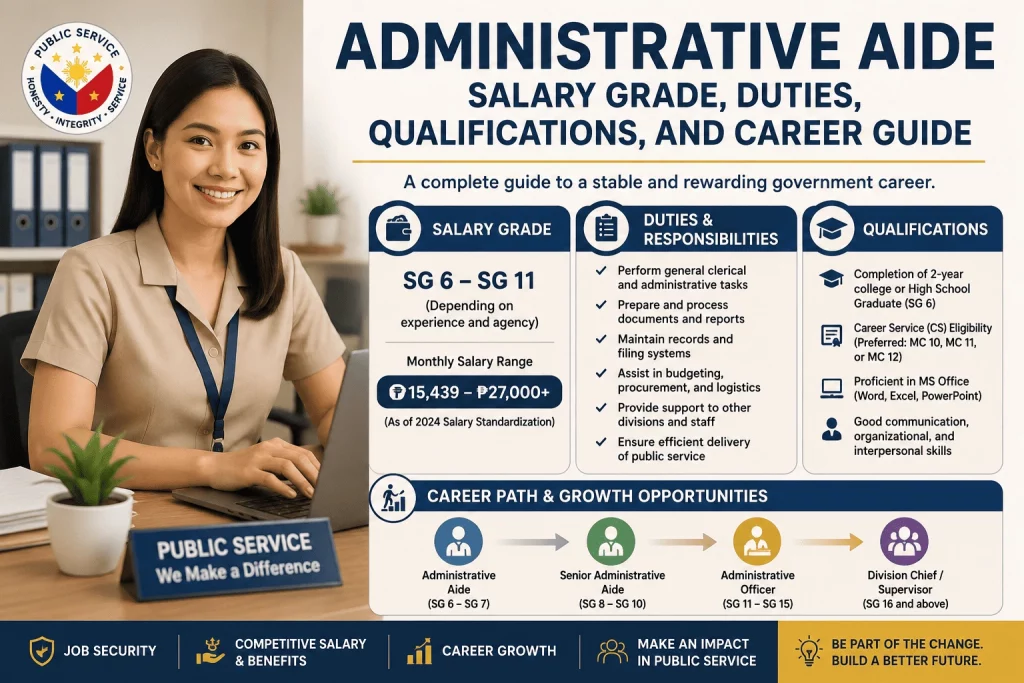
Quick Answer
An Administrative Aide is an entry-level clerical and support position in the Philippine civil service, classified from Administrative Aide I (Salary Grade 1) to Administrative Aide VI (Salary Grade 6). Most Admin Aide positions only require a high school diploma (Admin Aide I–III) or a two-year vocational course (Admin Aide IV–VI), making them among the most accessible entry points into government employment. Monthly basic pay under the 2026 salary schedule ranges from roughly ₱14,634 to ₱20,761, plus government benefits such as GSIS, PhilHealth, Pag-IBIG, and leave credits.
Administrative Aide Salary Grade at a Glance
| Position | Salary Grade |
|---|---|
| Administrative Aide I | SG 1 |
| Administrative Aide II | SG 2 |
| Administrative Aide III | SG 3 |
| Administrative Aide IV | SG 4 |
| Administrative Aide V | SG 5 |
| Administrative Aide VI | SG 6 |
What Is an Administrative Aide?
An Administrative Aide is a rank-and-file position under the Philippine government’s Position Classification System, administered jointly by the Civil Service Commission (CSC) and the Department of Budget and Management (DBM). It is one of the lowest-tiered, most accessible plantilla positions in the bureaucracy, designed for individuals who perform basic clerical, custodial, messengerial, or general support functions in a government office.
Unlike specialized professional roles that require a college degree and board licenses, Administrative Aide positions are built around minimal formal education requirements. This makes the position a common entry point for jobseekers who want to build a career in public service without first completing a four-year degree.
Administrative Aides are found in nearly every branch and level of government — national line agencies, local government units (LGUs), state universities and colleges (SUCs), government hospitals, and government-owned and controlled corporations (GOCCs). Because the role exists almost everywhere, it remains one of the most frequently posted job titles on the Civil Service Commission’s Government Manpower Information System (CSC-GMIS) and individual agency career pages.
It is worth noting that in many agencies, this same tier of work is also referred to as Administrative Assistant for slightly higher clerical roles (Salary Grade 7 and above), while Administrative Aide specifically covers Salary Grades 1 to 6. Jobseekers often use the two terms interchangeably in casual conversation, but they represent distinct classification bands with different qualification standards.
Administrative Aide I–VI at a Glance
| Position | Salary Grade | Typical Role |
|---|---|---|
| Administrative Aide I | SG 1 | Utility Worker I |
| Administrative Aide II | SG 2 | Utility Worker II |
| Administrative Aide III | SG 3 | Clerk I |
| Administrative Aide IV | SG 4 | Data Encoder (Data Entry Machine Operator I) |
| Administrative Aide V | SG 5 | Clerk II |
| Administrative Aide VI | SG 6 | Clerk III (Bookbinder II) |
This table is the fastest way to answer the most common search: “ano ang salary grade ng Administrative Aide” or “Administrative Aide job description per level.” Full details on duties, qualifications, and pay per level are covered in the sections below.
Administrative Aide I to VI: Position Classifications Explained
The Administrative Aide category is subdivided into six levels, each carrying a different salary grade, set of duties, and minimum qualification standard. Below is a breakdown of how each level is typically used across agencies.
Administrative Aide I (Utility Worker I) — SG 1
The entry point of the entire civil service ladder. Duties typically involve general utility work — cleaning, maintenance, hauling supplies, and simple errands within an office.
Administrative Aide II (Utility Worker II) — SG 2
A slightly elevated utility role, sometimes involving basic equipment operation, simple maintenance tasks, or driving duties in some agencies (e.g., Driver I is often allocated at this grade).
Administrative Aide III (Clerk I) — SG 3
Primarily clerical: filing documents, routing correspondence, basic data recording, and messengerial duties. This is one of the most commonly posted Admin Aide vacancies in LGUs and national agencies.
Administrative Aide IV (Data Entry Machine Operator I) — SG 4
Focused on encoding and data entry — inputting records into government databases or spreadsheets, maintaining digital and physical filing systems, and basic report generation.
Administrative Aide V (Clerk II) — SG 5
A step above general clerical work, often assigned more complex filing systems, records classification, or correspondence tracking responsibilities, sometimes with light supervisory exposure over Aide III/IV staff.
Administrative Aide VI (Bookbinder II / Clerk III) — SG 6
The highest tier in the Aide series, often involving document binding, records archiving, more advanced clerical processes, or acting as a lead clerk in smaller offices.
Note: Exact position titles and duty allocations vary by agency because each government office maintains its own Qualification Standards (QS) Manual and plantilla of positions, approved by the DBM and CSC. Always check the specific vacancy announcement (Item Number, Plantilla Title, and Salary Grade) rather than relying on the generic title alone.
Salary Grades and 2026 Salary Table
Administrative Aide positions fall under Salary Grades 1 to 6. Under the Third Tranche of Executive Order No. 64, series of 2024, which took effect January 1, 2026, the monthly basic salary schedule for these grades is as follows:
| Position | Salary Grade | Step 1 | Step 4 | Step 8 |
|---|---|---|---|---|
| Administrative Aide I | SG 1 | ₱14,634 | ₱14,968 | ₱15,456 |
| Administrative Aide II | SG 2 | ₱15,522 | ₱15,869 | ₱16,342 |
| Administrative Aide III | SG 3 | ₱16,486 | ₱16,856 | ₱17,360 |
| Administrative Aide IV | SG 4 | ₱17,506 | ₱17,898 | ₱18,433 |
| Administrative Aide V | SG 5 | ₱18,581 | ₱18,998 | ₱19,565 |
| Administrative Aide VI | SG 6 | ₱19,716 | ₱20,158 | ₱20,761 |
Figures based on the DBM-issued salary schedule under EO No. 64, Third Tranche, effective January 1, 2026. A fourth and final tranche is scheduled to take effect in 2027, which will further raise these amounts.
Each salary grade contains eight incremental steps, and employees typically move up one step roughly every three years of satisfactory service, subject to agency budget and performance ratings. On top of basic pay, most Admin Aide positions also receive:
- Personnel Economic Relief Allowance (PERA)
- Uniform/Clothing Allowance (annual)
- 13th and 14th month pay (in many agencies and LGUs)
- Cash gift
- Mid-year and year-end bonuses
- Productivity Enhancement Incentive (PEI)
These allowances can meaningfully increase total annual compensation beyond the basic salary shown above.
Qualification Standards
The CSC’s Qualification Standards (QS) for Administrative Aide positions are intentionally light on formal requirements, which is precisely what makes this position so accessible. Standards are generally built around four pillars: Education, Training, Experience, and Eligibility (ETEE).
Administrative Aide I to III
- Education: Elementary or high school graduate (varies by exact item)
- Training: None required
- Experience: None required
- Eligibility: CSC Sub-Professional Eligibility, OR Category I under the Local Government Career Service Examination, OR relevant barangay-based eligibility in some LGU postings
Administrative Aide IV to VI
- Education: Completion of at least a two-year vocational/technical course, or high school graduate with relevant short-term training (varies by agency and specific plantilla item)
- Training: Some agencies require a minimum number of hours in relevant clerical or computer training
- Experience: Sometimes a minimal amount (e.g., six months to one year) of relevant clerical experience, though many entry postings waive this
- Eligibility: CSC Sub-Professional Eligibility (Career Service Sub-Professional, First Level)
Because Qualification Standards can differ slightly from one agency’s plantilla to another, applicants should always cross-check the specific QS listed in the official vacancy announcement, which is the authoritative source — not general guides like this one.
Job Description and Core Duties
While the specific tasks vary depending on the office and salary grade, most Administrative Aide roles revolve around these core functions:
- Records management — filing, sorting, and retrieving physical and digital documents
- Correspondence handling — receiving, routing, and dispatching official letters and memos
- Data encoding — inputting information into government systems, spreadsheets, or databases
- Reception and front-desk support — assisting clients, answering basic inquiries, directing visitors
- General office support — photocopying, scanning, preparing simple reports, inventory of office supplies
- Utility and maintenance tasks (for Aide I–II specifically) — cleaning, minor repairs, hauling of materials, messengerial errands
- Custodianship of records or supplies — maintaining logbooks, tracking issued materials, and safekeeping office equipment
Administrative Aides serve as the backbone of day-to-day office operations. While the tasks may appear simple individually, consistent, accurate execution of these duties is essential to keeping government offices running smoothly and to ensuring public-facing services are delivered without delay.
Where Administrative Aides Work
Because the position exists across virtually the entire bureaucracy, Administrative Aide vacancies can be found in:
- National government agencies (e.g., Department of Education, Department of Health, Department of Social Welfare and Development)
- Local government units — provincial, city, municipal, and barangay offices
- State universities and colleges (SUCs)
- Government hospitals and health centers
- Government-owned and controlled corporations (GOCCs)
- Judiciary and quasi-judicial bodies
- Legislative offices (e.g., district/committee staff support at the local level)
Because LGUs and small national-agency field offices post Admin Aide vacancies most frequently, jobseekers who are flexible about location — including provincial or municipal postings — generally have more opportunities than those targeting only head-office positions in Metro Manila.
Civil Service Eligibility Requirements
The single most important credential for permanent appointment as an Administrative Aide is Civil Service Eligibility. For this position band, the relevant exam is the:
Career Service Sub-Professional Examination (CSE Sub-Professional)
This is administered by the Civil Service Commission and is the standard eligibility requirement for Salary Grade 1 to 9 positions (which covers the entire Administrative Aide range). Key facts:
- The exam covers verbal ability, numerical ability, analytical ability, and general information (including Philippine Constitution, code of conduct for public officials, and current events)
- It is offered in both Paper-and-Pencil Test (PPT) and Computerized Examination (COMEX) formats through CSC regional and field offices
- Passing grade is 80%
- Passers receive a Career Service Sub-Professional Eligibility, valid for life, which qualifies them for permanent appointment to SG 1–9 positions nationwide
Alternative eligibilities are also recognized for certain postings, particularly at the barangay or LGU level, such as:
- Barangay Health Worker (BHW) eligibility (for specific health-related aide positions)
- Skills/trade-based eligibility issued by TESDA, where relevant to the position (e.g., driving-related aide roles)
- PD 907 / RA 1080-type eligibilities are not applicable here since those are for professional-level licensed positions
Applicants without eligibility can still be hired, but typically only under casual, job order (JO), or contract of service (COS) status — not as a permanent, plantilla employee — until they pass the relevant exam.
How to Apply: Step-by-Step Process
Applying for an Administrative Aide position generally follows this sequence:
Step 1: Monitor Vacancy Announcements
Check these sources regularly:
- The CSC Government Manpower Information System (GMIS) at csc.gov.ph
- Individual agency or LGU official websites and Facebook pages
- The Philippine Government Electronic Procurement System (PhilGEPS) for some contractual postings
- Bulletin boards at the HRMO (Human Resource Management Office) of the target agency
Step 2: Prepare Your Application Documents
Standard requirements usually include:
- Duly accomplished Personal Data Sheet (CS Form No. 212), downloadable from the CSC website
- Photocopy of Civil Service Eligibility certificate (or valid alternative eligibility)
- Transcript of Records or diploma, depending on the position
- Certificate of employment or service record (if applicable)
- Performance rating for the last rating period (for current government employees applying for transfer/promotion)
- Recent identification photo and other agency-specific requirements
Step 3: Submit Your Application
Submit directly to the HRMO of the hiring agency, either in person, by courier, or through the application channel specified in the vacancy announcement (some agencies now accept email or online form submissions).
Step 4: Screening and Evaluation
The agency’s Human Resource Merit Promotion and Selection Board (HRMPSB) reviews applications against the Qualification Standards, shortlists candidates, and schedules further assessment.
Step 5: Interview and/or Practical Exam
Shortlisted applicants are usually invited for a panel interview. Some agencies also administer a basic skills test — typing speed, filing accuracy, or simple computer literacy tasks — especially for encoding-related Aide IV to VI positions.
Step 6: Appointment and Onboarding
Successful candidates receive a Notice of Appointment, which is submitted to the CSC for approval. Upon CSC approval, the appointment becomes effective, and the new employee undergoes onboarding, including enrollment in GSIS, PhilHealth, and Pag-IBIG.
Career Progression Path
An Administrative Aide position is often described as a starting point rather than a destination. Common progression routes include:
- Lateral movement within the Aide series — from Administrative Aide I up through VI, via promotion as higher-grade items become vacant
- Promotion into the Administrative Assistant series (SG 7–8), which typically requires additional education (some college units) or relevant experience
- Transition into the Administrative Officer series (SG 9–15 and above), which generally requires a bachelor’s degree — many Aides pursue a college degree part-time specifically to unlock this path
- Cross-agency transfers, moving from a smaller LGU to a larger national agency or GOCC once eligible and experienced
- Specialization tracks, such as moving into HR, records management, or IT-support roles if the employee gains relevant training or certifications along the way
Because many Admin Aide employees eventually finish a bachelor’s degree while working (a common and encouraged path in Philippine public service), the position is frequently used as a stepping stone toward higher-salary-grade professional roles rather than treated as a permanent ceiling.
Skills That Help You Get Hired
While the formal Qualification Standards are minimal, applicants who stand out in the selection process typically demonstrate:
- Basic computer literacy — familiarity with MS Word, Excel, and simple encoding tools
- Typing speed and accuracy, especially for data entry-focused Aide IV positions
- Strong organizational habits — filing systems, records tracking, and attention to detail
- Communication skills, both written (memos, simple reports) and verbal (client-facing interactions)
- Punctuality and reliability, which HR boards weigh heavily given the operational nature of the role
- Basic knowledge of government processes, such as familiarity with how documents move through an office (routing slips, tracking logs)
- A positive, service-oriented attitude, since many Admin Aide roles involve direct interaction with the public
Application Tips and Common Mistakes
Do:
- Tailor your Personal Data Sheet to highlight any clerical, computer, or customer-service experience, even if informal (e.g., school org work, part-time jobs)
- Apply to multiple agencies and LGUs simultaneously — vacancy competition can be intense, especially in Metro Manila
- Take the CSE Sub-Professional exam as early as possible; it remains valid for life and dramatically widens your eligible postings
- Follow up politely with the HRMO after submission if you haven’t heard back within a reasonable period
Avoid:
- Submitting an incomplete Personal Data Sheet (a leading cause of automatic disqualification)
- Applying only for permanent plantilla items without also considering casual or job order openings, which are often the actual entry point many successful applicants use before eligibility is secured
- Assuming all Admin Aide postings are identical — always read the specific Qualification Standards in the vacancy announcement
- Missing application deadlines, which for government postings are strictly enforced
Benefits of Working as an Administrative Aide
Beyond the monthly basic salary, permanent Administrative Aide employees are entitled to the full range of Philippine government employee benefits:
- GSIS membership — retirement, disability, and life insurance coverage
- PhilHealth — national health insurance coverage
- Pag-IBIG Fund — housing loan and savings program
- Leave credits — 15 days vacation leave and 15 days sick leave per year, cumulative and convertible to cash
- Mandatory bonuses — 13th month pay, mid-year bonus, year-end bonus, cash gift
- Job security — once appointed permanently, removal requires just cause and due process under civil service law
- Retirement benefits under RA 8291 (GSIS Act), including lump sum and monthly pension options depending on years of service
For many Filipino families, these non-salary benefits — particularly job security and GSIS retirement coverage — are a major draw of public sector employment, even at entry-level salary grades.
Frequently Asked Questions
What is the minimum educational requirement for Administrative Aide?
For Administrative Aide I to III, a high school diploma is typically sufficient. Administrative Aide IV to VI usually requires completion of a two-year vocational or technical course, though this varies by agency.
Do I need Civil Service Eligibility to apply?
Yes, for a permanent appointment. The Career Service Sub-Professional Eligibility is the standard requirement for Salary Grade 1–9 positions, which covers the entire Admin Aide range. Applicants without eligibility can sometimes be hired under casual or job order status.
How much is the salary of an Administrative Aide in 2026?
Under the 2026 salary schedule (Third Tranche of EO No. 64), Administrative Aide I (SG 1) starts at ₱14,634 per month, while Administrative Aide VI (SG 6) starts at ₱19,716 per month, both at Step 1, exclusive of allowances and bonuses.
What is the difference between Administrative Aide and Administrative Assistant?
Administrative Aide covers Salary Grades 1 to 6 and generally involves basic clerical and utility work. Administrative Assistant covers Salary Grade 7 and above, involving more complex clerical and administrative coordination duties, and typically requires some college-level education.
Can an Administrative Aide get promoted?
Yes. Common paths include promotion within the Aide series (I to VI), advancement into the Administrative Assistant series, or eventual movement into the Administrative Officer series after completing a bachelor’s degree.
Is a college degree required to become an Administrative Aide?
No. Most Administrative Aide positions do not require a college degree, which is precisely what makes the role one of the most accessible entry points into Philippine government service.
Where can I find current Administrative Aide job openings?
Check the CSC Government Manpower Information System (GMIS), individual agency and LGU websites, and the HRMO bulletin boards of target offices for the most current vacancy announcements.
What exam should I take to qualify?
The Career Service Sub-Professional Examination, administered by the Civil Service Commission, is the relevant exam for Administrative Aide positions (Salary Grade 1–9 range).
Is Administrative Aide a permanent government position?
It can be, once an applicant is formally appointed to a plantilla item and the appointment is approved by the CSC. Some Admin Aide roles, however, are filled under casual, job order, or contract-of-service arrangements, which do not carry the same security of tenure or full benefits.
How long does it take to move from Administrative Aide I to VI?
There is no fixed timeline — it depends on item vacancies, agency budget, performance, and whether the employee applies for and is selected for higher-grade positions as they open up. Some employees stay within a single level for years before a vacancy allows promotion.
Final Thoughts
The Administrative Aide position remains one of the most practical and accessible entry points into Philippine government service. It does not require a college degree, offers a clear (if gradual) path toward higher salary grades, and comes with the full package of civil service benefits once permanency is secured. For many Filipinos — particularly those balancing work with continuing education — starting as an Administrative Aide is not the end goal, but the first rung of a long and stable public service career.
If you’re preparing to apply, the most effective first steps are: (1) take the Career Service Sub-Professional Examination as soon as possible, (2) prepare a complete and accurate Personal Data Sheet, and (3) monitor vacancy announcements across multiple agencies and LGUs rather than waiting for a single opening. Persistence, accuracy in your application documents, and flexibility about posting location are the biggest practical advantages an applicant can have.
Related Topics
To learn more about navigating your career in the Philippine government, explore our deep-dive guides:
- Salary Grade 1 in the Philippines (2026): Complete Guide to Pay, Steps, and Eligibility
- Salary Grade 2 in the Philippines (2026): Complete Guide to Pay, Steps, and Eligibility
- Salary Grade 3 in the Philippines (2026): Complete Guide to Pay, Steps, and Eligibility
- Salary Grade 6 Philippines: Salary, Steps, Positions, and Career Guide
- Salary Grade 7 Philippines: Salary, Benefits & Positions
- Salary Grade 8 Philippines: Salary, Steps, Positions, Benefits, and Career Guide
- Salary Grade 10 Philippines: Salary, Positions, Benefits, and Career Guide
- Salary Grade 11 Philippines 2026: Complete Guide
- Salary Grade 12 Philippines 2026: Salary, Positions & Benefits
- Administrative Aide I Salary Grade and Qualifications (2026)
- Government Jobs in the Philippines 2026: Complete Job Search Guide
- How to Apply for Government Jobs in the Philippines: Step-by-Step Guide
- Government Salary Grade 2026: Complete Guide to the Philippine Salary Schedule
References
- Department of Budget and Management (DBM). National Budget Circular No. 601 – Implementation of the Third Tranche Compensation Adjustment for Civilian Government Personnel pursuant to Executive Order No. 64, s. 2024.
- Civil Service Commission (CSC). Position Qualification Standards and Civil Service eligibility policies.
- Official Gazette of the Republic of the Philippines. Executive Orders, laws, and official government issuances relating to the Salary Standardization Law