Salary Grade 3 (SG 3) is where the Philippine government’s pay scale starts to split into two different tracks: a driving/skilled-manual track led by Driver I, and a clerical track led by Clerk I. Unlike SG 1 and SG 2, which are almost entirely covered by the single Administrative Aide series, SG 3 is the first grade where a specific, license-based qualification can gate who is even eligible to apply.
This guide explains the current SG 3 salary schedule, why it works differently from SG 1 and SG 2 in terms of qualification requirements, what Driver I applicants specifically need to prepare, and how the SG 2-to-SG 3 jump compares to the SG 1-to-SG 2 jump covered in earlier guides in this series.
Quick Answer
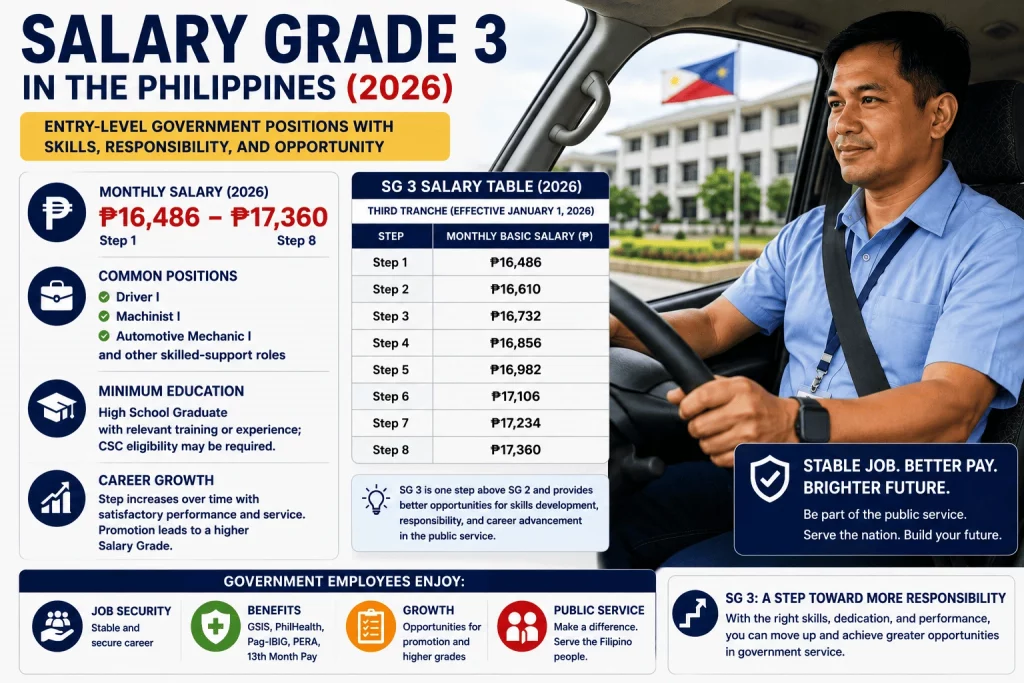
As of January 1, 2026, Salary Grade 3, Step 1 pays ₱16,486 per month under the third tranche of the Salary Standardization Law VI (SSL VI), rising to ₱17,360 at Step 8. SG 3 covers two distinct position families: Driver I, which requires a valid driver’s license, and Clerk I, which requires basic clerical and typing competence — making SG 3 the first grade in this series where the qualification standard actually differs meaningfully depending on which track you apply to.
Key Takeaways
- SG 3 pays from ₱16,486 (Step 1) to ₱17,360 (Step 8) as of the 2026 schedule.
- Unlike SG 1 and SG 2, SG 3 splits into at least two distinct position tracks: driving and clerical.
- Driver I is the first position in this salary-grade series that requires a government-issued license as a hard qualification, not just a preferred skill.
- The SG 2-to-SG 3 pay jump (₱964) is larger than the SG 1-to-SG 2 jump (₱888).
- The rates come from Executive Order No. 64, s. 2024, implementing the 2024–2027 salary schedule authorized under Republic Act No. 11466.
TL;DR
SG 3 pays ₱16,486 to ₱17,360 a month in 2026. It is the first grade in the low end of the pay scale where the required qualifications genuinely diverge by position: Driver I needs a valid driver’s license, while Clerk I needs basic clerical skill rather than a license. This licensing requirement is the main structural difference between SG 3 and the two grades below it.
Eligibility or Scope
This guide covers civilian government personnel under the national Compensation and Position Classification System (CPCS). It applies to national government agencies (NGAs), GOCCs not covered by a separate compensation system under Republic Act No. 10149, and LGUs that have adopted the national salary schedule, subject to local budget capacity. It does not apply to uniformed personnel or to job order and contract of service workers, who are not covered by the Salary Standardization Law.
Salary Grade 3 Table for 2026 (Third Tranche)
The table below shows the full step structure for SG 3, effective January 1, 2026, in Philippine pesos, representing monthly basic salary before deductions, allowances, or bonuses.
| Salary Step | Monthly Basic Salary (₱) |
|---|---|
| Step 1 | ₱16,486 |
| Step 2 | ₱16,610 |
| Step 3 | ₱16,732 |
| Step 4 | ₱16,856 |
| Step 5 | ₱16,982 |
| Step 6 | ₱17,106 |
| Step 7 | ₱17,234 |
| Step 8 | ₱17,360 |
The gap between Step 1 and Step 8 at SG 3 is ₱874 per month — slightly wider than the ₱822 gap at SG 1 and the ₱820 gap at SG 2, continuing the pattern of step spreads widening at higher grades.
Legal Basis
SG 3 figures come from the same framework as every other grade in this cycle: Republic Act No. 11466 (base authority for the CPCS), Executive Order No. 64, s. 2024 (authorizing the 2024–2027 tranche schedule), and the DBM’s annual National Budget Circulars, which publish the exact step tables. The figures here reflect the third tranche, effective January 1, 2026.
Why SG 3 Is Different: Two Position Tracks, Not One
SG 1 and SG 2 are dominated by a single classification family — the Administrative Aide series — covering utility, laborer, and messenger-type work with essentially the same entry bar: basic literacy, no license, no specialized training. SG 3 breaks that pattern. It is commonly associated with two separate, unrelated position families:
- Driver I — operates and maintains a government-assigned vehicle, requires a valid driver’s license issued by the Land Transportation Office (LTO), and falls under its own Driver series rather than the Administrative Aide series.
- Clerk I — performs basic clerical, filing, and typing duties, generally falls under the Clerical series, and does not require a driving license.
This means two applicants can both be looking at ‘SG 3 jobs’ and be preparing completely different qualification packets. Confirming which specific plantilla item and series a vacancy belongs to matters more at SG 3 than it did at SG 1 or SG 2.
Key Point Summary
- SG 3 is not a single job family; it covers at least two unrelated series.
- Driver I requires a valid LTO-issued license as a hard qualification.
- Clerk I requires clerical competence instead, with no license requirement.
Driver I: Qualification Requirements Specific to This Position
Because Driver I is the first license-gated position in this salary-grade series, its requirements look different from anything covered in the SG 1 or SG 2 guides. Typical requirements include:
- A valid driver’s license appropriate to the vehicle type the position will operate — commonly a non-professional or professional license depending on the agency’s vehicle fleet.
- A clean or acceptable driving record; some agencies request a certification of no major traffic violations.
- Basic vehicle maintenance knowledge, since Driver I positions are often responsible for reporting or performing minor upkeep on the assigned vehicle.
- Willingness to undergo periodic drug testing, which several agencies apply specifically to driving positions given the safety responsibility involved.
Unlike SG 1 or SG 2 positions, where the main disqualifier is failing to meet an education or eligibility requirement, a Driver I applicant can be disqualified purely on the license and driving-record requirement even if every other qualification is met. This is a structural difference worth flagging for anyone assuming SG 3 is simply ‘SG 2 plus a bit more pay.’
Clerk I: The Non-Driving Track at SG 3
Clerk I positions sit at the same salary grade as Driver I but follow a completely different qualification path. Typical requirements include basic proficiency in typing and filing, familiarity with basic office software in most modern postings, and, in some agencies, a specific number of typing words per minute as an informal screening benchmark during the interview stage. No driver’s license or driving-related certification applies to this track.
Applicants sometimes assume Clerk I is functionally similar to a Messenger position at SG 2, since both involve document handling. The practical difference is that Clerk I duties are desk-based and involve maintaining records or files accurately, while Messenger duties at SG 2 are primarily about physically transporting documents between locations.
SG 2 to SG 3: What Actually Changes
The jump from SG 2 to SG 3 is structurally different from the SG 1-to-SG 2 jump covered in the SG 2 guide. At SG 1 to SG 2, the main change was scope of duty and applicant pool size, with no new hard qualification. At SG 2 to SG 3, a genuine qualification barrier can appear, specifically for the Driver I track.
- The pay increase is larger: ₱964 more per month at Step 1, compared to ₱888 from SG 1 to SG 2.
- For the Driver I track specifically, a license requirement creates a hard barrier that does not exist when moving from SG 1 to SG 2 — an otherwise qualified SG 2 employee without a driver’s license cannot simply transfer into a Driver I item.
- For the Clerk I track, the barrier is softer and skills-based (typing, filing, basic computer literacy) rather than a hard external credential like a license.
This means an SG 2 employee planning ahead should decide early which SG 3 track to target, since the preparation — getting a driver’s license versus building clerical/typing skills — is not interchangeable.
SG 3 Compared to Nearby Salary Grades
The table below places SG 3 next to the salary grades immediately around it, using Step 1 figures from the 2026 schedule.
| Salary Grade | Illustrative Position | Step 1 Monthly Salary |
|---|---|---|
| Salary Grade 1 | Utility Worker I | ₱14,634 |
| Salary Grade 2 | Laborer II / Messenger | ₱15,522 |
| Salary Grade 3 | Driver I / Clerk I | ₱16,486 |
| Salary Grade 4 | Stenographer I / Mechanic I | ₱17,506 |
| Salary Grade 5 | Carpenter II | ₱18,581 |
Illustrative positions above are commonly cited examples; actual titles and their exact salary grade can vary by agency, since the CSC allows some flexibility in how functionally similar roles are classified and titled.
How Step Increments Work
An SG 3 employee does not automatically move to a higher step each year. Step increments depend on length of satisfactory service in the position and performance rating, following CSC and DBM rules.
- An employee starts at the step indicated in their appointment paper, most often Step 1.
- After completing the required number of years in service with at least a satisfactory performance rating, the employee becomes eligible for a step increment.
- The agency’s Human Resource Merit Promotion and Selection Board (HRMPSB) or equivalent unit processes the step adjustment.
- The new step takes effect upon approval and is reflected in the following payroll cycle.
How to Apply for a Driver I Position
Because Driver I has a hard licensing requirement not present in SG 1 or SG 2 applications, the process includes an extra verification step.
- Monitor vacancy announcements on the agency’s website or the CSC’s official job portal.
- Prepare standard requirements — application letter, Personal Data Sheet (CS Form No. 212) — plus a valid, unexpired driver’s license appropriate to the assigned vehicle type.
- Submit any agency-required driving record certification alongside your application, if specified in the vacancy posting.
- Undergo the agency’s screening process, which may include a practical driving assessment in addition to the standard HRMPSB interview.
- Receive a Notice of Appointment once selected, specifying the salary grade, step, and effectivity date.
Clerk I applicants generally follow the same first, third, fourth, and fifth steps, but substitute the license requirement in step two with proof of relevant clerical skills or a typing test where the agency requires one.
Frequently Overlooked Details About SG 3
- A Driver I appointee is typically personally accountable for the assigned government vehicle, including fuel logs and mileage reports — an accountability layer that does not exist for SG 1 or SG 2 positions.
- Some agencies require Driver I applicants to pass a practical driving test administered on-site, separate from the LTO license itself.
- Clerk I is sometimes classified at SG 4 rather than SG 3 depending on the agency and the specific plantilla item, so the exact grade should always be confirmed against the vacancy’s official item description rather than assumed from the title alone.
- Because Driver I involves operating agency property, some appointments include a probationary period focused specifically on driving performance, separate from the standard civil service probationary evaluation.
Benefits at SG 3
Statutory benefits — GSIS, PhilHealth, and Pag-IBIG coverage, 13th month pay, cash gift, leave credits, and PERA — apply the same way at SG 3 as at every other salary grade for regular plantilla employees, since these are set by law rather than by grade. Driver I positions in some agencies additionally qualify for a small transportation or hazard-related allowance tied to driving duties, though this varies by agency and is not a universal statutory benefit.
Choosing Between Driver I and Clerk I
Since both tracks share the same salary grade and pay table, the deciding factor for most applicants is not compensation but fit with existing skills and long-term career direction.
- Choose Driver I if you already hold a valid, unrestricted driver’s license, have a clean driving record, and are comfortable with the accountability that comes with operating government property.
- Choose Clerk I if you have stronger typing, filing, and basic office-software skills, and prefer desk-based work with predictable hours over time spent on the road.
- Consider the promotion ceiling of each track: Driver-series positions (Driver I, II, III) tend to plateau at a lower salary grade than the Clerical series, which can lead into Administrative Assistant and higher clerical or administrative roles with a broader range of higher-graded positions above them.
Neither track is inherently better; the right choice depends on which set of qualifications you can realistically build or already have, and which day-to-day work environment suits you.
How to Move Beyond Salary Grade 3
As with SG 1 and SG 2, salary grade is tied to the specific position, not the employee. An SG 3 employee cannot request a higher salary grade while remaining in an SG 3 item. Advancement requires promotion to a higher-graded position within the same office, lateral transfer to a higher-graded position elsewhere, or reclassification of the position itself by the agency with DBM approval. For Driver-series employees, moving into a clerical or administrative track later in a career is possible but typically requires building the clerical qualification set from scratch, since the Driver and Clerical series are treated as separate lines within the CPCS.
- Assuming all SG 3 positions have the same qualification requirements, when Driver I and Clerk I actually diverge sharply on licensing.
- Applying for a Driver I item without first confirming the license type the position requires — non-professional and professional licenses are not interchangeable for every vehicle class.
- Treating the SG 2-to-SG 3 jump as automatic after enough time in service, when it still requires a vacancy, application, and, for Driver I, a valid license.
- Using an outdated salary table; SSL VI is implemented in tranches, so figures change each January until 2027.
Best Practices
- Decide early which SG 3 track — Driver I or Clerk I — matches your existing qualifications, since the preparation paths do not overlap.
- Keep your driver’s license current well before applying to a Driver I item, since license renewal delays can disqualify an otherwise strong applicant.
- Check the specific plantilla item description, not just the job title, to confirm both the salary grade and which series (Driver, Clerical, or Administrative Aide) it falls under.
- Refer to official DBM circulars, not third-party summaries, when precise figures are needed for payroll or legal purposes.
Frequently Asked Questions
What is the salary of SG 3 Step 1 in 2026?
SG 3, Step 1 pays ₱16,486 per month, effective January 1, 2026, under the third tranche of SSL VI.
Is Driver I the only position at SG 3?
No. Clerk I is also commonly classified at SG 3 in many agencies, though some agencies place Clerk I at SG 4 instead — the exact grade depends on the specific plantilla item.
Do I need a professional driver’s license for a Driver I position?
It depends on the vehicle type the position operates. Some Driver I items only require a non-professional license, while others, especially those involving larger vehicles, require a professional license. Check the specific vacancy announcement.
Does SG 3 apply to job order or contract of service workers?
No. Job order and contract of service personnel are not covered by the Salary Standardization Law and do not receive a salary grade classification.
Will SG 3 salaries increase again after 2026?
Yes. A fourth tranche takes effect January 1, 2027, as the final phase of the 2024–2027 salary schedule under Executive Order No. 64, s. 2024.
Does a Driver I position come with extra allowances?
Some agencies provide a small transportation or hazard-related allowance for driving duties, but this is agency-specific rather than a universal statutory benefit tied to the salary grade itself.
What happens if a Driver I employee’s license lapses?
Requirements vary by agency, but a lapsed or suspended license generally affects an employee’s ability to perform core driving duties and can be grounds for administrative action, since the license is a continuing qualification for the position, not just an entry requirement.
Conclusion
Salary Grade 3 marks a real structural shift from SG 1 and SG 2. Instead of a single Administrative Aide-type entry point, it splits into at least two distinct tracks — Driver I, gated by a government-issued license, and Clerk I, gated by clerical skill rather than a license. As of January 1, 2026, it pays between ₱16,486 and ₱17,360 a month depending on step, under the third tranche of SSL VI.
Anyone planning a move from SG 2 to SG 3 should decide which track fits their existing qualifications before applying, since a Driver I item cannot be filled by an applicant without a valid license, no matter how strong their service record is otherwise. As with SG 1 and SG 2, salary grade attaches to the position, not the person, so moving beyond SG 3 still requires promotion or appointment to a higher-graded item.
For applicants comparing this guide against the SG 1 and SG 2 guides in this series, the main takeaway is that the pattern established at the bottom of the pay scale does not hold indefinitely. Qualification requirements, career tracks, and accountability all start to diverge meaningfully by SG 3, and that divergence only grows at higher salary grades.
Related Topics
To learn more about navigating your career in the Philippine government, explore our deep-dive guides:
- Salary Grade 6 Philippines: Salary, Steps, Positions, and Career Guide
- Salary Grade 7 Philippines: Salary, Benefits & Positions
- Salary Grade 8 Philippines: Salary, Steps, Positions, Benefits, and Career Guide
- Salary Grade 10 Philippines: Salary, Positions, Benefits, and Career Guide
- Salary Grade 11 Philippines 2026: Complete Guide
- Salary Grade 12 Philippines 2026: Salary, Positions & Benefits
- Salary Grade 13 Philippines 2026: Complete Salary & Positions Guide
- Salary Grade 14 Philippines 2026: Complete Salary & Positions Guide
- Salary Grade 15 Philippines: Salary, Positions, Qualifications, and Career Guide
- Salary Grade 19 Philippines 2026: How Much Do SG 19 Employees Earn?
- Salary Grade 24 Philippines 2026: Salary & Benefits
- Salary Grade 25 Philippines: Salary, Positions, Benefits, and Career Guide
- Government Jobs in the Philippines 2026: Complete Job Search Guide
- How to Apply for Government Jobs in the Philippines: Step-by-Step Guide
- Government Salary Grade 2026: Complete Guide to the Philippine Salary Schedule
References
- Department of Budget and Management (DBM). National Budget Circular No. 601 – Implementation of the Third Tranche Compensation Adjustment for Civilian Government Personnel pursuant to Executive Order No. 64, s. 2024.
- Civil Service Commission (CSC). Position Qualification Standards and Civil Service eligibility policies.
- Official Gazette of the Republic of the Philippines. Executive Orders, laws, and official government issuances relating to the Salary Standardization Law
Disclaimer
This guide is intended for informational purposes only and is based on official government issuances available at the time of writing. While every effort has been made to ensure accuracy, salary schedules, qualification standards, benefits, and implementing rules may change through subsequent laws, executive orders, DBM circulars, CSC issuances, or other government regulations.
Readers should always consult the latest official publications of the Department of Budget and Management (DBM), Civil Service Commission (CSC), and the Official Gazette for the most current and authoritative information.