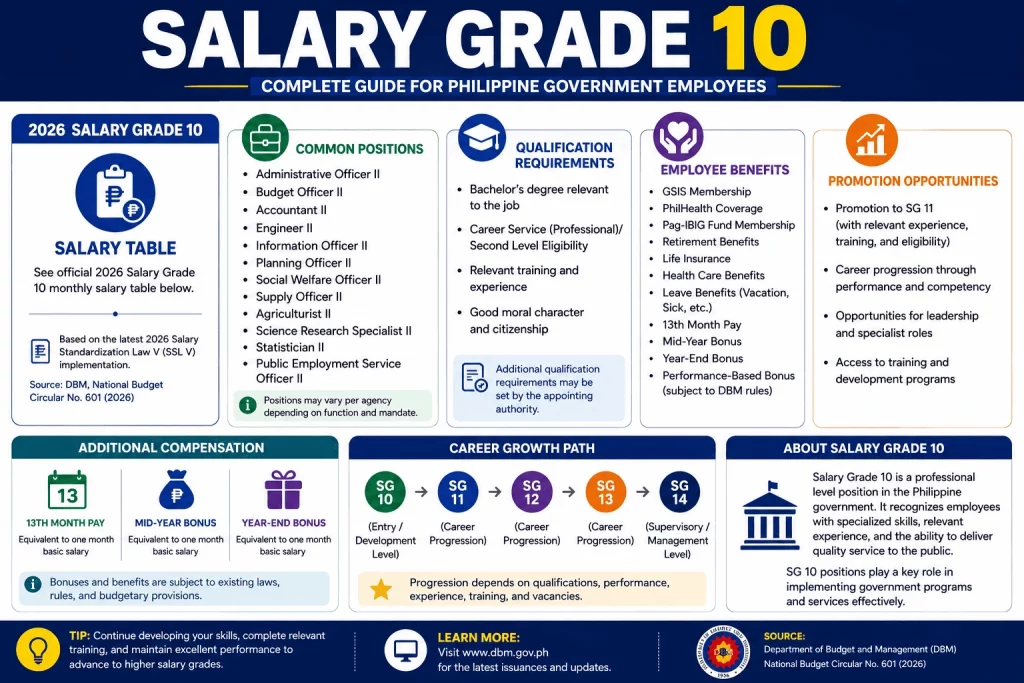
Salary Grade (SG) 10 is one of the most common compensation levels in the Philippine government’s salary structure. Thousands of employees across national government agencies (NGAs), local government units (LGUs), state universities and colleges (SUCs), and government-owned or controlled corporations (GOCCs) hold positions classified under this salary grade.
Whether you are planning to apply for a government job, preparing for the Civil Service Examination, or considering a career in public service, understanding Salary Grade 10 can help you make informed career decisions. Beyond the monthly basic salary, government employees under SG 10 may also receive a comprehensive package of statutory benefits, bonuses, leave privileges, and retirement benefits, making public service an attractive long-term career option.
This guide explains everything you need to know about Salary Grade 10 in the Philippines. You’ll learn how the salary grade system works, who qualifies for SG 10 positions, the types of jobs commonly assigned to this grade, the official salary schedule, available benefits, promotion opportunities, and practical tips for aspiring government employees. All salary information in this guide is based on the official compensation schedule issued by the Department of Budget and Management (DBM) under the Third Tranche of the Updated Salary Schedule effective January 1, 2026.
Quick Answer
Salary Grade 10 is a compensation level under the Philippine government’s salary standardization system. As of January 1, 2026, employees assigned to Salary Grade 10 receive a monthly basic salary based on their salary step, with Step 1 representing the entry-level rate and Step 8 representing the highest rate within the grade. In addition to their basic salary, eligible employees may receive statutory benefits such as the Personnel Economic Relief Allowance (PERA), mid-year and year-end bonuses, Performance-Based Bonus (PBB), GSIS benefits, PhilHealth coverage, Pag-IBIG benefits, and various leave privileges, subject to existing laws and government regulations.
Key Takeaways
- Salary Grade 10 is part of the Philippine government’s standardized compensation system.
- Government employees under SG 10 are paid according to one of eight salary steps based on their length of service and authorized step increments.
- SG 10 positions are found across national government agencies, local government units, state universities and colleges, and other government institutions.
- Employees may receive more than just their monthly salary through bonuses, allowances, insurance coverage, retirement benefits, and leave credits.
- Promotion opportunities are available through merit, performance, qualifications, and the availability of higher plantilla positions.
- The official salary schedule is issued by the Department of Budget and Management (DBM) and implemented under Executive Order No. 64, s. 2024, through National Budget Circular No. 601.
TL;DR
If you’re applying for a government position classified under Salary Grade 10, your monthly basic salary depends on your assigned salary step under the official DBM salary schedule. Beyond your basic pay, you’ll also be eligible for government-mandated benefits such as bonuses, PERA, GSIS retirement benefits, PhilHealth, Pag-IBIG membership, and leave privileges. Salary progression occurs through authorized salary step increments, while career advancement may lead to higher salary grades based on qualifications, performance, and available plantilla positions.
What Is Salary Grade 10?
Salary Grade 10 is one of the 33 salary grades established under the Philippine government’s salary standardization system. It represents a compensation level assigned to positions with specific duties, responsibilities, qualification standards, and complexity of work. Employees occupying Salary Grade 10 positions receive compensation based on the official salary schedule approved by the government, with pay increasing through salary steps as they gain service and meet the requirements for step progression.
Unlike salaries in the private sector, government compensation follows a standardized framework designed to promote fairness, consistency, and transparency across agencies. This means that a position classified as Salary Grade 10 generally follows the same salary schedule regardless of the agency, although certain positions may receive additional allowances or benefits as authorized by law.
Salary Grade 10 serves as a mid-level entry point for many technical, administrative, and specialized government positions. Employees at this level are typically expected to perform duties requiring a combination of education, technical knowledge, administrative competence, and independent judgment.
The salary grade assigned to a position is determined through position classification standards established by the government. It reflects the complexity of the work, the degree of responsibility, required competencies, supervision received, and the impact of the position on organizational objectives.
Understanding the Philippine Salary Grade System
The Philippine Salary Grade System is the government’s standardized compensation framework used to determine the basic salaries of civilian government employees. Instead of allowing each agency to establish its own salary rates, the government classifies positions into salary grades ranging from Salary Grade 1 to Salary Grade 33.
Each salary grade contains eight salary steps. These steps recognize an employee’s progression within the same position through satisfactory service and authorized salary step increments. While the salary grade determines the overall compensation level, the salary step determines the exact monthly basic salary within that grade.
Several factors influence a position’s salary grade classification, including:
- Nature and complexity of work
- Level of responsibility
- Required education
- Experience requirements
- Training requirements
- Scope of decision-making
- Degree of supervision exercised
- Organizational impact
This standardized system ensures that employees performing substantially similar work receive comparable compensation across government agencies.
For employees, the system provides a clear career progression framework. Advancement may occur through salary step increments within the same grade or through promotion to positions assigned to higher salary grades.
Where Salary Grade 10 Fits in the Government Salary Structure
Salary Grade 10 falls within the lower-middle range of the Philippine government’s compensation structure. It is commonly assigned to administrative, technical, supervisory support, and specialized positions that require more responsibility than entry-level roles but do not yet carry significant managerial authority.
Generally, Salary Grade 10 positions require applicants to possess:
- Appropriate educational qualifications
- Relevant technical competencies
- Civil Service eligibility when required
- Good communication skills
- Ability to work with minimal supervision
- Knowledge of government procedures applicable to the position
Compared with lower salary grades, SG 10 positions often involve more complex administrative responsibilities, technical functions, records management, financial support work, program implementation, or specialized operational tasks.
Many professionals begin their long-term government careers at Salary Grade 10 because it provides opportunities for continuous learning, salary progression, professional development, and eventual promotion to higher salary grades such as SG 11, SG 12, and beyond.
Career advancement is influenced by several factors, including:
- Outstanding performance ratings
- Completion of required training
- Additional education
- Professional licenses or certifications
- Civil Service eligibility
- Availability of plantilla positions
- Organizational requirements
For individuals seeking stable employment, comprehensive government benefits, and long-term career growth, Salary Grade 10 serves as an important stepping stone toward higher-level technical, supervisory, and managerial positions within the Philippine civil service.
Salary Grade 10 Monthly Salary Table (2026)
The Department of Budget and Management (DBM) implements the official Salary Grade 10 salary schedule through National Budget Circular No. 601, which covers the Third Tranche of the Updated Salary Schedule for Civilian Government Personnel under Executive Order No. 64, s. 2024. Effective January 1, 2026, employees occupying Salary Grade 10 positions receive a monthly basic salary based on one of eight salary steps.
Each salary step represents an employee’s progression within the same salary grade. Employees normally advance through salary steps after meeting the government’s prescribed requirements, including satisfactory performance and the completion of the required period of service, subject to applicable Civil Service Commission (CSC) and DBM rules.
The salary shown in the table below refers to basic monthly salary only. It does not yet include government allowances, bonuses, incentives, or other statutory benefits.
Official Salary Grade 10 Salary Schedule
The following table is based on the official salary schedule published by the Department of Budget and Management (DBM) under National Budget Circular No. 601.
| Salary Step | Monthly Basic Salary |
| Step 1 | ₱26,917 |
| Step 2 | ₱27,131 |
| Step 3 | ₱27,347 |
| Step 4 | ₱27,565 |
| Step 5 | ₱27,786 |
| Step 6 | ₱28,007 |
| Step 7 | ₱28,230 |
| Step 8 | ₱28,456 |
Effective Date: January 1, 2026
Issuing Agency: Department of Budget and Management (DBM)
Implementing Issuance: National Budget Circular No. 601
Legal Basis: Executive Order No. 64, s. 2024
Understanding Salary Steps
Salary Grade 10 contains eight salary steps, each corresponding to a different level of compensation within the same salary grade. Newly appointed employees generally start at Step 1, unless existing laws, rules, or authorized appointments allow placement at a higher step.
A salary step should not be confused with a promotion. While a promotion moves an employee to a higher salary grade with greater responsibilities, a salary step increase rewards continuous satisfactory service within the same position.
Purpose of Salary Steps
The government uses salary steps to recognize:
- Length of satisfactory government service
- Continuous professional growth
- Good performance
- Employee retention
- Career development within the same plantilla position
As employees progress through the salary steps, they receive higher monthly compensation without changing salary grades.
Salary Progression by Step
The difference between the entry salary (Step 1) and the highest salary (Step 8) demonstrates how employees can gradually increase their earnings while remaining in the same position.
| Comparison | Amount |
| Step 1 | ₱26,917 |
| Step 8 | ₱28,456 |
| Total Difference | ₱1,569 |
Although the monthly increases between individual steps may appear modest, they accumulate over time and also increase the value of other compensation that is computed using an employee’s basic salary, such as retirement benefits and certain bonuses.
How Salary Step Increments Work
Salary step increments are governed by Civil Service Commission and Department of Budget and Management policies. Employees do not automatically move to the next step every year simply because of length of service.
Instead, step increments are generally granted when employees satisfy applicable government rules regarding:
- Satisfactory or better performance
- Required length of service
- Availability of funding
- Compliance with applicable compensation regulations
- Approval by the authorized government office
Employees should consult their Human Resource Management Office (HRMO) for agency-specific implementation guidelines.
Legal Basis for Salary Grade 10
The Salary Grade 10 salary schedule is part of the Philippine government’s standardized compensation system established through the Salary Standardization Law and updated compensation policies issued by the Department of Budget and Management.
For the 2026 salary schedule, the principal legal authorities include the following.
Executive Order No. 64, s. 2024
Executive Order No. 64 authorized the implementation of the updated compensation schedule for civilian government personnel through a multi-year tranche system.
Its objectives include:
- Maintaining a competitive government compensation system
- Improving employee morale
- Promoting fairness across agencies
- Supporting recruitment and retention
- Recognizing the increasing complexity of government work
The updated salary schedule benefits qualified civilian personnel throughout the Philippine government.
National Budget Circular No. 601
The Department of Budget and Management issued National Budget Circular No. 601 to implement the Third Tranche of the updated salary schedule beginning January 1, 2026.
The circular provides official guidance regarding:
- Updated salary schedules
- Coverage
- Funding sources
- Implementation rules
- Salary adjustment procedures
- Applicable government entities
Government agencies use this circular as the official reference when implementing the updated compensation schedule.
Government Agencies Covered
The updated salary schedule generally applies to civilian personnel working in:
- National Government Agencies (NGAs)
- State Universities and Colleges (SUCs)
- Constitutional Offices
- Government-Owned or Controlled Corporations (covered by applicable compensation rules)
- Local Government Units implementing the authorized compensation schedule
- Other civilian government offices covered by applicable DBM issuances
Coverage remains subject to the specific provisions contained in Executive Order No. 64, National Budget Circular No. 601, and other applicable compensation policies.
Who Receives Salary Grade 10?
Salary Grade 10 is assigned to numerous civilian government positions across different agencies. Rather than being attached to a single job title, the salary grade corresponds to the classification of a position based on its duties, responsibilities, qualification standards, and complexity of work.
Although position titles vary among agencies, Salary Grade 10 commonly applies to administrative, technical, clerical, financial, operational, and specialized support roles.
The exact classification of each position is determined through the government’s Position Classification and Compensation System.
National Government Agencies
Many departments and attached agencies employ SG 10 personnel to support daily government operations.
Examples include positions involved in:
- Administrative support
- Records management
- Human resource administration
- Procurement
- Budget support
- Accounting operations
- Information management
- Technical assistance
- Regulatory support
- Program implementation
These employees play an essential role in ensuring that public services are delivered efficiently and in accordance with government regulations.
Local Government Units (LGUs)
Provincial, city, municipal, and barangay governments also maintain plantilla positions classified under Salary Grade 10.
Employees may work in offices responsible for:
- Planning
- Treasury
- Engineering
- Health services
- Agriculture
- Social welfare
- Disaster risk reduction
- Local administration
- Licensing
- Business regulation
The availability of specific SG 10 positions depends on the organizational structure and approved plantilla of each local government unit.
Common Government Positions Under Salary Grade 10
Salary Grade 10 covers a wide range of first-level supervisory support, administrative, technical, clerical, and specialized government positions. While the salary grade determines the compensation level, the exact duties, qualification standards, and position titles vary depending on the government agency, local government unit (LGU), state university and college (SUC), or government-owned or controlled corporation (GOCC).
Because each agency has its own approved plantilla positions, not every office will have the same Salary Grade 10 job titles. However, many positions share similar responsibilities and qualification requirements.
Administrative Positions
Administrative positions make up a significant portion of Salary Grade 10 jobs. Employees in these roles help ensure that government offices operate efficiently by handling records, communications, procurement, scheduling, budgeting, and office coordination.
Typical responsibilities include:
- Preparing official documents and correspondence
- Coordinating meetings and administrative activities
- Maintaining records management systems
- Processing internal requests and reports
- Assisting in procurement and inventory management
- Supporting finance and budgeting activities
- Managing office supplies and logistics
These positions require strong organizational skills, attention to detail, and knowledge of government administrative procedures.
Technical Positions
Technical positions under Salary Grade 10 require specialized knowledge or practical expertise in a particular field.
Depending on the agency, employees may assist in:
- Information technology
- Engineering support
- Agriculture
- Environmental management
- Public health
- Laboratory services
- Research activities
- Statistics and data management
- Geographic information systems
- Planning and project implementation
Technical personnel often work closely with higher-level specialists and professionals while performing independent assignments within their area of expertise.
Financial and Accounting Support Positions
Many accounting and finance offices employ Salary Grade 10 personnel to assist in managing public funds.
Common duties include:
- Preparing accounting documents
- Processing payroll
- Maintaining financial records
- Assisting with budget preparation
- Monitoring expenditures
- Preparing liquidation reports
- Reconciling financial transactions
- Supporting internal and external audits
Accuracy, integrity, and familiarity with government accounting rules are essential for these positions.
Human Resource Positions
Government Human Resource Management Offices (HRMOs) frequently employ Salary Grade 10 personnel.
Responsibilities may include:
- Recruitment support
- Processing appointments
- Maintaining personnel records
- Leave administration
- Performance evaluation documentation
- Employee benefits administration
- Training coordination
- Personnel database management
These positions require a thorough understanding of Civil Service Commission (CSC) rules and government employment policies.
Records and Information Management Positions
Government agencies generate thousands of official documents each year.
Salary Grade 10 personnel assigned to records management help maintain document integrity by:
- Filing official records
- Digitizing documents
- Managing archives
- Processing incoming correspondence
- Maintaining document tracking systems
- Ensuring records security
- Assisting with Freedom of Information (FOI) requests
Good records management contributes to government transparency and operational efficiency.
Information Technology Positions
As government agencies continue their digital transformation initiatives, many Information Technology positions are classified under Salary Grade 10.
Typical assignments include:
- Computer system maintenance
- Technical support
- Network administration assistance
- Software implementation
- Database maintenance
- Website support
- Cybersecurity assistance
- User account management
Employees in these positions help agencies improve digital services while ensuring the reliability of government information systems.
Specialized Government Positions
Some Salary Grade 10 positions involve specialized technical or operational responsibilities depending on the agency.
Examples include work related to:
- Agriculture
- Fisheries
- Forestry
- Public health
- Tourism
- Social welfare
- Labor and employment
- Disaster risk reduction
- Environmental protection
- Infrastructure development
Because government agencies perform diverse functions, specialized SG 10 positions often require field-specific knowledge and additional technical competencies.
Qualification Requirements
Applicants for Salary Grade 10 positions must satisfy the qualification standards established for the specific position. These standards generally include education, experience, training, and eligibility requirements. While requirements vary depending on the position and agency, all applicants must meet the minimum qualifications stated in the approved Position Description Form (PDF) and Qualification Standards Manual.
Meeting only the minimum requirements does not automatically guarantee appointment. Government agencies evaluate applicants based on merit, competence, education, experience, training, and performance during the recruitment process.
Educational Requirements
Most Salary Grade 10 positions require applicants to possess at least a bachelor’s degree relevant to the position.
Examples include degrees in:
- Business Administration
- Accountancy
- Public Administration
- Information Technology
- Computer Science
- Engineering
- Agriculture
- Education
- Nursing
- Social Work
- Economics
- Statistics
- Environmental Science
- Criminology
- Communications
Some technical or highly specialized positions require degrees directly related to the nature of the work.
Civil Service Eligibility
Many permanent Salary Grade 10 positions require Civil Service eligibility.
Depending on the position, acceptable eligibilities may include:
- Career Service Professional Eligibility
- Career Service Subprofessional Eligibility
- Bar Eligibility
- Board Licensure Eligibility
- Special laws granting eligibility
- Other eligibility recognized by the Civil Service Commission
Certain contractual, job order, casual, or coterminous positions may have different eligibility requirements depending on applicable laws and agency policies.
Applicants should carefully review each vacancy announcement to determine the specific eligibility required.
Experience Requirements
Experience requirements differ significantly among Salary Grade 10 positions.
Some positions accept qualified fresh graduates, while others require previous work experience relevant to the duties of the position.
Relevant experience may include:
- Administrative work
- Accounting
- Customer service
- Project implementation
- Government service
- Technical support
- Information technology
- Planning
- Procurement
- Research
- Field operations
Applicants with directly related experience generally have a stronger competitive advantage during the hiring process.
Training Requirements
Many government positions specify minimum hours of relevant training.
Examples include:
- Leadership development
- Records management
- Government procurement
- Budgeting
- Public financial management
- Information security
- Office productivity software
- Human resource management
- Project management
- Customer service
- Occupational safety
Training acquired from recognized institutions may strengthen an applicant’s qualifications, particularly when competing against other eligible candidates.
Recruitment and Selection Process
Government recruitment follows the principles of merit, fitness, fairness, and equal opportunity. Agencies must comply with Civil Service Commission rules when filling vacant plantilla positions.
Although procedures vary slightly among agencies, applicants typically undergo the following stages:
- Publication of the vacant position.
- Submission of application documents.
- Initial qualification screening.
- Evaluation of education, experience, training, and eligibility.
- Written examination or competency assessment (when required).
- Panel interview.
- Background verification.
- Final deliberation.
- Issuance of appointment.
- Assumption to duty.
Applicants should prepare complete and accurate documentation, as incomplete submissions are one of the most common reasons applications are not considered.
Salary Grade 10 Benefits and Allowances
Employees holding Salary Grade 10 positions receive more than just their monthly basic salary. Qualified government personnel are entitled to a comprehensive compensation package that may include mandatory allowances, bonuses, insurance coverage, retirement benefits, leave privileges, and other incentives authorized by law. While some benefits are granted to nearly all eligible civilian government employees, others depend on employment status, agency performance, funding availability, and existing government regulations.
Understanding these benefits provides a clearer picture of the total compensation package available to Salary Grade 10 employees.
Personnel Economic Relief Allowance (PERA)
The Personnel Economic Relief Allowance (PERA) is a fixed monthly allowance granted to eligible civilian government employees to help offset the increasing cost of living.
Key Features
- Paid monthly in addition to the basic salary.
- Intended to provide financial assistance for daily living expenses.
- Generally granted to eligible government employees regardless of salary grade, subject to applicable DBM rules.
- Not considered part of the employee’s basic salary.
Because PERA is separate from the monthly basic salary, it should not be confused with the Salary Grade 10 salary schedule.
Mid-Year Bonus
Eligible Salary Grade 10 employees receive a Mid-Year Bonus equivalent to one month’s basic salary, subject to the conditions prescribed by existing government rules.
To qualify, employees generally must:
- Be in government service on the required eligibility date.
- Have rendered the minimum required period of service.
- Meet the applicable performance and employment requirements.
The Mid-Year Bonus is typically released around the middle of the calendar year.
Year-End Bonus
The Year-End Bonus is another important financial benefit received by qualified government personnel.
This benefit generally consists of:
- One month’s basic salary
- Subject to existing DBM and CSC rules
- Released toward the end of the calendar year
Together with the Mid-Year Bonus, the Year-End Bonus significantly increases the annual compensation received by Salary Grade 10 employees.
Cash Gift
In addition to the Year-End Bonus, qualified government employees may receive a Cash Gift authorized under the General Appropriations Act (GAA) and related budget issuances.
The amount and eligibility requirements may vary depending on the applicable budget law and DBM guidelines for the year.
Performance-Based Bonus (PBB)
The Performance-Based Bonus (PBB) is an incentive program designed to reward high-performing government agencies and employees.
Unlike fixed bonuses, the PBB depends on several factors, including:
- Agency performance
- Individual performance ratings
- Compliance with government performance targets
- Submission of required reports and documentation
Because the PBB is performance-driven, the amount received may differ among agencies and employees.
Productivity Enhancement Incentive (PEI)
Eligible civilian government personnel may also receive the Productivity Enhancement Incentive (PEI).
The PEI recognizes the collective contributions of government employees toward improving the efficiency and effectiveness of public service.
Eligibility and release are subject to annual budget authorization and DBM guidelines.
Government Insurance and Social Protection Benefits
Salary Grade 10 employees enjoy extensive social protection through mandatory membership in several government institutions. These programs provide financial assistance during retirement, illness, disability, emergencies, and housing needs.
Government Service Insurance System (GSIS)
Permanent government employees are generally covered by the Government Service Insurance System (GSIS).
GSIS provides numerous benefits, including:
Retirement Benefits
Employees who meet the required age and years of service may qualify for retirement benefits under applicable GSIS laws and regulations.
Life Insurance
Members receive life insurance protection, providing financial security for their beneficiaries.
Disability Benefits
Employees who become permanently or partially disabled due to illness or injury may qualify for disability benefits, subject to GSIS rules.
Survivorship Benefits
Eligible dependents may receive survivorship benefits upon the death of a qualified GSIS member.
Loan Programs
GSIS also offers various loan facilities, including:
- Salary loans
- Emergency loans
- Policy loans
- Multi-purpose loans
- Housing-related financing
PhilHealth Benefits
Salary Grade 10 employees are generally covered by the Philippine Health Insurance Corporation (PhilHealth).
PhilHealth provides healthcare support through:
- Hospitalization benefits
- Outpatient services
- Selected preventive healthcare services
- Maternity benefits
- Catastrophic illness coverage under applicable benefit packages
Membership helps reduce medical expenses for employees and qualified dependents.
Pag-IBIG Fund Benefits
Eligible government employees are also members of the Home Development Mutual Fund (Pag-IBIG Fund).
Benefits include:
Housing Loans
Members may apply for housing loans to:
- Purchase residential property
- Construct a house
- Improve an existing home
- Refinance qualified housing obligations
Multi-Purpose Loans
Members may obtain loans for:
- Education
- Home improvements
- Medical expenses
- Business capital
- Other personal financial needs
Savings Program
Employee and employer contributions accumulate over time and earn dividends, providing additional long-term savings.
Leave Benefits
Government employees receive generous leave privileges under Civil Service Commission rules, allowing them to balance work responsibilities with personal and family needs.
Vacation Leave
Vacation leave may be used for:
- Personal matters
- Family activities
- Rest and recreation
- Travel
- Other approved purposes
Unused leave credits may accumulate in accordance with applicable government rules.
Sick Leave
Sick leave helps employees recover from illness while maintaining income during approved absences.
It may be used for:
- Personal illness
- Medical treatment
- Recovery periods
- Certain medical procedures
Medical documentation may be required depending on agency policies and the duration of leave.
Special Leave Benefits
Depending on eligibility and applicable laws, government employees may also avail themselves of:
- Maternity leave
- Paternity leave
- Solo Parent leave
- Violence Against Women (VAW) leave
- Rehabilitation leave
- Special emergency leave
- Study leave
- Special leave privileges
- Mandatory leave for specific positions, where applicable
These leave benefits promote employee welfare while ensuring continuity of public service.
Additional Employee Benefits
Aside from statutory benefits, many government agencies provide additional employee support programs, including:
- Learning and development opportunities
- Scholarships and training programs
- Leadership development courses
- Wellness programs
- Employee recognition awards
- Occupational safety initiatives
- Mental health support activities
- Team-building programs
- Uniform or clothing allowances, where authorized
- Hazard pay, subsistence allowance, laundry allowance, or other position-specific benefits when provided by law or applicable regulations
The availability of these additional benefits depends on the nature of the position, agency policies, and applicable budgetary provisions.
Total Compensation Goes Beyond Basic Salary
One of the biggest advantages of a Salary Grade 10 government position is that compensation extends well beyond the monthly basic salary.
A typical employee’s annual compensation package may consist of:
- Monthly basic salary
- Personnel Economic Relief Allowance (PERA)
- Mid-Year Bonus
- Year-End Bonus
- Cash Gift
- Performance-Based Bonus (subject to eligibility)
- Productivity Enhancement Incentive (when authorized)
- GSIS benefits
- PhilHealth coverage
- Pag-IBIG membership benefits
- Paid leave credits
- Retirement benefits
- Agency-specific incentives authorized by law
When these components are considered together, government employment offers a stable and competitive compensation package that supports both immediate financial needs and long-term financial security.
Salary Grade 10 Compared With Other Salary Grades
Salary Grade 10 sits between Salary Grades 9 and 11 in the Philippine government’s compensation structure. While the difference in monthly salary between adjacent grades may appear moderate, promotion to a higher salary grade usually comes with increased responsibilities, more complex duties, broader decision-making authority, and improved long-term earning potential.
Understanding these differences helps employees plan their careers and identify realistic promotion goals.
Salary Grade 9 vs. Salary Grade 10
Salary Grade 9 positions are generally considered support or entry-level technical and administrative roles. Employees often perform routine tasks under closer supervision.
Compared with SG 9, Salary Grade 10 positions usually involve:
- Greater responsibility
- More independent decision-making
- Increased technical knowledge
- Higher qualification standards
- Broader administrative functions
Employees promoted from SG 9 to SG 10 often begin handling more specialized assignments while working with less direct supervision.
Salary Grade 10 vs. Salary Grade 11
Promotion to Salary Grade 11 generally marks another significant step in a government employee’s career.
Compared with SG 10, Salary Grade 11 positions may involve:
- Supervisory functions
- More technical specialization
- Project coordination
- Policy implementation
- Higher accountability
- More complex decision-making
Employees are often expected to demonstrate stronger leadership, communication, and analytical skills before advancing to this level.
Salary Grade Comparison Table
| Feature | Salary Grade 9 | Salary Grade 10 | Salary Grade 11 |
| Responsibility | Moderate | Moderate to High | Higher |
| Technical Complexity | Moderate | Higher | More Advanced |
| Independent Work | Limited | Moderate | Extensive |
| Promotion Potential | Good | Very Good | Excellent |
| Leadership Expectations | Minimal | Developing | Often Required |
Although salary increases are important, career progression should also be viewed in terms of professional growth, expanded responsibilities, and opportunities for advancement.
Career Progression From Salary Grade 10
Salary Grade 10 is often viewed as a strong foundation for a long-term career in government. Employees who consistently perform well, pursue professional development, and meet qualification standards may advance to higher salary grades over time.
Career progression depends on several factors, including:
- Performance ratings
- Educational attainment
- Civil Service eligibility
- Relevant work experience
- Required training
- Availability of plantilla positions
- Agency staffing requirements
Typical Promotion Path
While career paths differ across agencies, many employees progress through a sequence similar to the following:
| Career Stage | Typical Salary Grade |
| Entry-Level Government Position | SG 6–9 |
| Technical / Administrative Position | SG 10 |
| Senior Technical Position | SG 11–13 |
| Supervisory Position | SG 14–18 |
| Managerial Position | SG 19–24 |
| Executive Position | SG 25–33 |
This progression is not automatic. Promotions are based on merit, qualifications, organizational needs, and available vacancies.
How to Improve Promotion Opportunities
Employees seeking advancement should focus on continuous professional growth.
Recommended strategies include:
- Pursue graduate studies when appropriate.
- Complete relevant government training programs.
- Earn professional certifications.
- Maintain excellent performance ratings.
- Develop leadership and communication skills.
- Volunteer for special projects.
- Build expertise in your field.
- Stay updated on government policies and regulations.
Consistent professional development improves competitiveness for higher-level positions.
Advantages of Holding a Salary Grade 10 Position
Salary Grade 10 offers a balanced combination of financial stability, career growth, and employment security. Many professionals choose government service because it provides predictable compensation and long-term benefits that extend beyond monthly salary.
Key Advantages
- Competitive government compensation
- Comprehensive employee benefits
- Stable employment
- GSIS retirement benefits
- Opportunities for promotion
- Regular training and development
- Paid leave privileges
- Healthcare coverage
- Housing and loan programs
- Structured career progression
- Public service experience
- Work that directly contributes to national development
For many employees, these advantages make Salary Grade 10 an attractive starting point for a lifelong career in public service.
Challenges of Salary Grade 10 Positions
Like any career, government employment also presents challenges.
Common challenges include:
- Competitive hiring process
- Lengthy recruitment timelines
- Extensive documentary requirements
- Increasing workload during peak periods
- Changing government policies
- Budgetary limitations
- Promotion depending on available plantilla positions
Despite these challenges, many employees consider the stability and long-term benefits worthwhile.
Tips for Landing a Salary Grade 10 Government Position
Success in government recruitment requires preparation. Applicants who understand the hiring process and meet the qualification standards have a stronger chance of securing an appointment.
1. Obtain Civil Service Eligibility
For many permanent positions, Civil Service eligibility is a mandatory requirement. If you have not yet obtained eligibility, consider taking the appropriate Civil Service Examination or determine whether you qualify through another mode of eligibility recognized by the Civil Service Commission.
2. Build Relevant Experience
Volunteer work, internships, contractual employment, and private-sector experience related to the position can strengthen your application.
3. Continue Learning
Participate in seminars, webinars, and government-recognized training programs relevant to your profession.
4. Prepare Complete Documents
Common application documents include:
- Personal Data Sheet (PDS)
- Transcript of Records
- Diploma
- Certificates of Training
- Certificate of Employment
- Civil Service Eligibility documents
- PRC License (if applicable)
- Performance ratings (if required)
Incomplete applications are often disqualified during initial screening.
5. Monitor Government Vacancies
Regularly check official government recruitment portals and agency websites for vacant plantilla positions. Read vacancy announcements carefully to ensure you meet all qualification standards before applying.
Common Misconceptions About Salary Grade 10
Several misconceptions may discourage qualified applicants from pursuing government careers.
Myth: Everyone with the same Salary Grade receives exactly the same pay.
Fact: Monthly basic salary depends on the employee’s assigned salary step.
Myth: Promotion is automatic after several years.
Fact: Promotions depend on qualifications, performance, available plantilla positions, and agency requirements.
Myth: Government employees receive only their monthly salary.
Fact: Eligible employees may receive various bonuses, allowances, insurance benefits, retirement benefits, and leave privileges in addition to their basic salary.
Myth: Fresh graduates cannot qualify for Salary Grade 10 positions.
Fact: Some SG 10 positions accept qualified fresh graduates, while others require relevant work experience or professional licenses. Applicants should always review the qualification standards for the specific vacancy.
Frequently Asked Questions (FAQs)
1. What is Salary Grade 10?
Salary Grade 10 is one of the standardized compensation levels for civilian government employees in the Philippines, with salary determined by the employee’s assigned salary step.
2. How many salary steps does Salary Grade 10 have?
Salary Grade 10 has eight salary steps, each representing a higher level of compensation within the same salary grade.
3. Can fresh graduates apply for Salary Grade 10 positions?
Yes. Some SG 10 positions accept qualified fresh graduates, while others require experience, training, or professional licensure.
4. Do Salary Grade 10 employees receive bonuses?
Yes. Eligible employees may receive benefits such as the Mid-Year Bonus, Year-End Bonus, Cash Gift, Performance-Based Bonus, Productivity Enhancement Incentive, and other benefits authorized by law.
5. Is Salary Grade 10 the same in every government agency?
The salary schedule is standardized, but available positions, duties, and qualification standards vary depending on the agency.
6. Can Salary Grade 10 employees receive promotions?
Yes. Promotion opportunities depend on qualifications, performance, available vacancies, and agency requirements.
7. Are Salary Grade 10 employees covered by GSIS?
Permanent government employees are generally covered by GSIS and its associated retirement, insurance, and loan programs.
8. Where can I verify official Salary Grade 10 salary schedules?
The most reliable sources are the Department of Budget and Management (DBM), the Civil Service Commission (CSC), and official government issuances implementing the Salary Standardization Law.
Final Verdict
Salary Grade 10 provides a solid foundation for individuals pursuing careers in the Philippine government. Beyond its competitive basic salary, it offers a comprehensive compensation package that includes bonuses, allowances, insurance coverage, retirement benefits, healthcare, housing assistance, and paid leave.
For professionals seeking long-term career stability, structured promotion opportunities, and meaningful public service, SG 10 represents an excellent starting point. Success, however, depends not only on meeting the minimum qualification standards but also on continuous learning, strong performance, and a commitment to serving the public.
Whether you are a fresh graduate, an experienced professional, or someone planning to transition into government service, understanding Salary Grade 10 can help you make informed career decisions and prepare for future advancement within the Philippine civil service.
Related Topics
To learn more about navigating your career in the Philippine government, explore our deep-dive guides:
- Salary Grade 11 Philippines 2026: Complete Guide
- Salary Grade 12 Philippines 2026: Salary, Positions & Benefits
- Salary Grade 13 Philippines 2026: Complete Salary & Positions Guide
- Salary Grade 14 Philippines 2026: Complete Salary & Positions Guide
- Salary Grade 15 Philippines: Salary, Positions, Qualifications, and Career Guide
- Salary Grade 19 Philippines 2026: How Much Do SG 19 Employees Earn?
- Salary Grade 24 Philippines 2026: Salary & Benefits
- Salary Grade 25 Philippines: Salary, Positions, Benefits, and Career Guide
- Government Jobs in the Philippines 2026: Complete Job Search Guide
- How to Apply for Government Jobs in the Philippines: Step-by-Step Guide
References
- Department of Budget and Management (DBM). National Budget Circular No. 601 – Implementation of the Third Tranche Compensation Adjustment for Civilian Government Personnel pursuant to Executive Order No. 64, s. 2024.
- Civil Service Commission (CSC). Position Qualification Standards and Civil Service eligibility policies.
- Official Gazette of the Republic of the Philippines. Executive Orders, laws, and official government issuances relating to the Salary Standardization Law
Disclaimer
This guide is intended for informational purposes only and is based on official government issuances available at the time of writing. While every effort has been made to ensure accuracy, salary schedules, qualification standards, benefits, and implementing rules may change through subsequent laws, executive orders, DBM circulars, CSC issuances, or other government regulations.
Readers should always consult the latest official publications of the Department of Budget and Management (DBM), Civil Service Commission (CSC), and the Official Gazette for the most current and authoritative information.