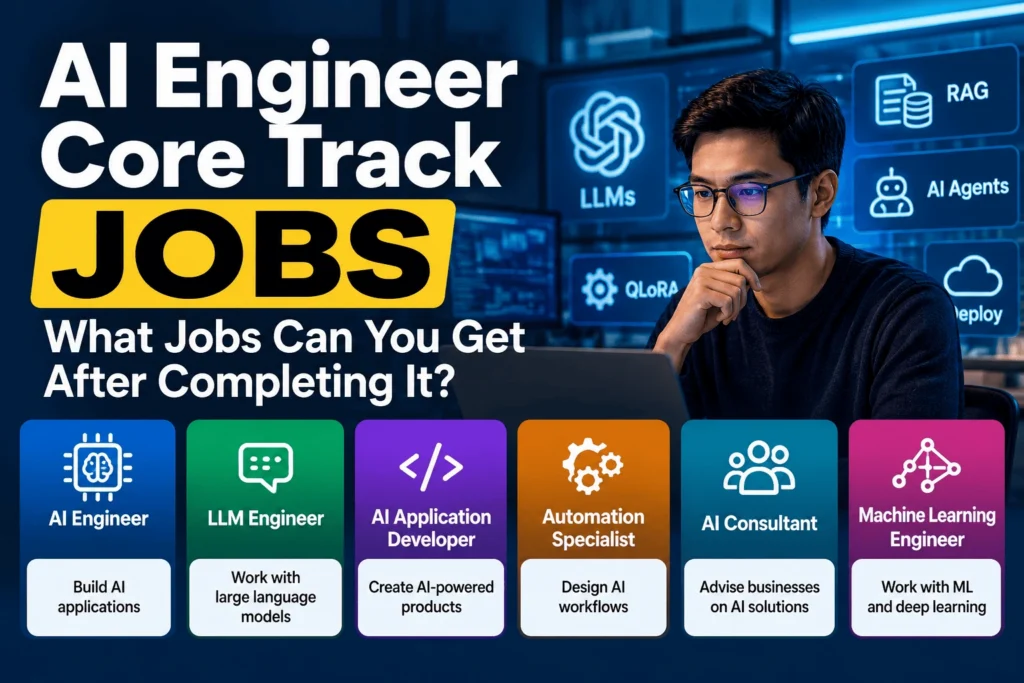
Direct answer: Completing the AI Engineer Core Track can help you develop skills relevant to AI Engineer, LLM Engineer, AI Application Developer, Automation Specialist, and AI Consultant roles. The course alone doesn’t guarantee employment, but it gives you practical experience in RAG systems, AI agents, fine-tuning, and LLM application development — the exact areas employers increasingly screen for when hiring AI talent.
If you’ve already gone through the curriculum, or you’re deciding whether to enroll, the real question isn’t “does this course exist” — it’s “does it lead anywhere.” This article walks through the specific job titles the skillset maps to, what those roles actually pay, how freelancers can monetize the same skills without a full-time job, and what it realistically takes to go from finishing the course to landing your first AI-related role.
Haven’t reviewed the course itself yet? Read our full AI Engineer Core Track Review for the curriculum, instructor background, and pros and cons before you decide to enroll.
Career outcomes at a glance:
| Job Role | Difficulty | Course Relevance |
|---|---|---|
| AI Engineer | Medium | Excellent |
| LLM Engineer | High | Excellent |
| AI Application Developer | Medium | Excellent |
| Automation Specialist | Medium | Very Good |
| AI Consultant | Medium | Very Good |
| Machine Learning Engineer | High | Partial |
Can the AI Engineer Core Track Help You Get a Job?
Short answer: it helps, but it isn’t a job guarantee — and no course, from any provider, honestly is one. What it does give you is the raw material employers actually look for:
- Practical projects — eight built applications, not eight sets of lecture notes
- Portfolio applications — chatbots, RAG systems, and agent workflows you can demo live
- GitHub-ready work — code you can push to a repository and link from your resume
- Real-world AI engineering skills — RAG, agents, and fine-tuning, applied rather than just explained
Important clarification: employers hire based on skills, portfolio, experience, and problem-solving ability — not certificates alone. A Udemy completion certificate signals that you finished a structured program, but it’s the projects behind it that actually get you through a technical interview. If you’re evaluating whether this course is “worth it” purely by asking whether the certificate itself opens doors, you’re asking the wrong question. Ask instead whether the work you produce during the course is strong enough to show a hiring manager. For most students who complete the projects seriously, it is.
Skills You Gain From the AI Engineer Core Track
Before mapping skills to job titles, it helps to lay out exactly what you walk away with:
Prompt Engineering
Structuring and refining prompts to get consistent, controllable output from a model — the baseline skill underneath everything else in the course. This includes techniques like few-shot examples, structured output formatting, and iterative refinement based on failure cases, all of which show up in almost every AI-related job description regardless of seniority.
Retrieval-Augmented Generation (RAG)
Connecting an LLM to your own data source so it answers with grounded facts instead of hallucinated guesses — arguably the single most in-demand AI engineering skill right now. This covers chunking documents sensibly, generating and storing embeddings, retrieving the right context at query time, and feeding that context back into the model in a way that actually improves accuracy rather than just adding noise.
AI Agent Development
Designing systems that plan, call tools, and execute multi-step tasks with limited supervision — the core skill behind workflow automation and AI assistants. This includes function-calling, giving a model access to external tools (search, calculators, APIs), and structuring the loop that lets an agent decide what to do next based on the results of its previous step.
LangChain
A widely used framework for chaining together LLM calls, tools, and data sources into a coherent application, rather than writing raw API calls for every step. Familiarity with LangChain (or an equivalent orchestration framework) is frequently listed as a preferred or required skill in AI Engineer and LLM Engineer job postings.
Vector Databases
Storing and retrieving embeddings efficiently — the infrastructure layer that makes RAG systems actually work at scale. Even a basic working knowledge of how vector search differs from traditional keyword search is enough to hold your own in a technical interview on this topic.
QLoRA Fine-Tuning
A parameter-efficient method for adapting an existing model to a narrow task without the cost of full retraining — a resource-conscious approach that mirrors how fine-tuning is actually done in most companies. Very few employers expect candidates to train models from scratch; knowing how to fine-tune efficiently on a budget is the far more commonly tested skill.
Python AI Development
The connective tissue across every project — reading data, calling APIs, structuring pipelines, and gluing components together. This is less about advanced computer science and more about writing clean, maintainable code that other engineers (or your future self) can actually work with.
LLM Application Development
Turning all of the above into something a user can actually interact with — chat interfaces, function-calling systems, and multi-modal tools. This is the skill that ties everything together into a demoable product rather than a collection of disconnected scripts.
Want a deeper breakdown of how each module is taught? Explore the full AI Engineer Core Track curriculum to see exactly what’s covered week by week.
AI Engineer
What Does an AI Engineer Do?
An AI Engineer builds AI-powered applications, develops the workflows connecting models to real data and users, and deploys LLM-powered systems into production. It’s a builder’s role — less about researching new model architectures, more about assembling reliable products with existing ones.
Why this course helps: every core responsibility above maps directly onto a module in the curriculum. The RAG section teaches you to connect models to data; the agents section teaches you to build workflows; the production-deployment section introduces what it takes to ship a working system, even if only at an introductory level.
Typical employers: startups building AI-native products, SaaS companies adding AI features to existing platforms, and enterprise organizations standing up internal AI tooling.
A useful way to think about the AI Engineer title in 2026: it’s less about deep research and more about integration and reliability. Companies don’t need someone to invent a new model architecture — they need someone who can take a frontier or open-source model, wrap it in a reliable application, and make sure it behaves predictably in front of real users. That’s precisely the muscle the course’s project set is designed to build, from the brochure generator (data extraction and generation) through the RAG knowledge worker (grounded, reliable answers over real company data).
LLM Engineer
What Does an LLM Engineer Do?
An LLM Engineer specializes more narrowly than a general AI Engineer — building RAG systems, optimizing prompts for reliability and cost, and fine-tuning models for specific use cases. The title is newer and more specialized, but it’s rapidly becoming its own hiring category rather than a subset of “AI Engineer.”
Skills from the course that map directly: RAG, QLoRA fine-tuning, and agent workflows — the three pillars of the curriculum are, not coincidentally, the three pillars of this job title.
Why demand is growing: enterprise AI adoption has moved past the pilot-project phase. Companies that spent 2024–2025 experimenting with chatbots are now hiring specifically for people who can make those systems reliable, cost-efficient, and safe to run in production — which is a different (and scarcer) skill than knowing how to call an API.
Within the LLM Engineer title itself, there’s a meaningful split worth knowing about: some roles lean toward “production LLM developer” (integrating APIs, building pipelines, optimizing prompts and cost) while others lean toward “fine-tuning specialist” (custom model training, evaluation, and optimization). The course’s QLoRA module gives you a real foothold in the second category, while the RAG and agents modules cover the first. Knowing which flavor of the role a given job posting is actually describing — production integration versus deep model customization — will help you position your portfolio and interview answers accordingly.
AI Application Developer
Responsibilities
Building AI-powered products end to end, integrating third-party and first-party APIs, and developing customer-facing tools that put a model’s capabilities in front of real users.
Relevant Course Projects
The course’s project set reads almost like a job simulation for this exact role: AI chatbots, multi-modal AI assistants (the airline customer support build), and knowledge systems (the RAG-powered knowledge worker). If this is the role you’re targeting, these are the three projects worth polishing the most before you start applying.
Automation Specialist
Responsibilities
Designing process automation, building AI-driven workflows, and deploying agents that handle repetitive or multi-step tasks without constant human oversight.
Why Course Skills Matter
AI agents are increasingly the mechanism companies use for automation that used to require either manual work or brittle rule-based scripts. The agents module in the course — building a system that plans and executes rather than just responds — is a near-direct rehearsal for this role. Automation Specialist positions are also common in operations, finance, and customer service departments that aren’t traditionally “tech roles,” which widens the door for career changers coming from non-engineering backgrounds.
This is worth underlining for anyone reading this from a non-developer background: “Automation Specialist” job postings increasingly sit inside operations and business teams rather than engineering departments, and hiring managers there are often more interested in whether you can identify a repetitive process and automate it end-to-end than in your formal computer science credentials. If your prior career involved operations, customer support, or process management, this is frequently the most realistic entry point into AI work — you already understand the business problems agents are built to solve, and the course fills in the technical execution side.
AI Consultant
Responsibilities
Advising businesses on where and how to apply AI, recommending specific solutions rather than building everything from scratch, and producing working prototypes to prove out an idea before a company commits budget to it.
Freelance Potential
This is one of the more accessible paths for graduates who don’t want to pursue a traditional full-time role. Small and mid-sized businesses frequently need someone who can scope an AI opportunity, build a proof of concept, and hand off a working prototype — exactly the kind of scoped deliverable the course’s projects are built to demonstrate. Consulting work also tends to pay a premium over comparable full-time salary-equivalent rates, since clients are paying for judgment and speed, not just implementation hours.
Machine Learning Engineer
This role deserves a more careful answer than the others, because the course sets you up for it only partially.
Additional knowledge often needed beyond the course: statistics, classical machine learning (regression, classification, clustering), and deeper deep-learning fundamentals (architectures, training dynamics, evaluation beyond LLM-specific metrics).
How the course helps: it acts as a bridge into AI specialization rather than a complete substitute for a full ML engineering background. The QLoRA fine-tuning module in particular gives you real exposure to model training concepts, but a true ML Engineer role — especially at larger companies — typically expects broader ML theory than this course covers on its own. If Machine Learning Engineer is your end goal, treat this course as a strong first step, not the last one.
A realistic path from here to there: graduates who specifically want the ML Engineer title (rather than AI Engineer or LLM Engineer) typically pair this course with a supplementary statistics and classical-ML foundation — either a separate course, a university-adjacent program, or structured self-study — before applying. Trying to skip that step and apply directly for ML Engineer roles with only this course’s background is one of the more common sources of frustration graduates report, simply because the interview process for that title still leans heavily on traditional ML fundamentals that this course doesn’t cover.
Freelance Opportunities After the AI Engineer Core Track
Not everyone finishing this course is targeting a full-time role — a meaningful share of graduates go straight into freelance or contract work, where the project-based structure of the course pays off almost immediately.
AI Chatbot Development
Small businesses regularly want a chatbot for their website or product without hiring a full-time engineer — a scoped, well-defined deliverable that maps directly onto the course’s chatbot project.
RAG Systems
“Make our documents searchable and answerable” is one of the most commonly requested freelance AI deliverables right now, and it’s exactly what the RAG module teaches.
Internal Knowledge Assistants
A close cousin of RAG work — building a tool that lets a company’s staff query internal documentation, policies, or product information conversationally instead of digging through folders.
Customer Support Agents
Multi-modal, function-calling support agents (like the airline project in the course) are in real demand from e-commerce and SaaS companies looking to deflect support tickets.
AI Automation Projects
Workflow automation using agents — connecting tools, triggering actions, and reducing manual busywork — is a growing freelance category, particularly for clients already using platforms like Zapier or Make who want something more capable.
AI Consulting Services
Beyond hands-on building, some graduates package their knowledge into advisory work: helping a business figure out where AI fits before anyone writes a line of code.
Where to find this work: freelance platforms like Upwork and Fiverr both have growing AI-development categories, but referrals and direct outreach to small businesses you already have some connection to tend to convert faster than cold platform bidding, especially early on when you don’t yet have client reviews to lean on. A working demo — even one built for a fictional business — is often more persuasive in a pitch than a resume line about the course.
Salary Expectations
Salary ranges for AI-related roles vary enormously by country, experience level, company type, and how specialized the role actually is — the same job title can mean very different levels of seniority depending on the employer. With that caveat firmly in place, here’s a general picture based on current market data:
Quick reference — typical range (US, base pay):
| Role | Typical Range |
|---|---|
| AI Engineer | $$$ (higher end of the market — roughly $140K–$250K+) |
| LLM Engineer | $$$ (comparable to or above AI Engineer — roughly $150K–$230K+) |
| AI Application Developer | $$ (generally tracks below specialized AI/LLM Engineer pay) |
| Automation Specialist | $$ (varies heavily by industry; often housed in operations rather than engineering pay bands) |
| AI Consultant | $$–$$$ (project-based; varies widely by scope, client size, and location) |
Note: AI Engineer and LLM Engineer figures are drawn from current salary-guide data; Application Developer, Automation Specialist, and Consultant figures are directional only, since these titles are less standardized and pay bands differ significantly by company and region.
United States (base pay, general benchmarks):
- AI Engineer: roughly $140,000–$185,000 average, with senior and specialized roles reaching well above $250,000 in total compensation
- LLM Engineer: roughly $150,000–$230,000, with fine-tuning and production-specialist roles at the higher end of that range
- Remote roles specifically tend to land somewhat below top-market coastal-city pay, but still comfortably within six figures for experienced engineers
Philippines (local and remote-for-international-employer benchmarks):
- Junior AI Engineer: roughly ₱55,000–₱120,000 per month for local roles
- Mid-level AI Engineer: roughly ₱95,000–₱180,000 per month locally, or the equivalent of roughly $20,000–$35,000 annually
- Senior AI Engineer: roughly ₱170,000–₱270,000 per month locally
- Remote roles for international (especially US) clients pay meaningfully more than local Philippine market rates, with experienced engineers serving overseas clients commonly earning the equivalent of $35,000–$90,000+ annually depending on specialization and client location
Important note: these figures move constantly, differ by source, and depend heavily on your specific specialization (RAG and agent-framework experience currently commands a premium over generic ML background), your portfolio quality, and whether you’re targeting local, regional, or international remote employers. Treat these as directional ranges to calibrate expectations, not a quote you should expect for yourself on day one — and avoid trusting any source, including this one, that gives you an overly precise number without showing where it came from.
A few patterns worth understanding beyond the raw numbers:
- The remote premium is real but not automatic. A Philippine-based engineer working directly for a US or Singaporean company typically earns meaningfully more than the local market rate for the same skill level — but this requires actively targeting international clients or employers rather than assuming remote work automatically pays foreign rates.
- Specialization compounds pay. Generic “I can use ChatGPT” skills are now baseline expectations, not differentiators. Production experience with RAG pipelines, agent frameworks, and fine-tuning — exactly what this course covers — is where the salary premium actually sits.
- The title matters less than the work. “AI Engineer” and “LLM Engineer” job postings vary wildly in what they actually expect, from junior API-integration work to senior production-systems ownership. Read the responsibilities section of a posting carefully rather than anchoring your salary expectations to the title alone.
Building a Portfolio After Completing the Course
The course gives you the raw projects. What you do with them afterward determines whether they actually help you get hired.
Publish Projects on GitHub
A public repository with clean commits and a clear README turns a finished course project into something a recruiter or hiring manager can actually inspect, rather than taking your word for it.
Create Case Studies
For each major project, write a short case study: the problem, your approach, the trade-offs you made, and the result. This is what separates “I took a course” from “I can explain my engineering decisions” — the second is what interviewers are actually testing for.
Build Personal AI Projects
Once you’ve finished the course projects, extend one of them or start something new that solves a problem you personally care about. Original work, even small, signals initiative in a way that course completion alone doesn’t.
Share Work on LinkedIn
Short posts walking through what you built — with a screenshot, a short demo clip, or a link to the repo — consistently drive more recruiter interest than a static resume line ever will.
Contribute to Open Source
Even small contributions to LLM-adjacent open-source tools (LangChain, vector database libraries, agent frameworks) demonstrate that you can work with real codebases, not just self-contained tutorial projects.
None of these five steps need to happen all at once, and none of them require additional paid tools or courses — they mainly require the discipline to treat the week or two after “course completed” as part of the program rather than the finish line. Students who skip straight from the last lecture to job applications without this step consistently report a harder time getting past the resume screen, simply because there’s nothing external to point to yet.
How Long Does It Take to Become Job-Ready?
There’s no fixed number here — the honest answer depends on a few compounding factors:
- Prior coding experience: developers who already knew Python before starting the course move through it faster and have more energy left over for portfolio polish afterward.
- Portfolio quality: two students can finish the same course with wildly different outcomes depending on whether they treated the projects as checkboxes or as real deliverables worth refining.
- Consistency: AI tooling and best practices shift quickly; staying job-ready is less a one-time finish line and more an ongoing habit of continuing to build after the course ends.
Typical progression most graduates follow:
Beginner Developer → AI Course → Portfolio → Junior AI Role
The gap most people underestimate is between “AI Course” and “Portfolio” — finishing the lectures is not the same as having a polished, explainable body of work. Budget real time for that step; it’s where most of the actual job-readiness gets built.
Most developers who already know Python can reasonably expect to move through the eight-week curriculum, then spend another two to six weeks turning the course projects into a genuine portfolio (case studies, GitHub cleanup, LinkedIn posts) before they’re truly ready to start applying seriously. Complete beginners closing a Python gap first should expect a longer runway — often three to six months of foundational coding practice before the course itself becomes a productive use of time rather than a source of constant frustration. Neither timeline is a hard rule; treat both as planning inputs rather than deadlines to hit exactly.
Is the AI Engineer Core Track Worth It for Career Growth?
For Developers
Yes, directly. You already have the prerequisite coding skill, so the course output — working RAG systems, agents, and fine-tuned models — converts almost immediately into portfolio material relevant to AI Engineer and LLM Engineer roles.
For Career Changers
Conditionally yes, provided you already have some programming foundation before starting. Career changers who pair the course with the portfolio-building steps above see the strongest outcomes; those who treat it as a passive credential tend to see the weakest.
For Students
Strong value as a supplement to a computer science or data-related degree, since most academic programs haven’t caught up to LLM engineering as a practical discipline — this course fills that gap with hands-on experience employers are actively screening for.
For IT Professionals
A credible specialization path, particularly for those looking to move from supporting AI infrastructure toward building on top of it. Pairing the course with real production experience at your current job (even informally) accelerates the transition.
Final Thoughts
The AI Engineer Core Track has real career relevance because it’s built around portfolio-first learning rather than passive content consumption. The skills it teaches — RAG, agents, prompt engineering, and efficient fine-tuning — map directly onto the job titles currently seeing the fastest hiring growth in AI: AI Engineer, LLM Engineer, AI Application Developer, Automation Specialist, and AI Consultant. It’s best suited for technical learners — developers, data professionals, and career changers with some coding background — rather than complete beginners starting from zero.
Final direct answer: the AI Engineer Core Track can help learners prepare for AI Engineer, LLM Engineer, AI Application Developer, Automation Specialist, and AI Consultant roles. Its greatest value doesn’t come from the certificate — it comes from the practical projects and portfolio pieces that let you demonstrate real AI engineering skills to an employer or client, rather than just claiming you have them.
👉 Check the latest price on Udemy
Frequently Asked Questions
What jobs can I get after the AI Engineer Core Track? The skills map most directly to AI Engineer, LLM Engineer, AI Application Developer, Automation Specialist, and AI Consultant roles, along with freelance work building chatbots, RAG systems, and automation workflows for clients.
Can I become an AI Engineer after this course? The course gives you the technical foundation and a portfolio of relevant projects, both of which are genuinely useful for AI Engineer roles. Whether you land the title depends on how strong your portfolio becomes afterward and how well you can explain your engineering decisions in an interview.
Is the AI Engineer Core Track enough to get hired? On its own, no single course guarantees a hire — employers evaluate skills, portfolio, and problem-solving ability together. The course gives you strong raw material for all three, but the job search itself still requires its own effort: applying, interviewing, and continuing to build after the course ends.
What is an LLM Engineer? An LLM Engineer specializes in building and optimizing systems around large language models specifically — RAG pipelines, prompt optimization, and fine-tuning — rather than the broader scope of a general AI or machine learning engineer.
Can beginners get AI jobs after completing the course? Complete beginners with no coding background will struggle, since the course assumes existing Python knowledge. Beginners who already code, even at a junior level, are well-positioned to use the course as a specialization step toward an AI-focused role.
Does the course help freelancers? Yes — arguably more directly than it helps full-time job seekers. The project structure (chatbots, RAG systems, automation agents) maps almost one-to-one onto the most commonly requested freelance AI deliverables.
Is the AI Engineer Core Track worth it for career changers? Conditionally yes, provided you have some existing programming foundation. Career changers with zero coding experience should build basic Python fluency first, then take the course, rather than trying to learn both at once.
How much can freelancers realistically earn with these skills? It varies widely by platform, client location, and how well-packaged your portfolio is, but scoped AI deliverables (a chatbot, a RAG system, an automation workflow) commonly command project rates well above general web-development freelance work, since clients are paying for a still-scarce specialization rather than a commodity skill. Building two or three strong, well-documented sample projects before pitching clients tends to matter more for early pricing power than years of general freelance experience.
Should I list every course project on my resume? No — pick two or three that best match the role you’re targeting and go deep on those, rather than listing all eight briefly. An AI Application Developer role benefits more from a detailed walkthrough of the chatbot and RAG projects than a shallow list of everything you built; a fine-tuning-heavy LLM Engineer posting benefits more from leading with the QLoRA work.
Related Guides
- AI Engineer Core Track Review: Is This Udemy AI Engineering Course Worth It?
- Google AI Essentials Review (2026): Everything You Need to Know Before You Enroll
- Google AI Professional Certificate: The Complete 2026 Review
- Google AI Professional Certificate Jobs: What Jobs Can You Get After Completing It?
- Google AI Essentials Jobs: What Jobs Can You Get After Completing It?