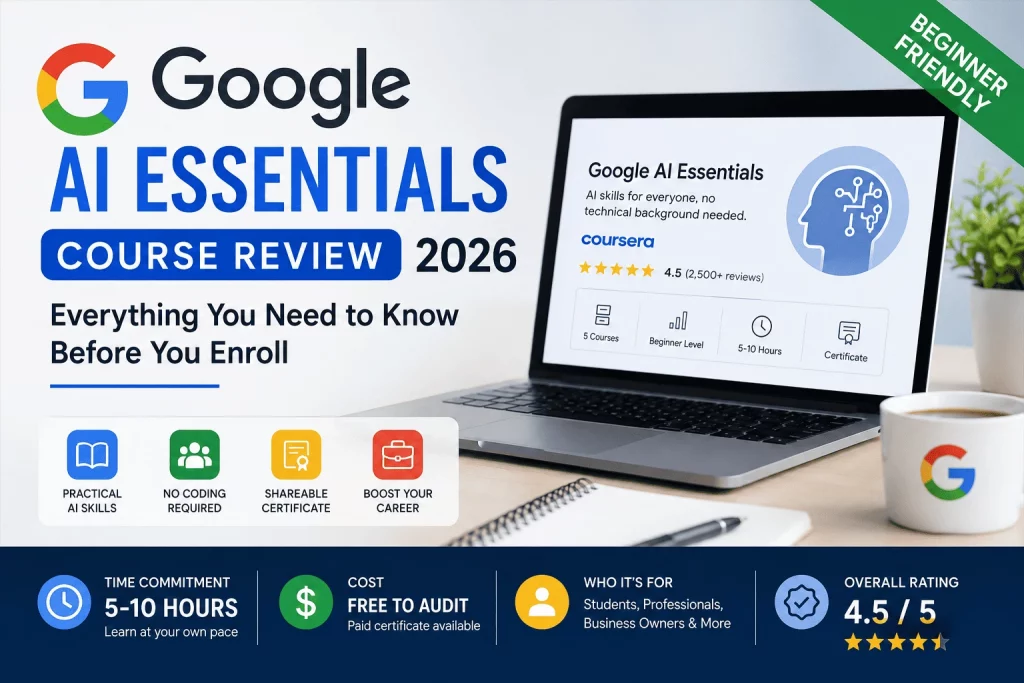
Last Updated: July 2026 — pricing, curriculum, and certificate details are reviewed regularly as Google updates the program.
AI literacy has quietly become a baseline job requirement rather than a specialist skill. Surveys of hiring managers consistently show that most now expect employees across departments — not just engineers — to understand how to use AI tools responsibly and effectively. That shift is exactly why Google built Google AI Essentials: a short, non-technical course designed to teach practical AI skills to people who have never written a line of code and never plan to.
This review breaks down everything you need to know before you enroll — what the course actually covers, how much it costs, how strong the certificate really is, who it’s genuinely a good fit for, and how it stacks up against alternatives from Microsoft, IBM, and DeepLearning.AI. This isn’t a marketing recap. It’s an editorial assessment based on the actual curriculum, pricing structure, and certificate mechanics, so you can decide whether it’s worth your time before you spend it.
Quick Verdict
| Category | Rating |
|---|---|
| ⭐ Overall Rating | 4.5 / 5 |
| ⭐ Difficulty | 2 / 5 (Beginner) |
| ⭐ Certificate Value | 3.5 / 5 |
| ⭐ Employer Recognition | 4 / 5 |
| ⭐ Career Impact | 3.5 / 5 |
| ⭐ Beginner Friendly | 5 / 5 |
| ⭐ Time Commitment | 5 / 5 (Low — 5 to 10 hours) |
Course Snapshot™
| Category | Rating |
|---|---|
| Beginner Friendly | ⭐⭐⭐⭐⭐ |
| Career Value | ⭐⭐⭐⭐☆ |
| Difficulty | ⭐⭐☆☆☆ |
| Certificate Recognition | ⭐⭐⭐⭐☆ |
| Practical Skills | ⭐⭐⭐⭐☆ |
What Is Google AI Essentials?
Google AI Essentials is a beginner-level online course built by Google, delivered primarily through Coursera (and mirrored on Google’s own Skills platform). It’s structured as a five-course Specialization — meaning it’s broken into five short modules that together form one complete program, rather than five separate purchases.
Unlike Google’s more technical certificates (Data Analytics, IT Support, or Cybersecurity), AI Essentials doesn’t teach programming, machine learning theory, or data science. It’s built around a single, practical goal: helping everyday professionals use generative AI tools — think chat-based assistants, AI writing tools, and AI-powered productivity features — more effectively and responsibly at work.
It’s worth noting upfront that Google now offers two related but distinct AI credentials, and mixing them up is one of the most common sources of confusion online:
- Google AI Essentials — the five-course, non-technical Specialization this review covers. Issued as a Specialization Certificate.
- Google AI Professional Certificate — a newer, more comprehensive seven-course program that includes hands-on work with Gemini, NotebookLM, and Google AI Studio, and is tied to Google’s employer hiring consortium.
They sound similar, cost differently, and carry different weight on a resume — so this review is careful to separate the two rather than blur them together, which is a mistake several other reviews make.
Who Should Take This Course?
Google AI Essentials was built with a broad, non-technical audience in mind. Here’s how it tends to play out for each group in practice.
Students benefit from taking this before entering the job market, regardless of major. Whether you’re studying business, education, healthcare, or the humanities, employers across nearly every field now expect some baseline AI fluency, and a recognizable certificate on a first resume can help offset a thin work history.
Professionals in non-technical roles — marketing, HR, operations, administration, customer support — tend to get the most day-to-day mileage out of the course, since the curriculum is built around exactly the kind of tasks these roles handle: drafting communications, summarizing information, and organizing work more efficiently with AI assistance.
Career Changers often need a credible, recognizable credential to signal AI competence in a new field, especially when their prior experience doesn’t obviously connect to AI or technology. Because the course requires no coding background, it’s an accessible entry point regardless of what field you’re leaving.
Business Owners, particularly those running small or mid-sized teams, tend to use the course to understand what AI tools can realistically do before deciding whether to hire a specialist or invest in more expensive tooling. It’s less about becoming a hands-on AI operator and more about making informed decisions on behalf of a team.
Government Employees working in agencies that are actively rolling out AI-adoption policies often need a foundational, responsible-use framework before they can use AI tools on the job at all. The course’s dedicated module on responsible AI use maps directly onto this need.
Freelancers who want to speed up content creation, research, or client work tend to find the prompt engineering and productivity modules the most immediately useful, since those skills translate directly into faster turnaround times on billable work.
Remote Workers competing in a global talent pool often use the certificate as a way to differentiate themselves in applications where a hiring manager has never met them and is screening candidates purely on paper.
Entrepreneurs building or scaling a business tend to treat the course as a fast way to identify where AI can realistically save time or cut costs, without needing to hire a technical consultant just to get oriented.
Is This Course Right for You?™
| If You Are… | Recommendation |
|---|---|
| Student | ✅ Yes |
| Teacher | ✅ Yes |
| Accountant | ✅ Yes |
| Marketing Professional | ✅ Strongly Recommended |
| Software Engineer | ⭐ Better Advanced AI Course |
| Data Scientist | ⭐ Better Advanced AI Course |
| Entrepreneur | ✅ Strongly Recommended |
| Government Employee | ✅ Yes |
If you’re already writing code, training models, or working hands-on with machine learning pipelines, this course will feel too introductory. It’s built for AI users, not AI builders — that distinction matters more than almost anything else in deciding whether to enroll.
What You’ll Learn
The course is organized around one core idea: understanding what AI tools can do, then applying that understanding to real workplace tasks. Rather than teaching AI as an abstract technology, each module ties concepts directly to something you can do differently at work by the end of it — draft content faster, structure a better prompt, or evaluate whether an AI-generated output is safe to use as-is.
By the end of the five modules, most learners come away able to explain basic AI terminology, use a generative AI tool for a real task with an appropriately structured prompt, recognize where AI outputs need human review, and describe practical ways to keep learning as AI tools evolve.
Course Curriculum Breakdown
Module 1: Introduction to AI This opening module covers the basics of what generative AI actually is, how large language models work at a conceptual level (without requiring any math or coding background), and the practical differences between the various types of AI tools you’re likely to encounter at work — standalone chat assistants, AI features built into productivity software, and specialized AI tools for specific tasks like writing or design. It also touches on the limitations of current AI systems, so learners come away with realistic expectations rather than either blind trust or unnecessary skepticism. This module sets the vocabulary the rest of the course builds on, which matters more than it sounds — a lot of workplace confusion around AI comes down to people using the same words to mean different things.
Module 2: Maximize Productivity With AI Tools This is the most immediately applicable module for most learners. It focuses on applying AI tools to everyday work tasks — drafting emails and reports, summarizing long documents or meeting notes, brainstorming ideas when starting from a blank page, and organizing scattered information into something usable. Rather than teaching these as abstract capabilities, the module walks through realistic workplace scenarios, which is where the course’s practical framing shows up most clearly. Learners typically leave this module with two or three concrete workflows they can start using the same day.
Module 3: Discover the Art of Prompt Engineering Prompt engineering sounds more technical than it actually is in this context — this module teaches how to structure clear, effective prompts to get meaningfully better results from AI tools, including how to add context, specify tone, assign a role or persona to the AI, and iterate on a prompt when the first result isn’t quite right. This is consistently cited as one of the most useful modules by learners, since small changes in how a request is phrased can make a large difference in output quality, and most people never learn this skill formally.
Module 4: Use AI Responsibly This module covers the ethical and practical side of AI use that often gets skipped in tool-focused tutorials: recognizing bias in AI-generated content, protecting sensitive or confidential data when using AI tools, fact-checking AI outputs before relying on them, and knowing when human judgment should override an AI suggestion entirely. For learners in regulated industries or government roles, this module often carries the most direct, immediate relevance, since responsible-use policies are increasingly a compliance requirement rather than a nice-to-have.
Module 5: Stay Ahead of the AI Curve The closing module is forward-looking rather than skills-based — it focuses on how to keep building AI literacy after the course ends, including frameworks for evaluating new AI tools as they emerge, how to tell a genuinely useful new tool from a gimmick, and where the field is likely heading next. It functions less as a technical module and more as a mindset reset: given how quickly AI tools change, the course is explicit that finishing it is a starting point, not a finish line.
Learning Outcome Matrix™
| Skill | Beginner | Intermediate |
|---|---|---|
| AI Terminology & Concepts | ✅ Covered | — |
| Using AI Tools for Productivity | ✅ Covered | ✅ Partially |
| Prompt Engineering | ✅ Covered | ✅ Partially |
| Responsible/Ethical AI Use | ✅ Covered | — |
| Evaluating New AI Tools | ✅ Covered | — |
| Coding / Model Training | ❌ Not Covered | ❌ Not Covered |
Certificate Value
This is where careful reading of the fine print matters. Google AI Essentials issues a Specialization Certificate from Google — not a Professional Certificate, and that distinction affects how much weight it carries.
On a resume: The certificate is a clean, legible line that signals foundational AI literacy. It’s most valuable for career changers or professionals in non-technical roles who need to show they’ve taken deliberate steps to build AI skills, rather than for candidates trying to prove deep technical AI expertise.
On LinkedIn: The certificate is shareable and displays as a Google-issued credential, which tends to catch attention in a feed simply because of brand recognition, even among people unfamiliar with Coursera’s certificate tiers.
Employer recognition: Unlike Google’s Career Certificates (Data Analytics, IT Support, Project Management, and the newer Google AI Professional Certificate), AI Essentials is not part of Google’s employer hiring consortium. That consortium is reserved for the longer, more rigorous Professional Certificate tracks. This doesn’t mean employers ignore it — the Google name still carries weight — but it does mean the certificate functions more as a literacy signal than a job-qualifying credential on its own.
Career impact: Best understood as a foundation-layer credential. It rarely gets someone hired by itself, but it’s frequently enough to clear an initial resume screen or support an internal case for a promotion or role change, especially when paired with visible, applied use of AI tools in your actual work.
What it looks like on a resume: The most common mistake is listing the certificate name alone with no context. A stronger approach pairs the credential with a specific line about what it enables. For example:
Google AI Essentials Certificate — Google, 2026. Applies generative AI tools and structured prompting to streamline content drafting, research, and reporting workflows.
That framing does more work than the certificate title on its own, because it tells a hiring manager what you can actually do rather than just what you completed.
How employers actually weigh it: In practice, most employers treat a Specialization Certificate like this one as evidence of initiative and baseline competence rather than as a formal qualification — similar to how a short internal training certificate might be viewed. It’s rarely a dealbreaker in either direction: having it won’t guarantee an interview, but for close calls between two similar candidates, a demonstrated, applied AI skill set can tip things in your favor, especially in roles where AI tool adoption is actively expanding.
Time Commitment
Most learners complete the entire five-module program in 5 to 10 hours, depending on how quickly they move through readings and graded activities. Coursera’s own estimates vary slightly depending on which module page you check, but real-world completion reports consistently land in that range — several learners report finishing the whole thing in a single weekend.
Daily plan (if rushing): 1–2 hours per day across 4–5 days, one module per sitting.
Weekly plan (if pacing it): 1 module per week over five weeks, roughly 1–2 hours per week — a realistic pace for anyone fitting this in around a full-time job.
There are no lengthy capstone projects or extended assignments here — the course is deliberately built to be finished quickly, which is part of its appeal for busy professionals.
Completion Roadmap™
Enroll → Study → Finish → Certificate → LinkedIn → Resume → Projects → Job Applications
The most common mistake learners make is stopping at “Certificate.” The credential does far more work when it’s followed by adding it to LinkedIn, updating your resume with a specific line about what you can now do, and — most importantly — applying the AI skills to a real project or work task you can point to in an interview.
Pros
- Extremely beginner-friendly — no coding or technical background required
- Short time commitment (5–10 hours) fits around a full-time job or studies
- Backed by the Google brand, which carries real recognition value
- Practical, workplace-focused content rather than abstract AI theory
- Strong average learner ratings and a very large enrollment base
- Available on both Coursera and Google’s own Skills platform
Cons
- Issues a Specialization Certificate, not the more heavily weighted Professional Certificate
- Not part of Google’s employer hiring consortium
- Too introductory for anyone already using AI tools daily or working technically with AI
- Requires a paid Coursera enrollment (no fully free certificate track)
- Some learners report the content moves faster into “responsible use” framing than deep technical explanation
Pricing
Is it free? Not entirely. You can audit some individual course videos for free, but the graded work and certificate require payment.
Audit option: Available on select modules, letting you preview the content structure before paying.
Certificate cost: $49 USD as a standalone purchase, which most learners complete within a single Coursera billing cycle since the whole program only takes 5–10 hours.
Subscription option: Google AI Essentials is also included with a Coursera Plus subscription, which unlocks thousands of other courses and certificates (from Google, IBM, Meta, and university partners) for one recurring fee. If you only want this single certificate, the standalone $49 purchase is the cheaper route; if you’re planning to complete several certificates this year, Coursera Plus can work out cheaper overall.
A 7-day free trial is typically available for new Coursera accounts, which is enough time to preview the course structure before committing.
Putting the cost in perspective: For context, a single cloud certification exam from AWS or Microsoft Azure typically costs $150–$300 for the exam alone, before factoring in study materials. A single university-level AI course, taken for credit, commonly runs well into four figures per course. Measured against either of those benchmarks, a $49 total cost for a complete, Google-issued credential is genuinely inexpensive — even if it’s not free in the strictest sense.
Financial aid and employer coverage: Coursera offers financial aid on a case-by-case basis for learners who qualify, which can reduce or eliminate the cost entirely. It’s also worth checking whether your employer already has a Coursera for Business subscription, since many companies cover the cost of career-development courses like this one at no personal expense to the employee — it’s worth a quick email to HR before paying out of pocket.
Google AI Essentials vs Microsoft AI Fundamentals
| Feature | Google AI Essentials | Microsoft AI Fundamentals (AI-900 path) |
|---|---|---|
| Focus | Practical, everyday AI tool use | Enterprise/Azure AI concepts |
| Coding Required | No | No (learning path); optional for deeper Azure work |
| Cost | $49 (or Coursera Plus) | Free learning content; certification exam is paid |
| Best For | General professionals, career changers | IT professionals, Microsoft/Azure-based workplaces |
| Certificate Type | Specialization Certificate | Free completion badge; separate paid AI-900 exam certification |
The honest takeaway: choose Google if you want to use AI tools better in a general office job. Choose Microsoft’s path if your workplace already runs on Azure and you eventually want the formal AI-900 certification behind the free learning content. It’s also worth noting that Microsoft’s learning path is entirely free to complete — you only pay if you decide to sit the formal AI-900 exam — which makes it a genuinely lower-cost option for learners who don’t need the exam credential specifically.
For someone deciding purely on cost and immediate applicability to a general office job, Google AI Essentials tends to win. For someone in an IT department, or working toward a broader cloud career path where AI-900 is one certification among several (alongside Azure Fundamentals or Azure AI Engineer credentials), Microsoft’s path fits more naturally into a longer-term plan.
Google AI Essentials vs IBM AI Fundamentals
IBM’s AI foundations content, delivered through IBM SkillsBuild and Coursera, tends to lean more toward the business and enterprise perspective — how AI affects organizational strategy, operations, and decision-making — rather than Google’s more tool-first, hands-on approach to everyday individual tasks. Where Google AI Essentials asks “how do I use this tool to do my job faster,” IBM’s content is more likely to ask “how should my organization think about deploying AI responsibly and strategically.”
IBM’s free-tier options through SkillsBuild are also worth comparing directly against Google’s paid Specialization if pure cost is your deciding factor, since IBM offers genuinely free certificates on some introductory AI tracks — a meaningful difference if budget is the primary constraint rather than brand recognition. That said, IBM’s certificates, while respected in technical hiring circles, don’t carry quite the same instant name recognition with non-technical hiring managers that “Google” does on a resume.
The practical distinction comes down to audience: choose Google AI Essentials if you’re an individual contributor who wants to work faster with AI tools day-to-day; choose IBM’s foundations content if you’re a manager, business analyst, or decision-maker who needs to understand AI at an organizational level.
Google AI Essentials vs ChatGPT-Specific Courses
Independent “ChatGPT mastery” courses — widely available on platforms like Udemy or from individual creators — often go deeper on prompt techniques for one specific tool, sometimes covering more advanced or niche use cases than Google AI Essentials has room for in its broader, tool-agnostic curriculum. If your only goal is squeezing more out of one specific chatbot, these courses can occasionally out-deliver Google’s more general approach on that single dimension.
But they typically lack three things Google AI Essentials includes by design: brand recognition that a hiring manager immediately understands, a structured, multi-module curriculum rather than a loosely organized set of tips, and dedicated responsible-use framing that increasingly matters to employers concerned about compliance and data protection. Quality also varies enormously across independent creators in a way it doesn’t with an institutionally backed course — there’s no consistent quality bar the way there is with Google’s editorial and instructional design process.
If your goal is a recognizable resume credential that signals broad AI literacy rather than tool-specific tricks, Google AI Essentials is generally the stronger choice. If you already have foundational AI literacy and want to go deep on one specific tool for a specific job function, a well-reviewed independent course can be a reasonable supplement — just don’t expect it to carry the same weight on a resume.
Alternative Course Matrix™
| If You Want… | Better Choice |
|---|---|
| General AI Literacy | Google AI Essentials |
| Programming-Focused AI | IBM AI Engineering |
| Enterprise/Cloud AI | Microsoft AI Fundamentals |
| Deep Prompt Engineering | DeepLearning.AI Prompt Engineering |
| Employer-Consortium Credential | Google AI Professional Certificate |
Is Google AI Essentials Worth It?
For most non-technical professionals, students, and career changers, yes — with a realistic understanding of what it is and isn’t. At $49 and under 10 hours, it’s one of the lowest-cost, lowest-time-investment ways to add a recognizable AI credential to a resume or LinkedIn profile. It won’t qualify you for a technical AI role, and it isn’t part of Google’s formal hiring consortium the way its longer Professional Certificates are — but as a foundational literacy credential that’s genuinely practical for day-to-day work, it delivers solid value for the price.
If your goal is deeper technical AI skill or a credential tied directly to Google’s employer network, the newer Google AI Professional Certificate is the more appropriate (and more expensive) step up.
Expert Recommendation
If you’re completely new to artificial intelligence, Google AI Essentials is one of the strongest starting points available today.
Rather than teaching programming or machine learning theory, it focuses on practical AI literacy that professionals can apply immediately in everyday work.
For most learners, it’s a better first step than jumping directly into technical AI certifications — save those for after you’ve confirmed AI is a skill area worth specializing in further.
Frequently Asked Questions
Is Google AI Essentials free? No, not entirely. Some content can be audited for free, but the graded coursework and certificate require a $49 payment or a Coursera Plus subscription.
How long does it take? Most learners finish in 5 to 10 hours across the five modules, often within a single weekend.
Is the certificate worth it? Yes, as a foundational literacy credential, especially for non-technical professionals and career changers. It carries less weight than Google’s Professional Certificates, so set expectations accordingly.
Can beginners take it? Yes — it’s specifically designed for people with no prior AI or technical background.
Is coding required? No. There is no programming, scripting, or technical setup involved anywhere in the course.
Does Google AI Essentials help get a job? It can support a job application by demonstrating AI literacy, but it rarely secures a job on its own. It works best combined with a visible project or demonstrated use of AI skills.
Is it recognized by employers? Many employers recognize the Google brand and view it favorably, though it is not part of Google’s formal employer hiring consortium the way its Professional Certificates are.
Can I add it to LinkedIn? Yes, the certificate is shareable and designed to be added directly to a LinkedIn profile.
Is it better than Microsoft AI Fundamentals? It depends on your goal. Google AI Essentials is better for general, everyday AI tool use; Microsoft’s path is stronger if your workplace runs on Azure and you want a path toward the AI-900 certification.
Is it better than IBM AI Fundamentals? Google AI Essentials is more tool-focused and practical; IBM’s content leans more toward business and enterprise strategy. Neither is strictly “better” — they serve different goals.
Is Google AI Essentials the same as the Google AI Professional Certificate? No. AI Essentials is a shorter, five-course Specialization issued as a Specialization Certificate. The Professional Certificate is a longer, seven-course program tied to Google’s hiring consortium, with a different price structure and deeper hands-on work.
What’s the difference between a Specialization Certificate and a Professional Certificate? A Professional Certificate generally reflects a longer, more rigorous curriculum with more extensive assessment, and is more likely to be tied to formal employer recognition programs. A Specialization Certificate, like this one, confirms completion of a shorter, more introductory program.
Do I need a Coursera account to take this course? Yes, Google AI Essentials is delivered through Coursera (or the equivalent listing on Google’s Skills platform, which uses the same underlying content and credential).
Can I complete it on mobile? Yes, Coursera’s platform supports mobile access for video lessons and most assignments, though some graded activities are easier to complete on desktop.
Is there a deadline to finish the course? No fixed deadline — it’s self-paced. Your only real time constraint is your Coursera billing cycle if you want to avoid paying for a second month.
Will this course teach me machine learning? No. It deliberately avoids machine learning theory and coding, focusing instead on practical, non-technical AI tool use.
Is there a Coursera Plus option, and is it worth it just for this course? Coursera Plus is available and includes this course along with thousands of others, but if you only want the Google AI Essentials certificate, the standalone $49 purchase is almost always cheaper. Coursera Plus only makes sense if you plan to complete multiple certificates within the same year.
How does this compare to just learning AI tools on my own for free? Self-teaching through free tutorials and trial-and-error can build similar practical skills over time, but it won’t produce a recognizable, shareable credential, and it typically takes longer to cover the same ground in a structured way — the course’s main value-add is the structure and the certificate, not information you couldn’t find elsewhere for free.
Can I retake modules if I don’t pass a graded assessment? Yes, Coursera’s standard model allows learners to review material and retake graded quizzes and assignments as needed to complete the course.
Conclusion
Google AI Essentials does exactly what it sets out to do: give non-technical professionals a fast, credible, low-cost way to build practical AI literacy. It won’t turn you into an AI engineer, and it’s not the same credential as Google’s more heavyweight Professional Certificates — but for the price and time investment, it remains one of the most sensible starting points for anyone who needs to demonstrate real, applicable AI skills without committing months to a technical program. Go in with the right expectations, finish what you start, and pair the certificate with actual applied use of what you learn, and it earns its place on a resume.
Editorial Policy & Methodology: This review was compiled by evaluating the current published curriculum, pricing structure, certificate type, and learner outcome data for Google AI Essentials, cross-checked against Google’s own course listings and independent learner reports. Ratings reflect editorial judgment based on these criteria, not sponsorship or affiliate relationships.
About the Author: This review was prepared by the ApplySmartPH editorial team, which researches career development resources, professional certifications, online learning platforms, and employment trends to help readers make informed career decisions
Related Professional Development Guides
Leadership rarely develops in isolation — it usually pairs with a handful of other practical workplace skills. If you’re building out a broader professional development plan, these guides cover the skills that most often complement leadership training: