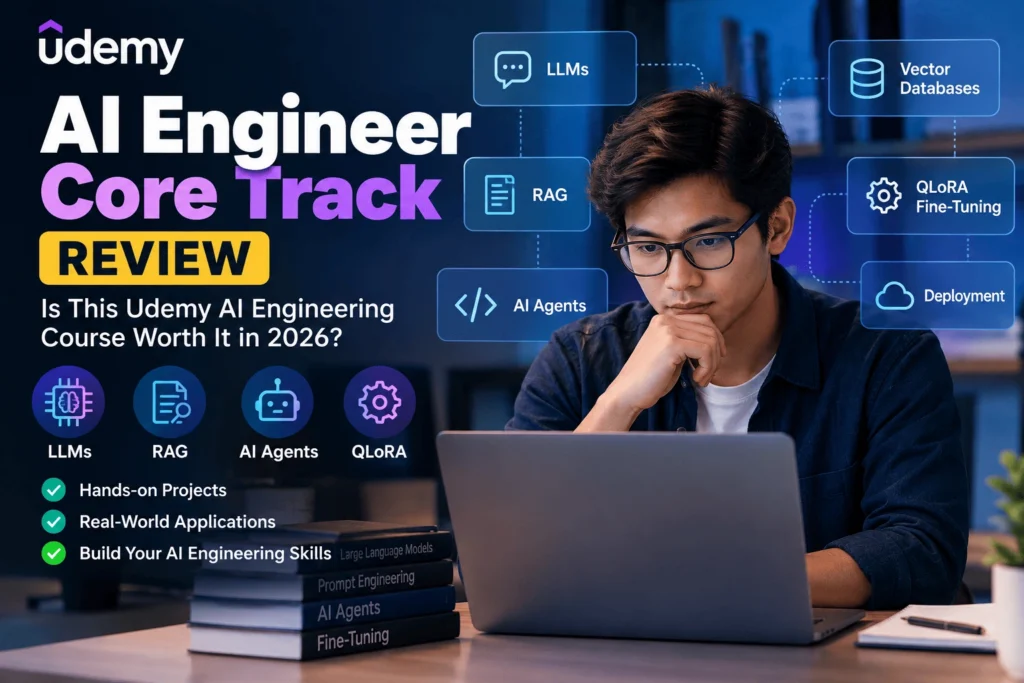
Direct answer: Yes, the AI Engineer Core Track is worth it for developers, data professionals, and technically-inclined career switchers who already know basic Python. Taught by Ed Donner (171,000+ students, 4.7/5 from 22,510+ ratings), it’s an 8-week, project-based course covering RAG, AI agents, and QLoRA fine-tuning, ending with 8 portfolio-ready applications. It’s not ideal for complete beginners with no coding background, since Python isn’t taught from scratch.
Course facts at a glance:
| Item | Details |
|---|---|
| Platform | Udemy |
| Instructor | Ed Donner (with Ligency) |
| Rating | 4.7/5 |
| Students | 171,000+ |
| Ratings Count | 22,510+ |
| Duration | 8 Weeks |
| Projects | 8 hands-on builds |
| Certificate | Yes (completion certificate) |
| Skill Level | Intermediate |
| Prerequisite | Basic Python |
Generative AI stopped being a novelty around the time every company started asking the same question: who on our team can actually build with this? Prompting a chatbot is one thing. Shipping a retrieval system that doesn’t hallucinate, an agent that reliably completes a multi-step task, or a fine-tuned model that runs inside a company’s budget is another. That gap — between “I use ChatGPT” and “I can engineer with LLMs” — is exactly where the AI Engineer Core Track positions itself.
The course, taught by Ed Donner and produced with Ligency on Udemy, has become one of the most recommended entry points into LLM engineering, with well over 170,000 students and a 4.7-star average across more than 22,000 ratings. That kind of scale invites a fair question: is it actually good, or is it just well-marketed? This review breaks down the curriculum, the instructor, the projects, the pricing pattern, the certificate’s real value, and the career outcomes it can realistically support — so you can decide whether it belongs on your list.
What separates this course from the flood of generic “AI for beginners” content isn’t the topic list — RAG, agents, and fine-tuning show up in plenty of course descriptions now. It’s the insistence on building rather than watching, and an instructor whose background is in shipping AI products commercially rather than presenting slides about them. Whether that combination is worth your time and money depends heavily on where you’re starting from, which is the question this review is built to help you answer.
Quick Verdict
Best for:
- Developers who already write code and want to specialize in AI
- Data professionals moving into applied AI and LLM work
- AI enthusiasts who’ve used tools like ChatGPT and want to build, not just prompt
- Career switchers with a technical foundation (even from an unrelated field) who are ready to code daily for eight weeks
Not ideal for:
- Complete beginners with no programming background
- Learners who don’t know Python and aren’t willing to learn it alongside the course
- Anyone looking for a purely conceptual, non-technical overview of AI
At a glance:
| Category | Assessment |
|---|---|
| Difficulty | Intermediate |
| Practical Projects | Excellent |
| Career Value | High |
| Beginner Friendly | Moderate |
| Certificate Value | Good (skills proof, not a formal credential) |
| Overall Value | High |
How it stacks up by learner type:
| Best For | AI Engineer Core Track |
|---|---|
| Developers | ✅ Excellent |
| Data Analysts | ✅ Good |
| Career Shifters (with some coding) | ✅ Good |
| IT Professionals | ✅ Good |
| Complete Beginners (no coding) | ❌ Not Recommended |
If you can already write basic Python and you’re serious about becoming employable in AI engineering rather than just AI-literate, this course earns its reputation. If you can’t yet write a for-loop, you’ll want to close that gap first.
👉 Enroll in the AI Engineer Core Track on Udemy
What Is the AI Engineer Core Track?
The AI Engineer Core Track is a hands-on Udemy course built around one goal: turning developers into LLM engineers over an eight-week arc of progressively harder builds. It sits under Ed Donner’s broader AI curriculum, which also includes an Agentic Track and a Production/Deployment Track — this Core Track is the foundational, most widely enrolled entry point.
Rather than teaching AI as theory, the course is structured around Generative AI concepts you apply immediately:
- Large Language Models (LLMs) — how they work, their strengths and failure modes, and how to choose between frontier models (OpenAI, Anthropic, Google) and open-source alternatives
- Retrieval-Augmented Generation (RAG) — connecting an LLM to your own data so it answers with facts instead of guesses
- AI Agents — systems that plan, call tools, and complete multi-step tasks with limited human input
- Fine-Tuning Models — adapting an existing model to a narrow task using efficient techniques like QLoRA, rather than training from scratch
- Production AI Applications — moving a working prototype toward something that could run in front of real users
The course description frames this plainly: become an LLM engineer by building and deploying real applications, working across more than 20 different models, and mastering RAG, QLoRA, and agent design along the way. That’s a meaningfully different promise than “learn what AI can do” — it’s “learn to build with it,” and the curriculum backs that up.
About the Instructor
Who Is Ed Donner?
Ed Donner isn’t a course-creator-first personality — he’s a career technologist and entrepreneur who moved into AI education after building things in the industry. Before teaching, he spent roughly fifteen years in Wall Street technology roles, ultimately serving as a Managing Director at JPMorgan Chase, where he led a team of around 300 software engineers. From there, he co-founded an AI startup that was later acquired, then co-founded a second company, Nebula, which applies AI to talent and recruitment — using pattern-matching across skillsets rather than simple keyword search to identify job fit.
That background matters for a technical course like this one. Donner isn’t explaining AI concepts secondhand; he’s applied them at the scale of enterprise engineering teams and built AI products commercially. Students frequently cite this credibility in reviews, noting that the course avoids surface-level “here’s how to call an API” content and gets into the engineering decisions that actually come up when you build LLM-powered systems for real use cases.
Teaching Style
The course leans heavily on project-based learning. Instead of long theory blocks followed by a quiz, each new concept — RAG, fine-tuning, agentic workflows — is introduced and then immediately built into a working project. Reviewers consistently describe the pace as energetic but clear, with Donner keeping explanations tight rather than padding runtime. For a technical audience that wants to build rather than watch, this hands-on cadence is one of the course’s biggest strengths, though it also means the course rewards active coding along with the instructor rather than passive viewing.
Who Should Take This Course?
Software Developers
If you already write code in any language, you have the foundation this course needs. You’ll pick up the AI-specific concepts — prompting patterns, embeddings, vector stores, agent loops — much faster than someone learning to code and learning AI at the same time.
Python Programmers
Python is the course’s working language throughout. If you’re already comfortable with Python syntax, data structures, and basic scripting, you’ll spend your energy on the AI concepts rather than fighting the language.
Data Analysts
Analysts who already work with data pipelines and some Python will find the RAG and embeddings sections a natural extension of skills they already have — retrieval systems are, at their core, a smarter way of querying and surfacing data.
Machine Learning Enthusiasts
If you’ve dabbled in traditional ML (regression, classification, maybe some PyTorch or TensorFlow) and want to pivot toward the LLM side of the field, this course is a direct bridge — especially the fine-tuning and QLoRA sections, which assume some comfort with model training concepts.
IT Professionals
Systems and infrastructure professionals who want to move from supporting AI tools to building them will benefit from the production-deployment framing woven through the later modules, even though full-scale deployment is covered in more depth in Donner’s separate Production Track.
Career Changers
This is where the course draws the most attention — and the most caution. Career changers with some coding background (even a bootcamp-level foundation) report strong outcomes. Career changers with zero programming experience tend to struggle with the pace, since the course assumes you can already read and write basic Python from day one.
Course Curriculum Breakdown
AI Foundations
The course opens with grounding: what generative AI actually is, how large language models generate text, and the core vocabulary you’ll need for everything that follows (tokens, context windows, embeddings, temperature, and similar terms).
Prompt Engineering
Before building anything complex, you learn to get consistent, controllable output from a model — prompt structuring, iterative refinement, and strategies for reducing hallucination and off-target responses. This section is short relative to its importance, since the course treats prompting as a tool rather than the whole skillset.
LLM Application Development
This is where the course shifts into building. You work directly with LLM APIs (OpenAI’s among them) to construct functioning applications, moving from toy examples toward multi-feature tools with real logic behind them.
Retrieval-Augmented Generation (RAG)
One of the most job-relevant sections. You learn how to architect a RAG pipeline — chunking and embedding your own data, storing it in a vector database, retrieving relevant context at query time, and feeding that context back into the model so its answers are grounded in your source material rather than invented.
AI Agents
Here the course moves from single-turn Q&A into systems that plan and act across multiple steps. You design agents that can break a task down, call tools or functions, and execute a workflow with minimal supervision — the skillset behind most of today’s “AI assistant” and automation products.
Fine-Tuning Models
Rather than teaching full model training (expensive and usually unnecessary), the course focuses on QLoRA — a parameter-efficient fine-tuning method that lets you specialize an existing model to a narrow task without retraining it from scratch. This is a practical, resource-conscious skill that mirrors how fine-tuning is actually done in industry.
Production Deployment
The final stretch introduces what it takes to move a working prototype toward something usable outside your own machine — deployment considerations, scalability thinking, and the realities of running an AI application in front of actual users. This section is intentionally an introduction rather than a deep dive; students who want to go further typically continue into Donner’s dedicated production-focused course.
👉 Get the AI Engineer Core Track here
Skills You’ll Learn
Technical skills:
- Prompt engineering and iterative prompt design
- AI agent development and multi-step workflow design
- RAG system architecture (embeddings, vector stores, retrieval logic)
- LangChain for building LLM-powered applications
- General LLM application development patterns
- Fine-tuning techniques, including QLoRA
- Python-based AI development end to end
Professional skills:
- Structured problem-solving for ambiguous, open-ended technical tasks
- Automation design — spotting where an agent or pipeline can replace manual work
- Turning an AI concept into a shippable solution, not just a demo
Hands-On Projects
The projects are arguably the course’s strongest selling point, because they double as portfolio material. Rather than isolated exercises, each project is a self-contained application you can show a hiring manager or a client. Examples drawn from the course structure include:
- An AI-powered brochure generator that scrapes and intelligently navigates a company’s website to produce marketing copy — a practical demonstration of combining web data extraction with generation
- A multi-modal customer support agent for an airline use case, complete with a UI and function-calling so the agent can actually take action, not just respond
- An audio-to-minutes tool that turns a recorded meeting into structured notes and action items, using a mix of open- and closed-source models
- A code-conversion tool that translates Python into optimized C++, with the course highlighting dramatic performance gains as a demonstration of what well-engineered AI tooling can achieve
- A RAG-powered knowledge worker that becomes a subject-matter expert on a company’s internal documents — one of the most directly job-relevant builds in the course
By the end, you’re not holding a certificate and a stack of notes — you’re holding several working applications you can walk through in a job interview or repurpose for freelance client work.
What makes these projects work as portfolio pieces isn’t just that they’re functional — it’s that each one demonstrates a different engineering muscle. The brochure generator shows you can wrangle messy, unstructured web data into something useful. The airline support agent shows you can design a multi-modal interface with real function-calling, not a scripted demo. The meeting-minutes tool shows you can combine models from different providers inside one pipeline. The code-conversion project shows you can push a model toward a genuinely hard optimization task rather than a simple text-generation use case. And the RAG knowledge worker shows you can solve the single most requested enterprise AI use case: “make our internal knowledge searchable and answerable.” Taken together, the project set reads less like a list of exercises and more like a small case-study portfolio you could hand to a hiring manager or a freelance client.
Course Strengths
Practical Focus
Nearly every concept is taught by building something with it, not just describing it. This is the throughline reviewers mention most: the course treats you as someone who wants to ship, not just understand.
Industry-Relevant Content
RAG, agents, and efficient fine-tuning aren’t academic curiosities — they’re the exact skills companies are hiring for right now in AI engineering and LLM engineering roles.
Modern AI Topics
The curriculum covers current techniques and works across more than 20 models, spanning both frontier providers and open-source options, so you’re not learning a single vendor’s tooling in isolation.
Portfolio Development
Each project is designed to be demo-able. Few courses at this price point leave you with this much tangible, showable output.
Frequent Updates
Because the AI field moves quickly, the course is maintained on a regular update cycle rather than left static — an important consideration given how fast model capabilities and tooling change.
Cross-Model Fluency
Working across more than 20 models — spanning frontier providers and open-source options — means you don’t graduate knowing only one vendor’s ecosystem. That flexibility matters in a job market where the “best” model for a given task changes every few months, and employers increasingly want engineers who can evaluate and swap between providers rather than lock into one API.
Potential Weaknesses
Requires Python Knowledge
This is the single biggest gatekeeper. The course does not teach Python from scratch, so if you can’t already read and write basic Python, you’ll be learning two things at once — the language and the AI concepts — which will slow you down significantly.
Large Time Commitment
Eight weeks of genuinely hands-on building is a real commitment, especially for anyone doing this alongside a full-time job. Expect to set aside consistent hours per week rather than trying to binge it in a weekend.
Fast Pace for Beginners
Even with some coding background, the jump from prompting to RAG to agents to fine-tuning happens quickly. Students without prior exposure to AI concepts sometimes need to rewatch sections or slow down deliberately.
Requires Consistent Practice
Because each module builds on the last, falling behind compounds quickly. This isn’t a course you can watch passively in the background — the projects assume you’re actually coding along.
Limited Depth on Production Engineering
The production-deployment module is deliberately introductory rather than exhaustive. If your goal is to master scalable deployment, observability, and infrastructure for AI systems in depth, this course lays the groundwork but isn’t the finish line — Donner’s dedicated production-focused course exists precisely to go further on that specific skill set.
Certificate and Completion Value
Completing the course earns you a Udemy certificate of completion. It’s worth being precise about what that is and isn’t:
- Udemy Certificate: Confirms you completed the course content. It is not an accredited or industry-recognized certification body credential like AWS or Google’s professional certificates.
- Skills Validation: The certificate’s real value comes from what it represents — that you sat through eight weeks of hands-on LLM engineering work, not that a testing body evaluated you.
- Resume Value: Listing the course is reasonable, but it carries far more weight when paired with the projects you built rather than the certificate alone.
- LinkedIn Value: Many students add the certificate and a short project write-up to their LinkedIn profile — this is common in the reviews and testimonials the course has generated, and it does help visibility with recruiters scanning for AI skills.
The honest takeaway: treat the certificate as a supporting artifact, not the main deliverable. The main deliverable is the working code and the projects sitting in your portfolio. That’s what employers actually evaluate.
Career Opportunities After Completing This Course
Graduates of the course — based on the roles the curriculum most directly prepares you for — are positioned to pursue:
AI Engineer
The direct target role: building and maintaining AI-powered applications and pipelines, exactly what the course’s projects simulate.
LLM Engineer
A more specialized title focused specifically on working with large language models — prompting, RAG, fine-tuning, and evaluation — which maps almost one-to-one onto the course curriculum.
AI Application Developer
Building the product layer on top of AI capabilities — interfaces, integrations, and user-facing features powered by an LLM backend.
Machine Learning Engineer
A broader role that the course supports partially; the fine-tuning module is directly relevant, though a full ML engineering role typically expects additional background in classical ML beyond what this course covers.
AI Consultant
For freelancers and consultants, the course’s project range (chatbots, RAG systems, automation agents) mirrors exactly the kind of scoped deliverables small businesses are hiring for.
Automation Specialist
The agents module in particular sets you up to design and deploy workflow automation — a fast-growing niche as companies look to reduce manual, repetitive work with AI-driven agents.
It’s worth being realistic: this course alone won’t guarantee a job title change. What it does reliably deliver is a working, demonstrable skillset and a portfolio you can point to — the two things that actually move the needle in an AI hiring conversation.
It’s also worth noting how these roles are actually hired for right now. Most AI engineering postings, especially at small and mid-sized companies, don’t ask for a specific certification — they ask candidates to walk through something they’ve built. A recruiter or hiring manager scanning a resume is far more likely to click through to a GitHub repo of the meeting-minutes tool or the RAG knowledge worker than to verify a Udemy certificate number. That’s the practical reason the project-heavy structure of this course translates into real hiring leverage: it gives you concrete answers to the interview question that trips up most self-taught candidates — “okay, but what have you actually built?”
AI Engineer Core Track vs. Google AI Professional Certificate
These two are often shortlisted together, but they serve different learners.
| Feature | AI Engineer Core Track | Google AI Professional Certificate |
|---|---|---|
| Focus | Technical AI engineering (build & deploy) | Broader AI foundations & literacy |
| Projects | Extensive, portfolio-grade | Moderate, guided exercises |
| Coding Required | Yes, Python throughout | Limited to minimal |
| Difficulty | Higher (intermediate) | Beginner friendly |
| Best For | Developers, technical career switchers | General professionals, non-coders |
Who should choose which: if you already code and want to specialize in building LLM-powered products, the AI Engineer Core Track is the more direct path to an engineering role. If you’re a non-technical professional who wants to understand AI well enough to use it effectively in your current job — without becoming a developer — a broader foundations program like the Google AI Professional Certificate is the better starting point. Some learners reasonably do both in sequence: foundations first, then this course to go technical.
Pricing and Discounts
Like most Udemy courses, the AI Engineer Core Track carries a list price that rarely reflects what most students actually pay. Udemy runs frequent, deep promotional discounts — often bringing courses down substantially from their listed price during regular sale periods — so it’s worth checking the current price on the course page before purchasing rather than assuming the sticker price is final. A few things to know regardless of the price you see:
- Lifetime access: Once purchased, you keep access to the course indefinitely, including future content updates.
- Mobile access: The course is available through Udemy’s mobile app, so you can review lecture content away from a desktop, though the hands-on coding is realistically a desktop activity.
- Updates included: Because the course is actively maintained, purchasing once covers you through subsequent revisions as the curriculum evolves with the field.
If you’re price-sensitive, waiting for one of Udemy’s periodic sitewide sales is a reasonable strategy — the course is rarely, if ever, sold only at full list price.
Is the AI Engineer Core Track Worth It?
For Developers
Yes, clearly. You already have the prerequisite skill (coding), so nearly all your learning time goes toward the AI-specific material. This is the profile the course serves best.
For Career Changers
Conditionally yes — provided you already have some programming foundation, even from a bootcamp or self-taught background. Career changers with zero coding experience should build basic Python fluency first, then take this course, rather than trying to learn both simultaneously.
For Students
Strong value, particularly for computer science or data-adjacent students who want practical AI experience that goes beyond what a typical university curriculum covers, since most academic programs haven’t caught up to LLM engineering as a discipline.
For IT Professionals
Worthwhile as a specialization move, especially if you’re aiming to shift from supporting infrastructure toward building on top of it. The production-deployment section, while introductory, gives a useful preview of what that shift involves.
👉 Check the current price and enroll here
Pros and Cons at a Glance
Pros
- Project-based learning with 8 portfolio-ready builds
- Covers RAG, AI Agents, and QLoRA fine-tuning in depth
- Taught by an instructor with real commercial AI/engineering experience
- Works across 20+ models (frontier and open-source)
- Frequent course updates to keep pace with the field
Cons
- Requires existing Python knowledge — not taught from scratch
- Fast pace once past the foundations section
- Not beginner-friendly for non-coders
- Production-deployment coverage is introductory, not deep
- Large weekly time commitment across 8 weeks
Final Verdict
The AI Engineer Core Track earns its strong reputation for a specific reason: it treats AI engineering as a skill you build by building, not a subject you learn by watching. The curriculum covers the exact techniques — RAG, agents, QLoRA fine-tuning — that show up in real AI engineering job descriptions today, and the eight portfolio-ready projects give you tangible proof of what you can do, which matters more to employers than a certificate alone ever will.
Its limitations are equally clear: it assumes you can already code, moves at a pace that rewards consistency, and won’t hand you a job on its own. If you’re a developer, data professional, or technically-inclined career changer ready to put in focused weeks of hands-on work, this is one of the more credible, well-built paths into LLM engineering currently available. If you’re starting from zero — no coding at all — pick up basic Python first, then come back to this course when you’re ready to build.
Bottom line: high value for the right audience, moderate value for beginners without a coding foundation, and a strong recommendation if your goal is to move from “I use AI tools” to “I can build AI systems.”
Frequently Asked Questions
Is the AI Engineer Core Track beginner friendly? It’s beginner friendly for AI concepts but not for programming. If you already know basic Python, the AI material is taught clearly enough for a true AI beginner to follow. If you don’t know Python yet, expect a steep learning curve.
Do I need Python experience? Yes. Python is the working language throughout the course, and it isn’t taught from scratch. Basic comfort with Python syntax, functions, and simple scripting is the realistic minimum before starting.
How long does the course take? The course is structured as an eight-week program, though the actual time depends on your pace — some students move faster by dedicating more hours per week, while others take longer around a full-time schedule.
Does it include a certificate? Yes, a Udemy certificate of completion is issued once you finish the course. It’s a skills-completion certificate rather than an accredited professional certification.
Can I get an AI job after completing it? It significantly strengthens your candidacy, especially combined with the projects you build, but it isn’t a guaranteed job pipeline. Treat it as building the skills and portfolio that make you a credible candidate for AI engineer, LLM engineer, or AI application developer roles — the job search itself still requires its own effort.
Is the course updated regularly? Yes, the course is maintained on an ongoing basis to reflect current models, tools, and techniques, which matters given how quickly the AI field changes.
Is it better than the Google AI Professional Certificate? “Better” depends on your goal. For hands-on technical engineering skill, the AI Engineer Core Track goes deeper and produces more tangible output. For broad AI literacy without a coding requirement, the Google AI Professional Certificate is the more accessible option. They serve different audiences rather than directly competing.
Related reading: Google AI Essentials Review · Google AI Professional Certificate Review · Google AI Professional Certificate Jobs · Google Career Certificates Guide · Free Online Courses for Skill Upgrade
👉 Start the AI Engineer Core Track on Udemy →