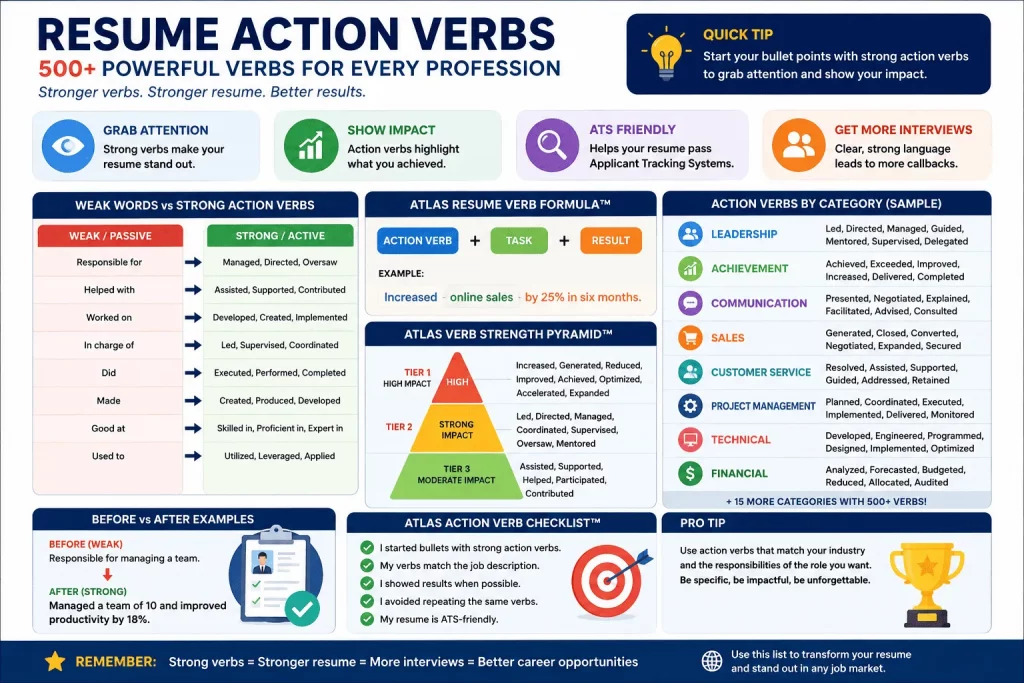
Recruiters spend an average of six to eight seconds scanning a resume before deciding whether to keep reading. In that narrow window, the words you choose matter more than almost anything else on the page. Weak, passive language — phrases like “responsible for,” “helped with,” or “worked on” — blends into the background noise of a stack of applications. Strong, specific action verbs on resume documents do the opposite: they signal ownership, momentum, and measurable results in the very first word a recruiter reads.
This guide breaks down why action verbs matter, how Applicant Tracking Systems (ATS) evaluate them, and how to replace tired resume language with words that actually move the needle. You’ll also find a categorized library of 500+ resume action verbs, profession-specific verb lists, proprietary frameworks for choosing the right verb every time, and a checklist you can run before you hit submit.
Why Recruiters Dislike Weak Resume Language
Recruiters read hundreds of resumes that all say roughly the same thing. “Responsible for customer service.” “Helped manage a team.” “Worked on marketing campaigns.” These phrases describe a job description, not a candidate’s contribution. They don’t tell a recruiter what actually happened, how well it was done, or what changed as a result.
Weak language creates three problems:
- It hides your impact. Saying you were “responsible for” a task tells a reader what was assigned to you, not what you accomplished.
- It sounds passive. Passive phrasing puts the reader to work figuring out what you actually did, and most won’t bother.
- It fails to differentiate you. If every candidate uses the same generic phrases, nothing on the page stands out.
Why Action Verbs Create Stronger Resumes
Action verbs immediately shift a bullet point from a description of duties to a statement of achievement. Compare these two lines:
- Weak: Responsible for customer service.
- Strong: Resolved customer concerns and improved satisfaction scores by 20%.
The second version starts with a verb that shows initiative (“Resolved”), and it closes with a measurable outcome (20% improvement). That single change makes the bullet more credible, more specific, and more memorable.
Strong verbs also help resumes read faster. Recruiters skim in a pattern that favors the left edge of the page — the first word of each bullet point carries disproportionate weight. When that word is a concrete action verb instead of a filler phrase, the entire resume feels more confident and results-driven.
How Action Verbs Improve ATS Relevance
Most mid-size and large employers filter applications through an Applicant Tracking System before a human ever sees them. These systems parse resume text and match it against the language in the job posting. Action verbs play a direct role in that matching process:
- Keyword alignment: Job postings are typically written with verbs like “managed,” “led,” “developed,” or “analyzed.” Resumes that mirror this language score higher in ATS relevance checks.
- Section parsing: ATS software often identifies work experience by scanning for verb-led bullet points, since this is the standard resume format.
- Skill inference: Many systems infer competencies (leadership, technical skill, communication) from the verbs surrounding a job title, not just from a standalone skills section.
In short, choosing the right action verb isn’t just a stylistic choice — it’s a functional part of getting past automated screening and into a recruiter’s hands.
Why Strong Wording Increases Interview Potential
Recruiters and hiring managers consistently report that resumes using specific, active language are easier to evaluate and more likely to progress to an interview. Strong wording does three things at once: it demonstrates communication skill, it makes accomplishments easier to verify, and it gives an interviewer natural follow-up questions to ask (“Tell me more about how you increased retention by 15%”). A resume built entirely on weak verbs gives an interviewer nothing to grab onto.
What Are Resume Action Verbs?
Resume action verbs are strong, specific words that describe your achievements, responsibilities, and accomplishments — replacing passive phrases like “responsible for” or “helped with” with active language that shows exactly what you did and what resulted from it.
| Weak Example | Strong Example |
|---|---|
| Responsible for customer service. | Resolved customer concerns and improved satisfaction scores by 20%. |
Action verbs typically appear at the start of a resume bullet point, followed by the task performed and, ideally, a quantifiable result. This structure gives hiring managers a fast, credible read on what you actually contributed in each role.
Weak Words vs. Strong Action Verbs
Before diving into the full verb library, it helps to see how common weak phrases map to stronger alternatives. Use this table as a quick substitution guide while editing your resume.
| Weak Word or Phrase | Better Alternative |
|---|---|
| Responsible For | Managed |
| Helped | Assisted |
| Worked On | Developed |
| Did | Executed |
| Made | Created |
| Handled | Coordinated |
| In Charge Of | Directed |
| Took Care Of | Maintained |
| Dealt With | Resolved |
| Worked With | Collaborated |
| Was Involved In | Contributed |
| Tried To | Achieved |
Notice that the “better alternative” column doesn’t just sound more sophisticated — it’s also more specific. “Managed” implies ownership of a process or team; “responsible for” could mean almost anything.
The Atlas Resume Verb Formula™
One of the fastest ways to fix weak resume bullets is to apply a simple, repeatable formula:
Action Verb + Task + Result
This structure forces you to lead with a strong verb, describe what you actually did, and — critically — close with the outcome. Without the result, even a strong verb falls flat.
- Weak: Responsible for managing schedules.
- Strong: Coordinated executive schedules, reducing scheduling conflicts by 30%.
Run every bullet point on your resume through this formula. If you can’t identify a measurable result, use a qualitative one instead (e.g., “improving team communication” or “streamlining the onboarding process”), but always aim for a number when you have one — percentages, dollar amounts, headcounts, and timeframes are the most persuasive.
👉 Create stronger resume bullet points instantly with our Free Resume Builder Online | Create & Download PDF Resume.
The Atlas Resume Verb Strength Pyramid™
Not all action verbs carry equal weight. Some communicate outcomes directly; others communicate involvement without outcome. The Atlas Resume Verb Strength Pyramid organizes verbs into three tiers so you can prioritize the strongest language for your most important achievements.
Tier 1 — Highest Impact (use for quantified achievements): Increased, Generated, Reduced, Improved, Achieved, Optimized, Accelerated, Expanded
Tier 2 — Strong Ownership (use for leadership and process work): Led, Directed, Managed, Coordinated, Supervised
Tier 3 — Supporting Contribution (use sparingly, for genuinely supportive roles): Assisted, Supported, Helped
A resume built entirely on Tier 3 verbs reads as passive, even if the underlying work was substantial. Aim to concentrate Tier 1 and Tier 2 verbs on your top bullet points — the first one or two lines under each job — since that’s where recruiter attention is highest. Save Tier 3 language for genuinely supporting tasks where you weren’t the primary owner.
The Atlas Action Verb Selector™
Choosing a verb becomes much easier once you start from your goal rather than from a generic list. The Atlas Action Verb Selector matches common resume goals to the verbs that best express them.
| If Your Goal Is… | Use Verbs Like |
|---|---|
| Increase Revenue | Generated, Increased, Expanded |
| Reduce Costs | Reduced, Eliminated, Optimized |
| Lead Teams | Led, Directed, Supervised |
| Improve Efficiency | Streamlined, Automated, Accelerated |
| Improve Customer Service | Resolved, Assisted, Supported |
| Launch New Initiatives | Launched, Piloted, Introduced |
| Solve Problems | Diagnosed, Resolved, Troubleshot |
| Build Relationships | Cultivated, Partnered, Networked |
| Improve Quality | Refined, Enhanced, Standardized |
| Train Others | Mentored, Trained, Coached |
Before writing a bullet point, ask yourself: what was the underlying goal of this task? Then choose the verb that matches that goal rather than defaulting to whatever verb comes to mind first.
The Atlas Resume Verb Finder™
When you’re staring at a bullet point and can’t decide where to start, skip the full verb library and answer one question instead: What did you accomplish? The Atlas Resume Verb Finder is a mini decision tree that routes you straight to the right verb family based on the type of outcome you’re describing.
What did you accomplish?
→ Revenue Increase
- Generated
- Increased
- Expanded
→ Leadership
- Led
- Directed
- Supervised
→ Efficiency
- Streamlined
- Automated
- Optimized
Pick the branch that matches your outcome, then choose the verb within it that best fits the scale and nature of what you did — “Generated” for creating something new (like leads or a revenue stream), “Increased” for growing an existing number, and “Expanded” for broadening scope or reach. The same logic applies within the Leadership and Efficiency branches: “Led” suits hands-on team leadership, “Directed” suits higher-level oversight, and “Supervised” suits direct, day-to-day management of people or tasks. “Streamlined” suits process simplification, “Automated” suits removing manual work with technology, and “Optimized” suits fine-tuning something that already exists.
Use the Finder as a fast first pass when you’re rewriting a resume under time pressure, then cross-reference the fuller Strength Pyramid and category lists below if you want more options within a branch.
Best Resume Action Verbs by Category
Below is a categorized library of resume action verbs, organized by the type of work they best describe. Use these lists as a reference when rewriting your bullet points — but always choose the verb that most accurately reflects what you did rather than picking the most impressive-sounding word. Each category below includes a short note on when it applies, since the same underlying task can often be described from more than one angle depending on which skill you want to highlight.
For example, running a client meeting could be framed as a communication task (“Presented quarterly results to stakeholders”), a leadership task (“Directed the client review process”), or a sales task (“Secured renewal commitment during the account review”), depending on which achievement you most want a recruiter to notice. Choosing the right category — not just the right verb — is part of building a resume that emphasizes your strongest, most relevant skills for the role you’re targeting.
Leadership Action Verbs
Use these when describing team management, mentorship, or organizational direction.
Led, Directed, Managed, Coordinated, Supervised, Mentored, Guided, Delegated, Orchestrated, Chaired, Headed, Oversaw, Spearheaded, Championed, Cultivated, Empowered, Facilitated, Governed, Influenced, Inspired, Motivated, Pioneered, Presided over, Recruited, Shaped, Steered, Strengthened, Trained, Unified, Advocated for, Authorized, Built, Consolidated, Drove, Established, Fostered, Instituted, Organized, Ran, Transformed
Achievement Action Verbs
Use these when highlighting results, milestones, and measurable wins.
Achieved, Exceeded, Delivered, Improved, Increased, Generated, Expanded, Accelerated, Attained, Boosted, Completed, Enhanced, Maximized, Outperformed, Surpassed, Amplified, Advanced, Capitalized on, Elevated, Excelled at, Finalized, Fulfilled, Gained, Grew, Reached, Realized, Sustained, Strengthened, Succeeded in, Transformed, Won, Yielded, Accomplished, Doubled, Tripled, Propelled, Raised, Reduced, Streamlined, Upgraded
Communication Action Verbs
Use these when describing writing, presenting, negotiating, or interpersonal work.
Presented, Negotiated, Explained, Facilitated, Advised, Consulted, Articulated, Authored, Briefed, Clarified, Collaborated, Communicated, Composed, Conveyed, Corresponded, Debated, Documented, Drafted, Edited, Illustrated, Interpreted, Interviewed, Liaised with, Lectured, Persuaded, Promoted, Publicized, Reported, Summarized, Translated, Wrote, Addressed, Campaigned for, Counseled, Demonstrated, Informed, Mediated, Moderated, Publicized, Voiced
Sales Action Verbs
Use these when describing revenue generation, client acquisition, or account growth.
Generated, Closed, Converted, Negotiated, Expanded, Secured, Acquired, Boosted, Cultivated, Delivered, Developed, Drove, Earned, Established, Exceeded, Forecasted, Grew, Identified, Increased, Influenced, Launched, Leveraged, Marketed, Maximized, Networked, Penetrated, Pitched, Prospected, Retained, Sold, Solicited, Sourced, Strengthened, Targeted, Upsold, Won, Captured, Positioned, Qualified, Onboarded
Customer Service Action Verbs
Use these when describing support, retention, and client-facing problem-solving.
Resolved, Assisted, Supported, Guided, Addressed, Retained, Advised, Advocated for, Answered, Clarified, Coached, Communicated, Diagnosed, Educated, Enhanced, Ensured, Facilitated, Followed up with, Handled, Helped, Improved, Informed, Listened to, Maintained, Managed, Mediated, Monitored, Processed, Provided, Referred, Responded to, Satisfied, Served, Solved, Streamlined, Tracked, Troubleshot, Welcomed, Onboarded, De-escalated
Project Management Action Verbs
Use these when describing planning, execution, and delivery of initiatives.
Planned, Coordinated, Directed, Implemented, Executed, Delivered, Administered, Allocated, Budgeted, Built, Controlled, Defined, Estimated, Evaluated, Facilitated, Forecasted, Initiated, Launched, Led, Managed, Monitored, Negotiated, Optimized, Organized, Overhauled, Prioritized, Scheduled, Scoped, Streamlined, Supervised, Tracked, Completed, Finalized, Mobilized, Orchestrated, Piloted, Restructured, Reviewed, Standardized, Synchronized
Administrative Action Verbs
Use these when describing office coordination, records, and operational support.
Organized, Scheduled, Processed, Coordinated, Managed, Maintained, Archived, Arranged, Assembled, Catalogued, Compiled, Composed, Distributed, Documented, Drafted, Executed, Filed, Handled, Implemented, Logged, Monitored, Operated, Ordered, Prepared, Recorded, Reconciled, Screened, Streamlined, Supported, Systematized, Tracked, Transcribed, Updated, Verified, Dispatched, Facilitated, Input, Maintained, Registered, Sorted
Technical Action Verbs
Use these when describing engineering, development, or IT contributions.
Developed, Engineered, Programmed, Automated, Designed, Configured, Architected, Built, Coded, Debugged, Deployed, Diagnosed, Documented, Enhanced, Executed, Implemented, Improved, Installed, Integrated, Maintained, Migrated, Modeled, Optimized, Overhauled, Piloted, Refactored, Resolved, Scaled, Streamlined, Tested, Troubleshot, Upgraded, Validated, Wrote, Customized, Launched, Monitored, Provisioned, Standardized, Automated
Financial Action Verbs
Use these when describing budgeting, accounting, and financial analysis.
Audited, Budgeted, Forecasted, Reduced, Allocated, Analyzed, Assessed, Balanced, Calculated, Consolidated, Controlled, Estimated, Evaluated, Examined, Executed, Financed, Funded, Managed, Maximized, Monitored, Negotiated, Optimized, Prepared, Processed, Projected, Reconciled, Reported, Reviewed, Saved, Streamlined, Structured, Tracked, Trimmed, Underwrote, Validated, Verified, Administered, Appraised, Modeled, Recovered
Healthcare Action Verbs
Use these when describing clinical care, patient support, and treatment planning.
Assessed, Diagnosed, Treated, Monitored, Evaluated, Educated, Administered, Advised, Advocated for, Assisted, Cared for, Charted, Coached, Coordinated, Counseled, Documented, Examined, Facilitated, Guided, Implemented, Improved, Managed, Performed, Prepared, Prescribed, Provided, Recorded, Referred, Rehabilitated, Screened, Stabilized, Supported, Tested, Tracked, Trained, Triaged, Updated, Verified, Consulted, Delivered
The Psychology Behind Action Verbs and Hiring Decisions
Hiring managers process resumes under real cognitive load — they’re often reviewing dozens or hundreds of applications for a single role, frequently in short bursts between other work. Research on resume screening consistently shows that reviewers rely heavily on quick pattern recognition rather than deep, sentence-by-sentence reading, especially in the first pass. Action verbs work with this pattern recognition rather than against it: a strong, specific verb at the start of a line gives the reviewer’s eye an immediate anchor point, letting them extract meaning without slowing down to parse a full sentence.
There’s also a credibility effect. Specific verbs paired with measurable outcomes read as more trustworthy than vague, sweeping claims, because they imply the candidate remembers — and can defend — the details of what happened. A bullet point like “Reduced onboarding time by 35% by redesigning the training schedule” signals a level of ownership and recall that “Helped improve onboarding” simply doesn’t.
Finally, action verbs shape the interview that follows. Interviewers frequently build their questions directly from resume language, asking candidates to expand on specific bullet points. A resume filled with strong, specific verbs naturally produces stronger, more specific interview conversations — because the interviewer has concrete details to ask about instead of vague generalities to probe.
Formatting Tips That Pair With Strong Action Verbs
Strong verbs work best inside a resume format that’s built to showcase them. A few formatting habits make a meaningful difference:
- Keep bullet points to one or two lines. A strong opening verb loses impact if it’s buried in a dense paragraph. Aim for concise, single-idea bullets.
- Lead every bullet with the verb — not a date, a company name, or a filler phrase. The verb should always be the first word readers encounter.
- Use consistent verb tense. Past roles should use past tense (“Managed,” “Led,” “Developed”); your current role can use present tense (“Manage,” “Lead,” “Develop”) if you’re still actively performing the work.
- Avoid stacking multiple verbs in one bullet. A bullet like “Managed and led and coordinated the project” dilutes impact. Choose the single most accurate verb.
- Bold sparingly, if at all. Let the verb and the result carry the weight rather than relying on formatting tricks to draw attention.
- Order bullets by impact, not chronology. Within each role, lead with your strongest, most quantifiable achievement rather than listing tasks in the order they happened.
Additional Before-and-After Rewrites
More examples make the substitution pattern easier to internalize. Here are additional rewrites spanning a range of industries and seniority levels.
Before: In charge of a small team of associates. After: Supervised a five-person associate team, improving on-time task completion by 22%.
Before: Worked with vendors to get better pricing. After: Negotiated vendor contracts, reducing annual procurement costs by $18,000.
Before: Did research for marketing projects. After: Conducted competitive research that informed a rebranding strategy adopted company-wide.
Before: Helped design the new employee handbook. After: Co-authored a revised employee handbook, improving policy clarity for 300+ staff.
Before: Was part of the team that launched the app. After: Contributed to the launch of a mobile app that reached 10,000 downloads in its first month.
Before: Tried to keep the project on schedule. After: Monitored project milestones and reallocated resources to keep delivery on schedule despite two vendor delays.
Each rewrite follows the same underlying logic: replace a vague verb or phrase, add specificity about the task, and close with a result — even an approximate or qualitative one when exact numbers aren’t available.
Resume Action Verbs by Profession
While category-based lists are useful, some roles call for language tailored to the specific work involved. Below are profession-specific verb lists you can pull from directly.
Teacher Resume Verbs
Educated, Instructed, Taught, Facilitated, Mentored, Assessed, Developed, Designed, Implemented, Guided, Motivated, Coached, Evaluated, Adapted, Differentiated, Communicated, Counseled, Cultivated, Encouraged, Fostered, Graded, Modeled, Monitored, Prepared, Supervised
Nurse Resume Verbs
Assessed, Administered, Monitored, Documented, Educated, Coordinated, Treated, Evaluated, Stabilized, Advocated for, Charted, Collaborated, Delivered, Diagnosed, Facilitated, Implemented, Managed, Performed, Prepared, Provided, Rehabilitated, Screened, Supported, Triaged, Trained
Accountant Resume Verbs
Audited, Reconciled, Analyzed, Prepared, Forecasted, Budgeted, Reported, Reviewed, Verified, Calculated, Consolidated, Controlled, Estimated, Evaluated, Examined, Filed, Maintained, Managed, Processed, Projected, Recorded, Streamlined, Structured, Tracked, Validated
Administrative Assistant Resume Verbs
Coordinated, Organized, Scheduled, Managed, Maintained, Processed, Arranged, Compiled, Drafted, Facilitated, Filed, Handled, Implemented, Logged, Monitored, Ordered, Prepared, Recorded, Reconciled, Screened, Streamlined, Supported, Tracked, Updated, Verified
Customer Service Resume Verbs
Resolved, Assisted, Supported, Addressed, Guided, Responded to, Retained, Advised, Answered, Clarified, Coached, Diagnosed, Educated, Ensured, Facilitated, Handled, Improved, Informed, Maintained, Managed, Processed, Provided, Solved, Streamlined, Welcomed
Virtual Assistant Resume Verbs
Coordinated, Managed, Organized, Scheduled, Processed, Maintained, Supported, Communicated, Compiled, Drafted, Executed, Facilitated, Handled, Implemented, Monitored, Prepared, Researched, Streamlined, Tracked, Updated, Automated, Booked, Documented, Liaised with, Reconciled
Software Developer Resume Verbs
Developed, Engineered, Programmed, Designed, Built, Architected, Automated, Coded, Debugged, Deployed, Integrated, Maintained, Migrated, Optimized, Refactored, Resolved, Scaled, Streamlined, Tested, Troubleshot, Upgraded, Validated, Wrote, Configured, Launched
Government Employee Resume Verbs
Administered, Implemented, Coordinated, Enforced, Evaluated, Facilitated, Managed, Monitored, Oversaw, Prepared, Processed, Reviewed, Regulated, Reported, Represented, Researched, Resolved, Scheduled, Standardized, Supervised, Supported, Tracked, Trained, Verified, Advised.
👉 Build a professional resume using proven action verbs with our Free Resume Builder Online | Create & Download PDF Resume.
How to Replace Weak Resume Language
Rewriting a resume line by line can feel tedious, but the process is straightforward once you apply the Atlas Resume Verb Formula (Action Verb + Task + Result). Here are a few before-and-after examples across different roles.
Before: Helped customers with concerns. After: Resolved customer concerns while maintaining a 95% satisfaction rating.
Before: Worked on social media campaigns. After: Developed social media campaigns that increased engagement by 45%.
Before: Did data entry for the accounting team. After: Processed and reconciled over 500 monthly transactions with 99.9% accuracy.
Before: Was in charge of the front desk. After: Managed front-desk operations for a 40-person office, streamlining visitor check-in.
Before: Made changes to the website. After: Redesigned the company website, improving page load speed by 35%.
Notice the pattern: each rewritten line replaces a vague verb with a specific one, then adds a concrete result. If you don’t have an exact number, estimate conservatively or describe the qualitative impact (“reducing customer wait times” or “improving cross-team communication”).
Action Verbs for Resume Achievements
Achievement statements are the backbone of a strong resume. They belong in a dedicated “Key Achievements” section or woven into your work experience bullets. Strong achievement verbs pair naturally with numbers:
- Increased sales by 30%.
- Reduced expenses by 20%.
- Generated 500 qualified leads in one quarter.
- Improved employee retention by 15% year over year.
- Cut project delivery time by two weeks on average.
When writing achievement statements, favor Tier 1 verbs from the Strength Pyramid (Increased, Generated, Reduced, Improved, Achieved, Optimized, Accelerated, Expanded) since these most directly communicate measurable outcomes.
Action Verbs for Work Experience Sections
Your work experience section should read as a sequence of specific contributions, not a list of job duties. Structure each entry with three to six bullet points, each beginning with a verb from the appropriate category above.
- Managed a portfolio of 25 enterprise accounts.
- Coordinated cross-departmental operations across three regional offices.
- Delivered project outcomes two weeks ahead of schedule.
Vary your verbs across the section — using “managed” in every bullet point undercuts the effect even if each instance is accurate. Rotate between Tier 1 and Tier 2 verbs, and reserve repeated verbs for genuinely repeated types of work.
Resume Action Verb Mistakes to Avoid
Repeating the Same Verb
It’s tempting to lean on one or two favorite verbs throughout a resume, but repetition dulls their impact and can look careless to a recruiter.
Bad: Managed customer accounts. Managed team schedules. Managed vendor relationships. Managed budget reporting.
Instead, vary the language: Managed customer accounts. Coordinated team schedules. Cultivated vendor relationships. Oversaw budget reporting.
Using Weak Verbs
Avoid defaulting to generic, low-impact words that don’t communicate ownership or result.
Bad: Helped, Worked, Did, Made
These words aren’t wrong in casual conversation, but on a resume they read as vague and passive. Replace them with verbs that name the specific action taken.
Exaggerating Contributions
Strong action verbs should describe what genuinely happened — not inflate your role beyond what you can defend in an interview. If you supported a project rather than led it, use “Supported” or “Contributed to” rather than “Directed.” Recruiters and hiring managers often ask follow-up questions specifically to test whether the resume’s claimed scope matches reality. Overstating your role can damage credibility fast, so match your verb tier to your actual level of ownership.
The Atlas Resume Verb Score™
Before submitting your resume, it helps to evaluate it against a simple scoring framework. The Atlas Resume Verb Score gives you a quick way to gauge how strong your current wording is.
| Score | Meaning |
|---|---|
| 90–100 | Excellent — resume uses strong, varied verbs with measurable results throughout |
| 70–89 | Strong — mostly strong verbs, a few areas could use sharper wording |
| 50–69 | Average — mix of strong and weak language; needs targeted revision |
| Below 50 | Rewrite — resume relies heavily on passive or generic phrasing |
Scoring Questions
Ask yourself the following for each bullet point on your resume:
- Does it use a strong action verb?
- Does it show measurable impact?
- Does it avoid repeating a verb already used elsewhere on the page?
- Is the verb relevant to the role you’re applying for?
- Is the overall phrasing ATS-friendly (clear, standard terminology, no unnecessary jargon)?
If a bullet point answers “no” to more than one of these questions, it’s a strong candidate for revision.
Resume Action Verb Checklist™
Run through this checklist before submitting any resume:
- ✓ Strong verbs used at the start of every bullet point
- ✓ No verb is repeated more than twice across the document
- ✓ Each bullet includes a measurable or qualitative result
- ✓ Language matches keywords from the job posting for ATS-friendliness
- ✓ Profession-specific terms are included where relevant
- ✓ No bullet point relies on “responsible for,” “helped,” “worked on,” or similar weak phrasing
- ✓ Verb tier matches your actual level of ownership over the task
Good vs. Bad Resume Example
Weak: Responsible for managing projects.
Strong: Directed cross-functional projects, resulting in a 25% improvement in delivery timelines.
The strong version replaces a passive phrase with a Tier 2 leadership verb (“Directed”), specifies the scope of the work (“cross-functional projects”), and closes with a quantified result (25% improvement). This is the same three-part structure from the Atlas Resume Verb Formula — Action Verb + Task + Result — applied consistently.
👉 Build a professional resume using proven action verbs with our Free Resume Builder Online | Create & Download PDF Resume.
A Final Word on Accuracy Over Impressiveness
It’s worth repeating: the goal of using strong action verbs is precision, not exaggeration. A resume packed with impressive-sounding words but disconnected from the candidate’s real level of contribution tends to unravel quickly in an interview, when a hiring manager asks a natural follow-up question like “Walk me through exactly how you did that.” Candidates who can answer confidently — because their resume language accurately reflects their real involvement — come across as more credible than those who oversold a single line item.
Use the frameworks in this guide as a way to communicate your real contributions more clearly, not as a way to inflate them. A resume that says “Assisted in reducing customer wait times by 10%” and can be fully explained in an interview will always outperform one that claims “Led a company-wide transformation” for work the candidate only partially supported. Strong verbs earn their impact through accuracy, specificity, and a result you can stand behind.
Key Takeaways
- Action verbs strengthen resumes by replacing vague, passive phrasing with specific, ownership-driven language.
- Strong verbs improve recruiter engagement because they’re easier to scan and more memorable.
- ATS systems favor clear, descriptive language that mirrors job posting keywords.
- Replace weak wording like “responsible for” or “helped” with impact-focused verbs like “managed,” “developed,” or “resolved.”
- Match verbs to your profession, your actual level of ownership, and your specific achievements — never inflate your role beyond what you can defend in an interview.
Action Verbs in Context: Full Bullet Point Examples by Profession
Seeing a verb in a list is one thing. Seeing it inside a complete, realistic bullet point makes it much easier to apply to your own resume. Below are fully written examples across a range of professions, each built with the Atlas Resume Verb Formula.
Teacher
- Designed a project-based curriculum unit that increased student engagement scores by 18%.
- Mentored five first-year teachers through a structured onboarding program.
- Assessed student progress using differentiated evaluation methods across three grade levels.
Nurse
- Administered medication and treatment plans for a 20-patient caseload per shift.
- Coordinated discharge planning with physicians, reducing readmission rates by 12%.
- Educated patients and families on post-operative care protocols.
Accountant
- Reconciled monthly financial statements for a portfolio of 40 client accounts.
- Forecasted quarterly budgets within a 2% variance of actuals.
- Audited internal expense reports, identifying $45,000 in recoverable costs.
Administrative Assistant
- Coordinated executive calendars across four time zones, eliminating scheduling conflicts.
- Processed over 200 vendor invoices monthly with zero discrepancies.
- Organized company-wide events for up to 150 attendees.
Customer Service Representative
- Resolved an average of 60 customer inquiries daily while maintaining a 96% satisfaction rating.
- Retained at-risk accounts through proactive outreach, reducing churn by 10%.
- Streamlined the ticket escalation process, cutting resolution time by 25%.
Virtual Assistant
- Managed inboxes, calendars, and travel logistics for three remote executives simultaneously.
- Automated recurring reporting tasks, saving 5 hours of manual work per week.
- Compiled research briefs used to support client business decisions.
Software Developer
- Engineered a caching layer that reduced average page load time by 40%.
- Migrated a legacy codebase to a modern framework with zero downtime.
- Debugged and resolved critical production issues within a two-hour SLA.
Government Employee
- Administered a $2.5 million grant program serving over 1,000 residents.
- Coordinated interagency compliance reviews across five departments.
- Standardized reporting procedures, reducing processing time by 30%.
Using Action Verbs Beyond the Resume: Cover Letters and LinkedIn
Action verbs aren’t limited to the work experience section of a resume — the same principles strengthen a cover letter and a LinkedIn profile as well.
In a cover letter, action verbs help you open paragraphs with confidence rather than passive framing. Instead of writing “I was responsible for leading a team of five,” a cover letter reads more persuasively as “I led a five-person team through a product launch that generated $200,000 in first-quarter revenue.” The same Action Verb + Task + Result formula applies, just written in full sentences rather than bullet points.
On LinkedIn, your headline and “About” section benefit from the same Tier 1 and Tier 2 verbs used in your resume’s top bullet points. Recruiters searching LinkedIn often use Boolean search strings built around specific verbs and skills, so aligning your profile language with your resume improves both discoverability and consistency across your professional presence.
Common Synonyms and When to Use Them
Many resume verbs are close synonyms, but small differences in meaning matter. Choosing the most accurate synonym — not just the most impressive-sounding one — keeps your resume both persuasive and honest.
| Verb | Best Used When… |
|---|---|
| Led vs. Directed | “Led” suggests hands-on team leadership; “Directed” suggests higher-level strategic oversight. |
| Managed vs. Coordinated | “Managed” implies decision-making authority; “Coordinated” implies aligning multiple parties without full authority. |
| Developed vs. Built | “Developed” fits processes, strategies, or content; “Built” fits physical or technical deliverables. |
| Improved vs. Optimized | “Improved” is a general enhancement; “Optimized” implies a more technical, data-driven refinement. |
| Increased vs. Generated | “Increased” describes growth of an existing metric; “Generated” describes creating something new, like leads or revenue. |
When in doubt, choose the verb that most precisely matches what actually happened rather than the one that sounds the most impressive. Precision builds more credibility with recruiters than exaggeration does.
How Many Verbs Should Appear on a One-Page vs. Two-Page Resume
Resume length affects how many distinct action verbs you’ll realistically use:
- One-page resume (typically 1–3 roles, 3–5 bullets each): Aim for 12–20 distinct verbs, prioritizing Tier 1 and Tier 2 language for your most recent and most relevant role.
- Two-page resume (typically 4+ roles or a senior-level career history): Aim for 25–35 distinct verbs, varying language across roles so that no single verb dominates the page.
Regardless of length, prioritize variety over volume. A resume with fewer, well-chosen verbs used correctly outperforms one that repeats the same three verbs across every section.
Frequently Asked Questions
What are resume action verbs?
Resume action verbs are strong, specific words — such as “managed,” “developed,” or “increased” — that describe your achievements and responsibilities more precisely than passive phrases like “responsible for” or “helped with.” They typically begin each bullet point in a work experience section.
Why are action verbs important on a resume?
Action verbs make a resume easier to scan, more credible, and more memorable. They show initiative and ownership rather than simply listing job duties, which helps recruiters quickly understand your actual contributions in each role.
What are the best action verbs for resumes?
The strongest resume verbs are those that show measurable outcomes, such as “increased,” “generated,” “reduced,” “improved,” “achieved,” and “optimized.” These belong in Tier 1 of the Atlas Resume Verb Strength Pyramid because they communicate results directly rather than just involvement.
How many action verbs should I use?
There’s no fixed number, but a good rule of thumb is to avoid repeating the same verb more than twice across your resume. Most resumes use somewhere between 15 and 30 distinct action verbs across all bullet points, depending on length and number of roles listed.
Can action verbs improve ATS performance?
Yes. Many Applicant Tracking Systems parse resumes by identifying verb-led bullet points and matching them against keywords from the job posting. Using action verbs that mirror the language in the job description can improve how a resume is ranked during automated screening.
Should I repeat action verbs?
Avoid repeating the same verb more than twice in a resume. Repetition makes bullet points blend together and can suggest limited vocabulary or limited range of experience, even when the underlying work was varied.
What action verbs work best for leadership roles?
Leadership roles are best described with verbs like “led,” “directed,” “managed,” “coordinated,” “supervised,” “mentored,” and “delegated.” These fall into Tier 2 of the Atlas Resume Verb Strength Pyramid and clearly communicate ownership over people or processes.
Are there action verbs I should avoid using on a resume?
Yes. Avoid vague verbs like “did,” “handled,” “worked on,” “helped,” and “was involved in.” These don’t communicate what you actually accomplished. Also avoid overly casual language (“crushed it,” “nailed”) and verbs that overstate your role relative to your actual responsibilities, since inflated claims are easy for interviewers to expose with follow-up questions.
Do entry-level resumes need different action verbs than senior resumes?
Entry-level resumes can and should still use strong action verbs, but the scope described will naturally be smaller. An entry-level candidate might write “Assisted in coordinating a 50-person campus event,” while a senior candidate might write “Directed a cross-functional team of 15 across three departments.” The verb tier should match the actual level of ownership and scale — entry-level candidates shouldn’t force Tier 1 leadership verbs onto tasks with limited scope, since accuracy matters more than sounding senior.
Should I use the same action verbs on my resume and LinkedIn profile?
Generally yes, with some flexibility. Keeping consistent language between your resume and LinkedIn profile reinforces your personal brand and helps you show up in recruiter searches that use similar keywords. That said, LinkedIn’s “About” section can use slightly more narrative language than a resume’s tightly formatted bullet points, as long as the underlying verbs and achievements stay consistent.
How do I find the right action verb if I’m not sure what to use?
Start by identifying your underlying goal for that task or project — did you want to increase revenue, reduce costs, lead a team, or solve a problem? Then reference the Atlas Action Verb Selector table above, which maps common resume goals directly to the verbs that best express them. If you’re still unsure, default to the most literal, accurate description of what you did rather than reaching for an impressive-sounding synonym that doesn’t quite fit.
Can action verbs help with career changers or gaps in employment?
Yes. Action verbs are especially useful for career changers because they let you frame transferable skills in language relevant to a new target role. For example, someone moving from teaching into corporate training can reframe “Instructed” and “Facilitated” — verbs common to both fields — to bridge the gap between industries. Focusing on transferable action verbs, rather than job titles alone, helps recruiters see how your prior experience applies to the new role.
Industry-Specific Extensions: Marketing, HR, and Operations
Beyond the core categories and professions covered above, a few additional fields benefit from their own targeted verb sets.
Marketing: Launched, Positioned, Branded, Rebranded, Segmented, Targeted, Optimized, A/B tested, Amplified, Grew, Analyzed, Campaigned, Curated, Distributed, Localized, Produced, Promoted, Repositioned, Tracked, Visualized.
Human Resources: Recruited, Onboarded, Administered, Facilitated, Mediated, Negotiated, Retained, Screened, Interviewed, Evaluated, Implemented, Resolved, Advised, Coached, Developed, Standardized, Enforced, Investigated, Documented, Trained.
Operations: Streamlined, Standardized, Optimized, Coordinated, Implemented, Automated, Reduced, Forecasted, Scaled, Monitored, Audited, Restructured, Negotiated, Sourced, Procured, Distributed, Scheduled, Tracked, Managed, Consolidated.
These lists overlap with the core categories above by design — many resume verbs are genuinely cross-functional. What changes by industry is less the vocabulary itself and more which verbs recruiters expect to see clustered together. A marketing resume heavy on “audited” and “reconciled” reads oddly, just as an accounting resume heavy on “branded” and “campaigned” would raise questions. Match your verb choices not just to the task, but to the conventions of the field you’re applying into.
Putting It All Together
Strong resume language isn’t about finding the single most impressive-sounding word — it’s about consistently and accurately describing what you did and what resulted from it. The Atlas Resume Verb Formula (Action Verb + Task + Result) gives you a repeatable structure. The Strength Pyramid helps you prioritize which verbs to use where. The Action Verb Selector helps you choose a verb based on your actual goal. And the Resume Action Verb Checklist gives you a final quality check before you submit.
Work through your resume one bullet point at a time. Identify any weak or passive phrasing, replace it with a verb from the appropriate category or profession-specific list above, and make sure every bullet closes with a measurable or qualitative result. By the time you finish, your resume should read as a sequence of concrete accomplishments rather than a list of assigned duties — exactly the kind of language that captures recruiter attention, clears ATS filters, and increases your odds of landing an interview.
Ready to put these verbs to work? Use the substitution table, the Atlas Resume Verb Formula, and the checklist above to revise your resume line by line — starting with the bullet points recruiters will read first.
Related Guides
- Resume Achievements Examples: 300+ Achievement Statements for Every Profession
- Resume Format Examples: Best Resume Formats for Every Career
- Work Experience Examples for Resume: 200+ Examples by Profession
- Skills for Resume: 300+ Skills Examples for Every Profession
- Resume Summary Examples: 150 Professional Summary Examples for Every Job
- Resume Builder: Complete Guide to Creating a Professional Resume
- Resume Objective Examples: 150+ Examples for Every Job
- Application Letter for Fresh Graduates: Sample and Writing Guide
- Free Application Letter Generator for Government Jobs and Private Companies
- Application Letter for Administrative Assistant I: Complete Sample and Writing Guide
- Application Letter for Teacher I: Sample, Format, and Writing Guide
- Application Letter for Nurse I: Sample and Writing Guide