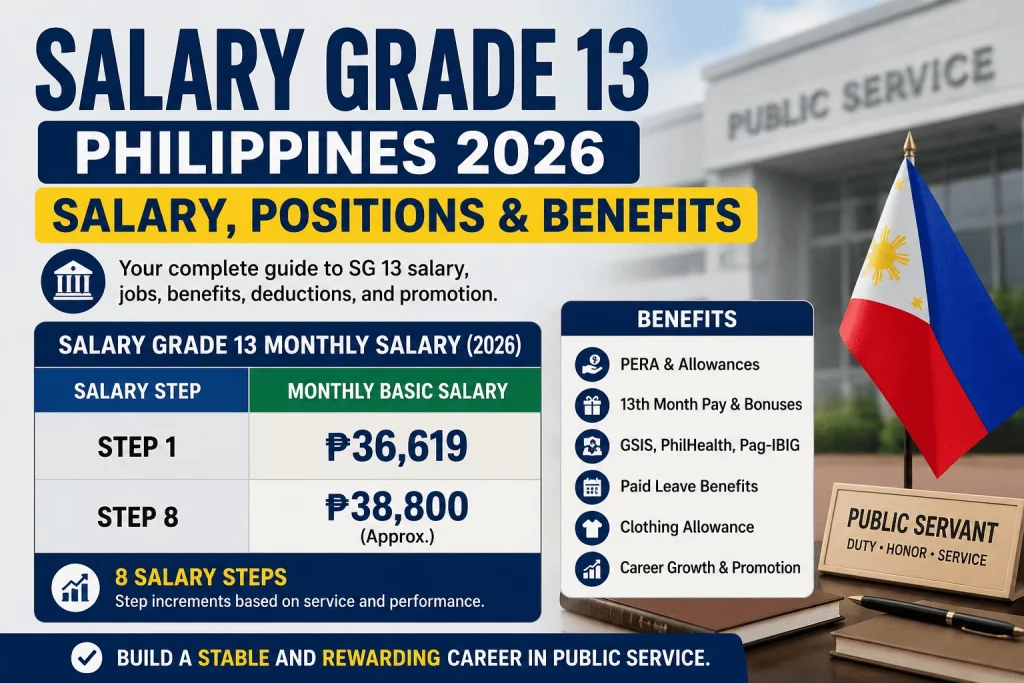
Salary Grade 13 (SG 13) represents an important milestone in the Philippine government’s career progression system. Many government employees are promoted to Salary Grade 13 after gaining experience in entry-level professional positions, making it one of the most sought-after compensation levels for teachers, administrative personnel, and other public sector professionals.
Beginning January 1, 2026, government employees covered by the Salary Standardization Law VI (SSL VI) receive updated compensation under the Third Tranche of the government’s salary adjustment program. The updated salary schedule was implemented through Executive Order No. 64 and the Department of Budget and Management (DBM) National Budget Circular No. 601, providing higher salaries for civilian government employees nationwide.
Beyond the monthly basic salary, Salary Grade 13 employees may also receive government benefits such as the Personnel Economic Relief Allowance (PERA), 13th Month Pay, Year-End Bonus, clothing allowance, leave credits, GSIS retirement benefits, PhilHealth coverage, and Pag-IBIG membership, depending on their employment status and eligibility.
Whether you’re applying for a government position, expecting a promotion, or comparing public-sector career opportunities, this guide explains everything you need to know about Salary Grade 13 Philippines 2026, including official salary rates, salary steps, government positions, qualifications, estimated take-home pay, benefits, and career advancement opportunities.
Quick Answer
Salary Grade 13 in the Philippines ranges from ₱36,125 (Step 1) to approximately ₱38,241 (Step 8) per month in 2026 under the Third Tranche of the Salary Standardization Law VI. Employees appointed to approved SG 13 plantilla positions may also receive government allowances, bonuses, retirement benefits, and other statutory incentives in addition to their monthly basic salary.
Key Point: Salary Grade 13 provides higher compensation, stronger promotion opportunities, and expanded professional responsibilities than lower salary grades.
Key Takeaways
- Salary Grade 13 pays approximately ₱36,125 to ₱38,241monthly in 2026, depending on the employee’s salary step.
- The updated salary schedule became effective on January 1, 2026 under the Third Tranche of SSL VI.
- Teacher III is one of the most common positions classified under Salary Grade 13.
- Salary Grade 13 employees receive government benefits beyond their monthly basic salary.
- Employees progress through eight salary steps before reaching the highest salary within the grade.
- Promotion to higher Salary Grades depends on qualification standards, vacancies, and agency selection procedures.
TL;DR
Salary Grade 13 is one of the most attractive mid-level government salary grades because it combines competitive compensation, comprehensive employee benefits, and structured career progression. In 2026, employees earn approximately ₱36,125 to ₱38,241 monthly before deductions, with additional allowances and bonuses significantly increasing their total annual compensation.
Quick Verdict
Salary Grade 13 offers an excellent balance of salary, career stability, and promotion opportunities. Compared with Salary Grades 11 and 12, SG 13 provides higher earnings, broader responsibilities, and stronger long-term career growth while maintaining the benefits and security associated with permanent government employment.
Rating
⭐⭐⭐⭐⭐ 4.9 / 5
Best For
- Teacher III and equivalent positions
- Mid-career government professionals
- Administrative personnel preparing for higher promotions
- Employees seeking long-term government careers
- Professionals prioritizing job security and retirement benefits
Not Ideal For
- Professionals seeking performance-based salary negotiations
- Individuals expecting rapid salary growth
- Contract of Service (COS) and Job Order (JO) workers who are not covered by the Salary Grade system
Bottom Line
Salary Grade 13 is an excellent professional compensation level that rewards experience, competence, and continued government service. For many employees, it serves as the gateway to supervisory and senior professional positions while providing competitive salaries and comprehensive government benefits.
Salary Grade 13 Salary Table (2026)
| Salary Step | Monthly Basic Salary |
|---|---|
| Step 1 | ₱36,125 |
| Step 2 | ₱36,283 |
| Step 3 | ₱36,599 |
| Step 4 | ₱36,919 |
| Step 5 | ₱37,244 |
| Step 6 | ₱37,572 |
| Step 7 | ₱37,904 |
| Step 8 | ₱38,241 |
Government employees under Salary Grade 13 receive monthly basic salaries ranging from ₱36,125 to ₱38,241 in 2026. Employees typically start at Step 1 and may advance through higher salary steps based on years of satisfactory service and performance
At a Glance
| Item | Details |
|---|---|
| Salary Grade | 13 |
| Monthly Basic Salary (2026) | Approximately ₱36,125–₱38,241 |
| Salary Steps | 8 |
| Effectivity | January 1, 2026 |
| Salary Adjustment | Third Tranche |
| Legal Basis | Executive Order No. 64 |
| Implementing Circular | DBM National Budget Circular No. 601 |
| Coverage | Civilian Government Employees |
| Governing Agency | Department of Budget and Management (DBM) |
| Promotion Eligible | Yes |
| Retirement Benefits | GSIS |
| Healthcare Coverage | PhilHealth |
| Housing Program | Pag-IBIG Fund |
Legal Basis
The 2026 Salary Grade 13 salary schedule is based on the implementation of the Third Tranche of the Salary Standardization Law VI (SSL VI).
The updated compensation rates are implemented through:
- Executive Order No. 64
- Department of Budget and Management (DBM) National Budget Circular No. 601
These issuances establish the official salary schedule for civilian government personnel covered by the Compensation and Position Classification System.
Key Point: Government agencies are required to implement the salary schedules issued by the DBM for employees covered by the Compensation and Position Classification System.
Salary Grade 13 at a Glance
| Category | Information |
|---|---|
| Career Level | Mid-Level Professional |
| Government Coverage | National Government Agencies, qualified LGUs, SUCs, selected GOCCs |
| Salary Progression | Step 1 to Step 8 |
| Promotion Opportunity | Salary Grade 14 and above |
| Employment Type | Usually Permanent Plantilla Positions |
| Salary Review | Based on DBM-approved salary schedules |
Salary Grade 13 positions generally involve independent professional work, greater technical expertise, and increased accountability. Employees at this level often perform analytical, supervisory support, administrative, educational, or specialized technical functions depending on the requirements of their agency.
Salary Grade Comparison Table
| Feature | Salary Grade 12 | Salary Grade 13 | Salary Grade 14 |
|---|---|---|---|
| Career Level | Professional | Mid-Level Professional | Senior Professional |
| Monthly Salary (2026) | Lower | ₱36,125–₱38,241* | Higher |
| Salary Steps | 8 | 8 | 8 |
| Government Benefits | Yes | Yes | Yes |
| Promotion Opportunity | Excellent | Excellent | Higher |
| Typical Responsibility | Professional Functions | Independent Professional Work | Senior Technical or Supervisory Functions |
*Approximate range based on the 2026 Third Tranche salary schedule. Employees should refer to the official DBM salary schedule or their agency’s HR office for the exact salary corresponding to their assigned salary step.
Moving from Salary Grade 12 to Salary Grade 13 represents a significant career milestone. Employees generally receive higher compensation, broader responsibilities, and improved promotion opportunities while remaining covered by the government’s comprehensive compensation and benefits system.
Key Point: Salary Grade 13 serves as an important bridge between professional government positions and higher-level technical or supervisory careers.
What Is Salary Grade 13?
Salary Grade 13 (SG 13) is an official compensation level under the Philippine government’s Compensation and Position Classification System (CPCS). It is assigned to government positions whose duties, responsibilities, qualification standards, and level of accountability have been evaluated and classified by the Department of Budget and Management (DBM). The 2026 salary rates are implemented under the Third Tranche of Executive Order No. 64 through DBM National Budget Circular No. 601.
Unlike private-sector salaries that may be negotiated, government salaries follow a standardized Salary Grade system. Every plantilla position is assigned a corresponding Salary Grade to ensure fair and consistent compensation across government agencies.
Salary Grade 13 is generally considered a mid-level professional salary grade. Employees occupying SG 13 positions often perform independent professional, technical, administrative, or supervisory-support functions requiring greater experience and accountability than lower salary grades.
It is also important to remember that Salary Grade 13 is assigned to the position—not to the employee. A person’s educational background or years of service alone do not determine the salary grade. Instead, the position itself is classified by the DBM.
Why Is Salary Grade 13 Important?
Salary Grade 13 is an important career milestone because it usually represents promotion from entry-level professional positions into more experienced government roles.
Employees at this level generally receive:
- Higher monthly compensation
- More complex job responsibilities
- Better promotion opportunities
- Greater retirement benefits due to higher salary
- Increased eligibility for supervisory positions
Many government professionals consider SG 13 an important stepping stone toward Salary Grades 14, 15, and higher.
Practical Example
A government employee promoted from Salary Grade 12 to a properly classified Salary Grade 13 plantilla position receives a higher monthly salary and assumes broader professional responsibilities based on the agency’s organizational structure.
Key Point: Salary Grade 13 is a DBM-approved position classification—not a job title or a salary that employees can negotiate.
Salary Grade 13 Monthly Salary Table (2026)
Salary Grade 13 employees receive updated compensation beginning January 1, 2026 under the Third Tranche of the Salary Standardization Law VI, implemented through Executive Order No. 64 and DBM National Budget Circular No. 601.
Official Salary Range
| Salary Step | Monthly Basic Salary |
|---|---|
| Step 1 | ₱36,125 |
| Step 8 | Approximately ₱38,241 |
Salary Grade 13 contains eight salary steps. Employees progress through these steps based on applicable government rules and satisfactory service.
Note: Refer to the official DBM Third Tranche Salary Schedule for the exact monthly salary corresponding to each salary step.
Annual Basic Salary
| Salary Step | Annual Basic Salary |
|---|---|
| Step 1 | ₱433,500 |
| Step 8 | Approximately ₱458,892 |
These amounts represent basic salary only. Government benefits, allowances, bonuses, and other authorized incentives are not yet included.
Salary Increase Under SSL VI
The government continues implementing salary adjustments under the four-year Salary Standardization Law VI program.
| Year | Status |
|---|---|
| 2024 | First Tranche |
| 2025 | Second Tranche |
| 2026 | Third Tranche |
| 2027 | Fourth and Final Tranche (scheduled) |
The Third Tranche aims to improve government compensation while maintaining a sustainable Compensation and Position Classification System.
Practical Example
An employee newly appointed to an approved Salary Grade 13 Step 1 position receives a monthly basic salary of ₱36,125 before mandatory deductions. Depending on eligibility, the employee may also receive PERA, bonuses, leave benefits, and other government-authorized incentives.
Key Point: The published Salary Grade 13 salary is the basic monthly salary. Total compensation is usually higher after including government allowances and benefits.
Salary Grade 13 Step 1–8 Explained
Every Salary Grade in the Philippine government consists of eight salary steps. These salary steps recognize continuous government service and allow employees to receive higher salaries even while remaining in the same position.
Employees do not need an immediate promotion to receive higher compensation. Instead, they may become eligible for salary step increments after meeting the applicable service and performance requirements.
How Salary Steps Work
Most employees begin at Step 1 upon appointment unless government rules permit appointment at a higher salary step based on previous qualifying government service.
As employees continue rendering satisfactory service, they may move to higher salary steps within Salary Grade 13.
| Salary Step | Typical Employee Status |
|---|---|
| Step 1 | Newly appointed employee |
| Step 2 | Eligible after required satisfactory service |
| Step 3 | Continued service |
| Step 4 | Mid-level salary progression |
| Step 5 | Higher compensation within SG 13 |
| Step 6 | Senior salary progression |
| Step 7 | Advanced salary progression |
| Step 8 | Highest salary step under SG 13 |
Although employees remain under Salary Grade 13, each higher step provides additional monthly compensation.
Step Increment vs Promotion
Salary step progression is often confused with promotion, but they are different.
| Step Increment | Promotion |
|---|---|
| Same Salary Grade | Higher Salary Grade |
| Same Position | Usually Different Position |
| Higher Monthly Salary | Higher Salary and Greater Responsibilities |
| Based on service and performance rules | Requires appointment to another plantilla position |
Receiving a salary step increment does not change an employee’s Salary Grade. Promotion involves appointment to a higher-classified government position.
Practical Example
Suppose an employee is appointed to a Salary Grade 13 Step 1 position.
After meeting the required service and performance standards, the employee may become eligible for higher salary steps while remaining in the same position. Later, the employee may compete for promotion to a Salary Grade 14 or higher position if a qualified vacancy becomes available.
Why Salary Steps Matter
Salary step progression provides long-term financial growth through:
- Higher monthly salary
- Increased annual earnings
- Improved retirement computation
- Better lifetime government compensation
Employees who remain in government service for many years benefit from both salary step progression and future promotional opportunities.
Key Point: Salary steps reward continuous government service, while promotions recognize appointment to positions with higher levels of responsibility and compensation.
Government Positions Under Salary Grade 13
Salary Grade 13 is assigned to various mid-level professional positions in the Philippine government under the Department of Budget and Management (DBM) Compensation and Position Classification System. The exact Salary Grade of a position depends on the agency’s approved plantilla, qualification standards, and DBM-approved position classification.
While several positions are commonly associated with Salary Grade 13, applicants should always verify the Salary Grade stated in the official vacancy announcement or appointment papers because classifications may differ among agencies.
Common Government Positions Under Salary Grade 13
The following are examples of positions that are commonly classified as Salary Grade 13 in many government agencies.
| Position | Typical Agency or Sector |
|---|---|
| Teacher III | Department of Education (DepEd) |
| Administrative Officer I | National Government Agencies |
| Administrative Assistant V | Various Government Offices |
| Librarian I | National Government Agencies and SUCs |
| Agriculturist I | Department of Agriculture and related agencies |
| Planning Officer (selected agencies) | National Government Agencies |
| Technical Staff | Government Offices |
| Professional Staff | Various Agencies |
Certain engineering, accounting, finance, social welfare, health, and technical positions may also be assigned Salary Grade 13 depending on the agency’s approved plantilla and DBM classification.
Government Agencies That May Have SG 13 Positions
Salary Grade 13 positions are commonly found in:
- Department of Education (DepEd)
- Department of Agriculture (DA)
- Department of Health (DOH)
- Department of Social Welfare and Development (DSWD)
- Bureau of Internal Revenue (BIR)
- Bureau of Customs (BOC)
- Civil Service Commission (CSC)
- Commission on Audit (COA)
- State Universities and Colleges (SUCs)
- Local Government Units (LGUs)
Each agency maintains its own staffing pattern and qualification standards while following DBM-approved position classifications.
Practical Example
A Teacher III in DepEd and an Administrative Officer I in another national government agency may both occupy Salary Grade 13 positions. Although they receive similar basic salaries under the official salary schedule, their responsibilities, career paths, and promotion opportunities differ.
Key Point: Salary Grade 13 identifies the compensation level of a government position—not a specific profession.
Salary Grade 13 Qualification Requirements
Qualification standards vary depending on the position being filled. There is no single set of requirements that applies to every Salary Grade 13 position.
Government agencies follow qualification standards approved by the Civil Service Commission (CSC), while the DBM determines the salary grade classification of the position.
Typical qualification requirements include:
- Bachelor’s Degree relevant to the position
- Appropriate Civil Service Eligibility or equivalent eligibility
- Professional license when required by law
- Required work experience for promotional positions
- Position-specific training
Certain technical and supervisory positions may also require graduate education, specialized certifications, or additional competency requirements.
Typical Qualification Standards
| Qualification | Typical Requirement |
|---|---|
| Education | Bachelor’s Degree |
| Eligibility | Career Service Professional or equivalent |
| Experience | Depends on the position |
| Training | Position-specific |
| License | When required by law |
Applicants should always review the official qualification standards indicated in the vacancy announcement before submitting an application.
Key Point: Meeting the minimum qualification standards allows you to apply, but appointment still depends on the agency’s merit selection process.
Who Qualifies for Salary Grade 13?
Salary Grade 13 is generally awarded to employees appointed to approved SG 13 plantilla positions after meeting all qualification requirements.
Individuals who commonly qualify include:
- Government employees promoted from lower Salary Grades
- Teacher II employees promoted to Teacher III
- Licensed professionals
- Career Service Professional Eligibility holders
- Qualified applicants who satisfy agency qualification standards
Government agencies evaluate applicants based on:
- Education
- Experience
- Eligibility
- Training
- Competencies
- Performance
- Interview results
Practical Example
An experienced government employee promoted from Salary Grade 12 to an Administrative Officer I position classified as Salary Grade 13 receives higher compensation together with increased responsibilities.
Key Point: Salary Grade 13 is obtained through appointment to a properly classified government position—not simply through years of service.
Government Benefits and Allowances
Salary Grade 13 employees receive several government benefits in addition to their monthly basic salary.
These benefits significantly increase the employee’s overall compensation package.
Common Benefits
| Benefit | Description |
|---|---|
| PERA | Personnel Economic Relief Allowance |
| 13th Month Pay | One month basic salary |
| Year-End Bonus | Government bonus |
| Clothing Allowance | Annual benefit |
| Cash Gift | Qualified employees |
| GSIS Benefits | Retirement, insurance, loans |
| PhilHealth Coverage | National health insurance |
| Pag-IBIG Benefits | Housing and savings programs |
| Vacation Leave | Paid leave credits |
| Sick Leave | Paid leave credits |
Additional incentives may be granted depending on existing laws, DBM issuances, and agency policies.
Practical Example
Besides receiving monthly salary, a permanent Salary Grade 13 employee may receive PERA, annual bonuses, GSIS retirement benefits, paid leave, clothing allowance, and other government-authorized incentives.
Key Point: Government benefits substantially increase the total value of Salary Grade 13 compensation.
Salary Deductions
The published Salary Grade 13 salary represents the employee’s basic monthly salary.
Before payroll is released, mandatory deductions are applied.
Common Payroll Deductions
| Deduction | Purpose |
|---|---|
| GSIS Premium | Retirement and insurance |
| PhilHealth Contribution | Health insurance |
| Pag-IBIG Contribution | Housing fund |
| Withholding Tax | Income tax when applicable |
Additional payroll deductions may include:
- GSIS Salary Loan
- GSIS Emergency Loan
- Pag-IBIG Multi-Purpose Loan
- Housing Loan
- Cooperative Contributions
- Other agency-authorized deductions
The total deductions vary from one employee to another.
Key Point: Two Salary Grade 13 employees may receive different take-home pay depending on their payroll deductions.
Estimated Take-Home Pay
Although Salary Grade 13 Step 1 has a monthly basic salary of ₱36,125, the employee’s actual take-home pay is lower because of mandatory deductions.
For employees without significant loan obligations, estimated take-home pay often falls within the low to mid-₱30,000 range, although actual payroll amounts differ depending on salary step and deductions.
Sample Illustration
| Payroll Item | Illustration |
|---|---|
| Basic Salary | ₱36,125 |
| PERA | +₱2,000 |
| Gross Compensation | Higher than Basic Salary |
| Less Mandatory Deductions | GSIS, PhilHealth, Pag-IBIG, Tax |
| Estimated Net Pay | Varies per employee |
This example is provided for illustration only and should not be considered an official payroll computation.
Factors Affecting Take-Home Pay
- Salary Step
- GSIS Contributions
- PhilHealth Contributions
- Pag-IBIG Contributions
- Income Tax
- Government Loans
- Cooperative Deductions
- Other payroll deductions
Practical Example
An employee with no outstanding GSIS or Pag-IBIG loans typically receives a higher monthly take-home pay than another Salary Grade 13 employee with multiple payroll deductions.
Key Point: Always estimate take-home pay using your own deductions instead of relying solely on the published salary.
Salary Grade 13 vs Salary Grade 12
Salary Grade 13 provides higher compensation and greater responsibilities than Salary Grade 12.
| Feature | Salary Grade 12 | Salary Grade 13 |
|---|---|---|
| Career Level | Professional | Mid-Level Professional |
| Monthly Salary | Lower | Higher |
| Promotion Opportunity | Excellent | Better |
| Responsibility | Professional Functions | Independent Professional Work |
| Long-Term Growth | Strong | Stronger |
Promotion from SG 12 to SG 13 generally represents one of the most important professional advancements for government employees.
Key Point: Salary Grade 13 offers higher compensation together with increased responsibility and stronger promotion potential.
Salary Grade 13 vs Salary Grade 14
Salary Grade 14 is the next career level after SG 13 and generally carries greater technical expertise, broader responsibilities, or supervisory duties.
| Feature | Salary Grade 13 | Salary Grade 14 |
|---|---|---|
| Monthly Salary | High | Higher |
| Responsibility | Mid-Level Professional | Senior Professional |
| Promotion Opportunity | Excellent | Higher |
| Leadership | Moderate | Greater |
Promotion depends on qualification standards, agency requirements, available plantilla positions, and successful completion of the merit selection process.
Key Point: Salary Grade 14 is the next logical promotion target for many SG 13 employees.
Salary Progression and Promotion
Government employees increase their earnings through salary step progression and promotion.
These are different mechanisms.
Salary progression includes:
- Step Increments
- Promotion to Higher Salary Grades
- Appointment to Higher Positions
- Professional Development
Typical Career Path
| Career Stage | Example |
|---|---|
| Professional | Salary Grade 11–12 |
| Mid-Level Professional | Salary Grade 13 |
| Senior Professional | Salary Grade 14–18 |
| Supervisory | Salary Grade 19+ |
| Executive | Salary Grade 24+ |
Promotion generally considers:
- Education
- Experience
- Performance
- Training
- Eligibility
- Available Vacancies
Employees who continue improving their qualifications often become more competitive for higher Salary Grade appointments.
Key Point: Long-term career advancement depends on continuous learning, excellent performance, and available promotion opportunities.
Career Opportunities
Salary Grade 13 opens opportunities across many sectors of government.
Common career fields include:
- Education
- Public Administration
- Agriculture
- Finance
- Accounting
- Planning
- Human Resources
- Regulatory Agencies
- Local Government
- National Government Agencies
Many senior government officials began their careers in mid-level professional positions before advancing to supervisory and executive roles.
Key Point: Salary Grade 13 provides a strong foundation for long-term advancement in Philippine government service.
Where to Find Salary Grade 13 Government Jobs
Salary Grade 13 vacancies are regularly posted through official government recruitment channels.
Reliable sources include:
- Civil Service Commission Job Portal
- Department of Education
- Commission on Audit
- Bureau of Internal Revenue
- Department of Agriculture
- Department of Health
- Local Government Unit websites
- State Universities and Colleges
- Official agency websites
Before applying, verify:
- Salary Grade
- Qualification Standards
- Documentary Requirements
- Application Deadline
- Employment Status
Key Point: Always apply through official government recruitment channels to ensure the vacancy information is legitimate.
Decision Tree: Should You Accept a Salary Grade 13 Position?
| Situation | Recommendation |
|---|---|
| Seeking long-term government employment | ✅ Highly Recommended |
| Promotion from SG 12 | ✅ Excellent Career Move |
| Wants retirement and government benefits | ✅ Recommended |
| Prefers predictable salary progression | ✅ Strong Choice |
| Already earning substantially more in private industry | ⚠ Compare the total compensation package |
| Wants rapid salary growth | ⚠ Evaluate private-sector opportunities |
Decision Guide
If your priorities include:
- Career stability
- Government retirement benefits
- Structured salary progression
- Professional development
- Long-term public service
then Salary Grade 13 is an excellent compensation level to pursue.
Key Point: Salary Grade 13 offers an outstanding balance of salary, benefits, career growth, and long-term employment security for qualified government professionals.
Pros and Cons of Salary Grade 13
Salary Grade 13 offers a competitive government compensation package that combines higher monthly salaries, comprehensive employee benefits, and structured career advancement. However, like any career path, it also has limitations that applicants should consider before accepting an appointment.
Pros and Cons Comparison
| Pros | Cons |
|---|---|
| Higher salary than SG 12 | Promotion depends on available plantilla positions |
| Comprehensive government benefits | Salary is standardized and generally non-negotiable |
| Stable permanent employment | Promotion process may take time |
| GSIS retirement and insurance | Some agencies have heavier workloads |
| Paid vacation and sick leave | Private companies may offer higher starting salaries |
| Annual bonuses and allowances | Salary adjustments depend on government policies |
| Clear career progression | Transfers may be required for promotion |
Advantages
Salary Grade 13 represents an important professional milestone. Employees receive higher compensation while enjoying government security, retirement benefits, healthcare coverage, paid leave, and annual bonuses.
Many employees also become more competitive for supervisory and higher professional positions after gaining experience at this salary grade.
Limitations
Unlike private companies, government salaries follow standardized compensation rules. Promotions depend on qualification standards, agency requirements, available vacancies, and the merit selection process rather than salary negotiations.
Key Point: Salary Grade 13 is ideal for professionals seeking long-term career stability, structured salary progression, and comprehensive government benefits.
Real-World Salary Examples
Understanding Salary Grade 13 becomes easier through practical situations.
Example 1: Teacher III Promotion
A public school teacher promoted from Teacher II to Teacher III receives the corresponding Salary Grade 13 basic salary together with government benefits, higher responsibilities, and improved opportunities for future promotion.
Example 2: Administrative Officer I
An employee appointed as Administrative Officer I in a national government agency receives the official Salary Grade 13 basic salary plus PERA, annual bonuses, GSIS coverage, leave benefits, and other government-authorized incentives.
Example 3: Different Take-Home Pay
Two employees occupying Salary Grade 13 positions may receive different monthly payroll amounts.
One employee without outstanding government loans generally takes home more than another employee with GSIS, Pag-IBIG, or cooperative deductions.
Key Point: Basic salary is standardized, but actual take-home pay varies depending on payroll deductions.
Common Mistakes
Many applicants misunderstand how Salary Grade 13 works.
Avoid these common mistakes:
- Assuming the published salary equals take-home pay.
- Believing Salary Grade refers to a specific profession.
- Thinking salary increases are automatic every year.
- Ignoring qualification standards before applying.
- Assuming all agencies classify positions exactly the same.
- Forgetting to account for mandatory deductions.
- Confusing salary step progression with promotion.
- Expecting Job Order and Contract of Service workers to receive Salary Grade benefits.
Key Point: Understanding how Salary Grade, salary steps, and government appointments work helps avoid unrealistic salary expectations.
Best Practices
Following these best practices can help maximize your government career.
Recommended Practices
- Monitor internal promotion opportunities.
- Complete required government training.
- Maintain excellent performance ratings.
- Keep your Personal Data Sheet (PDS) updated.
- Pursue graduate education when applicable.
- Review DBM salary schedule updates annually.
- Maintain complete employment records.
- Continue developing technical and leadership skills.
Employees who actively prepare for promotion generally become more competitive for higher Salary Grade appointments.
Key Point: Career advancement depends on continuous professional development and consistent job performance.
Beginner Tips
If you’re applying for your first Salary Grade 13 position, these tips can help.
Helpful Advice
- Read the vacancy announcement carefully.
- Verify the Salary Grade stated in the posting.
- Confirm the qualification standards.
- Prepare all documentary requirements.
- Understand how salary steps work.
- Learn the government benefits available.
- Ask your HR office about payroll deductions.
Proper preparation improves both your application and long-term career planning.
Key Point: Understanding the government recruitment process helps applicants make better career decisions.
Expert Tips
Experienced government professionals often recommend planning beyond the current salary grade.
Professional Advice
- Complete graduate studies relevant to your field.
- Join CSC-accredited learning and development programs.
- Develop supervisory and leadership skills.
- Volunteer for special assignments.
- Build expertise in your technical field.
- Maintain excellent performance evaluations.
- Monitor internal promotion announcements regularly.
Employees who consistently improve their qualifications are generally more competitive for Salary Grade 14 and higher positions.
Key Point: Continuous learning and leadership development are among the best investments for long-term government careers.
Decision Guide
Whether Salary Grade 13 is the right career move depends on your personal goals and priorities.
Should You Accept a Salary Grade 13 Position?
| Situation | Recommendation |
|---|---|
| Government employee seeking promotion | ✅ Highly Recommended |
| Teacher II promoted to Teacher III | ✅ Excellent Career Move |
| Licensed professional entering government service | ✅ Recommended |
| Wants retirement and long-term benefits | ✅ Strong Choice |
| Already earning significantly more in private industry | ⚠ Compare total compensation |
| Prioritizes rapid salary growth | ⚠ Consider private-sector opportunities |
Decision Tree
Do you want long-term government employment?
⬇ Yes
Do you value retirement benefits and job security?
⬇ Yes
Do you prefer structured salary progression?
⬇ Yes
Salary Grade 13 is an excellent career choice.
Key Point: Salary Grade 13 is best suited for professionals who value career stability, government benefits, and long-term advancement.
People Also Ask
How much is Salary Grade 13 in the Philippines in 2026?
Salary Grade 13 pays approximately ₱36,125 to ₱38,241 per month in 2026, depending on the employee’s assigned salary step.
What positions are under Salary Grade 13?
Teacher III is one of the most common Salary Grade 13 positions. Other professional positions may also be classified as SG 13 depending on the agency’s approved plantilla and DBM position classification.
Is Teacher III Salary Grade 13?
Yes. Teacher III is commonly classified under Salary Grade 13 in the Department of Education.
Do Salary Grade 13 employees receive government benefits?
Yes. Qualified employees may receive PERA, GSIS benefits, PhilHealth coverage, Pag-IBIG benefits, paid leave, annual bonuses, clothing allowance, and other authorized incentives.
Can Salary Grade 13 employees be promoted?
Yes. Employees may receive salary step increments and eventually qualify for promotion to Salary Grade 14 or higher after satisfying qualification standards and agency requirements.
Does Salary Grade 13 apply to LGU employees?
Yes. Local Government Units may have Salary Grade 13 positions, although implementation follows applicable laws, DBM guidelines, local ordinances, and budget availability.
Key Point: These questions address the most common concerns of applicants and improve the article’s visibility in AI-powered search platforms.
Frequently Asked Questions
1. What is the starting salary of Salary Grade 13?
The official Step 1 monthly basic salary is approximately ₱36,125 beginning January 1, 2026.
2. How many salary steps does Salary Grade 13 have?
Salary Grade 13 contains eight salary steps, allowing employees to increase their salary while remaining in the same position.
3. Is PERA included in the basic salary?
No. PERA is a separate allowance granted to qualified government employees and is not included in the published basic salary.
4. Is Salary Grade 13 automatically a permanent position?
No. Salary Grade refers only to the compensation classification. Employment status depends on the appointment issued by the agency.
5. Can newly hired employees receive Salary Grade 13?
Yes, provided they are appointed to an officially classified Salary Grade 13 position and meet the required qualification standards.
6. Is the published salary already the take-home pay?
No. Mandatory deductions such as GSIS, PhilHealth, Pag-IBIG, withholding tax, and other authorized deductions reduce the actual payroll amount.
7. Who determines Salary Grades in the Philippine government?
The Department of Budget and Management (DBM) administers the Compensation and Position Classification System and issues the official salary schedules for covered civilian government employees.
Final Verdict
Salary Grade 13 is one of the strongest mid-level professional salary grades in Philippine government service. It provides competitive compensation, structured salary progression, comprehensive government benefits, and excellent opportunities for long-term career advancement.
Although promotions depend on qualification standards and available plantilla positions, employees who consistently improve their education, experience, and performance are well-positioned to advance to higher Salary Grades in the future.
For professionals seeking stable employment, retirement security, predictable salary progression, and meaningful public service careers, Salary Grade 13 remains an excellent compensation level in 2026.
Key Point: Salary Grade 13 combines competitive government pay, comprehensive benefits, and long-term career opportunities, making it an attractive choice for qualified public servants.
Who Should Apply?
Salary Grade 13 is ideal for:
- Teacher III applicants
- Government employees seeking promotion
- Administrative professionals
- Licensed professionals
- Career Service Eligibility holders
- Individuals pursuing permanent government employment
- Mid-career public sector professionals
- Employees planning long-term government careers
Who Should Avoid?
Salary Grade 13 may not be suitable for:
- Professionals seeking rapid private-sector salary growth
- Individuals who prefer flexible salary negotiations
- Applicants unwilling to work within government promotion systems
- Those prioritizing short-term earnings over long-term benefits
Overall Recommendation
Salary Grade 13 offers one of the best combinations of salary, benefits, stability, and career progression available in Philippine government service. Under the 2026 Third Tranche of the Salary Standardization Law VI, it continues to provide meaningful compensation improvements while preserving the structured advancement system that rewards experience, competence, and public service.
For qualified professionals planning a long-term government career, Salary Grade 13 is an excellent choice that balances financial security with opportunities for continued professional growth.
Related Topics
To learn more about navigating your career in the Philippine government, explore our deep-dive guides:
- Government Salary Grade 2026: Complete Guide to the Philippine Salary Schedule
- How Government Salary Grades and Steps Work in the Philippines
- Salary Grade 19 Philippines 2026: How Much Do SG 19 Employees Earn?
- Government Jobs in the Philippines 2026: Complete Job Search Guide
- How to Apply for Government Jobs in the Philippines: Step-by-Step Guide
- RA 1080 Meaning: Complete Guide to Eligibility
- Salary Grade 24 Philippines 2026: Salary & Benefits
- Salary Grade 11 Philippines 2026: Complete Guide
- Salary Grade 12 Philippines 2026: Salary, Positions & Benefits
References
- Department of Budget and Management (DBM) — National Budget Circular No. 601 (Implementation of the Third Tranche of the Updated Salary Schedule, effective January 1, 2026).
- Executive Order No. 64 — Updating the Salary Schedule for Civilian Government Personnel (Official Gazette).
- Department of Budget and Management (DBM) — National Budget Circulars page (Compensation and Position Classification System issuances).
- Civil Service Commission (CSC) — Official Website (Qualification Standards and Civil Service rules).
- Official Gazette of the Republic of the Philippines — Official publication of Executive Orders, laws, and related issuances.
- Government Service Insurance System (GSIS) — Official information on membership, benefits, and loan programs.
- PhilHealth — National Health Insurance Program guidelines and benefit packages.
- Home Development Mutual Fund (Pag-IBIG Fund) — Membership, savings, and loan program information.
Disclaimer
This guide is intended for informational purposes only and is based on official government issuances available at the time of writing. While every effort has been made to ensure accuracy, salary schedules, qualification standards, benefits, and implementing rules may change through subsequent laws, executive orders, DBM circulars, CSC issuances, or other government regulations.