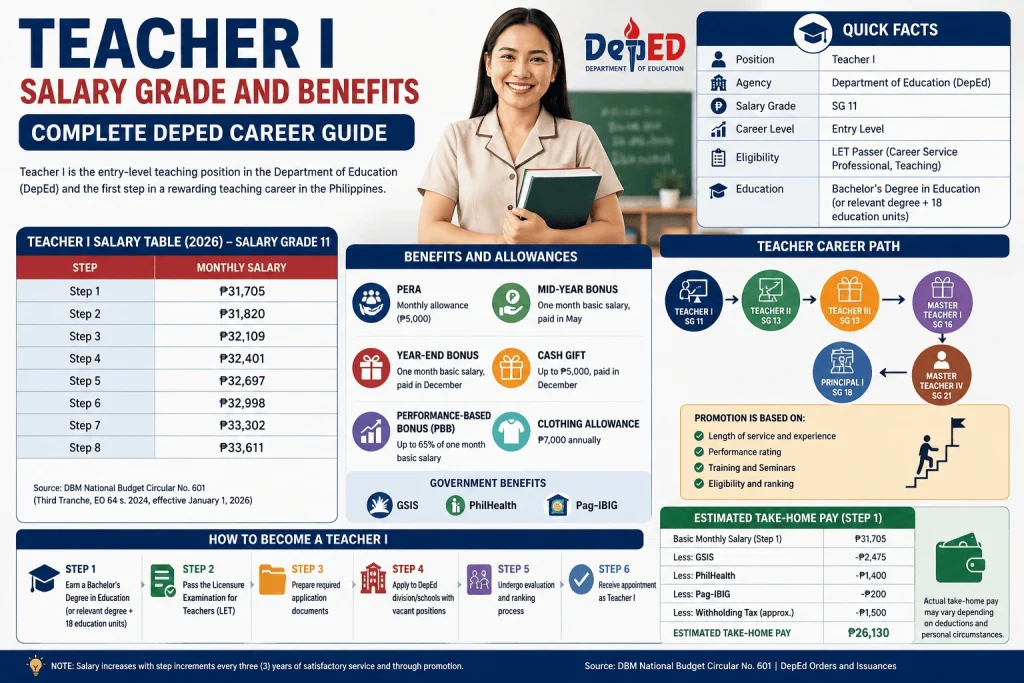
Teacher I is where almost every public school teaching career in the Philippines begins. It’s the entry-level plantilla position most Licensure Examination for Teachers (LET) passers are hired into, and it’s the single most-searched teaching position in the country — new graduates want to know what it pays, what it takes to qualify, and how quickly they can move up from there.
With DepEd employing close to a million personnel nationwide and Teacher I accounting for the largest single share of that workforce, this isn’t a niche question. Every year, tens of thousands of new education graduates and career-shifters research this exact position before deciding whether to sit the LET, which division to apply to, and whether public school teaching is the right long-term move compared to private school teaching or a non-teaching career.
This guide covers all of it: the current Teacher I salary under Salary Grade 11, the full Step 1–8 pay table, qualifications and application requirements, day-to-day duties, benefits and allowances, and the realistic career path from Teacher I onward. If you’re deciding whether to apply, preparing your application, or already a Teacher I planning your next move, everything you need is below.
What Is a Teacher I?
Teacher I is the entry-level teaching position within the Department of Education (DepEd), assigned to public elementary and secondary schools nationwide. It’s classified under Salary Grade 11 in the government’s compensation structure and is typically the first plantilla item a newly licensed teacher is appointed to.
Because it sits at the base of DepEd’s classroom career ladder, Teacher I carries the broadest hiring volume of any teaching rank — it’s the position DepEd fills first when a school has a vacancy, and the one nearly every classroom teacher holds at some point in their career.
It’s worth being precise about what “entry-level” means here, because it’s a common source of confusion for first-time applicants. Teacher I is entry-level in the sense that it requires no prior teaching experience and is the first rank in the plantilla structure — it is not a temporary, contractual, or “probationary-only” role in the way the term is sometimes used in the private sector. A Teacher I appointment is a genuine government position with a real Salary Grade, real statutory benefits from day one, and a defined path to permanent civil-service status once the standard requirements are satisfied. Understanding this distinction matters when comparing a Teacher I offer against a private school position that might carry a similar or even higher starting salary but without the same structural guarantees — a comparison covered in full in Section 9.
Quick Facts Table
| Item | Details |
|---|---|
| Position | Teacher I |
| Agency | Department of Education (DepEd) |
| Salary Grade | SG 11 |
| Career Level | Entry Level |
| Eligibility | LET Passer (Career Service Professional, Teaching) |
| Education | Bachelor’s Degree in Education (or relevant degree + 18 education units) |
Teacher I Salary Grade (2026)
A Teacher I earns ₱31,705 per month at Step 1 in 2026, rising to ₱33,611 at Step 8, under Salary Grade 11.
Teacher I’s pay is classified under Salary Grade 11 in the national Salary Standardization Law schedule — the same law that governs pay for every civilian government position, not just teaching. As of January 1, 2026, DepEd is implementing the third tranche of Executive Order No. 64, s. 2024, per DBM National Budget Circular No. 601, which set the current SG 11 rates below.
Teacher I Salary Table (2026)
| Step | Monthly Salary |
|---|---|
| Step 1 | ₱31,705 |
| Step 2 | ₱31,820 |
| Step 3 | ₱32,109 |
| Step 4 | ₱32,401 |
| Step 5 | ₱32,697 |
| Step 6 | ₱32,998 |
| Step 7 | ₱33,302 |
| Step 8 | ₱33,611 |
Source: Salary Schedule for Civilian Government Personnel, Third Tranche implementation of EO 64, s. 2024, effective January 1, 2026 (DBM National Budget Circular No. 601). Figures are basic pay only, before PERA, the Teaching Allowance, and bonuses — see Section 6.
At Step 1, a Teacher I’s annual basic pay works out to roughly ₱380,460 before deductions and before allowances or bonuses are added. A fourth and final EO 64 tranche takes effect January 1, 2027, which is expected to raise Teacher I’s Step 1 rate to roughly ₱33,387 — worth checking before finalizing a resignation date, transfer, or retirement timeline around that period.
To put SG 11 in context: it sits well above the lowest government pay grades (SG 1 starts at roughly ₱14,634) but noticeably below other professional-track government roles that require a licensure exam and years of graduate study to reach comparable pay — a reflection of Teacher I being designed as a genuine entry point rather than a senior professional post. The gap between Teacher I and the next rank, Teacher II, is also smaller in percentage terms than the gap teachers see later when moving into the Master Teacher track (covered in Section 8) — which is one reason DepEd’s career-progression reforms increasingly emphasize helping teachers move past the first few ranks efficiently rather than staying at Teacher I for years on end.
How Salary Steps Work
It’s easy to confuse Salary Grade with Salary Step — they’re two different things, and understanding the difference matters for realistic career and income planning.
Salary Grade is the classification of the position itself. Teacher I is fixed at SG 11 regardless of how long someone holds the job — the only way to move to a different Salary Grade is through promotion to a different position (Teacher II, Teacher III, and so on).
Salary Step is a tenure-based increment within the same Salary Grade. A Teacher I starts at Step 1 on their first day and moves one step higher roughly every three years of satisfactory service, without changing job titles. As the table in Section 2 shows, moving from Step 1 to Step 8 as a Teacher I raises monthly basic pay from ₱31,705 to ₱33,611 — a modest but automatic increase tied purely to time in service and satisfactory performance.
Performance considerations still apply to step movement: DepEd requires at least a “Satisfactory” IPCRF (Individual Performance Commitment and Review Form) rating to progress through the steps, and a stronger rating record becomes essential once a teacher is ready to apply for actual promotion rather than just a step increase.
Promotion opportunities, by contrast, move a teacher to a different, higher Salary Grade — the much bigger financial jump discussed throughout this guide. Step increments and promotions often get mentally lumped together because both show up as a higher number on the payslip, but only promotion changes the Salary Grade itself.
Atlas Teacher I Salary Growth Framework™
Teacher I
   ↓
Annual Step Increments
   ↓
Teacher II Promotion
   ↓
Teacher III Promotion
   ↓
Master Teacher Path
Teacher I Qualifications
To be appointed as a Teacher I, a candidate needs to satisfy DepEd’s standard entry-level requirements across four areas:
Educational Requirement. A Bachelor’s degree in Elementary Education or Secondary Education. Non-education graduates can also qualify if their degree is relevant to a teaching area and they’ve completed 18 professional education units.
Eligibility Requirement. Passing the Licensure Examination for Teachers (LET), administered by the Professional Regulation Commission (PRC). Passing the LET also satisfies the Career Service Professional eligibility requirement for teaching positions, so LET passers don’t need a separate Civil Service exam.
Training Requirement. While Teacher I is an entry-level post and doesn’t require prior in-service training, DepEd increasingly looks for evidence of relevant seminars, student-teaching evaluations, or demo-teaching performance during the hiring and ranking process, especially in competitive divisions.
Experience Requirement. None formally required — Teacher I is designed as the entry point for fresh graduates and first-time hires. Prior tutoring, private-school teaching, or substitute teaching experience can strengthen an application but isn’t mandatory.
A frequent point of confusion is whether a non-education degree automatically disqualifies an applicant. It doesn’t. DepEd allows graduates of relevant degree programs — for example, a BS in a specific subject like Mathematics, English, or Biology — to qualify for Secondary Teacher I positions in that subject area, provided they complete 18 professional education units through a Certificate in Teaching (CT) program or equivalent coursework, and still pass the LET in the relevant specialization. This pathway is common among career-shifters and is one reason the applicant pool for Teacher I positions in specialized subjects (Math, Science, English) tends to be broader than for general Elementary Education posts.
Qualification Checklist
- [ ] Bachelor’s Degree in Education (or relevant degree + 18 education units)
- [ ] LET Passer with a valid PRC license
- [ ] Complete application documents (PDS, transcript of records, LET rating, NBI clearance, and other DepEd-required attachments)
- [ ] Good moral character certification
Teacher I Duties and Responsibilities
A Teacher I’s day-to-day work centers on the classroom, but the role carries administrative and community-facing responsibilities as well — a workload that first-year teachers often underestimate when comparing the job purely on salary.
Classroom instruction. Delivering daily lessons aligned to the K to 12 curriculum for an assigned grade level or subject area, typically across five to six teaching periods a day depending on the school’s scheduling and staffing.
Lesson planning. Preparing Daily Lesson Logs (DLLs) or Daily Lesson Plans (DLPs) in advance, mapped to the Most Essential Learning Competencies (MELCs) for the subject — work that happens largely outside paid classroom hours, in the evenings or on weekends.
Student assessment. Creating, administering, and checking quizzes, exams, and performance tasks, then computing and recording grades each quarter through DepEd’s grading and reporting systems.
Classroom management. Maintaining discipline, attendance, and a productive learning environment across a full teaching load, often for class sizes well above international averages in public schools.
Parent communication. Conducting parent-teacher conferences, addressing concerns about a student’s academic or behavioral progress, and issuing report cards each quarter.
School activities. Participating in school programs, co-curricular activities, DepEd-mandated events (Brigada Eskwela, feeding programs, disaster-preparedness drills), and — very commonly — ancillary functions outside direct teaching, such as being a class adviser or handling a specific committee assignment (Sports Coordinator, SPG Adviser, Property Custodian, and similar roles that get distributed among teaching staff each school year).
Taken together, these responsibilities are why many Teacher I job descriptions understate the real time commitment: the posted teaching load covers only the classroom-facing hours, while lesson preparation, grading, reporting, and ancillary duties routinely extend a Teacher I’s actual working hours well beyond what’s reflected in the salary table in Section 2.
Teacher I Responsibility Framework™
| Area | Responsibility |
|---|---|
| Teaching | Deliver lessons aligned to the K to 12 curriculum |
| Assessment | Evaluate students and record quarterly grades |
| Administration | Prepare lesson logs and submit required reports |
| Community | Engage parents and participate in school and community activities |
Teacher I Benefits and Allowances
Beyond the Salary Grade 11 basic pay in Section 2, a Teacher I receives the standard package of mandatory government benefits and teacher-specific allowances.
Mandatory government benefits:
- GSIS (Government Service Insurance System) — retirement, disability, and life insurance
- PhilHealth — national health insurance coverage
- Pag-IBIG — housing loan and provident savings fund
DepEd-specific benefits:
- PERA (Personnel Economic Relief Allowance) — a flat ₱2,000 per month on top of basic pay
- Teaching Allowance — under Republic Act No. 11997 (Kabalikat sa Pagtuturo Act), currently ₱10,000 per school year as of SY 2025–2026, intended for classroom supplies and instructional materials
- Clothing/Uniform Allowance — an annual allowance for work attire
- Mid-Year Bonus — one month’s basic salary, released around May
- Year-End Bonus — one month’s basic salary, released in November
- Cash Gift — an additional annual incentive released alongside the year-end bonus
- Performance-Based Bonus (PBB) — a variable, performance-tied bonus, not guaranteed every year
Benefits Summary Table
| Benefit | Description |
|---|---|
| PERA | Monthly allowance, ₱2,000 |
| Teaching Allowance | Per-school-year allowance under RA 11997 |
| Mid-Year Bonus | Annual benefit, one month’s basic pay |
| Year-End Bonus | Annual benefit, one month’s basic pay |
| Cash Gift | Annual incentive |
| PBB | Performance-based, variable |
Adding PERA and the Teaching Allowance to a Step 1 Teacher I’s basic pay brings regular monthly cash to roughly ₱33,705 before deductions, and the year’s two bonus payouts add the equivalent of two extra monthly paychecks on top of that.
How to Become a Teacher I
Becoming a Teacher I is a defined, six-step process from graduation to appointment.
Step-by-Step Process
Step 1 — Earn a Bachelor’s Degree. Complete a Bachelor’s degree in Elementary or Secondary Education, or a relevant degree with 18 professional education units.
Step 2 — Pass the LET. Take and pass the Licensure Examination for Teachers, administered twice yearly by the PRC, in the appropriate track (Elementary or Secondary, with a major/specialization for Secondary).
Step 3 — Prepare Application Documents. Assemble the Personal Data Sheet (CS Form No. 212), transcript of records, LET rating, diploma, NBI clearance, and other documents required by the hiring Schools Division Office.
Step 4 — Apply Through DepEd. Submit an application to the specific Schools Division Office (SDO) where a Teacher I vacancy exists — DepEd hiring is division-based, not centralized, so applicants typically apply to the division(s) where they want to teach.
Step 5 — Attend Evaluation and Ranking. Participate in the division’s ranking process, which typically includes a review of academic credentials, LET rating, teaching demonstration, and an interview, scored against a published set of criteria.
Step 6 — Receive Appointment. Once ranked and matched to an available plantilla item, receive a formal appointment as Teacher I, subject to the standard probationary and eligibility requirements for government employment.
Atlas Teacher I Application Roadmap™
Graduate
   ↓
Pass LET
   ↓
Prepare Documents
   ↓
DepEd Application
   ↓
Ranking Process
   ↓
Teacher I Appointment
Teacher I Career Path
Teacher I is a starting point, not a ceiling. From here, the classroom career ladder runs through two additional entry-tier ranks before branching into the Master Teacher (classroom-expert) or Principal (school-leadership) tracks. A newly appointed Teacher I typically spends their first one to three years focused on building a strong IPCRF track record and completing whatever additional training or graduate units their division requires — the foundation that everything later in the ladder depends on.
Teacher I
   ↓
Teacher II
   ↓
Teacher III
   ↓
Master Teacher I
   ↓
Master Teacher II
   ↓
Principal I
Atlas Teacher I Promotion Timeline™
| Position | Typical Timeframe |
|---|---|
| Teacher I | Entry |
| Teacher II | 1–3 years |
| Teacher III | 3–6 years |
| Master Teacher I | 7–12 years |
| Principal I | 10–15 years |
These are typical ranges under DepEd’s traditional promotion system, which requires a minimum of three years of permanent service in a rank plus a “Very Satisfactory” or better performance rating before a teacher becomes eligible for the next one — though in practice, limited plantilla items for higher ranks have historically stretched real timelines beyond that minimum for many teachers. DepEd’s Expanded Career Progression (ECP) System, rolled out under DepEd Order No. 024, s. 2025, replaces the old wait-for-a-vacancy model with a reclassification process: qualified teachers can move up once they meet the requirements, rather than waiting for a higher-rank item to open. Readers early in their career should treat the table above as a historical baseline, not a fixed promise.
Teacher I vs. Private School Teacher
A common question among fresh graduates is whether to pursue a DepEd plantilla item or a private-school teaching post. The two aren’t structured the same way.
| Factor | Public School Teacher (Teacher I) | Private School Teacher |
|---|---|---|
| Salary | Fixed government rate (₱31,705 at Step 1, SG 11) | Set independently by each school, typically ₱15,000–₱25,000 for an equivalent entry-level role |
| Benefits | Comprehensive statutory package (GSIS, PhilHealth, Pag-IBIG, PERA, Teaching Allowance, bonuses) | Varies by school — SSS/PhilHealth/Pag-IBIG standard, but bonuses and allowances depend on the employer |
| Security of Tenure | High — civil-service tenure protections once permanent | Varies — typically probationary status for several years before regularization under labor law |
| Promotion | Structured Salary Grade ladder with defined qualification criteria | School-based, no standardized ladder or Salary Grade system |
Public figures are Step 1 basic pay under DBM NBC 601 (Third Tranche, EO 64 s. 2024). Private-school figures are indicative market ranges, not a regulated scale.
Expert Insight: Most LET passers who prioritize long-term stability choose public school teaching over private school teaching, even when a specific private post offers comparable or slightly higher starting pay. The reasoning usually comes down to the structural guarantees Teacher I carries that a private contract typically doesn’t: GSIS pension eligibility, tenure protections after regularization, a defined and predictable promotion ladder, and statutory bonuses that are consistent nationwide rather than dependent on one school’s finances. Private school teaching can still make sense — particularly at well-established or international schools, or for teachers who want to build experience in a specific curriculum (IB, Cambridge) before applying to DepEd — but it’s a different trade-off, not a strictly better or worse one.
Is Teacher I a Good Career?
Yes, for teachers prioritizing job security and structured long-term growth — Teacher I offers strong government benefits and a defined promotion path, though pay starts modest and early-career workload is heavy.
Advantages
- Stable employment — civil-service protections once a teacher achieves permanent status, meaning termination requires cause and due process rather than being at-will
- Government benefits — GSIS, PhilHealth, Pag-IBIG, PERA, and statutory bonuses guaranteed nationwide, regardless of the school’s location or budget situation
- Promotion opportunities — a defined Salary Grade ladder all the way to Principal IV, now supported by the Expanded Career Progression reclassification system, which is designed to shorten the historically long wait for promotion covered in Section 8
- Pension benefits — GSIS retirement coverage, unlike most private-sector teaching contracts, which typically rely on SSS alone
Challenges
- Workload — full teaching loads plus lesson planning, grading, and ancillary duties (class advisory, committee assignments) often extend well beyond classroom hours, as detailed in Section 5
- Documentation requirements — DepEd’s reporting, IPCRF, and compliance paperwork add administrative burden on top of teaching, and can be especially heavy during accreditation periods or DepEd program rollouts
- Competitive hiring — Teacher I applications in popular divisions (especially urban Schools Division Offices) can be highly competitive, with ranking based on credentials, LET rating, and demonstration teaching; rural or hard-to-staff divisions are typically easier to enter but may come with the geographic and logistical trade-offs that come with a remote assignment
- Modest starting pay relative to workload — while Teacher I compensation compares favorably to many private-sector entry-level roles once benefits are counted, the Step 1 basic salary alone (₱31,705) is often lower than what similarly credentialed professionals earn in the private sector during the first few years, before promotion narrows that gap
Atlas Teacher I Career Decision Matrix™
| Goal | Recommendation |
|---|---|
| Job Security | Excellent |
| Long-Term Career | Excellent |
| Government Benefits | Excellent |
| Fast Promotion | Good — faster under the new Expanded Career Progression system than under the traditional vacancy-based model |
Frequently Asked Questions
What salary grade is Teacher I? Teacher I is Salary Grade 11, paying ₱31,705 per month at Step 1 in 2026 under the third tranche of Executive Order No. 64.
How much does a Teacher I earn in 2026? Between ₱31,705 (Step 1) and ₱33,611 (Step 8) per month in basic pay, plus PERA, the Teaching Allowance, and statutory bonuses on top.
Is LET required for Teacher I? Yes. Passing the Licensure Examination for Teachers is required for appointment as Teacher I and also satisfies the Career Service Professional eligibility requirement.
Can fresh graduates apply for Teacher I? Yes. Teacher I is DepEd’s designated entry-level position — no prior teaching experience is required, only a relevant Bachelor’s degree and a passed LET.
What benefits does a Teacher I receive? GSIS, PhilHealth, and Pag-IBIG coverage, plus PERA, the Teaching Allowance under RA 11997, a Clothing Allowance, a Mid-Year Bonus, a Year-End Bonus, a Cash Gift, and — when funded — a Performance-Based Bonus.
How do I get promoted to Teacher II? By accumulating at least one to three years of satisfactory service as Teacher I, earning a “Very Satisfactory” or better IPCRF rating, and ranking successfully when a Teacher II item becomes available for reclassification or appointment.
Is Teacher I a permanent position? It can be. Teacher I appointments typically start under a probationary or provisional status and convert to permanent, tenured status once the standard civil-service requirements are met.
How long does it take to move from Teacher I to Teacher II? Typically one to three years, provided the teacher maintains a “Very Satisfactory” or better IPCRF rating and a Teacher II item is available for reclassification or appointment in their division — see Section 8 for the full promotion timeline.
Can a Teacher I be assigned to any subject or grade level? Assignment depends on the applicant’s LET specialization (for Secondary) or general Elementary certification, and on the specific staffing needs of the school or division at the time of hiring — a Math major, for example, is generally assigned to teach Math rather than an unrelated subject, though DepEd can assign teachers outside their specialization when staffing needs require it.
Reference Guide
- Teacher Salary Guide Philippines: Complete DepEd Salary and Career
- Teacher II Salary Grade and Promotion Guide: Complete DepEd Career Path
- Teacher III Salary Grade and Promotion Guide: Complete DepEd Career Path (2026)
- Teacher IV Salary Grade and Promotion Guide: Complete DepEd Career Path (2026)
- Teacher V Salary Grade and Promotion Guide: Complete DepEd Career Path
- Teacher VI Salary Grade and Promotion Guide: Complete DepEd Career Path
- Teacher VII Salary Grade and Promotion Guide: Complete DepEd Career Path (2026)
- Government Jobs in the Philippines 2026: Complete Job Search Guide
- Government Employee Benefits in the Philippines: What You Need to Know
- Government Salary Grade 2026: Complete Guide to the Philippine Salary Schedule
- PERA, RATA, and Hazard Pay Guide
References
- Department of Budget and Management (DBM). National Budget Circular No. 601 – Implementation of the Third Tranche Compensation Adjustment for Civilian Government Personnel pursuant to Executive Order No. 64, s. 2024.
- Civil Service Commission (CSC). Position Qualification Standards and Civil Service eligibility policies.
- Official Gazette of the Republic of the Philippines. Executive Orders, laws, and official government issuances relating to the Salary Standardization Law
Disclaimer
This guide is intended for informational purposes only and is based on official government issuances available at the time of writing. While every effort has been made to ensure accuracy, salary schedules, qualification standards, benefits, and implementing rules may change through subsequent laws, executive orders, DBM circulars, CSC issuances, or other government regulations.
Readers should always consult the latest official publications of the Department of Budget and Management (DBM), Civil Service Commission (CSC), and the Official Gazette for the most current and authoritative information.