Last updated: July 17, 2026. Reviewed against current DBM and CSC issuances. Rates and eligibility rules change through new circulars and annual appropriations — always confirm current figures with your agency’s HR or Payroll Unit before relying on this guide for a specific claim.
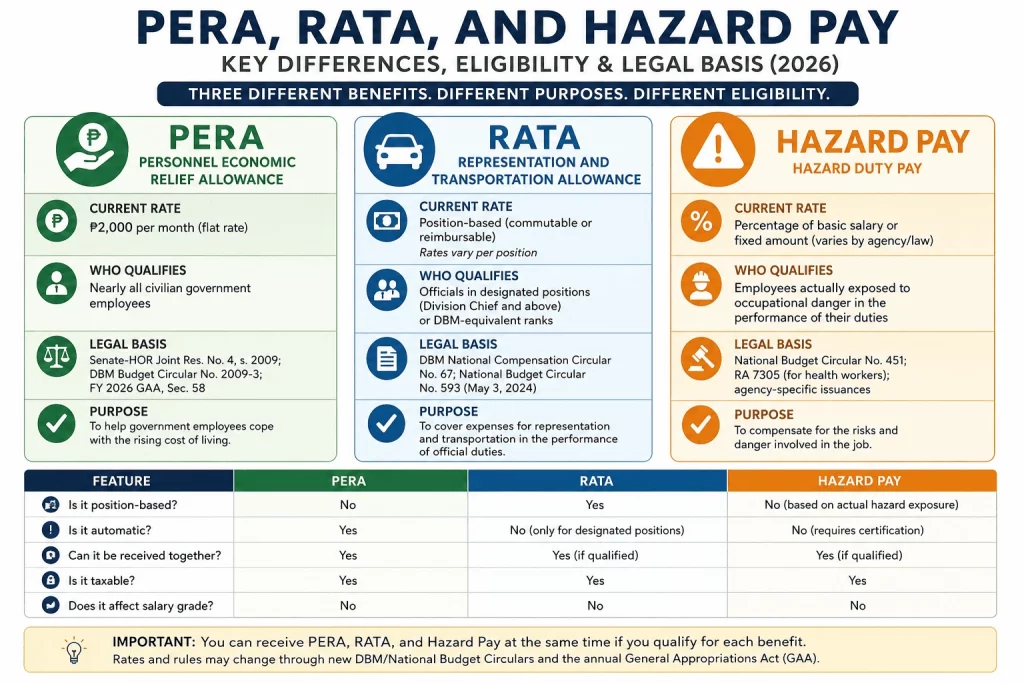
PERA, RATA, and Hazard Pay are three separate Philippine government compensation benefits. PERA is a flat ₱2,000 monthly economic relief allowance paid to nearly all civilian government employees. RATA is a position-based allowance — currently governed by National Budget Circular No. 593 (2024) — paid only to officials in designated positions such as division chiefs and above, to cover representation and transportation costs. Hazard Pay compensates employees actually exposed to occupational danger, with rates and conditions set by National Budget Circular No. 451 for most agencies and by Republic Act No. 7305 (Magna Carta of Public Health Workers) for health personnel specifically.
Key Takeaways
- PERA is ₱2,000/month, standardized, and covers nearly all civilian government personnel regardless of salary grade.
- RATA is granted only to specific designated positions (division chief and up, or DBM-equivalent ranks) — it is not a general employee benefit.
- Hazard Pay requires actual, certified exposure to occupational risk, not just employment in a “risky” agency.
- The three benefits have independent legal bases and can be received together if each is separately earned.
- Rates change through DBM/National Budget Circulars and the annual General Appropriations Act (GAA) — this article reflects the FY 2026 GAA and the most recent RATA and Hazard Pay circulars available at time of writing.
At a Glance
| Benefit | Current Rate/Basis | Primary Legal Authority | Typical Recipients |
|---|---|---|---|
| PERA | ₱2,000/month flat rate | Senate-HOR Joint Resolution No. 4, s. 2009; DBM Budget Circular No. 2009-3; annual GAA (FY 2026 GAA, Sec. 58) | Nearly all civilian government employees |
| RATA | Position-based, commutable or reimbursable, rate set per position | DBM National Compensation Circular No. 67; National Budget Circular No. 593 (May 3, 2024) | Division chiefs and higher, or DBM-equivalent-rank officials |
| Hazard Pay | Percentage of basic salary or fixed amount, varies by agency/law | National Budget Circular No. 451; RA 7305 (health workers); agency-specific issuances | Health workers, disaster responders, lab personnel, correctional officers, and similarly certified high-risk roles |
A bill to raise PERA to ₱7,000/month was filed in the 20th Congress but had not been enacted as of this writing — the ₱2,000 rate remains current. Check DBM’s official site for status updates.
What Are PERA, RATA, and Hazard Pay?
PERA (Personnel Economic Relief Allowance) is a standardized monthly allowance meant to offset the cost of living for government workers. RATA (Representation and Transportation Allowance) reimburses officials in designated positions for expenses tied to official representation and transportation duties. Hazard Pay compensates employees whose actual duties expose them to occupational danger beyond normal working conditions.
| PERA | RATA | Hazard Pay | |
|---|---|---|---|
| In one line | Cost-of-living allowance | Pay for representation/transport duties | Pay for actual danger exposure |
| Who gets it | Almost everyone | Division chief and up | Certified high-risk roles only |
The three are easy to mix up because payroll often lists them side by side. The sections below break down each one individually.
PERA Defined
PERA began in 1991 at ₱500/month, rose to ₱1,000 under Administrative Order No. 53 (1993), and was consolidated with the ₱1,500 Additional Compensation (ADCOM) allowance in 2010 to form the current flat rate of ₱2,000 per month, per Senate and House of Representatives Joint Resolution No. 4, s. 2009, and DBM Budget Circular No. 2009-3 (August 18, 2009). It applies whether or not the employee also receives RATA.
RATA Defined
RATA combines two allowances:
- Representation Allowance (RA) — covers costs of representing an office at official functions.
- Transportation Allowance (TA) — covers transportation tied to official duties.
RATA can be commutable (paid as a fixed monthly amount) or reimbursable (paid against actual receipts), and payment presupposes actual performance of the duties tied to the position. DBM National Compensation Circular No. 67 sets uniform rules for national government officials, while National Budget Circular No. 593 (May 3, 2024) provides the current updated rates and regulations “for FY 2024 and years thereafter.”
Hazard Pay Defined
Hazard Pay is granted to employees who are actually and directly exposed to danger in performing their duties — not simply to employees assigned to a particular office. National Budget Circular No. 451 authorizes agency heads to grant Hazard Duty Pay without prior DBM approval, subject to prescribed conditions, and requires agencies to report grantees to DBM quarterly. Public health workers have a separate, stronger statutory basis under RA 7305 (Magna Carta of Public Health Workers): in Cawad v. Abad (G.R. No. 207145, July 28, 2015) — a case brought by the Philippine Public Health Association, Inc. and individual health workers — the Supreme Court struck down circular provisions that had set hazard pay below the rates RA 7305 requires, confirming that agency circulars cannot lawfully undercut a specific statute.
Legal Basis and Official Issuances
| Benefit | Governing Issuances |
|---|---|
| PERA | Senate-HOR Joint Resolution No. 4, s. 2009; DBM Budget Circular No. 2009-3; DBM Budget Circular No. 2011-2; Section 58, General Provisions, FY 2026 GAA |
| RATA | DBM National Compensation Circular No. 67; National Budget Circular No. 593 (May 3, 2024); DBM Local Budget Circular (for LGU officials, subject to the 45%/55% personal services cap under RA 7160, Sec. 325(a)) |
| Hazard Pay | National Budget Circular No. 451; RA 7305 (public health workers); RA 4670 (Magna Carta for Public School Teachers, where applicable); CSC-DBM and DBM-DOH joint circulars for specific programs (e.g., DBM-DOH Joint Circular No. 1, s. 2020 on COVID-19 Active Hazard Duty Pay) |
Rates and coverage change through new circulars and each year’s GAA — the specific GAA section number shifts annually (Sec. 58 for FY 2026, Sec. 51 for FY 2025, Sec. 52 for FY 2024), so confirm the current year’s provision before relying on a figure.
Eligibility Comparison
| Benefit | Eligibility Basis | Who Typically Qualifies |
|---|---|---|
| PERA | Employee status, civilian appointment | Permanent, temporary, contractual, casual, or substitute civilian personnel, national or local, regardless of salary grade |
| RATA | Position/designation | Division chiefs and higher, agency heads, or positions DBM certifies as equivalent rank; officers-in-charge for one month or more |
| Hazard Pay | Actual risk exposure, certified | Health workers, lab personnel, disaster responders, correctional officers, others certified by agency head or covered by specific law |
Eligibility for PERA
PERA covers all civilian appointive government personnel — permanent, temporary, contractual, casual, substitute, or emergency status — regardless of salary grade, and regardless of whether the employee also receives RATA. Uniformed AFP, DILG, and NAMRIA personnel are covered separately. The one hard limit: no one may receive PERA from more than one government source at the same time.
Eligibility for RATA
RATA is not automatic. Under DBM National Compensation Circular No. 67, it generally applies to:
- Officials at or above the rank of division chief in the Personal Services Itemization
- Positions DBM formally certifies as equivalent rank
- Officers-in-charge performing full-time duties of a covered position for one full calendar month or more
Rank-and-file, technical, and most administrative staff do not qualify unless specifically named or certified.
Eligibility for Hazard Pay
National Budget Circular No. 451 ties Hazard Pay to actual, direct exposure to risk — not merely working in a hazardous-sounding office. Qualifying conditions historically include field operations near armed conflict, disaster/rescue operations formally certified by civil defense authorities, and similar direct-exposure work. Public health workers instead qualify under the separate, stronger statutory floor set by RA 7305, which the Supreme Court has confirmed agencies cannot pay below.
PERA vs. RATA vs. Hazard Pay
| Feature | PERA | RATA | Hazard Pay |
|---|---|---|---|
| Full Name | Personnel Economic Relief Allowance | Representation and Transportation Allowance | Hazard Pay / Hazard Duty Pay |
| Current Rate | ₱2,000/month flat | Position-based, varies by rank | Percentage of basic salary or fixed amount, varies by law/agency |
| Coverage | Nearly all civilian government employees | Division chief and up, or DBM-certified equivalent rank | Employees with certified actual exposure to occupational risk |
| Basis of Entitlement | Employee/appointment status | Position/designation | Nature of work + certified risk exposure |
| Can Be Combined With Others? | Yes, if independently qualified | Yes, if independently qualified | Yes, if independently qualified |
| Key Legal Basis | Joint Resolution No. 4, s. 2009; BC 2009-3 | NCC 67; NBC 593 (2024) | NBC 451; RA 7305 (health workers) |
Practical Examples
| Situation | Likely Benefit |
|---|---|
| Administrative assistant, no supervisory rank | PERA only (if otherwise qualified) |
| Division chief performing official representation duties | PERA + RATA |
| Nurse in an infectious-disease ward with certified exposure | PERA + Hazard Pay (per RA 7305) |
| Regional director overseeing hazardous field operations | PERA + RATA + Hazard Pay, each independently earned |
Decision Tools
Use these to quickly figure out which benefit applies to a given employee, without re-reading the full eligibility sections above.
1. Decision Matrix
| Situation | Benefit |
|---|---|
| Rank and File | PERA |
| Division Chief | PERA + RATA |
| Nurse (certified exposure) | PERA + Hazard Pay |
| Regional Director | PERA + RATA + Hazard Pay |
2. Workflow
Government Employee
      ↓
Permanent / Civilian Appointee?
      ↓ YES
   PERA granted
      ↓
Division Chief or Equivalent Rank?
      ↓ YES
   RATA granted
      ↓
Certified Hazard Exposure?
      ↓ YES
   Hazard Pay granted
If any answer along this chain is NO, that specific benefit simply doesn’t apply — the employee still keeps whichever benefits they already qualified for earlier in the chain.
3. Eligibility Checker
Question 1 — Are you a permanent, civilian government employee? YES → proceed to Question 2. NO → check the separate rules for uniformed/casual personnel.
Question 2 — Do you hold a division chief position or DBM-certified equivalent rank? YES → eligible for RATA (in addition to PERA). NO → PERA only, unless Question 3 applies.
Question 3 — Does your agency head certify actual, direct exposure to occupational danger? YES → eligible for Hazard Pay (in addition to whatever else you qualified for above).
4. Benefits Decision Tree
        PERA
          ↓
  Basis: Everyone (civilian, appointive)
          ↓
        RATA
          ↓
  Basis: Position (division chief+)
          ↓
      Hazard Pay
          ↓
  Basis: Actual, certified exposure
5. Visual Summary
PERA        → Economic Relief   → Universal
RATA        → Position          → Division chief and up
Hazard Pay  → Danger Exposure   → Certified, case-by-case
Common Misunderstandings
“Every government employee gets all three.” No — RATA and Hazard Pay both require a specific position or certified risk exposure; PERA alone is close to universal.
“RATA is a salary increase.” It’s a reimbursement-style allowance tied to representation/transportation duties, commutable or receipt-based, not part of basic pay.
“Hazard Pay depends on salary grade.” It depends on actual exposure to risk, certified per the applicable circular or law — not job title or rank alone.
“PERA replaces other allowances.” PERA is paid regardless of RATA status; it does not cancel out other legally distinct benefits.
“Agency practice decides entitlement.” Only law, GAA provisions, and DBM/CSC circulars create legal entitlement — informal agency practice does not.
Frequently Asked Questions
Can a government employee receive both PERA and RATA?
Yes. An employee who qualifies for PERA and separately occupies a RATA-authorized position (e.g., division chief) may receive both.
Can Hazard Pay be received together with PERA?
Yes. They have independent legal bases — PERA under Joint Resolution No. 4, s. 2009, and Hazard Pay under NBC 451 or RA 7305 — so qualifying for one doesn’t affect the other.
Is RATA available to all government employees?
No. It’s limited to division chiefs and higher, or positions DBM certifies as equivalent rank, per DBM National Compensation Circular No. 67.
Does every healthcare worker automatically receive Hazard Pay?
No. Health workers need certified actual exposure to danger or infection under RA 7305’s implementing rules — the Supreme Court has confirmed agencies cannot set this below RA 7305’s statutory floor, but exposure still must be certified.
Does salary grade determine PERA eligibility?
No. PERA is paid regardless of salary grade under DBM Budget Circular No. 2009-3 — the flat ₱2,000 rate applies broadly across civilian ranks.
How much is PERA in 2026?
₱2,000 per month, per Section 58 of the General Provisions of the FY 2026 General Appropriations Act. A House bill proposing an increase to ₱7,000 was pending in the 20th Congress as of mid-2026 but not yet law.
Where can employees verify their benefits?
Where can employees verify their benefits?
The Department of Budget and Management (dbm.gov.ph), the Civil Service Commission, and the agency’s own HR/Payroll Unit are the authoritative sources — check the specific circular number cited above rather than relying on secondhand summaries.
Best Practices for Government Employees
- Check your payslip against the circular, not against a coworker’s pay. RATA and Hazard Pay are position- and exposure-specific, so two employees at the same salary grade may legally receive different amounts.
- Ask HR for the specific circular number backing any allowance — “PERA,” “RATA,” and “Hazard Pay” are labels; the entitlement lives in the cited circular or law.
- Watch for new GAA provisions each fiscal year — the section number authorizing PERA shifts annually (Sec. 58 in FY 2026, Sec. 51 in FY 2025).
- Keep designation orders and appointment papers current — RATA claims typically require proof of the specific position held.
- Don’t assume one benefit implies another — each requires independent qualification.
Related Topics
- Government Salary Grade 2026: Complete Guide to the Philippine Salary Schedule
- Government Jobs in the Philippines 2026: Complete Job Search Guide
- Job Order vs. COS vs. Permanent: What Is a Plantilla Position?
- How to Get a Plantilla Position in the Philippine Government (2026 Guide)
- CSC Eligibility Requirements: Complete Guide for Government Job Applicants
- CSC Eligibility Requirements: Complete Guide for Government Job Applicants
References
- Senate and House of Representatives Joint Resolution No. 4, s. 2009 (PERA consolidation to ₱2,000) — full text not independently located online; see the DBM issuances portal for the official copy
- DBM Budget Circular No. 2009-3, dated August 18, 2009
- DBM Budget Circular No. 2011-2, dated September 26, 2011 — full text not independently located online; see the DBM issuances portal
- FY 2026 General Appropriations Act, General Provisions, Section 58 — see the DBM website or Official Gazette for the enacted text
- DBM National Compensation Circular No. 67 (RATA guidelines, national government)
- DBM National Budget Circular No. 593, dated May 3, 2024 (updated RATA rules, FY 2024 and thereafter)
- DBM index of National Budget Circulars — for browsing the full RATA/hazard pay circular history
- DBM National Budget Circular No. 451 (Guidelines on the Grant of Hazard Duty Pay)
- Republic Act No. 7305 (Magna Carta of Public Health Workers), Official Gazette
- Cawad v. Abad, G.R. No. 207145, July 28, 2015 — full decision via Supreme Court E-Library (the case is sometimes referenced by the lead petitioner organization, Philippine Public Health Association, Inc.; the official case title is Cawad v. Abad)
- Republic Act No. 7160 (Local Government Code), Section 325(a) — RATA cap for LGUs
- DBM-DOH Joint Circular No. 1, s. 2020 (COVID-19 Active Hazard Duty Pay) — full text not independently located online; see the DBM issuances portal
A few older circulars above don’t have a stable public link at time of writing — they’re cited by number/date so you can request a certified copy from DBM or your agency’s records office if needed. This article summarizes publicly available circulars, laws, and jurisprudence for general informational purposes. It is not legal advice. Confirm current rates and eligibility with the DBM, CSC, or your agency’s HR/Payroll Unit before making employment or payroll decisions.