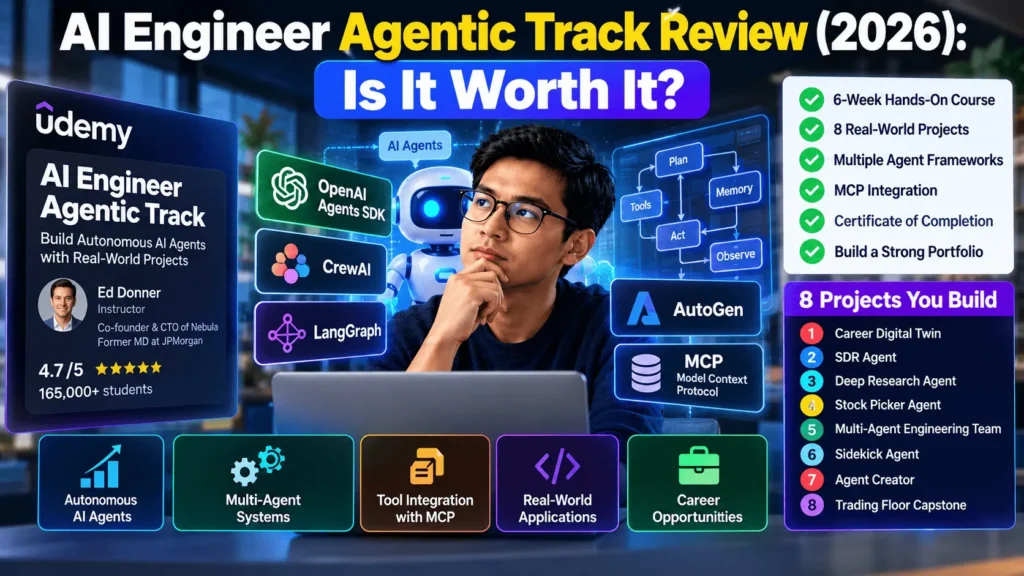
Direct answer: The AI Engineer Agentic Track is a hands-on Udemy course by Ed Donner that teaches learners how to build autonomous AI agents using frameworks such as the OpenAI Agents SDK, CrewAI, LangGraph, AutoGen, and MCP. The course is project-based, includes eight real-world agent projects, and is best suited for developers who already have some Python and AI fundamentals.
Quick Verdict
| Category | Rating |
|---|---|
| Curriculum | 9.5/10 |
| Projects | 10/10 |
| Beginner Friendly | 7/10 |
| Career Value | 9/10 |
| Certificate Value | 7/10 |
| Overall | 9.3/10 |
Agentic AI is the part of the field moving fastest right now — the shift from “AI that answers” to “AI that acts.” If you’ve already built basic LLM applications and you’re wondering where to specialize next, this is the exact course most often recommended for that jump. Here’s a full breakdown of what it teaches, what you build, how it compares to Ed Donner’s foundational course, and whether it’s worth your time.
New to Ed Donner’s courses? Start with our AI Engineer Core Track Review to see the foundational program this one builds on.
Quick facts:
| Item | Details |
|---|---|
| Platform | Udemy |
| Instructor | Ed Donner |
| Duration | 6 Weeks |
| Projects | 8 |
| Skill Level | Intermediate |
| Certificate | Yes |
What Is AI Engineer Agentic Track?
AI Engineer Agentic Track is a six-week program focused entirely on autonomous AI agents. Rather than covering LLM fundamentals broadly (that’s the Core Track’s job), this course goes deep on one specific, fast-growing area: agents that plan, decide, and act with limited human oversight. It covers the OpenAI Agents SDK, CrewAI, LangGraph, AutoGen, and the Model Context Protocol (MCP) — five of the most actively used frameworks in the agentic AI space right now.
The course is designed for technical learners and aspiring AI engineers, not for people encountering AI concepts for the first time. It assumes you can already write Python and understand the basics of how LLMs work, then spends its six weeks building genuine competency across the current agent-framework landscape.
Who Is Ed Donner?
Ed Donner is the instructor behind this course and its companion AI Engineer Core Track. His background is what gives the curriculum its credibility:
- Co-founder and CTO of Nebula, an AI company applying pattern-matching to talent and recruitment
- Former Managing Director at JPMorgan Chase, where he led a team of roughly 300 software engineers
- Engineering leadership experience spanning around fifteen years in Wall Street technology before moving into AI entrepreneurship and teaching
- Creator of the AI Engineer Core Track, the foundational course this one is designed to follow
Donner isn’t teaching agentic AI as an abstract trend — he’s building on the same commercial, production-minded background that shaped the Core Track, applied specifically to the agent frameworks companies are adopting right now.
Why Agentic AI, and Why Now?
It’s worth spending a moment on why this specific specialization exists as a separate course rather than as another module bolted onto the Core Track. Through most of 2024 and into 2025, the dominant AI engineering pattern was single-turn: a user asks, a model answers, sometimes grounded in retrieved data via RAG. That pattern is well understood and increasingly commoditized — most companies can now stand up a basic chatbot or RAG system without much specialized talent.
Agentic AI is a different problem. Instead of answering one question well, an agent has to plan a sequence of actions, decide when it has enough information, call tools or other agents along the way, and recover when something doesn’t go as expected. That’s a meaningfully harder engineering challenge, and it’s exactly the challenge most large companies are currently trying to solve as they move past pilot chatbots toward AI systems that actually complete work. The five frameworks this course covers — OpenAI Agents SDK, CrewAI, LangGraph, AutoGen, and MCP — represent the current best attempts at solving that problem, each with a different philosophy about how agents should be structured and coordinated. Understanding all five, even at a working level rather than expert depth, is genuinely rare and genuinely valuable right now.
AI Engineer Agentic Track at a Glance
| Item | Details |
|---|---|
| Platform | Udemy |
| Instructor | Ed Donner (with Ligency) |
| Rating | 4.7/5 |
| Students | 165,000+ |
| Duration | 6 Weeks |
| Projects | 8 |
| Skill Level | Intermediate |
| Certificate | Yes |
| Focus | AI Agents & MCP |
What Will You Learn?
OpenAI Agents SDK
Building autonomous agents using OpenAI’s dedicated agent-building toolkit — the most direct path to production-ready agents if you’re already working inside the OpenAI ecosystem.
CrewAI
Multi-agent collaboration, where several specialized agents work together on a shared task — think of it as assembling a small team of AI specialists rather than relying on one generalist agent.
LangGraph
State-based agent workflows, where an agent’s behavior is modeled as a graph of steps and decisions rather than a single linear chain — useful for anything that needs to loop, branch, or wait on human input mid-task.
AutoGen
Microsoft’s framework for agent creation and orchestration, particularly strong for collaborative, conversation-style agent interactions like code review and iterative problem-solving.
MCP (Model Context Protocol)
Connecting agents to tools and external systems through a standardized protocol — this is the newest and arguably most consequential piece of the curriculum, since MCP is quickly becoming the common language agents use to talk to databases, APIs, and other tools regardless of which framework built them.
Curriculum Breakdown
Week 1 – Agent Foundations Core agent concepts and design patterns — the shared vocabulary and architecture ideas that every framework in the following weeks builds on.
Week 2 – OpenAI Agents SDK Two projects: an SDR (sales development representative) agent and a Deep Research agent, both built using OpenAI’s native agent tooling.
Week 3 – CrewAI Two projects: a Stock Picker agent and a simulated Engineering Team, both demonstrating multi-agent collaboration on realistic business tasks.
Week 4 – LangGraph The Sidekick project, focused on building stateful, graph-based agent workflows with more complex control flow than a simple linear pipeline.
Week 5 – Agent Frameworks A broader look beyond the core five, touching Google ADK and AWS Strands — giving you exposure to the wider agent-framework ecosystem, not just the frameworks with dedicated project weeks.
Week 6 – MCP A full week on MCP servers and tool integration, culminating in the Trading Floor capstone project that ties the course’s concepts together into a single, more ambitious build.
👉 Check the latest AI Engineer Agentic Track pricing on Udemy
The 8 Projects You Build
The project list is one of the course’s strongest selling points, and it’s worth listing in full:
- Career Digital Twin — an AI agent that represents you to potential employers, showcasing your skills and experience autonomously
- SDR Agent — a sales development agent that handles prospect research and outreach-style tasks
- Deep Research Agent — an agent that conducts extensive, multi-step research on any topic you choose
- Stock Picker Agent — a CrewAI-based multi-agent system analyzing and selecting stocks based on defined criteria
- Multi-Agent Engineering Team — a simulated team of specialized agents collaborating on a software engineering task
- Sidekick Agent — a LangGraph-based stateful assistant capable of more complex, branching workflows
- Agent Creator — a meta-project: an agent that helps build other agents
- Trading Floor Capstone — the final project, combining MCP, tool integration, and everything learned across the previous five weeks into one larger system
These aren’t disconnected exercises — each project demonstrates a different agent-framework skill while building toward a portfolio that reads as a coherent body of work, not eight unrelated tutorials.
A useful way to think about the project list: it moves in difficulty and ambition as the weeks progress. The early projects (Career Digital Twin, SDR Agent) are focused, single-framework builds that establish core competency. The middle projects (Stock Picker, Multi-Agent Engineering Team) introduce coordination between multiple agents working toward a shared goal. The later projects (Sidekick, Agent Creator, Trading Floor) push into more complex state management and tool integration, with the capstone specifically designed to combine everything into one system rather than testing frameworks in isolation. If you’re deciding which projects to prioritize polishing for a portfolio, the later, more ambitious builds tend to demonstrate the most to a technical interviewer, precisely because they require you to reason about several moving pieces at once rather than a single well-scoped task.
What Makes This Course Different?
Traditional AI courses tend to focus on prompting, chatbots, and basic automation — useful groundwork, but limited to systems that respond rather than act.
The Agentic Track focuses specifically on:
- Autonomous decision-making, where the system chooses its next step rather than following a fixed script
- Multi-agent systems, where several agents divide and coordinate work
- Tool use, giving agents the ability to interact with the outside world (search, databases, APIs)
- Agent orchestration, the practice of managing how multiple agents and tools work together reliably
This is the meaningful distinction buyers should understand before enrolling: this isn’t “another prompting course with agent branding.” It’s specifically about the harder engineering problem of building systems that plan and act with reduced supervision — a different (and currently scarcer) skill set than general LLM application development.
Strengths
Modern Agent Frameworks
Covering five actively used frameworks in one course — rather than picking just one and going deep — gives you the comparative fluency to choose the right tool for a given job, which is exactly the kind of judgment employers value in a specialist.
Strong Project Portfolio
Eight distinct, demoable projects, several of which (the Trading Floor capstone, the Multi-Agent Engineering Team) are genuinely impressive to show a hiring manager or client, not just functional tutorials.
MCP Coverage
A full dedicated week on MCP is a meaningful differentiator. MCP adoption has grown quickly since its introduction, and dedicated, structured MCP instruction is still relatively rare compared to general agent-framework content.
Practical Learning
Like the Core Track, this course is built around building rather than watching — every framework is introduced and then immediately put to work in a real project.
Updated Content
Course updates continue to reflect current agent tooling, which matters more here than in most technical subjects, since agent frameworks and standards like MCP are evolving quickly.
Instructor Credibility Transfers Directly
Because this is the same instructor and production team behind the Core Track, the teaching style, project quality, and update discipline that made the original course successful carry over rather than being an unknown quantity. Students who already trust Donner’s approach from the Core Track have good reason to expect a similarly high bar here, and the course’s rating and enrollment numbers so far support that continuity.
Weaknesses
Requires Python Knowledge
As with the Core Track, Python isn’t taught from scratch. If you can’t already read and write Python comfortably, this course will be a struggle regardless of your interest in agents.
Fast Pace
Covering five frameworks in six weeks means each one gets focused, intensive treatment rather than a leisurely introduction. Students without prior AI exposure often need to slow down or rewatch sections to keep up.
Not Ideal for Complete Beginners
This course assumes AI fundamentals — embeddings, basic LLM behavior, prompting — are already familiar ground. Complete beginners are better served starting with the Core Track first.
Framework Breadth vs. Depth
Because multiple frameworks are covered in one course, learners may need deeper, framework-specific study afterward if they want true mastery of any single one (CrewAI or LangGraph specifically, for example). This course is closer to “strong working fluency across five frameworks” than “expert-level depth in one.”
This trade-off is worth weighing deliberately rather than treating as a flaw. A course that spent six weeks on CrewAI alone would produce a deeper CrewAI specialist, but a much less useful generalist — and in practice, most agent-engineering roles right now don’t ask for CrewAI expertise specifically; they ask for someone who can evaluate which framework fits a given problem and get productive quickly in whichever one the team has already standardized on. Breadth-first is arguably the more employable skill profile at this stage of the field’s maturity, even if it means less depth in any single tool on day one.
Is AI Engineer Agentic Track Good for Beginners?
Beginners can complete the course, but learners with Python experience and familiarity with LLM concepts will likely gain the most value. If you’ve never worked with an LLM API before, you’ll spend much of your energy catching up on fundamentals that this course assumes you already have, rather than absorbing the agent-specific material it’s actually built to teach.
The more useful beginner question isn’t “can I finish this course” — most motivated learners can — but “will I get proportionate value for the time I put in.” For someone brand new to AI, the honest answer is usually no; the Core Track is the better use of that same time.
Certificate Value
Completing the course earns a Udemy certificate of completion — the same kind offered for the Core Track, with the same limitations.
Resume value: worth listing, but the certificate title itself carries little independent weight with employers. What it represents — six weeks of hands-on agent-framework work — is the actual substance behind the line.
LinkedIn value: useful for visibility and keyword discoverability (agent frameworks, MCP, and multi-agent systems are increasingly searched terms among recruiters), especially when paired with links to your projects.
Portfolio importance: this is where the course’s real value concentrates. Employers hiring for agent-focused roles are far more persuaded by a working Trading Floor capstone or a functioning multi-agent engineering team than by the certificate that came with them. Treat the certificate as a minor supporting detail and the eight projects as the actual credential.
For more on how to convert a Udemy completion certificate into something employers actually respond to — publishing on GitHub, building case studies, and positioning it correctly on a resume — see our dedicated AI Engineer Core Track Certificate breakdown; the same principles apply directly to this course’s certificate as well.
Career Opportunities
The skills taught here map to some of the fastest-growing job titles in AI right now:
- AI Engineer — general AI application building, now increasingly expected to include agent competency
- Agent Engineer — a newer, more specialized title focused specifically on designing and deploying autonomous agent systems
- LLM Engineer — overlapping with the Core Track’s target role, but with agent orchestration as an added specialization
- AI Automation Specialist — using agents to replace or augment manual, repetitive business processes
- AI Consultant — advising businesses on where agentic AI fits and building prototypes to prove it out
- Freelance AI Developer — building custom agent systems (research agents, sales agents, support agents) for clients on a project basis
For a deeper breakdown of how these roles are hired for and what they typically pay, see our companion piece on AI Engineer Core Track Jobs, much of which applies equally to agent-specialized roles.
It’s worth being specific about how the Agentic Track’s skills change your positioning within these roles, rather than just unlocking the titles outright. A candidate who only knows RAG and basic chatbot-building can credibly apply for AI Engineer roles, but an agent-specialized candidate can speak directly to the harder, more current problem most companies are actually stuck on: getting an AI system to reliably complete a multi-step task without constant supervision. In interviews, being able to walk through how you’d structure an agent’s decision loop, handle a tool-call failure, or coordinate several agents toward one goal is a noticeably different (and currently scarcer) conversation than explaining how you built a chatbot — and it’s the conversation this course specifically prepares you to have.
AI Engineer Agentic Track vs. AI Engineer Core Track
| Core Track | Agentic Track |
|---|---|
| LLMs | Agents |
| RAG | Multi-Agent Systems |
| Fine-Tuning | MCP |
| Foundation | Specialization |
For most learners, the Core Track is the foundation and the Agentic Track is the specialization. The Core Track gives you broad LLM engineering fluency — prompting, RAG, basic agents, and fine-tuning. The Agentic Track takes the agent thread from that foundation and goes considerably deeper: five frameworks, MCP, and multi-agent orchestration, all areas the Core Track only introduces.
Should you take both? If you’re aiming for a role specifically focused on agentic AI or automation, yes — the Core Track first for foundations, then the Agentic Track for specialization, is the sequence Donner’s own course descriptions point toward. If your interest is broader LLM engineering (RAG-heavy roles, general AI application development), the Core Track alone may be sufficient, with the Agentic Track as an optional next step once agents become a bigger part of your work.
For the full head-to-head on how the Core Track compares against a completely different kind of program, see our AI Engineer Core Track vs. Google AI Professional Certificate comparison — useful context if you’re still deciding between a technical specialization path and a broader AI-literacy credential.
👉 View the complete curriculum and project list
Pricing and Value for Money
Like all of Ed Donner’s Udemy courses, list price is rarely what students actually pay — Udemy runs frequent, deep promotional discounts, so it’s worth checking the current price on the course page rather than assuming the sticker price is final. A few things worth knowing regardless of the price at checkout:
- Frequent Udemy discounts mean waiting for a sale is a reasonable strategy if you’re price-sensitive
- Lifetime access means your purchase covers future updates to the course as agent frameworks and MCP tooling continue to evolve
- Project-based curriculum means the value proposition isn’t just video runtime — you’re paying for eight structured, guided builds, which is a meaningfully different value calculation than a purely lecture-based course of similar length
Given how quickly agent frameworks change, the ongoing-access element matters more here than it might for a more stable technical subject — a course frozen in time on 2025-era agent tooling would age poorly, and Donner’s stated update cadence is part of what keeps this course relevant.
There’s also a reasonable case for thinking about this course’s price relative to what freelance or consulting work in this space can generate. A single well-scoped agent-building project for a small business client — a research agent, a sales-outreach agent, a support agent — commonly commands a project fee well above the discounted cost of the course itself. That doesn’t guarantee you’ll land that work immediately, but it’s a useful frame for evaluating the investment: this isn’t spending money to consume content, it’s spending a relatively small amount to build a skill set with direct, demonstrable earning potential on the freelance side alone, independent of any full-time job outcome.
Is AI Engineer Agentic Track Worth It?
For Developers
Yes, clearly, provided you already have the Python and general AI fundamentals the course assumes. This is exactly the audience the course is built for.
For AI Engineers
Strong value as a focused specialization. If you’re already working with LLMs professionally but haven’t gone deep on agent orchestration specifically, this course fills that gap directly and efficiently.
For Career Changers
Conditionally yes — this is a better second course than a first one. Career changers should build general AI/LLM fundamentals first (through the Core Track or equivalent) before specializing here.
For Freelancers
High value. Agent-building is one of the more commercially in-demand freelance categories right now — research agents, sales agents, and support agents are exactly the kind of scoped deliverables clients are actively requesting, and this course’s project set maps closely onto that demand.
For Complete Beginners
Not recommended as a starting point. The pace and assumed background will work against you. Build fundamentals first, then come back to this course once agent orchestration becomes the next logical step.
A Quick Self-Check Before Enrolling
If you’re still unsure which category you fall into, ask yourself three questions: Can you comfortably read and modify someone else’s Python code, not just write your own from scratch? Have you already made at least one API call to an LLM provider (OpenAI, Anthropic, or similar) outside of a chat interface? Do you understand, at least at a basic level, what an embedding or a vector database does? If you answered yes to all three, you’re well positioned to start this course directly. If you answered no to more than one, spending a few weeks on foundational material — this site’s AI Engineer Core Track Review covers a course built for exactly that gap — will make the six weeks here considerably more productive.
Pros and Cons at a Glance
Pros
- 8 portfolio-ready projects, including a multi-framework capstone
- Dedicated MCP coverage — a rare, currently high-value skill
- Exposure to multiple agent frameworks (OpenAI Agents SDK, CrewAI, LangGraph, AutoGen)
- Strong specialization value for developers already past the fundamentals
Cons
- Requires existing Python knowledge
- Fast pace once past Week 1
- Not ideal for complete beginners
Final Verdict
Bottom Line
AI Engineer Agentic Track is one of the most comprehensive AI agent courses currently available on Udemy. Its biggest strengths are the eight practical projects, coverage of multiple agent frameworks, and a deep focus on MCP and autonomous AI systems — an area of the field advancing quickly enough that structured, up-to-date instruction carries real value. Developers interested in agentic AI will likely find significant value here, while complete beginners may benefit from first learning AI engineering fundamentals before enrolling.
If you’ve already got some LLM experience under your belt and you want to specialize in the part of AI engineering that’s growing fastest right now — autonomous agents, multi-agent systems, and the tooling that connects them to the real world — this course is a well-built, currently relevant way to get there.
👉 Start building AI agents with AI Engineer Agentic Track
Frequently Asked Questions
Is AI Engineer Agentic Track worth it? Yes, for developers and AI engineers who already have Python and basic LLM fundamentals and want to specialize in autonomous agent systems. It’s less well suited as a first AI course for complete beginners.
Do I need Python for AI Engineer Agentic Track? Yes. Python isn’t taught from scratch in this course, and every project assumes you can read and write it comfortably from the start.
Is AI Engineer Agentic Track beginner friendly? Moderately. Beginners can technically complete it, but learners with prior Python experience and LLM familiarity will get proportionately more value for the same six weeks.
What projects do you build? Eight projects: a Career Digital Twin, an SDR Agent, a Deep Research Agent, a Stock Picker Agent, a Multi-Agent Engineering Team, a Sidekick Agent, an Agent Creator, and a Trading Floor capstone that ties the course together.
Does the course teach MCP? Yes — an entire week (Week 6) is dedicated to the Model Context Protocol, covering MCP servers and tool integration, culminating in the Trading Floor capstone project.
Is AI Engineer Agentic Track better than Core Track? They’re not really competing — they’re sequential. The Core Track is the foundation (LLMs, RAG, fine-tuning, basic agents); the Agentic Track is the specialization (multi-agent systems, agent frameworks, MCP). Most learners benefit from the Core Track first, then this course once they want to go deeper on agents specifically.
Does the certificate help with jobs? Modestly, and mainly as a supporting detail. As with the Core Track, employers are far more persuaded by the working projects behind the certificate than the certificate document itself. Publish your projects and lead with those in any application.
Related Guides
- AI Engineer Core Track Review: Is This Udemy AI Engineering Course Worth It?
- AI Engineer Core Track Jobs: What Jobs Can You Get After Completing It?
- AI Engineer Core Track vs Google AI Professional Certificate: Which Should You Choose?
- AI Engineer Core Track Certificate: Does It Matter to Employers?