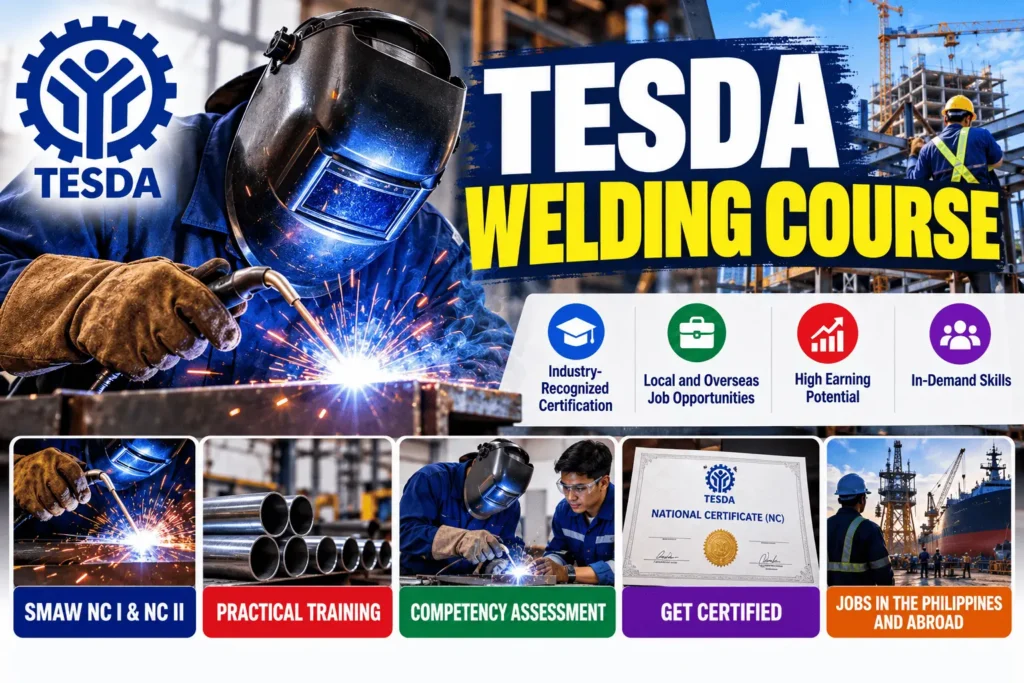
Quick Answer: TESDA Welding Courses train individuals in welding techniques used in construction, manufacturing, shipbuilding, and industrial work. One of the most popular qualifications is Shielded Metal Arc Welding (SMAW) NC II, which certifies a worker’s competency in performing welding operations on carbon steel plates and pipes according to industry standards. Training is followed by a separate competency assessment. Pass it, and you receive a TESDA National Certificate.
Walk past any construction site, fabrication shop, or shipyard in the Philippines and you’ll see the blue-white flash of an arc being struck. Welding holds a lot of the built world together, from steel buildings and bridges to ships, tanks, pipelines, and machinery. That’s why Shielded Metal Arc Welding has long been one of TESDA’s most popular courses.
This guide explains what the TESDA welding course covers, how SMAW NC I and NC II differ, what you’ll learn, what you’ll need to enroll, how long training takes, how assessment works, and where the certificate can take you, both at home and abroad. It also tells you how to choose a training center and where to read more about scholarships, requirements, and certification.
Quick Facts
| Item | Details |
|---|---|
| Course | Shielded Metal Arc Welding (SMAW) |
| Qualification | NC I / NC II (higher levels may be offered for some welding qualifications) |
| Training Type | Technical-vocational, hands-on, competency-based |
| Industry | Construction, manufacturing, shipbuilding, energy, maintenance |
| Certification | TESDA National Certificate (after competency assessment) |
| Career Path | Welder, fabricator, pipe welder, structural welder, and more |
What Is the TESDA Welding Course?
The TESDA Welding Course is a competency-based training program that teaches learners how to perform welding operations safely and efficiently using industry-standard equipment and procedures. Instead of focusing on theory alone, it’s built around what a welder actually does on the job: reading drawings, preparing metal, setting up equipment, joining pieces, and checking the result.
TESDA’s qualification for SMAW NC II covers the competencies a person needs to weld carbon steel plate and pipe components as specified by layout, blueprints, diagrams, work orders, welding procedures, or oral instructions, using shielded metal arc welding equipment.
Why welding skills matter
Welding is a “joining” skill that many industries can’t do without. A welder’s work often carries real consequences, because a bad weld can fail under load, leak under pressure, or crack in service. That’s why employers care so much about verified competence, and why a TESDA National Certificate matters. It shows that someone qualified assessed your skills against a recognized standard.
Industries that hire welders
- Construction. Structural steel, reinforcing work, steel frames, roofing structures.
- Manufacturing and fabrication. Machinery, metal furniture, tanks, trailers, and custom metalwork.
- Shipbuilding and repair. Hull and structural work, pipe systems.
- Energy and utilities. Power plants, pipelines, and related projects.
- Maintenance and repair. Factories, plants, and workshops that need ongoing repair welding.
- Oil, gas, and heavy industry. Often with stricter qualification requirements.
Quick Answer Box: The TESDA Welding Course teaches learners how to perform welding operations safely and efficiently using industry-standard equipment and procedures.
Types of TESDA Welding Certifications
TESDA doesn’t have just one welding course. The Metals and Engineering sector includes several arc welding processes, each with its own Training Regulations:
- SMAW (Shielded Metal Arc Welding). The classic “stick” welding process, covered in this guide.
- GTAW (Gas Tungsten Arc Welding). Commonly called TIG welding.
- GMAW (Gas Metal Arc Welding). Commonly called MIG welding.
- FCAW (Flux-Cored Arc Welding). A wire-fed process often used in structural and heavy work.
SMAW is the usual starting point because the equipment is relatively simple, it works in many environments, and employers across industries know it.
A note on names: you may also see TESDA’s newer qualification listed as Manual Metal Arc Welding (MMAW) NC II, which is another name for SMAW. TESDA has promulgated updated Training Regulations for it, so a training center may use either title. Ask the center which Training Regulation its program is registered under, since requirements and training hours are set per qualification and can change over time.
SMAW NC I
SMAW NC I is the more basic certification. Depending on the provider and how TESDA has structured the qualification in your area, it covers:
- Basic welding competencies. Safety practices, simple setup, and fundamental arc welding skills.
- Entry-level skills. Enough to work under supervision on straightforward tasks.
- Initial certification. A way to start building a certification record before moving up.
Not every training center offers NC I. Some focus on NC II directly. If you’re completely new to welding, ask whether an NC I program is available or whether the NC II program starts from the fundamentals.
SMAW NC II
SMAW NC II is the more widely requested certification.
- More advanced welding skills. Beyond simple joints, it covers welding carbon steel plates and pipes according to specifications.
- Industry requirements. Many employers and recruiters treat NC II as the standard proof of welding competence for skilled workers.
- Most commonly requested certification. If a job post says “SMAW NC II,” this is the one.
For the bigger picture on how the NC levels fit together, read What Is a TESDA National Certificate (NC)? NC I, NC II, NC III, and NC IV Explained.
What Is SMAW NC II?
SMAW = Shielded Metal Arc Welding.
SMAW is a process in which an electric arc is struck between a flux-coated electrode (the “welding rod”) and the metal being welded. The arc’s heat melts both the rod and the base metal, forming a weld pool. As the rod burns, its flux coating produces a shielding gas and slag that protect the molten weld from contamination by the air. After the weld cools, you chip off the slag to reveal the weld bead.
Welding processes in SMAW work
SMAW work typically involves:
- Striking and maintaining an arc
- Running weld beads on plate
- Making different joint types (such as butt, lap, tee, and corner joints)
- Welding in different positions (flat, horizontal, vertical, overhead), depending on the training level and test
- Welding on pipe, which is more demanding than plate
Equipment used
- Welding machine (power source)
- Electrode holder and ground clamp
- Welding cables
- Electrodes (welding rods) of various types
- Protective gear: welding helmet or hand shield, gloves, apron or jacket, safety shoes, safety glasses
- Hand tools: chipping hammer, wire brush, grinder, clamps
- Measuring and marking tools: steel rule, try square, tape measure, soapstone or scribers
- Cutting and preparation equipment, depending on the center
Workplace applications
SMAW is used outdoors and indoors, in the field and in workshops. Because the equipment is portable and doesn’t need external shielding gas, it’s common in construction, repair, and maintenance work, where conditions aren’t controlled. It’s used on structural steel, fabrication jobs, pipe systems, and general repairs.
What Will You Learn in a TESDA Welding Course?
TESDA qualifications group learning into basic, common, and core competencies. For SMAW NC II, the Training Regulation lists units across these three groups.
Basic competencies
These are workplace skills that apply to many jobs:
- Participating in workplace communication
- Working in a team environment
- Practicing career professionalism
- Practicing occupational health and safety procedures
Common competencies
These are shared technical skills for the trade:
- Applying safety practices
- Interpreting drawings and sketches
- Performing industry calculations
- Contributing to quality systems
- Using hand tools
Core competencies
These are the welding-specific skills:
- Preparing weld materials
- Setting up welding equipment
- Fitting up weld materials
- Repairing welds
- Welding carbon steel plates and pipes using SMAW
Technical skills in plain language
Welding safety. This comes first, and for good reason. You’ll learn about protective equipment, safe handling of electrical equipment, fire prevention, ventilation, and how to avoid arc flash, burns, and fume exposure.
Reading welding symbols and drawings. Welding drawings use standard symbols to tell you what kind of weld to make, where, and how big. Reading them correctly is a basic requirement for fabrication work.
Equipment setup. You’ll learn to connect and adjust the machine, choose the right electrode and current settings for the job, and check that the equipment is in safe condition.
Metal preparation. Clean, properly prepared metal makes better welds. You’ll practice cleaning, cutting, beveling, and aligning pieces.
Welding procedures. Following a procedure means using the right method, materials, and settings for a given job. You’ll learn to follow instructions and work to specifications.
Inspection basics. You’ll learn to look at your own welds and recognize common defects such as undercut, porosity, lack of fusion, and cracks, and how to correct them.
Practical activities
Most of your time in a good program is spent practicing:
- Joint preparation. Cutting, cleaning, beveling, and fitting up joints.
- Position welding. Practicing in flat, horizontal, vertical, and overhead positions as the program requires.
- Weld bead application. Running consistent beads with correct travel speed, arc length, and electrode angle.
- Equipment maintenance. Caring for machines, cables, and tools so they stay safe and reliable.
Expect to go through a lot of electrodes and scrap plate. Welding is a hands-on skill, and steady practice is what turns a rough bead into a clean, strong weld.
TESDA Welding Course Requirements
Requirements vary by training center and by program, but most centers ask for similar documents.
Common requirements
- Valid ID
- Birth certificate (PSA copy is often requested)
- Recent photos (usually passport-size or 1×1, with the number requested by the center)
- Enrollment form (provided by the center)
- Training requirements, if applicable (for example, a medical certificate, barangay clearance, or proof of education, depending on the program or scholarship)
Entry requirements for trainees
TESDA’s Training Regulations also set trainee entry requirements for each qualification. For physically demanding trades like welding, programs commonly expect trainees to be physically and mentally fit and able to communicate. Ask the center what applies to its program. If you have a health condition that affects your eyes, lungs, or ability to work safely around heat and equipment, discuss it with the center and a doctor before enrolling.
Scholarship-specific documents
If you’re applying for a TESDA-funded scholarship, you may need extra documents, such as proof of residency, an application form for that program, or proof that you belong to a priority group. See the TESDA Scholarships Guide.
For a full list of enrollment documents and tips on preparing them, read TESDA Requirements: Documents Needed for Enrollment.
How to Enroll in a TESDA Welding Course
Step 1: Find a TESDA-accredited training center
Look for a center registered to offer the welding qualification you want. Public TESDA technical-vocational institutions and private accredited centers both offer welding in many areas. Read TESDA Accredited Training Centers: How to Find Approved Training Providers for how to check.
Step 2: Prepare enrollment requirements
Gather your ID, birth certificate, photos, and any other documents the center asks for. Make photocopies and keep the originals safe.
Step 3: Submit your application
Go to the center or its TESDA office, fill out the form, and submit your documents. Ask about the schedule, fees, whether a scholarship slot is available, and whether the program includes the competency assessment.
Step 4: Attend training
Show up consistently and take safety seriously. Hours of hands-on practice matter more than almost anything else in welding.
Step 5: Take the competency assessment
After training, you’ll be assessed by a TESDA-accredited assessor. Pass, and you can receive your National Certificate.
For a detailed walkthrough of the process, read How to Enroll in TESDA Programs: Step-by-Step Guide.
Training Duration
Training hours are set in the Training Regulations for each qualification. In TESDA’s published Training Regulation for SMAW NC II, the nominal training duration is 268 hours, made up of 18 hours of basic competencies, 56 hours of common competencies, and 194 hours of core competencies. Training centers often describe this as roughly one to a few months, depending on schedule.
Note: Nominal hours don’t include the separate national competency assessment. Newer Training Regulations (such as the updated MMAW NC II) may have different details, so confirm the hours with the center you plan to enroll in.
Factors affecting duration
Full-time schedules. A full-time class can finish the required hours in a matter of weeks.
Part-time schedules. Evening or weekend classes stretch the same hours over a longer period. This suits people who are working or studying.
Training provider requirements. Some centers add orientation, practice time, or review sessions. Others schedule classes in batches, so you might wait for the next intake.
Your pace and attendance. Because training is competency-based, learners who need more practice may need more time. Missing sessions can delay completion.
Scholarship schedules. Government-funded programs run on set calendars. Check start dates before planning around a job offer or deployment schedule.
TESDA Welding Assessment and Certification
Training and certification are separate steps. Finishing the course does not automatically give you an NC. You earn it by showing competence in an assessment.
The assessment process
Training
   ↓
Competency Assessment
   ↓
Pass Assessment
   ↓
Receive National Certificate
What happens in the assessment
A TESDA-accredited assessor evaluates whether you can perform the required units of competency. For welding, this usually involves demonstrating practical skills, such as setting up equipment, preparing materials, and producing welds that meet the standard. Expect some combination of practical demonstration, oral questioning, and review of your work. Your assessor will tell you the specifics at your assessment center.
Assessment is competency-based: you’re judged as “competent” or “not yet competent” against the standard. If you’re not yet competent, you can usually practice more and be assessed again after the assessor identifies the gaps. Ask your center about retake procedures.
Tips for assessment day
- Practice the exact kinds of tasks listed in the competency standards.
- Prepare your protective gear and tools, as required.
- Arrive early and follow every safety rule. Unsafe behavior can count against you.
- Work cleanly and double-check your preparation, because fit-up and cleaning affect weld quality.
- Ask your trainer for mock assessments.
After you pass
When you pass the assessment, TESDA issues your National Certificate. Keep the original safe, make digital copies, and verify that your record appears in TESDA’s registry. See the TESDA Certificate Verification Guide for how to check your certificate, what to do if it can’t be found, and how to replace a lost one.
NCs are typically valid for five years, so plan for renewal if you want to keep a current certificate.
Career Opportunities for Certified Welders
Welding is a trade with many branches. Your first job may be general, then you can specialize.
| Position | Industry |
|---|---|
| Welder | Construction |
| Fabricator | Manufacturing |
| Pipe Welder | Industrial |
| Structural Welder | Construction |
| Maintenance Welder | Factories |
| Shipyard Welder | Marine Industry |
How careers usually develop
Entry-level. Many new welders start as helpers, trainee welders, or general welders under supervision, doing simpler joints and repair work.
Skilled welder. With experience and demonstrated quality, you move to more demanding work: structural welding, pipe welding, or specialized fabrication.
Specialist. Some welders train in other processes (GTAW, GMAW, FCAW), work with different materials, or take specific welder qualification tests required by employers or projects.
Leadership and inspection. Experienced welders may become leadmen, supervisors, or move into inspection and quality roles with further training.
Business. Some welders open small fabrication shops, offering gates, grills, trusses, frames, and repairs for homes and businesses.
Welder qualification tests
On many industrial and overseas projects, employers don’t rely on your NC alone. They may require a welder qualification test against a specific code or procedure. TESDA’s newer MMAW NC II Training Regulation notes that the qualification conforms with international references such as ISO 9606-1, AWS D1.1, ASME IX, and the Asian Welding Federation’s Common Welders Certification Scheme. Even so, project-specific tests are common. Your NC is a strong foundation, not always the final step.
Welding Jobs Abroad
Welding is one of the skills most often associated with overseas work. Many OFWs have gone abroad as welders, fabricators, and pipefitters.
Popular destinations
Welders from the Philippines have commonly sought work in:
- Middle East. Long associated with construction, oil and gas, and industrial projects.
- Japan. Skilled-worker programs have included manufacturing and construction-related fields.
- South Korea. Industrial employment programs have included manufacturing trades.
- Australia. Skilled trades are in demand, though requirements are strict.
- Canada. Trades can be in demand, but licensing and immigration rules apply.
Opportunities, quotas, and rules change from year to year and from country to country. Treat this as a starting list, not a promise. Check current programs with the Department of Migrant Workers (DMW) and licensed recruitment agencies.
Certification advantages
An NC shows that your skills were assessed against a Philippine national standard. Many employers and agencies ask for it as part of screening. Historically, a TESDA-issued NC has been part of the documentary requirements for deploying some Filipino workers, though rules differ by employer, job, and destination. Make sure your certificate can be verified and, if required, authenticated. Our TESDA Certificate Verification Guide explains the process.
Skills demand
Overseas employers usually care about more than the certificate. They look at:
- Process range. Can you weld with more than one process?
- Position and joint skills. Can you do pipe and out-of-position work?
- Experience. Years on real projects count heavily.
- Test results. Many employers run trade tests before hiring.
- Language and safety awareness. Basic English or the local language helps on site.
Employer requirements
Expect to show your certificate, work experience, valid passport, medical clearance, and sometimes a trade test. Some countries and employers also require specific licenses or recognition of foreign qualifications.
Protect yourself from scams
Overseas hiring attracts scammers. Keep these rules in mind:
- Use only DMW-licensed recruitment agencies, and verify the agency and job order first.
- Never pay for a certificate you didn’t earn. A real NC requires an assessment, and fake certificates can end your application and cause legal trouble.
- Be cautious about huge placement fees, “guaranteed” jobs, or demands for payment through personal accounts.
- Get your contract in writing and read it before you sign.
How Much Can Welders Earn?
There’s no single fixed salary for TESDA-certified welders, and anyone quoting one figure for all welders is oversimplifying. What you earn depends on several factors.
Salary factors
Experience. This is usually the biggest factor. Fresh graduates normally start lower than welders with years of quality work behind them.
Certification level. An NC proves baseline competence. Additional certifications, other welding processes, and passed qualification tests can improve your standing.
Industry. Pay differs across general construction, manufacturing, shipbuilding, energy, and specialized industrial work. Jobs with higher risk or tighter quality requirements, such as pressure piping, often pay more.
Location. Wages vary by region, by city versus province, and by employer. Cost of living differs too, so compare real take-home value.
Employer and project type. Large companies and long-term projects can offer better pay and benefits than short-term or informal jobs.
Overseas opportunities. Overseas jobs can pay significantly more than comparable local jobs, but they come with costs (placement and travel expenses, living costs, time away from family) and risks. Compare total packages, not just headline salary.
Realistic expectations
Local welding pay varies widely. Some entry-level jobs pay close to the regional minimum wage, while experienced, specialized welders can earn much more. Compare actual job postings in your area, ask people already working in the trade, and check the current regional minimum wage with DOLE. For a broader look at which courses tend to pay more and how to boost your earning power, read Best TESDA Courses for High-Paying Jobs in the Philippines.
How to grow your income as a welder
- Get certified so employers can verify your skills.
- Practice until your welds are consistently clean. Quality builds reputation.
- Learn more processes such as GTAW, GMAW, or FCAW where training is available.
- Get comfortable with pipe and out-of-position work.
- Learn to read drawings and weld symbols well.
- Pass employer or project welder qualification tests when offered.
- Take safety seriously. Reliable, safe workers are valued and trusted with bigger jobs.
- Think about leadership or inspection roles later in your career.
Why Choose a TESDA Welding Course?
- ✔ Industry-recognized certification. An NC gives employers a standard way to understand your skills.
- ✔ Practical training. The course is built around hands-on practice.
- ✔ Employment opportunities. Welders are needed across construction, manufacturing, shipbuilding, and maintenance.
- ✔ Career growth. You can move from general welding into specialized or supervisory roles.
- ✔ Local and overseas demand. Welding is among the trades most often linked with overseas jobs.
There are other practical advantages. Compared with a four-year degree, a welding course is shorter and usually much cheaper, and scholarship options may reduce or remove training costs for qualified applicants. And because it’s a trade, you can also use your skills to earn extra income on the side or build your own small business.
Honest challenges
Welding isn’t easy work, and it’s better to know that going in.
- It’s physically demanding. You may work in heat, awkward positions, and noisy environments.
- Safety risks are real. Burns, arc flash, fumes, and electrical hazards require discipline and protective equipment.
- It takes practice. Clean welds don’t come from reading about them. Expect to practice a lot.
- Standards are strict. Employers may reject poor-quality work, and tests can be demanding.
If you’re patient, careful, and willing to practice, these challenges are manageable, and many welders find the work satisfying.
How to Choose a TESDA Welding Training Center
Where you train affects how much you learn and whether you can get assessed and certified. Use this checklist.
- ✔ TESDA accredited. Confirm that the center is accredited or registered.
- ✔ Registered program. Make sure the specific welding program you want is registered with TESDA, not just the center in general.
- ✔ Qualified trainers. Ask about trainers’ certifications and industry experience.
- ✔ Adequate facilities. Look for enough welding booths, working machines, ventilation, protective equipment, and materials for all trainees.
- ✔ Assessment support. Ask whether the center is also an assessment center or helps you schedule your assessment.
Questions to ask before paying
- Is this exact program (SMAW NC II or MMAW NC II) registered with TESDA?
- How many training hours does it include, and what is the weekly schedule?
- How many trainees share one welding booth or machine?
- Are electrodes, plates, and protective gear included, or do I pay separately?
- What are the total fees, and what do they cover?
- Is the assessment included, and when is it scheduled?
- What is the center’s pass rate, and can I speak to past graduates?
- Are scholarship slots available?
Red flags
- Promises of “guaranteed NC” without assessment
- No visible TESDA accreditation or registration
- Very few machines for many trainees
- Pressure to pay large amounts upfront in cash without receipts
- Refusal to give written details of fees and schedule
For help checking providers, read TESDA Accredited Training Centers: How to Find Approved Training Providers.
Scholarships and Costs
Training costs vary by center and region. TESDA-funded scholarship programs may cover training costs for qualified applicants, and welding is among the qualifications that scholarship programs have offered in many areas. Eligibility, slots, and covered expenses depend on the specific program and local office, so ask your nearest TESDA office or accredited center. See the TESDA Scholarships Guide for the application process.
If you can’t attend a physical center right now, check what’s available through TESDA’s online program in Free TESDA Online Courses with Certificates. Keep in mind that welding is a hands-on skill, so online lessons can help with theory and safety knowledge but can’t replace supervised practice and a proper competency assessment.
Safety Tips Every Welding Learner Should Know
Safety isn’t optional in welding. These basics apply even before your first class:
- Always wear proper protective gear. That means a welding helmet or shield with appropriate shade, gloves, long-sleeved non-flammable clothing, closed safety shoes, and eye protection.
- Never look at the arc without eye protection. Arc flash can injure your eyes quickly.
- Keep your workspace dry and clear. Electricity and water are a dangerous combination.
- Watch for fire hazards. Remove flammable materials, know where extinguishers are, and watch for sparks and hot slag.
- Ventilate. Welding fumes can be harmful, especially on coated or galvanized metals and in enclosed spaces.
- Handle hot metal carefully. Metal stays hot long after you stop welding.
- Inspect your equipment. Damaged cables or poor connections can cause shocks and fires.
- Follow your trainer’s instructions. Ask if you’re unsure.
Frequently Asked Questions
Is SMAW NC II difficult?
It can be challenging at first, because welding requires hand-eye coordination, steady practice, and attention to detail. Most beginners find that it gets easier with consistent practice and good instruction. The physical conditions and safety requirements also take some getting used to. Many learners with no prior experience have completed the course successfully.
How long is the welding course?
TESDA’s published Training Regulation for SMAW NC II lists 268 nominal training hours. How long that takes in calendar time depends on whether the class is full-time or part-time and on the center’s schedule. Newer or updated qualifications may have different hours, so confirm with your provider. The competency assessment is separate.
Do I need experience?
Usually no. TESDA training is designed to start from the basics, and many learners come in with no welding background. Some programs may have trainee entry requirements, so check with the center. If you already have experience, you may be able to go straight to assessment, depending on TESDA’s rules for your qualification. Ask your TESDA office about the options.
Can I work abroad with SMAW NC II?
Many Filipino welders have worked abroad, and an NC is often a useful or required part of the application. However, the NC alone doesn’t guarantee a job. Employers may require experience, trade tests, medical clearance, and other documents, and requirements differ by country and employer. Work through licensed recruitment agencies and verify job offers with the DMW.
How much does training cost?
Costs vary widely by center, region, and whether materials are included. Some programs are inexpensive, and TESDA scholarships may cover training costs for qualified applicants. Ask each center for a written breakdown of fees, and check scholarship options first. Don’t pay anyone who promises a certificate without training and assessment.
Are scholarships available?
Yes, scholarship programs have been available for many TESDA qualifications, including welding, depending on the region, funding, and available slots. Eligibility rules vary. Read the TESDA Scholarships Guide and ask your local TESDA office.
What jobs can I get after certification?
Common jobs include welder, fabricator, structural welder, pipe welder, maintenance welder, and shipyard welder. You may also find work in construction companies, fabrication shops, factories, shipyards, and repair businesses, or start your own small welding shop after gaining experience.
Is welding in demand in the Philippines?
Welding has long been one of TESDA’s most popular qualifications and is widely linked to construction, manufacturing, and industrial work. Demand varies by region and industry, and by the quality of your skills and credentials. Check local job postings and talk to employers to see what’s in demand where you live.
Related TESDA Guides
- TESDA Courses List 2026: Complete Guide to Training Programs and Certifications
- Best TESDA Courses for High-Paying Jobs in the Philippines
- TESDA Scholarships Guide: How to Apply for Free Training Programs
- TESDA Accredited Training Centers: How to Find Approved Training Providers
- How to Enroll in TESDA Programs: Step-by-Step Guide
- TESDA Requirements: Documents Needed for Enrollment
- What Is a TESDA National Certificate (NC)? NC I, NC II, NC III, and NC IV Explained
- Free TESDA Online Courses with Certificates
- TESDA Certificate Verification Guide: How to Check TESDA Certificates Online
Final Thoughts
Welding remains one of the most in-demand technical skills, and the TESDA path into it is clear: pick a registered program, train hard, pass your assessment, and build experience.
- Welding remains one of the most in-demand technical skills. It supports construction, manufacturing, shipbuilding, and maintenance work.
- SMAW NC II is a recognized certification. It’s the credential most employers and recruiters ask for when hiring beginners and mid-level welders.
- Proper training and assessment improve employment opportunities. A certificate earned through real practice and a real assessment is worth far more than a piece of paper.
- Certification can support both local and international career goals. It’s a foundation to build on with experience, extra processes, and project-specific tests.
Your next steps are simple. Check the TESDA Courses List for related qualifications, see whether you qualify for a scholarship, prepare your enrollment documents, and choose an accredited training center. Once you’re certified, keep your record verified and your skills sharp.
Training hours, requirements, fees, and qualification titles can change as TESDA updates its Training Regulations. Always confirm current details with TESDA or your accredited training center before enrolling or paying.